Comprehensive Metabolic Panel (CMP) Explained
Key Takeaways
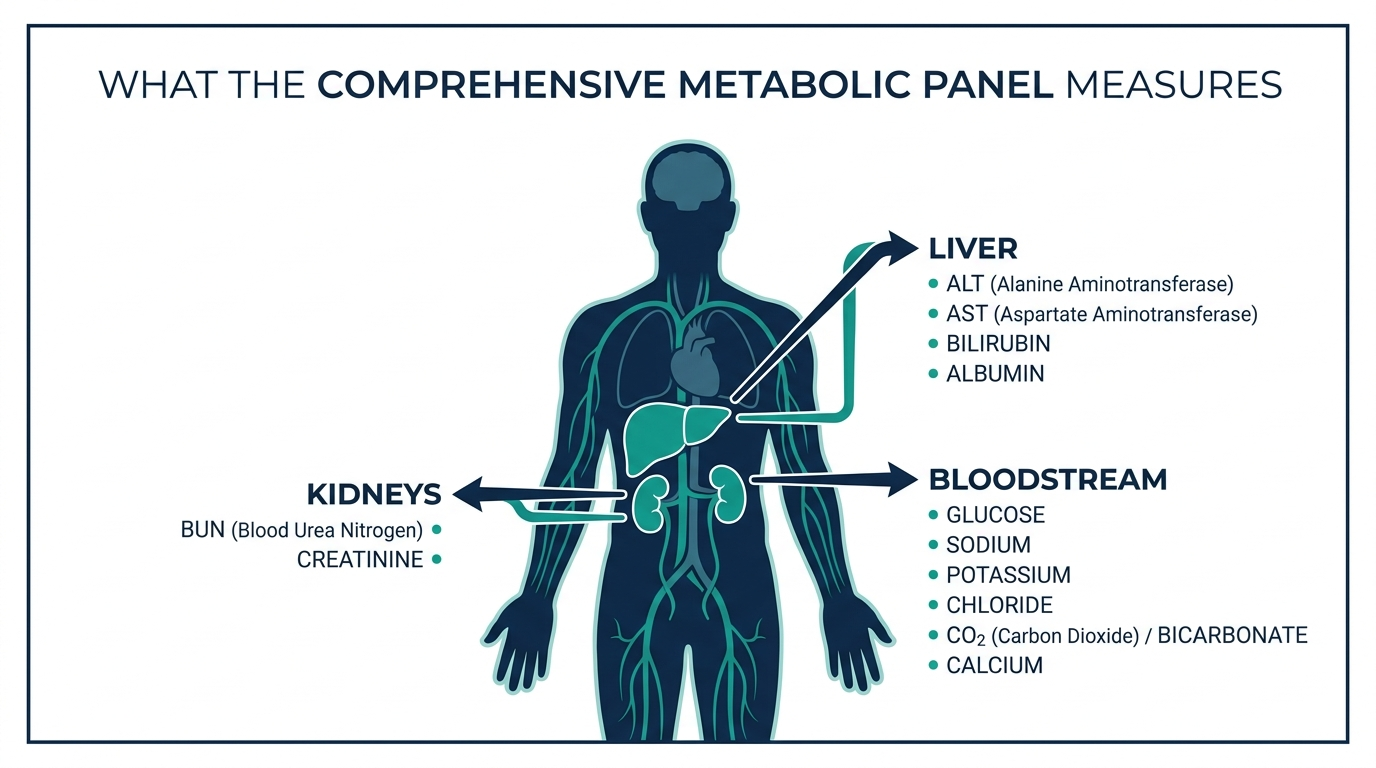
- A comprehensive metabolic panel is a single blood draw that measures 14 markers covering your blood sugar, kidney function, liver function, electrolytes, and blood proteins.
- Doctors order a comprehensive metabolic panel as a broad health check during routine physicals and to monitor chronic conditions like diabetes, kidney disease, and liver disease.
- One result slightly outside the reference range is rarely a diagnosis on its own, so a clinician reads the whole pattern together with your symptoms and history.
A comprehensive metabolic panel (CMP) is a common blood test that measures 14 substances in your blood to give a wide snapshot of your metabolism and organ function. Doctors order it during routine checkups and to watch chronic conditions because, from one tube of blood, it screens your blood sugar, kidneys, liver, electrolyte balance, and protein levels at the same time. This page is the overview that ties together the individual marker deep-dives, so you can see how each number fits into the bigger picture.
What is a Comprehensive Metabolic Panel (CMP)?
A comprehensive metabolic panel is a group of 14 blood tests that a lab runs together from a single sample (MedlinePlus). It builds on the smaller basic metabolic panel (BMP), which has 8 tests, by adding liver enzymes and blood proteins (Testing.com). The “metabolic” name reflects that these markers track how your body turns food into energy, manages fluids, and clears waste.
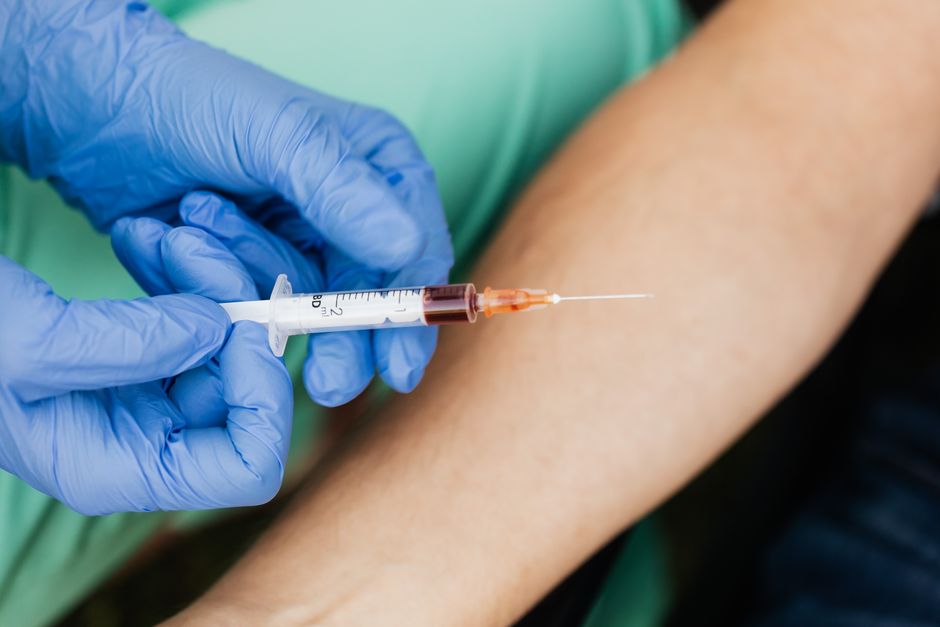
The sample is usually drawn from a vein in your arm and sent to a lab. Some markers, especially glucose, can be affected by recent meals, so your doctor may ask you to fast for 8 to 12 hours beforehand (Cleveland Clinic). Always follow the specific instructions your clinic gives you, because not every CMP order requires fasting.
What does a Comprehensive Metabolic Panel (CMP) measure?
The 14 markers fall into a few natural groups. Below is a one-line summary of each so you can scan quickly. Reference ranges vary by lab and by your age and sex, so treat these as typical adult values, not strict cutoffs (HealthMatters.io).
Blood sugar
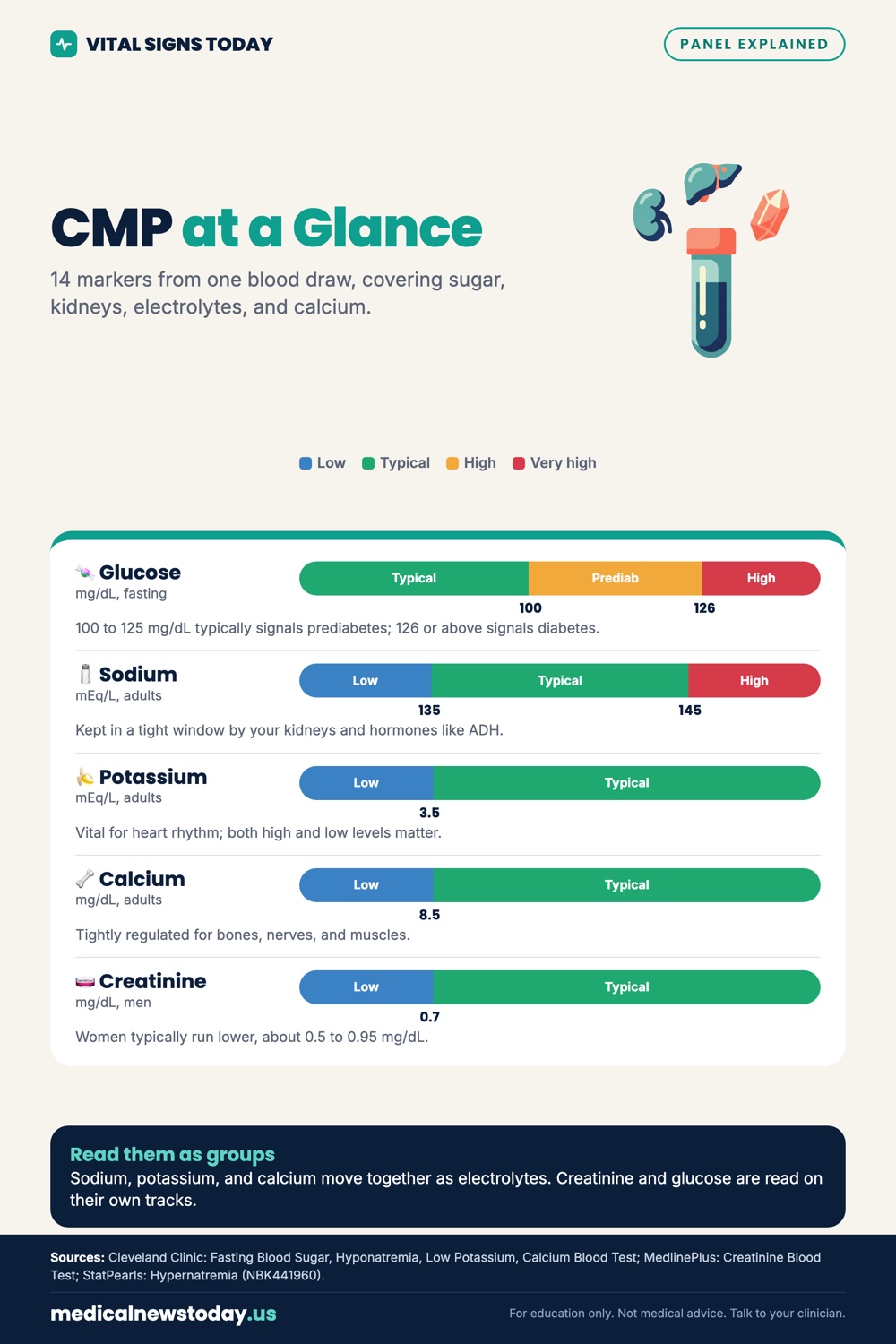
Glucose: the amount of sugar in your blood, a core screen for prediabetes and diabetes (typical fasting range about 70 to 99 mg/dL).
Kidney function
BUN (blood urea nitrogen): a waste product from protein breakdown that rises when kidneys are not clearing it well (typically about 6 to 20 mg/dL).
Creatinine: a muscle waste product filtered by the kidneys, one of the most direct signals of kidney function (typically about 0.6 to 1.3 mg/dL).
eGFR (estimated glomerular filtration rate): a calculated number, based mainly on creatinine, that estimates how fast your kidneys filter blood (higher is generally better).
Electrolytes and fluid balance
Sodium: the main electrolyte that controls fluid balance and nerve signaling (typically 135 to 145 mmol/L).
Potassium: an electrolyte vital for heart rhythm and muscle function, where both high and low levels matter (typically 3.5 to 5.0 mmol/L).
Chloride: an electrolyte that moves with sodium to keep fluid and acid balance steady (typically 95 to 105 mmol/L).
CO2 (carbon dioxide, mostly bicarbonate): reflects the acid-base balance of your blood (typically 22 to 29 mmol/L).
Minerals and proteins
Calcium: a mineral essential for bones, nerves, and muscles, with levels tightly regulated by the body (typically 8.5 to 10.5 mg/dL).
Albumin: the main protein made by your liver that keeps fluid inside blood vessels (typically 3.5 to 5.0 g/dL).
Total protein: the combined amount of albumin and other proteins, a broad marker of nutrition and liver or kidney health (typically 6.0 to 8.0 g/dL).
Liver function
Bilirubin: a waste product from broken-down red blood cells that the liver clears, where high levels can cause jaundice (total typically 0.1 to 1.2 mg/dL).
ALT (alanine aminotransferase): a liver enzyme that leaks into the blood when liver cells are stressed or damaged (typically about 7 to 56 U/L).
AST (aspartate aminotransferase): an enzyme found in the liver and other tissues that, read alongside ALT, points to liver strain (typically about 10 to 40 U/L).
Why would a doctor order a Comprehensive Metabolic Panel (CMP)?
The most common reason is a routine checkup, where the CMP serves as a wide baseline of how your organs are working before any symptoms appear (Testing.com). Catching a drifting kidney or liver value early often gives you time to act before it becomes a problem.
Doctors also order it to investigate symptoms such as fatigue, swelling, confusion, weakness, or unexplained weight changes, since these can trace back to electrolyte, kidney, or liver issues. If you already have a chronic condition like diabetes, high blood pressure, or kidney disease, the CMP becomes a monitoring tool to track whether things are stable or shifting (Cleveland Clinic). It is also used to watch for side effects of medications that can affect the kidneys or liver, because many drugs are processed by these organs.

How to read your Comprehensive Metabolic Panel (CMP) results
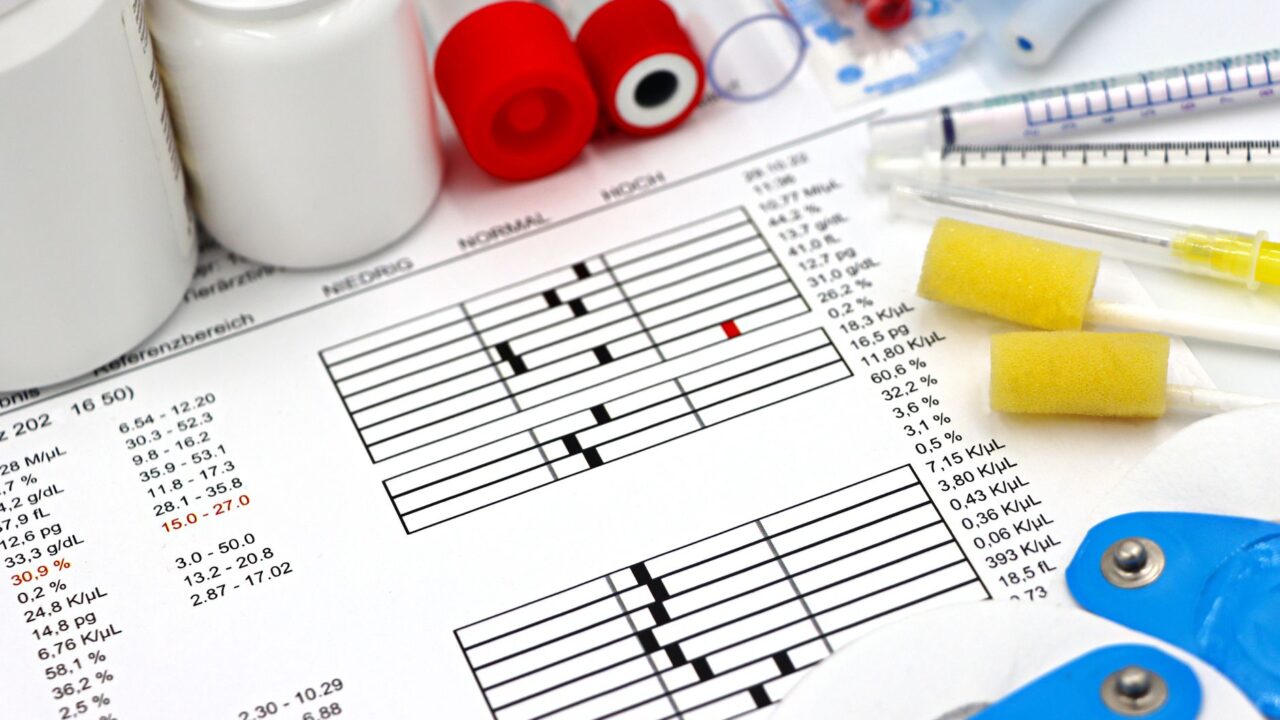
Lab reports usually show each marker next to a reference range and flag values that fall outside it, often with an “H” for high or “L” for low. Start by knowing that reference ranges are statistical, not magic lines, so a value just outside the range is common in healthy people and is not the same as a diagnosis (MedlinePlus).
The real skill is reading the pattern, not a single number. Clinicians group the markers the way the panel is built. Glucose stands alone for blood sugar. BUN, creatinine, and eGFR are read together for the kidneys. Sodium, potassium, chloride, and CO2 are read together as electrolytes. ALT, AST, bilirubin, albumin, and total protein are read together for the liver and protein status. A small change in one liver enzyme means something very different from several liver markers moving in the same direction.
Trend matters as much as the single snapshot. Comparing today’s panel with previous ones tells your doctor whether a value is stable, improving, or worsening, which is far more useful than one reading in isolation. Hydration, recent meals, intense exercise, and medications can all nudge results, so context is part of the read. The safest move is to go over your numbers with the clinician who ordered them rather than self-diagnosing from the printout.
When should you get this panel tested?
For healthy adults, a CMP is commonly included in an annual physical, with frequency adjusted to your age and risk factors. If you have a chronic condition or take medications that affect the liver or kidneys, your doctor may order it more often, sometimes every few months, to keep watch (Cleveland Clinic).
You may also need one sooner if new symptoms appear, such as persistent fatigue, swelling in the legs, changes in urination, nausea, or confusion, since these can reflect kidney, liver, or electrolyte problems. There is no single right schedule for everyone, so the timing should follow your clinician’s advice based on your personal health profile.
How the markers cross-inform each other: ratios and pairings that matter
The real diagnostic power of a CMP is not in the 14 numbers individually, it is in how they relate. Clinicians read several calculated relationships that no single marker reveals on its own.
The BUN-to-creatinine ratio. BUN and creatinine both rise when kidneys struggle, but the ratio between them separates two very different situations. A high ratio, with BUN rising faster than creatinine, often points to dehydration or reduced blood flow to the kidneys rather than intrinsic kidney damage, because a dry body reabsorbs more urea. A normal or low ratio with both elevated leans more toward damage within the kidney itself. This is why a doctor who sees a raised BUN does not immediately assume kidney disease, the ratio and the creatinine tell them whether to reach for a water bottle or a nephrology referral.
Albumin and total protein together. Total protein is albumin plus globulins. If total protein is low because albumin is low, the story points toward the liver, kidneys, gut, or inflammation. If total protein is normal or high but albumin is low, globulins must be elevated to compensate, which raises questions about chronic inflammation or immune activity. Reading these two lines side by side often reframes what a lone low albumin would suggest.
ALT and AST as a pair. These liver enzymes are most informative in relation to each other. ALT is fairly specific to the liver, while AST also appears in muscle and other tissues. When AST is disproportionately higher than ALT, the pattern can point away from typical liver-cell injury and toward other sources, whereas an ALT that outpaces AST is more classic for liver-cell stress. A single mildly elevated enzyme means little, the pattern of the two moving together or apart is what carries meaning.
Calcium read against albumin. Nearly half of blood calcium travels bound to albumin, so a low albumin can make total calcium look low even when the biologically active calcium is normal. Clinicians mentally correct calcium for albumin, or order an ionized calcium, before concluding that a low total calcium is a real problem. This is one of the most common sources of a false alarm on a CMP.
Common CMP patterns and what they suggest
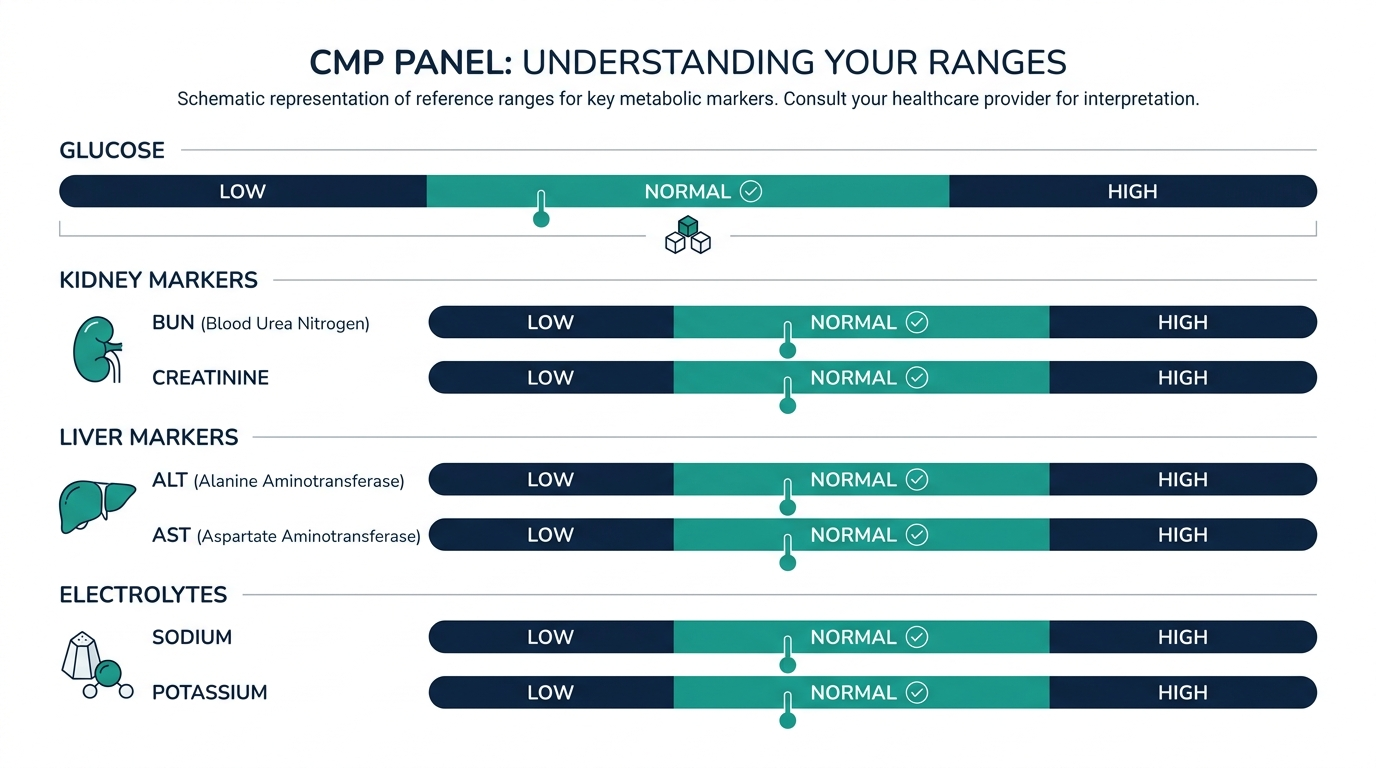
Certain combinations of results recur so often that clinicians recognize them at a glance. Seeing how the panel clusters helps you understand why your doctor focuses on some numbers and not others.
- Dehydration pattern. A high BUN with a high BUN-to-creatinine ratio, sometimes with mildly elevated sodium, often reflects being underhydrated rather than organ disease. It frequently corrects on a repeat test after drinking fluids.
- Kidney pattern. A low eGFR with an elevated creatinine, and often a raised BUN and potassium, points toward reduced kidney function. Persistence over three months is what distinguishes chronic kidney disease from a temporary dip.
- Liver pattern. Elevated ALT and AST, sometimes with a raised bilirubin and a low albumin, points toward liver strain or injury. The relative heights of the enzymes help narrow the cause.
- Diabetes or prediabetes pattern. A fasting glucose above the normal range, especially if it repeats, prompts follow-up testing such as a hemoglobin A1c to assess blood sugar over months rather than one moment.
- Acid-base pattern. A low CO2 (bicarbonate) can signal metabolic acidosis, while a high CO2 can reflect the body compensating for other imbalances. Read alongside sodium, potassium, and chloride, it hints at what is disturbing the body’s pH balance.
None of these patterns is a diagnosis by itself. Each is a direction that tells your clinician which follow-up test or which part of your history to explore next.
The anion gap: a calculated number hiding inside your CMP
Your CMP measures sodium, potassium, chloride, and CO2, and from these many labs calculate a value called the anion gap. It is not a substance the lab measures directly, it is arithmetic that estimates the balance of charged particles in your blood. The concept is that positive and negative charges must balance, and the “gap” represents unmeasured acids.
The anion gap becomes useful when the acid-base numbers look off. A high anion gap suggests that unmeasured acids are accumulating, which can happen in conditions ranging from uncontrolled diabetes to kidney failure to certain poisonings. A normal or low anion gap points the investigation in different directions. You will not always see the anion gap printed on a standard CMP, but the ingredients to calculate it are there, which is why a clinician can derive it from your existing results without ordering another test. If your electrolytes or CO2 are flagged, the anion gap is often the next thing your doctor reaches for.
How to prepare and what can skew your CMP
Getting a clean CMP result depends partly on preparation. A few practical points prevent misleading numbers:
- Fasting for the glucose. Because glucose is part of the panel, you may be asked to fast for 8 to 12 hours (Cleveland Clinic). A recent meal can push glucose up and make it look abnormal when it is not.
- Hydration. This is the most common confounder across the whole panel. Dehydration concentrates the blood and can nudge BUN, sodium, and other values up, while overhydration or IV fluids can dilute them. Arriving reasonably hydrated gives a more representative reading.
- Recent intense exercise. A hard workout before the draw can transiently raise creatinine and some enzymes, so it is worth avoiding strenuous exercise right before the test.
- Medications and supplements. Many drugs affect kidney or liver markers and electrolytes. Bring a full list, including over-the-counter products and supplements, so your clinician can interpret the results in context.
- Tourniquet and sample handling. A prolonged tourniquet or a slightly hemolyzed sample can falsely raise potassium, which is why a surprisingly high potassium in someone without symptoms is often rechecked before it is believed.

How the CMP fits with other common panels
A CMP is broad but not exhaustive. It is frequently ordered alongside other panels that cover what it does not, and knowing the division of labor helps you understand your full workup.
- Complete blood count (CBC). The CMP looks at chemistry and organ function, while the CBC counts your blood cells, red, white, and platelets. Together they cover metabolism and blood health, which is why they are often ordered as a pair at a physical.
- Lipid panel. Cholesterol and triglycerides are not part of a CMP. A lipid panel is added when cardiovascular risk is the question.
- Liver function tests. The CMP includes several liver markers, but a dedicated liver panel adds enzymes such as GGT and ALP for a deeper look when liver disease is suspected.
- Hemoglobin A1c. When the CMP glucose is elevated, an A1c is the natural follow-up because it reflects average blood sugar over roughly three months rather than a single fasting moment.
- Thyroid panel. Thyroid hormones are not on a CMP, so symptoms like fatigue or weight change that a CMP cannot explain often prompt separate thyroid testing.
The CMP is best understood as the broad opening screen. When one of its clusters raises a question, a more focused panel usually follows to answer it.
Common misunderstandings about the CMP
- “A CMP checks everything.” It does not. It is a strong metabolic and organ-function screen, but it does not measure cholesterol, thyroid hormones, blood cell counts, vitamins, or many other things. It is one panel among several.
- “Any value outside the range means something is wrong.” Reference ranges are statistical, so a value slightly outside the range is common in healthy people and is not a diagnosis (MedlinePlus). The pattern and the trend matter more than one flagged line.
- “A normal CMP means I am completely healthy.” A normal panel is reassuring but not a clean bill of health, because many conditions do not show up on a CMP at all. It rules out certain problems, not all of them.
- “One reading is enough to act on.” Many CMP values shift with hydration, meals, exercise, and timing, so borderline results are frequently rechecked and read against previous panels before any conclusion is drawn.
Every marker in this panel
Tap any marker for a full plain-English explainer, including what high and low results mean.
- What Does High Glucose Mean in a Blood Test? Thresholds, Causes, and Red Flags
- What Does Low Glucose Mean in a Blood Test? Causes and Cutoffs
- What Is Glucose in a Blood Test? Your Blood Sugar Number, Decoded
- What Does a High BUN Mean in a Blood Test? Causes and Next Steps
- What Is a Low BUN on a Blood Test? Causes and When to Worry
- What Is BUN in a Blood Test? The Kidney Number That Moves for Surprising Reasons
- What Is Creatinine in a Blood Test? The Kidney Number Most People Misread
- What Is High Creatinine in a Blood Test? What It Really Means
- What Is Low Creatinine in a Blood Test? What a Low Result Means
- eGFR and Creatinine Explained: What Your Kidney Numbers Really Mean
- What Is eGFR in a Blood Test? The Kidney Number Most People Scroll Past
- What Is a High eGFR in a Blood Test? When It Is Fine and When It Is a Warning
- What Is a Low eGFR in a Blood Test? What Your Kidney Number Really Means
- What Does High Sodium Mean in a Blood Test? Causes and Risks
- What Does Low Sodium Mean in a Blood Test? Why It Is Usually a Water Problem, Not a Salt Problem
- What Does High Potassium Mean in a Blood Test? Causes & Danger Levels
- What Does Low Potassium Mean in a Blood Test? Levels and Causes
- What Is Potassium in a Blood Test? The Narrow Number That Guards Your Heartbeat
- What Does High Chloride Mean in a Blood Test? Causes & When to Worry
- What Does Low Chloride Mean in a Blood Test? Causes & When to Worry
- What Is Chloride in a Blood Test? The Quiet Electrolyte That Reveals Your Acid-Base Balance
- What Does High CO2 Mean in a Blood Test? Causes, Range, and When to Worry
- What Does Low CO2 Mean in a Blood Test? Causes and When to Worry
- What Is CO2 in a Blood Test? The Acid-Base Number Hiding in Plain Sight
- CA-AKG (Calcium Alpha-Ketoglutarate) and Longevity: What the Evidence Really Shows
- What Does High Calcium Mean in a Blood Test? Causes and When to Worry
- What Does Low Calcium Mean in a Blood Test? Causes, Symptoms, and the Protein Trap
- What Does High Albumin Mean in a Blood Test? Causes and When to Worry
- What Does Low Albumin Mean in a Blood Test? Causes and When to Worry
- What Is Albumin in a Blood Test? The Quiet Protein That Reads Your Liver, Kidneys, and Nutrition at Once
- What Is a Protein Total Blood Test? The Number That Hides Two Stories at Once
- What Does High Globulin Mean in a Blood Test? Causes and Next Steps
- What Does Low Globulin Mean in a Blood Test? Causes & Next Steps
- What Is Globulin in a Blood Test? The Overlooked Protein That Tracks Your Immune System
- What Does High Bilirubin in a Blood Test Mean? Causes and When to Worry
- What Does Low Bilirubin Mean in a Blood Test? Causes and Risks
- What Is Bilirubin in a Blood Test? Normal Range, High and Low Levels Explained
- What Is a Low Anion Gap Blood Test? What a Low Result Really Means
- What Is Anion Gap in a Blood Test? The Calculated Number That Catches Hidden Acid
- What Is a High Anion Gap in a Blood Test? What It Means and When It Is Serious
Frequently asked questions
Do I need to fast before a comprehensive metabolic panel?
Often yes, usually for 8 to 12 hours, mainly so the glucose reading is accurate. Some orders do not require fasting, so follow the exact instructions your clinic gives you and ask if you are unsure.
What is the difference between a CMP and a BMP?
A basic metabolic panel (BMP) has 8 tests focused on blood sugar, kidneys, and electrolytes. A comprehensive metabolic panel adds 6 more tests, mostly liver enzymes (ALT and AST), bilirubin, albumin, and total protein, for a total of 14.
What conditions can a CMP help detect?
It can flag signs of diabetes, kidney disease, liver disease, and electrolyte or acid-base imbalances. It is a screening and monitoring tool, so abnormal results usually lead to follow-up tests rather than a final diagnosis.
Is one abnormal result something to worry about?
Usually not on its own. Reference ranges are based on averages, so mild deviations are common in healthy people. Your clinician looks at the whole pattern, your history, and any trend before deciding whether anything needs attention.
How long do CMP results take?
Results are typically available within a day or two, and sometimes the same day, depending on the lab. Your clinic or patient portal will let you know when they are ready to review.
Sources
- MedlinePlus, Comprehensive Metabolic Panel (CMP)
- Cleveland Clinic, Comprehensive Metabolic Panel (CMP)
- Testing.com, CMP Blood Test
- HealthMatters.io, Comprehensive Metabolic Panel (CMP) Normal Ranges
- University of Rochester Medical Center, Comprehensive Metabolic Panel
This article is for general educational purposes and is not medical advice. It cannot diagnose or treat you and does not replace your clinician. Always discuss your lab results and any health decisions with a qualified healthcare professional.
Vital Signs Today may earn a commission if you buy through links on this page. It does not affect our editorial assessments.