Related: EGFR levels by age: chart
You scanned your kidney panel, found the line marked eGFR, and the number was high. Maybe it read 110, maybe 125, maybe your report just printed a flat “>90” with no real number at all. For almost every other marker on the page, a high number feels like a warning. With eGFR, the instinct most people have is the opposite: higher must be better, because eGFR measures kidney function, and more function sounds like a win.
That instinct is mostly right, and occasionally very wrong. Here is the part the patient leaflets skip. A high eGFR is usually nothing to worry about, but in a specific group of people it is an early fingerprint of kidneys working under too much pressure, and that pattern has a name doctors take seriously.
Part of our Comprehensive Metabolic Panel guide.
What is eGFR in a blood test, and what does high mean?
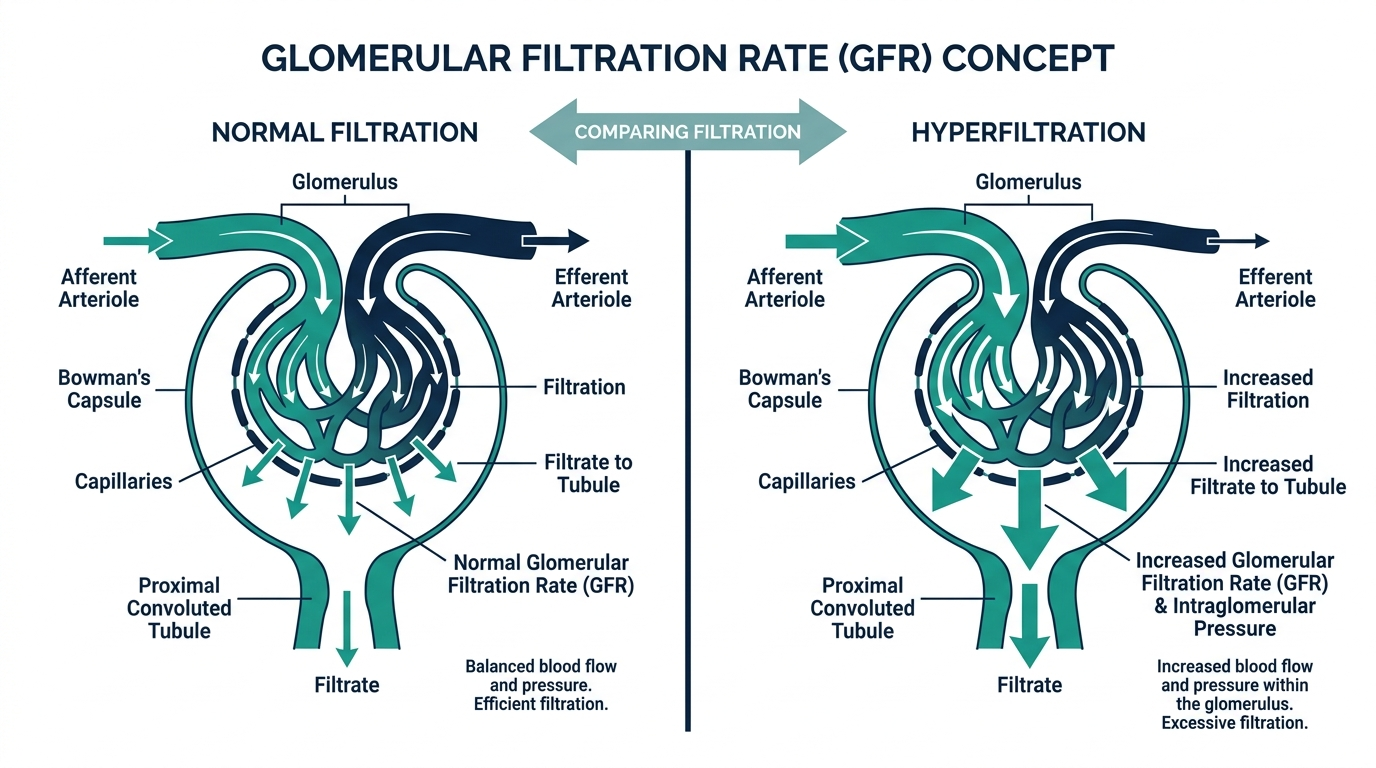
eGFR stands for estimated glomerular filtration rate, and it estimates how many milliliters of blood your kidneys filter every minute, scaled to a standard body size of 1.73 square meters. It is not measured directly. A formula calculates it from your blood creatinine level along with your age and sex (MedlinePlus). In plain terms, eGFR is a horsepower rating for your kidneys, and the whole scale is built so that low is the danger zone.
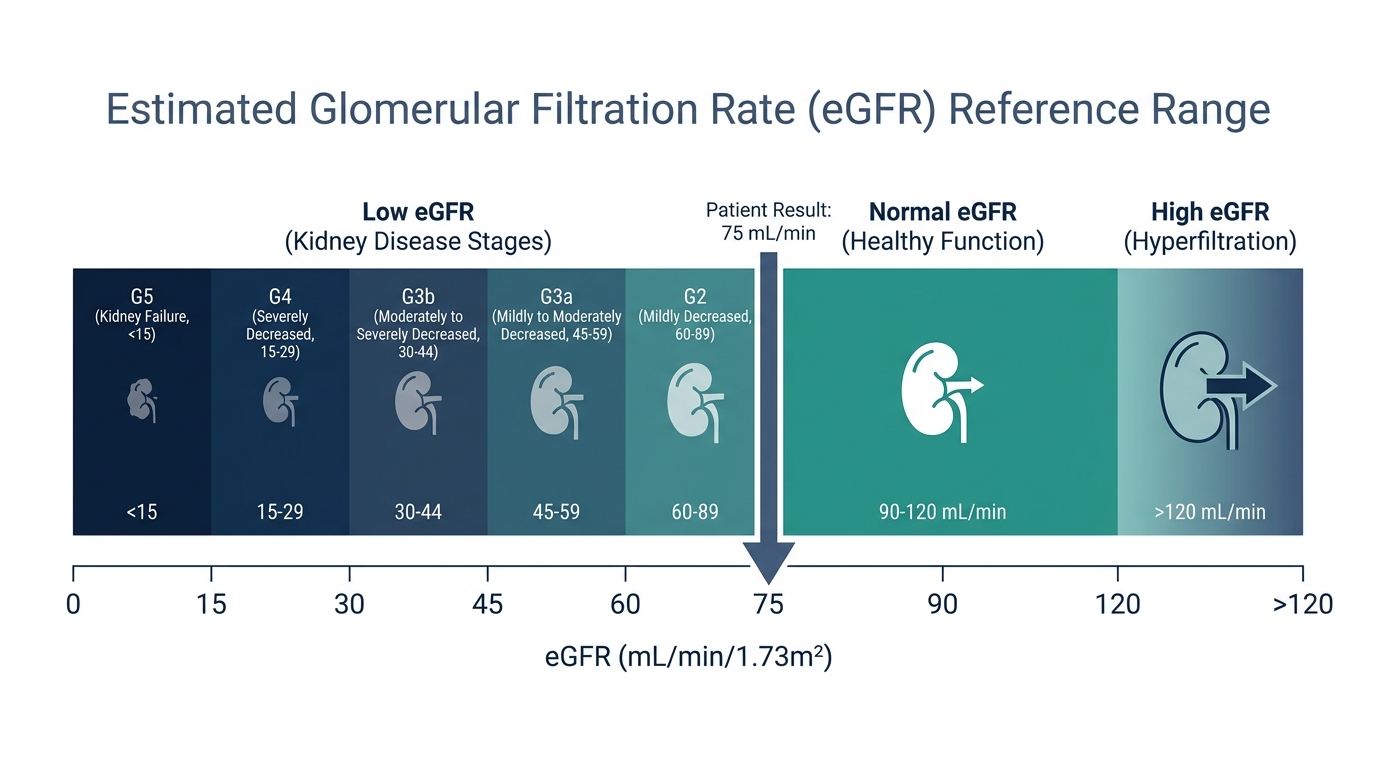
For adults, a normal eGFR is roughly 90 or higher, and a healthy young adult often sits around 100 to 116 (National Kidney Foundation). So a result of 95, 105, or even 118 in a younger person is not a “high” result in any meaningful sense. It is simply healthy filtration. This is why most labs do not even print an exact number above 90. They cap it and report “>90” or “>60”, because above that line the estimate is no longer precise and, for routine purposes, no longer clinically interesting (Cleveland Clinic).
The result that genuinely counts as high is a measured eGFR well above the normal ceiling, generally in the range of about 130 to 140 mL/min/1.73 m2 or more. That state has a name: glomerular hyperfiltration (PMC, hyperfiltration in diabetes). That is the version of “high eGFR” worth understanding, and the rest of this article is about it.
How is eGFR calculated, and why the equation changed?
Understanding where the number comes from explains most of its quirks. eGFR is not measured by collecting your filtered fluid. A validated equation, most often the CKD-EPI equation, estimates it from your blood creatinine, age, and sex. Because it is an estimate, it inherits every weakness of the inputs it relies on.
The equation itself has evolved. Older versions included a separate coefficient based on race, which systematically raised reported eGFR for Black patients and, in practice, could delay recognition of kidney disease. In 2021 a national task force recommended a refit equation that removes the race variable, and most United States labs have since adopted it. If you compare an eGFR from a few years ago with a recent one, part of any shift can come from this equation change rather than from your kidneys.
There is also a second, often better input. Cystatin C is a protein filtered by the kidneys that, unlike creatinine, does not depend on muscle mass. An eGFR based on cystatin C, or on creatinine and cystatin C combined, is more accurate when muscle mass is unusual, which is exactly the situation where a creatinine-only eGFR misleads. If your number looks surprisingly high or low for your body, a cystatin C based estimate is the standard way to double-check it.
What causes a high eGFR?
Most of the time a high-looking eGFR has a boring explanation, and the genuinely high ones cluster around a short list of metabolic causes. From most to least common in practice:
- A young, healthy, muscular body. eGFR is calculated from creatinine, and younger people simply filter faster. An eGFR over 100 in your twenties is normal and expected, not a red flag (National Kidney Foundation).
- Diabetes, especially early on. This is the single most important cause of true hyperfiltration. High blood sugar drives the kidneys to filter harder. Hyperfiltration shows up in a large share of people with diabetes near diagnosis, reported across studies in roughly 10 to 67 percent of type 1 and 6 to 73 percent of type 2 patients (PMC, hyperfiltration in diabetes).
- Obesity and insulin resistance. Excess weight and insulin resistance push baseline filtration upward, independent of diabetes (PMC, hyperfiltration and cardiovascular risk).
- Pregnancy. A healthy pregnancy normally raises GFR substantially. This is a physiologic, expected rise, not disease.
- High protein intake or fluid loading. A protein-heavy meal or a large fluid load can transiently lift filtration, which is why context and timing matter.
Notice the theme. The concerning causes of a high eGFR are the same conditions that quietly age your blood vessels: high blood sugar, excess weight, and insulin resistance. The kidney is not malfunctioning so much as being driven too hard.
What is a normal eGFR, and how does it change with age?
Filtration is not meant to stay flat for life. eGFR peaks in young adulthood and drifts down gradually over the decades as the number of working nephrons declines, which is normal aging, not disease. A rough sense of the trajectory helps you read your own result in context rather than against a single universal cutoff.
- Young adults: often 100 or higher, sometimes up toward the high 110s, reflecting peak filtration.
- Middle age: commonly settling into the 90s, still comfortably normal.
- Older adults: frequently in the 70s or 80s, which can be entirely healthy for that age even though it sits below the young-adult range.
This is why an eGFR of 118 means something different in a 25-year-old than in a 70-year-old. In the young person it is expected. In the older person, a value that high is unusual enough to ask whether low muscle mass is inflating the estimate or whether metabolic hyperfiltration is at play. Age is not a footnote to your eGFR. It is part of how the number is read.
What are the symptoms of a high eGFR?
There are none. A high eGFR produces no symptoms you can feel. You will not notice hyperfiltration the way you might notice swelling, fatigue, or foamy urine from advanced kidney disease. It is a silent number, detectable only on a blood test, which is precisely why it slips past so many people. By the time symptoms of kidney trouble appear, filtration has usually fallen, not risen.
If you do have symptoms alongside a high eGFR, they almost always belong to the underlying cause rather than the filtration rate itself. Excessive thirst, frequent urination, and unexplained weight changes point toward undiagnosed diabetes, which is worth flagging to your clinician regardless of the eGFR.
When is a high eGFR dangerous or a medical emergency?
Let us be clear about the scale. A high eGFR is never an emergency. There is no number, however high, that sends you to the emergency room the way a dangerously low one might. Nobody dies acutely from filtering too fast.
The danger is slow and structural. True glomerular hyperfiltration, the kind running above roughly 130 to 140 mL/min/1.73 m2, raises the pressure inside each tiny filtering unit of the kidney. Over years, that elevated pressure forces more protein and fluid across the filtration barrier and predisposes the nephrons to irreversible damage (PMC, hyperfiltration in diabetes). In people with diabetes, hyperfiltration is linked to a faster slide toward albuminuria and diabetic kidney disease. The high number today can be the opening chapter of a low number a decade from now.
There is a second reason to take it seriously, and it is the part most patients never hear. In otherwise healthy middle-aged adults, hyperfiltration was associated with nearly double the cardiovascular risk (hazard ratio 1.88), a risk comparable to having an eGFR in the mildly reduced 45 to 60 range (PMC, hyperfiltration and cardiovascular risk). The researchers framed it as an easily spotted marker of an unfavorable metabolic and vascular state. So a stubbornly high eGFR is not the emergency. It is the smoke that tells you to look for the fire.
What should you do about a high eGFR?
The right move depends entirely on which kind of “high” you have. Walk it back through these steps.
- First, find out if it is a real number or a capped one. If your report says “>90” or “>60”, that is not a high result at all. It is the lab declining to print a precise value because your kidneys are working fine (Cleveland Clinic). No action needed beyond routine care.
- Check your age. An eGFR over 100 in a young adult is normal and declines naturally with age, so context is everything (National Kidney Foundation).
- Screen for the metabolic causes. If you have a genuinely elevated number, the productive next tests are a fasting glucose or HbA1c for diabetes, a urine albumin-to-creatinine ratio to check whether protein is already leaking, and a blood pressure reading.
- Address the driver, not the number. Hyperfiltration tends to improve with the very things that help everything else: weight reduction, sodium restriction, and tighter blood sugar control (PMC, hyperfiltration in diabetes). You do not treat the eGFR. You treat what is pushing it up.
There is no medication aimed at “lowering eGFR.” The goal is never to slow your kidneys down. It is to remove the metabolic load that is forcing them to overwork in the first place.
A concrete example makes the pattern click. A 41-year-old with a rising waistline gets a measured eGFR of 134, feels perfectly well, and assumes it means athletic kidneys. His fasting glucose comes back in the prediabetes range and a urine test shows a trace of albumin. The high eGFR was the first quiet signal of early metabolic strain, not fitness. Six months of weight loss, less salt, and better glucose control bring his filtration back toward the normal band and clear the albumin. Nothing was ever done to the eGFR directly. The driver was treated, and the number followed.
When should you see a doctor?
You do not need a clinic visit for a capped “>90” result on an otherwise clean panel. You should bring a high eGFR to your doctor when it is a genuine measured number well above normal, when it shows up alongside diabetes, obesity, or high blood pressure, or when any protein appears in your urine. Trends matter more than single readings, so a result that stays elevated across repeat tests deserves attention more than a one-time blip after a steak dinner. And if you have diabetes, ask specifically whether your filtration suggests early hyperfiltration, because catching it early is the entire point.
The insider read: why a “great” eGFR can be the most misread number on the panel
Here is the clinical nuance that trips up patients and even slips past busy clinicians. eGFR is an estimate built on creatinine, and creatinine is a byproduct of muscle. The formula assumes an average relationship between your creatinine and your kidney function. When that assumption breaks, the number lies.
A person with very low muscle mass, for instance someone elderly, frail, or with a chronic wasting illness, produces little creatinine. Low creatinine makes the formula spit out a high eGFR even when the kidneys are not actually filtering well. So a comforting “high” eGFR in a frail patient can mask real kidney impairment. The number looks great precisely because there is barely any muscle feeding it.
The mirror image is the early diabetic with a genuinely high eGFR. Their kidneys really are filtering fast, and that speed is not a sign of health but of strain. Both patients see a reassuring number, and in both cases the reassurance is misplaced. The lesson is that eGFR cannot be read in isolation. It has to be interpreted against your age, your muscle mass, your blood sugar, and whether any protein is leaking into your urine (NIDDK). A single high eGFR answers far less than people assume.
Frequently asked questions
Is a high eGFR good or bad?
Usually good or neutral. For adults a normal eGFR is about 90 or higher, and many healthy young people run 100 or more (National Kidney Foundation). It only becomes a concern when a genuinely measured value runs well above normal, around 130 to 140 mL/min/1.73 m2 or higher, which is called hyperfiltration and is most often tied to diabetes, obesity, or insulin resistance.
What does an eGFR result of greater than 90 mean?
It means your kidneys are working normally and the lab chose not to print a precise number. Many labs cap high results and report “>90” or “>60” because the estimate is not accurate at the top of the scale and is not clinically interesting there (Cleveland Clinic). It is not a “high” result in the worrying sense.
What causes a truly high eGFR?
The main driver of genuine hyperfiltration is diabetes, especially in its early stages, followed by obesity and insulin resistance. Pregnancy and a high-protein meal can also raise filtration temporarily (PMC, hyperfiltration in diabetes). Being young and muscular naturally produces a higher number too, without any disease.
Can a high eGFR be wrong or misleading?
Yes. Because eGFR is estimated from creatinine, which comes from muscle, a person with low muscle mass can show a falsely high eGFR that hides real kidney impairment. The number should always be interpreted alongside age, muscle mass, blood sugar, and urine protein (NIDDK).
Should I be worried about a high eGFR with diabetes?
It is worth a conversation with your doctor. In people with diabetes, hyperfiltration is linked to faster progression toward kidney disease, and in healthy adults it has been associated with nearly double the cardiovascular risk (PMC, hyperfiltration and cardiovascular risk). The good news is that it often improves with weight loss, lower sodium intake, and better blood sugar control.
Can dehydration or a high-protein meal raise eGFR?
A large protein meal or a big fluid load can transiently lift filtration, which is one reason a single high reading after a heavy dinner is not the same as a persistently high one. Dehydration more often pushes eGFR down by concentrating creatinine. Because short-term factors move the number, clinicians trust the trend across repeat tests over any one result.
Does a high eGFR mean I have great kidneys?
Not necessarily. In a young, muscular person a high eGFR usually does reflect strong filtration. But the same high number can come from low muscle mass masking real impairment, or from metabolic hyperfiltration driven by high blood sugar or excess weight. A high eGFR is only reassuring once age, muscle mass, blood sugar, and urine protein all line up.
This article is for general educational purposes and is not medical advice. It cannot diagnose or treat you and does not replace your clinician. Always discuss your lab results and any health decisions with a qualified healthcare professional.
Vital Signs Today may earn a commission if you buy through links on this page. It does not affect our editorial assessments.