Disclosure: Vital Signs Today may earn a commission if you buy through links on this page, at no extra cost to you. This does not influence our evidence-based assessments. We are not a medical provider; talk to a clinician before acting on test results.
Related: WBC normal range by age (full chart)
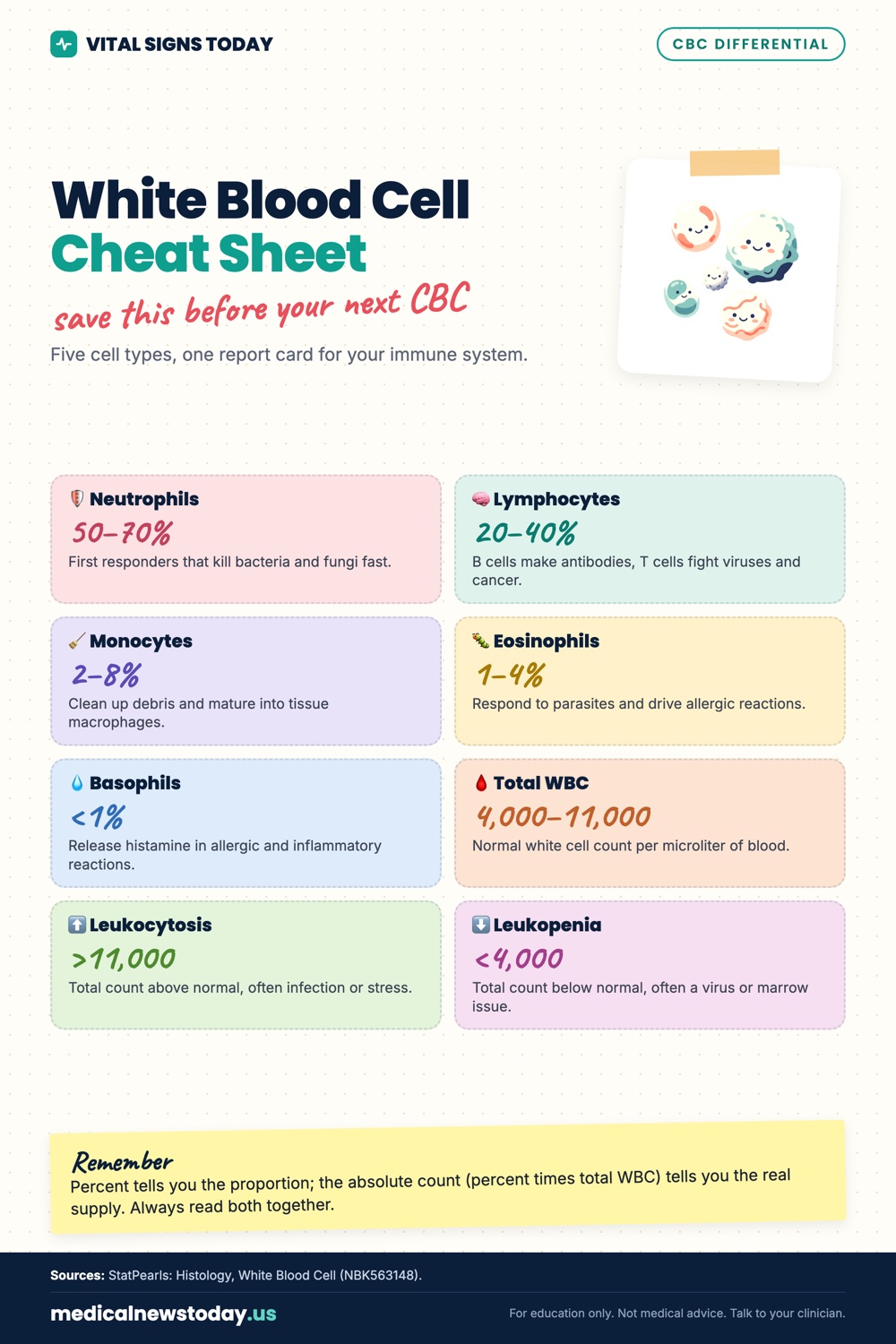
Quick answer: A WBC differential is a blood test that counts each of the five white blood cell types, expressed as both a percentage and an absolute number. Normal results show neutrophils at 50 to 70 percent, lymphocytes at 20 to 40 percent, monocytes at 2 to 8 percent, eosinophils at 1 to 4 percent, and basophils under 1 percent. Shifts in any one type point toward infection, allergy, autoimmune activity, or, rarely, a blood disorder, making the differential far more informative than a plain white count alone.
What Is a WBC Differential?
A WBC differential (also called a white blood cell differential or diff) breaks a complete blood count into its five white cell subpopulations: neutrophils, lymphocytes, monocytes, eosinophils, and basophils. Modern analyzers count thousands of cells automatically; a lab tech reviews a stained smear by hand when the machine flags abnormal shapes. The result you receive lists each cell type twice: as a percentage of the total white count and as an absolute count (cells per microliter). Both numbers matter, and conflating them is the most common mistake patients make reading their own lab printout.
A standard complete blood panel almost always includes the differential. You rarely order it in isolation.
All five types trace back to the same source: hematopoietic stem cells in your bone marrow. From a shared origin they branch into two lineages. Neutrophils, monocytes, eosinophils, and basophils come from the myeloid line, while lymphocytes come from the lymphoid line. This matters when reading results, because a problem that hits the myeloid line, a marrow suppressed by chemotherapy for example, tends to drop several cell types together rather than just one. When only a single lineage is affected, the cause is usually more specific, like a virus temporarily suppressing lymphocytes or a bacterial infection surging neutrophils. Knowing which branch a cell comes from is half of interpreting why a count moved.
WBC Differential Normal Range: What Each Cell Type Should Look Like
Normal ranges vary slightly by lab, age, sex, and analyzer, but the table below covers accepted adult reference intervals used at Quest Diagnostics and Labcorp.
| Cell Type | Percent (%) | Absolute Count (cells/mcL) | Main Job |
|---|---|---|---|
| Neutrophils | 50 to 70 | 1,800 to 7,700 | Kill bacteria and fungi; first responders |
| Lymphocytes | 20 to 40 | 1,000 to 4,800 | Adaptive immunity; B cells make antibodies, T cells target viruses and cancer |
| Monocytes | 2 to 8 | 200 to 950 | Clean up debris; transition into tissue macrophages |
| Eosinophils | 1 to 4 | 15 to 500 | Respond to parasites and coordinate allergic reactions |
| Basophils | 0 to 1 | 0 to 100 | Release histamine; involved in allergic and inflammatory responses |
Want to check your white blood cells?
Three ways to get it measured. Pick whichever fits you.
Affiliate links: we may earn a commission at no extra cost to you. A lab test does not replace a visit with your clinician.
Children run a different ratio: lymphocytes dominate over neutrophils until roughly age 5, which is normal physiology, not disease. Ethnic background also matters. People of African, Middle Eastern, or West Indian descent often have neutrophil counts near 1,200 to 1,500, a benign variant called ethnic or constitutional neutropenia that labs and many clinicians still flag as low. If your absolute neutrophil count sits between 1,000 and 1,800 and you are otherwise healthy, ask whether this variant applies before accepting a diagnosis.
Absolute vs. Percent: Why Both Numbers Matter
The percentage tells you the proportion; the absolute number tells you the actual supply. Missing this distinction sends patients to unnecessary specialist visits every year. Here is a concrete example:
- Total WBC: 2,500 cells/mcL (low)
- Lymphocyte percent: 60% (looks high)
- Lymphocyte absolute: 1,500 (within normal range)
The patient’s total count is low, so lymphocytes look proportionally elevated, but the actual number is fine. The problem is neutropenia (low neutrophil absolute), not lymphocytosis. Chasing the percentage alone leads you to the wrong question.
The reverse happens too. A white count of 15,000 with 75% neutrophils means an absolute neutrophil count (ANC) of 11,250, a clear neutrophilia that confirms active bacterial infection or steroid effect. Never read the percentage without the absolute, and never read the absolute without knowing the total white count context.
For a broader look at which markers give you the most signal per dollar, see the guide to best biomarkers to test.
High Neutrophils: What the Causes Tell You
An elevated absolute neutrophil count, above roughly 7,700 in adults, is called neutrophilia, and the differential diagnosis is wide but interpretable. The most common drivers, in rough order of frequency:
- Bacterial infection: classic presentation; levels often run 10,000 to 20,000+ with a left shift (immature bands visible on the smear).
- Corticosteroids: prednisone at any dose demarginalizes neutrophils from vessel walls within hours; a count of 12,000 to 15,000 after a steroid burst is expected, not alarming.
- Physiologic stress: surgery, trauma, heart attack, and even intense exercise temporarily spike neutrophils.
- Smoking: chronic smokers run 15 to 25 percent higher counts at baseline due to airway inflammation.
- Chronic inflammatory conditions: rheumatoid arthritis, inflammatory bowel disease, and gout can all push neutrophils modestly upward.
- Chronic myeloid leukemia (CML): a rare but important cause; counts often exceed 50,000 with the full cell spectrum from blasts to mature forms, and the smear looks unmistakably abnormal. Always get a smear review if the count is above 30,000 without a clear infectious explanation.
What people get wrong: assuming any neutrophilia means serious infection. A count of 8,000 in a patient two days post-surgery on dexamethasone means nothing by itself. Context (medications, recent illness, time of draw) matters more than the number alone.
High Lymphocytes: What It Means and When to Worry
Lymphocytosis, an absolute lymphocyte count above 4,800 in adults, has a short and mostly benign differential in otherwise healthy people, but a few causes warrant urgent attention.
- Viral infections: Epstein-Barr virus (mono), cytomegalovirus, pertussis, and COVID-19 all drive reactive lymphocytosis. Counts of 5,000 to 10,000 with atypical lymphocytes on smear are classic for EBV.
- Post-splenectomy: the spleen normally culls aged lymphocytes; without it, baseline counts run higher.
- Chronic lymphocytic leukemia (CLL): the most important cause of persistent lymphocytosis in adults over 50. CLL often presents as an incidental finding on a routine CBC: absolute lymphocytes persistently above 5,000 with a smear showing small, mature lymphocytes and characteristic smudge cells. CLL does not always require immediate treatment, but it always requires formal hematology referral and immunophenotyping by flow cytometry to confirm.
- Whooping cough: pertussis causes the highest lymphocyte counts of any bacterial infection, sometimes 30,000 to 50,000, due to a toxin that prevents lymphocytes from leaving the blood.
A single elevated reading in the context of a recent cold or upper respiratory infection almost never needs follow-up beyond a repeat test in four to six weeks. Persistent lymphocytosis without a clear infectious trigger is where you involve a clinician.
Eosinophils and Allergies: A Closer Look
Eosinophils are the allergy-and-parasite cell, and their elevation, eosinophilia, is one of the most commonly misread findings on a differential. Mild eosinophilia (absolute count 500 to 1,500) is almost always allergic or atopic in the US context: seasonal allergies, asthma, eczema, and food allergies all push eosinophils up modestly. Many patients with year-round allergic rhinitis run absolute counts of 600 to 900 chronically.
The more actionable pattern is moderate eosinophilia (1,500 to 5,000). Here, the clinician should ask about:
- Prescription medications (NSAIDs, certain antibiotics, anticonvulsants cause drug-related eosinophilia)
- Recent international travel or exposure to soil-transmitted parasites (strongyloides, toxocara)
- Eosinophilic gastrointestinal disease, which presents with eosinophilia plus GI symptoms
- Adrenal insufficiency (low cortisol removes a brake on eosinophil production)
Hypereosinophilia above 5,000, especially if sustained, is a different matter entirely and can cause end-organ damage to the heart and nervous system. That range requires specialist evaluation.
One practical pearl: eosinophil counts crash during acute bacterial infection or stress because cortisol suppresses them. If someone with known allergies presents acutely ill, their eosinophil count will temporarily read near zero. This is a sign of the acute illness, not suddenly cured allergies.
Monocytes and Basophils: The Two Most Overlooked Cells
Neutrophils and lymphocytes get most of the attention because they move the most and carry the clearest signals, but the smaller fractions are worth reading too.
Monocytes are the cleanup and repair crew. They circulate briefly before migrating into tissue and maturing into macrophages. A mild monocytosis, an absolute count above roughly 950, commonly appears in the recovery phase of an infection, when the body is clearing debris, and in chronic inflammatory or autoimmune conditions like inflammatory bowel disease and sarcoidosis. Persistent, unexplained monocytosis in an older adult is the one pattern that deserves a closer look, because it can be an early sign of a bone marrow disorder called chronic myelomonocytic leukemia. A single mildly high monocyte count after a cold, by contrast, means almost nothing.
Basophils are the rarest white cell, often reported as zero on a normal differential, and their job is to release histamine in allergic and inflammatory reactions. A low or zero basophil count is normal and never a concern. The finding that matters is the opposite. A persistently elevated basophil count, called basophilia, is uncommon and can be an early clue to a myeloproliferative disorder such as chronic myeloid leukemia. Because the normal count sits so close to zero, even a small sustained rise is worth flagging to a clinician rather than dismissing.
Low WBC Differential Counts: Neutropenia and Lymphopenia
Low counts on the differential are as clinically meaningful as high ones, and the two that matter most are neutropenia and lymphopenia.
Neutropenia
An absolute neutrophil count (ANC) below 1,800 is neutropenia by most lab references, but risk stratification uses a tighter threshold: ANC below 500 is severe neutropenia and carries real infection risk. Common causes:
- Chemotherapy: expected, managed with growth factors (G-CSF) when severe
- Viral infections: many viruses transiently suppress marrow production
- Autoimmune neutropenia: particularly in lupus and Felty syndrome
- Ethnic/benign neutropenia: as noted above, ANC 1,000 to 1,800 in an otherwise healthy person of certain ethnic backgrounds
- Drug-induced: dozens of medications, including some antithyroid drugs, clozapine, and sulfasalazine, can suppress neutrophil production
Lymphopenia
An absolute lymphocyte count below 1,000 is lymphopenia. Causes include HIV (CD4 T-cell depletion is a subset), high-dose corticosteroids, severe malnutrition, autoimmune conditions, and active severe infections like sepsis or COVID-19. Isolated lymphopenia in an otherwise well patient is often transient and viral, but HIV testing should be reflexive in any unexplained case.
What Affects Your WBC Differential on the Day of the Draw?
Unlike a fasting glucose or lipid panel, the differential needs no special preparation, and no fasting is required. But several everyday factors move the numbers enough to matter when you are comparing one draw to another.
- Time of day: Neutrophils and total white count run slightly higher in the afternoon than first thing in the morning. Serial results are most comparable when drawn at a consistent time.
- Exercise: A hard workout in the hours before a draw can transiently raise neutrophils and total white count. For a clean baseline, avoid intense exercise the morning of the test.
- Recent illness: A cold or any viral infection in the past two weeks can leave lymphocytes elevated or neutrophils suppressed. This is the most common reason a repeat draw looks different from the first.
- Medications: Corticosteroids raise neutrophils within hours, while some drugs suppress specific lines. Note any prescription or recent steroid burst when you submit the sample.
- Smoking and pregnancy: Both shift the baseline upward, chronic smokers by 15 to 25 percent and pregnancy through a physiologic neutrophilia that is entirely normal.
None of these require you to change your routine before a routine screen. They matter most when a single flagged result has to be judged against a prior one, because the explanation is often as simple as when and how the blood was drawn.
How the WBC Differential Is Actually Ordered and What It Costs
In practice, you rarely order a differential alone. It is included automatically with a complete blood count (CBC with differential, CPT 85025). A standalone CBC without diff (CPT 85027) is cheaper but gives you less information. Most clinicians order the differential version by default.
Cash pricing at national labs in 2026:
- Quest Diagnostics: $29 to $60 for a CBC with differential ordered directly through QuestDirect
- Labcorp: $35 to $75 via LabcorpOnDemand (prices vary by state)
- Urgent care or primary care office draw: $50 to $150 total depending on facility fee
- HSA and FSA funds: fully eligible for this test
- Medicare: covered at 100% when ordered by a physician for a medical indication; not covered for purely preventive screening without a diagnosis code
If you are getting blood drawn for any reason, capturing a CBC with diff at the same visit costs almost nothing incremental and adds real information about your immune baseline. Anyone doing a one-time full baseline is often smarter to order a comprehensive panel rather than cherry-pick. How a full-body panel compares goes through what that looks like end-to-end.
What a Manual Smear Review Adds
Automated analyzers are fast and accurate for routine samples, but they flag about 20 to 25 percent of samples for manual review. A trained hematology tech looks at a stained peripheral smear and reports findings the machine cannot reliably characterize:
- Bands (immature neutrophils): a left shift with more than 10 to 15% bands strongly suggests bacterial infection or severe systemic stress
- Atypical lymphocytes: reactive forms seen in viral infections, especially EBV; distinct from the neoplastic cells of leukemia
- Blasts: immature precursor cells that should not appear in peripheral blood; their presence is a medical emergency requiring same-day oncology contact
- Hypersegmented neutrophils: five or more lobes suggests vitamin B12 or folate deficiency
- Toxic granulation and Dohle bodies: visible neutrophil changes in severe infection or sepsis
If your lab report notes "smear reviewed" and lists any of the above, that line carries more weight than the numeric counts. It means a human evaluated your sample specifically.
WBC Differential in the Context of a Full Panel
The differential is most useful when read alongside other markers. A few patterns clinicians use:
- Neutrophilia + elevated CRP and ESR: infection or inflammatory flare
- Lymphocytosis + low hemoglobin + elevated LDH: raises concern for lymphoma
- Eosinophilia + low albumin: consider parasitic infection or protein-losing enteropathy. The albumin test explains why that protein is so broadly useful.
- Neutropenia + thrombocytopenia + anemia: pancytopenia pattern, which can indicate bone marrow failure or infiltration and requires urgent evaluation
- Basophilia: not common, but counts persistently above 100 to 200 should prompt investigation for myeloproliferative neoplasm, particularly CML, alongside the alkaline phosphatase result. See the alkaline phosphatase test for related markers.
The differential is a piece of a picture, not the whole canvas. For anyone building an annual health baseline, the adiponectin test and metabolic markers round out immune findings with metabolic context.
FAQ
What does it mean if my WBC differential is abnormal?
Abnormal usually means one cell type is outside its reference range. Whether that matters depends on how far out of range, whether it is the percentage or the absolute count that is off, whether it is persistent or a single reading, and what clinical symptoms accompany it. A mildly elevated neutrophil percent during a cold is not the same as a markedly elevated lymphocyte absolute count that persists for three months. Talk to a clinician about results that fall significantly outside range or that do not resolve with a clear transient cause.
Can stress cause an abnormal WBC differential?
Yes. Physical stress such as surgery, trauma, or intense exercise demarginalizes neutrophils from vessel walls and pushes the ANC up transiently. Emotional stress can have a similar but smaller effect via cortisol. These shifts typically normalize within hours to a day. A blood draw after a hard workout or a stressful morning can show neutrophilia that has no clinical meaning.
What is an absolute vs. percent WBC differential?
The percent (relative) differential expresses each cell type as a fraction of total white cells. The absolute differential multiplies that percentage by the total WBC count to give actual cells per microliter. Absolute counts are the clinically actionable numbers for risk assessment. For example, an ANC below 500 carries real infection risk regardless of what the neutrophil percentage looks like.
What causes high eosinophils on a differential?
In the US, allergic and atopic conditions (hay fever, asthma, eczema) are the dominant cause of mild eosinophilia. Medications, particularly NSAIDs and some antibiotics, are the second most common cause. Parasitic infections are less common in domestic settings but should be considered with travel history or an unexplained count above 1,500. Adrenal insufficiency and certain autoimmune conditions round out the list.
What does high neutrophils and low lymphocytes mean together?
A high neutrophil-to-lymphocyte ratio (NLR) reflects a pattern seen in acute infection, major physiologic stress, or systemic inflammation. An NLR above 3 to 5 is associated with worse outcomes in critically ill patients and has been studied as a prognostic marker in cancer and cardiovascular disease. In an otherwise healthy outpatient, a transiently elevated NLR after illness is not alarming, but a persistent ratio above 4 to 5 without explanation merits follow-up.
Does the WBC differential show cancer?
It can raise suspicion for blood cancers. Leukemia and lymphoma can produce characteristic patterns: persistent lymphocytosis with smudge cells (CLL), blasts in circulation (acute leukemia), or extreme neutrophilia across the full maturation spectrum (CML). However, a normal differential does not rule out solid tumor cancers, and an abnormal differential requires confirmatory testing (flow cytometry, bone marrow biopsy) before any diagnosis is made.
How often should I get a WBC differential test?
There is no single universal recommendation. Most primary care guidelines include a CBC with differential in annual or biennial preventive panels, particularly for adults over 40, those on chronic medications that can affect marrow, and anyone with a history of autoimmune disease or recurrent infections. For otherwise healthy adults under 40, once every two to three years as part of a general baseline is reasonable. The frequency argument for more regular testing is strongest when you have a known condition where the differential tracks treatment response.
Can a viral infection lower my white blood cell counts?
Yes. Many common viruses transiently suppress bone marrow output, which can drop neutrophils, lymphocytes, or both for a week or two. This is why an unexpectedly low count in someone who recently had a viral illness is usually nothing more than a temporary effect that resolves on a repeat draw. The counts to take seriously are those that stay low without a clear recent infection, particularly an absolute neutrophil count under 500 or an unexplained persistent lymphopenia, which warrants HIV testing.
What is a normal neutrophil-to-lymphocyte ratio?
In a healthy adult, the neutrophil-to-lymphocyte ratio (NLR) typically sits between about 1 and 3. It is calculated by dividing the absolute neutrophil count by the absolute lymphocyte count, so you can work it out from your own report. A ratio that climbs above 3 to 5 reflects a stress or inflammatory pattern, and while a brief rise after illness is meaningless, a persistently high NLR without an obvious cause is worth discussing with a clinician. It is a cheap, derived number that adds context the individual counts miss.
What is a left shift on a WBC differential?
A left shift means immature neutrophil forms (bands, metamyelocytes, myelocytes) are appearing in peripheral blood, pushed out of the marrow before full maturation. It indicates the marrow is working at maximum output to meet demand, almost always due to severe bacterial infection, sepsis, or major tissue injury. The term comes from older manual cell counting where immature forms were plotted to the left of mature neutrophils. Seeing more than 10% bands on a manual smear alongside clinical symptoms is a reliable signal of serious infection requiring prompt evaluation.