Your blood work lands in the patient portal at 7 p.m. on a Friday, two days before your appointment, and you do what everyone does. You scan for red. An H here, an L there, a value bolded in a color that feels like a warning. By the time you close the tab you are either convinced you are fine or convinced something is wrong, and you are probably wrong on both counts. A lab report is not a verdict. It is a snapshot, and snapshots lie if you do not know how to read them.
The good news is that the logic behind a blood report is simpler than it looks, and once you understand the four moving parts on every line, the cryptic page turns into something you can actually follow. Here is how to do it properly.
How to read blood work test results, line by line
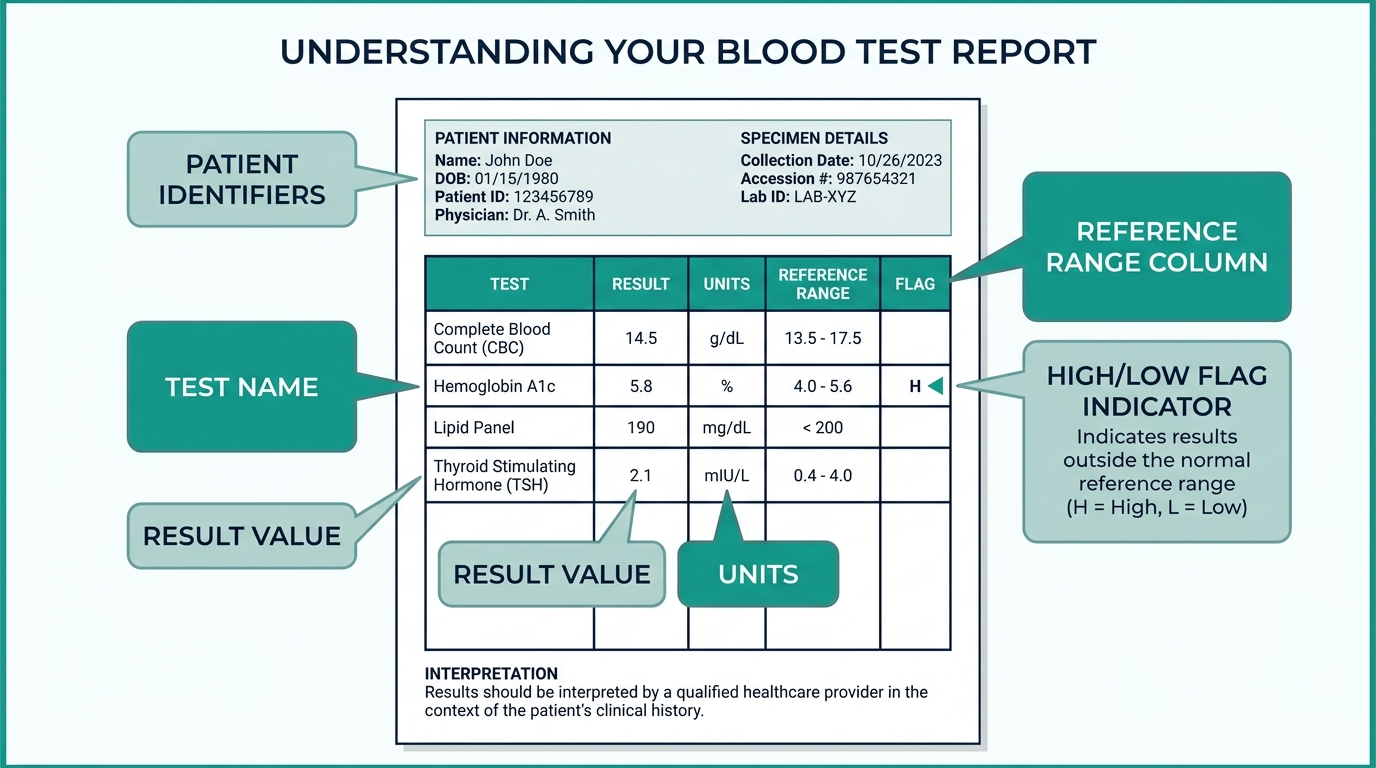
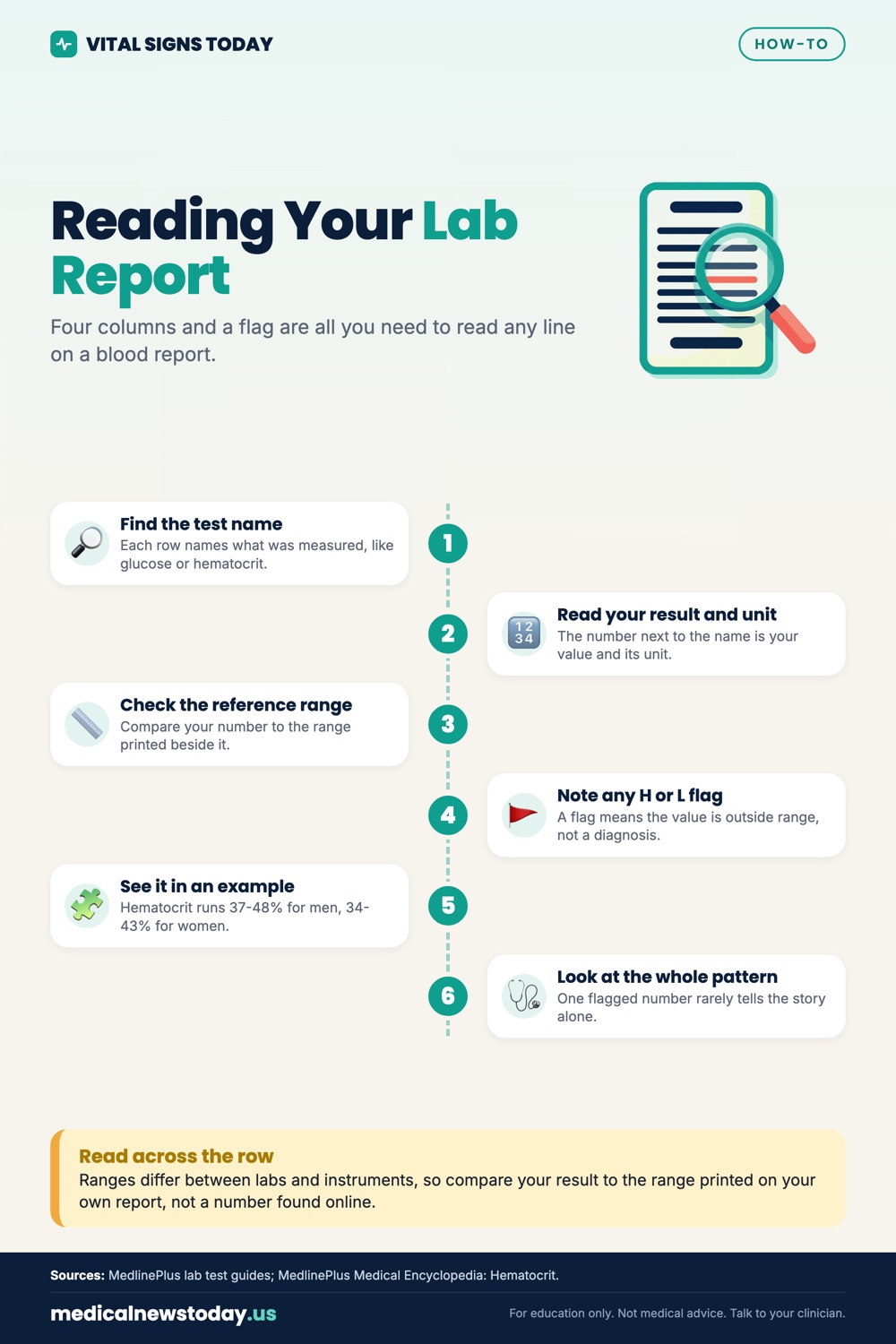
To read blood work test results, look at four things on every row: the name of the test, your result, the unit of measure, and the reference range printed right beside it. A flag such as H or L only tells you the result fell outside that range, not whether it matters. Reading well means comparing each number to the range on your own report and then looking at the whole pattern, not one lonely value.
Every standardized lab report gives you the same columns. The test name (for example glucose or hemoglobin), the measured number, the unit such as mg/dL, the reference range for that test, and a flag if your value sits above or below that range (MedlinePlus). Once you train your eye to read across the row instead of hunting for bold red, the report stops being intimidating. The flag is the lab pointing at something, not the lab making a diagnosis.
What is blood work, and what does blood work show?
Blood work is a lab test that measures cells, chemicals, proteins, and other substances in a sample of your blood. It shows changes in your body, but only as a snapshot, not a full picture of your health (MedlinePlus). That distinction matters more than people realize.
What can blood work show in practical terms? It is one of the most common tools clinicians use to monitor overall health and help diagnose conditions, by checking whether your blood cells, electrolytes, proteins, and enzymes are at expected levels (Cleveland Clinic). Blood tests help diagnose disease, monitor chronic conditions such as diabetes or high cholesterol, check whether a treatment is working, and assess how well organs like your kidneys and liver are functioning (MedlinePlus). What it does not do is tell you, on its own, that you are sick or well. That is the job of a clinician reading the numbers next to your symptoms and history.
What is the blood work your doctor usually orders?
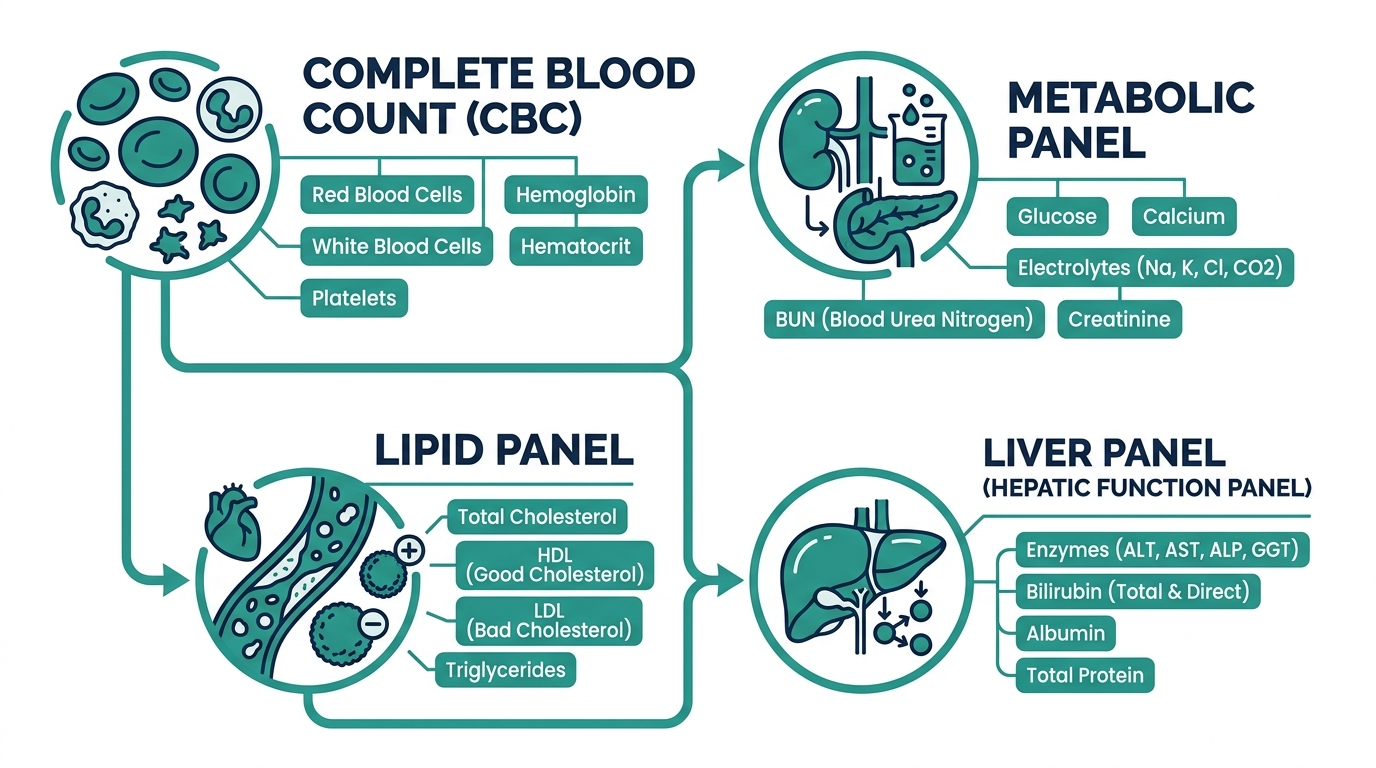
Most routine blood work is one of two panels: a complete blood count (CBC) and a comprehensive metabolic panel (CMP). Between them they cover your blood cells and your basic body chemistry, which is why this pair shows up on nearly every annual physical.
The CBC measures the amount and size of your red blood cells, hemoglobin, white blood cells, and platelets (Cleveland Clinic). It is how a clinician spots anemia, signs of infection, or a clotting problem. The CMP is a routine test that measures 14 different substances, including blood glucose, calcium, the electrolytes sodium, potassium, bicarbonate, and chloride, the kidney waste products BUN and creatinine, and liver markers such as albumin, ALT, AST, and bilirubin (MedlinePlus). In other words, the CBC reads your cells and the CMP reads your chemistry. Learn what lives on each panel and a wall of acronyms becomes two short, readable lists.
What is a normal level on a blood test?
A normal level is any result that falls inside the reference range, which is the band of values seen in large groups of healthy people (MedlinePlus). The catch is that the word normal is genuinely misleading, and the people who write these guidelines say so plainly.
To make this concrete, here are real adult CBC ranges from one major lab (Cleveland Clinic):
- Hemoglobin: 11.5 to 15.5 g/dL for females or those taking estrogen, and 13 to 17 g/dL for males or those taking testosterone.
- White blood cell count: 4,000 to 10,000 cells per mcL.
- Platelet count: 150,000 to 400,000 cells per mcL.
- Hematocrit: 36 to 48 percent for females or those taking estrogen, and 40 to 55 percent for males or those taking testosterone.
Notice that the same test has different ranges depending on sex and hormone status. Ranges also shift with age, pregnancy, and the specific instrument the lab uses, which is exactly why you compare your result to the range on your own report and not to a number you found online (MedlinePlus). You cannot reliably compare results between two different labs.
What does an out-of-range result actually mean?
An out-of-range result means your value fell outside the band seen in healthy people. It does not automatically mean you are sick. A result outside the reference range may or may not be a sign of a health problem, and plenty of perfectly healthy people land outside it (MedlinePlus). The reverse is also true. A result inside the range does not guarantee good health, because some people with a condition still test normal.
This is why an abnormal flag is a starting point, not a conclusion. An abnormal blood test result may not mean you have a serious medical condition (Cleveland Clinic). Clinicians interpret a flagged value in light of your symptoms, your medical history, and the results of other tests, rather than reacting to it in isolation (MedlinePlus).
How do blood tests work behind the scenes?
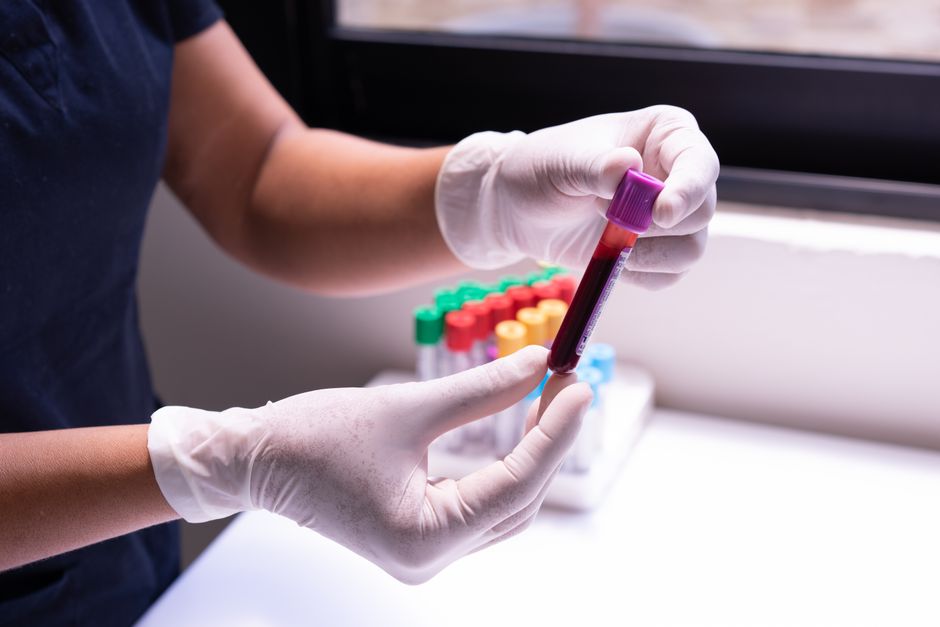
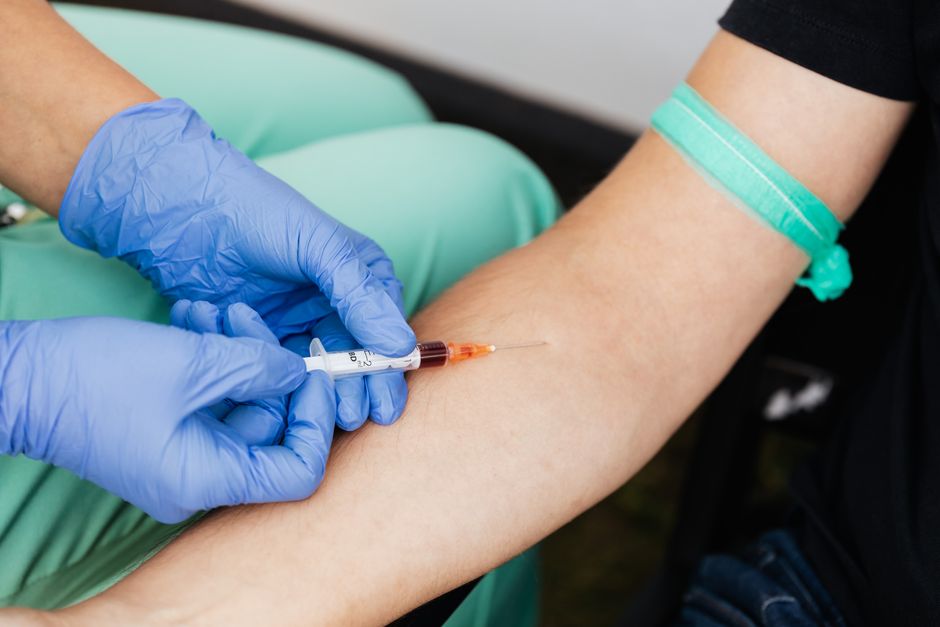
A blood sample is drawn, usually from a vein in your arm, then sent to a lab where automated analyzers count cells and measure chemical concentrations. The results are mapped against reference ranges built from healthy populations, and anything outside the band gets flagged (MedlinePlus).
The part worth understanding is how that reference range is born. A lab measures a marker in a large group of presumably healthy people, then typically defines normal as the middle 95 percent of those values. By definition, that leaves the top 2.5 percent and the bottom 2.5 percent of healthy people sitting outside the range. Do the math and roughly 1 in 20 healthy people will flag abnormal on any given test for purely statistical reasons. Run a 14-marker CMP on a perfectly healthy person and the odds that at least one value flags are surprisingly high. That is not a body falling apart. That is just how the math of a 95 percent range works, and it is the single most common reason a worried patient walks in with a report that turns out to be nothing.
The insider habit: read the trend, not the snapshot
Here is what experienced clinicians do that patients almost never think to do. They do not obsess over whether a single number is in or out of range. They look at how that number has moved over time. A value sitting comfortably inside the reference range can still be a warning if it has been climbing steadily across three years of annual labs, and a value flagged just outside the range can be completely stable and benign.
Healthcare professionals rarely focus on one number alone. They look for patterns over time and across related tests (MedlinePlus). A fasting glucose that has gone from 88 to 95 to 102 over three years is telling you a story even while it hovers near the edge of normal, and that trajectory is invisible if you only stare at this year’s snapshot. This is the most useful shift you can make in how you read your own results. Stop asking is this number bad. Start asking which way is this number moving, and is it moving with anything else on the page. Pull up last year’s report next to this year’s, line the markers up, and the trend that matters jumps out. That single habit separates people who panic over a lone flag from people who catch a real problem early.
It also explains why your clinician may shrug at a flag that scared you, or pay close attention to a value that looked fine to you. They are reading a movie. The portal only showed you one frame.
How to prepare so your results are actually accurate
The single fastest way to get a misleading report is to prep the wrong way. Many chemistry and lipid tests are affected by what you did in the hours before the draw, and a result skewed by a preventable factor can send you and your clinician chasing a problem that is not there.
Fasting is the classic example. Blood glucose and the standard lipid panel are commonly ordered fasting, which usually means no food or drink except water for 8 to 12 hours beforehand (MedlinePlus). Eat a bagel on the way to the lab and your glucose and triglycerides can read higher than your true baseline. Coffee, even black, counts as breaking a fast for some tests. If your order does not specify fasting, do not assume you need to, because unnecessary fasting is its own source of stress and sometimes lightheadedness.
Beyond fasting, several everyday factors move numbers:
- Hydration. Being dehydrated concentrates your blood, which can nudge markers like hemoglobin, hematocrit, sodium, and BUN upward. Being well hydrated gives a cleaner read.
- Recent hard exercise. A tough workout in the day before a draw can transiently raise creatine kinase, AST, and even creatinine, which may look alarming on a liver or kidney line without meaning anything.
- Supplements and medications. Biotin, a common ingredient in hair and nail supplements, can interfere with certain lab immunoassays and skew results, which is why the FDA has warned about it. Always tell the lab and your clinician what you take, including over-the-counter products.
- Time of day. Some markers, cortisol and iron among them, follow a daily rhythm and read differently in the morning versus the afternoon.
The practical move is simple. Ask the ordering office two questions before you go: do I need to fast, and should I hold any of my regular medications or supplements. Then keep your draw conditions consistent from year to year so your trend line means something.
Beyond CBC and CMP: the other panels you may see
The CBC and CMP cover cells and basic chemistry, but a typical annual or a workup for specific concerns often adds a few more panels. Knowing what each one is for keeps you from being surprised by extra acronyms.
Lipid panel
A lipid panel measures the fats in your blood: total cholesterol, LDL (often called the bad cholesterol), HDL (the protective one), and triglycerides. It is used to estimate cardiovascular risk (MedlinePlus). LDL and HDL are read together rather than alone, because a favorable HDL changes how a given LDL is interpreted.
Hemoglobin A1c
A1c reflects your average blood sugar over roughly the previous two to three months by measuring the percentage of hemoglobin that has glucose attached (MedlinePlus). Unlike a fasting glucose, which is a single snapshot, A1c is a memory of your recent average, which is why it is central to diagnosing and monitoring diabetes.
Thyroid panel
Thyroid testing usually starts with TSH, the pituitary hormone that tells your thyroid to work harder or ease off. A high TSH often points to an underactive thyroid, and a low TSH to an overactive one, which feels counterintuitive until you realize TSH is the signal, not the thyroid hormone itself.
These add-on panels are where the pattern-reading skill matters most, because a single marker on any of them rarely tells the whole story.
Reading the whole page: how markers explain each other
The real skill in reading blood work is not decoding one line, it is seeing how lines relate. Clinicians read clusters, because a value only becomes meaningful in the company of its neighbors. A few worked scenarios show how this works.
If hemoglobin is low but you want to know why, the CBC gives you a clue in a value called MCV, the average size of your red blood cells. Small cells point in one direction (often iron related), large cells in another (often B12 or folate related). Low hemoglobin plus small cells tells a different story than low hemoglobin plus large cells, and the follow-up testing diverges from there.
If your liver enzymes ALT and AST are both up, the pattern of which is higher, and whether other liver markers like bilirubin and alkaline phosphatase moved with them, helps sort a muscle source from a true liver source. Remember that a hard workout can raise AST on its own, which is why a single mildly elevated enzyme with everything else normal is often repeated rather than acted on immediately.
If BUN is elevated but creatinine is normal, that split often points toward dehydration rather than kidney disease, because BUN is more sensitive to fluid status. Both up together is a stronger signal to look at kidney function properly.
The takeaway is a habit: when one value surprises you, do not react to it alone. Look at the two or three markers that travel with it on the panel, then look at how the whole cluster has moved since last year. That is how a page of numbers becomes a story instead of a scatter of flags.

When a flag is a red flag: signs to act on promptly
Most out-of-range values are mild and get sorted out with a repeat test or a conversation. A smaller set deserves prompt attention, especially when the number is paired with how you feel.
- A markedly abnormal value, not just slightly out. A glucose barely above the cutoff is different from one far above it. Magnitude matters, and a wildly abnormal result is more likely to be real and to need action.
- Numbers paired with symptoms. Low hemoglobin alongside real fatigue, breathlessness, or a racing heart is more concerning than the same number in someone who feels fine. A high potassium alongside palpitations is a genuine flag.
- A sudden jump from a stable baseline. A kidney or liver marker that leaps from years of steady readings is worth a prompt call, even if it is only modestly out of range, because the change itself is the signal.
- Critical values. Labs have thresholds so extreme that they trigger an immediate phone call to the ordering clinician. If you get such a call, take it seriously and do not wait for your scheduled appointment.
If you are ever unsure whether a result needs urgent attention, contact your clinician’s office rather than deciding alone from a portal at 7 p.m. on a Friday. That is exactly the situation these results tend to arrive in.
Common mistakes people make reading their own labs
A handful of predictable errors send patients into needless worry or false reassurance. Knowing them in advance defuses most of the panic a portal can cause.
- Comparing your number to a range you found online. Reference ranges are lab specific. The only range that applies to your result is the one printed on your own report next to it.
- Treating in range as a clean bill of health. A normal result does not rule out disease, and it does not capture where you sit within the range or which way you are trending.
- Reacting to one flag in isolation. A lone value out of a large panel is often statistical noise, since running many markers on a healthy person makes at least one flag likely by chance.
- Ignoring prep. A non-fasting draw, a hard workout the day before, or a biotin supplement can all skew a result that then looks like a problem.
- Diagnosing yourself from the acronym. Test names hint at what is measured, but the meaning of a value depends on your history and symptoms, which the report does not contain.
Avoiding these five is most of what separates a calm, informed patient from a frightened one holding the same piece of paper.
What to do after you get your results
Reading the report well is only useful if it changes what you do next. Here is a sane sequence once your labs land.
- Do not diagnose from the portal. Note what flagged, write down any questions, and resist the urge to search each acronym into a spiral.
- Pull last year’s report alongside this one. Line up the markers and look for trends. A stable flag and a climbing in range value tell very different stories.
- Bring the whole picture to your clinician. The flags plus your symptoms, history, medications, and prep conditions are what let them interpret the numbers properly.
- Ask about a repeat when a lone value looks off. Many mild abnormalities are confirmed or dismissed simply by testing again, sometimes with better prep.
- Keep your own record. A simple running log of your key markers turns each annual draw into another data point on a trend line, which is where the real value lives.
The goal is not to become your own doctor. It is to walk into the appointment able to follow the conversation, ask sharper questions, and understand the plan instead of nodding along to a page you never learned to read.
Frequently asked questions
What is lab work and how is it different from blood work?
Lab work is the broad term for any test run on a sample sent to a laboratory, including urine, tissue, and blood. Blood work specifically means tests run on a blood sample. So all blood work is lab work, but lab work also covers samples that are not blood (MedlinePlus).
How do I read lab results for blood work without a doctor?
Read across each row: test name, your result, the unit, and the reference range printed beside it, then note any H or L flag (MedlinePlus). You can understand the layout on your own, but interpreting what a flagged value means for you still requires your clinician, who reads it alongside your symptoms and history.
Does an abnormal result mean something is wrong?
Not necessarily. A result outside the reference range may or may not signal a health problem, and many healthy people fall outside it for statistical reasons (MedlinePlus). An abnormal flag is a prompt to look closer, not a diagnosis (Cleveland Clinic).
Why do reference ranges differ between labs?
Labs use different testing methods and instruments, so they calibrate their own reference ranges. That is why you should compare your result only to the range on your own report and cannot reliably compare results from two different labs (MedlinePlus).
What two panels make up most routine blood work?
A complete blood count, which measures your red and white blood cells, hemoglobin, and platelets (Cleveland Clinic), and a comprehensive metabolic panel, which measures 14 substances including glucose, electrolytes, and kidney and liver markers (MedlinePlus).
This article is for general educational purposes and is not medical advice. It cannot diagnose or treat you and does not replace your clinician. Always discuss your lab results and any health decisions with a qualified healthcare professional.
Related reading
Vital Signs Today may earn a commission if you buy through links on this page. It does not affect our editorial assessments.