Disclosure: Vital Signs Today may earn a commission if you buy through links on this page, at no extra cost to you. This does not influence our evidence-based assessments. We are not a medical provider; talk to a clinician before acting on test results.
You got your blood work back, scanned past the cholesterol and the blood sugar, and there it was near the bottom: vitamin D, with a number you have no instinct for. Is 31 good? Is 18 a problem? Should you panic at 12 or celebrate at 60? Most people have no internal yardstick for this one number, and that is exactly why a result that looks fine can hide a real shortfall, or why a normal-looking value on one lab report would have been flagged on another.
Here is what almost no explainer tells you up front. Vitamin D is reported as a single number, but that number means slightly different things depending on which guideline your clinician follows and which machine your lab used. Once you understand that, your result stops being a mystery and starts being something you can actually read.
How to read vitamin D blood test results
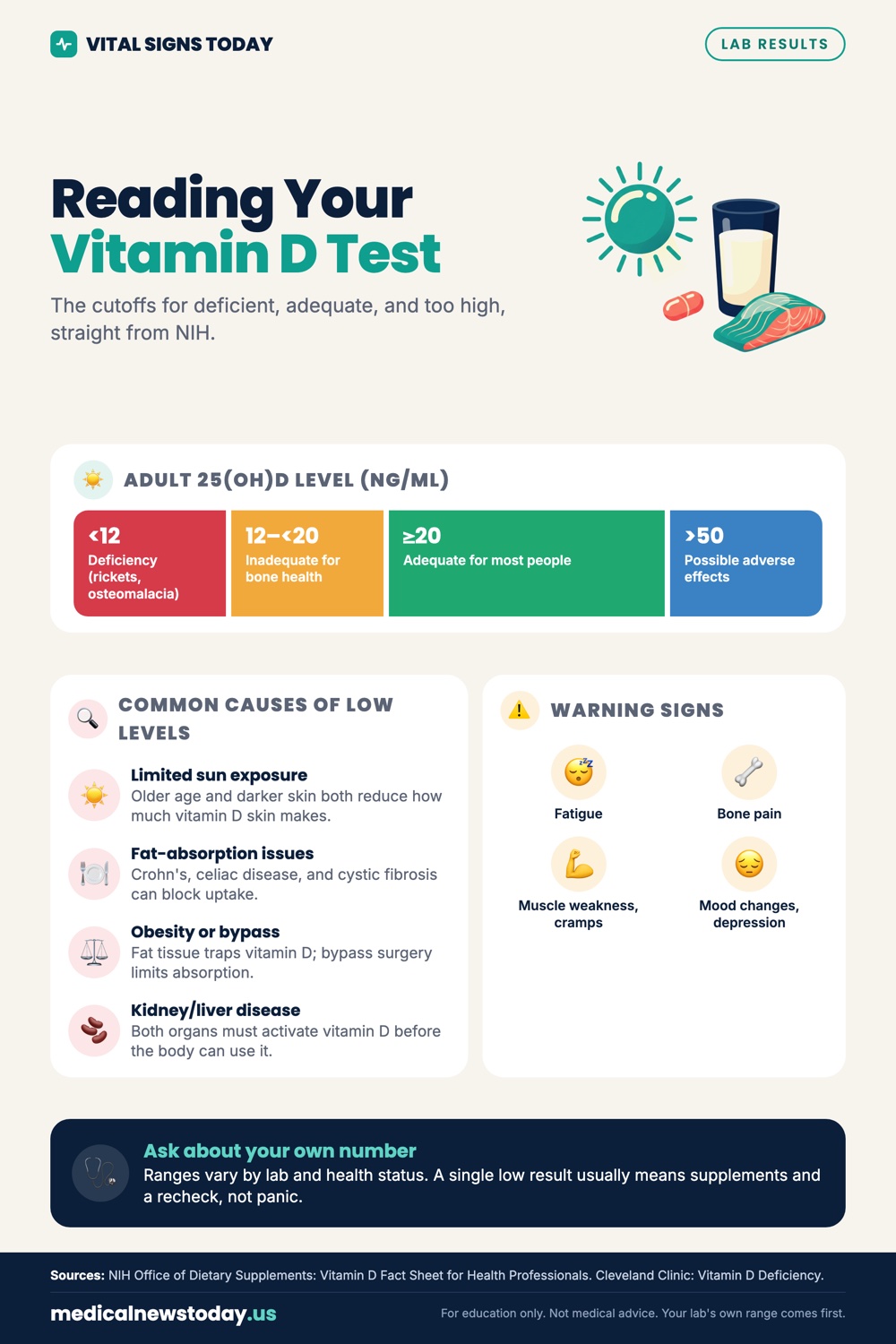
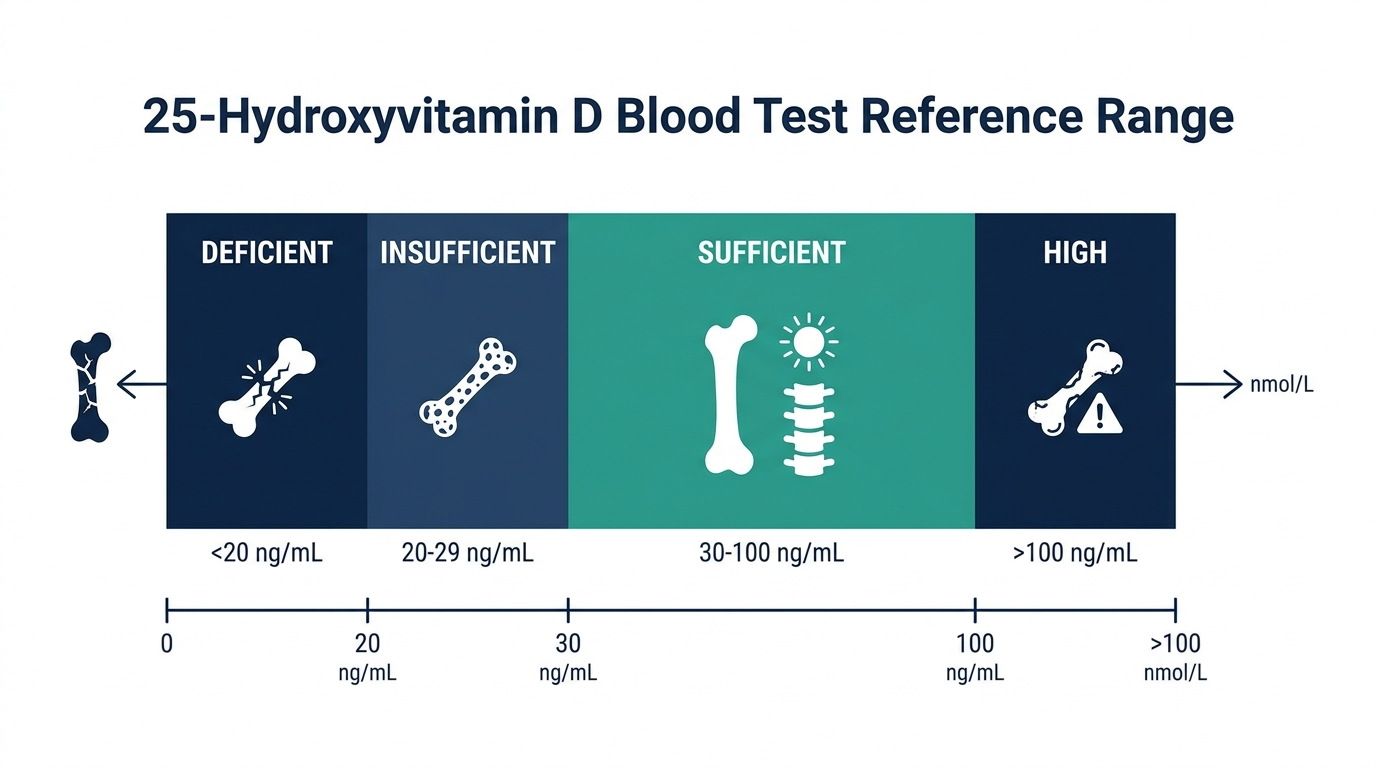
To read your vitamin D blood test results, find the number labeled 25-hydroxyvitamin D, note whether it is in ng/mL or nmol/L, and compare it against the standard bands: below 20 ng/mL is generally considered deficient, 20 to 30 ng/mL is a gray zone often called insufficient, and roughly 20 to 50 ng/mL is the range most labs treat as adequate (NCBI StatPearls). The single most important move is to read your value against the reference range printed on your own report, because that is the range your specific lab calibrated.
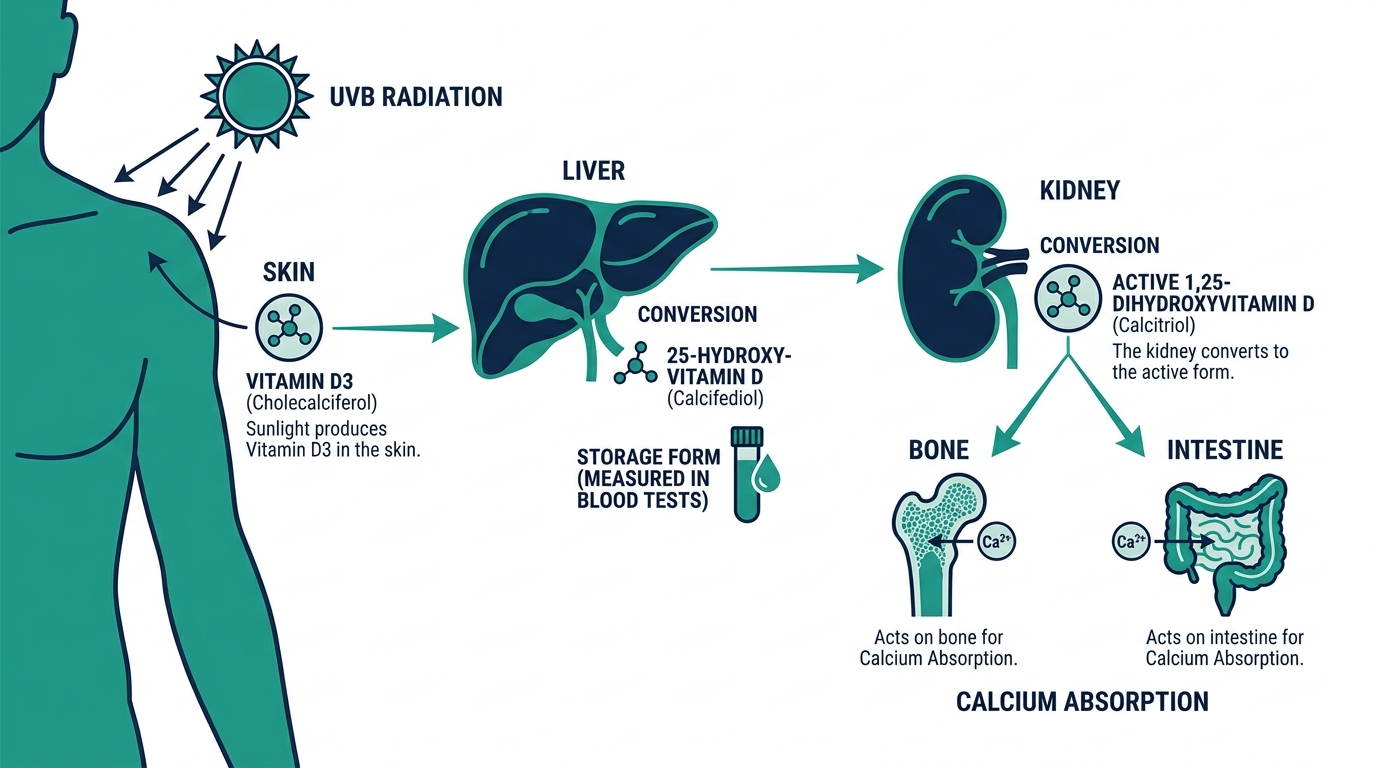
The number you are looking for is 25-hydroxyvitamin D, written as 25(OH)D. That is the storage form of vitamin D, and it is what reflects your true status over the past several weeks (Cleveland Clinic). Ignore the units anxiety for a second: if your result is in ng/mL, the bands above apply directly. If it is in nmol/L, multiply nothing in your head, just know that 50 nmol/L is about 20 ng/mL and 75 nmol/L is about 30 ng/mL.

What blood test shows vitamin D levels?
The blood test that shows your vitamin D level is the 25-hydroxyvitamin D test, often written 25(OH)D. This is the standard, preferred test for checking vitamin D status, and it is the one your clinician almost certainly means when they say they want to check your vitamin D (MedlinePlus). Most vitamin D blood tests measure 25(OH)D specifically because it is the most accurate way to see whether you have enough (Cleveland Clinic).
It is a simple blood draw, usually from a vein in your arm, and it often rides along with a broader metabolic or bone panel rather than being ordered on its own. There is a second vitamin D test, 1,25-dihydroxyvitamin D, which measures the active hormone form, but that one is reserved for specific kidney and calcium problems and is not the test you use to find out if you are low. So if you are wondering what the vitamin D blood test is for in routine practice, the answer is the 25(OH)D test.
What is vitamin D for in a blood test, and why is it measured?
Vitamin D on a blood test is a marker of how well your body can absorb calcium and maintain healthy bones, muscles, and immune function. Vitamin D maintains the balance of calcium in your blood and bones and is essential for building and maintaining the skeleton, while also supporting the nervous, musculoskeletal, and immune systems (Cleveland Clinic). When the number on your report is low, those systems are the ones at risk.
Clinicians order the test when they suspect a deficiency or when you fall into a higher-risk group, rather than screening everyone. High-risk groups include people over 65, those with darker skin tones, homebound or nursing-home residents, exclusively breastfed infants, and people with kidney or liver disease, Crohn’s disease, celiac disease, or cystic fibrosis (Cleveland Clinic). Deficiency is strikingly common. Cleveland Clinic estimates roughly a billion people worldwide are low, and about 35 percent of U.S. adults (Cleveland Clinic).

What is a normal vitamin D level?
A normal vitamin D level for most adults is generally 20 to 50 ng/mL of 25-hydroxyvitamin D, though experts genuinely disagree about the exact cutoffs (NCBI StatPearls). Some guidelines set the bar for sufficiency higher, at above 30 ng/mL. This is not sloppiness, it is an honest reflection of an unsettled science.
Here is the practical way to hold it:
- Below 20 ng/mL: generally classified as deficient by the Institute of Medicine and many labs (NCBI StatPearls).
- 20 to 30 ng/mL: a gray zone often labeled insufficient, where some clinicians treat and others watch.
- 20 to 50 ng/mL: the band most labs treat as adequate for the general adult population (NCBI StatPearls).
- Above 50 ng/mL: higher than typically needed, and worth a conversation about your supplement dose.
The takeaway: a result of 18 ng/mL is a flag on almost any scale, a result of 25 ng/mL is genuinely debatable and depends on your clinician’s guideline, and a result of 40 ng/mL is comfortably adequate by every standard.
What does a low vitamin D level mean?
A low vitamin D level means your body does not have enough stored vitamin D to fully support calcium balance, bone strength, and muscle function. A decreased 25(OH)D result points to causes like too little sun exposure, low dietary intake, problems absorbing vitamin D from the gut, or liver and kidney disease that impairs how your body processes it (MedlinePlus).
Many people with low levels feel nothing at all, which is part of why it goes undetected. When symptoms do show up in adults, they tend to be vague and easy to blame on something else: fatigue, bone pain, muscle weakness or cramps, and mood changes such as low mood (Cleveland Clinic). Over time, a sustained shortfall can weaken bones, which is the link to conditions like osteomalacia in adults and rickets in children. A single low result is not a catastrophe, but it is a reason to act, because vitamin D is one of the more straightforward deficiencies to correct.

What does a high vitamin D level mean?
A high vitamin D level usually means you are taking more in supplements than your body needs, not that you got too much sun or food. Vitamin D toxicity is almost always caused by excessive supplement doses, because your skin self-regulates how much it makes from sunlight and food contains relatively little (Cleveland Clinic).
The truly dangerous zone is far above the normal range. Levels above 100 ng/mL may pose a risk of toxicity, and frank hypervitaminosis D, with levels exceeding 150 ng/mL, is considered toxic (NCBI StatPearls). The reason it matters is that too much vitamin D drives calcium too high in the blood, which can cause nausea, weakness, frequent urination, and over time can damage the kidneys. So if your result comes back above 100, the first question is not your sun habits, it is what is in your supplement cabinet and at what dose.
The insider truth: your number can change just by switching labs
Here is the part clinicians know and most patients never hear. The same tube of your blood can come back with meaningfully different vitamin D numbers depending on which testing method the lab uses. This is not a small rounding issue. Across commonly used commercial assays, the measured bias on a single shared sample can range from roughly plus 18 percent on one platform to plus 34 percent on another, measuring the identical specimen (PMC, vitamin D assay standardisation).
The consequence is concrete. When national survey data was reanalyzed with standardized methods, what looked like a real shift in population vitamin D levels turned out to be partly an assay artifact rather than a true change in people (PMC, vitamin D assay standardisation). In other words, some deficiency labels reflect the measurement as much as the person. This is exactly why the NIH Office of Dietary Supplements created the Vitamin D Standardization Program to push labs toward comparable results (PMC, vitamin D assay standardisation).
What you do with this: do not over-interpret a borderline result, like 19 versus 22 ng/mL, as a hard line between sick and healthy. And if you are tracking your vitamin D over time to see if a supplement is working, try to use the same lab each time, so you are comparing like with like instead of chasing differences that came from the machine.

Want to check your vitamin D?
Three ways to get it measured. Pick whichever fits you.
Affiliate links: we may earn a commission at no extra cost to you. A lab test does not replace a visit with your clinician.
The markers your clinician reads alongside vitamin D
A 25(OH)D value rarely travels alone. Vitamin D sits inside a small system that manages calcium, and a clinician often reads three or four related markers to understand what your vitamin D number actually means for your body.
- Calcium. Vitamin D exists largely to help your gut absorb calcium, so calcium is the downstream marker. A low vitamin D with a low or low-normal calcium tells a different story than low vitamin D with normal calcium.
- Parathyroid hormone (PTH). This is the quiet tell. When vitamin D and calcium run low, the parathyroid glands work harder and PTH rises to pull calcium back up, sometimes by leaching it from bone. A low vitamin D paired with a high PTH suggests the deficiency is biologically active and worth correcting, not just a number below a cutoff.
- Phosphorus. Vitamin D also influences phosphate handling, so phosphorus can shift in significant deficiency, which is part of the picture in bone-softening conditions.
- Alkaline phosphatase. This enzyme can rise when bone turnover increases, which is why it is sometimes elevated in long-standing vitamin D deficiency affecting the skeleton.
The practical reading scenario: if your vitamin D is 18 ng/mL but your calcium, phosphorus, PTH and alkaline phosphatase are all normal, your clinician may simply recommend replacement and a recheck. If that same low vitamin D comes with a high PTH, they take it more seriously, because your body is visibly compensating. This is why chasing the vitamin D number in isolation misses the point. It is one dial on a connected panel.
How vitamin D deficiency is actually corrected
The reason a low result is not a crisis is that vitamin D is one of the more fixable deficiencies. Correction is done with supplemental vitamin D, either D3 (cholecalciferol) or D2 (ergocalciferol), and the dose and duration depend on how low you started and why.
A few principles are worth understanding before you talk to your clinician:
- Deficiency is usually treated with a higher loading dose for a period, then a lower maintenance dose. The exact regimen is a clinical decision, because it depends on your starting level, body weight, and whether you have an absorption problem.
- Absorption matters. Vitamin D is fat soluble, so taking it with a meal that contains some fat improves how much you absorb. People with celiac disease, Crohn’s disease, or after certain weight-loss surgeries may absorb it poorly and need a different approach.
- Fixing the cause counts as much as the pill. If limited sun exposure or a gut absorption issue drove the deficiency, addressing that keeps the level from sliding back after treatment ends.
- More is not better. Because toxicity comes almost entirely from over-supplementation, the goal is to reach the adequate range and hold there, not to push the number as high as possible.
The universal caveat: dose is a decision for your clinician, not a number to copy from an article, because the right amount depends on your specific result and health history.
When and how to retest, and how to prep
One of the most common mistakes is retesting too soon. Vitamin D stores change slowly, so checking again a couple of weeks after starting a supplement tells you almost nothing.
- Timing. Because 25(OH)D reflects your status over the preceding weeks, a recheck is typically done after roughly three months of a steady supplement dose, once the level has had time to plateau. Retesting earlier catches the number mid-climb and can mislead you.
- Same lab, same conditions. As covered above, assay differences between labs can shift your number, so use the same lab when tracking a trend so any change you see is real, not a machine artifact.
- Fasting is generally not required for a 25(OH)D test, though your clinician may bundle it with fasting tests like glucose or a lipid panel, in which case you follow the fasting rule for those.
- Season counts. Levels often dip in winter when sun exposure falls and rise in late summer, so a value taken in February and one taken in August are not strictly comparable unless you account for the season.
The habit that makes retesting useful: change one thing, wait long enough for it to register, then recheck under the same conditions. That is how you learn whether your supplement dose is doing its job.
Where your vitamin D actually comes from
Understanding your result is easier when you know the three ways vitamin D enters your body, because a low number usually traces back to one of them falling short.
- Sunlight. Your skin makes vitamin D when exposed to UVB rays, which is why deficiency is more common in people who spend little time outdoors, live at higher latitudes, cover their skin, or have darker skin tones that produce less vitamin D per minute of sun.
- Food. Relatively few foods are naturally rich in vitamin D. Fatty fish such as salmon and mackerel, egg yolks, and fortified foods like milk and some cereals are the main dietary sources, but food alone rarely fills a large gap.
- Supplements. For many people with limited sun exposure, supplements are the reliable lever, which is also why they are the usual cause when a level runs too high.
This is why your clinician asks about your routine when a result is low. A desk-bound winter, a diet with little fatty fish, and no supplement is a common recipe for a number under 20, and each part of it is something you can adjust.
Common misconceptions about vitamin D results
A few persistent myths lead people to misread their own number:
- “I get plenty of sun, so I can’t be low.” Sunscreen, glass windows, latitude, season, and skin tone all cut how much vitamin D your skin makes, so plenty of sun does not guarantee an adequate level.
- “Higher is always healthier.” Above the adequate range there is no proven added benefit, and past 100 ng/mL you move toward risk, so more is not the goal.
- “A normal number means my bones are fine.” Vitamin D is one input to bone health, not the whole story, which is why it is read with calcium, PTH and sometimes bone density.
- “My level dropped, the supplement failed.” A drop measured on a different lab or in a different season may be an artifact, not a real decline, which is why same-lab, same-season tracking matters.
Clearing these up is often the difference between reacting sensibly to a result and either ignoring a real shortfall or over-correcting one that was never that low.
Frequently asked questions
What blood test is for vitamin D?
The 25-hydroxyvitamin D test, written 25(OH)D, is the blood test for vitamin D. It measures the storage form of vitamin D and is the standard, preferred way to check your status (MedlinePlus). A second test, 1,25-dihydroxyvitamin D, measures the active hormone but is reserved for specific kidney and calcium issues.
What is a normal vitamin D level on a blood test?
For most adults, a normal 25-hydroxyvitamin D level is generally 20 to 50 ng/mL, though some guidelines set sufficiency at above 30 ng/mL (NCBI StatPearls). Always compare your result against the reference range printed on your own lab report.
What does it mean if my vitamin D is low?
A low result means you do not have enough stored vitamin D, often from limited sun exposure, low intake, absorption problems, or liver or kidney disease (MedlinePlus). Many people feel nothing, but it can cause fatigue, bone pain, and muscle weakness, and over time weaken bones (Cleveland Clinic).
Can vitamin D be too high?
Yes, but it is almost always from supplements, not sun or food (Cleveland Clinic). Levels above 100 ng/mL may risk toxicity, and above 150 ng/mL is considered toxic, which can raise blood calcium and harm the kidneys (NCBI StatPearls).
Why did my vitamin D result change between labs?
Different labs use different testing methods, and the same blood sample can give meaningfully different numbers, with measured bias varying by 18 percent or more between platforms (PMC, vitamin D assay standardisation). To track changes over time, use the same lab each time so you are comparing like with like.
This article is for general educational purposes and is not medical advice. It cannot diagnose or treat you and does not replace your clinician. Always discuss your lab results and any health decisions with a qualified healthcare professional.
Related reading
Vital Signs Today may earn a commission if you buy through links on this page. It does not affect our editorial assessments.