Disclosure: Vital Signs Today may earn a commission if you buy through links on this page, at no extra cost to you. This does not influence our evidence-based assessments. We are not a medical provider; talk to a clinician before acting on test results.
Related: vitamin d blood test: the full guide
- For most people of any age, a normal vitamin D level is a serum 25-hydroxyvitamin D of 20 ng/mL (50 nmol/L) or higher, which the U.S. Food and Nutrition Board considers adequate for bone and overall health.
- The standard reference range does not change by age or sex: the same 20 ng/mL adequacy cutoff applies to infants, children, adults, and older adults, and to both men and women.
- The Endocrine Society sets a stricter sufficiency threshold of above 30 ng/mL, so a result between 20 and 30 ng/mL may be called adequate by one standard and insufficient by another.
What is a normal vitamin D level?
A normal vitamin D level is a serum 25-hydroxyvitamin D, written 25(OH)D, of 20 ng/mL (50 nmol/L) or higher, the cutoff the U.S. Food and Nutrition Board treats as adequate for nearly everyone (NIH Office of Dietary Supplements). The same body considers below 12 ng/mL (30 nmol/L) a true deficiency and the 12 to 20 ng/mL band as inadequate or at risk. Note that the optimal target is debated. The Endocrine Society defines sufficiency as above 30 ng/mL and suggests a preferred range of 40 to 60 ng/mL for patients it treats (StatPearls, NCBI).
Why two numbers? The 20 ng/mL figure comes from a population standard built around bone health, while the 30 ng/mL figure comes from clinical guidelines for diagnosing and treating deficiency. Your lab report usually flags one of them, so the “normal” label you see depends on which standard the lab follows.
One vitamin, two units: results come in ng/mL or nmol/L. To convert, multiply ng/mL by 2.5. So 20 ng/mL equals 50 nmol/L, and 30 ng/mL equals 75 nmol/L.
Which vitamin D test should you get?
This is where many people, and occasionally a busy clinician, go wrong. There are two vitamin D blood tests, and only one is right for checking your status.
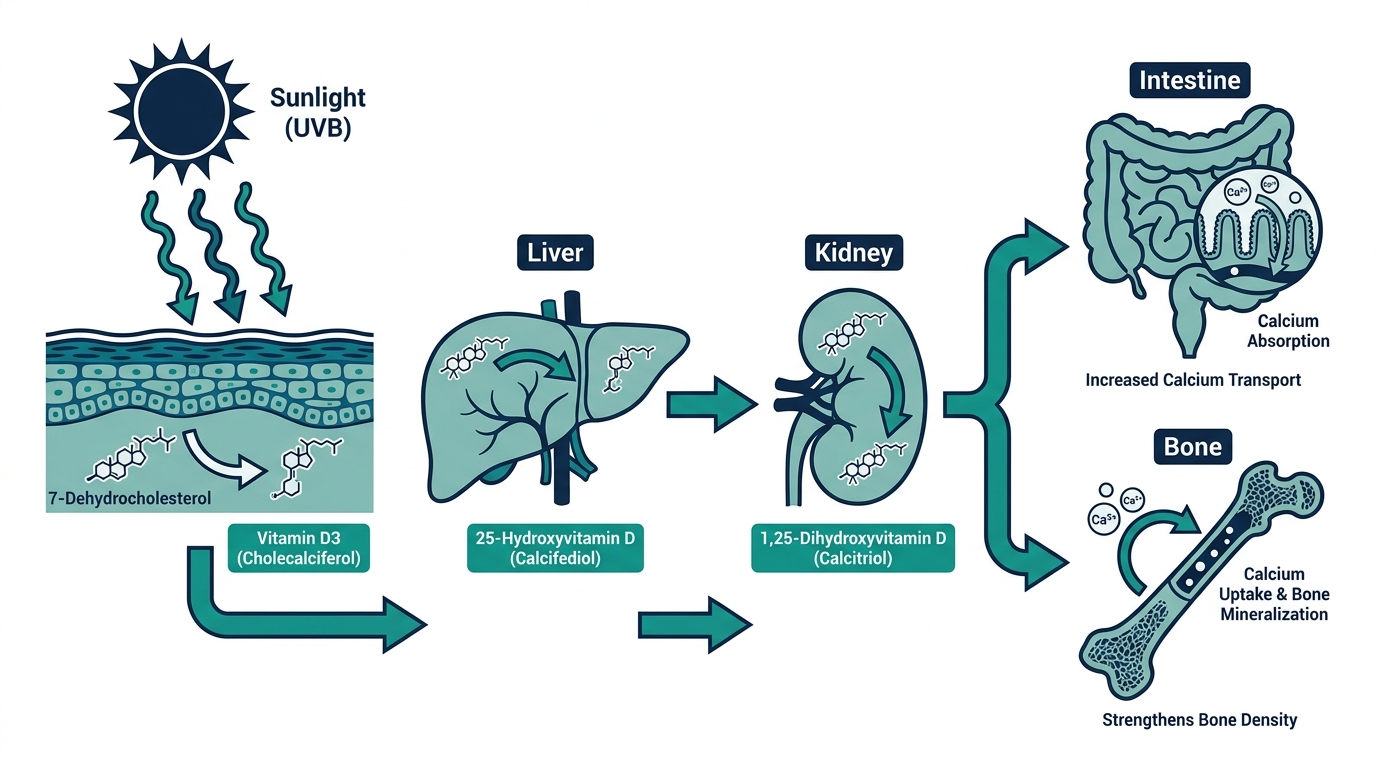
- 25-hydroxyvitamin D, or 25(OH)D: the storage form and the correct screening test. It reflects everything you have banked from sun, food, and supplements over the past weeks, so it is the number every reference range above refers to.
- 1,25-dihydroxyvitamin D, or calcitriol: the active hormone. The body regulates it tightly, so it can stay normal, or even run high, in someone who is genuinely deficient. Ordering this test to screen for low vitamin D is a classic misstep that can falsely reassure. It has specific uses, such as evaluating certain kidney and calcium disorders, but routine screening is not one of them (StatPearls, NCBI).
If your report simply says “vitamin D” with a value in ng/mL and a range around 20 to 50 or 30 to 100, it is almost certainly the 25(OH)D test. When in doubt, check the test name on the report before you interpret the number, because a normal-looking active-form result can hide a real deficiency.
Vitamin D normal range by age
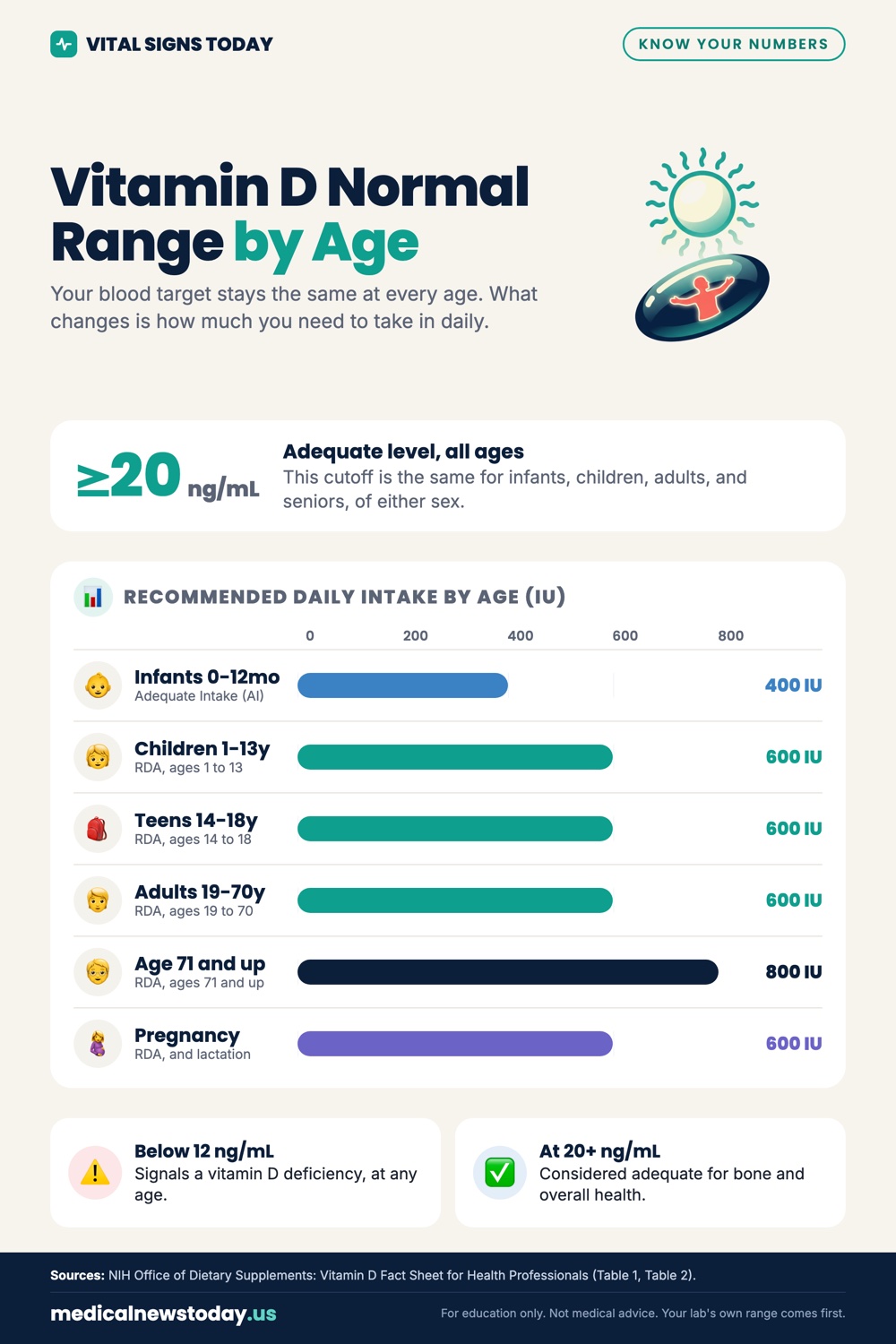
The vitamin D reference range does not shift with age. Across infants, children, adults, and seniors, a 25(OH)D of 20 ng/mL (50 nmol/L) or higher is the adequacy cutoff used by the Food and Nutrition Board, and below 12 ng/mL (30 nmol/L) signals deficiency at every age (NIH Office of Dietary Supplements). What does change by age is how much vitamin D you need to consume to reach that range, which is why the recommended intake climbs from 400 IU in infancy to 800 IU after age 70.
The table below pairs the constant blood reference range with the age-specific recommended intake. Intake values are the Recommended Dietary Allowance, except infant values, which are an Adequate Intake (NIH Office of Dietary Supplements).
| Age group (both sexes) | Normal 25(OH)D range | Recommended daily intake |
|---|---|---|
| Infants, 0 to 12 months | ≥ 20 ng/mL (50 nmol/L) | 400 IU (10 mcg), Adequate Intake |
| Children, 1 to 13 years | ≥ 20 ng/mL (50 nmol/L) | 600 IU (15 mcg) |
| Teens, 14 to 18 years | ≥ 20 ng/mL (50 nmol/L) | 600 IU (15 mcg) |
| Adults, 19 to 70 years | ≥ 20 ng/mL (50 nmol/L) | 600 IU (15 mcg) |
| Older adults, 71+ years | ≥ 20 ng/mL (50 nmol/L) | 800 IU (20 mcg) |
| Pregnancy and lactation | ≥ 20 ng/mL (50 nmol/L) | 600 IU (15 mcg) |
Want to check your vitamin D?
Three ways to get it measured. Pick whichever fits you.
Affiliate links: we may earn a commission at no extra cost to you. A lab test does not replace a visit with your clinician.
Reading the bands: below 12 ng/mL is deficient, 12 to 20 ng/mL is inadequate or at risk, 20 ng/mL and above is adequate, and consistently above 50 ng/mL (125 nmol/L) may bring no added benefit and could cause harm (NIH Office of Dietary Supplements).
How does sex change the range?
Sex does not change the vitamin D reference range. The 20 ng/mL adequacy cutoff and the deficiency threshold below 12 ng/mL apply identically to men and women, and the recommended daily intake is also the same for both sexes within each age band, for example 600 IU for adults 19 to 70 (NIH Office of Dietary Supplements). There is no separate male or female normal range the way there is for hemoglobin or creatinine.
Sex still influences your real-world status, just not the cutoff. Women face higher demand during pregnancy and breastfeeding and a sharper drop in bone-protective hormones after menopause, which raises the stakes of staying above the line. Body composition matters too, because vitamin D is fat-soluble and people with more body fat may need higher intake to reach the same blood level. These are reasons your number may differ, not reasons the target differs.
What makes vitamin D rise or fall with age?
Vitamin D status tends to fall with age mainly because aging skin makes less of it. After about age 70, the skin’s capacity to synthesize vitamin D from sunlight drops to roughly a quarter of what it was in young adulthood, which is the central reason the recommended intake rises to 800 IU at 71 and older (NIH Office of Dietary Supplements). Older adults also spend less time outdoors and absorb dietary vitamin D less efficiently.
Several forces push the number around at any age:
- Sun exposure: latitude, season, sunscreen, and indoor lifestyles all cut skin production. Winter months reliably lower levels.
- Skin tone: higher melanin slows synthesis, so darker-skinned people often have lower 25(OH)D for the same sun.
- Body fat: vitamin D is stored in fat tissue, which can lower the amount circulating in blood.
- Gut and kidney health: conditions like Crohn disease, celiac disease, and chronic kidney disease impair absorption or activation.
- Diet and supplements: few foods are naturally rich in vitamin D, so fortified foods and supplements drive most intake.
Timing matters when you test. Because sun drives so much of your supply, most people hit their lowest 25(OH)D at the end of winter and early spring, and their highest in late summer. A level checked in February can read several points below the same person’s August value. If you want your worst-case status, testing at the end of winter is the honest moment; if you are tracking a supplement, test at the same time of year each time so the seasons do not muddy the trend.
What does low vitamin D feel like, and what to do about it?
The tricky part of vitamin D deficiency is that it is often silent, which is exactly why it gets missed. When symptoms do appear, they tend to be vague: persistent tiredness, aching bones or muscles, low mood, and a run of minor illnesses. In children, severe long-standing deficiency causes rickets, with soft, bowing bones; in adults, the equivalent is osteomalacia, or softening of the bones, along with muscle weakness (NIH Office of Dietary Supplements). Because these signs overlap with so many other conditions, a blood test is the only way to confirm the cause.
If your 25(OH)D comes back low, the correction is usually straightforward, and a few practical points make it work:
- D3 over D2. Cholecalciferol (D3) generally raises blood levels more effectively than ergocalciferol (D2), which is why most over-the-counter supplements use D3.
- Take it with fat. Vitamin D is fat-soluble, so taking your supplement with a meal that contains some fat improves absorption.
- Give it time, then retest. Blood levels change slowly. It takes weeks for a new dose to register, so a repeat 25(OH)D is usually drawn about 3 months later rather than a few weeks in.
- Do not mega-dose on your own. Correcting a true deficiency sometimes needs higher short-term doses, but that belongs under clinician guidance, because vitamin D can be overdone.
Two partners are worth checking alongside it. Magnesium is needed to activate vitamin D, so a low magnesium level can blunt your response to supplements, and calcium plus parathyroid hormone (PTH) round out the picture of how your bones are actually doing. Vitamin D is rarely read in true isolation.
When is an out-of-range result a concern?
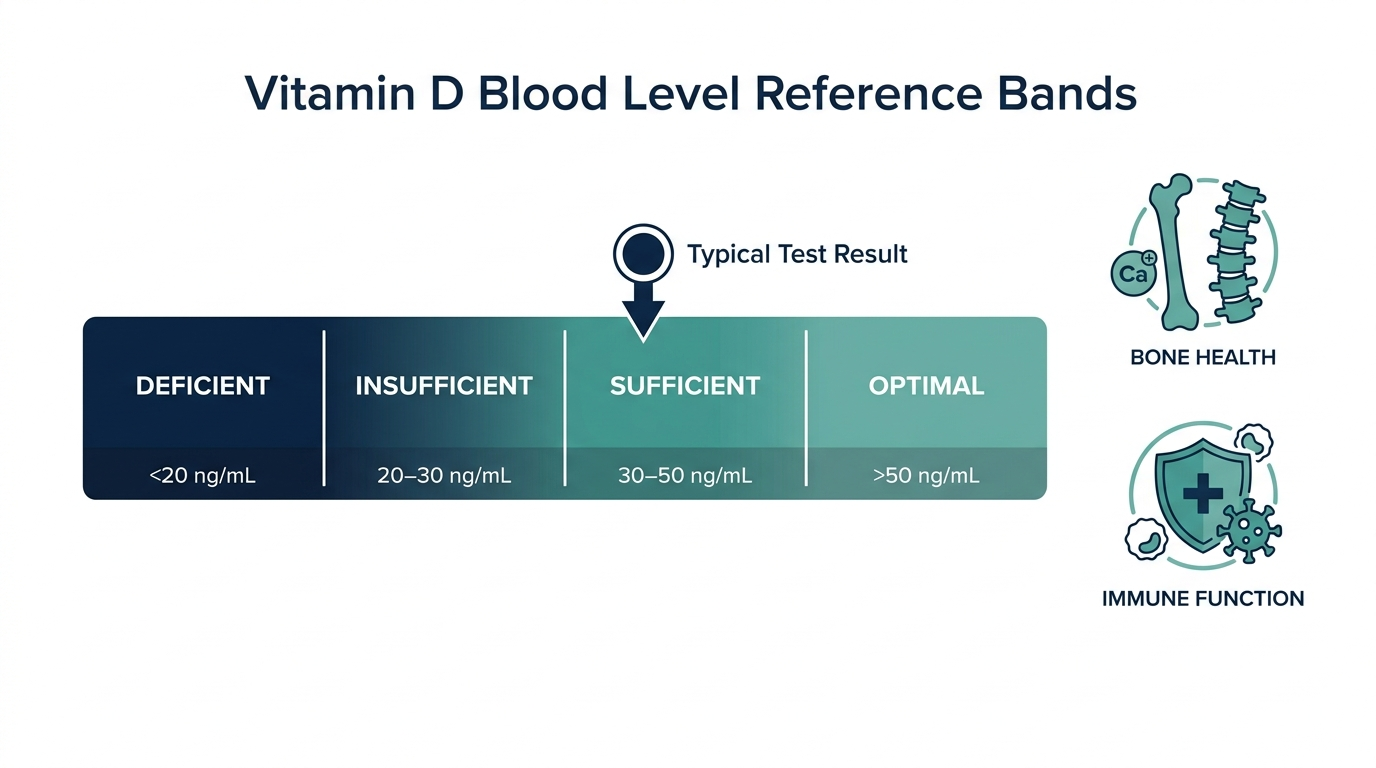
An out-of-range result is a concern when 25(OH)D falls below 12 ng/mL (30 nmol/L), which the Food and Nutrition Board defines as deficiency and which is linked to rickets in children and osteomalacia, or soft bones, in adults (NIH Office of Dietary Supplements). A result in the 12 to 20 ng/mL band is inadequate and usually prompts your clinician to recommend more vitamin D, though it is less urgent than frank deficiency.
High results matter too. Vitamin D toxicity is rare and almost always caused by over-supplementation rather than sun or food. Levels above 50 ng/mL (125 nmol/L) may offer no extra benefit, and concentrations over 150 ng/mL (375 nmol/L) can cause hypercalcemia, with nausea, weakness, frequent urination, and in severe cases kidney damage (StatPearls, NCBI). The takeaway: more is not always better.
Always read your result against the specific range printed on your lab report, since a value near 25 ng/mL can read as normal under the Food and Nutrition Board standard yet insufficient under Endocrine Society guidance. Your clinician interprets the number alongside your age, symptoms, calcium, and bone health.
Two real reading scenarios
The same vitamin D number can prompt different action depending on the standard and the person, so here are two common situations.
Scenario one: normal or insufficient? A 38-year-old office worker tests at 24 ng/mL in March. Her lab uses the Food and Nutrition Board standard, so the result is flagged normal, above the 20 ng/mL adequacy line. Her clinician, who leans on the Endocrine Society target of above 30, suggests a modest daily D3 supplement taken with dinner and a retest in 3 months. Same number, judged adequate by one ruler and worth nudging up by another. Neither reading is wrong; they answer different questions.
Scenario two: the reassuring test that was the wrong test. A 55-year-old man with fatigue is told his vitamin D is fine. A closer look shows the lab ran 1,25-dihydroxyvitamin D, the active hormone, which was normal. When the correct 25(OH)D storage test is ordered, it comes back at 11 ng/mL, frank deficiency. The first result was reassuring precisely because it was the wrong test. This is why the test name matters as much as the value.
Frequently asked questions
Is a vitamin D level of 30 good?
A level of 30 ng/mL (75 nmol/L) is adequate by the Food and Nutrition Board standard and sits right at the Endocrine Society’s sufficiency threshold of above 30 ng/mL. It is a solid result for most people, though some clinicians aim a little higher.
What vitamin D level is too low?
Below 12 ng/mL (30 nmol/L) is deficient and warrants treatment, per the NIH Office of Dietary Supplements. A level of 12 to 20 ng/mL is considered inadequate and usually prompts a clinician to recommend more vitamin D through diet or supplements.
Does the normal vitamin D range differ for seniors?
No. The blood reference range stays at 20 ng/mL or higher for older adults, the same as for younger people. What changes is the recommended daily intake, which rises to 800 IU at age 71 and above because aging skin makes less vitamin D.
What is the ideal vitamin D level by some experts?
The Endocrine Society suggests a preferred range of 40 to 60 ng/mL for patients it treats, higher than the 20 ng/mL population adequacy cutoff (StatPearls, NCBI). There is no universal agreement on an optimal target, so discuss your goal with your clinician.
Can your vitamin D level be too high?
Yes. Levels above 50 ng/mL (125 nmol/L) may bring no added benefit, and above 150 ng/mL (375 nmol/L) can cause toxicity with high blood calcium, nausea, and kidney problems. Toxicity comes from excess supplements, not sun or food.
How long does it take to raise vitamin D?
Blood levels change slowly. It generally takes several weeks of consistent supplementation to move your 25(OH)D, which is why a repeat test is usually done about 3 months after starting, not a few weeks in. Taking D3 with a meal that contains fat helps absorption.
Should I take vitamin D2 or D3?
D3 (cholecalciferol) generally raises blood levels more effectively than D2 (ergocalciferol), which is why most over-the-counter supplements use D3. Some high-dose prescription vitamin D is D2. If you are correcting a deficiency, follow the form and dose your clinician recommends.
Do I need to fast for a vitamin D test?
No. A 25(OH)D test does not require fasting and can be drawn at any time of day. If it is part of a broader panel that also checks glucose or cholesterol, you may be asked to fast for those tests, but the vitamin D result itself is not affected by a recent meal.
What is the difference between 25(OH)D and the active form?
25(OH)D is the storage form and the correct test for checking your status. The active form, 1,25-dihydroxyvitamin D, is tightly regulated by the body and can look normal even when you are deficient, so it is not used for routine screening. Always confirm your report shows the 25(OH)D test.
Sources
- NIH Office of Dietary Supplements, Vitamin D Health Professional Fact Sheet
- StatPearls (NCBI Bookshelf), Vitamin D
- StatPearls (NCBI Bookshelf), Vitamin D Deficiency
- Endocrine Society Clinical Practice Guideline, Journal of Clinical Endocrinology and Metabolism
This article is for general educational purposes and is not medical advice. It cannot diagnose or treat you and does not replace your clinician. Always discuss your lab results and any health decisions with a qualified healthcare professional.
Related reading
Related: see our ranking of the best at-home blood tests.
Vital Signs Today may earn a commission if you buy through links on this page. It does not affect our editorial assessments.