
Your results come back, you scan down the page, and there it is next to one of your numbers: a flag, a bold value, the word “abnormal.” Your stomach drops. Before you spiral, read this. The word “abnormal” on a lab report is one of the most misunderstood pieces of language in all of medicine, and it almost certainly does not mean what your gut is telling you it means.
Here is the short version that most people are never told plainly: abnormal is a statistical label, not a diagnosis. Understanding the difference is the single most useful thing you can learn about reading your own lab work.
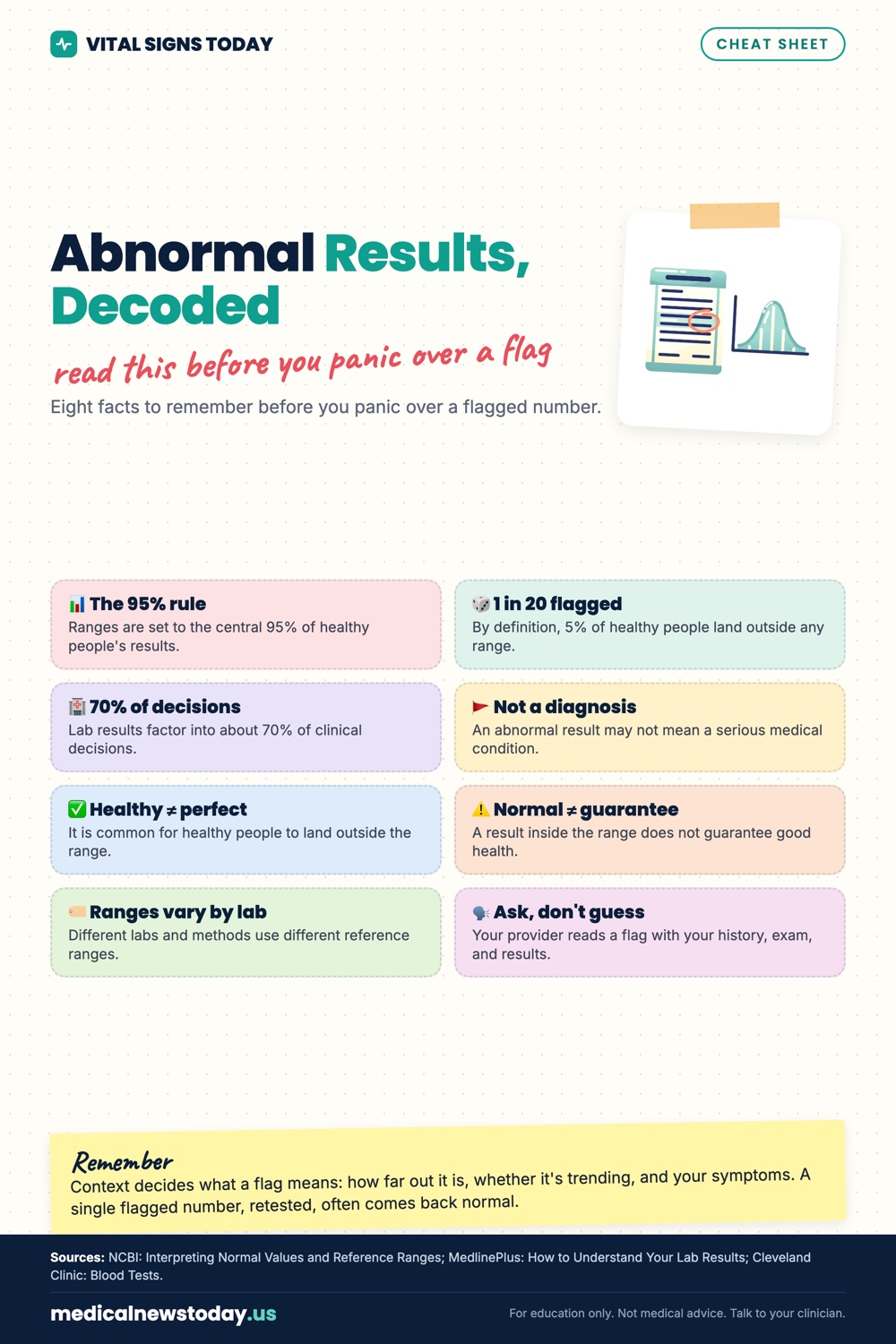
What does abnormal mean in test results?
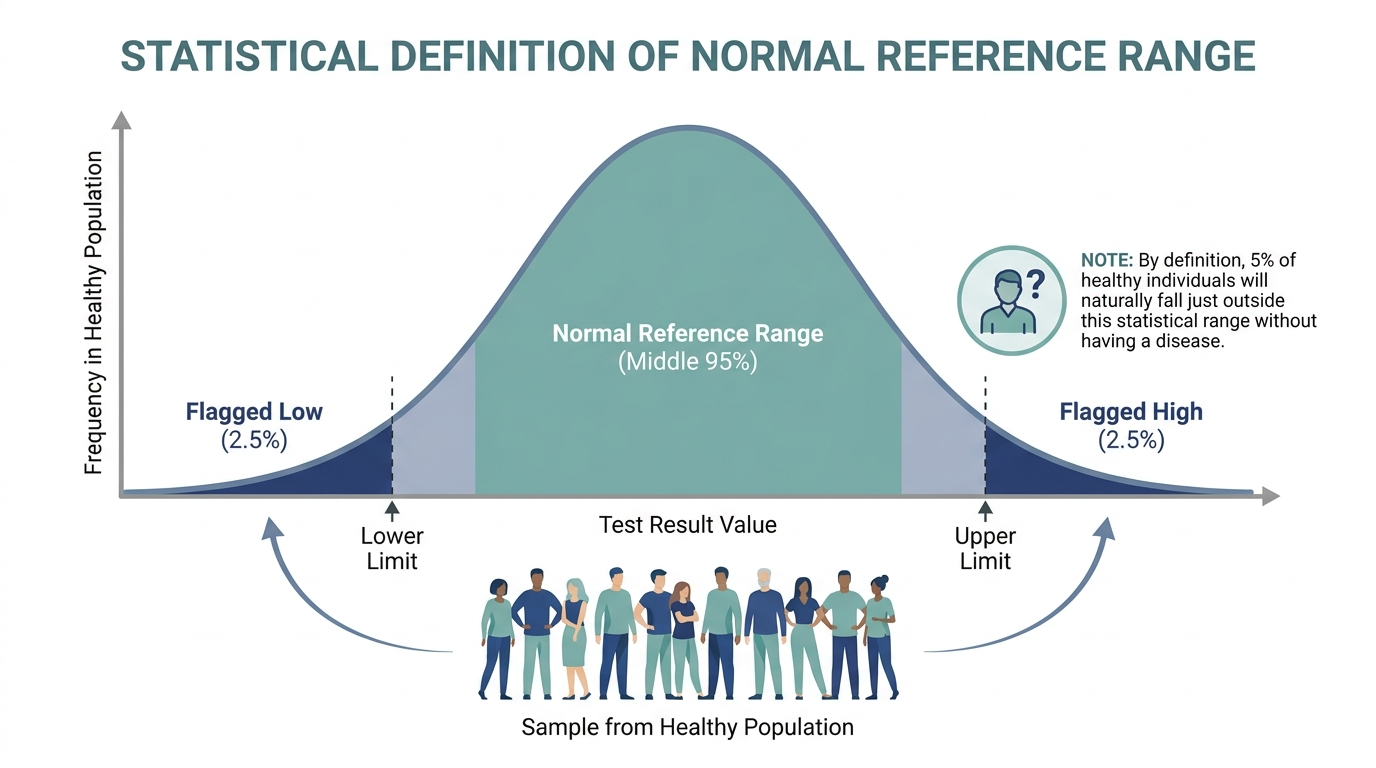
When you ask what does abnormal mean in test results, the honest answer is narrow and specific: a result is flagged abnormal when it falls outside the reference range, which is the band of values considered typical for a healthy population. That is the entire technical meaning. A result that is higher or lower than the range that applies to you may or may not be a sign of a health problem (MedlinePlus).
In plain terms, “abnormal” means “outside the expected band, look closer.” It does not mean “diseased,” “dangerous,” or “you have a condition.” An abnormal blood test result may not mean you have a serious medical condition (Cleveland Clinic). The flag is a prompt for interpretation, not a verdict.
How is the “normal” range actually decided?
The reference range is built by measuring a marker in a large group of presumably healthy people, then keeping the middle 95 percent of those values. The lowest 2.5 percent and highest 2.5 percent are trimmed off, and what remains becomes the “normal” range (NCBI, Interpreting Reference Ranges).
This is the detail that changes everything. Because the range is defined as the central 95 percent, the design itself guarantees that 5 percent of perfectly healthy people will land outside it on any given test (NCBI, Interpreting Reference Ranges). One in twenty healthy people will be flagged abnormal on a marker, not because anything is wrong, but because the math drew a line and they sat just past it. The “normal” range was never a biological boundary between sick and well. It is a statistical fence around the typical.
If I am healthy, why do I have an abnormal result?
Because abnormal happens to healthy people constantly, and the more tests you run, the more likely it becomes. This is pure statistics stacking up. If a single test flags 1 in 20 healthy people, then running a panel of 20 markers on a healthy person makes it likely that at least one comes back outside the range purely by chance.
Approximately 1 in 20 healthy people will have results outside of the normal range (Cleveland Clinic). On top of that statistical noise, ordinary life nudges your numbers. If any of your levels are abnormal, it does not always mean you have a medical condition that needs treatment. Diet, activity level, medicines, having a menstrual period, not drinking enough water, and other factors can affect the results (MedlinePlus).
So a slightly off number after a hard workout, a salty dinner, a poor night of sleep, or a missed water bottle is often just that: a snapshot of a body that is doing normal things, not a flare warning.
Which everyday things push a normal number just past the line?
Before a flag means anything about your health, it is worth ruling out the ordinary reasons a value drifts. Blood is not a fixed readout. It shifts with what you did in the hours and days before the needle went in, and a surprising amount of that movement has nothing to do with disease.
Timing and food are the usual suspects. Glucose and triglycerides climb after a meal, which is why many panels ask you to fast for 8 to 12 hours first. Iron tends to run higher in the morning and drift down through the day. Cortisol follows the same clock in reverse, high on waking and low at night, so the same person can look flagged at 8 a.m. and unremarkable by late afternoon.
Then there is the draw itself. A tight tourniquet left on too long, a clenched and pumping fist, or being upright versus lying down can each nudge a result. If red cells rupture inside the collection tube, a problem called hemolysis, potassium can read falsely high even though your blood is fine. That is one of the most common reasons a frightening potassium flag turns out to be a handling artifact rather than a heart risk, and it is why a provider may simply repeat the draw.
Life fills in the rest. A hard workout in the previous day or two can raise creatine kinase, liver enzymes, and white cells. Dehydration concentrates the blood and lifts several markers at once. A cold or other infection raises inflammatory markers like CRP for days. For women, the point in the menstrual cycle shifts iron and some hormones. Certain medicines and supplements, including high-dose biotin, can distort specific assays entirely. None of these is disease. They are the reason a single flagged number is a prompt to look again, not a conclusion.
What do abnormal blood tests mean for my health, then?
An abnormal blood test means one thing for certain and several things only maybe. For certain, it means a value sat outside the reference band and deserves a look in context. The “maybe” is everything else, and context is what separates a meaningless flag from a real signal.
When people ask what do abnormal blood tests mean or what does abnormal blood test mean for their case, the answer always lives in the surrounding picture: how far outside the range the value sits, whether it is trending or a one off, what your symptoms are, what medicines you take, and what the rest of the panel shows. Reference ranges may vary depending on age, sex, or testing location, and results outside the reference range do not always mean something is wrong (Cleveland Clinic).
A value barely past the edge of the range is read very differently from one that is far outside it. Your provider interprets the abnormal result in the context of your overall health rather than treating the flag as a standalone fact (Cleveland Clinic).
Which abnormal results should you not wait on?
Most abnormal flags can wait for a routine conversation with your provider. A small number cannot, and knowing the difference lets you stay calm without becoming careless. Labs already sort for this with a separate tier called critical values, or panic values, results so far outside the range that the lab is required to phone your clinician right away rather than simply printing a flag on the page.
The everyday version of that rule is simple. If a result is genuinely dangerous, you usually hear about it fast, often the same day, by a phone call rather than a quiet portal notification. A potassium far above range, a fasting blood sugar in the high hundreds, a hemoglobin that has dropped sharply, or a platelet count near the floor are the kinds of values that trigger urgent follow up. If no one is urgently calling you, your abnormal is very unlikely to sit in that tier.
Symptoms change the math too. A mildly abnormal number with no symptoms is usually watched. The same number alongside chest pain, severe shortness of breath, confusion, fainting, or heavy bleeding is a reason to seek care now rather than wait for the next appointment. When a flag and a symptom point in the same direction, treat the symptom as the priority and let the number follow.
Are abnormal blood test results normal? When abnormal is genuinely fine
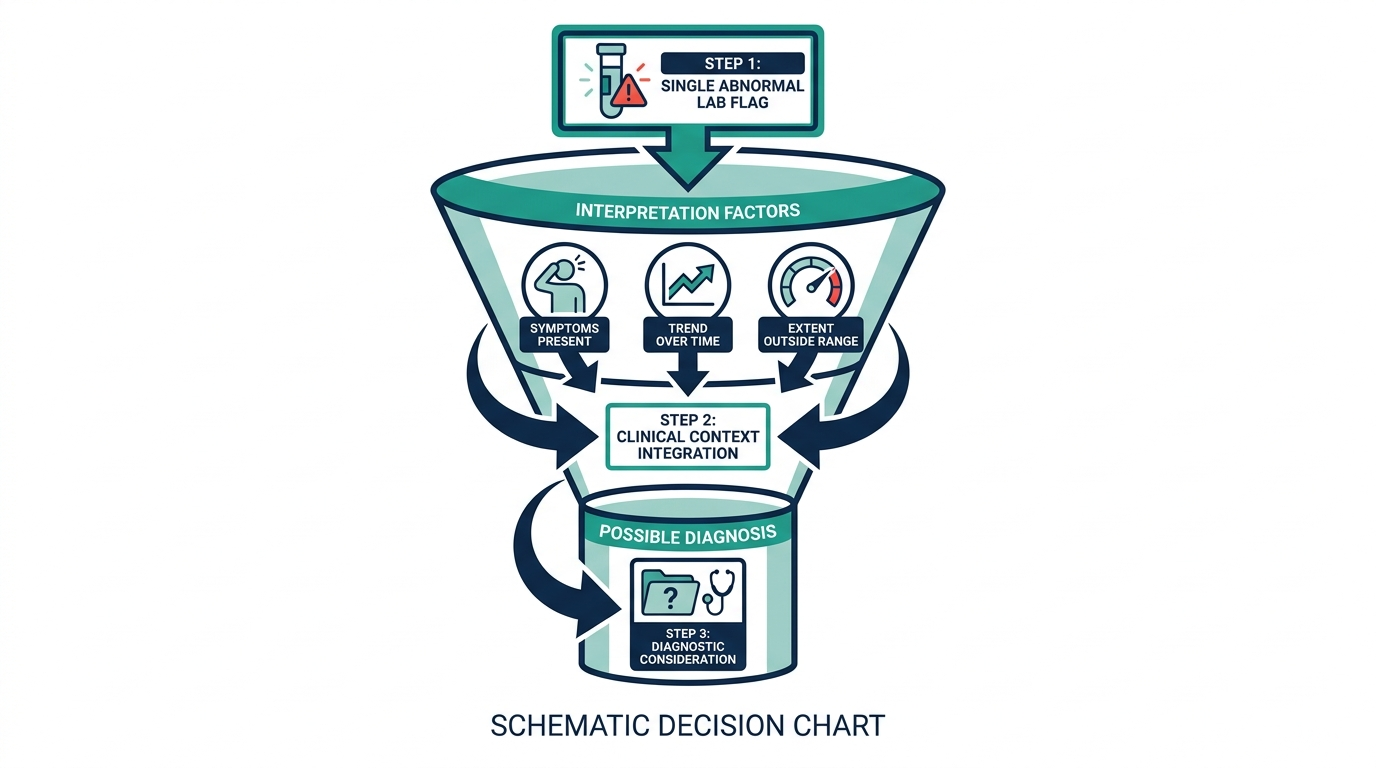
Yes, abnormal blood test results can be completely normal for you, and this is far more common than patients realize. A test result within a reference range is not always a guarantee of good health, and it is common for healthy people to sometimes have results outside the reference range (MedlinePlus). Normal and abnormal are not the same as healthy and sick.
There are whole categories of “abnormal that is fine.” A naturally high or low value that has been stable for years and tracks with your build or genetics. A flag driven by the lab’s particular range rather than yours, since a result that is normal at one lab can read abnormal at another. A number knocked off by a recent meal, workout, or dehydration. In these cases the right move is often not treatment but monitoring. If your results are out of the reference range, you may not need treatment, only monitoring (Cleveland Clinic).
Picture a common case. A healthy 34 year old runs a marathon on Sunday, gets routine labs on Monday, and sees three flags: elevated liver enzymes, a high creatine kinase, and a slightly raised white cell count. On paper it looks alarming. In context it is a textbook picture of hard muscular effort, not liver disease, and a repeat draw a week later after rest comes back clean. The numbers were real. The interpretation, not the flag, was the part that mattered.
What does abnormal on test results NOT tell you (the insider view)
Here is the insight that clinicians carry but rarely say out loud: the binary normal-or-abnormal flag is the least sophisticated way to read a lab report, and chasing isolated flags is how anxious patients and over-testing both get started. The number itself, where it sits, and where it has been over time matter far more than the yes or no flag.
Three things the abnormal label hides. First, it hides magnitude. A potassium one decimal past the edge and a potassium dangerously high both read “abnormal,” yet one is noise and the other is an emergency. Labs handle this with a separate tier called critical or panic values, results so far out they trigger an immediate call to your provider regardless of any flag. If no one is urgently phoning you, your abnormal is almost certainly not in that tier.
Second, it hides your personal baseline. Reference ranges are built from a crowd, not from you (NCBI, Interpreting Reference Ranges). A value that is average for the population could be a meaningful shift for a specific person, and a value flagged abnormal could be that person’s lifelong normal. This is why a single result in isolation is weak, and a trend across several tests is strong.
Third, it hides the reverse risk: false reassurance. Some people with real health problems have results that read perfectly normal (MedlinePlus). The absence of a flag is not a clean bill of health, just as the presence of one is not a diagnosis. The flag is a starting point for a conversation, never the conclusion of one.
The practical takeaway: do not panic at a flag, and do not relax completely at a clean page. Bring the actual numbers, and ideally your past results, to someone who can read them against your whole story.
What should I do if I get an abnormal result?
Do not self diagnose from the flag, and do contact your provider for context. An abnormal result is a reason to ask a question, not a reason to assume the worst. Your healthcare provider will let you know if you need further tests to determine the cause of an abnormal level (Cleveland Clinic).
A simple, calm sequence works best. Check the result against the reference range printed on your own report, not a range you found online, because you must use the range supplied by the lab that ran your test (MedlinePlus). Note how far outside the range you are and whether it is a first time or a pattern. Then ask your provider what the result means in your context and whether it needs a repeat test, monitoring, or nothing at all. If your test was part of a routine checkup, your provider may simply want to review results with you rather than because something is wrong (Cleveland Clinic).
Frequently asked questions
What does abnormal mean on test results?
It means the value fell outside the reference range, the band of results considered typical for healthy people. A result higher or lower than that range may or may not signal a health problem, and it is interpreted in the context of your overall health (MedlinePlus). Abnormal is a flag to look closer, not a diagnosis.
Are abnormal blood test results normal?
They can be. Because reference ranges keep the central 95 percent of healthy values, roughly 1 in 20 healthy people land outside the range on any single test purely by chance (NCBI, Interpreting Reference Ranges). Diet, hydration, activity, and medicines can also push numbers slightly off without any disease present (MedlinePlus).
What do abnormal blood results mean for my health?
On their own they mean a value sat outside the range and deserves context, not that you are sick. Results outside the reference range do not always mean something is wrong, and ranges vary by age, sex, and testing location (Cleveland Clinic). How far out the value is, the trend over time, and your symptoms decide what it actually means.
Can I be unwell with normal results?
Yes. A result within the reference range is not a guarantee of good health, and some people with health problems still test normal (MedlinePlus). This is why a clean lab page does not replace paying attention to symptoms or following up on concerns with your provider.
What should I do if my result is flagged abnormal?
Do not panic and do not self diagnose. Compare the value to the range on your own report, then ask your provider what it means in your context. Your provider will tell you whether you need further tests, monitoring, or nothing, and many slightly abnormal results need only monitoring (Cleveland Clinic).
How far outside the range is worrying?
There is no single cutoff, because it depends on the marker. A value a hair past the edge is often noise, while the same distance out on a tightly controlled marker can carry weight. Labs flag anything outside the range but reserve urgent calls for critical values that sit far beyond it. How far out the number is, whether it is trending, and how it fits your symptoms decide how much it matters.
Should I retest an abnormal result?
Often yes. Because ordinary factors like a recent meal, workout, illness, or dehydration can shift a value, a single flag is frequently rechecked before anyone acts on it. Your provider sets the timing, but a repeat test that comes back in range is one of the most common outcomes for a mild, symptom-free abnormal result (MedlinePlus).
This article is for general educational purposes and is not medical advice. It cannot diagnose or treat you and does not replace your clinician. Always discuss your lab results and any health decisions with a qualified healthcare professional.
Related reading
Vital Signs Today may earn a commission if you buy through links on this page. It does not affect our editorial assessments.