Part of our Comprehensive Metabolic Panel guide.
You got your blood work back, scanned past the cholesterol numbers, and stopped on two lines you have probably never thought about: creatinine and eGFR. One is a number with decimals. The other comes with a vaguely ominous label like “kidney function.” If your eyes glazed over, you are not alone. These two values are quietly one of the most important readouts of your long-term health, and most people have no idea what they actually mean.
Here is the part nobody tells you: creatinine and eGFR are not two separate tests. One is calculated from the other. Understanding that single fact changes how you read your own results.
What are eGFR and creatinine in plain English?
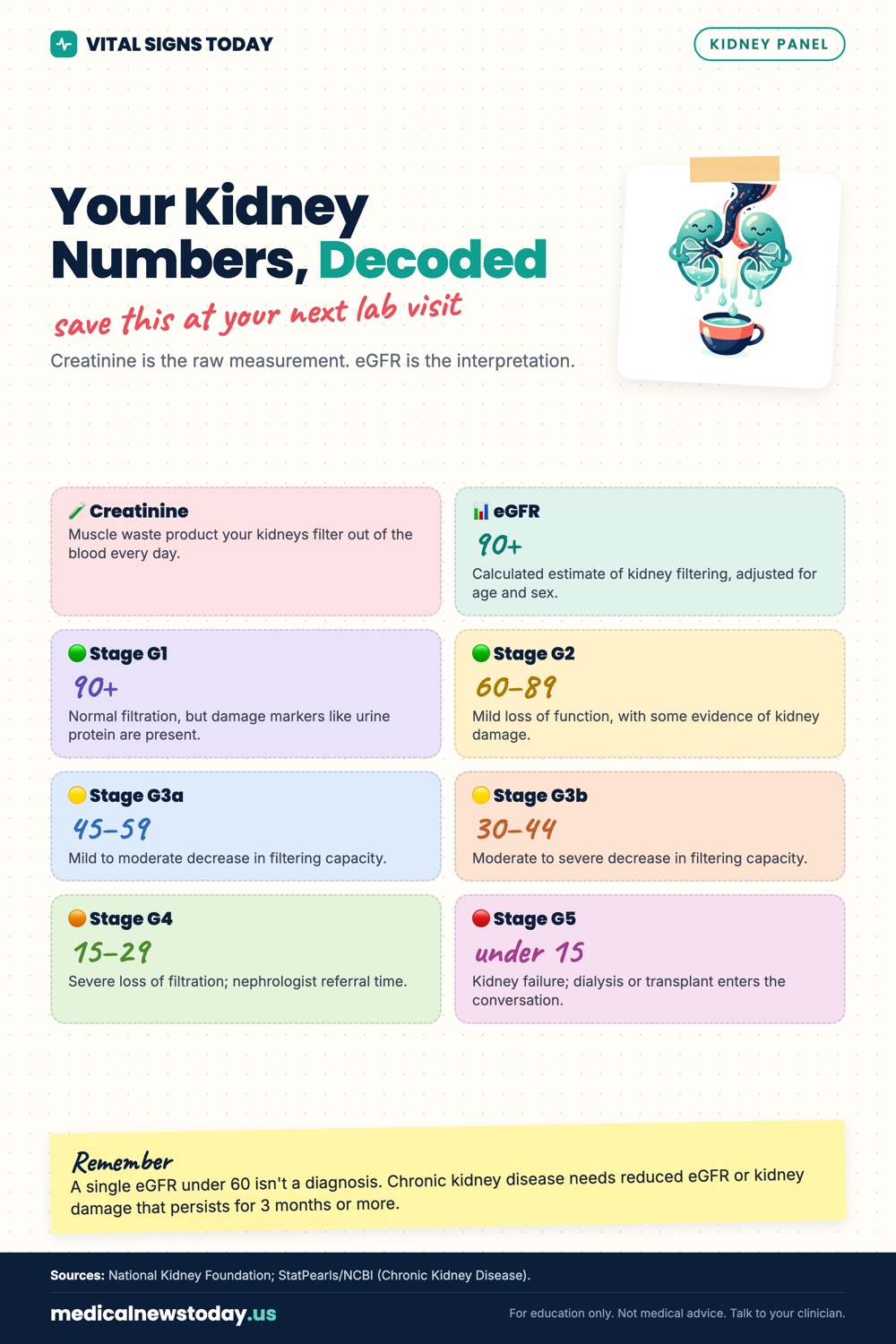
Creatinine is a waste product your muscles make every day, and your kidneys filter it out of your blood. eGFR (estimated glomerular filtration rate) is a calculation that uses your creatinine level, age, and sex to estimate how much blood your kidneys filter per minute. In short: creatinine is the raw measurement, eGFR is the interpretation. A normal adult eGFR is roughly 90 or higher.
How does creatinine actually relate to your kidneys?
Think of creatinine as exhaust. Your skeletal muscles burn through a compound called creatine phosphate for energy, and creatinine is the leftover by-product, produced at a fairly steady rate in proportion to your total muscle mass (National Kidney Foundation). Healthy kidneys pull it out of the bloodstream and dump it into your urine. So if creatinine starts piling up in your blood, it usually means the filters are slowing down.
That is the logic in one sentence: higher blood creatinine often signals lower kidney filtration. But “often” is doing a lot of work in that sentence, and this is exactly where most explainers stop and most people get misled.
Here is the catch a lot of patients never hear. Because creatinine comes from muscle, your muscle mass distorts the number. A heavily muscled 25-year-old powerlifter can run a creatinine that looks “high” with perfectly healthy kidneys. Meanwhile, a frail older adult with very little muscle, what clinicians call sarcopenia, can show a “normal” or even low creatinine while their kidneys are genuinely struggling. As one analysis put it bluntly, creatinine tells you what is happening with the kidneys only after you correct for what it is actually measuring, which is muscle mass (PMC, Creatinine and muscle mass cohort study). In sarcopenic elderly patients, an eGFR built from creatinine tends to overestimate real kidney function, which means it can quietly miss disease.
What is a normal creatinine and eGFR level?
There is no single magic creatinine number, and anyone who quotes one without caveats is oversimplifying. A normal creatinine level shifts with age, sex, body size, and muscle mass, and some people sitting inside the “normal” reference range still have kidney disease (National Kidney Foundation). That is precisely why labs do not ask you to interpret creatinine alone. They feed it into the eGFR equation, which already adjusts for age and sex.
For eGFR, the landmarks are cleaner:
- 90 or above: generally normal kidney function in adults (National Kidney Foundation).
- Below 60: a sign the kidneys may not be filtering properly, especially if it persists.
- Below 15: a marker of kidney failure, often the point where dialysis or transplant enters the conversation.
One crucial nuance: a single eGFR below 60 is not a diagnosis. Chronic kidney disease (CKD) requires either an eGFR under 60 or evidence of kidney damage such as protein in the urine, and it has to persist for at least three months (StatPearls, Chronic Kidney Disease). A one-off low reading after a hard workout, dehydration, or a protein-heavy meal is not the same as CKD.
What do the CKD stages based on eGFR mean?
The global standard, the 2012 KDIGO classification, sorts kidney function into six categories by eGFR (StatPearls):
- Stage G1: eGFR 90 or higher, with some evidence of kidney damage.
- Stage G2: eGFR 60 to 89, mild loss of function with damage present.
- Stage G3a: eGFR 45 to 59, mild to moderate decrease.
- Stage G3b: eGFR 30 to 44, moderate to severe decrease.
- Stage G4: eGFR 15 to 29, severe loss of filtration.
- Stage G5: eGFR under 15, kidney failure.
Notice that stages G1 and G2 still require signs of damage like albuminuria to count as disease, because a high eGFR alone is healthy. The staging is not just academic. It is how clinicians decide when to adjust medications, when to refer to a nephrologist, and how aggressively to protect what kidney function remains.
Why did eGFR calculations change in 2021?
This is the update that quietly affected millions of lab reports, and most patients never heard about it. For more than two decades, the standard eGFR equation included a “race coefficient” that adjusted results upward for Black patients, based on older data suggesting they had higher average creatinine levels (PMC, 2021 CKD-EPI race-free equations review).
In 2021, a joint task force from the National Kidney Foundation and the American Society of Nephrology recommended scrapping that race variable entirely. The new race-free CKD-EPI 2021 creatinine equation is now the recommended standard for eGFR reporting in the United States (Clinical Chemistry, NKF Laboratory Engagement Working Group). The practical effect: for the same creatinine value, the new equation estimates a slightly lower eGFR for Black patients and a slightly higher one for non-Black patients. For most people the change is small, but in some cases, particularly at higher eGFR values and younger ages, results can shift by more than 10% (National Kidney Foundation). If you compare an old report to a recent one and the number moved without any change in your health, this is likely why.
When is creatinine the wrong tool, and what is better?
Because creatinine is hostage to muscle mass, there is a second filtration marker that sidesteps the problem: cystatin C. It is a protein made at a steady rate by virtually all cells in your body, and crucially it is not meaningfully affected by muscle mass, diet, or nutrition (New England Journal of Medicine). That makes cystatin C especially useful for older adults at risk of sarcopenia, where creatinine alone can flatter the kidneys and hide real decline.
The National Kidney Foundation now notes that an eGFR calculated from both creatinine and cystatin C together is more accurate than either marker alone (National Kidney Foundation). Cystatin C is often used as a confirmatory test when a creatinine-based eGFR comes back borderline. If your number is sitting near the line and you want a clearer picture, this is a reasonable test to ask your clinician about.
If you are the type who tracks your own biomarkers over time, eGFR and creatinine pair naturally with other longevity-relevant labs. For broader context on reading your own panels, see our overview of biomarkers explained.
Frequently asked questions
Does a single high creatinine mean I have kidney disease?
No. Creatinine can spike temporarily from dehydration, intense exercise, or a high-protein meal. Chronic kidney disease requires reduced eGFR or kidney damage that persists for at least three months, confirmed on repeat testing (StatPearls).
Can I have normal creatinine but still have kidney problems?
Yes. Some people inside the normal creatinine range still have kidney disease, and adults with low muscle mass can show normal creatinine despite declining function (National Kidney Foundation). That is one reason eGFR and urine testing matter more than creatinine alone.
Why did my eGFR change when my creatinine stayed the same?
The 2021 switch to the race-free CKD-EPI equation changed how eGFR is calculated, so the same creatinine value can now produce a different eGFR than it did before 2021 (National Kidney Foundation).
What eGFR is considered kidney failure?
An eGFR below 15 is the standard marker of kidney failure and often signals the need to discuss dialysis or transplant, while an eGFR below 60 is the threshold for possible CKD (National Kidney Foundation).
Is cystatin C better than creatinine?
Not better in every case, but complementary. Cystatin C is not affected by muscle mass, so it is especially useful in older adults, and combining it with creatinine gives the most accurate eGFR (National Kidney Foundation).
This article is for general educational purposes and is not medical advice. Always discuss your lab results and any health decisions with a qualified clinician.