
Disclosure: Vital Signs Today may earn a commission if you buy through links on this page, at no extra cost to you. This does not influence our evidence-based assessments. We are not a medical provider; talk to a clinician before acting on test results.
Related: calcium blood test: the full guide · How to bring calcium back into range
You scanned your blood work, expecting the usual reassuring run of normal flags, and one line stopped you. Calcium, slightly above the range, maybe with a little asterisk next to it. Your mind probably jumped straight to bones, or milk, or that calcium supplement you have been taking. Here is what almost nobody tells you up front: the calcium number on your report has very little to do with your diet, and a genuinely high reading is one of the more meaningful abnormal results a routine panel can turn up.
The good news is that most high calcium is mild, slow, and very treatable. The catch is that it rarely makes you feel sick until it climbs, so it often goes unnoticed for years.
Part of our Comprehensive Metabolic Panel guide.
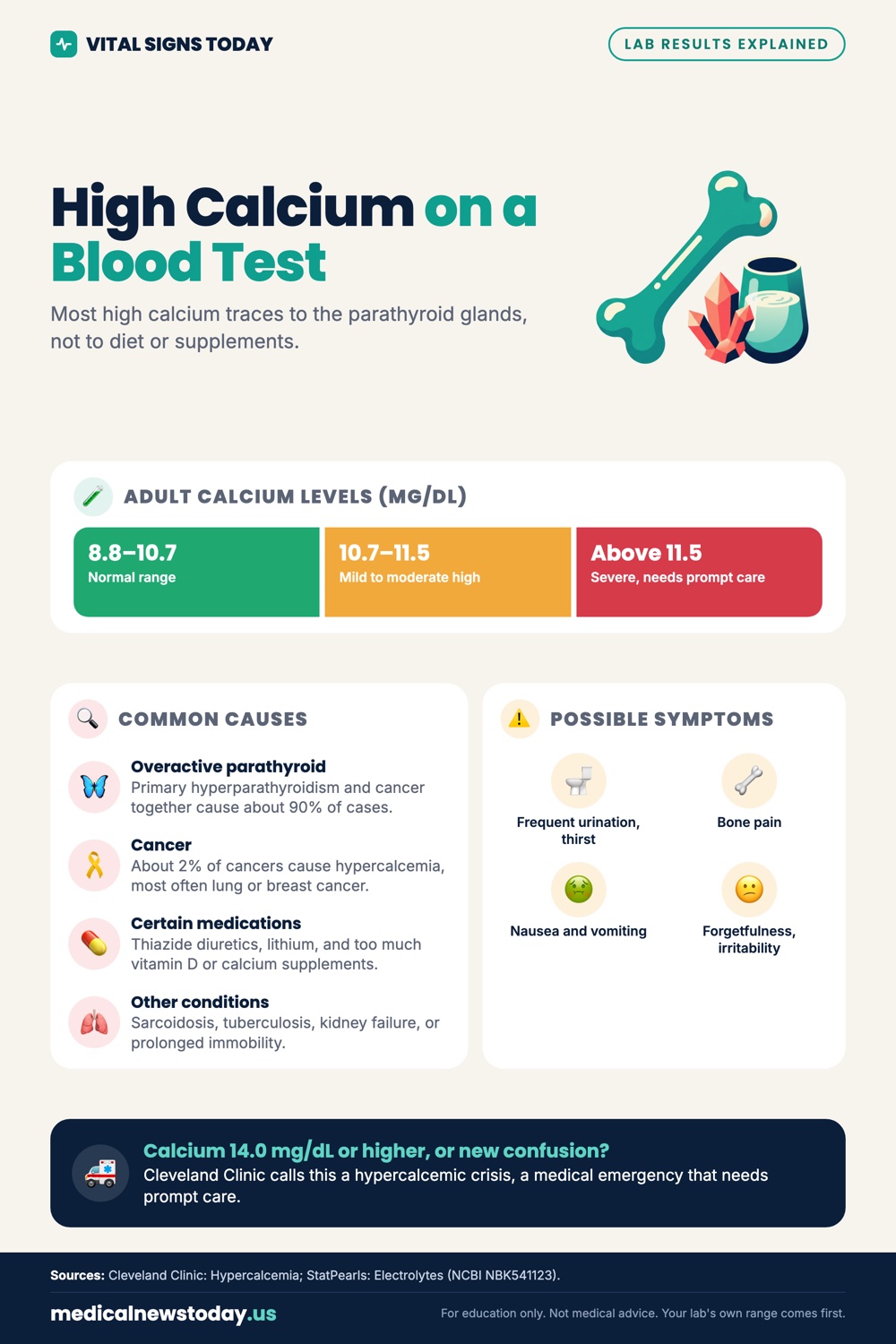
What does high calcium mean in a blood test?
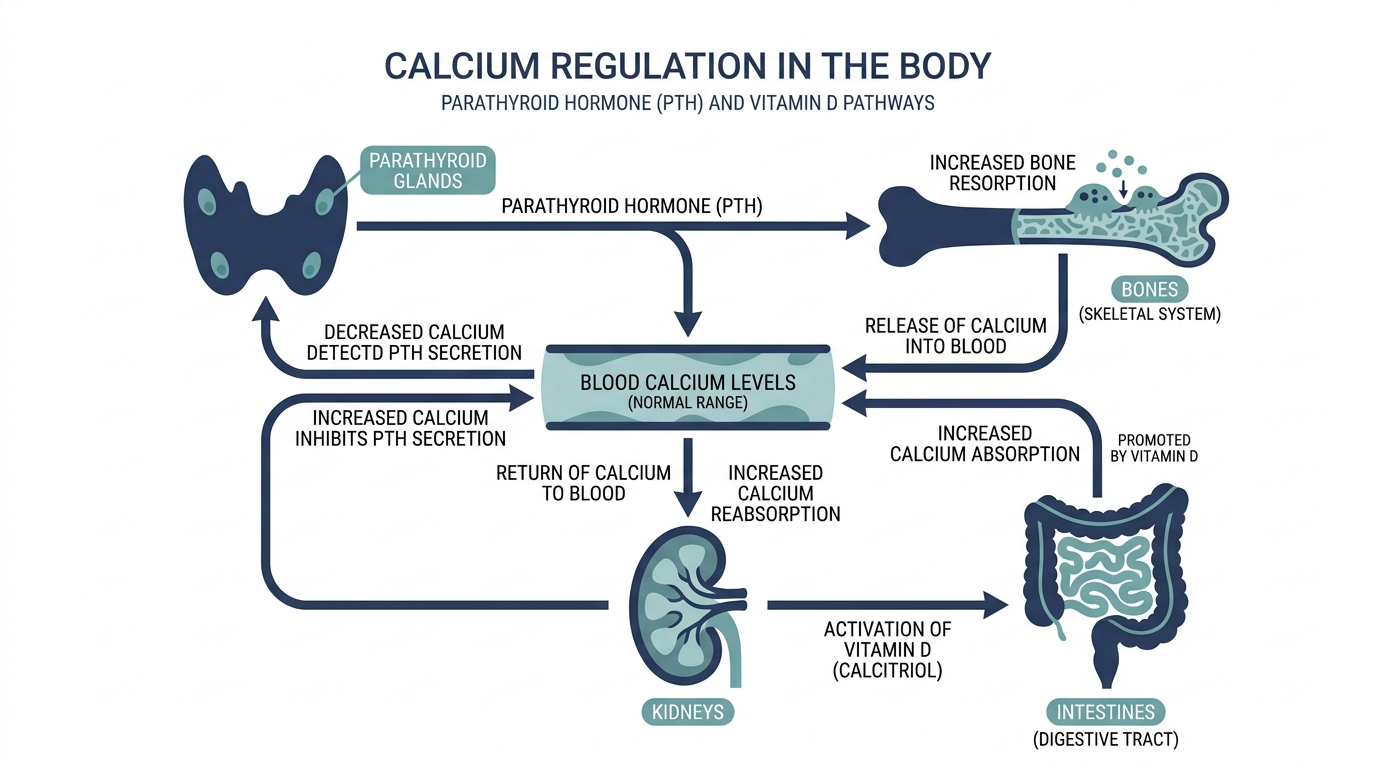
A high calcium in a blood test, the condition doctors call hypercalcemia, means there is more calcium circulating in your bloodstream than your body should normally allow. For most adults the normal total calcium range is roughly 8.5 to 10.2 mg/dL (Cleveland Clinic). A result above about 10.5 mg/dL is generally what counts as high (StatPearls, NCBI Bookshelf).
Here is the part people get backwards. Less than one percent of your body’s calcium is in your blood. The vast majority is locked in your bones. So a high blood calcium is not a sign that you are eating too much calcium. It is a sign that something is moving calcium out of your bones, or out of your gut, into your blood faster than your kidneys can clear it. That something is what your doctor is actually trying to find. The number is the smoke. The cause is the fire.
Clinicians grade how high it is, because the level changes how urgent the situation is (Cleveland Clinic):
- Mild: 10.5 to 11.9 mg/dL. Often found by accident, frequently no symptoms.
- Moderate: 12.0 to 13.9 mg/dL. Symptoms become more likely.
- Hypercalcemic crisis: 14.0 to 16.0 mg/dL. A medical emergency.
One single mildly high reading is common and often does not even repeat on a recheck. A clearly elevated number, or a mildly high one that keeps showing up, is what deserves a real workup.

What causes a high calcium?
This is where the diagnosis lives, and the honest answer is that two causes account for the overwhelming majority. Roughly 90 percent of all hypercalcemia comes down to just two things: overactive parathyroid glands and cancer (StatPearls, NCBI Bookshelf). The rest of the list is real but far less common.
In rough order of how often they turn up:
- Primary hyperparathyroidism. This is the single most common cause of high calcium found on routine outpatient blood work (MedlinePlus). One of your four tiny parathyroid glands, usually because of a benign growth, starts pumping out too much parathyroid hormone, which pulls calcium out of your bones and into your blood. It is typically mild, slow, and entirely fixable, often with a small surgery (Cleveland Clinic).
- Cancer. The second big cause, and the one that drives urgency. Several cancers can raise calcium, including lung cancer, breast cancer, multiple myeloma, kidney cancer, leukemia, and lymphoma (Cleveland Clinic). Cancer-related hypercalcemia tends to come on faster and higher, usually in someone already known to have cancer.
- Too much vitamin D or calcium intake. Megadosing vitamin D supplements, or taking very large amounts of calcium over time, can push levels up (MedlinePlus).
- Certain medications. Thiazide diuretics (common blood pressure pills) and lithium are the classic offenders (Cleveland Clinic).
- Granulomatous diseases. Conditions like sarcoidosis and tuberculosis can raise calcium through abnormal vitamin D activity (Cleveland Clinic).
- Prolonged immobility and kidney disease. Being bedbound for a long stretch, and some kidney conditions, can also contribute.
The pattern doctors carry in their heads: mild, long-standing, symptom-free high calcium in an otherwise healthy person is usually the parathyroid. A number that appeared quickly, climbed fast, or showed up alongside weight loss or known cancer gets investigated urgently.
What are the symptoms of a high calcium?
Most people with mild hypercalcemia have no symptoms at all, which is exactly why it is so often caught by accident on a routine panel (MedlinePlus). Your body tolerates a small excess quietly. Symptoms tend to show up as the level climbs higher.
When they do appear, doctors remember them with an old teaching phrase: stones, bones, groans, and psychiatric overtones. In plain language (Cleveland Clinic):
- Stones. Kidney stones, plus more frequent urination and increased thirst as your kidneys try to flush the excess.
- Bones. Bone pain and, over the long term, weaker bones.
- Groans. Stomach upset: nausea, vomiting, constipation, and poor appetite.
- Psychiatric overtones. Fatigue, brain fog, forgetfulness, depression, irritability, and in severe cases confusion.
These symptoms get missed for years because they are so generic. Tired, a bit constipated, drinking more water, not quite sharp. Plenty of people chalk that up to stress or aging and never connect it to a calcium number quietly drifting up on every test.
When is a high calcium dangerous or a medical emergency?
The level is what determines danger. A calcium of 14.0 mg/dL or higher is considered a hypercalcemic crisis and is a medical emergency that usually requires immediate hospitalization for IV fluids and other treatment (Cleveland Clinic). At that level the heart rhythm, kidneys, and brain can all be affected.
The red flags that should prompt urgent care, especially when paired with a high calcium result, are confusion or marked drowsiness, severe nausea and vomiting, extreme thirst with very frequent urination, an irregular or racing heartbeat, and severe weakness (Merck Manual). Very severe hypercalcemia can progress to delirium and even coma.
The takeaway: a mildly high calcium with no symptoms is not an emergency, and you do not need to panic over a single 10.6. But high calcium plus new confusion, vomiting, or a pounding heart is a reason to be seen the same day, not next week.

What should you do about a high calcium?
First, do not assume the number is even real until it is confirmed. The standard sequence after a high reading is straightforward.
- Repeat the test. A single mildly elevated calcium is often rechecked, sometimes fasting and without a recent calcium supplement, to confirm it is genuinely high.
- Check parathyroid hormone (PTH). This is the single most important next test, because it splits the diagnosis in two. If PTH is high or even just inappropriately normal while calcium is high, that points to hyperparathyroidism. If PTH is suppressed, that points away from the parathyroid and toward causes like cancer or vitamin D excess (StatPearls, NCBI Bookshelf).
- Add vitamin D and kidney function, and review your medication and supplement list. Thiazide diuretics, lithium, and high-dose vitamin D are common, fixable contributors.
What you can do on your own while this is being sorted out: stay well hydrated, which helps your kidneys clear calcium, and pause any non-prescribed calcium or high-dose vitamin D supplements until you talk to your clinician. Do not stop a prescribed medication on your own.
Whether you need treatment depends entirely on the cause and the level. Mild hyperparathyroidism may simply be monitored, or treated with a minor surgery to remove the overactive gland (Cleveland Clinic). Cancer-related hypercalcemia is treated with medications like bisphosphonates or denosumab alongside treating the underlying cancer (Cleveland Clinic). Drug-induced cases often resolve once the medication is changed.
When should you see a doctor?
Any confirmed high calcium result deserves a conversation with your clinician, even if you feel completely fine, because the most common cause, hyperparathyroidism, is usually silent and still worth treating to protect your bones and kidneys over time (Cleveland Clinic).
See a doctor promptly if your calcium is clearly high, if it has been creeping up across several tests, or if you have symptoms like kidney stones, bone pain, unusual fatigue, or stubborn constipation. Seek urgent or emergency care if you have a very high reading together with confusion, persistent vomiting, severe weakness, or an irregular heartbeat.
The insider point: your calcium number may be wrong, and almost no patient knows it
Here is the clinical nuance that gets missed constantly. About 45 percent of the calcium in your blood is bound to a protein called albumin (StatPearls, NCBI Bookshelf). The standard test, total calcium, measures both the bound and the free calcium together. The problem is that only the free, unbound calcium is biologically active, and your albumin level can shift the total number without your true calcium status changing at all.
This cuts both ways. If your albumin is low, which is common in older adults, hospitalized patients, and people with chronic illness, your total calcium can read falsely low and hide a real hypercalcemia. If your albumin is high, the total can read falsely high. This is why clinicians use a corrected calcium calculation that adjusts for albumin, or order an ionized calcium test, which measures only the active free calcium directly (Cleveland Clinic).
The practical lesson: do not over-read a borderline total calcium in isolation, and do not assume a normal total fully rules out a problem if your albumin is abnormal. A good workup reads calcium and albumin together, and when in doubt measures the ionized calcium. Many mildly abnormal results are simply albumin artifacts, and some real problems hide behind a normal-looking total. This one detail is the difference between chasing a phantom and catching something real.

The PTH fork: how one follow-up test sorts almost every case
Once a high calcium is confirmed and corrected for albumin, nearly the entire diagnosis turns on a single test, parathyroid hormone. PTH is the hormone that raises blood calcium, so its behavior when calcium is already high tells you whether the parathyroid glands are the problem or an innocent bystander. This is the decision tree a clinician runs.
- High calcium with high or inappropriately normal PTH. The glands should be shutting down when calcium is high. If they are not, they are the driver. This is primary hyperparathyroidism, the most common outpatient cause. It is usually mild, slow, and curable.
- High calcium with low, suppressed PTH. The glands are correctly switched off, which means something else is pushing calcium up. Attention shifts to cancer, excess vitamin D, granulomatous disease, or certain medications. A suppressed PTH with a fast-rising calcium is the pattern that prompts an urgent look for malignancy.
When PTH is suppressed, the next tests often include a PTH-related protein (PTHrP), which some cancers make, and vitamin D metabolites, to separate a cancer effect from vitamin D excess or a granulomatous disease like sarcoidosis. This orderly branching is why the PTH result is worth waiting for before drawing any conclusions.
The panel that surrounds a high calcium
| Companion test | What it adds to a high calcium |
|---|---|
| Albumin | Corrects the total calcium. A high or low albumin can shift the number without any true change in active calcium. |
| Ionized calcium | Measures only the active free calcium directly, bypassing the protein problem. The tiebreaker when the total is borderline. |
| Parathyroid hormone (PTH) | The master switch that splits the diagnosis into parathyroid versus non-parathyroid causes. |
| Phosphorus | Often low in hyperparathyroidism, since PTH makes the kidneys dump phosphorus. A high calcium with low phosphorus supports a parathyroid cause. |
| Vitamin D and PTHrP | Sort out vitamin D excess, granulomatous disease, and cancer when PTH is suppressed. |
| Creatinine and eGFR | High calcium can injure the kidneys, and kidney disease can also contribute to calcium problems. |
Want to check your calcium?
Three ways to get it measured. Pick whichever fits you.
Affiliate links: we may earn a commission at no extra cost to you. A lab test does not replace a visit with your clinician.
Reading the pattern: worked scenarios
- Calcium 10.8, no symptoms, high PTH, low phosphorus, found on routine labs. The classic primary hyperparathyroidism picture. Often monitored, sometimes cured with a minor parathyroid surgery.
- Calcium 13.5, rising fast, suppressed PTH, weight loss, known or suspected cancer. Points to cancer-related hypercalcemia. Urgent evaluation and treatment.
- Calcium 10.7 in someone taking a thiazide diuretic or lithium. Often medication-related. The clinician reviews whether the drug can be changed, then rechecks.
- Calcium 11.0 with a history of high-dose vitamin D supplements, suppressed PTH, high vitamin D level. Vitamin D excess. Stopping the supplement and hydrating usually corrects it.
- Calcium 10.6 total but albumin low. May actually be a truly elevated ionized calcium hidden by low protein, or the reverse. Correct or measure ionized calcium before deciding.

How the test is done and what can skew it
Calcium is measured from a routine venous draw as part of a basic or comprehensive metabolic panel. For a plain total calcium you do not usually need to fast, though a recheck is sometimes done fasting and after pausing calcium supplements. Factors that can push the reading up or make it look higher than the true active level include:
- Dehydration, which concentrates the blood and raises calcium and albumin together.
- Prolonged tourniquet time or fist pumping, which concentrates protein-bound calcium in the vein.
- High albumin, which lifts the total even when active calcium is normal.
- Recent high-dose vitamin D or large calcium supplement intake.
- Prolonged immobilization or bed rest, which releases calcium from bone.
Because of these effects, a single mildly high value is frequently rechecked before any workup, and it often does not repeat.
Why a mild high calcium still deserves attention
It is tempting to shrug off a symptom-free 10.7, but the most common cause, hyperparathyroidism, does slow, quiet damage over years even when you feel fine. The excess parathyroid hormone steadily pulls calcium out of bone, which can weaken the skeleton and raise fracture risk over time, and the extra calcium the kidneys must handle can promote kidney stones and, eventually, reduced kidney function. This is why clinicians treat or at least monitor confirmed hyperparathyroidism rather than ignoring a mild number. The point of catching it early is precisely to prevent the stones and bone loss before they happen, not to react after damage is done.
Common misconceptions about high calcium
- “High blood calcium means I take too much calcium.” Diet is rarely the cause. Most of your calcium is in bone, and a high blood level usually reflects a parathyroid or other internal driver.
- “If I feel fine, it does not matter.” Mild hypercalcemia is often silent while quietly affecting bones and kidneys. It still warrants evaluation.
- “A high calcium means cancer.” Cancer is a major cause, but in healthy outpatients found on routine labs, an overactive parathyroid gland is more common and usually benign.
- “One high reading is a diagnosis.” A single mildly high value is often an artifact or does not repeat. Confirmation and PTH testing come first.
- “Total calcium always tells the truth.” It is skewed by albumin. Correcting for albumin or measuring ionized calcium is what reveals the real level.
Who should have calcium checked, and how often
Total calcium is included by default on the metabolic panels most adults get at routine visits, so many high results are found by accident. Closer attention or repeat testing makes sense for:
- People with kidney stones or unexplained bone loss, where hyperparathyroidism is a treatable culprit worth ruling out.
- Anyone with a known cancer, where a rising calcium can signal disease activity.
- People on thiazide diuretics, lithium, or high-dose vitamin D, which can raise calcium.
- Those with a previously high or slowly climbing calcium, who need repeat testing and a PTH to define the cause.
- Anyone with the classic symptom cluster, stones, bone pain, digestive upset, or mood and memory changes.
The recurring principle is that a high calcium is a starting point, not a conclusion. Confirm it, correct it for albumin, and let the PTH result guide the branch. Read that way, a slightly high number on a routine panel becomes one of the more rewarding findings in medicine, because the leading cause is common, quiet, and genuinely fixable.
Frequently asked questions
What level of calcium is considered high in a blood test?
The normal total calcium range for most adults is about 8.5 to 10.2 mg/dL, and a result above roughly 10.5 mg/dL is generally considered high (Cleveland Clinic). Always compare your result to the reference range printed on your own lab report, since ranges vary slightly by laboratory.
What is the most common cause of high calcium?
In otherwise healthy people found on routine blood work, the most common cause is primary hyperparathyroidism, an overactive parathyroid gland. Together with cancer, it accounts for about 90 percent of all hypercalcemia (StatPearls, NCBI Bookshelf).
Can high calcium be caused by taking too much calcium?
It usually is not from diet alone, because most of your body’s calcium is in your bones, not your blood. However, taking very large amounts of calcium or high-dose vitamin D supplements over time can raise your blood calcium (MedlinePlus). Most high calcium comes from a parathyroid or other internal cause rather than what you eat.
Is a high calcium result dangerous?
It depends on the level. Mild hypercalcemia often causes no symptoms, but a calcium of 14.0 mg/dL or higher is a hypercalcemic crisis and a medical emergency requiring immediate treatment (Cleveland Clinic). Seek urgent care if a high reading comes with confusion, vomiting, or an irregular heartbeat.
What test do doctors order after finding high calcium?
The key follow-up test is parathyroid hormone (PTH). A high or inappropriately normal PTH points to hyperparathyroidism, while a suppressed PTH points toward other causes such as cancer or vitamin D excess (StatPearls, NCBI Bookshelf). Doctors often also check vitamin D, kidney function, and review your medications.
This article is for general educational purposes and is not medical advice. It cannot diagnose or treat you and does not replace your clinician. Always discuss your lab results and any health decisions with a qualified healthcare professional.
Vital Signs Today may earn a commission if you buy through links on this page. It does not affect our editorial assessments.