
Disclosure: Vital Signs Today may earn a commission if you buy through links on this page, at no extra cost to you. This does not influence our evidence-based assessments. We are not a medical provider; talk to a clinician before acting on test results.
You scanned your metabolic panel, the sodium looked fine, the potassium looked fine, and then you hit chloride sitting just over the top of its range. It does not get the attention sodium or potassium gets, so most people either panic or ignore it. Neither is the right move. Chloride is the quiet workhorse of your blood chemistry, and when it runs high it is rarely the problem itself. It is usually pointing at something else.
Here is the useful way to think about it. A high chloride is almost never a disease on its own. It is a signpost. The skill is reading where the signpost points, and that is what this article will walk you through.
Part of our Comprehensive Metabolic Panel guide.
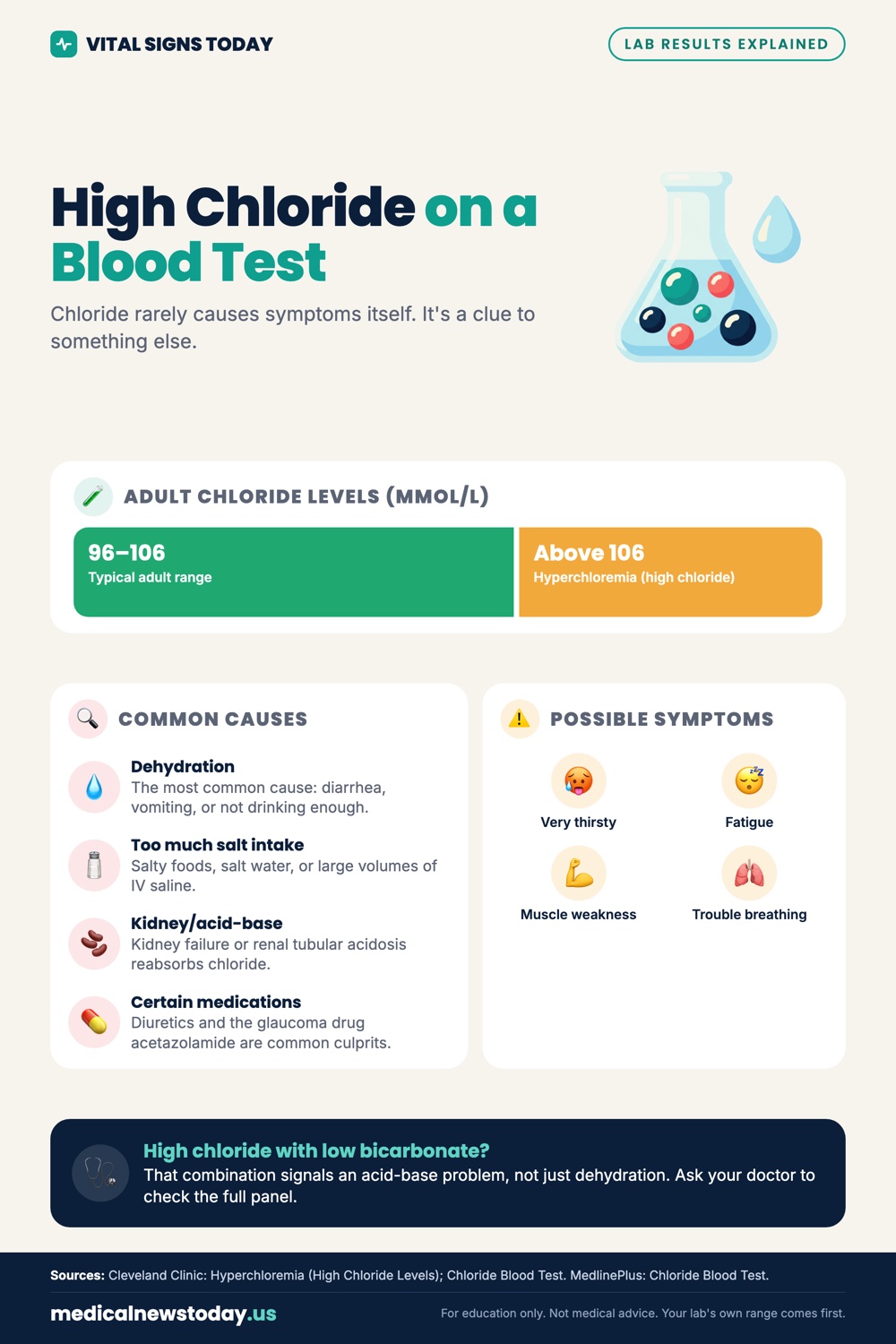
What does high chloride mean in a blood test?
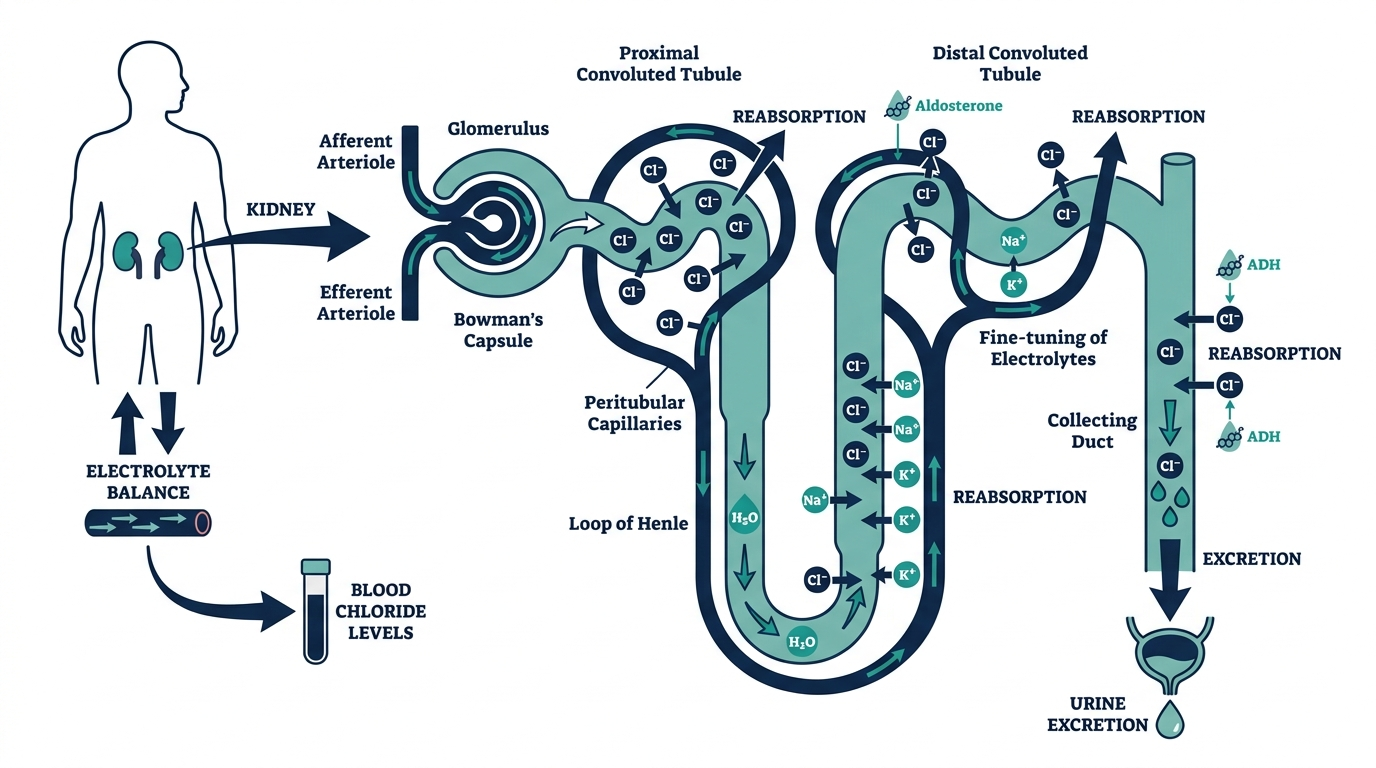
A high chloride means you have more of the electrolyte chloride circulating in your blood than normal, a state doctors call hyperchloremia. Chloride is the negatively charged partner to sodium, and together they help control your fluid balance, blood volume, and the acid-base (pH) balance of your blood (MedlinePlus). When chloride climbs, it usually means you are either short on water, taking in too much salt, or your body is shifting chloride to compensate for a change in acid balance.
The number that counts as high is straightforward. A typical normal adult chloride range is 96 to 106 milliequivalents per liter (mEq/L), which is the same as 96 to 106 millimoles per liter (mmol/L) (Cleveland Clinic). Anything above the top of your lab’s printed range is hyperchloremia. Always read your result against the reference range on your own report, because it varies slightly by lab and instrument.
One thing to hold onto from the start: chloride is almost never measured by itself. It rides along inside a basic metabolic panel (BMP), comprehensive metabolic panel (CMP), or electrolyte panel (Cleveland Clinic). That matters, because chloride only becomes meaningful when you read it next to sodium and bicarbonate. A high chloride in isolation tells you very little. A high chloride with a low bicarbonate tells you a great deal.

What causes a high chloride?
The differential for hyperchloremia is shorter and more practical than it looks. Most cases trace back to one of three buckets, and dehydration is by far the most common (Cleveland Clinic).
- Dehydration. This is the everyday cause. When you lose water faster than you lose electrolytes, chloride concentrates in what fluid is left. Vomiting, diarrhea, heavy sweating, fever, and simply not drinking enough all push chloride up. Sodium usually rises alongside it (Cleveland Clinic).
- Too much salt or saline. A genuinely high salt intake, swallowing seawater, or receiving large volumes of intravenous saline in a hospital can all load the blood with chloride (Cleveland Clinic).
- Acid-base and kidney problems. This is the medically important bucket. In hyperchloremic metabolic acidosis, bicarbonate is lost and chloride rises to take its place, keeping the blood electrically balanced. The usual drivers are severe diarrhea, renal tubular acidosis, and carbonic anhydrase inhibitor medications such as acetazolamide (StatPearls, NCBI Bookshelf). Chronic kidney disease can also let chloride build up.
Less common causes worth a mention include Cushing’s syndrome and respiratory alkalosis, both of which can nudge chloride upward (Cleveland Clinic). But if you are an otherwise healthy person looking at a mildly high chloride, dehydration is the overwhelming favorite, and a glass of water on the morning of your draw might have changed the number.
What are the symptoms of a high chloride?
Here is the part that surprises people: hyperchloremia itself usually causes no symptoms at all. It is almost always found on a routine blood test rather than because someone felt unwell from it (Cleveland Clinic).
When symptoms do appear, they belong to the underlying cause, not to the chloride number. If dehydration is driving it, you may feel thirsty, tired, and notice your urine is dark. If an acid-base disturbance is behind it, you might experience fatigue, muscle weakness, swelling, high blood pressure, or trouble breathing as the body tries to compensate (Cleveland Clinic). The practical lesson is that you cannot feel your chloride. So if it is high, the question is never “how do I make the symptom go away,” it is “what is this number a symptom of.”
When is a high chloride dangerous or a medical emergency?
A chloride that is a point or two over the top of the range, with a normal bicarbonate and you feeling fine, is rarely an emergency. It often reflects mild dehydration or even the timing of your blood draw. The danger lives not in the chloride number alone but in what it is attached to.
The combination that should get attention is a high chloride with a low bicarbonate, which signals hyperchloremic metabolic acidosis, an actual acid-base disturbance rather than a lab quirk (StatPearls, NCBI Bookshelf). Left unaddressed, the conditions that cause persistently high chloride, particularly kidney disease and ongoing acid-base imbalance, can progress to serious complications including kidney failure, kidney stones, and effects on the heart, bones, and muscles (Cleveland Clinic).
Seek urgent care if a high chloride comes packaged with red-flag symptoms: confusion or extreme drowsiness, rapid or labored breathing, a racing or irregular heartbeat, severe or relentless vomiting and diarrhea, or signs of severe dehydration such as dizziness on standing and barely passing urine. Those are signals that the body is decompensating, and the chloride is just the visible edge of it.

What should you do about a high chloride?
The first move is the least dramatic and the most useful: do not interpret chloride alone. Look at it next to your sodium and your bicarbonate (sometimes labeled CO2 on the panel). If sodium is high too, you are likely looking at dehydration. If bicarbonate is low, your clinician will be thinking about an acid-base cause and may calculate your anion gap to sort out which kind (StatPearls, NCBI Bookshelf).
For a mild, isolated elevation in an otherwise healthy person, the practical steps are modest (Cleveland Clinic):
- Drink enough water. Correcting simple dehydration often resolves a mild hyperchloremia on its own.
- Ease up on salt. Cut back on heavily salted and processed foods, and go easy on alcohol and caffeine, which can worsen dehydration.
- Review your medications. Some drugs, including acetazolamide and certain others, can raise chloride. Never stop a prescribed medication on your own, but do ask your clinician whether any of yours could be a factor.
- Repeat the test. A single mildly abnormal result is often best confirmed with a repeat draw, ideally well-hydrated, before anyone goes hunting for rarer causes.
When the cause is medical, treatment targets that cause rather than the chloride number. Kidney-related hyperchloremia is managed with a nephrologist, and acid-base disturbances are treated by fixing the process that is consuming bicarbonate (Cleveland Clinic).
When should you see a doctor?
If your chloride is flagged high, the result deserves a conversation with the clinician who ordered it, even when you feel perfectly well. That is doubly true if the elevation is more than mild, if it shows up alongside a low bicarbonate or an abnormal sodium, or if you have known kidney disease, diabetes, or take diuretics. A persistent or worsening high chloride across more than one test is a clear reason to dig deeper (MedlinePlus).
And again, do not wait on a routine appointment if a high chloride arrives with confusion, breathing trouble, an irregular heartbeat, or severe dehydration. Those symptoms point to the underlying disturbance becoming dangerous, and that needs prompt evaluation.
The insider read: why a high chloride is sometimes the lab, sometimes the IV bag, and sometimes the most honest number on the panel
Here is the nuance that separates how a chemistry-literate clinician reads chloride from how the patient version describes it. The single most overlooked cause of a high chloride in a hospital setting is the saline drip itself. Large-volume resuscitation with normal saline, which is 0.9% sodium chloride, floods the blood with chloride ions and can drive a hyperchloremic metabolic acidosis that is entirely iatrogenic, meaning the treatment caused it (StatPearls, NCBI Bookshelf). A chloride that climbed after a day on IV fluids is telling a completely different story than one that was high on a fasting outpatient draw, and conflating the two leads people down the wrong path.
The second insider habit is refusing to read chloride without the anion gap. The anion gap is calculated as sodium minus the sum of bicarbonate and chloride, and a normal value sits around 8 to 16 mEq/L (StatPearls, NCBI Bookshelf). Hyperchloremic metabolic acidosis is the classic normal anion gap acidosis: bicarbonate falls, chloride rises to fill the electrical gap, and the gap stays narrow. That single calculation separates the relatively benign causes, like diarrhea and saline, from acid-base problems that need real work. A high chloride paired with a normal gap and a low bicarbonate is the body doing exactly what it should to stay electrically neutral, which is why chloride is sometimes the most honest, least dramatic number on the whole panel. It is just keeping the books balanced for whatever else is happening.

Where chloride comes from and what it does
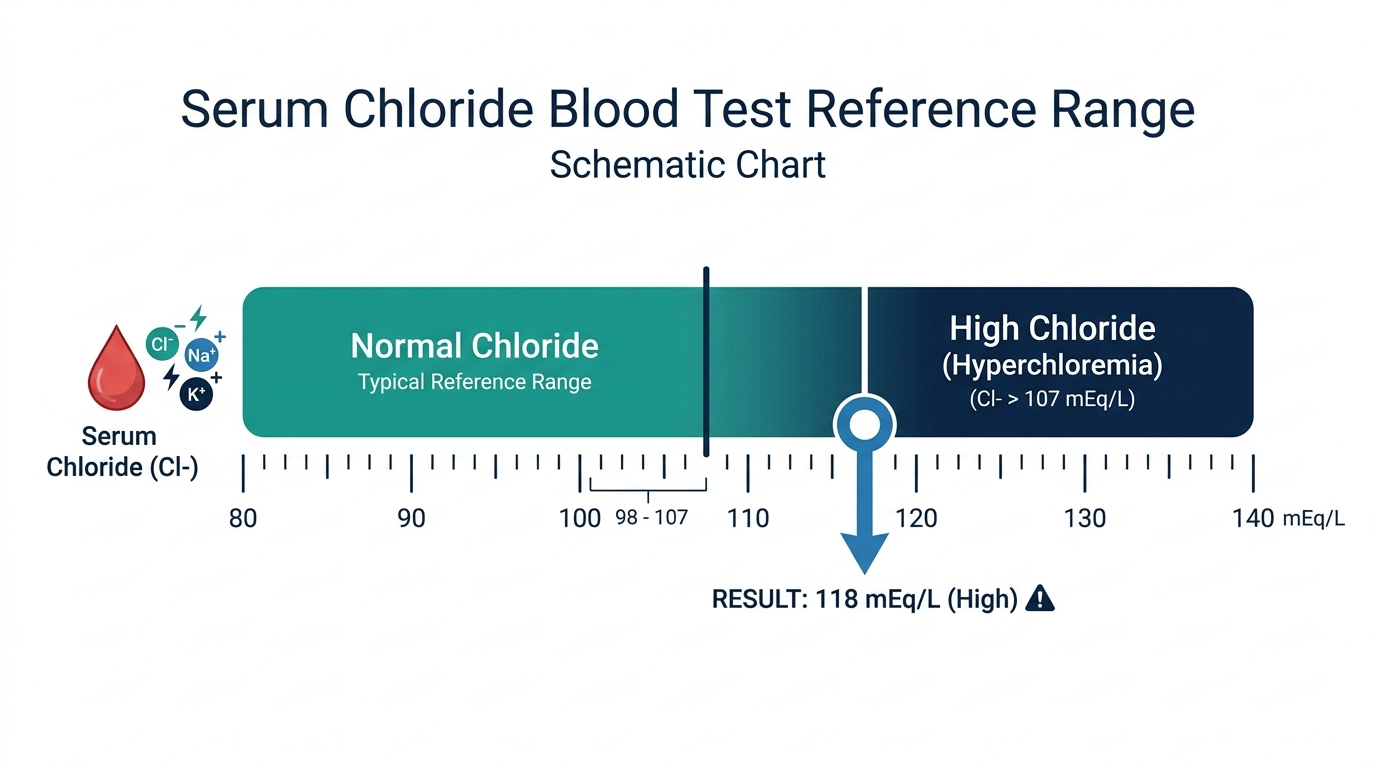
Chloride is the most abundant negatively charged ion in the fluid outside your cells, and almost all of it enters your body through the salt you eat, since table salt is sodium chloride. Your kidneys are the gatekeepers, reabsorbing or excreting chloride to hold the level steady, and they do this in close partnership with sodium and bicarbonate (MedlinePlus).
Chloride pulls its weight in three jobs. It helps maintain the volume and pressure of your blood by keeping water where it belongs, because water follows sodium and chloride. It preserves electrical neutrality, since every positive charge in your blood must be balanced by a negative one, and chloride is the main negative counterweight to sodium. And it is central to acid-base balance, shifting inversely with bicarbonate to keep your blood pH inside a narrow safe band. That third job is the key to reading a high result well. When bicarbonate drops, chloride often rises to take its place, not because anything is wrong with chloride itself, but because the body is defending its charge balance.
The numbers to read alongside a high chloride
Chloride is a supporting actor, and it only makes sense in the context of the other electrolytes on the panel.
| Marker | Why it matters next to a high chloride | Typical adult reference |
|---|---|---|
| Sodium | Chloride usually tracks sodium. Both high together points to dehydration or salt loading. | Roughly 135 to 145 mEq/L |
| Bicarbonate (CO2) | The inverse partner. High chloride with low bicarbonate signals metabolic acidosis. | Roughly 22 to 29 mEq/L |
| Anion gap | Sodium minus chloride and bicarbonate. Separates a benign chloride rise from a dangerous acid buildup. | Roughly 8 to 16 mEq/L (StatPearls) |
| Potassium | Often shifts with acid-base changes and rounds out the electrolyte picture. | Roughly 3.5 to 5.0 mEq/L |
Want to check your chloride?
Three ways to get it measured. Pick whichever fits you.
Affiliate links: we may earn a commission at no extra cost to you. A lab test does not replace a visit with your clinician.
A quick trick clinicians use: compare chloride and sodium as a pair. If sodium climbs and chloride climbs with it in proportion, you are likely looking at concentration, meaning dehydration. If chloride climbs out of proportion to sodium while bicarbonate falls, the story tilts toward an acid-base problem, and the anion gap becomes the deciding calculation.
How to read your high chloride: three scenarios
- High chloride, high sodium, high BUN, concentrated urine. This is textbook dehydration. Everything is concentrated together. Rehydration typically brings all of them back down, and no deeper workup is needed if the person is otherwise well.
- High chloride, low bicarbonate, normal anion gap. This is hyperchloremic (normal gap) metabolic acidosis. The classic drivers are diarrhea, renal tubular acidosis, and saline infusion. Here the chloride is doing its job, filling the charge gap left by lost bicarbonate (StatPearls, NCBI Bookshelf).
- High chloride, low bicarbonate, high anion gap. This combination shifts attention toward a different class of acidosis with an accumulating acid, and it deserves prompt medical evaluation rather than a wait and see approach.

Test preparation and what can distort the result
A chloride value is usually stable, but several factors can shift it or fake a change, and knowing them prevents chasing a phantom.
- Hydration on the day of the draw. A dry morning concentrates chloride, while good hydration can normalize a borderline result. Timing matters for a mild elevation.
- Recent IV fluids. Normal saline is 0.9% sodium chloride, so a chloride drawn after IV fluids can be elevated by the treatment itself rather than any disease (StatPearls, NCBI Bookshelf).
- Diet and medications. A very high salt intake raises chloride, and drugs such as acetazolamide can push it up by altering acid-base handling. Diuretics can move it in either direction depending on the type.
- Sample handling. Certain lab interferences, including high blood lipids and some assay quirks, can produce a falsely off reading, which is one reason a surprising isolated value is often repeated before action.
The best safeguard against being misled by any single one of these is a well hydrated repeat draw. A true, meaningful hyperchloremia persists. A one off from timing or fluids usually does not.
Who should pay closest attention, and when to recheck
Most people meet their chloride simply because it comes bundled in a routine metabolic panel. It deserves more deliberate attention in specific groups: people with chronic kidney disease, in whom chloride and acid-base balance can drift; people with diabetes, who are prone to acid-base disturbances; anyone on diuretics or carbonic anhydrase inhibitors like acetazolamide; and people with ongoing vomiting or diarrhea, which shifts electrolytes quickly.
For rechecking, a mild isolated elevation in a well person usually needs nothing beyond the next routine panel, ideally drawn well hydrated. A high chloride tied to a low bicarbonate, an abnormal sodium, or a known kidney or acid-base condition warrants closer follow up on a timeline your clinician sets, because in those settings the trend across several panels tells you whether the process is stable, improving, or worsening.
Common misconceptions about a high chloride
- “High chloride means I eat too much salt.” Salt can contribute, but dehydration is the far more common driver, and acid-base shifts account for the medically important cases. The salt shaker is rarely the whole story.
- “It is a disease I need to treat directly.” Hyperchloremia is almost always a signpost, not a diagnosis. You treat the cause, whether that is rehydration, adjusting fluids, or addressing an acid-base problem, not the chloride number itself (Cleveland Clinic).
- “A high chloride means my kidneys are failing.” Not by itself. Kidney disease is one possible cause, but a mild high chloride in a healthy, slightly dehydrated person says nothing about kidney failure. The eGFR and creatinine answer that question.
- “I can feel when my chloride is off.” You cannot. Chloride changes are silent, and any symptoms belong to the underlying cause, which is exactly why it is caught on a blood test rather than by how you feel (Cleveland Clinic).
How a high chloride connects to the anion gap
There is one more number that turns a high chloride from a curiosity into a clue, and it usually is not printed in bold: the anion gap. The anion gap is a simple calculation your lab or clinician can run from the electrolytes already on your panel, comparing the positively charged sodium against the negatively charged chloride and bicarbonate. It is the tool doctors use to sort out what kind of acid-base problem, if any, a high chloride is signaling.
The pattern that matters is this. When chloride rises to fill in for bicarbonate that has been lost, the anion gap tends to stay normal. This is called a normal anion gap, or hyperchloremic, metabolic acidosis, and it points toward causes such as ongoing diarrhea, renal tubular acidosis, or certain medications. When acid builds up for a different reason, from something like uncontrolled diabetes or a toxin, the gap widens instead, and chloride behaves differently. So the same low bicarbonate can mean two very different things, and the anion gap is what separates them.
For you as a reader, the practical point is that a high chloride is best understood next to two neighbors: bicarbonate and the anion gap. A high chloride with a low bicarbonate and a normal anion gap is a coherent, recognizable story that guides a clinician straight toward a shortlist of causes. You do not need to calculate the gap yourself, but knowing it exists explains why your doctor may look unbothered by a mildly high chloride in isolation and yet take real interest the moment bicarbonate drops alongside it. The chloride is rarely the headline. It is one word in a sentence the anion gap helps finish.
Frequently asked questions
What does high chloride mean in a blood test?
It means you have more chloride circulating than normal, a state called hyperchloremia, usually above the top of your lab’s range of roughly 96 to 106 mEq/L (Cleveland Clinic). It is rarely a disease itself and most often points to dehydration, high salt intake, or an acid-base shift, so it is read alongside sodium and bicarbonate.
What is a normal chloride level?
A typical normal adult chloride range is 96 to 106 mEq/L, equal to 96 to 106 mmol/L, although the exact cutoff varies by lab (Cleveland Clinic). Compare your result to the reference range printed on your own report.
Does high chloride cause symptoms?
Usually no. Hyperchloremia itself is typically asymptomatic and is found on a routine blood test (Cleveland Clinic). Any symptoms, such as thirst, fatigue, or muscle weakness, generally come from the underlying cause rather than the chloride itself.
Why is my chloride high in a blood test?
The most common reason is dehydration, where chloride concentrates as you lose water (Cleveland Clinic). Other causes include high salt or saline intake, severe diarrhea, kidney problems, and hyperchloremic metabolic acidosis, where chloride rises as bicarbonate falls (StatPearls, NCBI Bookshelf).
When should I worry about a high chloride?
Worry less about a mild isolated elevation and more about a high chloride paired with a low bicarbonate, an abnormal sodium, or symptoms like confusion, breathing trouble, or severe dehydration (StatPearls, NCBI Bookshelf). A persistent or worsening result, especially with kidney disease or diabetes, should be evaluated by your clinician (MedlinePlus).
This article is for general educational purposes and is not medical advice. It cannot diagnose or treat you and does not replace your clinician. Always discuss your lab results and any health decisions with a qualified healthcare professional.
Vital Signs Today may earn a commission if you buy through links on this page. It does not affect our editorial assessments.