
Part of our Comprehensive Metabolic Panel guide.
You scanned your blood work, saw most numbers sitting inside the reference range, and somewhere near the protein lines you spotted one word with a small number next to it: albumin. No alarming flag, so you moved on. Here is what most people never get told. Albumin is one of the most ordinary looking numbers on the page and quietly one of the most informative, because it touches your liver, your kidneys, your nutrition, and your inflammation all at once.
Most explainers file albumin under “protein, probably fine.” It deserves a closer read than that, and once you understand what it reflects, you read your own results differently.
What is albumin in a blood test?
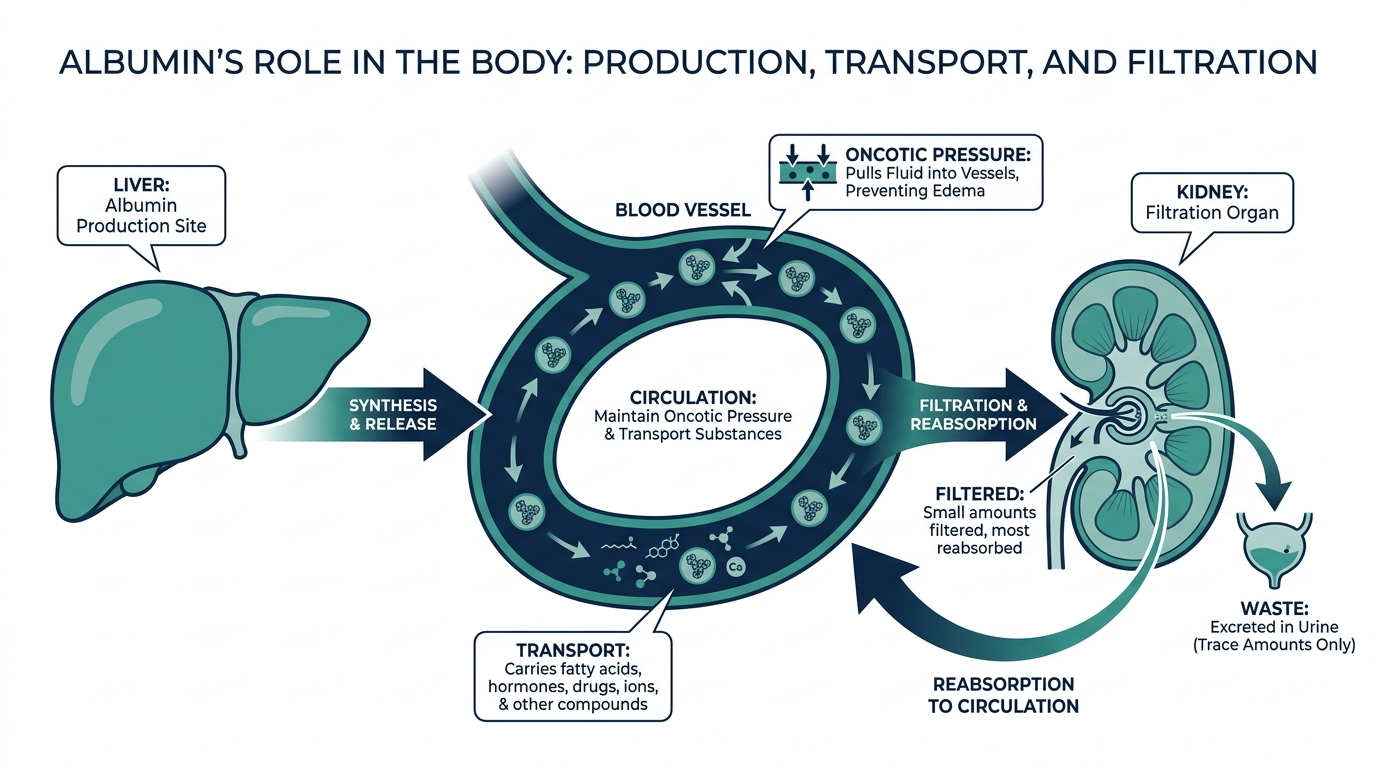
Albumin is a protein made by your liver, and the albumin blood test simply measures how much of it is circulating in your blood. It is the most abundant protein in your blood plasma, and it shows up on routine panels like the comprehensive metabolic panel (CMP) and standard liver function tests (MedlinePlus). In plain terms, albumin is your blood’s workhorse protein. It keeps fluid inside your blood vessels instead of leaking into tissue, and it ferries hormones, vitamins, medicines, and other substances around the body (Cleveland Clinic).
That dual job, holding fluid in place and acting as a transport truck, is the key to everything below. Because albumin is made in the liver, filtered by the kidneys, and built from the protein you eat, the level acts like a status light for several systems at once.

What does albumin mean in a blood test?
When you ask what does albumin mean in a blood test, the honest answer is that it is a general health signal rather than a single-disease test. A normal albumin level suggests your liver is producing protein well, your kidneys are holding onto it, and your nutrition is adequate. An abnormal level tells your clinician that one of those systems may be off, and points them toward the next question to ask (Cleveland Clinic).
This is why albumin rarely gets interpreted in isolation. On its own it cannot diagnose anything. Read alongside the rest of your panel, it becomes a useful pointer that narrows down where to look next.
What is a normal albumin level in a blood test?
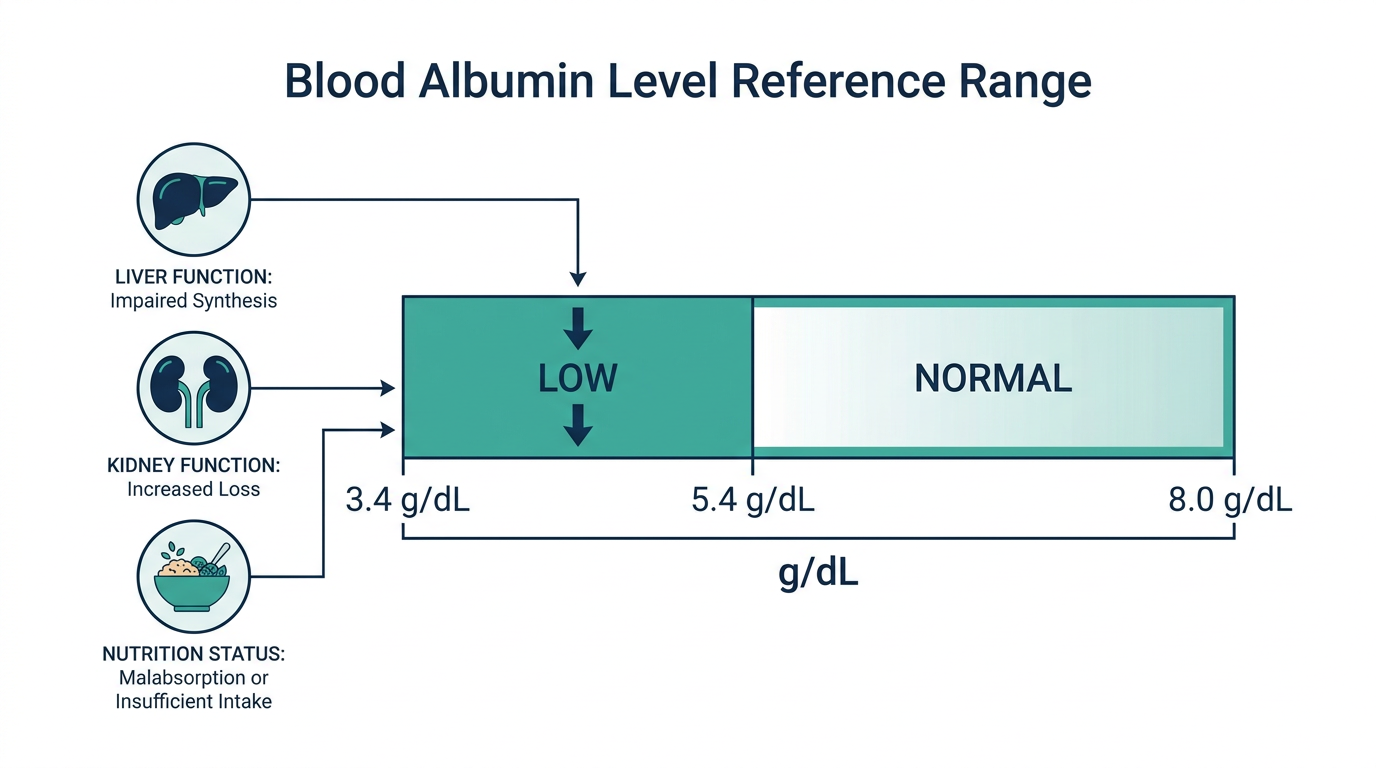
A normal albumin level in a blood test for adults generally runs from about 3.5 to 5.5 grams per deciliter (g/dL), though the exact cutoffs vary by laboratory and instrument (Cleveland Clinic). Some labs use a slightly tighter range, such as 3.5 to 5.0 g/dL. Always read your result against the reference range printed on your own report, because that is the range your lab actually calibrated its analyzer to.
A few everyday things nudge the number without signaling disease. Fasting, certain medications, and pregnancy can lower albumin temporarily (MedlinePlus). The practical takeaway: a result that drifts just outside the range is worth a conversation, not a panic.
What does a low albumin level mean?
A low albumin level, called hypoalbuminemia, means your blood has less of this protein than expected, and it is the abnormal result clinicians care about most. It usually reflects one of four problems: the liver is not making enough albumin, the kidneys are leaking it out, the gut is losing it, or your body simply is not getting or absorbing enough protein (Cleveland Clinic).
The common culprits behind a low albumin level include:
- Liver disease. Conditions like cirrhosis and hepatitis impair the liver’s ability to manufacture albumin (MedlinePlus).
- Kidney disease. Damaged kidneys, as in nephrotic syndrome, let albumin escape into the urine instead of keeping it in the blood (Cleveland Clinic).
- Malnutrition or malabsorption. Not eating enough protein, or digestive disorders like Crohn disease that block absorption, starve albumin production (MedlinePlus).
- Inflammation, infection, and severe burns, which increase loss and shift the body away from making albumin (Cleveland Clinic).
Here is the insider point that rarely reaches the patient version. Albumin doubles as a “negative acute phase reactant,” which is a technical way of saying it drops fast whenever your body is fighting significant inflammation or acute illness. During an infection or after major surgery, the liver pivots to producing inflammatory proteins and dials back albumin. So a low albumin level in a sick or hospitalized person often reflects how inflamed and stressed the body is right now, not just long-term nutrition. That is exactly why a single low reading taken during illness can look alarming yet recover on its own once you are well.

What does a high albumin level mean?
A high albumin level, hyperalbuminemia, is far less common and almost always points to one simple cause: dehydration. When you are low on fluid, the water portion of your blood shrinks and the albumin already present becomes more concentrated, so the number reads high even though your actual protein production has not changed (Cleveland Clinic).
Severe diarrhea and other states that strip the body of fluid can produce the same concentrated picture (MedlinePlus). The reassuring part is that a high albumin level usually corrects itself once you rehydrate. There is no chronic disease defined by a high albumin alone, which is why clinicians treat it as a clue about hydration rather than a red flag in its own right.
Why is albumin measured with total protein and globulin?
Albumin is most informative when read next to total protein and globulin, which is why the three usually appear together on a panel. Your blood protein splits into two camps: albumin, which makes up most of it, and the globulins, which handle immune defense and additional transport. Measuring all three, plus the albumin to globulin (A/G) ratio, helps your clinician separate a liver problem from a kidney problem from a nutrition problem (MedlinePlus).
The logic is comparative. Total protein gives the headline figure. Albumin and globulin show how that total is divided. The A/G ratio is the spread between the two. A few simplified patterns:
- Low albumin with low total protein: can point toward malnutrition or a liver that is underproducing.
- Low albumin with a low A/G ratio: raises the question of kidney loss or chronic inflammation, where albumin falls while globulins hold steady or rise.
- Normal albumin with high total protein: shifts attention to the globulin side rather than albumin.
One inexpensive cluster of numbers, read together, does triage that any single value cannot. That is why labs bundle them rather than reporting albumin alone.
The part most people never hear: albumin and how long you live
This is where albumin graduates from a routine protein marker to something genuinely worth watching. A consistent body of research has found that a lower serum albumin is an independent predictor of death, even in people who are not obviously sick and even after adjusting for the usual risk factors.
The signal shows up across very different populations. In a 15-year community cohort of healthy adults, serum albumin independently predicted both all-cause and cerebro-cardiovascular death, with the higher albumin group carrying meaningfully lower mortality risk over the follow-up (PMC, serum albumin and 15-year mortality). In a large prospective study of people aged 65 and older, low albumin was independently associated with a higher risk of death, with hypoalbuminemia carrying roughly a 1.6-fold increase in mortality risk compared with normal levels (PubMed, hypoalbuminemia and mortality in older adults).
Why would one protein level forecast survival? The leading explanation is that albumin is a quiet composite readout. It sums up your liver’s synthetic capacity, your protein nutrition, and your background level of inflammation, the same forces that drive aging and chronic disease. A low albumin is less a disease in itself and more a sensitive, cheap mirror of how much strain your body is carrying. You will not get a diagnosis from a single low albumin, but a number that is drifting down over time is a reasonable reason to look closer rather than scroll past.

What albumin actually does in the body
To understand why a low number matters, it helps to picture the two jobs albumin performs every second. Both explain the symptoms that show up when it runs low.
The first job is holding fluid inside your blood vessels. Albumin is the main protein responsible for oncotic pressure, the inward pull that keeps the watery part of blood from leaking out into surrounding tissue. Albumin accounts for the majority of that pressure, so when its concentration falls far enough, the pull weakens and fluid seeps into the tissues (medical reference). That leakage is what produces swelling.
The second job is transport. Albumin is a molecular delivery truck, carrying hormones, calcium, certain vitamins, and many medications through the bloodstream. This transport role has a practical consequence people rarely hear: because many drugs bind to albumin, a low albumin level can change how much of a medication is active and free in the blood, which is one reason clinicians factor albumin into dosing decisions for certain drugs. One protein, two roles, and both feed directly into how a low result shows up in real life.
Symptoms of low albumin, and the red flags
Mildly low albumin often causes no symptoms at all and is picked up only because it appears on a routine panel. When it drops further, the signs tend to trace back to that lost oncotic pressure and the fluid it can no longer hold in place.
- Swelling, called edema. Puffiness in the lower legs and ankles is the classic sign, since gravity pools the leaked fluid there.
- Puffiness around the eyes. Especially noticeable in the morning, and a common early clue in kidney-related albumin loss.
- Abdominal fullness or swelling. Fluid can collect in the abdomen, a state called ascites, often linked to significant liver disease.
- Fatigue and general weakness. Nonspecific but common, reflecting the underlying illness driving the low albumin.
The red flags are less about the swelling itself and more about what causes it. New or worsening leg swelling, a rapidly enlarging abdomen, or shortness of breath deserve prompt medical attention, because they can signal advancing liver, kidney, or heart problems rather than the albumin number alone. As with every value in this article, the symptom points you toward the cause, and the cause is what gets treated.
How the albumin test is done and what can shift the result
The albumin test is a routine blood draw, usually part of a comprehensive metabolic panel or a liver function panel, so it rarely needs to be ordered on its own. For most people it requires no special preparation, though a few factors can nudge the number without any disease behind it.
- Hydration status. This is the big one. Dehydration concentrates the blood and can push albumin falsely high, while overhydration or IV fluids can dilute it and read falsely low. The same person can show different albumin values depending on fluid balance that day.
- Fasting and certain medications. Fasting and some drugs can lower albumin temporarily, which is why a borderline result is read in context rather than treated as fixed.
- Pregnancy. Blood volume expands in pregnancy, diluting albumin, so a lower value can be normal physiology.
- Position and tourniquet time. Prolonged tourniquet application during the draw can slightly concentrate proteins locally, a technical factor labs try to minimize.
The practical point is that a single albumin value is a snapshot influenced by the day. A trend across several results, read with your hydration and health in mind, tells a far more reliable story than one isolated number.

The tests that pinpoint why albumin is low
Because a low albumin can come from the liver, the kidneys, the gut, or nutrition, the real diagnostic work is figuring out which. A handful of companion tests usually sort it out, and knowing them demystifies what your clinician orders next.
- Liver enzymes and bilirubin. If the liver is the suspect, ALT, AST, ALP, and bilirubin help confirm whether liver damage is impairing albumin production.
- Urine albumin and the albumin-to-creatinine ratio (ACR). If the kidneys are leaking protein, a urine test catches it. A normal urine ACR is under 30 mg/g, a moderately increased result runs 30 to 300 mg/g, and above 300 mg/g signals a stronger kidney signal (NIH). Finding albumin in the urine while it is low in the blood points squarely at the kidneys.
- Total protein and globulin. As covered above, the split between albumin and globulin and the A/G ratio help separate liver, kidney, and nutrition causes.
- Inflammatory markers such as CRP. Because albumin falls during inflammation, checking an inflammation marker helps decide whether a low value reflects acute illness rather than chronic organ trouble.
- Prealbumin, in some settings. Because it turns over faster than albumin, prealbumin is sometimes used to assess shorter-term nutrition, though it too drops with inflammation.
This is the recurring theme in one paragraph. Albumin flags that something is off, and this cluster of follow-up tests decides where the problem lives. No single number closes the case.
Worked interpretation scenarios
Reading albumin against its companions is what turns a vague low value into a working diagnosis. A few illustrative patterns show the logic clinicians use.
- Low albumin with abnormal liver enzymes and high bilirubin. Points toward liver disease impairing production, especially in chronic conditions like cirrhosis.
- Low blood albumin with high urine albumin (ACR). The classic fingerprint of kidney loss, as in nephrotic syndrome, where protein escapes into the urine.
- Low albumin with a high CRP during an acute illness. Suggests the drop is largely a response to inflammation, and the albumin often recovers once the illness resolves.
- Low albumin with low total protein and a history of poor intake or gut disease. Raises malnutrition or malabsorption, such as Crohn disease, as the driver.
- High albumin with signs of dehydration. Usually just concentration from low fluid, correcting once rehydrated, rather than any true rise in protein production.
The same low albumin belongs to very different stories depending on the company it keeps. That is precisely why your clinician reads the panel as a set, not as a row of separate numbers.
Who should pay attention, and common misconceptions
Albumin is not a test people usually seek out on its own, since it rides along on routine panels. It deserves closer attention in people with known or suspected liver disease, kidney disease, chronic inflammatory conditions, or nutrition problems, and in older adults, where a downward drift can be an early, cheap signal of rising strain. A few myths cause confusion when the number is read in isolation.
- “Low albumin means liver disease.” Not necessarily. Kidney loss, poor nutrition, gut disease, burns, and acute inflammation all lower albumin with a perfectly healthy liver.
- “High albumin is a disease I need treated.” Almost always it just reflects dehydration and corrects with fluids. There is no chronic disease defined by high albumin alone.
- “A low albumin during illness is a crisis.” Because albumin drops as a negative acute phase reactant, a low value during infection or after surgery often reflects the body’s stress response and recovers as you heal.
- “One albumin number tells me my nutrition status.” Albumin is influenced by inflammation and hydration, not nutrition alone, so it is a rough and slow nutrition marker at best, and it should never be read as a standalone verdict on how well you eat.
The thread through all of it is the article’s core idea. Albumin looks ordinary but quietly reflects your liver, kidneys, nutrition, and inflammation at once, which makes it a sensitive pointer and a poor standalone diagnosis. Read as part of the panel and watched over time, it earns the closer look most people never give it.
Frequently asked questions
What is a normal albumin level in a blood test?
A normal adult albumin level is generally about 3.5 to 5.5 g/dL, though some labs use a slightly tighter range and exact cutoffs vary by laboratory (Cleveland Clinic). Compare your result to the reference range printed on your own report.
What does a low albumin level mean?
A low albumin level, or hypoalbuminemia, most often reflects liver disease, kidney loss, poor nutrition or malabsorption, or active inflammation and infection (MedlinePlus). It is a clue, not a diagnosis, and is interpreted alongside the rest of your panel.
What does a high albumin level mean?
A high albumin level is almost always caused by dehydration, which concentrates the protein already in your blood, and it often corrects itself once you rehydrate (Cleveland Clinic). Severe diarrhea can produce the same picture.
Can albumin be low without liver disease?
Yes. Kidney loss, malnutrition, gut disorders like Crohn disease, severe burns, and acute inflammation can all lower albumin even when the liver is healthy (Cleveland Clinic). Albumin also falls during illness as a negative acute phase reactant.
Why is albumin measured with total protein?
Albumin and globulin are the two main blood proteins, and reading them together with total protein and the A/G ratio helps separate liver, kidney, and nutrition problems that a single number cannot distinguish (MedlinePlus).
This article is for general educational purposes and is not medical advice. It cannot diagnose or treat you and does not replace your clinician. Always discuss your lab results and any health decisions with a qualified healthcare professional.
Vital Signs Today may earn a commission if you buy through links on this page. It does not affect our editorial assessments.