Related: How to bring BUN back into range
You scanned your metabolic panel, found the BUN line, and saw a number sitting below the reference range. Most articles about blood urea nitrogen are written for the opposite problem, the high reading that hints at kidney trouble. So you are left staring at a low number with almost nothing to tell you whether it matters.
Here is the short version before we go deep. A low BUN is rarely the emergency a high BUN can be. In most people it is benign, and sometimes it is just a sign you drank a lot of water before the draw. But a genuinely low BUN occasionally points to something worth knowing about, and the only way to read it correctly is to stop looking at the number in isolation.
Part of our Comprehensive Metabolic Panel guide.
What is bun blood test low, and what does it actually mean?
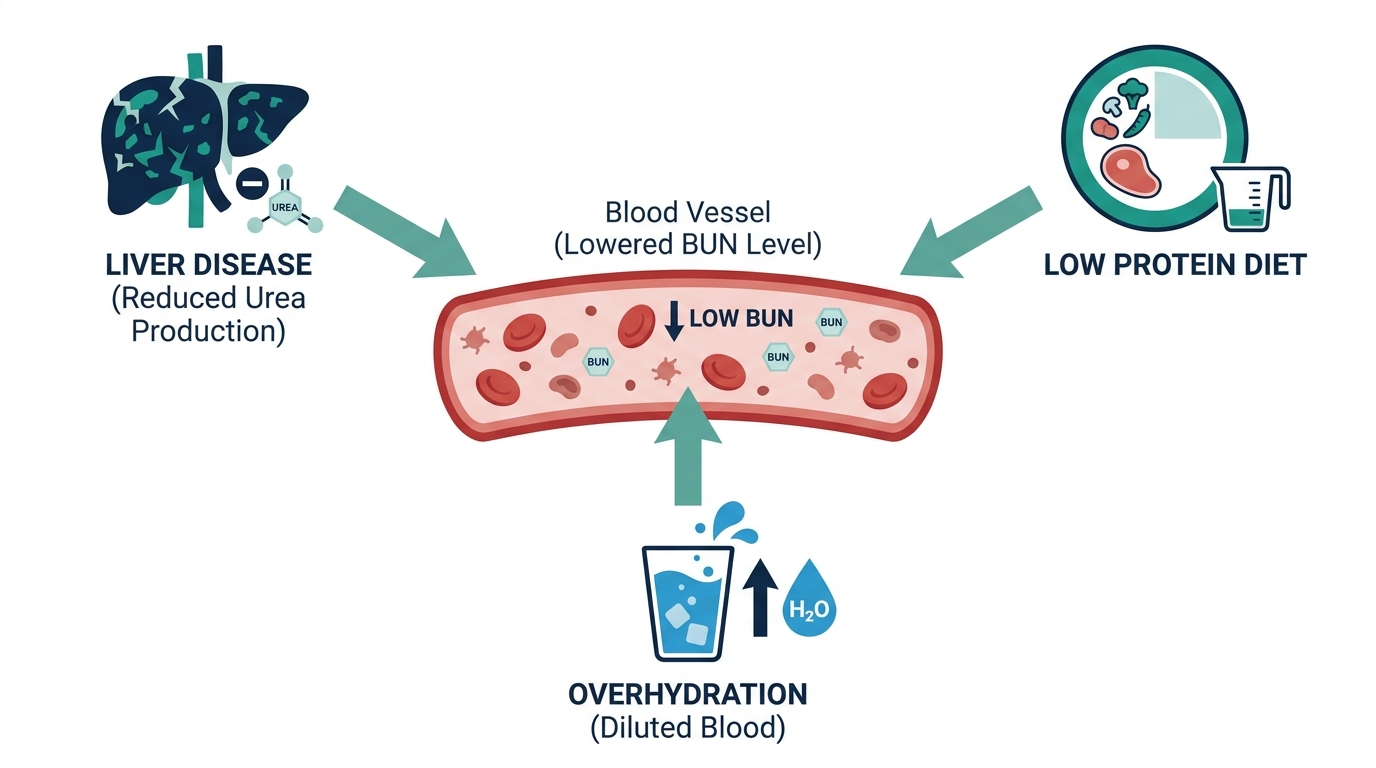
When your “what is bun blood test low” search lands you here, this is the answer in one line. BUN, or blood urea nitrogen, measures urea, a waste product your liver makes when it breaks down protein, and that your kidneys filter out into urine (MedlinePlus). A low BUN means there is less urea circulating than expected, which usually traces back to how much protein you eat, how well your liver is producing urea, or how diluted your blood is, not to your kidneys failing.
That is the conceptual flip most people miss. A high BUN is mostly a story about the kidneys not clearing waste. A low BUN is mostly a story about the supply side, less urea being made, or more water diluting it, with the kidneys often working perfectly fine the whole time.

What does a low BUN mean on a blood test?
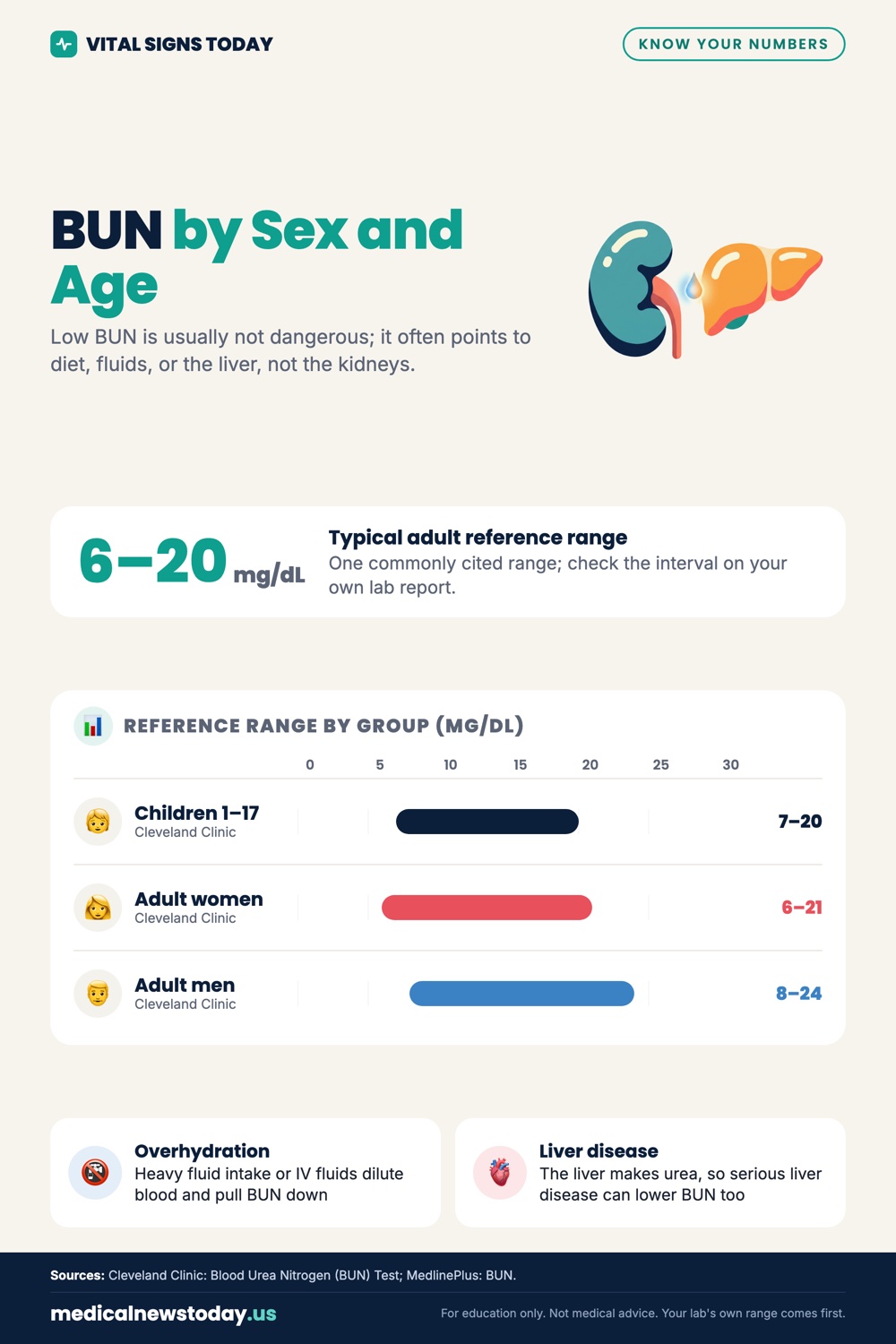
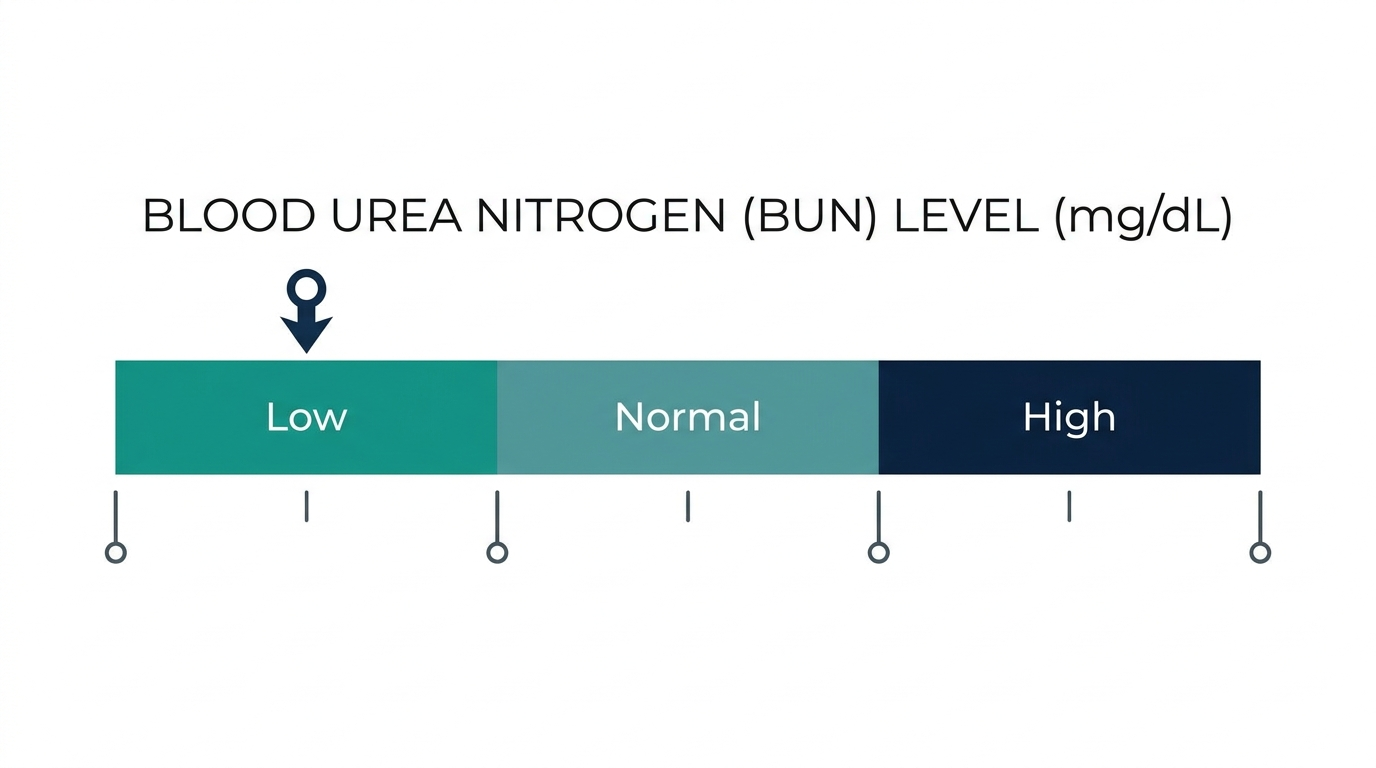
A low BUN means your blood holds less urea nitrogen than the lab’s reference range, and on its own it is usually not a sign of disease. The normal adult range is generally about 6 to 20 mg/dL, though it varies by lab and by sex (MedlinePlus). Cleveland Clinic lists roughly 6 to 21 mg/dL for adult women and 8 to 24 mg/dL for adult men, which tells you the cutoff for “low” is not a single universal number (Cleveland Clinic).
So what counts as low? Practically, a result printed below the bottom of the range on your own report, for many labs anything under about 6 to 8 mg/dL. The reference range on your printout is the one that matters, because that is the range your specific lab calibrated for its instrument and population. A value of 7 mg/dL might be flagged low at one lab and sit inside the range at another.
The honest clinical reality, stated plainly by Cleveland Clinic, is that low BUN levels are not common, and when they happen they often do not signal anything dangerous (Cleveland Clinic). That is why a lone low BUN with an otherwise clean panel rarely sets off alarms.
What causes a low BUN?
A low BUN comes down to a small, well-defined list of causes. Ranked roughly from most to least common in everyday practice:
- Overhydration or dilution. Drinking a lot of fluid, or receiving IV fluids in a hospital, dilutes the blood and drops the BUN. This is the most ordinary, least worrying cause, and it can be transient. Hydration status is one of the recognized normal sources of BUN variation (Cleveland Clinic).
- Low-protein diet. Urea is the breakdown product of protein. Eat little protein and you make less urea, so the BUN falls. Vegans, very low-protein dieters, and people with poor appetite often run low (NCBI Clinical Methods).
- Malnutrition. A step beyond a low-protein diet, true undernutrition or starvation lowers BUN because there simply is not enough protein turnover to generate urea (MedlinePlus).
- Liver disease. This is the cause that matters most. Your liver makes urea. In significant liver disease, the liver loses the capacity to synthesize it, so the BUN can be low even when the kidneys are completely normal (MedlinePlus).
- Small body size. People with a smaller body type can sit at the low end simply because of lower muscle mass and protein turnover, with no underlying problem (Cleveland Clinic).
- Pregnancy. Normal pregnancy lowers BUN. Expanded blood volume, a higher filtration rate, and the growing fetus pulling protein toward building tissue all push it down. Pregnant women commonly sit around 5 to 7 mg/dL, and that is expected, not abnormal (NCBI Clinical Methods).
- SIADH and water retention. Syndrome of inappropriate antidiuretic hormone secretion makes the body hold onto water, diluting the blood and dragging both sodium and BUN down (NCBI StatPearls).
Notice the pattern. Almost every cause is either making too little urea (low protein, malnutrition, liver disease) or having too much water (overhydration, pregnancy, SIADH). That two-bucket framing is the fastest way to think about your own result.
What are the symptoms of a low BUN?
A low BUN itself causes no symptoms. There is no such thing as feeling unwell “because your BUN is low.” Urea is a waste product, and having a little less of it floating around does not affect how you feel.
What you may notice are symptoms of whatever is driving the low number. If liver disease is behind it, the clues are things like fatigue, yellowing of the skin or eyes, swelling in the abdomen or legs, or easy bruising. If malnutrition is the cause, you might see unintended weight loss, muscle wasting, or low energy. If overhydration or SIADH is the issue, the low sodium that travels with it can bring headaches, nausea, confusion, or in severe cases seizures (NCBI StatPearls).
The takeaway: do not hunt for “low BUN symptoms.” Look instead at the rest of your body and the rest of your panel for what might be lowering it.

When is a low BUN dangerous or a medical emergency?
A low BUN number, by itself, is not a medical emergency. There is no red-flag BUN threshold on the low side the way a sky-high BUN can signal kidney failure. The danger, when there is any, lives in the cause, not the number.
Treat these situations as urgent, driven by the underlying problem rather than the BUN figure itself:
- Signs of advanced liver disease. Jaundice, a swollen belly, vomiting blood, black stools, or new confusion alongside a low BUN warrant prompt medical attention, because the liver may be losing its ability to do its jobs, urea production being just one of them (MedlinePlus).
- Severe low sodium with the low BUN. When dilution from overhydration or SIADH is the cause, the accompanying hyponatremia is the real risk. Rapidly developing confusion, severe headache, seizures, or loss of consciousness need emergency care (NCBI StatPearls).
- Profound malnutrition. A very low BUN as part of a picture of severe weight loss and muscle wasting is a flag that the body is running on empty and needs clinical assessment.
If your low BUN is isolated, you feel well, and the rest of your panel is normal, none of this applies. It is the company the low BUN keeps that determines urgency.
What should you do about a low BUN?
Start by reading it in context, not in panic. A single low BUN with a normal creatinine, normal liver enzymes, and normal sodium, in someone who feels fine, usually needs nothing more than awareness. Here is a sensible path:
- Check creatinine and the BUN/creatinine ratio. Creatinine is sourced from muscle, not protein intake or the liver, so it stays steadier. A low BUN with normal creatinine, giving a low ratio, points toward low protein intake, liver disease, or dilution rather than kidney trouble (NCBI Clinical Methods).
- Look at liver enzymes and sodium. Normal ALT, AST, and bilirubin make liver disease unlikely. Normal sodium makes overhydration or SIADH unlikely. These nearby numbers do most of the interpretive work.
- Review your diet and fluids. Be honest about protein intake and how much water you drank before the draw. Both are easily fixable explanations.
- Repeat the test if needed. Because hydration alone can move BUN, a repeat draw on a normal day often settles the question without any further workup.
Treatment, when it is needed at all, is aimed at the cause. Add protein for a low-protein diet, manage the liver condition for liver disease, correct fluid status for overhydration or SIADH. Nobody treats a low BUN number directly, because the number is a messenger, not the problem.
When should you see a doctor?
See your clinician if your low BUN comes with any of these: symptoms of liver disease such as jaundice, swelling, or unexplained fatigue; signs of malnutrition such as unintended weight loss or muscle loss; a low sodium reading on the same panel; or simply a persistently low BUN that you cannot explain by diet or fluids. Pregnancy is the one context where a low BUN is expected and reassuring rather than a reason to worry (NCBI Clinical Methods).
You do not need an urgent visit for an isolated low BUN in a healthy person. Mention it at your next appointment and let your clinician read it against your full panel and your history. The right move is interpretation, not alarm.
The insider read: why a low BUN fools people, and what clinicians actually check
Here is the nuance that rarely makes it into patient explainers. BUN is a notoriously unreliable standalone marker, and a low value is even softer than a high one. The same number, say 6 mg/dL, can mean a healthy vegan who drank two liters of water that morning, a pregnant woman in her third trimester, or someone with quietly failing liver function. The number does not distinguish them. The context does.
This is why experienced clinicians almost never react to BUN alone. They read it as a ratio against creatinine and as one voice in a chorus with liver enzymes, albumin, and sodium (NCBI Clinical Methods). A low BUN/creatinine ratio is the actual signal, and even that has multiple meanings, from low protein intake to advanced liver disease (NCBI Clinical Methods).
The most common misread runs in both directions. Some people panic over a flagged-low BUN that is pure dilution and means nothing. Others wave off a low BUN that is actually an early, soft hint of declining liver synthesis, dismissed because BUN is “a kidney test” and the kidneys look fine. The trap is the label. BUN is filtered by the kidneys but manufactured by the liver and fueled by your diet, so a low value reports on all three. The skill is not reacting to the number. It is asking which of the three is talking.
The biology behind urea: where the number actually comes from
Understanding why a low BUN points to the liver and diet more than the kidneys becomes intuitive once you see how urea is made. When your body breaks down protein, whether from food or from turning over its own tissue, it produces ammonia, which is toxic. The liver converts that ammonia into urea, a far safer molecule, through a series of steps called the urea cycle. The urea then travels in the blood to the kidneys, which filter it into urine (MedlinePlus).
That pathway explains the whole logic of a low result. Three things must line up to keep BUN in the normal range: enough protein entering the system, a liver healthy enough to run the urea cycle, and blood that is not overly diluted. Knock down any one of them and the BUN falls. Eat little protein and there is less raw material. Damage the liver and the factory slows. Flood the body with water and the urea that is present gets diluted. This is why a single low BUN is best read as a question, which of these three is responsible, rather than as a verdict.
The BUN to creatinine ratio, decoded with examples
Because BUN alone is such a soft marker, clinicians lean heavily on its ratio to creatinine. Creatinine comes from muscle and is filtered by the kidneys, and it does not depend much on diet or liver function, so it acts as a steadier reference point. The normal BUN to creatinine ratio generally runs about 10 to 20 to 1 (NCBI Clinical Methods). Here is how the ratio helps interpret a low BUN.
- Low BUN with a low ratio, normal creatinine. This is the typical pattern for low protein intake, malnutrition, or reduced liver synthesis, since BUN falls while creatinine holds steady. It steers attention toward diet and the liver, not the kidneys.
- Low BUN with normal sodium and normal liver enzymes. This most often reflects diet or a smaller body size, and it is usually benign.
- Low BUN alongside a low sodium. This pairing suggests dilution from overhydration or SIADH, where excess water is dragging several values down together.
The lesson: a low BUN is rarely acted on in isolation. The ratio and the neighboring chemistry values carry most of the interpretive weight.

How to prepare for the test and what can skew a low BUN
BUN is part of a basic or comprehensive metabolic panel, and a few practical factors influence the reading enough to matter.
- Hydration on the day of the draw. Because water dilutes urea, heavy fluid intake or IV fluids before a test can push BUN down, sometimes into the flagged-low zone even in a perfectly healthy person. This is the most common reason for a spuriously low value.
- Recent protein intake. A stretch of eating very little protein lowers urea production. If you have been eating lightly or are on a low-protein diet, the number reflects that.
- Fasting instructions. A metabolic panel is sometimes drawn fasting because other components, such as glucose, require it. BUN itself is not dramatically changed by an overnight fast, but follow your lab’s instructions so all values are comparable across visits.
- Pregnancy. Expanded blood volume and a higher filtration rate normally lower BUN in pregnancy, so a low value there is expected rather than concerning (NCBI Clinical Methods).
The practical move for a borderline low result: repeat the test on an ordinary day with normal fluid and protein intake, which often resolves the question without further workup.
How BUN shifts with age, sex, and body size
Reference ranges for BUN are not identical for everyone, and knowing the context prevents unnecessary worry. Ranges differ modestly by sex, with some labs listing slightly different values for women and men (Cleveland Clinic).
Body size and muscle mass also matter. People with a smaller build and lower muscle mass tend to run at the lower end of the range simply because they have less protein turnover, with nothing wrong. Age plays a role too, since protein intake, muscle mass, and kidney filtration all change across the lifespan. The consistent principle across every group is the same one that runs through this article: compare your value to the range printed on your own report, read it alongside creatinine, sodium, and liver enzymes, and treat an unexplained persistently low value as a reason for a calm conversation rather than alarm.
Next steps and monitoring after a low BUN
For most people, a low BUN needs little more than context and, at most, a repeat test. Here is a sensible sequence once the result is flagged.
- Confirm it is real. Repeat the panel on a normal day. If hydration or a light-protein stretch explained it, the value often returns toward the middle of the range.
- Read the neighbors. Check creatinine, sodium, and liver enzymes on the same panel, since these usually explain a genuinely low BUN.
- Address the cause, not the number. Adjust protein intake for a dietary cause, manage the liver condition if one is found, and correct fluid or sodium status for dilution. No one treats the BUN figure directly.
- Track the trend. If your clinician is monitoring liver or nutritional status, serial panels over time tell a clearer story than any single draw.
Common misconceptions about a low BUN
- “BUN is a kidney test, so a low BUN means something is wrong with my kidneys.” A low BUN is usually the opposite of a kidney story. Urea is filtered by the kidneys but made by the liver from dietary protein, so a low value points to diet, dilution, or the liver, often with healthy kidneys.
- “A low BUN is dangerous by itself.” The number is a messenger. Any risk comes from the underlying cause, such as advanced liver disease or a severely low sodium, not from the BUN value.
- “I need to eat more protein to fix a low BUN.” Only if low protein intake is actually the cause. If dilution or the liver is responsible, more protein will not address the real issue.
- “A low BUN in pregnancy is a problem.” Normal pregnancy lowers BUN through expanded blood volume and higher filtration, so a low value there is expected and reassuring (NCBI Clinical Methods).
Frequently asked questions
What does a low BUN mean in a blood test?
A low BUN means your blood has less urea nitrogen than the reference range expects, usually because you make less urea (low protein intake, malnutrition, or liver disease) or your blood is diluted (overhydration, pregnancy, or SIADH). On its own it is generally not a sign of disease, and it often reflects diet or hydration rather than kidney trouble (Cleveland Clinic).
What is a low BUN level in a blood test?
The normal adult range is roughly 6 to 20 mg/dL, with some labs listing about 6 to 21 mg/dL for women and 8 to 24 mg/dL for men, so “low” generally means a result printed below the bottom of your own lab’s range (MedlinePlus). Always compare against the reference range on your specific report.
Is a low BUN dangerous?
The low number itself is not dangerous and is not a medical emergency. Any risk comes from the underlying cause, such as advanced liver disease or a severely low sodium level traveling alongside it, not from the BUN value (Cleveland Clinic).
Can a low BUN mean liver problems?
Yes. Because the liver produces urea, significant liver disease can lower BUN even when the kidneys are completely normal. That is why a low BUN is read alongside liver enzymes rather than treated as a pure kidney result (MedlinePlus).
Does drinking water lower your BUN?
Yes. Overhydration, including heavy water intake or IV fluids, dilutes the blood and lowers BUN, and hydration status is a recognized normal source of BUN variation. A repeat test on an ordinary day often clarifies a borderline low result (Cleveland Clinic).
This article is for general educational purposes and is not medical advice. It cannot diagnose or treat you and does not replace your clinician. Always discuss your lab results and any health decisions with a qualified healthcare professional.
Vital Signs Today may earn a commission if you buy through links on this page. It does not affect our editorial assessments.