Disclosure: Vital Signs Today may earn a commission if you buy through links on this page, at no extra cost to you. This does not influence our evidence-based assessments. We are not a medical provider; talk to a clinician before acting on test results.
You scanned your metabolic panel, your albumin looked fine, your total protein looked fine, and then your eye snagged on one line sitting below the normal range: globulin, low. Most people have no idea what globulin even is, let alone why a low number would show up flagged. Here is what almost no patient handout tells you plainly. Globulin is not one thing. It is a whole bundle of proteins, and the most important part of that bundle is your antibodies. So a low globulin can mean something as harmless as a lab quirk, or it can be the first quiet hint that your immune system is running low on ammunition.
That distinction matters, and reading your result correctly is the difference between ignoring a non-issue and catching something that deserves a follow-up.
Part of our Comprehensive Metabolic Panel guide.
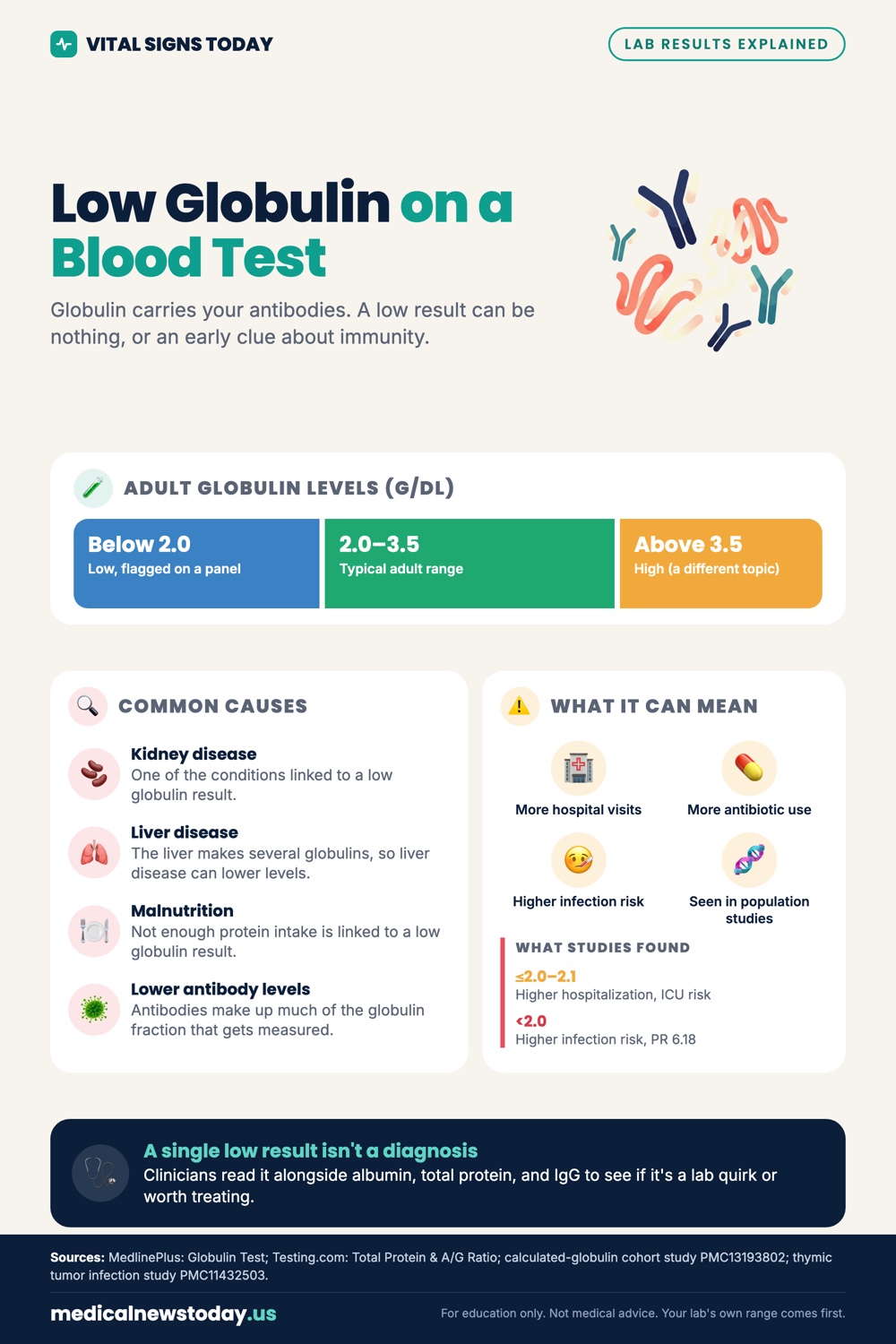
What does low globulin mean in a blood test?
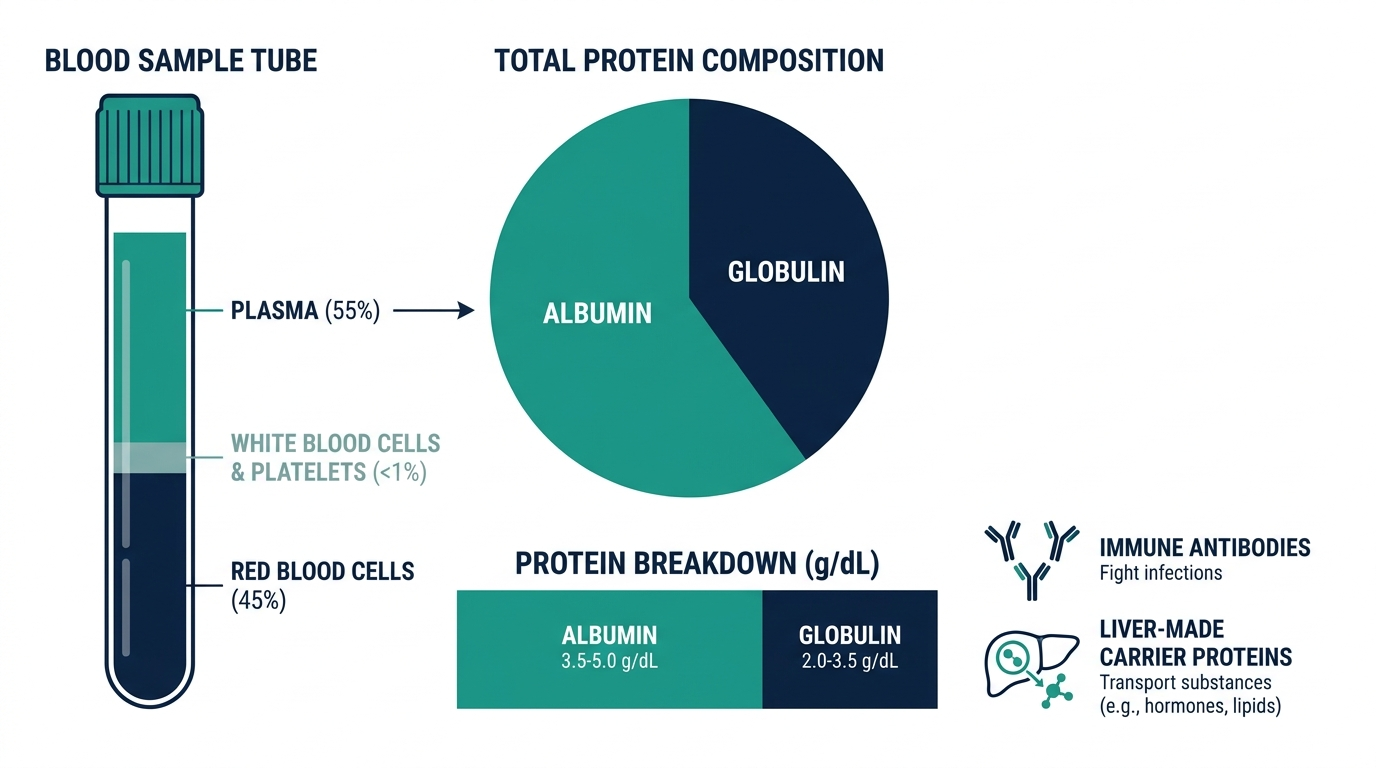
A low globulin means the non-albumin protein fraction of your blood is below the normal range, and because antibodies (immunoglobulins) make up a large share of that fraction, a low result often points toward either reduced antibody production or protein loss somewhere in the body. Globulins are a group of proteins, some built by your liver and some by your immune system, that handle blood clotting, transport, and fighting infection (MedlinePlus). When the total drops, one of those jobs is usually being shortchanged.
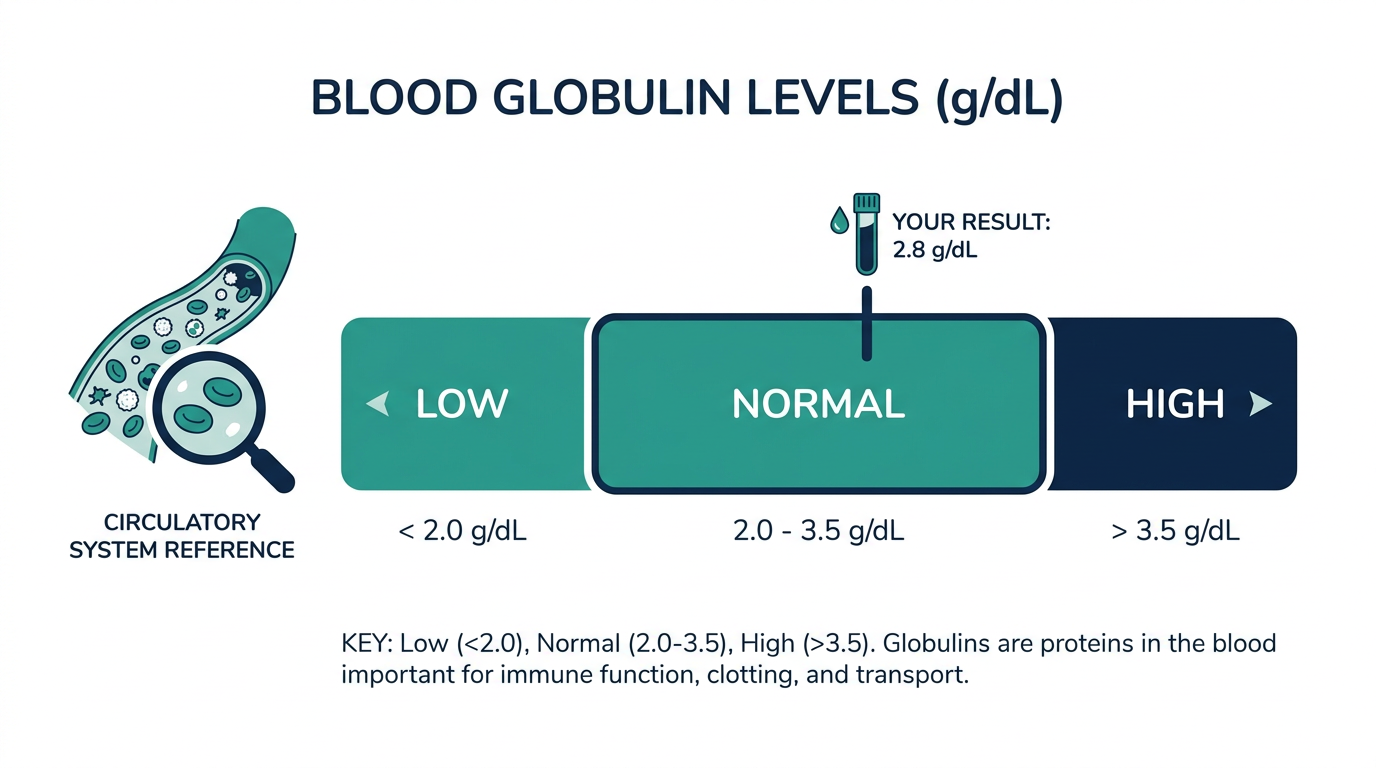
The number itself is often not measured directly. On a standard comprehensive metabolic panel, the lab measures total protein and albumin, then subtracts to get what is called calculated globulin (total protein minus albumin) (PMC, calculated globulin as a screening test). A typical normal globulin range runs about 2.0 to 3.5 g/dL, though the exact cutoff varies by lab and instrument (Cleveland Clinic). A result that sits a hair under the bottom of your lab’s range is a very different thing from a result that is clearly low, and that is the first thing your clinician will weigh.

What causes a low globulin?
A low globulin has a real differential, and the causes break into two big families: you are not making enough, or you are losing what you make. Here they are, most common and most important first.
- Reduced antibody production (hypogammaglobulinemia). Because immunoglobulins are a major part of the globulin fraction, low antibody levels pull the total down. This is the cause clinicians most do not want to miss, because it can leave you vulnerable to infection (Cleveland Clinic). It ranges from inherited conditions like common variable immunodeficiency (CVID) and X-linked agammaglobulinemia to acquired causes such as certain cancers (chronic lymphocytic leukemia, lymphoma, multiple myeloma), HIV, and medication side effects (StatPearls, NCBI).
- Medications that suppress B-cells. Drugs like rituximab, corticosteroids, and chemotherapy can drive globulin and antibody levels down as an expected side effect (Cleveland Clinic). This is one of the most common and most overlooked explanations in adults already being treated for another condition.
- Protein loss. If your kidneys leak protein into the urine (as in nephrotic syndrome) or your gut loses protein, the globulin and albumin both drop. Low globulin can be a sign of kidney disease (MedlinePlus).
- Liver disease. The liver makes several globulins, so significant liver dysfunction can lower them, and low globulin is a recognized marker of liver problems (Cleveland Clinic).
- Malnutrition. Poor protein intake or malabsorption leaves the body without the raw material to build these proteins, which is why malnutrition shows up on the list (MedlinePlus).
Notice the pattern. A single low globulin does not name a disease. It hands your clinician a short list, and the rest of your panel (albumin, kidney function, liver enzymes) usually tells them which branch to follow.
What are the symptoms of a low globulin?
Here is the honest answer most people are not prepared for: a low globulin itself usually causes no symptoms at all. It is a lab number, and plenty of people discover theirs purely by accident on a routine panel. What you feel, if anything, comes from the underlying cause, not the number.
When the cause is low antibodies, the giveaway is infections that are too frequent, too stubborn, or too severe for your age and history. Think recurrent ear infections, sinusitis, bronchitis, pneumonia, or gut infections that keep coming back (Cleveland Clinic). When the cause is protein loss or liver disease, you might instead notice swelling in the legs or abdomen, fatigue, poor appetite, jaundice, or foamy urine (Cleveland Clinic). The symptom picture is really a map back to whichever process lowered the protein in the first place.
When is a low globulin dangerous or a medical emergency?
A mildly low globulin on its own is rarely an emergency. The danger lives in the cause, and a few patterns deserve real urgency. The most important is genuine antibody deficiency. Calculated globulin is useful precisely because it can flag this cheaply: in one screening study, a calculated globulin below 18 g/L (about 1.8 g/dL on the BCG method) captured the large majority of people with low IgG antibody levels (PMC, calculated globulin as a screening test). The lower the number drops below your lab’s floor, the harder your clinician should look.
Why care so much? Untreated hypogammaglobulinemia can lead to severe, potentially life-threatening infections, permanent lung damage (bronchiectasis), autoimmune disease, and sepsis (Cleveland Clinic). The red flags that turn a lab curiosity into an urgent conversation are a low globulin paired with recurrent or unusually severe infections, a low globulin alongside a very low albumin and leg or abdominal swelling (which can signal serious protein loss or liver failure), or any high fever and feeling acutely unwell in someone known to have low antibodies. Those situations are not wait-and-see.
What should you do about a low globulin?
Start by not panicking and not ignoring it. The right move depends entirely on the cause, so the goal of the next steps is to find that cause. A reasonable workup, which your clinician will tailor, often includes:
- Repeat and confirm. A single borderline value is worth rechecking, since calculated globulin depends on both the total protein and albumin measurements and small lab variations can nudge it (PMC, calculated globulin as a screening test).
- Measure the actual antibodies. If antibody deficiency is suspected, the direct test is quantitative immunoglobulins (IgG, IgA, IgM), not the rough calculated globulin (StatPearls, NCBI).
- Serum protein electrophoresis. This separates the globulin fractions and helps distinguish a missing antibody pattern from other protein problems (MedlinePlus).
- Check the leaks. A urine test for protein and a look at kidney and liver function help rule in or out protein loss and organ disease (Cleveland Clinic).
- Review your medications. Tell your clinician about any immune-suppressing drugs, since these are a common and reversible-looking cause (Cleveland Clinic).
On lifestyle: if malnutrition is contributing, adequate protein and treating any malabsorption matters (Cleveland Clinic). But do not assume a protein shake fixes a low globulin. If the cause is reduced antibody production, no diet will rebuild it. Treatment then ranges from watchful waiting for mild cases to antibiotics, and in significant antibody deficiency, immunoglobulin replacement therapy (Cleveland Clinic).
When should you see a doctor?
Book a visit to review the result whenever globulin is flagged low, even if you feel fine, because the number is meant to prompt a question rather than answer one. Move faster if a low globulin comes with a history of frequent or hard-to-shake infections, with leg or belly swelling and fatigue, with foamy urine, with jaundice, or if you are on a B-cell-suppressing medication. And treat new severe infection in anyone with known low antibodies as urgent (Cleveland Clinic). If your only finding is a globulin sitting just below the reference line with a completely normal panel and no symptoms, it is usually a recheck, not a crisis.
The insider read: the low number most clinicians glance right past
Here is the nuance that separates a careful read from a rubber stamp. Calculated globulin sits on almost every routine metabolic panel, free of charge, yet it is one of the most ignored values in medicine. Because it is derived by subtraction rather than measured directly, it does not always get a hard reference flag, and a quietly low result can slide by unremarked for years. That is a missed opportunity, because a persistently low calculated globulin is a recognized, low-cost screen for primary antibody deficiency, and antibody deficiency is a diagnosis that is notorious for being overlooked until repeated infections have already done damage (PMC, a diagnosis that must not be overlooked).
The other trap runs the opposite way. Calculated globulin is only as trustworthy as the two values feeding it. If the albumin measurement is off, or the sample handling skewed the total protein, the calculated globulin can read falsely low when your real antibody levels are normal. That is exactly why the right response to a surprising low globulin is not alarm and not dismissal, but confirmation: repeat it, and if it holds, measure the actual immunoglobulins (PMC, calculated globulin as a screening test). A free number that nobody acted on has helped no one, and a free number acted on rashly can send you down the wrong road. The skill is in treating it as the cheap early tripwire it actually is.
What globulins actually are: four families in one number
Part of what makes globulin confusing is that the single number on your panel is a lumped total of several distinct protein families, each with its own job. When a lab runs serum protein electrophoresis, it separates these into bands, and understanding them explains why a low total can mean very different things.
- Alpha-1 globulins include proteins like alpha-1 antitrypsin, which protects tissues from enzyme damage, especially in the lungs.
- Alpha-2 globulins include haptoglobin, which mops up free hemoglobin, and ceruloplasmin, which carries copper.
- Beta globulins include transferrin, the iron transport protein, and components of the complement system.
- Gamma globulins are your immunoglobulins, the antibodies, and they are the largest and most clinically important contributor to the total.
This structure is the key to reading a low result. Because the gamma band carries most of the weight, a low total globulin usually points first at antibodies. But a low result can also reflect a drop in the transport and clotting globulins made by the liver, which is why liver disease and protein loss also appear on the differential. The total is a mixture, and the electrophoresis is what tells you which part is missing (MedlinePlus).
The numbers to read alongside a low globulin
Globulin is calculated, so it is only as meaningful as the values around it. Reading it beside its companions turns a lonely number into a story.
| Marker | What it adds when globulin is low |
|---|---|
| Albumin | If albumin is also low, think protein loss or malnutrition affecting all proteins. If albumin is normal, the problem is more specific to globulins. |
| Total protein | The parent value. Globulin is total protein minus albumin, so an off total protein skews the globulin. |
| A/G ratio | Albumin divided by globulin. A high ratio flags a relatively low globulin and can prompt antibody testing. |
| Quantitative immunoglobulins | Directly measure IgG, IgA, and IgM, confirming or excluding antibody deficiency (StatPearls). |
Want to check your globulin?
Three ways to get it measured. Pick whichever fits you.
Affiliate links: we may earn a commission at no extra cost to you. A lab test does not replace a visit with your clinician.
The single most useful pairing is globulin with albumin. When both fall together, the body is either losing protein or not building it, and the workup turns toward kidneys, gut, and nutrition. When globulin falls while albumin holds steady, the spotlight swings to the antibody fraction, and quantitative immunoglobulins become the next test (PMC, calculated globulin).
Reading your low globulin: three scenarios
- Low globulin, normal albumin, history of recurrent infections. This is the pattern that must not be missed. It raises the question of antibody deficiency, and the right next step is quantitative immunoglobulins rather than reassurance (Cleveland Clinic).
- Low globulin and low albumin together, with leg or abdominal swelling. Both proteins dropping together points toward protein loss through the kidneys or gut, or a liver that is not producing enough. Urine protein and liver and kidney panels come next.
- Low globulin in someone on rituximab, steroids, or chemotherapy. Here the cause is often the medication suppressing antibody production, which is expected but still worth monitoring, especially if infections start appearing.
Test preparation and what can distort the result
Because calculated globulin rides on two other measurements, several things can shift it or fake a low reading.
- Albumin and total protein accuracy. The most important interference is upstream. If either feeding value is off, the globulin inherits the error and can read falsely low. This is the single biggest reason to repeat a surprising result before acting (PMC).
- Hydration. Overhydration dilutes plasma proteins and can nudge globulin down, while dehydration concentrates them. Timing and fluid status matter for borderline values.
- Recent medications. Starting a B-cell suppressing drug can lower globulin over weeks, so the timeline of your treatment matters when interpreting a drop.
- Sample handling. Prolonged storage or improper handling can affect protein measurements, another argument for confirming an unexpected low value.
The consistent theme is confirmation. A calculated globulin that is truly and persistently low will hold on a repeat draw and can then be pinned down with direct immunoglobulin testing. A one off may simply be an artifact of the two numbers behind it.
Who should watch this number, and how often
Most people encounter globulin only as a byproduct of a routine panel, but a few groups benefit from paying closer attention: anyone with a history of frequent, severe, or hard to clear infections, which is the classic clue for antibody deficiency; people on immune suppressing therapy such as rituximab, long term steroids, or chemotherapy; people with known kidney or liver disease, where protein handling can drift; and people being evaluated for unexplained fatigue, swelling, or weight loss.
For monitoring, a low globulin with a clean panel and no symptoms usually needs only a repeat check and observation. A low globulin under active investigation for antibody deficiency, or in someone on immune suppressing treatment, is followed on the schedule the specialist sets, because the trend across several draws, alongside any pattern of infection, is far more informative than any single value. The number is best used as a tripwire that prompts the right confirmatory test, not as a standalone verdict.
Common misconceptions about a low globulin
- “A protein shake will fix it.” Only if malnutrition is the cause. If reduced antibody production is behind the low number, no amount of dietary protein rebuilds the missing immunoglobulins (Cleveland Clinic).
- “Low globulin is always minor.” Sometimes it is, but a clearly low value can be the first quiet sign of antibody deficiency, a diagnosis notorious for being missed until infections have already caused damage.
- “It must be a lab mistake.” It can be, because globulin is calculated, but the correct response is confirmation, not dismissal. Repeat it, and if it holds, measure the actual antibodies (PMC).
- “Globulin is one protein.” It is a family of many proteins spanning transport, clotting, and immunity. That is why a low total can point in several different directions until electrophoresis narrows it down.
How to track a low globulin over time and read the trend
A low globulin is most informative as a trend rather than a single data point, because the number moves with hydration, recent illness, and the exact way the lab derives it. Globulin on most panels is a calculated value, total protein minus albumin, so anything that shifts either of those two figures shifts globulin with it. That is why the smartest response to one low reading is usually a repeat under steadier conditions rather than an immediate hunt for disease. If the second draw lands in range, the first was likely a blip tied to a big fluid load, a recent infection, or normal lab variation.
When a low globulin persists across repeats, the trend deserves to be read alongside its companions rather than alone. Falling globulin together with a falling albumin can point toward poor protein intake or losses through the gut or kidneys, while a low globulin with a normal albumin steers attention toward the immune protein fraction and may prompt a closer look at antibody levels. The practical habit is to draw at a consistent time, log each result with its date and the lab that ran it, and bring the series to the same clinician so one person can watch the line rather than reacting to isolated sheets.
Comparing results across different laboratories introduces a subtle trap. Methods and reference intervals vary slightly between labs, so a change of provider can make a stable value look like it moved. Where possible, keep testing at the same lab, and if you must switch, note it and let a fresh baseline establish before drawing conclusions. A low globulin that stays flat and symptom free is very different from one that trends steadily downward alongside weight loss or frequent infections, and only a standardized series can tell those two stories apart.
Frequently asked questions
What does low globulin mean in a blood test?
It means the non-albumin protein fraction of your blood is below the normal range, often because of reduced antibody production or protein loss from the kidneys or gut. A typical normal range is about 2.0 to 3.5 g/dL, and low results can point to liver disease, kidney disease, malnutrition, or low antibodies (Cleveland Clinic).
Is low globulin serious?
It depends entirely on the cause. A globulin just below the reference line with an otherwise normal panel and no symptoms is usually minor, but a clearly low result can signal antibody deficiency, which left untreated can lead to severe infections and lasting organ damage (Cleveland Clinic).
What causes low globulin levels?
The main causes are reduced antibody production (hypogammaglobulinemia), B-cell-suppressing medications, protein loss through the kidneys or gut, liver disease, and malnutrition (StatPearls, NCBI; MedlinePlus).
Can low globulin be a lab error?
Yes. Calculated globulin is derived by subtracting albumin from total protein, so an inaccurate albumin or total protein result can make it read falsely low. A surprising low value should be rechecked and, if it persists, confirmed with direct immunoglobulin testing (PMC).
What test confirms a low globulin cause?
Quantitative immunoglobulins (IgG, IgA, IgM) confirm antibody deficiency, while serum protein electrophoresis, urine protein, and liver and kidney panels help identify protein loss or organ disease (StatPearls, NCBI).
This article is for general educational purposes and is not medical advice. It cannot diagnose or treat you and does not replace your clinician. Always discuss your lab results and any health decisions with a qualified healthcare professional.
Vital Signs Today may earn a commission if you buy through links on this page. It does not affect our editorial assessments.