
Disclosure: Vital Signs Today may earn a commission if you buy through links on this page, at no extra cost to you. This does not influence our evidence-based assessments. We are not a medical provider; talk to a clinician before acting on test results.
You scanned your metabolic panel, everything looked routine, and then your eye snagged on a line that said CO2 with a number flagged high. That is a confusing place to land, because most people associate carbon dioxide with breathing it out, not with something a blood draw from your arm would measure. So why is it on a panel that also lists sodium, potassium, and your kidney numbers?
Here is the part that clears up most of the confusion immediately. The CO2 on a standard metabolic panel is not the gas you exhale. It is almost entirely bicarbonate, the body’s main acid buffer, and a high value is telling you something specific about your acid and base balance. Once you understand that, the result stops being mysterious and starts being useful.
Part of our Comprehensive Metabolic Panel guide.
What does high CO2 mean in a blood test?
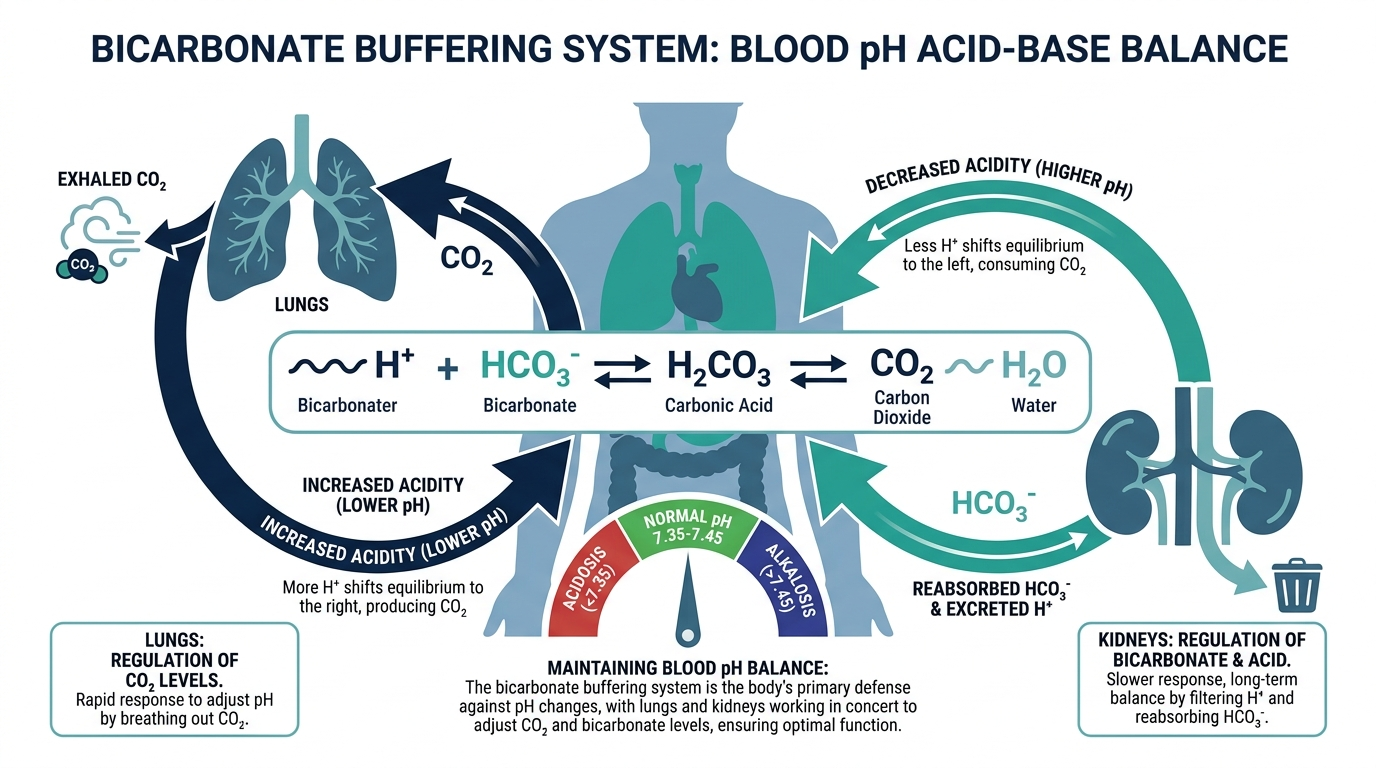
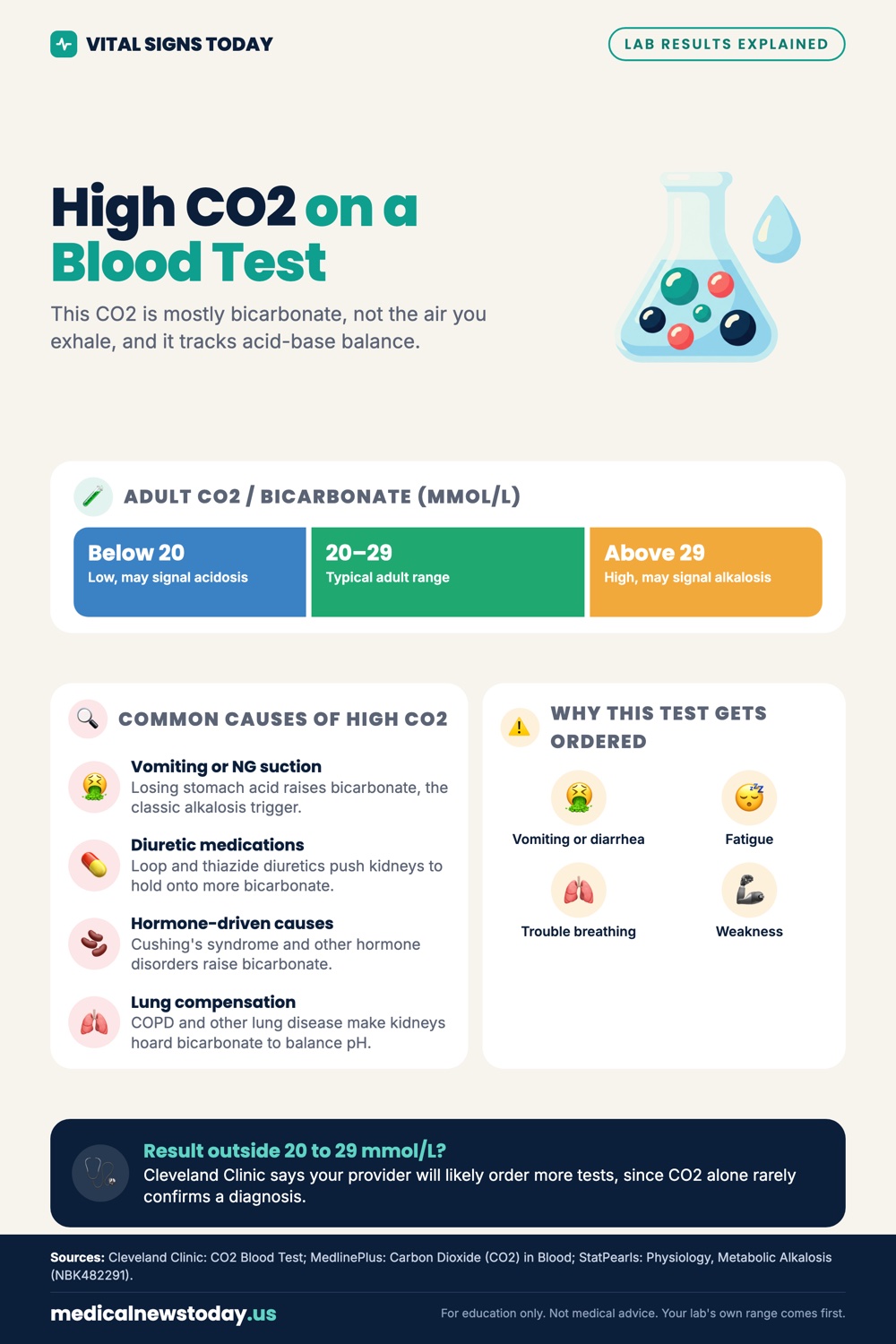
A high CO2 on a routine blood test means your blood is carrying more bicarbonate than expected, which usually signals that your body is either holding on to too much base or has lost too much acid. Most of the carbon dioxide measured in your blood travels as bicarbonate (HCO3), an electrolyte that helps control your acid-base, or pH, balance (MedlinePlus). When that number climbs, your blood is tilting toward the alkaline side, a state clinicians call metabolic alkalosis.
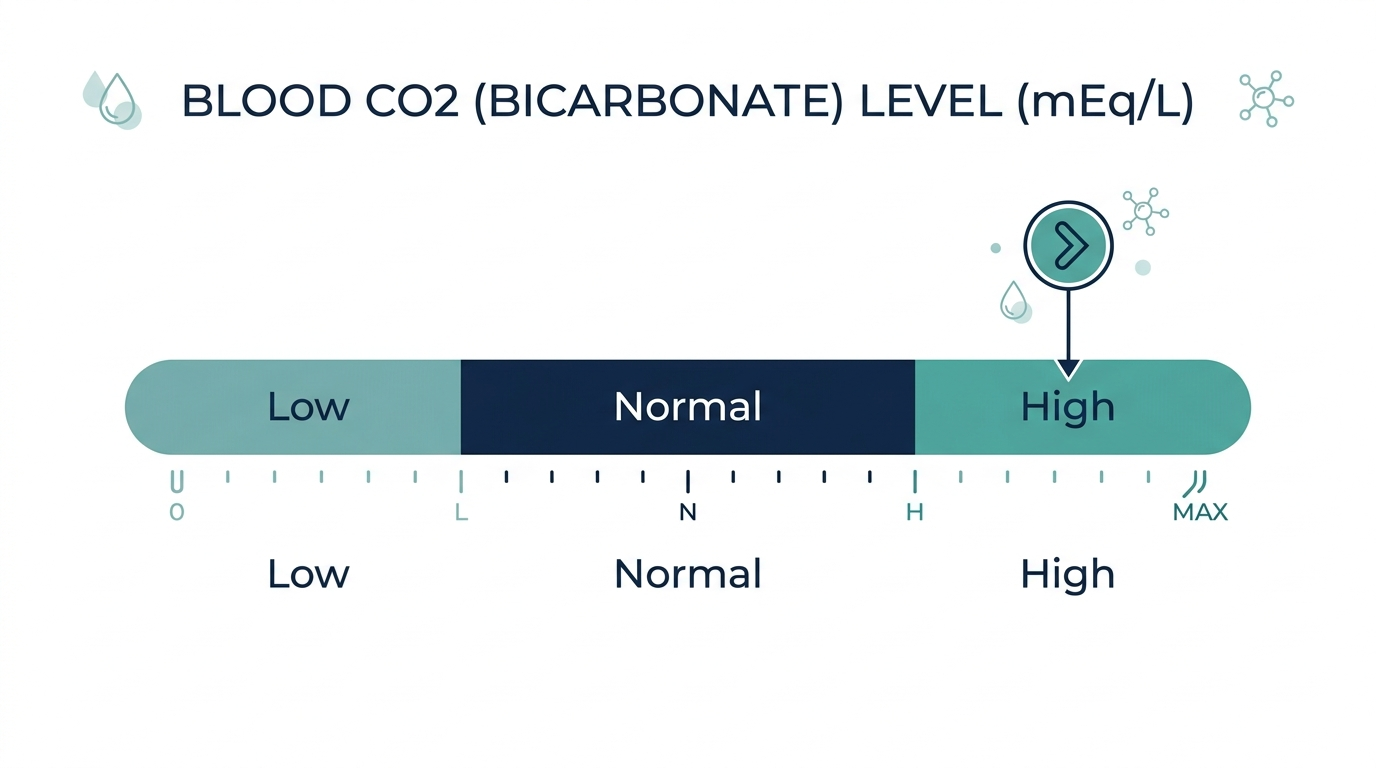
The typical reference range for CO2 on a metabolic panel runs from roughly 23 to 29 millimoles per liter, and the serum bicarbonate it reflects normally sits around 22 to 26 milliequivalents per liter (StatPearls, Bicarbonate physiology). A result above the top of your lab’s range is what counts as high. The exact cutoff varies by laboratory and instrument, so the number printed next to your result on your own report is the one that matters, not a figure you read online.
One thing to hold loosely: a single high CO2, with everything else on the panel normal and no symptoms, is often a mild finding rather than an emergency. It is a flag to interpret in context, not a diagnosis on its own.

What causes a high CO2?
A high CO2 on the metabolic panel points to metabolic alkalosis, and the causes fall into a fairly short list. Ranked roughly by how often they show up in real practice (StatPearls, Metabolic Alkalosis):
- Loss of stomach acid. This is the classic cause. Repeated vomiting or drainage from a nasogastric tube strips hydrochloric acid out of the body, and bicarbonate rises to fill the gap.
- Diuretic medications. Loop and thiazide water pills are among the most common culprits in everyday medicine. They push the kidneys to dump fluid and acid, which nudges bicarbonate up.
- Dehydration and volume loss. When the body becomes concentrated, bicarbonate gets relatively more concentrated too, a pattern sometimes called contraction alkalosis (MedlinePlus).
- Low potassium. Hypokalemia and metabolic alkalosis tend to travel together and reinforce each other, which is why your potassium is worth checking whenever CO2 is high.
- Hormone-driven causes. Conditions with excess aldosterone or cortisol, such as primary hyperaldosteronism and Cushing syndrome, drive the kidneys to retain bicarbonate (StatPearls, Metabolic Alkalosis).
- Compensation for a lung problem. If your lungs are chronically retaining carbon dioxide, the kidneys deliberately hoard bicarbonate to keep your pH closer to normal, and that shows up as a high CO2 on the panel (StatPearls, Bicarbonate physiology).
That last cause is important and easy to miss, and it is the reason a high CO2 is never read in isolation. Whether bicarbonate is the problem or the body’s fix depends entirely on the rest of the picture.
What are the symptoms of a high CO2?
Here is the honest answer most people are not expecting: a mildly high CO2 often causes no symptoms at all. It is frequently picked up by accident on a routine panel in someone who feels fine. When metabolic alkalosis is more pronounced, the symptoms tend to come from the disturbances that ride along with it, especially low potassium and low calcium effects, rather than from the bicarbonate itself.
When symptoms do appear, they can include muscle weakness, twitching, cramps, numbness or tingling (paresthesia), light-headedness, nausea, and confusion (StatPearls, Metabolic Alkalosis). Because these overlap with so many other conditions, they are rarely what sends someone to get the test. More often the test comes first and the symptoms, if any, make sense only in hindsight.
If you have been dealing with prolonged vomiting, diarrhea, trouble breathing, weakness, or fatigue, those are exactly the kinds of clues that point toward an electrolyte imbalance worth investigating (MedlinePlus).
When is a high CO2 dangerous or a medical emergency?
Most high CO2 results are mild and manageable. The danger rises with how high the number goes and what comes with it. Severe metabolic alkalosis becomes life-threatening mainly through its effect on the heart and muscles, particularly when it occurs alongside low potassium and low calcium, which together can trigger dangerous heart rhythm disturbances (StatPearls, Metabolic Alkalosis).
To give a sense of scale, one analysis found that for every 5 milliequivalent per liter rise in bicarbonate above 30, the odds of hospital mortality went up by about 21 percent in affected patients (StatPearls, Metabolic Alkalosis). That is a statistic about sick, hospitalized people, not a verdict on a single mildly flagged outpatient result, but it explains why clinicians take very high values seriously.
Treat these as red flags that deserve urgent attention rather than a wait-and-see approach: severe muscle weakness, hand and foot spasms (carpopedal spasm), a racing or irregular heartbeat, confusion, or seizures. Paired with a very high CO2, those warrant same-day medical care.

What should you do about a high CO2?
The single most useful move is to stop reading the CO2 line in isolation and look at it the way a clinician does, alongside the rest of the panel. A high CO2 is a clue, and the next steps are about finding what is driving it.
- Confirm and contextualize. Your clinician will check your potassium, chloride, sodium, and kidney numbers on the same panel, because the pattern across them points to the cause far better than CO2 alone (MedlinePlus).
- Review the obvious triggers. Recent vomiting, heavy diuretic use, and dehydration explain a large share of mild elevations and are often reversible once recognized (StatPearls, Metabolic Alkalosis).
- Restore what is missing. Treatment usually means correcting the underlying problem rather than the number itself, for example rehydrating, replacing potassium, and adjusting medications. The bicarbonate tends to follow once the driver is fixed.
- Consider an arterial blood gas if the cause is unclear. When the metabolic panel cannot fully explain the picture, a blood gas measures pH and the respiratory side directly and settles whether bicarbonate is the cause or the compensation.
What you should not do is try to self-correct a flagged CO2 with diet hacks or supplements. The fix depends on the cause, and the wrong intervention can make things worse.
When should you see a doctor?
If your CO2 is only slightly above range and you feel well, the right move is usually to discuss it with your clinician at your next visit, especially to review your medications and recent illnesses. A repeat test often sorts out whether it was a one-time blip or a real trend.
Seek prompt care if a high CO2 comes with persistent vomiting, marked weakness, muscle spasms, an irregular or racing heartbeat, confusion, or trouble breathing (StatPearls, Metabolic Alkalosis). And if you have a chronic lung condition such as COPD, any signs of carbon dioxide buildup deserve attention before they reach a dangerous level (StatPearls, Hypercapnia). When in doubt, the person who ordered the test is the right person to interpret it.
The thing most people miss: two very different high CO2 results
This is the nuance that trips up patients and even gets misread on occasion, so it is worth slowing down for. The word CO2 shows up on two completely different tests, and a high value means almost opposite things depending on which one you are looking at.
On a routine metabolic panel from a regular arm draw, CO2 is bicarbonate, and a high value points to metabolic alkalosis, your blood tilting alkaline (MedlinePlus). On an arterial blood gas, which uses a specialized arterial draw, the relevant CO2 number is PaCO2, the pressure of dissolved carbon dioxide gas. A high PaCO2, defined as greater than 42 millimeters of mercury, is hypercapnia, and it usually means your lungs are not clearing carbon dioxide well, which tilts your blood acidic, the opposite direction (StatPearls, Hypercapnia).
So a high CO2 can mean too alkaline or too acidic depending entirely on the test. The other quiet trap is the compensation case: in someone with chronic lung disease, a high bicarbonate on the metabolic panel is not a separate problem at all, it is the kidneys doing their job to offset retained gas (StatPearls, Bicarbonate physiology). Reading that bicarbonate as a fresh disorder, instead of as a clue to the lungs, is one of the more common ways a high CO2 gets misinterpreted. If your result has you worried, the first useful question is simply: which test is this, and what is my pH doing?

Chloride-responsive versus chloride-resistant alkalosis
Clinicians divide metabolic alkalosis, the state a high CO2 usually reflects, into two big families, and the split is not academic. It determines both the likely cause and the fix.
The first family is chloride-responsive (also called saline-responsive) alkalosis. These are the cases driven by loss of fluid, acid, and chloride, from vomiting, nasogastric drainage, diuretics, or dehydration. The tell is a low urine chloride, and the reason it matters is that these cases usually correct with fluid and chloride replacement. This is the common, reversible group behind most mild high CO2 results in outpatients.
The second family is chloride-resistant (saline-unresponsive) alkalosis. These are usually hormone-driven, from conditions with excess aldosterone or cortisol such as primary hyperaldosteronism or Cushing syndrome. Here urine chloride tends to be higher, blood pressure is often elevated, and simply giving fluids does not fix the problem, because the kidney is being told to retain bicarbonate. Distinguishing the two families is exactly why your clinician cares about your blood pressure and may check urine electrolytes when a high CO2 does not have an obvious cause.
Want to check your CO2?
Three ways to get it measured. Pick whichever fits you.
Affiliate links: we may earn a commission at no extra cost to you. A lab test does not replace a visit with your clinician.
Reading CO2 with the rest of the metabolic panel
CO2 is one line in a tightly linked set of electrolytes, and the pattern around it is what makes it interpretable:
- Chloride. Bicarbonate and chloride tend to move in opposite directions. A high CO2 paired with a low chloride is the classic metabolic alkalosis signature, and the two together are more informative than either alone.
- Potassium. Low potassium and metabolic alkalosis reinforce each other, so a high CO2 with a low potassium is a recognizable pairing that points toward vomiting, diuretics, or a hormone-driven cause.
- The anion gap. Calculated from sodium, chloride, and bicarbonate, the anion gap helps sort out mixed acid-base disorders. A high bicarbonate can partially mask or coexist with other disturbances, and the gap is one of the tools used to untangle them.
- Kidney numbers. A rising BUN and creatinine alongside a high CO2 can signal the dehydration and volume contraction behind contraction alkalosis.
This is why a clinician never reads the CO2 value by itself. The neighbors turn a single flagged number into a coherent story about fluid, acid, and hormones.
What can distort a CO2 result
Because CO2 on the panel measures a dissolved gas as bicarbonate, handling of the sample can shift it, and a few technical factors are worth knowing before you over-read a borderline value:
- Delayed processing or an unsealed tube. If the sample sits exposed to air, carbon dioxide can escape and the measured CO2 can drift. Good labs minimize this, but it is a real source of small variation.
- A very tight or prolonged tourniquet. Extended venous stasis during the draw can subtly alter electrolyte readings.
- Recent vomiting or heavy antacid use. These can genuinely raise bicarbonate, so they are causes rather than artifacts, but they are worth flagging to whoever reads the result.
If a high CO2 is isolated, mild, and unexpected in someone who feels well, a simple repeat under clean conditions often settles whether it was real or a handling quirk.

Worked examples: two paths to a high CO2
Picture two panels that both flag CO2 high.
In the first, the person has had several days of vomiting from a stomach bug. Their CO2 is elevated, chloride is low, potassium is low, and kidney numbers hint at dehydration. This is textbook chloride-responsive metabolic alkalosis from acid and fluid loss, and it typically corrects with rehydration and replacing potassium and chloride. The high bicarbonate is a consequence, not a separate disease.
In the second, the person feels well, takes no diuretics, has not been vomiting, but has high blood pressure and a persistently high CO2 with low potassium across more than one test. That combination raises the possibility of a hormone-driven, chloride-resistant cause and earns a more targeted evaluation. Same flagged line, very different investigation, because the surrounding pattern points in opposite directions.
Who should pay attention to a high CO2, and how often to recheck
A one-time, mildly high CO2 in an otherwise normal panel rarely needs aggressive follow-up beyond a conversation and, often, a repeat test. The people who should watch it more closely are those with recognizable drivers: anyone on long-term diuretics, people with recurrent vomiting or eating disorders, those with chronic lung disease where bicarbonate may be compensating for retained gas, and people with hard-to-control high blood pressure and low potassium, where a hormone-driven cause is on the table.
For most everyday cases the sensible cadence is to address the obvious trigger, medication, dehydration, vomiting, then recheck the panel once things settle. A CO2 that normalizes has answered the question. A CO2 that stays high without an obvious reason, especially with abnormal potassium or blood pressure, is the one that deserves a deeper look rather than another shrug.
Common misunderstandings about a high CO2
- “High CO2 means I am not breathing right.” On a routine metabolic panel, the CO2 line is bicarbonate, not the gas you exhale, and a high value there points toward the metabolic and electrolyte side, not directly to your lungs. The lung-related CO2 is a different measurement on an arterial blood gas.
- “I need to eat less alkaline food to fix it.” Diet tweaks and supplements are not the fix for a flagged CO2. The correction depends on the underlying cause, whether that is rehydration, replacing potassium, or adjusting a medication, and the wrong self-intervention can worsen an electrolyte imbalance.
- “A high CO2 always needs treatment.” A mild, isolated elevation in someone who feels well is frequently a minor finding that resolves on its own or with a simple recheck. Treatment is reserved for the cause when there is one, not for the number in isolation.
- “The exact number is what matters most.” The trend and the company it keeps matter more than a single value. A stable, slightly high CO2 with normal potassium and no symptoms is very different from a climbing value alongside low potassium and muscle spasms.
Frequently asked questions
What does a high CO2 mean in a blood test?
On a standard metabolic panel, a high CO2 means elevated bicarbonate, which usually reflects metabolic alkalosis, a shift of your blood toward the alkaline side (MedlinePlus). It is a clue rather than a diagnosis and is interpreted alongside your potassium, chloride, and kidney numbers.
What is the normal range for CO2 on a blood test?
CO2 on a metabolic panel typically runs about 23 to 29 millimoles per liter, reflecting a serum bicarbonate of roughly 22 to 26 milliequivalents per liter (StatPearls, Bicarbonate physiology). Ranges vary slightly by lab, so compare your value to the reference range printed on your own report.
What are the most common causes of high CO2?
The frequent causes are loss of stomach acid from vomiting, diuretic medications, dehydration, and low potassium, with hormone-driven and lung-compensation causes appearing as well (StatPearls, Metabolic Alkalosis). The pattern across the rest of your panel usually points to which one applies.
Is a high CO2 on a blood test dangerous?
A mildly high CO2 is often harmless and may cause no symptoms. It becomes dangerous when it is very high or paired with low potassium and low calcium, which can trigger heart rhythm problems, muscle spasms, confusion, or seizures (StatPearls, Metabolic Alkalosis). Those signs warrant urgent care.
Does high CO2 always mean a lung problem?
No. High CO2 on a routine metabolic panel is bicarbonate and points to metabolic alkalosis, while high CO2 as PaCO2 on an arterial blood gas means the lungs are retaining carbon dioxide gas (StatPearls, Hypercapnia). They are different tests with nearly opposite meanings, so the type of test matters.
This article is for general educational purposes and is not medical advice. It cannot diagnose or treat you and does not replace your clinician. Always discuss your lab results and any health decisions with a qualified healthcare professional.
Vital Signs Today may earn a commission if you buy through links on this page. It does not affect our editorial assessments.