
Disclosure: Vital Signs Today may earn a commission if you buy through links on this page, at no extra cost to you. This does not influence our evidence-based assessments. We are not a medical provider; talk to a clinician before acting on test results.
You scanned your metabolic panel, hit the line marked CO2, and saw a number under the reference range, maybe with a little “L” next to it. Your first instinct was probably wrong, because most people see “CO2” and picture the gas you breathe out. On a routine blood panel, that is not what this number measures. It measures your blood’s acid buffer, and when it runs low it is telling you something specific about your chemistry.
Here is the part most explainers miss. A low CO2 is rarely about your lungs. It is usually a window into your kidneys and how much acid your body is carrying.
Part of our Comprehensive Metabolic Panel guide.
What does low CO2 mean in a blood test?
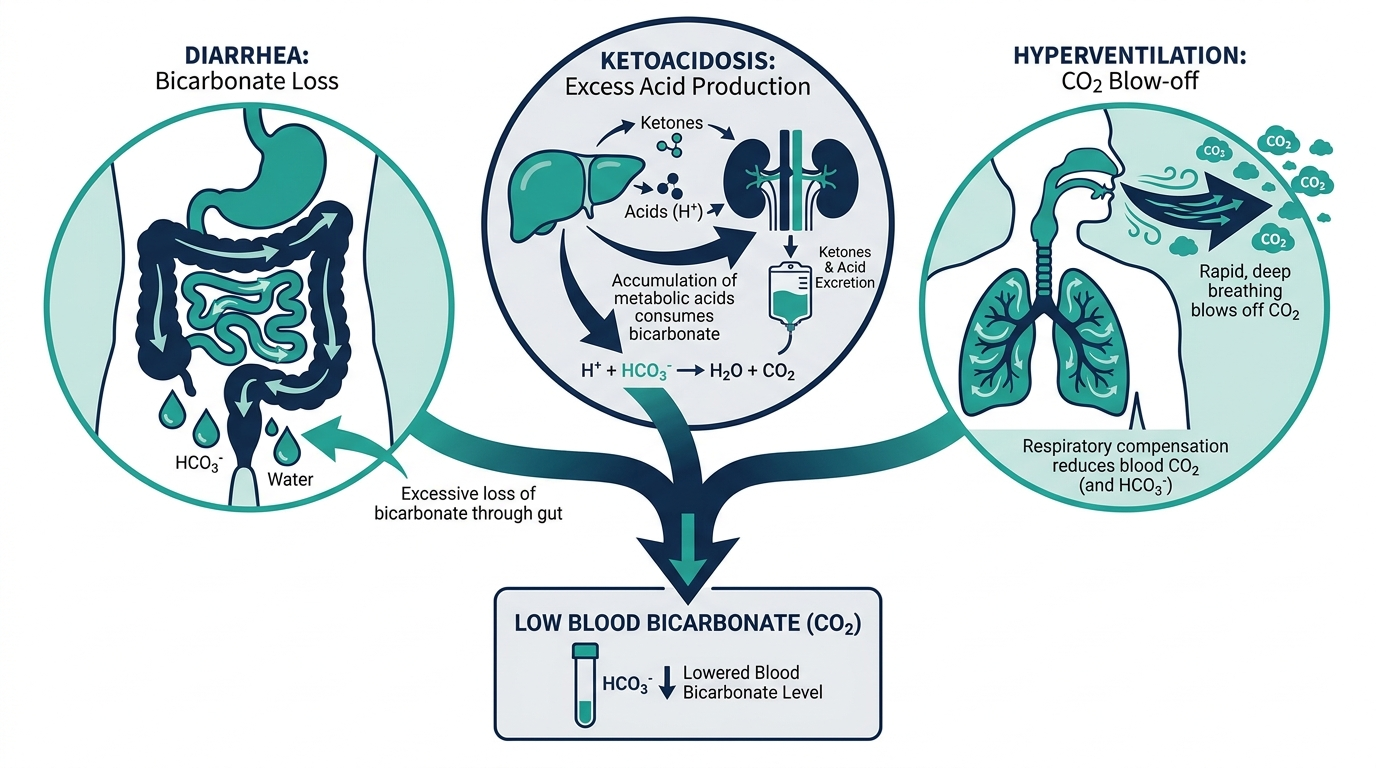
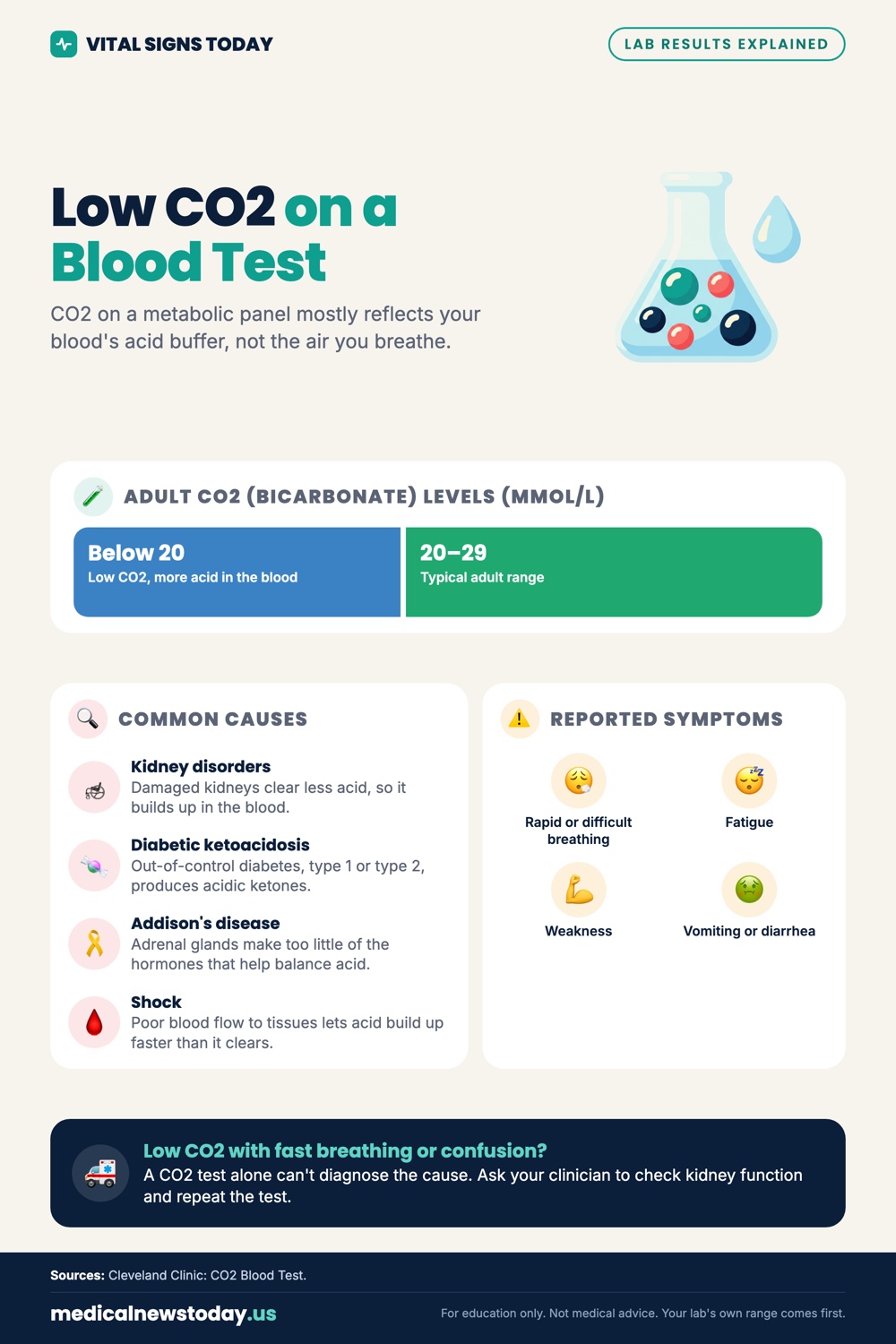
To answer the question most people are typing, what does low CO2 mean in a blood test: a low CO2 result usually means your blood is carrying too much acid, a state clinicians call metabolic acidosis. The “CO2” on a basic or comprehensive metabolic panel is shorthand for total carbon dioxide, and the large majority of that value is bicarbonate, the main base your body uses to neutralize acid (MedlinePlus).
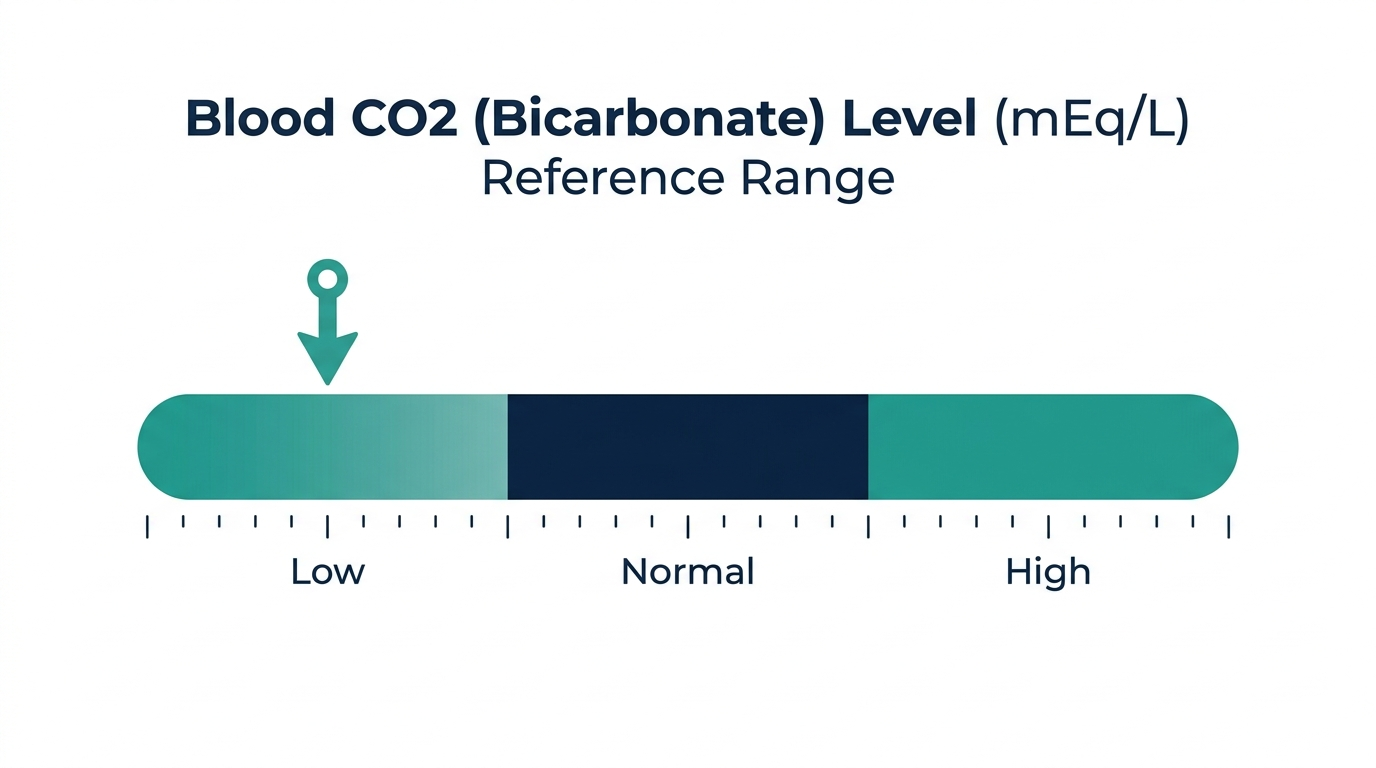
So when the number drops, your bicarbonate buffer is being depleted faster than your body can replace it. The standard CO2 range is roughly 20 to 29 mmol per liter, though it varies slightly by lab (Cleveland Clinic). Kidney specialists draw the line tighter and recommend serum bicarbonate stay at or above 22 mEq per liter, so a value below 22 is the threshold where they call it metabolic acidosis (National Kidney Foundation).
One result below the line is not a diagnosis. It is a flag. The CO2 number tells you acid and base are out of balance, but it cannot tell you why on its own (Cleveland Clinic). The why is where the work begins.

What causes a low CO2?
A low CO2 comes down to one of three mechanics: your body is making too much acid, it is losing too much bicarbonate, or your kidneys cannot clear the normal acid load. Here are the real causes, most common first.
- Kidney disease. One of the leading culprits. Damaged kidneys cannot excrete enough acid into the urine, so it builds up and eats through your bicarbonate. In chronic kidney disease, a persistently low bicarbonate is both a sign of the disease and a driver of faster decline (National Kidney Foundation).
- Long-lasting diarrhea. Easy to underrate. Your lower gut is full of bicarbonate, and severe or prolonged diarrhea flushes it out. Along with kidney failure, it is among the most common causes (Cleveland Clinic).
- Diabetic ketoacidosis. When diabetes is out of control, the body burns fat and pumps out acidic ketones that overwhelm the buffer, in both type 1 and type 2 diabetes (MedlinePlus).
- Lactic acidosis. When tissues run short on oxygen, muscle and red blood cells produce lactic acid. Causes range from intense exertion to liver failure, severe infection, and low blood sugar (Cleveland Clinic).
- Renal tubular acidosis. A kidney problem where the tubules fail to move enough acid into the urine, quietly acidifying the blood (Cleveland Clinic).
- Addison disease, shock, and hyperventilation. Adrenal insufficiency and circulatory shock can both push CO2 low. So can rapid, deep breathing from anxiety, pain, or a lung problem, the one exception to the “it is not your lungs” rule (MedlinePlus).
That last point matters because it splits low CO2 into two families. Most of the time it reflects an acid problem in the body’s metabolism. Occasionally it reflects breathing too fast. Your clinician separates these by looking at the full picture.
What are the symptoms of a low CO2?
Here is the honest answer most articles dodge: a mildly low CO2 often produces no symptoms at all. Plenty of people learn about it only because a routine panel caught it, and that is genuinely common with chronic, slow-burning acidosis (Cleveland Clinic).
When acidosis becomes significant, the body starts showing it. Reported symptoms of metabolic acidosis include (Cleveland Clinic):
- Rapid or deep breathing, as the lungs try to blow off acid
- Fast heartbeat
- Confusion or dizziness
- Fatigue and weakness
- Nausea, vomiting, and loss of appetite
- Breath that smells sweet or fruity, a classic clue to diabetic ketoacidosis
Notice how nonspecific most of these are. Tired, queasy, foggy, and a bit breathless describes a hundred conditions. That is precisely why the blood number is useful: it puts a measurable flag on a state your body might otherwise hide. A low CO2 plus several of these symptoms together carries more weight than either alone.
When is a low CO2 dangerous or a medical emergency?
Severity is not about how far below 22 the number sits in isolation. It is about how fast it dropped and what is driving it. A bicarbonate of 21 in an otherwise well person is a different animal from a bicarbonate of 21 in someone who is breathing hard, confused, and vomiting.
Treat it as urgent when a low CO2 comes bundled with red-flag symptoms: rapid breathing, a racing heart, confusion or trouble staying alert, severe weakness, or fruity-smelling breath. Severe metabolic acidosis can be fatal, and that cluster of breathing, circulation, and mental-status changes signals you should seek care immediately (Cleveland Clinic).
Two scenarios deserve extra alarm. Diabetic ketoacidosis is a true emergency, so a low CO2 with high blood sugar, deep breathing, and that sweet breath odor means get help now. Shock, where the body is not perfusing its tissues, is the other, and it is a serious medical emergency in its own right (MedlinePlus). In both, the low CO2 is a symptom of something accelerating, not the problem itself.

What should you do about a low CO2?
The most useful thing to understand is that you do not treat the CO2 number. You treat the cause. A CO2 blood test alone cannot diagnose a condition (Cleveland Clinic), so the next steps are about finding the why. Expect your clinician to do some or all of the following:
- Look at the rest of your panel. The electrolytes on the same draw let your clinician calculate an anion gap, the fork in the road. A high anion gap points toward added acid like ketones or lactate, while a normal gap points toward lost bicarbonate like diarrhea.
- Check your kidneys. Because kidney disease is a leading cause, creatinine and an estimated filtration rate are natural follow-ups, especially since untreated acidosis can speed kidney decline (National Kidney Foundation).
- Consider an arterial blood gas. If the picture is unclear or you are unwell, a blood gas confirms whether the body is truly acidic and whether breathing is compensating.
- Repeat the test. A single borderline value in a healthy person is sometimes just noise. Trends matter more than one reading.
When the acidosis is real and chronic, treatment can include oral alkali therapy such as sodium bicarbonate or sodium citrate, plus dietary shifts toward more fruits and vegetables and less of the acid load from meats, eggs, cheese, and grains (Cleveland Clinic). None of that is a self-prescribe project. Loading up on baking soda on your own can backfire, so this belongs with your clinician.
When should you see a doctor?
If the low CO2 turned up on a routine panel and you feel completely fine, the right move is a conversation, not an alarm. Bring it up at your next visit, ask whether it should be rechecked, and ask whether your kidney numbers were normal on the same draw.
Move faster if you have known kidney disease or diabetes, because in those groups a low CO2 is more likely to be meaningful (Cleveland Clinic). And do not wait at all if the number comes with the emergency cluster above: hard or fast breathing, racing heart, confusion, severe fatigue, or fruity breath. That is a same-day, possibly emergency-room situation.
The insider read: why one low CO2 fools people, and what gets missed
After enough panels cross your desk, you learn that the CO2 line is one of the most misread numbers on the report, in both directions.
The first trap is technical. Total CO2 is one of the most fragile values on the panel because carbon dioxide physically escapes from the sample if the tube sits open or unspun too long before it reaches the analyzer. A slowly handled specimen can read falsely low. So a mildly low CO2 in a person with zero symptoms and a spotless rest-of-panel is sometimes a sample-handling artifact, not real acidosis. This is why a careful clinician repeats a borderline value before chasing it.
The second trap is the opposite mistake: dismissing a real signal because it is small. A bicarbonate of 20 or 21 sounds trivial, the patient feels fine, so it gets waved off as “barely low.” But in someone with chronic kidney disease, that quiet, persistent dip is not cosmetic. Low serum bicarbonate is associated with faster progression to kidney failure, likely because the lingering acid load directly damages kidney tissue over time (National Kidney Foundation). The number that looks least dramatic can matter most over years.
The reconciling skill is context. The same value of 21 can be a lab artifact you ignore, an early kidney signal you act on, or one piece of an acute emergency. The CO2 number does not interpret itself. It earns meaning only when read next to the anion gap, the kidney markers, the symptoms, and the person.

The anion gap: the single most useful next step
When CO2 is low, the fastest way to narrow the cause is a number your clinician can calculate from the same panel, the anion gap. It is a simple subtraction, sodium minus the sum of chloride and bicarbonate, and it sorts metabolic acidosis into two very different families. Understanding this split explains most of what happens after a low CO2.
- High anion gap acidosis means extra acid has been added to the blood. The classic causes are diabetic ketoacidosis, lactic acidosis, advanced kidney failure, and certain poisonings. Here the low CO2 reflects acid the buffer is fighting.
- Normal anion gap acidosis means bicarbonate is being lost rather than acid added. The two headline causes are prolonged diarrhea, which flushes bicarbonate out of the gut, and renal tubular acidosis, where the kidney fails to reclaim or excrete acid properly.
This is why two people with an identical CO2 of 18 can be sent down completely different paths. One has ketones and needs urgent diabetes care, the other has had a week of diarrhea and needs fluids and bicarbonate. The anion gap is the fork that tells them apart, which is why it is almost always the first thing calculated after a low CO2.
The panel that surrounds a low CO2
| Companion test | What it adds to a low CO2 |
|---|---|
| Sodium and chloride | Needed to calculate the anion gap, the key sorting step. |
| Creatinine and eGFR | Screen for kidney disease, a leading cause, and gauge how much acid the kidneys can clear. |
| Glucose and ketones | A high glucose with ketones points to diabetic ketoacidosis, a true emergency. |
| Lactate | A high lactate confirms lactic acidosis, seen in poor tissue oxygen delivery, sepsis, or shock. |
| Potassium | Acid-base shifts move potassium in and out of cells, so it is watched closely in acidosis. |
| Arterial blood gas | Confirms whether the blood is truly acidic and whether breathing is compensating. |
Want to check your CO2?
Three ways to get it measured. Pick whichever fits you.
Affiliate links: we may earn a commission at no extra cost to you. A lab test does not replace a visit with your clinician.
Metabolic versus respiratory, and how the body compensates
The CO2 on a metabolic panel measures bicarbonate, the metabolic side of acid-base balance. Your lungs control the other side by adjusting how much carbon dioxide gas you breathe off. The two systems are designed to back each other up, and reading a low CO2 well means asking which one moved first.
- Metabolic acidosis with respiratory compensation. When acid builds up and bicarbonate falls, the lungs speed up breathing to blow off acid. This is why deep, rapid breathing, sometimes called Kussmaul breathing, accompanies serious acidosis. The low CO2 is the problem, and the fast breathing is the rescue attempt.
- Primary respiratory alkalosis. Occasionally the breathing moves first. Hyperventilation from anxiety, pain, or a lung problem blows off carbon dioxide, and the kidneys respond over time by lowering bicarbonate to keep balance. Here the low CO2 is the compensation, not the cause.
An arterial blood gas is what separates these definitively, because it shows the blood pH and the carbon dioxide gas directly. On the metabolic panel alone, the clue is context: acidosis symptoms and a high anion gap point metabolic, while a clear trigger for over-breathing points respiratory.

Reading the pattern: worked scenarios
- CO2 of 18, high glucose, ketones, deep breathing, fruity breath. Diabetic ketoacidosis, a high-gap emergency needing immediate care.
- CO2 of 19, normal anion gap, a week of severe diarrhea. Bicarbonate lost through the gut. Fluids and sometimes bicarbonate replacement, with recovery as the diarrhea resolves.
- CO2 of 20 to 21, stable chronic kidney disease, no symptoms. A quiet but meaningful signal. Often treated with oral alkali to slow kidney decline.
- CO2 of 21, feels completely well, spotless rest of panel, sample sat before processing. Frequently a handling artifact. Repeat before chasing it.
- CO2 of 18, high lactate, low blood pressure, very unwell. Lactic acidosis from poor perfusion or sepsis, a serious emergency.
How the test is done and what can skew it
CO2 is measured as part of a basic or comprehensive metabolic panel from a routine venous draw, and no fasting is specifically needed for it. The most important quirk is fragility. Total CO2 escapes from the sample as gas if the tube sits open or unspun too long, so a slowly handled specimen can read falsely low. Other factors:
- Delayed or improper sample handling, the leading cause of a falsely low value.
- Prolonged tourniquet time, which can subtly shift electrolytes.
- Certain medications, including some diuretics and, in overdose, aspirin, which can cause a real acidosis.
- Very recent intense exercise, which transiently raises lactic acid.
Common misconceptions about low CO2
- “Low CO2 means a lung or breathing problem.” On a metabolic panel it usually reflects an acid-base issue driven by metabolism or the kidneys, not the lungs. Breathing is the exception, not the rule.
- “A small dip below normal does not matter.” In someone with chronic kidney disease, a persistently low bicarbonate is linked to faster decline and often deserves treatment.
- “I can fix it by drinking baking soda.” Self-dosing alkali can backfire and mask the cause. Alkali therapy belongs with a clinician.
- “One low reading is a diagnosis.” It is a flag. A borderline value in a well person is often repeated, and sometimes it is just a sample artifact.
- “CO2 on my panel is the gas I exhale.” It mainly measures bicarbonate, your blood’s acid buffer, not exhaled carbon dioxide.
Who should watch this number, and how often
CO2 is included on standard metabolic panels, so most adults have it checked at routine visits. Closer attention is warranted for:
- People with chronic kidney disease, where bicarbonate is monitored and often kept at or above 22 to protect the kidneys.
- People with diabetes, especially during illness, where a falling CO2 can herald ketoacidosis.
- Anyone with prolonged vomiting or diarrhea, which disrupts acid-base balance.
- Those on medications that affect acid-base status, including certain diuretics.
- Anyone with a previous borderline value, where a repeat and the anion gap clarify whether it is real.
The through-line is that CO2 never interprets itself. Paired with the anion gap, kidney markers, glucose, and your symptoms, a low value becomes a precise pointer toward exactly what is off. Read alone, it is one of the most easily misjudged lines on the whole report.
Frequently asked questions
What is a normal CO2 level on a blood test?
The standard CO2 range is about 20 to 29 mmol per liter, and it varies slightly by laboratory (Cleveland Clinic). Kidney specialists recommend serum bicarbonate stay at or above 22 mEq per liter, so a value under 22 is generally where metabolic acidosis is considered (National Kidney Foundation). Always compare against the reference range on your own report.
Is a low CO2 level serious?
It depends on the cause and how you feel. A mildly low CO2 with no symptoms is often minor and sometimes just a sample-handling artifact, while a low CO2 with rapid breathing, confusion, fast heartbeat, or fruity breath can signal a dangerous acidosis and needs urgent care (Cleveland Clinic).
Why is my CO2 low in a blood test?
The most common reasons are kidney disease and prolonged diarrhea, followed by diabetic ketoacidosis, lactic acidosis, renal tubular acidosis, and sometimes hyperventilation, Addison disease, or shock (MedlinePlus). The test alone cannot pinpoint which one, so further evaluation is needed (Cleveland Clinic).
Does low CO2 mean I have a kidney problem?
Not necessarily, but kidney disease is one of the leading causes, so it is worth checking. Damaged kidneys cannot clear enough acid, and a persistently low bicarbonate is linked to faster progression toward kidney failure (National Kidney Foundation). Your clinician will usually review your kidney markers from the same blood draw.
Can anxiety or fast breathing cause a low CO2?
Yes. Rapid, deep breathing from anxiety, pain, or a lung problem can blow off carbon dioxide and lower the CO2 measure, a state called respiratory alkalosis (MedlinePlus). This is the main situation where a low CO2 reflects breathing rather than a metabolic acid problem.
This article is for general educational purposes and is not medical advice. It cannot diagnose or treat you and does not replace your clinician. Always discuss your lab results and any health decisions with a qualified healthcare professional.
Vital Signs Today may earn a commission if you buy through links on this page. It does not affect our editorial assessments.