
Part of our Comprehensive Metabolic Panel guide.
You opened your lab report, scanned the metabolic panel, and there it was sitting between your chloride and your glucose: CO2, with a number next to it. Your first thought was probably the obvious one. Is the lab measuring the carbon dioxide I breathe out? Not quite, and the gap between what people assume and what this number actually tracks is exactly why it gets ignored.
Here is the short version. The CO2 on your routine blood panel is mostly a measure of bicarbonate, the chemical your body uses to keep your blood from turning too acidic or too alkaline. It is one of the quietest acid-base signals on the whole report, and when it drifts, it usually means your kidneys, lungs, or metabolism are working overtime to hold the line.
What is CO2 in a blood test?
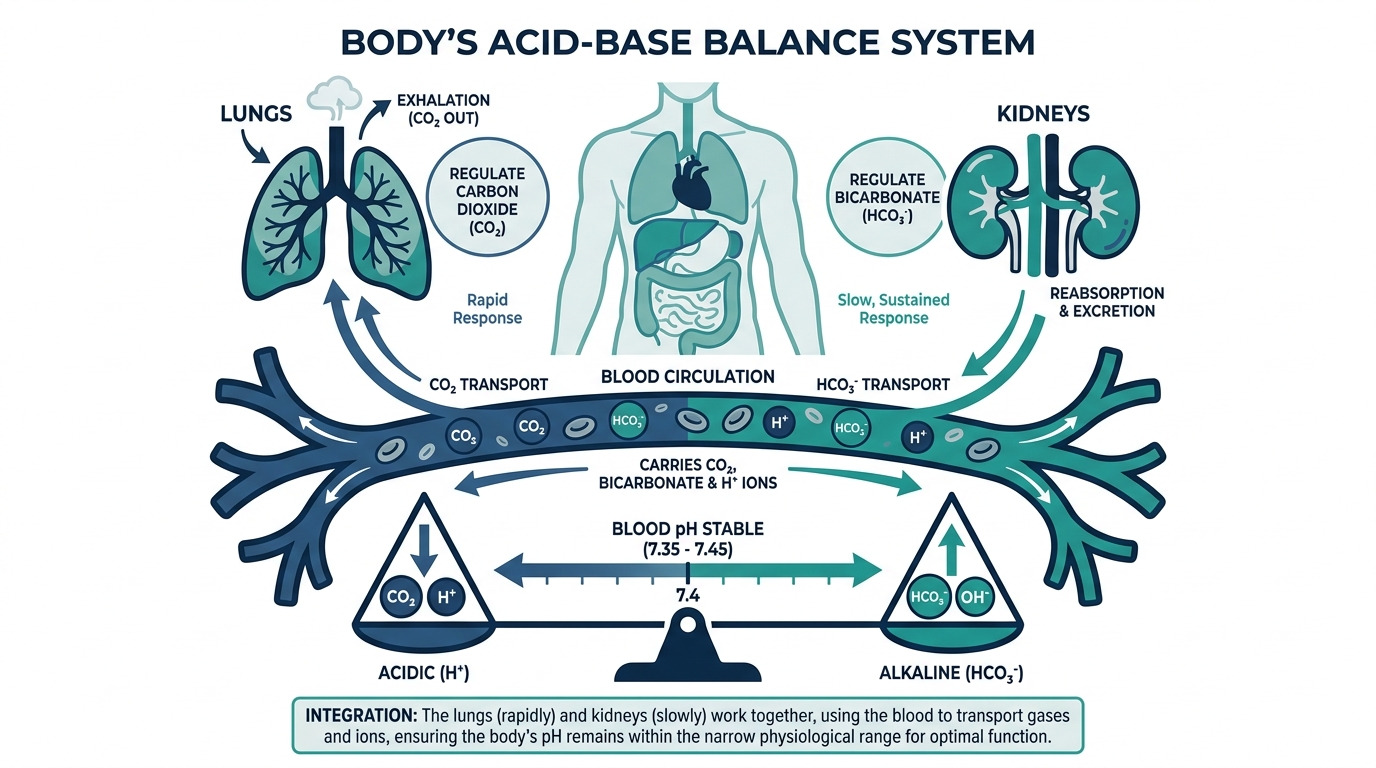
CO2 in a blood test measures the total carbon dioxide in your blood, which is mostly carried in the form of bicarbonate (HCO3). It is usually ordered as part of an electrolyte panel, a basic metabolic panel (BMP), or a comprehensive metabolic panel (CMP) (MedlinePlus). Because bicarbonate makes up roughly 95 percent of that total, clinicians treat the CO2 result as a practical stand-in for your bicarbonate level (NCBI Bookshelf, Serum Total Carbon Dioxide).
So when you see “CO2” on a standard venous blood panel, read it as “bicarbonate.” It is not the same thing as the carbon dioxide pressure measured in an arterial blood gas, and confusing the two is the single most common mistake people make with this number. More on that distinction below.

What does CO2 mean in a blood test?
When people ask what does CO2 mean in a blood test, the honest answer is that it reflects your body’s acid-base balance, also called your pH balance. Bicarbonate is the body’s main buffer, the chemical sponge that soaks up excess acid and keeps blood pH in a narrow, survivable window (MedlinePlus). The total CO2 measurement includes bicarbonate plus the small amounts of dissolved CO2 and carbonic acid in your blood (NCBI Bookshelf, Serum Total Carbon Dioxide).
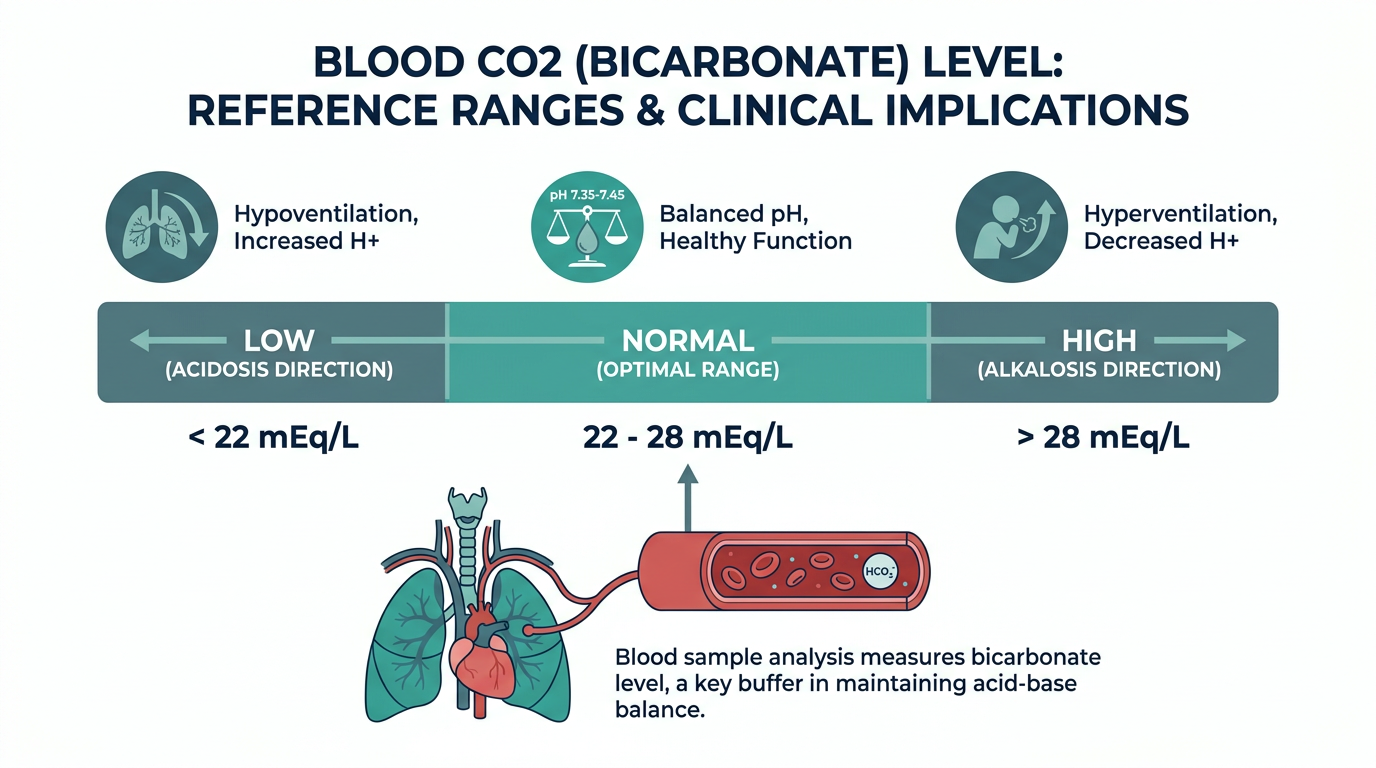
In practice, what does CO2 in blood test mean for you depends on the direction it moves. A result that falls below the range hints that acid is building up or bicarbonate is being lost. A result above the range hints that your body is holding onto too much base or losing too much acid. The number itself does not name the cause. It tells your clinician which way the chemistry has tipped so they know where to look next.
What is a normal CO2 level in a blood test?
A normal CO2 level is generally about 23 to 29 milliequivalents per liter (mEq/L), which is the same as 23 to 29 millimoles per liter (mmol/L) (MedlinePlus Medical Encyclopedia). Some references stretch the upper end slightly, listing total CO2 content as roughly 23 to 30 mEq/L, because dissolved CO2 and carbonic acid add a small amount on top of bicarbonate (NCBI Bookshelf, Serum Total Carbon Dioxide).
The practical takeaway is to read your result against the reference range printed on your own report, not a range you found online. Labs calibrate their own equipment, and a value that reads “low” on one lab’s scale may sit inside another’s. A single number a point or two outside the range, with no symptoms and a normal rest-of-panel, is rarely an emergency. It is the size of the shift and what it sits next to that matter.

What does a high CO2 level mean?
A high CO2 level means your blood is holding more bicarbonate than usual, which usually signals one of two acid-base states: metabolic alkalosis or compensation for a breathing problem. It is a clue, not a diagnosis. The common drivers behind a high reading include (MedlinePlus Medical Encyclopedia):
- Vomiting or losing stomach acid, which strips acid out of the body and leaves bicarbonate relatively high.
- Dehydration, which concentrates the blood and can nudge bicarbonate up.
- Metabolic alkalosis, a state where blood is not acidic enough.
- Lung disease, where the kidneys retain bicarbonate to offset CO2 the lungs cannot blow off, a pattern also seen in some cases of congestive heart failure (MedlinePlus).
- Cushing syndrome, a hormonal disorder that can raise bicarbonate.
Here is the insider point most patient explainers skip. A high CO2 on a venous panel does not tell you whether the problem started in the lungs or the kidneys. The same elevated bicarbonate number can mean “my kidneys are compensating for a lung that retains carbon dioxide” or “my body is losing acid through vomiting.” Those are completely different situations with different treatments, and you cannot separate them from the CO2 value alone. That is precisely why a clinician reads it next to your chloride, potassium, and the clinical picture, and may order an arterial blood gas to settle the question.
What does a low CO2 level mean?
A low CO2 level means your blood holds less bicarbonate than normal, which most often points to metabolic acidosis: too much acid in the blood, or too much bicarbonate being lost. As with a high reading, it is a signal rather than a verdict. Common causes of a low CO2 include (MedlinePlus Medical Encyclopedia):
- Diabetic ketoacidosis, where acids called ketones flood the blood and burn through bicarbonate.
- Kidney disease, when the kidneys cannot retain or regenerate enough bicarbonate.
- Prolonged diarrhea, which leaks bicarbonate out through the gut.
- Lactic acidosis, from poor oxygen delivery or severe illness.
- Addison disease, an adrenal disorder, and certain shock states.
One detail worth knowing: in metabolic acidosis, no matter the cause, the underlying event is a drop in bicarbonate concentration, whether from extra acid using it up, the body making less, or losing it through the kidneys or gut (NCBI Bookshelf, Biochemistry, Anion Gap). Certain medications can also lower CO2. Carbonic anhydrase inhibitors, used to treat glaucoma, are a classic example (MedlinePlus Medical Encyclopedia).

Why is CO2 read together with the anion gap?
CO2 rarely tells the full story by itself. When bicarbonate is low, clinicians calculate the anion gap, which uses your sodium, chloride, and bicarbonate to figure out what kind of acidosis you have. The anion gap is the difference between the positively and negatively charged particles the lab measures, and it is the standard tool for classifying metabolic acidosis (Cleveland Clinic).
The logic is elegant once you see it. If your CO2 is low and the anion gap is high, the acidosis is likely driven by an unmeasured acid such as ketones or lactate, the pattern behind diabetic ketoacidosis or lactic acidosis (NCBI Bookshelf, Anion Gap and Non-Anion Gap Metabolic Acidosis). If your CO2 is low and the anion gap is normal, the more likely story is bicarbonate loss through diarrhea or a kidney issue. One low CO2 value plus one calculation splits a long list of causes into two short ones. That is why bicarbonate earns its place on the panel: it is cheap, it is automatic, and paired with the anion gap it points the workup in the right direction.
The part most people never hear: CO2 on a panel is not the CO2 in an arterial blood gas
This is the distinction that trips up patients and even some non-specialists. The CO2 on your routine venous metabolic panel is total CO2, which is essentially bicarbonate, a metabolic value managed largely by your kidneys (NCBI Bookshelf, Serum Total Carbon Dioxide). The “CO2” you see on an arterial blood gas report, written as PaCO2, is something different: it is the pressure of carbon dioxide gas in arterial blood, a respiratory value driven by how well your lungs are clearing CO2 (MedlinePlus).
Why does the difference matter so much? Because they answer different questions. Total CO2 on a basic panel tells your clinician how your body’s buffer reserves look over time, the kidney side of the acid-base ledger. PaCO2 on an arterial gas tells them, in the moment, how your lungs are handling ventilation, the breathing side. A patient can have a “normal” CO2 on a routine panel and still be in trouble on a blood gas, or the reverse. When you read your own results, anchoring on which CO2 you are looking at, the venous bicarbonate number or the arterial gas pressure, keeps you from drawing the wrong conclusion about whether the issue is metabolic or respiratory.

The electrolytes CO2 is read next to on the panel
Bicarbonate does not float alone on your metabolic panel. It sits inside a group of electrolytes that move together to keep your blood electrically balanced, and reading them as a set is what turns a lone CO2 number into a diagnosis.
- Chloride. Chloride and bicarbonate often move in opposite directions, because both are negatively charged and the body swaps one for the other to stay balanced. A low CO2 with a high chloride is a recognizable pattern of a non-gap acidosis, while a high CO2 with a low chloride can accompany metabolic alkalosis. This inverse dance is one of the first things a clinician checks.
- Sodium. Sodium is the main positively charged electrolyte and one of the values plugged into the anion gap calculation, which is why it is read alongside bicarbonate and chloride.
- Potassium. Acid-base shifts and potassium travel together. In acidosis, potassium can move out of cells and read high, and in alkalosis it can drift low. A CO2 abnormality paired with an unexpected potassium is a clue that the disturbance is real and active.
The practical point is that a single CO2 number is nearly uninterpretable in isolation, but CO2 read with sodium, chloride and potassium tells your clinician both the direction of the acid-base problem and, via the anion gap, its likely category.
Worked examples: reading a CO2 result in context
Seeing how the number behaves in real patterns makes it far less mysterious. Here are common scenarios and what they nudge a clinician toward. None of these is a self-diagnosis, they show the reasoning.
- CO2 low, anion gap high, glucose very high: the classic footprint of diabetic ketoacidosis, where acids called ketones consume bicarbonate. This is a scenario that needs urgent care, not a wait-and-see.
- CO2 low, anion gap normal, recent prolonged diarrhea: points toward bicarbonate lost through the gut rather than an acid flooding the blood, a very different and usually less alarming path.
- CO2 high, chloride low, history of vomiting: loss of stomach acid leaving bicarbonate relatively elevated, a metabolic alkalosis picture.
- CO2 high in someone with known chronic lung disease: often the kidneys retaining bicarbonate to compensate for a lung that cannot fully clear carbon dioxide, which is why an arterial blood gas may be needed to see the respiratory side.
- CO2 one point out of range, everything else normal, no symptoms: frequently just normal variation or a minor preanalytic effect, and often simply rechecked.
The through line is that the CO2 value earns its meaning from its neighbors and from your clinical story. The same number can be an emergency in one context and a non-event in another.
Symptoms that may accompany an abnormal CO2
Bicarbonate itself is silent, but the acid-base disturbances it signals can produce symptoms, and pairing the number with how you feel is part of reading it well.
- With metabolic acidosis (often low CO2): people may breathe faster or deeper as the body tries to blow off acid, and can feel fatigued, confused, or nauseated. Deep, rapid breathing in the setting of a low bicarbonate is a notable sign.
- With metabolic alkalosis (often high CO2): symptoms can include muscle twitching, hand tremor, cramping, or tingling, often tied to the shifts in calcium and potassium that accompany the alkalosis.
- Underlying-cause symptoms: the vomiting, diarrhea, or excessive thirst and urination that drove the CO2 change are themselves signals worth reporting, because they point at the source.
A number that is only mildly out of range in someone who feels completely well is treated very differently from the same number in someone who is breathing hard, confused, or acutely ill. That is the red-flag distinction: symptoms plus an abnormal CO2 warrants prompt evaluation, whereas an isolated borderline value usually does not.
Why a CO2 result can be misleading
Before acting on a CO2 value, it helps to know that this particular marker is prone to preanalytic artifact, meaning the number can shift for reasons that have nothing to do with your acid-base status.
- Sample handling. Total CO2 is measured on a venous sample, and because dissolved CO2 gas can escape when a tube sits open or is delayed in transit, a specimen that is not handled promptly can read slightly lower than the true value. This is a well-known reason to repeat a borderline result.
- A tight or prolonged tourniquet. Drawing blood with a tourniquet left on too long can subtly alter electrolyte readings.
- Medications. Diuretics can raise bicarbonate, while carbonic anhydrase inhibitors used for glaucoma can lower it, so your medication list is part of interpreting the number.
- Recent vomiting or diarrhea on the test day. A transient gut upset can move the value without meaning a chronic problem.
The takeaway is a healthy skepticism about a single mildly abnormal CO2. If the value is borderline, does not fit your symptoms, or clashes with the rest of your panel, the sensible next step is often a simple repeat draw rather than an anxious workup.
Who is tested and what happens after an abnormal result
CO2 is rarely ordered alone. It arrives automatically as part of the basic or comprehensive metabolic panel, so most people get it during a routine physical, a hospital workup, or monitoring of a known condition.
Certain groups have their bicarbonate watched more closely:
- People with kidney disease, where the kidneys’ ability to regenerate bicarbonate can fail and a low CO2 is monitored over time.
- People with diabetes, where a falling CO2 with a rising anion gap can herald ketoacidosis.
- People with chronic lung disease or heart failure, where bicarbonate reflects renal compensation.
- People on diuretics or other medications that shift acid-base balance.
If your result is abnormal, the next steps usually follow a logical order: repeat or confirm the value, calculate the anion gap, review your other electrolytes and symptoms, and, when the question is whether the problem is respiratory, obtain an arterial blood gas. Treatment then targets the underlying cause rather than the number itself, since a low or high bicarbonate is a symptom of something upstream, whether that is uncontrolled diabetes, fluid loss, a kidney problem, or a medication effect. Correcting bicarbonate in a vacuum is not the goal. Fixing what moved it is.
Questions people ask most about a CO2 result
The first question is almost always whether a high or low CO2 on a blood panel has anything to do with breathing. It is an understandable mix up, because we associate carbon dioxide with the lungs. But the CO2 on a basic metabolic panel is mostly a measure of bicarbonate, the buffer your kidneys use to keep your blood from turning too acidic. It is a chemistry number, not a lung function reading. The carbon dioxide your lungs handle is measured on a separate arterial blood gas test, which is why the same word can point at two very different things.
People also ask whether a slightly abnormal CO2 is something to worry about. On its own, usually not much. CO2 sits within a fairly wide normal band, and small deviations are common and often meaningless, especially if you feel well and the rest of the panel is unremarkable. What gives a CO2 value weight is the company it keeps: the anion gap, the other electrolytes, and any symptoms. A borderline number in isolation is frequently just rechecked rather than acted on.
Another frequent question is what a doctor does with the result. Because CO2 is a marker of acid base balance, an abnormal value points toward a broader question rather than a single diagnosis. A low CO2 can accompany conditions that make the blood too acidic, while a high CO2 can reflect a compensatory shift. Clinicians read it alongside the anion gap and the clinical picture to decide whether it reflects a real metabolic disturbance or simply normal variation, which is why the number is almost never interpreted by itself.
How to prepare for a CO2 test and read your result with confidence
The good news is that a CO2 measurement, drawn as part of a basic or comprehensive metabolic panel, needs very little special preparation. If the panel includes glucose or a lipid measurement, your provider may ask you to fast beforehand, so the practical step is to check whether fasting is required for the overall panel rather than for the CO2 specifically. Bring a current list of your medications and supplements, since some, including certain diuretics and antacids, can shift acid base balance and are worth mentioning to whoever interprets the result.
A few small things at the draw itself can nudge the number. A tourniquet left on too long, or a delay before the sample is processed, can subtly alter electrolyte and CO2 readings, which is one more reason a single borderline value is often rechecked rather than trusted outright. None of this is something you control at the moment of the draw, but knowing it helps you understand why a repeat test can come back looking different without anything having changed in your body.
When your result comes back, read the CO2 against the reference range printed on your own report rather than a number you found elsewhere, since ranges vary slightly between labs. Then look at it in context: check the anion gap and the other electrolytes on the same panel, note how you actually feel, and compare it to any earlier results if you have them. A CO2 that has been steady across several panels tells a reassuring story, while a new shift paired with symptoms or other abnormal values is the pattern worth raising with your clinician. Read that way, a number that looks cryptic on its own becomes a useful part of the bigger acid base picture.
Frequently asked questions
What is a CO2 blood test?
A CO2 blood test measures the total carbon dioxide in your blood, which is carried mostly as bicarbonate. It is usually part of an electrolyte panel or a metabolic panel and helps check your body’s acid-base balance (MedlinePlus). Bicarbonate makes up about 95 percent of the result, so the test is read as an estimate of your bicarbonate level (NCBI Bookshelf).
What is a normal CO2 level?
A normal CO2 is generally about 23 to 29 mEq/L, the same as 23 to 29 mmol/L, although some references list total CO2 up to roughly 30 mEq/L (MedlinePlus Medical Encyclopedia). Compare your result to the reference range printed on your own lab report, since ranges vary slightly by lab.
Should I worry about a low CO2 level?
Not on its own. A low CO2 often points to metabolic acidosis from causes such as diabetic ketoacidosis, kidney disease, or prolonged diarrhea, and is interpreted alongside the anion gap and your symptoms (MedlinePlus Medical Encyclopedia). Your clinician will look at the rest of your panel before drawing conclusions.
What does a high CO2 level mean?
A high CO2 usually means extra bicarbonate, seen in metabolic alkalosis, vomiting, dehydration, or as compensation for lung disease (MedlinePlus Medical Encyclopedia). It does not by itself reveal whether the cause is in the lungs or the kidneys, which is why it is read in context.
Is CO2 on a blood test the same as the carbon dioxide I breathe out?
No. The CO2 on a routine venous panel is total CO2, essentially bicarbonate, a metabolic value managed by the kidneys (NCBI Bookshelf). The carbon dioxide gas your lungs clear is measured as PaCO2 on an arterial blood gas, which is a separate respiratory test (MedlinePlus).
This article is for general educational purposes and is not medical advice. It cannot diagnose or treat you and does not replace your clinician. Always discuss your lab results and any health decisions with a qualified healthcare professional.
Vital Signs Today may earn a commission if you buy through links on this page. It does not affect our editorial assessments.