Disclosure: Vital Signs Today may earn a commission if you buy through links on this page, at no extra cost to you. This does not influence our evidence-based assessments. We are not a medical provider; talk to a clinician before acting on test results.
Related: sodium blood test: the full guide
You scanned your lab report, found your cholesterol and blood sugar, and then your eyes snagged on one line near the top of the metabolic panel: sodium, flagged low. Maybe there was an L beside it, maybe just a number that fell under the reference range. It is an easy result to overlook, because we mostly think of sodium as the thing we are told to eat less of. On a blood test it means something almost opposite, and the distinction matters more than most people realize.
Here is the part that surprises patients. A low sodium result is very often not a sodium problem at all. It is usually a water problem. Understanding that one idea changes how you read this number and the questions you ask your clinician.
Part of our Comprehensive Metabolic Panel guide.
What does low sodium mean in a blood test?
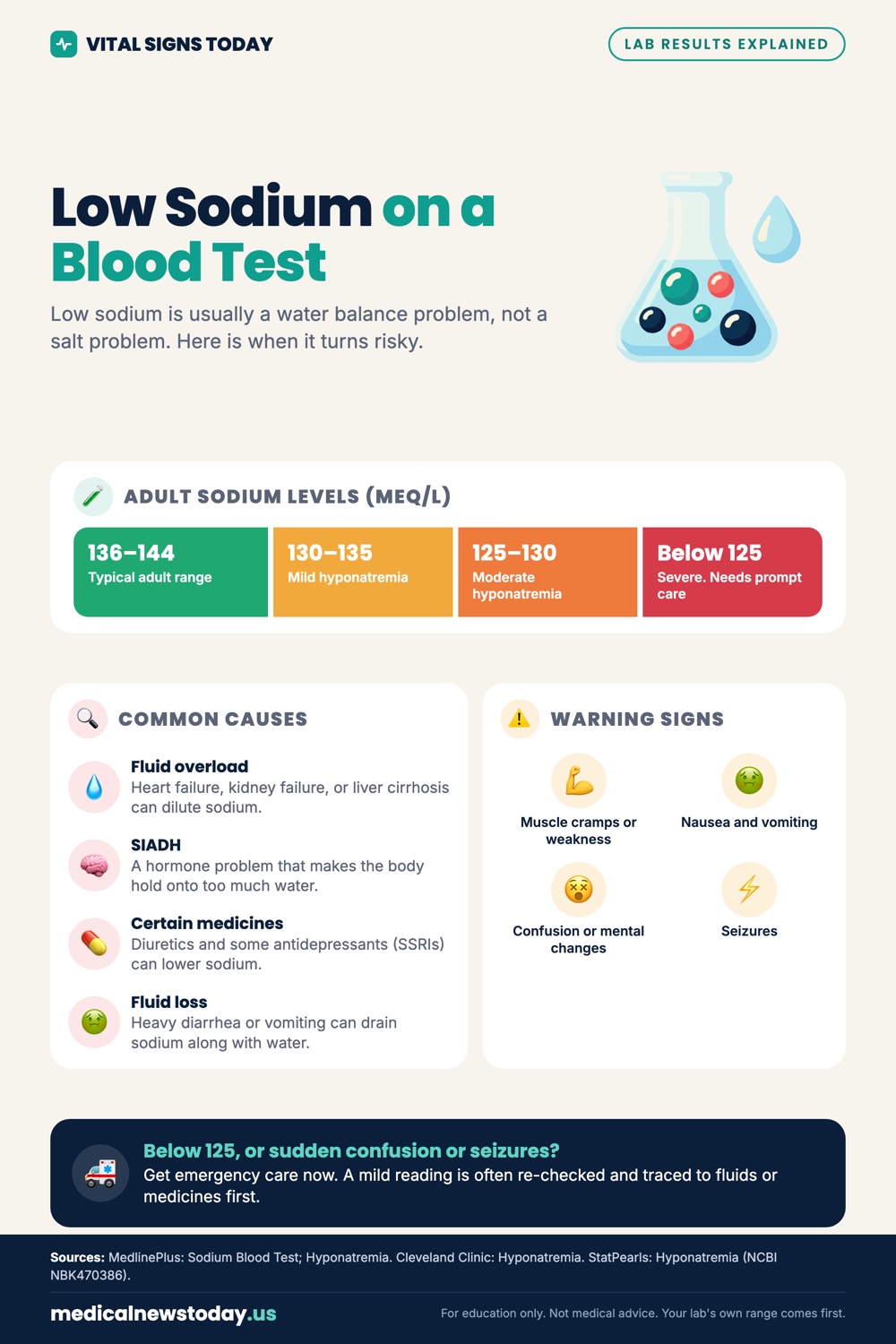
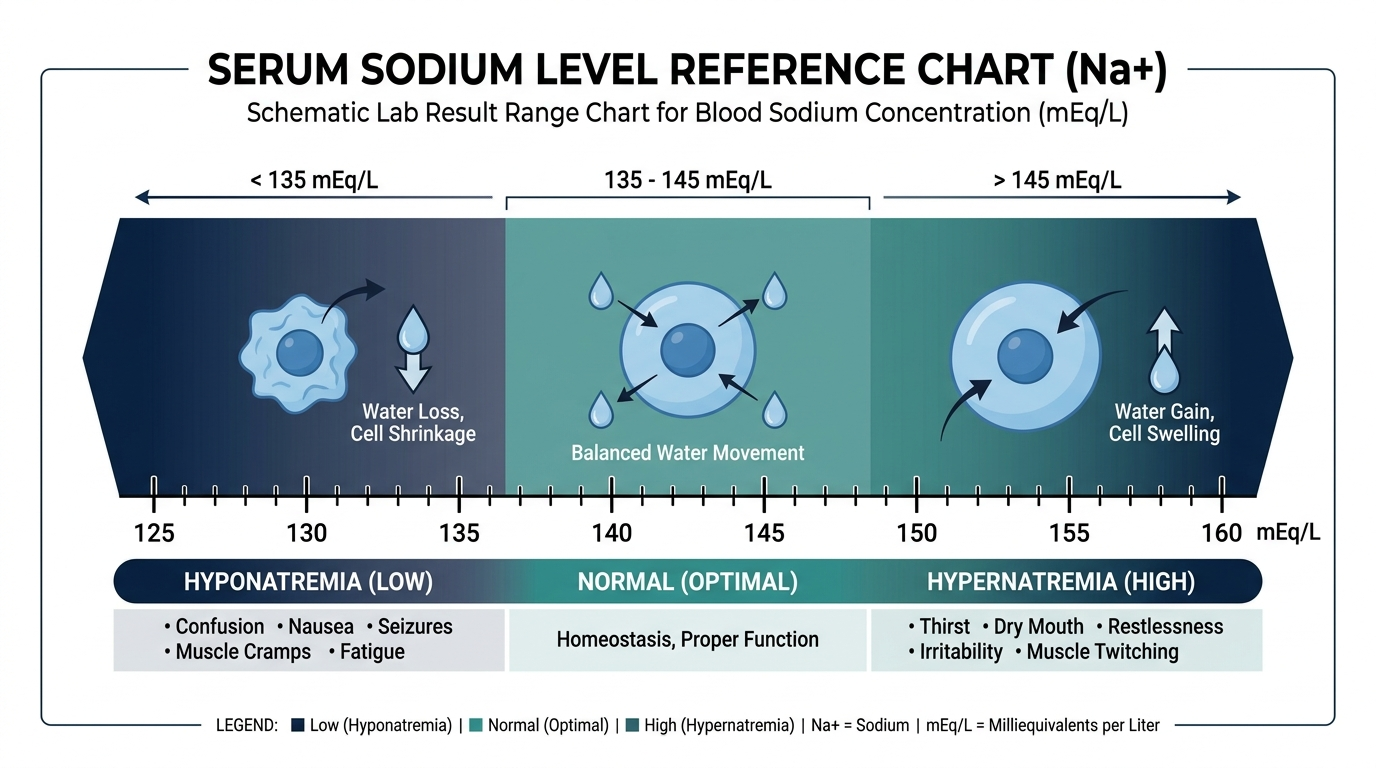
What does low sodium mean in a blood test? It means the concentration of sodium in your blood has dropped below the normal range, a condition doctors call hyponatremia, defined as a serum sodium below 135 milliequivalents per liter (mEq/L) (Cleveland Clinic). Sodium is an electrolyte, a charged mineral that controls how much water sits inside versus outside your cells and keeps your nerves and muscles firing properly (MedlinePlus).
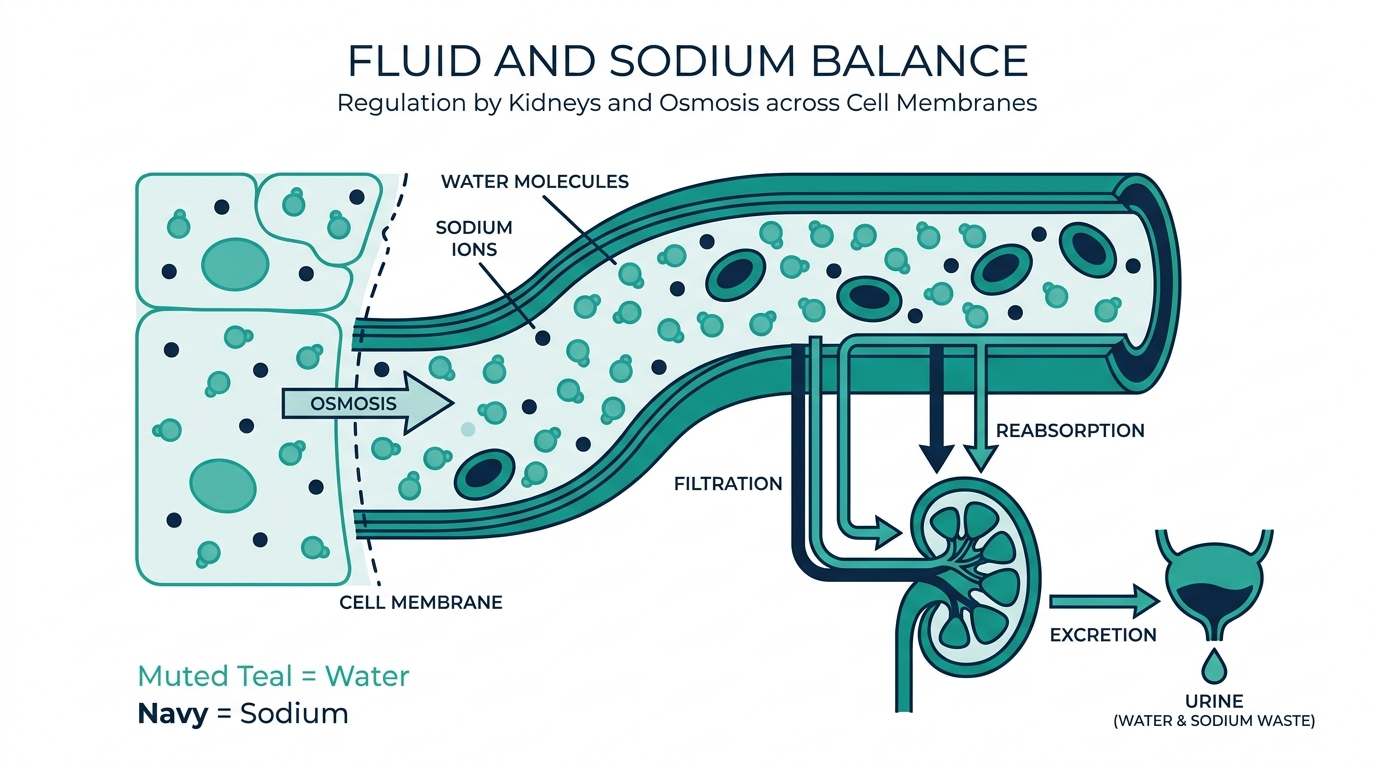
The key insight is that sodium on a blood test is a concentration, not a total amount. It is sodium relative to water. So a low reading usually does not mean you are short on salt. It much more often means you have too much water diluting the sodium you already have (National Kidney Foundation). That is why people who eat plenty of salt can still show low sodium on a lab report.

What is a normal sodium level in a blood test?
A normal blood sodium level generally falls between 135 and 145 mEq/L, the same figure as mmol/L on most reports (National Kidney Foundation). The exact cutoffs vary slightly by laboratory and instrument, so the number that matters most is the reference range printed beside your own result.
Clinicians usually grade how low the value is, because severity drives urgency. A reading in the low 130s is mild and common, often with no symptoms at all. As the number falls toward the low 120s and below, the risk of serious symptoms climbs sharply (MedlinePlus). Just as important as the number is how fast it dropped, a point we will come back to, because a slow decline and a sudden one are treated very differently.
What causes low sodium in a blood test?
Most low sodium results trace back to excess body water diluting the blood, and a short list of conditions causes the bulk of cases. According to Cleveland Clinic and the National Kidney Foundation, common drivers include (Cleveland Clinic):
- Heart, liver, and kidney disease. Heart failure, liver cirrhosis, and advanced kidney disease all cause the body to hold on to water, which dilutes sodium (MedlinePlus).
- Medications. Diuretics (water pills) and certain antidepressants such as SSRIs are frequent and underappreciated culprits (Cleveland Clinic).
- SIADH. The syndrome of inappropriate antidiuretic hormone makes the body retain water when it should release it, a classic cause of euvolemic hyponatremia.
- Fluid losses. Severe vomiting or diarrhea strips out both sodium and water, and the body’s attempt to rehydrate can tip sodium low (National Kidney Foundation).
- Drinking too much water. Overhydration, including the marathon runner who drinks heavily during a race, can dilute sodium faster than the kidneys can clear the extra fluid.
This is why clinicians do not treat a low sodium number in isolation. They classify it by your fluid status, whether you are dry (hypovolemic), normally hydrated (euvolemic), or fluid overloaded (hypervolemic), because the cause and the fix are completely different for each (NCBI StatPearls).
What are the symptoms of low sodium?
Mild low sodium often causes no symptoms at all, which is why it is so frequently discovered by accident on routine blood work. Symptoms appear mainly when sodium drops very low or very fast (MedlinePlus). When they do show up, common ones include:
- Nausea and vomiting
- Headache
- Fatigue and low energy
- Muscle weakness, cramps, or twitching (MedlinePlus)
- Confusion, restlessness, or trouble thinking clearly
- In severe cases, seizures, decreased consciousness, and coma
The reason the brain dominates the symptom list is mechanical. When blood sodium falls, water shifts into your cells to balance the concentration, and the cells swell. In the brain, locked inside the rigid skull, there is almost no room to expand, so swelling there produces the most dangerous effects (National Kidney Foundation). New or worsening confusion, a severe headache, or a seizure alongside a low sodium result is a medical emergency, not a wait-and-see finding.

Want to check your sodium?
Three ways to get it measured. Pick whichever fits you.
Affiliate links: we may earn a commission at no extra cost to you. A lab test does not replace a visit with your clinician.
Why is sodium measured with the rest of the metabolic panel?
Sodium is rarely measured alone, because it tells a fuller story next to the other electrolytes and kidney markers around it. It is usually run as part of an electrolyte panel, and it also appears on the basic metabolic panel (BMP) and the comprehensive metabolic panel (CMP) (MedlinePlus). That grouping is deliberate.
Reading sodium beside potassium, chloride, bicarbonate, glucose, and the kidney values (creatinine and BUN) lets a clinician see the pattern, not just the point. A low sodium with high glucose suggests one mechanism. A low sodium with abnormal kidney numbers suggests another. The panel turns a single flagged number into a map of what your fluid and filtration systems are actually doing, which is the difference between a guess and a diagnosis.
The part most people never hear: a low number can be fake, and the fix can be the real danger
Two things about low sodium catch even careful patients off guard, and both are worth knowing before you panic about a flagged result.
First, the number can be a measurement artifact. In pseudohyponatremia, the lab reads sodium as low even though the true concentration is normal, usually because very high triglycerides or proteins in the blood throw off the measurement (NCBI StatPearls). A related situation happens with very high blood sugar: glucose pulls water out of cells and dilutes the sodium reading, so the low number reflects the sugar problem, not a sodium one. This is exactly why a good clinician does not chase a low sodium value in isolation, but checks the blood’s osmolality and the surrounding labs first.
Second, and more counterintuitive, the correction can be more dangerous than the low number itself. When sodium has been low for more than about 48 hours, brain cells quietly adapt to the new normal. If sodium is then raised too quickly, those adapted cells lose water too fast and can suffer osmotic demyelination syndrome, a rare but devastating injury that can cause paralysis or death (NCBI StatPearls). This is why hospital teams correct chronic hyponatremia slowly and deliberately, often capping the rise at a set amount per day rather than rushing the number back to normal (Cleveland Clinic). The instinct to fix a low number fast is precisely the instinct that has to be resisted here.
What should I do if my blood test shows low sodium?
Start by not panicking, then bring it to your clinician with context. A mildly low sodium in the low 130s, with no symptoms, is common and often manageable with simple steps. Treatment is matched to the cause and can range from limiting how much fluid you drink, to adjusting a medication like a diuretic, to intravenous fluids or sodium-raising drugs in more serious cases (Cleveland Clinic).
The useful questions to ask are: How low is it, and how does it compare to my past results? Could one of my medications be causing it? Do I need a repeat test or any follow-up labs? If you have confusion, a severe headache, repeated vomiting, or a seizure along with a low sodium result, treat it as urgent and seek care immediately rather than waiting for a routine appointment (MedlinePlus).

The hormone behind the number: how your body guards sodium concentration
To understand why sodium is almost always a water story, it helps to meet the hormone in charge. Your body defends sodium concentration primarily by controlling water, not salt, and the main lever is antidiuretic hormone (ADH), also called vasopressin, released by the pituitary gland.
The system works like a thermostat. When blood becomes too concentrated, ADH rises, telling the kidneys to hold water back and making you thirsty, both of which dilute the blood toward normal. When blood becomes too dilute, ADH falls, the kidneys dump excess water in the urine, and concentration climbs back up. Low sodium develops when this water-clearing machinery is overwhelmed or misfiring in one of two broad ways:
- The signal is stuck on. In the syndrome of inappropriate antidiuretic hormone (SIADH), the body keeps releasing ADH when it should stop, so water is retained and sodium is diluted even though fluid status looks normal (NCBI StatPearls).
- The kidneys cannot keep up. When you take in far more free water than the kidneys can excrete, or when disease impairs excretion, dilution wins.
This is the mechanistic reason the fix for low sodium is so often about water and rarely about eating salt. You are usually correcting a water surplus, not a salt deficit.
The three fluid-status buckets, and how clinicians tell them apart
Earlier we said clinicians classify low sodium by whether you are dry, normally hydrated, or fluid overloaded. This classification is the backbone of the entire workup, because each bucket points to different causes and a different fix (NCBI StatPearls). Here is what each one actually means.
- Low volume (hypovolemic hyponatremia). You have lost both salt and water, from vomiting, diarrhea, or overuse of diuretics, and the body replaces the volume with relatively more water. Signs point to dehydration, and the treatment is usually careful fluid and salt replacement (National Kidney Foundation).
- Normal volume (euvolemic hyponatremia). Your total body water is roughly normal but slightly diluted, the classic pattern in SIADH and in some hormonal problems like hypothyroidism or adrenal insufficiency. The fix here often centers on fluid restriction.
- High volume (hypervolemic hyponatremia). You are carrying too much total fluid, as in heart failure, cirrhosis, or advanced kidney disease, where the body holds water even though it looks and feels swollen. Treatment targets the underlying organ problem and often restricts fluid (Cleveland Clinic).
To sort you into the right bucket, clinicians combine a physical exam for signs of dehydration or swelling with a few targeted labs, especially urine sodium and urine osmolality, plus blood osmolality. Those urine tests reveal whether your kidneys are appropriately conserving or wasting sodium and water, which frequently pinpoints the cause when the clinical picture is ambiguous.
Specific scenarios worth recognizing
A handful of distinct situations produce low sodium through their own mechanism, and recognizing them can explain an otherwise puzzling result.
- Exercise-associated hyponatremia. Endurance athletes who drink large volumes of plain water during a long event can dilute their sodium faster than the kidneys can clear the fluid. The counterintuitive lesson is that drinking to thirst, rather than forcing fluids, is the safer strategy in a marathon.
- Medication-induced, especially SSRIs and diuretics. Certain antidepressants and thiazide diuretics are among the most common and underappreciated triggers, which is why a full medication review is part of any low-sodium workup (Cleveland Clinic).
- Hormonal causes. An underactive thyroid or adrenal insufficiency can cause euvolemic low sodium, so these are checked when the cause is not obvious.
- Poor solute intake. In people with very limited diets or heavy alcohol use with little food, the kidneys lack the dietary solute needed to excrete free water, so even modest fluid intake can dilute sodium. This pattern is sometimes seen in heavy beer drinkers who eat little.
Each of these fits somewhere in the three-bucket framework, which is exactly why that framework is so useful. It converts a long list of causes into a manageable set of questions about your fluid balance.
How low sodium contrasts with high sodium
Seeing the mirror image sharpens the concept. High sodium, or hypernatremia, sits above roughly 145 mEq/L and, just like the low version, is usually a water story rather than a salt story, only in reverse.
- High sodium typically means water loss outpacing salt loss, so the blood becomes concentrated. It shows up in people who cannot access or sense thirst normally, such as older adults, infants, or anyone with an impaired thirst mechanism.
- Low sodium typically means water excess relative to salt, so the blood becomes dilute.
The shared lesson across both is the one that runs through this whole article: your body regulates the concentration of sodium by moving water, so an abnormal sodium number is first and foremost a question about water balance. That single reframing is what keeps patients from reaching for the salt shaker or the water bottle at exactly the wrong moment.
Acute versus chronic: why the timeline changes everything
One distinction quietly governs how seriously a given low sodium value is treated, and it is not the number itself. It is how long the sodium has been low. Clinicians divide hyponatremia into acute, developing in under roughly 48 hours, and chronic, present for longer (NCBI StatPearls).
- Acute low sodium gives brain cells no time to adapt, so water rushes in and swelling can be severe even at a level that a chronic patient tolerates. This is the dangerous end, and it can warrant prompt, closely monitored treatment.
- Chronic low sodium lets the brain gradually adjust, so a person can walk around feeling relatively fine at a number that would be alarming if it had dropped overnight. The catch, discussed above, is that this adaptation is exactly what makes correcting too fast dangerous.
This is why your clinician will ask when your last normal sodium was, or compare against old results. The same value can be a routine finding or an emergency depending entirely on how fast you got there.
Can you prevent low sodium?
For most healthy people, low sodium is not something to actively guard against, because a well-functioning body regulates it automatically. But a few sensible habits reduce risk in the situations where it does arise.
- Do not overhydrate during endurance exercise. Drink to thirst rather than on a rigid schedule, and consider electrolyte-containing fluids for very long efforts.
- Know your medications. If you take a diuretic or an SSRI, be aware that they can lower sodium, and keep up with any monitoring your clinician recommends (Cleveland Clinic).
- Manage the underlying condition. In heart, liver, or kidney disease, following your treatment and any fluid guidance is the real prevention, since those conditions drive the water retention behind the low number.
- Take symptoms seriously. New confusion, a severe headache, repeated vomiting, or a seizure alongside known low sodium is a reason to seek care promptly rather than wait (MedlinePlus).
Beyond these specific situations, the best prevention is simply having routine bloodwork so a slow, symptomless drift is caught early and interpreted in context rather than discovered during a crisis.
Why older adults are especially prone to low sodium
Low sodium is one of the most common electrolyte abnormalities found in older adults, and the reasons stack up in a way that is worth understanding if you or a parent are in this group. With age, the body’s fine control over water becomes less nimble. The kidneys handle free water less efficiently, the thirst signal blunts, and the hormonal systems that guard sodium concentration respond less sharply. The result is a body with a smaller margin for error, so a stress that a younger person would shrug off can tip an older one into hyponatremia.
Medications add a large share of the risk. Older adults are simply more likely to be on the drugs most associated with low sodium, particularly thiazide diuretics for blood pressure and certain antidepressants such as SSRIs, both of which appear repeatedly in low-sodium workups. Because several of these may be taken together, the effects can compound. This is why a careful medication review is such a routine part of investigating a low sodium result in an older person, and why a new low reading after starting or increasing one of these drugs is a pattern clinicians look for specifically.
The conditions that drive water retention, including heart failure, kidney disease, and the hormonal pattern of SIADH, also grow more common with age, which is another reason the number turns up more often on older adults’ panels. The practical implication is not fear but attention. If you are older, or caring for someone who is, it is reasonable to keep an eye on sodium across routine bloodwork, to know which of your medications can lower it, and to treat new confusion, unsteadiness, or repeated falls as possible signals rather than dismissing them as simply aging. A low sodium value in this group is common, often manageable, and most dangerous when it is missed.
Frequently asked questions
Is low sodium on a blood test serious?
It depends on how low it is and how fast it dropped. A mildly low sodium in the low 130s often causes no symptoms and is common, while a value in the low 120s or a rapid fall can be serious and may cause confusion or seizures (MedlinePlus). Always have your clinician interpret it alongside your symptoms and other labs.
What is a normal sodium level?
A normal blood sodium level is generally 135 to 145 mEq/L, which is the same as mmol/L on most reports (National Kidney Foundation). Compare your result to the reference range printed on your own lab report, since cutoffs vary slightly by laboratory.
Does low sodium mean I need to eat more salt?
Usually no. Low sodium on a blood test most often reflects too much water diluting the blood rather than too little dietary salt, so the fix is frequently about fluid balance or a medication, not adding salt (National Kidney Foundation). Do not start salt loading without medical advice.
What medications can cause low sodium?
Diuretics (water pills) and certain antidepressants such as SSRIs are common causes, and other drugs can contribute too (Cleveland Clinic). If your sodium is low, ask your clinician whether any of your medications could be responsible.
Can low sodium be a lab error?
Yes. In pseudohyponatremia the lab reports a low value even though true sodium is normal, often because of very high triglycerides or proteins, and very high blood sugar can also lower the reading (NCBI StatPearls). This is one reason clinicians check related labs before acting on a single low number.
This article is for general educational purposes and is not medical advice. It cannot diagnose or treat you and does not replace your clinician. Always discuss your lab results and any health decisions with a qualified healthcare professional.
Vital Signs Today may earn a commission if you buy through links on this page. It does not affect our editorial assessments.