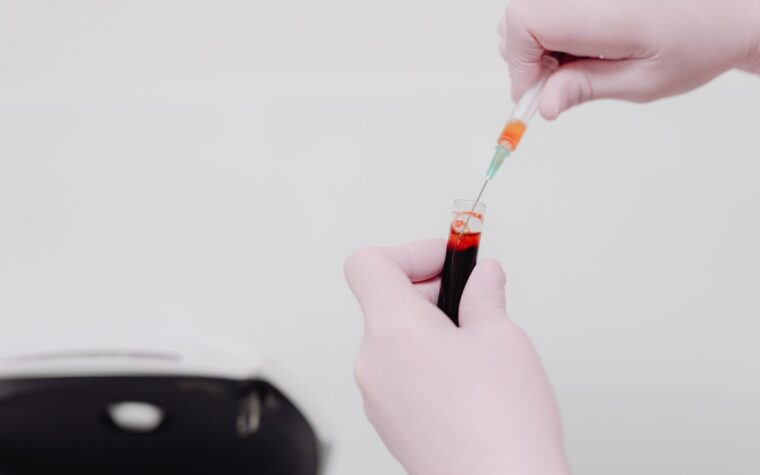
You got your blood work back, scanned the electrolytes, and there it was near the top: potassium, with a number like 4.2 next to it. Maybe it was flagged, maybe it was not. Either way, most people glance at it and move on. That is a mistake. Potassium is one of the few numbers on your entire panel where a small drift in either direction can change how your heart beats, and your clinician knows it. That is why it shows up on almost every routine blood test you will ever have.
Here is what that number actually tells you, why the range is so narrow, and the one lab quirk that fools people into thinking they have a problem when they do not.
Part of our Comprehensive Metabolic Panel guide.
What is potassium in a blood test?
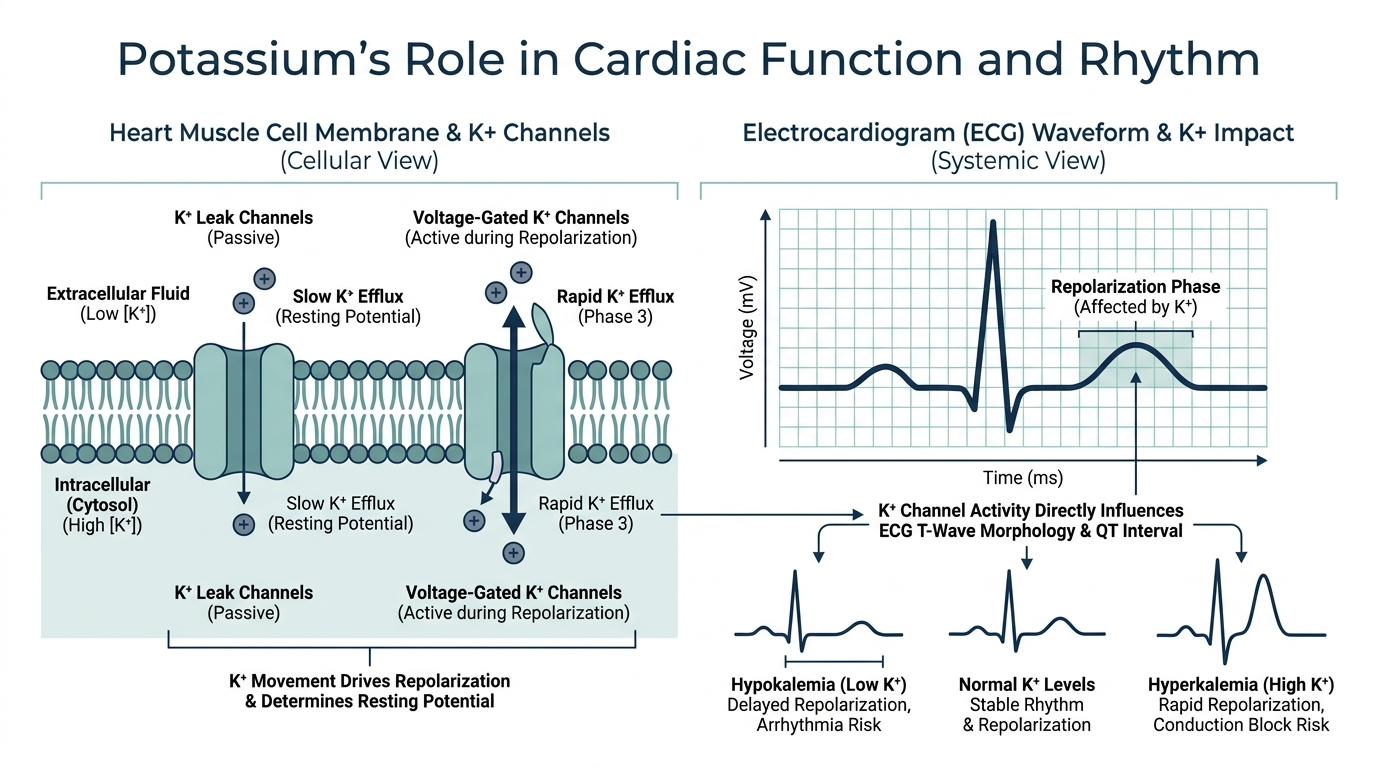
Potassium in a blood test is a measurement of how much potassium, an electrically charged mineral called an electrolyte, is circulating in your blood. It is usually reported as part of a basic metabolic panel or an electrolyte panel and is one of the most commonly ordered lab values there is (MedlinePlus). When someone asks what is a potassium blood test, the short answer is this: it is a quick check on a mineral that keeps your nerves firing, your muscles contracting, and most importantly, your heartbeat steady.
So what does potassium mean in a blood test in practical terms? Think of potassium as the spark plug for your electrically active tissues. Nerves and muscle cells, including heart muscle, rely on a precise balance of potassium inside and outside each cell to send signals. The test simply quantifies that supply in your bloodstream so your clinician can spot trouble before symptoms appear.

What blood test is for potassium and how is it measured?
The blood test that shows potassium levels is most often the basic metabolic panel (BMP) or a standalone electrolyte panel, both run from a routine venous blood draw (MedlinePlus). You do not need a special order called a “potassium test” in most cases, because potassium rides along inside these standard panels alongside sodium, chloride, and bicarbonate.
When you see potassium on a blood test, the lab is measuring serum potassium, the amount left in the liquid portion of your blood after it clots. This matters more than it sounds. Serum potassium runs about 0.5 mEq/L higher than plasma potassium, because potassium leaks out of cells during the clotting process (NCBI Bookshelf, Clinical Methods). Your clinician orders the potassium blood test for routine checkups, to investigate kidney disease, high blood pressure, or heart disease, and to monitor anyone on medications that shift potassium, such as diuretics or certain blood pressure drugs (Cleveland Clinic).
What is a normal potassium level?
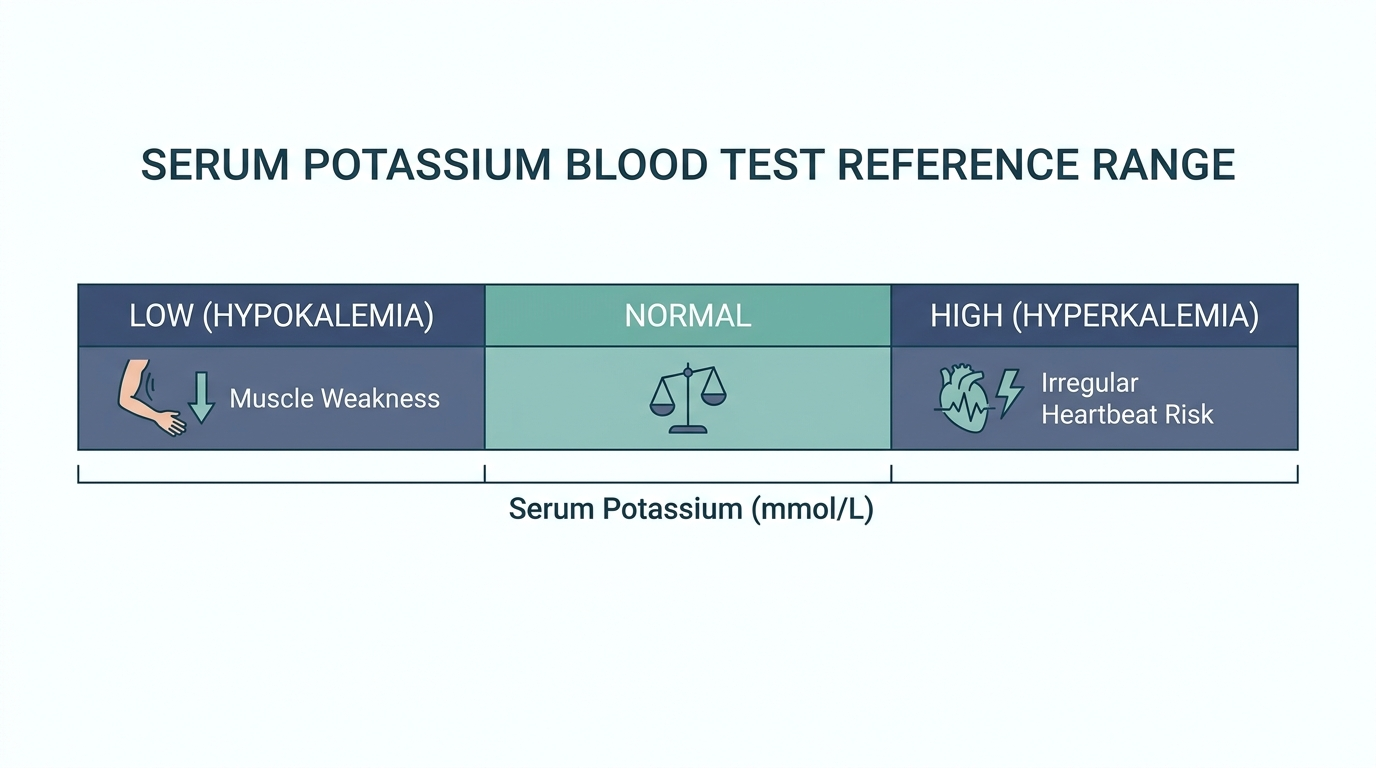
A normal potassium level for an adult generally falls between 3.5 and 5.2 mEq/L, which is the same as 3.5 to 5.2 mmol/L (Cleveland Clinic). Other clinical references cite a slightly wider range of 3.5 to 5.5 mEq/L (NCBI Bookshelf). The small differences come down to the lab and the instrument, so always read your result against the reference range printed on your own report.
What stands out about potassium is how tight that window is. Your body works hard to keep serum potassium inside roughly a 2 mEq/L band, and there is a reason for that obsession. A shift of just 1.0 mEq/L changes the ratio of potassium inside versus outside your cells by about 25 percent, which directly alters the electrical resting state of every cell in your body (NCBI Bookshelf). That is why even modest deviations are taken seriously.

What does a high potassium level mean?
A high potassium level, called hyperkalemia, means there is too much potassium in your blood, and it is generally defined as a level above 5.5 mmol/L, with anything above 6.5 mmol/L treated as a medical emergency (Cleveland Clinic). The single biggest cause is kidney disease, because healthy kidneys are what normally clear excess potassium from your body. When they slow down, potassium builds up.
Other common drivers of a genuinely high result include (Cleveland Clinic):
- Medications, especially certain blood pressure drugs that block potassium from being secreted, and some potassium-sparing diuretics.
- Kidney disease, which reduces how much potassium you can excrete.
- Uncontrolled diabetes, tissue injury from burns or surgery, and Addison disease.
- Excess intake, usually from supplements or salt substitutes rather than food alone.
The reason hyperkalemia is dangerous is the heart. Too much potassium disrupts the electrical signals that coordinate your heartbeat and can trigger life-threatening arrhythmias, palpitations, chest pain, and in severe cases cardiac arrest (Cleveland Clinic). The unsettling part is that mild hyperkalemia often causes no symptoms at all, or only vague ones like nausea and muscle weakness, which is exactly why a routine blood test catches it.
What does a low potassium level mean?
A low potassium level, called hypokalemia, means there is too little potassium in your blood. Cleveland Clinic classifies 3 to 3.5 mEq/L as mild hypokalemia and anything below 3 mEq/L as severe (Cleveland Clinic). The most common causes are losses through the gut and the urine.
Typical culprits behind a low result include (Cleveland Clinic):
- Fluid losses from frequent vomiting, diarrhea, or laxative overuse.
- Diuretic medications, a very common cause, along with certain antibiotics and corticosteroids.
- Adrenal disorders and chronic kidney disease.
- Heavy sweating and, in some cases, low dietary intake or alcohol use disorder.
Like its high counterpart, low potassium hits the heart and muscles. It can cause abnormal heart rhythms and palpitations, along with muscle weakness, cramps, fatigue, constipation, and in severe untreated cases, life-threatening paralysis (Cleveland Clinic). One practical prep note: some labs ask you to avoid natural black licorice for up to two weeks before testing, because it can genuinely lower potassium and skew your result (MedlinePlus).

Why is potassium measured with sodium and other electrolytes?
Potassium is rarely read in isolation. It travels with sodium, chloride, and bicarbonate in the electrolyte panel because these minerals work as a team to manage your body’s fluid balance, pH, and electrical signaling (MedlinePlus). Sodium is the main electrolyte outside your cells, potassium is the dominant one inside, and the interplay between them is what powers every nerve impulse and muscle contraction.
Reading them together gives context a lone potassium value cannot. A low potassium alongside abnormal bicarbonate, for example, points toward different causes than low potassium with normal everything else. The panel also flags kidney function through related values, and since the kidneys are the master regulator of potassium, that pairing helps your clinician understand the why behind an abnormal number rather than just the what.
The lab trap most people never hear about: pseudohyperkalemia
Here is the insider detail that gets lost in patient summaries. A surprising number of “high potassium” results are not real. They are an artifact of how the blood was drawn or handled, a phenomenon clinicians call pseudohyperkalemia, meaning a falsely elevated reading (NCBI Bookshelf).
The most common cause is hemolysis, where red blood cells rupture in the tube and spill their potassium into the serum. Because potassium concentration inside red cells is enormous compared with the blood around them, even a little cell breakage can push the number up substantially. Other triggers include a tourniquet left on too tight, clenching your fist or pumping it repeatedly during the draw, vigorous exercise just before the test, and very high platelet or white cell counts (NCBI Bookshelf). When hemolysis is suspected, the standard move is simply to redraw the sample carefully and retest.
Why does this matter to you? Because if your potassium comes back high and you feel completely fine, with no kidney issues and no relevant medications, the first question worth asking is whether the sample was hemolyzed. A repeat draw is cheap, fast, and frequently brings the number right back into range. It is the kind of detail that separates a calm, informed conversation with your clinician from an unnecessary scare.

Where potassium actually lives: the inside-versus-outside story
The single fact that unlocks almost everything about potassium is that most of it is hidden. Roughly 98 percent of your body’s potassium sits inside your cells, and only about 2 percent circulates in the blood where the test measures it. That is why a blood potassium of 4.0 is measuring a tiny sliver of the total, and why potassium can move dramatically without you eating or losing any at all.
The gatekeeper for this arrangement is the sodium-potassium pump, an enzyme in every cell membrane that constantly pushes potassium into the cell and sodium out (StatPearls, Sodium-Potassium Pump). This pump is what maintains the steep gradient that makes nerve and muscle signaling possible. It also means several hormones and conditions can shift potassium in or out of cells within minutes, changing the blood number without changing the body’s total supply. This is called a transcellular shift, and it explains many confusing results:
- Insulin drives potassium into cells. Insulin stimulates the pump, pulling potassium out of the blood, which is exactly why intravenous insulin with glucose is a frontline emergency treatment for dangerously high potassium (StatPearls).
- Acid-base balance shifts it. When blood becomes more acidic, potassium tends to leak out of cells into the blood, raising the measured level, while the opposite happens as acidosis corrects.
- Adrenaline and beta-agonist drugs push it in. Stress hormones and asthma inhalers can lower blood potassium by driving it into cells.
Hold onto this idea, because it reframes an abnormal result. Sometimes the total-body potassium is fine and the number is simply parked in the wrong compartment for the moment.
The medications most likely to move your potassium
Drugs are one of the most common reasons a potassium result drifts, and knowing which ones do what helps you make sense of your own number, especially if you take something for blood pressure or the heart.
| Medication group | Effect on potassium | Why |
|---|---|---|
| Loop and thiazide diuretics | Lower it | Increase potassium loss in the urine, a very common cause of hypokalemia (Cleveland Clinic) |
| ACE inhibitors and ARBs | Raise it | Reduce the hormone signal that normally helps excrete potassium |
| Potassium-sparing diuretics | Raise it | Block potassium secretion in the kidney (Cleveland Clinic) |
| NSAIDs | Raise it | Reduce kidney blood flow and potassium excretion |
| Insulin, beta-agonists | Lower it (temporarily) | Drive potassium into cells via transcellular shift |
This is why anyone starting or adjusting these medications, particularly blood pressure drugs and diuretics, is usually rechecked with a blood test. Never stop a prescribed medication on your own because of a potassium result. Bring the number to the clinician who prescribed it so the dose or the pairing can be adjusted safely.
How potassium problems show up on an EKG
Because potassium governs the electrical charge of heart cells, both high and low levels leave fingerprints on an electrocardiogram, and clinicians often reach for an EKG the moment a very abnormal potassium comes back. Understanding these signs demystifies why an abnormal result can turn into an urgent trip to get your heart traced.
- High potassium (hyperkalemia) classically produces tall, peaked T waves early on, and as levels climb further the QRS complex widens, a sign the ventricles are conducting dangerously slowly (NCBI Bookshelf). These changes can progress to life-threatening rhythms, which is why a level above 6.5 mmol/L is an emergency (Cleveland Clinic).
- Low potassium (hypokalemia) tends to flatten the T wave and bring out an extra bump called a U wave, along with other changes as levels fall further.
The takeaway for a patient is simple: if your clinician orders an EKG after a potassium result, they are checking whether the mineral imbalance has started to affect the heart’s electrical system. It is a fast, painless way to gauge how urgent the situation really is.
Diet, potassium, and blood pressure
For most people with healthy kidneys, dietary potassium is a good thing, and getting enough is linked to better blood pressure. National guidance sets an adequate intake of about 3,400 mg per day for adult men and 2,600 mg per day for adult women, and adequate potassium is associated with lower blood pressure, partly by counteracting the effect of sodium (NIH Office of Dietary Supplements).
Potassium-rich foods worth knowing include:
- Beans and lentils, which are among the densest sources.
- Potatoes and sweet potatoes, especially with the skin.
- Leafy greens, avocados, and tomatoes.
- Bananas, oranges, and dried fruits like apricots and raisins.
- Fish such as salmon, and dairy like yogurt and milk.
There is an important exception. People with chronic kidney disease or those on certain medications that raise potassium are often advised to limit high-potassium foods and to avoid potassium-based salt substitutes, because their bodies cannot clear the excess. Salt substitutes are a frequently overlooked culprit behind hyperkalemia precisely because they swap sodium for potassium (Cleveland Clinic). The right dietary target genuinely depends on your kidney function, which is one more reason potassium is read alongside kidney markers.
Who should have potassium checked, and how often
Because potassium is bundled into such common panels, most adults have it measured during routine care without asking. But some groups warrant closer, more frequent monitoring.
- Anyone with kidney disease, since the kidneys are the master regulator of potassium and impaired function is the leading cause of dangerous highs (Cleveland Clinic).
- People on diuretics or blood pressure medications that shift potassium, who are typically rechecked after starting or changing a dose.
- People with diabetes, where both the disease and its treatments can move potassium.
- Anyone with heart disease or an arrhythmia, given the direct effect of potassium on heart rhythm.
- People with ongoing vomiting, diarrhea, or an eating disorder, which can steadily deplete potassium.
If you fall into one of these groups, the frequency of testing is a conversation to have with your clinician rather than a fixed rule, because it depends on your medications, your kidney function, and how stable your levels have been. The unifying principle across everything above is that potassium is watched so closely not because it changes often in healthy people, but because when it does move, the stakes are high.
One last practical note that ties the whole picture together. If a result comes back abnormal but you feel completely well and have none of the risk factors above, the most likely explanations are often the least alarming ones: a sample affected by how the blood was drawn, a recent shift from a medication or a meal, or simple day-to-day variation. A calm, informed next step, usually a careful repeat draw and a look at the surrounding electrolytes and kidney markers, is what turns a single flagged number into a clear answer. That is the difference between reacting to a value and actually understanding it.
How to prepare so your potassium result is trustworthy
Potassium is one of the more fragile numbers on a metabolic panel, which means how you approach the draw can matter almost as much as your underlying physiology. You do not usually need to fast for a potassium measurement, since it is typically ordered as part of a broader panel, but a few habits genuinely improve the odds that the value on the report reflects what is actually circulating in your blood.
Start with the draw itself. Clenching and unclenching your fist repeatedly while the needle is in, a habit some people fall into to make a vein pop, can push potassium out of the muscle cells in your forearm and nudge the result upward. Letting the arm rest and staying relaxed is the simpler path. The same logic applies to a tourniquet left on too long, so if a draw feels unusually tight or prolonged, it is fair to mention it, because a technically difficult collection is a common reason a single high reading does not repeat.
Timing and lifestyle play a quieter role. A very heavy resistance workout in the hours before a draw can transiently raise potassium as stressed muscle releases it, so scheduling routine labs on a lighter day gives you a cleaner baseline. Heavy use of salt substitutes, which often replace sodium with potassium chloride, can also matter if you are on medications that already push potassium up. None of this means you should chase a perfect number. It means that when a result surprises you, walking back through the collection and the day around it is often the fastest way to separate a real change from a laboratory artifact.
Food, potassium, and how to read the label
Diet is where most people first try to take control of a potassium result, and it is also where the advice most often gets oversimplified. The instinct after seeing a high number is to cut every potassium-rich food, and after a low number to load up on bananas. Reality is more nuanced, because the amount you eat is only one input, and your kidneys, hydration, and medications usually decide far more about where your level lands.
Potassium-rich foods are not exotic. They include potatoes, tomatoes, beans and lentils, avocados, leafy greens, oranges, and dairy, alongside the bananas that get all the attention. For most healthy people, eating more of these is a benefit rather than a risk, and diets built around fruits, vegetables, and legumes are associated with better blood pressure in part because of their potassium content. The picture flips only when the kidneys cannot clear potassium efficiently, which is why dietary potassium restriction is a targeted tool for specific conditions rather than a general rule everyone should follow.
If you have been told to watch your intake, the practical skills are cooking methods and label reading. Boiling and draining high-potassium vegetables can lower their content, portion size still counts, and packaged foods increasingly list potassium on the nutrition facts panel so you can compare products directly. The larger point is that food changes should be matched to your actual physiology and made with your clinician, not driven by a single result or a viral tip. A repeat measurement after any deliberate dietary change is what tells you whether the effort is doing what you hoped.
Frequently asked questions
What is a normal potassium level on a blood test?
A normal adult potassium level is generally about 3.5 to 5.2 mEq/L, which equals 3.5 to 5.2 mmol/L, though some labs cite ranges up to 5.5 mEq/L (Cleveland Clinic). Always compare your number to the reference range on your own report.
What blood test shows potassium levels?
Potassium is reported on a basic metabolic panel or an electrolyte panel, both run from a standard blood draw (MedlinePlus). You usually do not need to request a separate potassium test, since it is included in these common panels.
Should I worry about a high potassium result?
Possibly, but not always. Levels above 5.5 mmol/L define hyperkalemia and above 6.5 mmol/L need urgent care (Cleveland Clinic). However, some high readings are false results from a difficult blood draw, so a careful redraw may be the next step (NCBI Bookshelf).
What causes low potassium on a blood test?
Common causes include vomiting, diarrhea, laxative or diuretic use, certain antibiotics, adrenal disorders, and chronic kidney disease (Cleveland Clinic). Levels of 3 to 3.5 mEq/L are mild and below 3 mEq/L are severe.
Why is potassium tested with sodium?
Sodium and potassium are partner electrolytes that together control fluid balance and the electrical signals in nerves and muscles, so labs measure them in the same panel for context (MedlinePlus). Reading them together helps pinpoint the cause of an abnormal result.
This article is for general educational purposes and is not medical advice. It cannot diagnose or treat you and does not replace your clinician. Always discuss your lab results and any health decisions with a qualified healthcare professional.
Vital Signs Today may earn a commission if you buy through links on this page. It does not affect our editorial assessments.