
You scanned your metabolic panel, saw most numbers inside their reference ranges, then hit one line with no tidy explanation: anion gap, flagged high. There is no organ called the anion gap and no pill that lowers it, so you are left with a flagged number and a quiet worry.
Here is the part worth understanding up front. The anion gap is not a thing your body makes. It is a piece of arithmetic, a subtraction the lab runs to sniff out hidden acid in your blood. When it climbs, it usually means something is producing acid faster than your body can clear it, and the cause matters far more than the number itself.
Part of our Comprehensive Metabolic Panel guide.
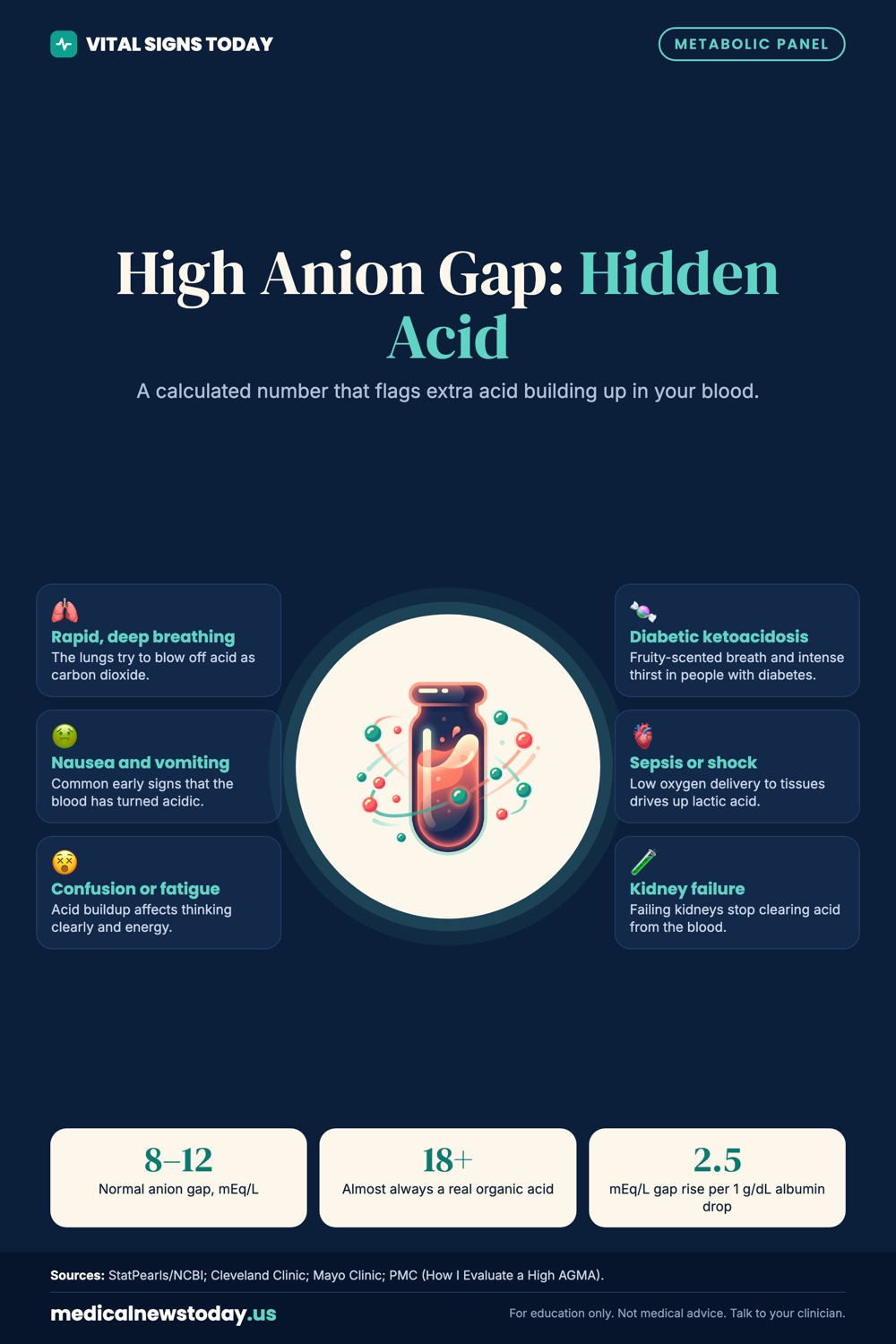
What is high anion gap in blood test, and what does it mean?
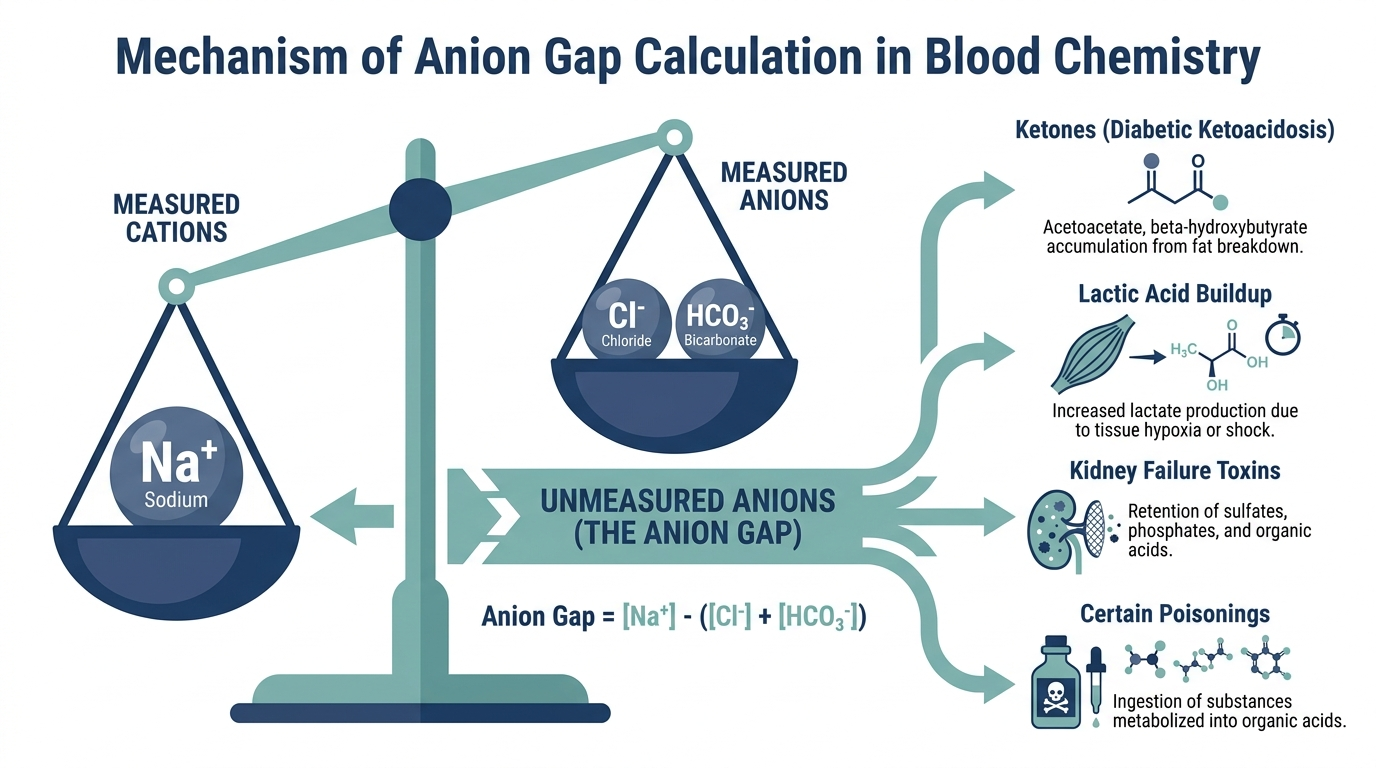
The anion gap is a calculated value that estimates the balance between positively and negatively charged particles (electrolytes) in your blood, and it is used as a quick check on whether your blood is too acidic (Cleveland Clinic). It is not measured directly. The lab takes electrolytes it already ran on your basic metabolic panel and subtracts them. The common formula is anion gap = sodium − (chloride + bicarbonate), and a normal anion gap typically lands around 8 to 12 mEq/L (StatPearls, NCBI).
So what does a high result actually mean? A high anion gap means there are more unmeasured acids floating in your blood than there should be, which most often signals a condition called metabolic acidosis, where the blood has tipped toward acidic (MedlinePlus). Think of it like a bank statement that does not balance. The lab can see the deposits and most withdrawals, but a high gap says money is leaving the account through a channel the statement does not list. That missing channel is extra acid.
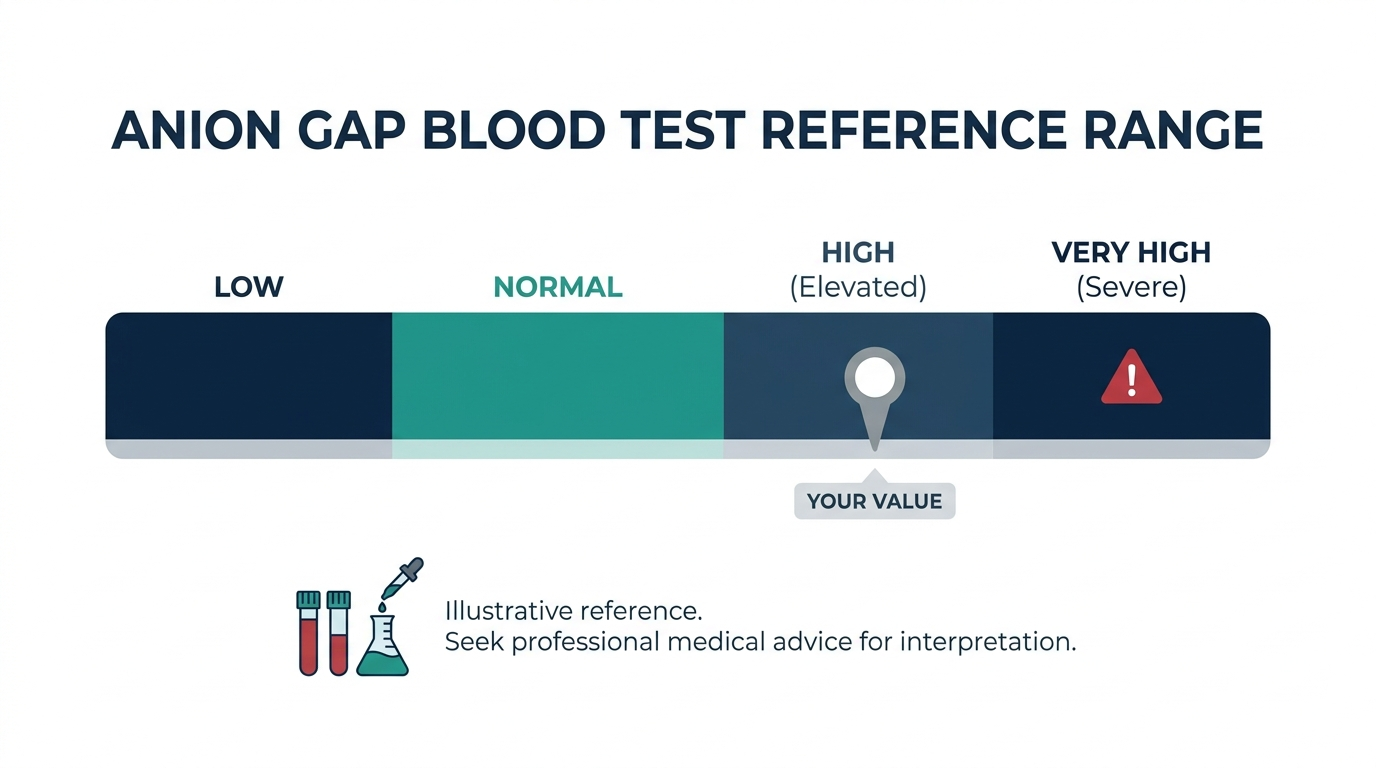
One honest caveat that trips people up. There is no single universal cutoff, because each lab calibrates its own instruments and prints its own reference range (Cleveland Clinic). Always read your result against the range on your own report. That said, in clinical practice an anion gap above roughly 18 almost always points to a real organic acid building up, rather than lab noise (StatPearls, NCBI).

What causes a high anion gap?
A high anion gap is a signpost, not a destination. Clinicians use it to open a short list of suspects, and the list is short enough that doctors memorize it with mnemonics like MUDPILES and the newer GOLD MARK. The real differential, with the everyday causes first:
- Diabetic ketoacidosis (DKA). When the body lacks insulin, it burns fat for fuel and floods the blood with acidic ketones. This is one of the most common and most dangerous causes, especially in type 1 diabetes (MedlinePlus).
- Lactic acidosis. When tissues do not get enough oxygen, from severe infection (sepsis), shock, or heart failure, they produce lactic acid. Lactic acidosis is one of the leading drivers of a high gap in hospitalized patients (How I Evaluate a High Anion Gap Metabolic Acidosis, PMC).
- Kidney failure (uremia). Healthy kidneys excrete acid. When they fail, acids such as sulfates and phosphates accumulate and widen the gap (MedlinePlus).
- Toxic ingestions. Methanol, ethylene glycol (antifreeze), and a salicylate (aspirin) overdose all generate acid metabolites. These are emergencies and a classic reason the gap shoots up (MedlinePlus).
- Other ketoacidosis. Heavy alcohol use and prolonged starvation can also produce ketones and acid (StatPearls, NCBI).
- Dehydration, severe diarrhea, or intense exercise. These can nudge the gap up, often transiently (Cleveland Clinic).
Notice the spread. The same flagged number can mean you skipped a few meals and trained hard yesterday, or it can mean a life-threatening crisis is unfolding. That is exactly why the gap is never read alone.
What are the symptoms of a high anion gap?
A high anion gap itself produces no symptoms. You cannot feel acid arithmetic. What you feel are the symptoms of the underlying acidosis and whatever condition is driving it. When the blood turns meaningfully acidic, the body fights back in ways you can notice (MedlinePlus):
- Rapid or deep breathing, sometimes labored, as the lungs try to blow off acid as carbon dioxide
- Nausea and vomiting
- Fatigue and weakness
- Confusion or trouble thinking clearly
- A fast heartbeat
In diabetic ketoacidosis specifically, the warning signs can come on within 24 hours and include intense thirst, frequent urination, belly pain, shortness of breath, and a distinctive fruity-scented breath (Mayo Clinic). The deep, sighing, rapid breathing pattern that shows up in serious acidosis has its own name, Kussmaul breathing, and it is the body’s automatic attempt to dump acid through the lungs.
The flip side matters too. If your anion gap is only mildly elevated and you feel completely fine, the cause is often something minor and transient. A symptomless mild elevation is a very different situation from a high gap in someone who is breathing hard, vomiting, and confused.

When is a high anion gap dangerous or a medical emergency?
This is where the number stops being academic. A markedly high anion gap is one of the loudest distress signals on a routine panel, because the conditions behind a big gap, DKA, lactic acidosis from sepsis, kidney failure, and toxic ingestions, can deteriorate fast.
Treat it as urgent when the high gap comes packaged with red-flag symptoms: deep or labored breathing, persistent vomiting, severe abdominal pain, confusion or drowsiness, a racing heart, or fruity breath. In a person with diabetes, these point toward DKA, which Mayo Clinic describes as a life-threatening emergency that needs same-day care (Mayo Clinic). If you suspect a poisoning, methanol, antifreeze, or an aspirin overdose, that is an emergency room visit, not a phone call to schedule next week (MedlinePlus).
As a rough orientation, a gap above 18 to 20 mEq/L is the territory where clinicians assume a genuine acid is accumulating and start hunting for the cause immediately (StatPearls, NCBI). The very high gaps, well into the 20s and 30s, almost always reflect a serious, active process. The number is not the danger. The acid behind it is.
What should you do about a high anion gap?
The anion gap is a starting point, so the right move is targeted follow-up rather than panic or self-treatment. There is no over-the-counter way to lower an anion gap, and you should not try, because the fix depends entirely on the cause.
What typically happens next, depending on your symptoms and history:
- Repeat and confirm. A single borderline result is sometimes just timing or mild dehydration. Your clinician may simply recheck it (Cleveland Clinic).
- Targeted tests for the cause. Blood glucose and ketones if diabetes is possible, lactate for lactic acidosis, kidney function tests, and a blood gas to confirm acidosis and measure pH (How I Evaluate a High Anion Gap Metabolic Acidosis, PMC).
- Treat the driver, not the gap. Insulin and fluids for DKA, antibiotics and resuscitation for sepsis-driven lactic acidosis, dialysis or antidotes for certain toxins. The gap normalizes when the underlying problem is treated (Mayo Clinic).
- Everyday basics. If the cause turns out to be dehydration or a transient state, staying hydrated and managing any chronic condition like diabetes or kidney disease is the long game (MedlinePlus).

When should you see a doctor?
If your anion gap came back high on routine bloodwork and you feel well, do not ignore it, but do not catastrophize either. Contact your clinician to ask what your specific result was, what your lab considers the upper limit, and whether any follow-up is warranted. Bring the full panel, because the gap is only interpretable next to your bicarbonate, glucose, and kidney numbers.
Seek care urgently, including emergency care, if a high gap is paired with deep or fast breathing, repeated vomiting, severe belly pain, confusion, extreme thirst with frequent urination, or fruity breath, or if you have diabetes and feel unwell (Mayo Clinic). When in doubt with a markedly high gap and symptoms, the emergency room is the safe choice.
The insider angle: the high gap that is not real, and the normal gap that is
Here is the nuance that separates a careful reading from a reflexive one, and it cuts both ways.
First, a falsely reassuring normal gap. The anion gap depends heavily on albumin, a negatively charged protein in your blood. When albumin is low, common in critically ill, malnourished, or chronically sick patients, the gap reads lower than the true acid load. For roughly every 1 g/dL drop in albumin below normal, the anion gap falls by about 2.5 mEq/L (StatPearls, NCBI). That means a patient with significant acid buildup can show a deceptively normal gap. Sharp clinicians correct the gap for albumin precisely so they do not miss a real, dangerous acidosis hiding behind low protein.
Second, the opposite trap, a high gap that is not true acidosis at all. Very high blood triglycerides or certain abnormal proteins can interfere with how the lab measures bicarbonate, producing a falsely low bicarbonate and therefore a falsely wide gap, a phenomenon called pseudohypobicarbonatemia. It does not mean your blood is acidic, but it can trigger an anxious and unnecessary workup if no one recognizes it (How I Evaluate a High Anion Gap Metabolic Acidosis, PMC). The same source flags a genuinely modern blind spot: euglycemic ketoacidosis from SGLT2 inhibitor diabetes drugs, where dangerous ketoacidosis develops while blood sugar looks almost normal, so the usual mental trigger for DKA never fires.
The takeaway is not to second-guess your doctor. It is to understand that the anion gap is a calculation with known soft spots, and the right context, your albumin, triglycerides, medications, and symptoms, is what turns a flagged number into a real answer.
GOLD MARK and MUDPILES: the mnemonics clinicians actually use
When an anion gap comes back high, clinicians run through a memorized checklist of acid-producing causes. Two mnemonics dominate: the older MUDPILES and the newer, evidence-informed GOLD MARK. Knowing what each letter stands for demystifies what your doctor is thinking when they order the next tests.
GOLD MARK, proposed to reflect the causes that actually turn up in modern practice, breaks down as:
- G – Glycols (ethylene glycol from antifreeze, and propylene glycol)
- O – Oxoproline, a metabolite linked to chronic acetaminophen use in susceptible people
- L – L-lactate, the classic lactic acidosis of sepsis, shock, and low oxygen delivery
- D – D-lactate, a rarer form seen in short bowel syndrome
- M – Methanol
- A – Aspirin (salicylates)
- R – Renal failure, where the kidneys stop clearing acid
- K – Ketoacidosis, from diabetes, alcohol, or starvation
The older MUDPILES covers similar ground (Methanol, Uremia, Diabetic ketoacidosis, Propylene glycol, Iron or Isoniazid, Lactic acidosis, Ethylene glycol, Salicylates). You do not need to memorize these. The point is that a high anion gap is not a vague worry, it is a well-defined shortlist, and the specific follow-up tests (lactate, ketones, kidney function, toxicology, a blood gas) exist to walk through that list quickly (How I Evaluate a High Anion Gap Metabolic Acidosis, PMC).
Reading the anion gap alongside the rest of your metabolic panel
The anion gap is calculated from your electrolytes, so it can never be read in isolation. The very numbers used to compute it, plus a few others, reframe what a high gap means.
| Marker | What it adds to a high anion gap |
|---|---|
| Bicarbonate (CO2) | A low bicarbonate confirms the blood is losing buffering capacity, supporting a true metabolic acidosis behind the wide gap. |
| Glucose | A high glucose alongside a wide gap raises immediate concern for diabetic ketoacidosis. A near-normal glucose does not rule out ketoacidosis on SGLT2 inhibitor drugs. |
| Creatinine and eGFR | Abnormal kidney function points to uremia as the acid source, since failing kidneys stop clearing acid. |
| Albumin | Essential for interpretation. Low albumin lowers the measured gap, so a normal-looking gap can hide real acid when albumin is low. |
| Lactate | Directly measures the acid in lactic acidosis, one of the most common hospital causes. |
A blood gas measuring pH and carbon dioxide often accompanies these when acidosis is suspected, because it confirms whether the blood is genuinely acidic and how far the lungs are compensating.
Correcting the anion gap for albumin, with a worked example
Because albumin is a negatively charged protein that contributes most of the normal gap, a low albumin can mask a dangerous acid buildup. The widely used correction is roughly: add about 2.5 mEq/L to the measured gap for every 1 g/dL that albumin sits below 4 g/dL (StatPearls, NCBI).
Here is how that plays out. Suppose a patient has a measured anion gap of 12, which looks normal, but their albumin is only 2 g/dL, which is 2 g/dL below the typical 4. The correction adds about 2.5 times 2, or 5, giving a corrected gap of roughly 17. That corrected value is meaningfully elevated, and a clinician who skipped the correction might have wrongly reassured the patient. This is exactly why sick, malnourished, or hospitalized patients, who often have low albumin, get their gap corrected before it is trusted.
A related concept, the delta gap, compares how much the anion gap rose against how much the bicarbonate fell. It helps clinicians spot a second acid-base problem hiding behind the first, for example a high-gap acidosis mixed with a separate metabolic alkalosis. You will not calculate this yourself, but it explains why a doctor sometimes says the gap points to more than one process at once.
Sample interpretations: the same high gap, very different stakes
Because a wide gap can be benign or a crisis, walking through realistic patterns shows how context decides. These are illustrative, not diagnoses, and none replaces the clinician who ordered your test.
- Mildly high gap, feeling well, recently dehydrated. A gap of 15 in someone who trained hard and did not drink enough, with normal glucose and kidney function. Often transient. A rehydrated repeat frequently settles it (Cleveland Clinic).
- Wide gap with high glucose and fruity breath. A gap in the 20s alongside a high blood sugar and ketones in a person with diabetes. This is the diabetic ketoacidosis pattern and needs same-day emergency care (Mayo Clinic).
- Wide gap with normal glucose on a diabetes drug. A person on an SGLT2 inhibitor with a wide gap and ketones but near-normal blood sugar. This euglycemic ketoacidosis is dangerous precisely because the normal glucose is falsely reassuring (How I Evaluate a High Anion Gap Metabolic Acidosis, PMC).
- Wide gap with poor kidney function. A high gap alongside a high creatinine and low eGFR points toward uremic acidosis, where failing kidneys let acid accumulate (MedlinePlus).
How the test is done, and what can skew the result
You never order an anion gap on its own. It is calculated automatically from the electrolytes on a basic or comprehensive metabolic panel, a standard blood draw. Because it is derived from several measured values, a few factors can distort it.
- Albumin level. The most important modifier. Low albumin lowers the calculated gap and can hide real acidosis, which is why the corrected gap exists (StatPearls, NCBI).
- Very high triglycerides or abnormal proteins. These can interfere with the bicarbonate measurement and produce a falsely wide gap without true acidosis (How I Evaluate a High Anion Gap Metabolic Acidosis, PMC).
- Hydration and recent exertion. Dehydration and intense exercise can nudge the gap up, often transiently (Cleveland Clinic).
- Sample handling. Delays or issues that affect the measured bicarbonate can shift the calculated gap, another reason a borderline result is often rechecked.
The practical rule is the same one clinicians follow: a mildly high gap in someone who feels well, especially with a plausible transient explanation, is usually a reason to recheck rather than to alarm. A wide gap with symptoms is a reason to act now.
Frequently asked questions
What does a high anion gap mean in a blood test?
A high anion gap usually means there are extra unmeasured acids in your blood, a state called metabolic acidosis (MedlinePlus). It is a clue, not a diagnosis, and points to causes such as diabetic ketoacidosis, lactic acidosis, kidney failure, or a toxic ingestion. Your clinician interprets it alongside your other electrolytes and symptoms.
What is a normal anion gap, and what counts as high?
A normal anion gap is generally around 8 to 12 mEq/L, though every lab sets its own reference range (StatPearls, NCBI). A value above roughly 18 almost always signals a real organic acid building up, but you should always compare your number to the range printed on your own report (Cleveland Clinic).
What are the symptoms of a high anion gap?
The gap itself causes no symptoms. You feel the underlying acidosis, which can include rapid or deep breathing, nausea, vomiting, fatigue, confusion, and a fast heartbeat (MedlinePlus). In diabetic ketoacidosis you may also notice intense thirst, frequent urination, and fruity breath (Mayo Clinic).
When is a high anion gap a medical emergency?
Treat it as urgent when a high gap comes with deep or labored breathing, persistent vomiting, severe belly pain, confusion, a racing heart, or fruity breath, particularly if you have diabetes (Mayo Clinic). Suspected poisoning from antifreeze, methanol, or aspirin overdose is also an emergency (MedlinePlus).
Can a high anion gap be a false result?
Yes. Very high triglycerides or certain abnormal proteins can falsely lower bicarbonate and widen the gap without true acidosis, a phenomenon called pseudohypobicarbonatemia (How I Evaluate a High Anion Gap Metabolic Acidosis, PMC). Low albumin can also mask a real high gap, which is why clinicians sometimes correct the gap for albumin (StatPearls, NCBI).
This article is for general educational purposes and is not medical advice. It cannot diagnose or treat you and does not replace your clinician. Always discuss your lab results and any health decisions with a qualified healthcare professional.
Vital Signs Today may earn a commission if you buy through links on this page. It does not affect our editorial assessments.