
Disclosure: Vital Signs Today may earn a commission if you buy through links on this page, at no extra cost to you. This does not influence our evidence-based assessments. We are not a medical provider; talk to a clinician before acting on test results.
Part of our Comprehensive Metabolic Panel guide.
You scanned your metabolic panel, saw a line called “total protein” sitting in the normal range, and moved on. That is exactly what most people do. Yet this one number is quietly summing up two completely different proteins doing two completely different jobs, and the way they balance against each other can say more about your liver, kidneys, and immune system than the single value on the page lets on.
Total protein is one of the most underused readouts in routine blood work. Read correctly, it is less a number and more a doorway into how your body is building, losing, and defending itself.
What is protein total blood test?
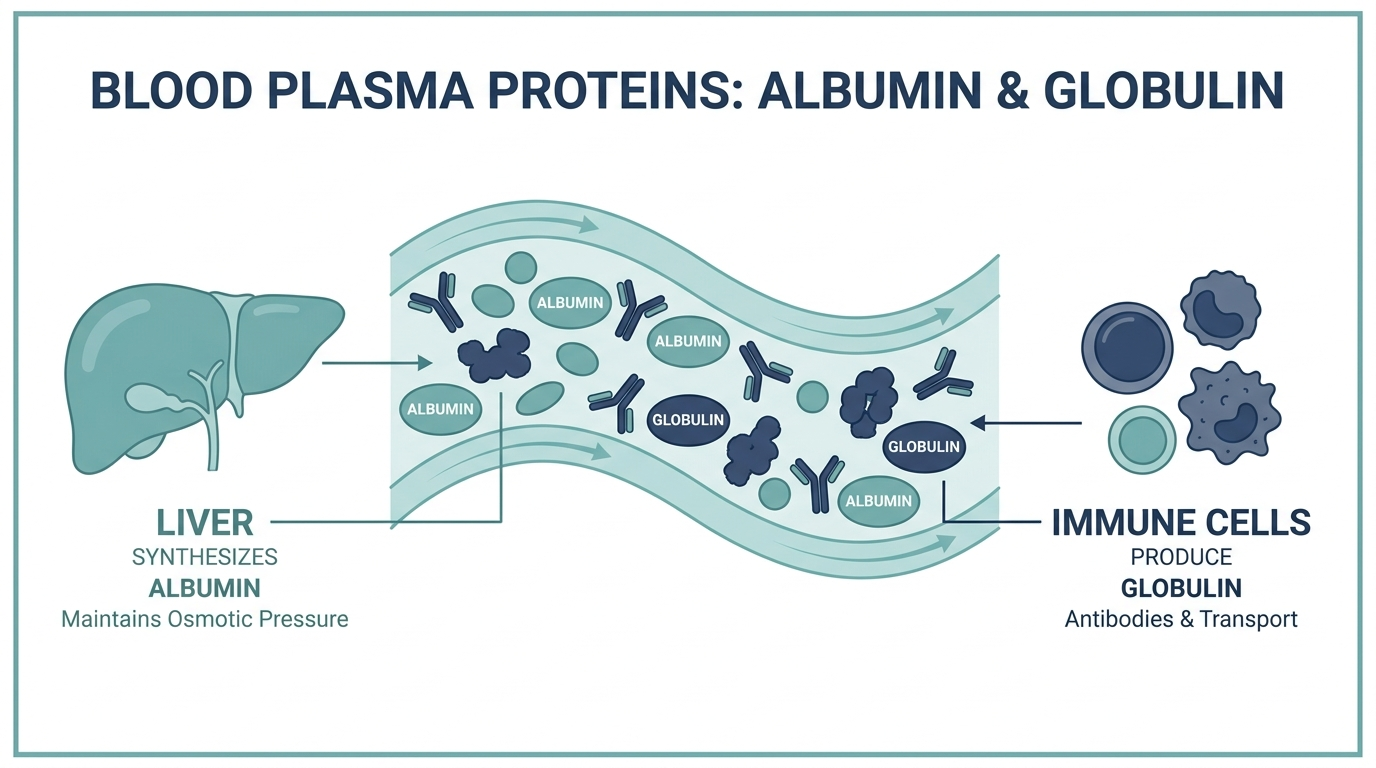
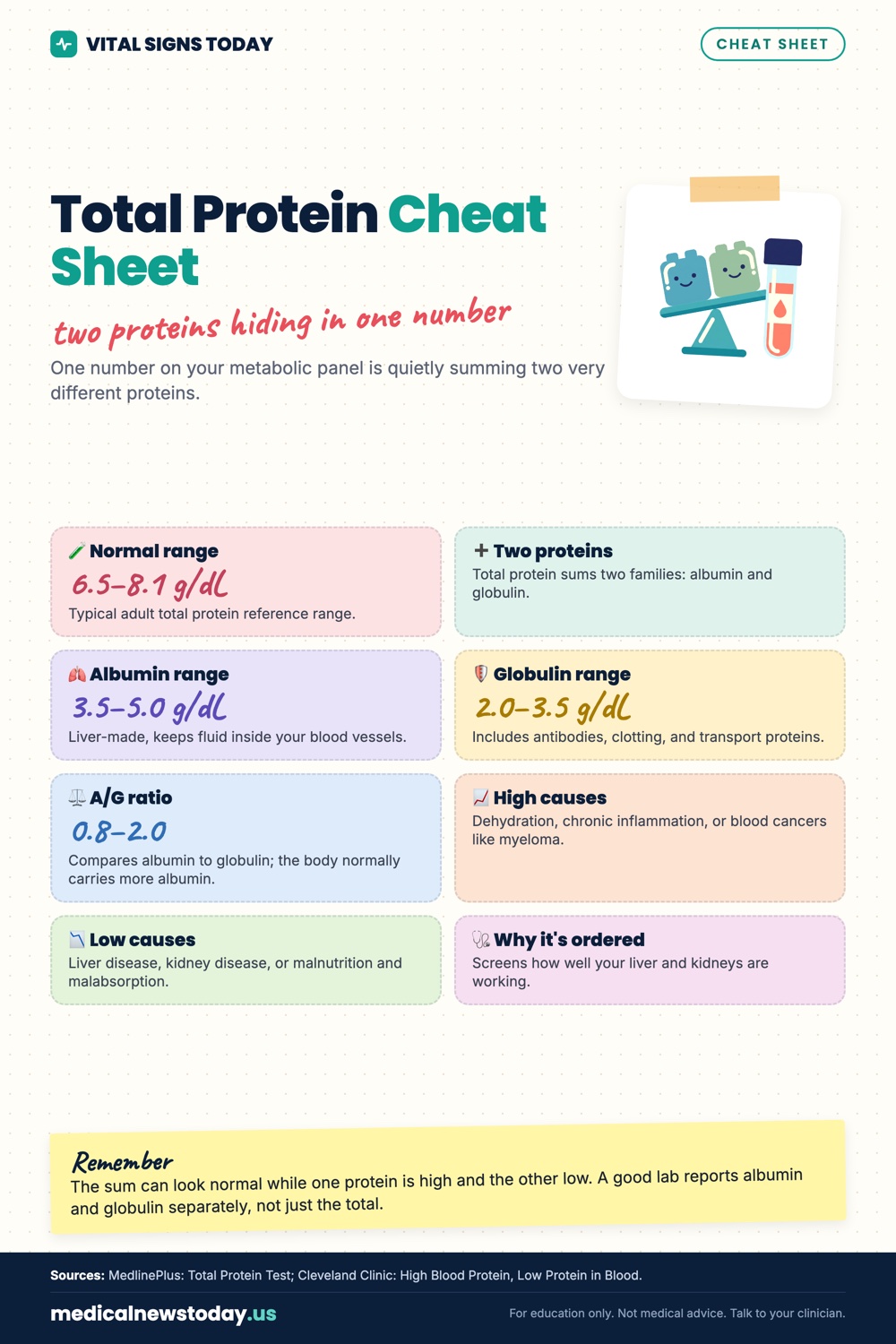
A what is protein total blood test question has a simple answer: it is a blood test that measures the total amount of protein in the liquid part of your blood, the serum. It almost always comes bundled in a comprehensive metabolic panel and reports two protein families added together, albumin and globulin (MedlinePlus). A typical adult total protein result lands around 6.3 to 8.0 grams per deciliter (Cleveland Clinic).
Albumin is the workhorse made by your liver that keeps fluid inside your blood vessels and ferries hormones and medications around. Globulins are a mixed bag that includes your antibodies and clotting and transport proteins. Total protein is just those two summed, which is why the headline number alone can hide a lot.

What is total protein in a blood test actually measuring?
When people ask what is total protein in a blood test, they are really asking what the lab is counting. The test measures the combined concentration of all proteins floating in your serum, dominated by albumin and globulin (MedlinePlus). Think of it like the total balance in two bank accounts reported as one figure. The sum can look perfectly healthy while one account is overdrawn and the other is overflowing.
That is why a good lab does not stop at the sum. It also reports albumin and globulin separately and divides one by the other to produce the albumin to globulin ratio, or A/G ratio (MedlinePlus). Your body normally carries slightly more albumin than globulin, so a healthy A/G ratio sits a little above 1, generally in the range of about 0.8 to 2.0 (Cleveland Clinic).
What is a total protein blood test ordered for?
A total protein blood test is usually ordered to check how well your liver and kidneys are working and to screen for nutrition problems (MedlinePlus). It is rarely a stand-alone test. Most often it rides along inside a comprehensive metabolic panel during a routine physical, so many people get the result without ever having asked for it.
Doctors lean on it more deliberately when you have unexplained swelling, fatigue, unintended weight loss, or symptoms that point toward liver or kidney trouble. Because albumin is made by the liver and lost through diseased kidneys, total protein and its breakdown act as an early, cheap window into both organs at once.
What is a normal total protein in a blood test?
A normal total protein result for most adults falls in the range of about 6.3 to 8.0 grams per deciliter, with albumin around 3.9 to 4.9 g/dL and globulin around 2.0 to 3.5 g/dL (Cleveland Clinic). The exact cutoffs shift slightly between laboratories and instruments, so the most reliable comparison is always the reference range printed on your own report.
Here is a practical detail people miss. Mild dehydration concentrates your blood and can nudge total protein toward the high end without anything being wrong, while pregnancy and being overly hydrated can pull it lower (Cleveland Clinic). Context matters before anyone reads too much into a single value.

What does total protein mean in a blood test when it is high?
A high total protein, called hyperproteinemia, is not a disease by itself. It is a sign that something underneath is pushing protein levels up, and it almost always needs a second look to find the cause (Cleveland Clinic). The most common culprits include:
- Dehydration. The most ordinary cause. Less fluid in the blood concentrates the proteins, so the value reads high even though your actual protein production is normal (Cleveland Clinic).
- Chronic inflammation or infection. Conditions like hepatitis B, hepatitis C, and HIV drive up globulins as the immune system stays switched on (Cleveland Clinic).
- Blood cancers. Multiple myeloma and certain lymphomas cause plasma cells to churn out abnormal globulins, raising total protein (Cleveland Clinic).
Now the insider point that rarely makes it into the patient handout. When total protein is high, clinicians do not panic about the sum, they look at the A/G ratio. A high total protein paired with a low A/G ratio is a classic flag for the abnormal globulins of multiple myeloma, and it often prompts a follow-up test called serum protein electrophoresis to see whether one specific protein is spiking (Cleveland Clinic). The shape of the imbalance, not the total, is what points to the diagnosis.
What does total protein mean on a blood test when it is low?
A low total protein, hypoproteinemia, generally means your body is either not making enough protein or is losing it faster than it can replace it (Cleveland Clinic). The main drivers cluster into a few buckets:
- Liver disease. Your liver builds albumin, so cirrhosis and hepatitis can lower production and drag total protein down (Cleveland Clinic).
- Kidney disease. Conditions like nephrotic syndrome let protein leak out into the urine instead of staying in the blood (Cleveland Clinic).
- Malnutrition and malabsorption. Not eating enough protein, or conditions like celiac disease and Crohn’s disease that block absorption, starve the body of building blocks (MedlinePlus).
Because albumin holds fluid inside blood vessels, a meaningfully low total protein often shows up physically as swelling in the legs, ankles, or abdomen, along with fatigue and brittle hair (Cleveland Clinic). The blood number and the puffy ankles are telling the same story.
Why is total protein read together with albumin and globulin?
Total protein is most useful when it is broken into its parts, because two people can have an identical total while their albumin and globulin balance is completely different. The A/G ratio is what turns a flat sum into a direction (MedlinePlus). Picture total protein as the average and the A/G ratio as the tilt.
A simplified version of how the pieces combine:
- Low A/G ratio can point to autoimmune disease such as lupus, liver disease including cirrhosis, or kidney disease, and it is the pattern that raises concern for myeloma when total protein is high (MedlinePlus).
- High A/G ratio is less common and may be linked to certain genetic conditions or leukemia (MedlinePlus).
- Low globulin specifically can flag kidney or liver disease and may mean the immune system is under-producing antibodies (MedlinePlus).
This is why a doctor almost never reacts to total protein in isolation. The same total can mean dehydration in one person and an early blood disorder in another. The split is what carries the signal.
The part most people never hear: a normal total protein can still hide a problem
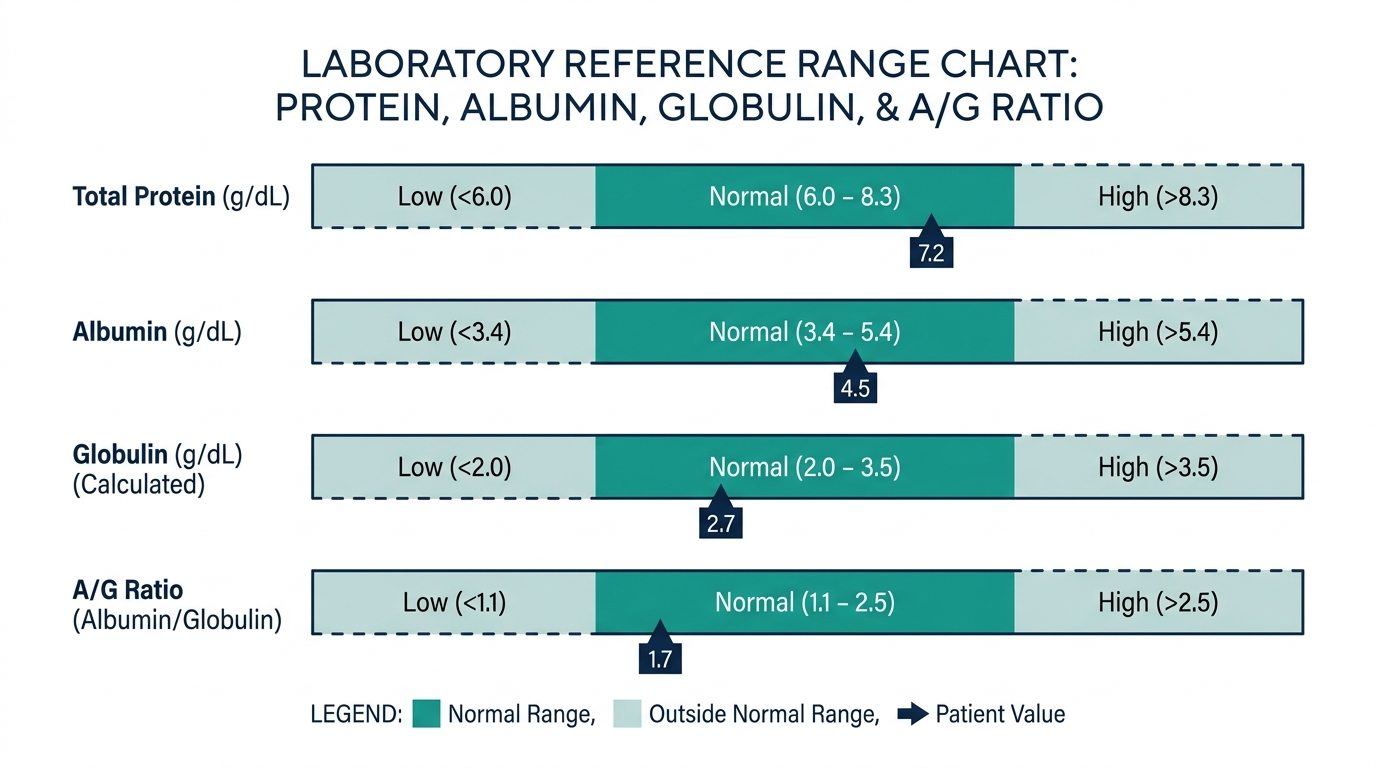
Here is the detail that separates a casual glance from an informed read. Total protein is a sum, and sums can mask offsetting changes. Albumin can be quietly falling while globulin is quietly rising, and the two errors cancel out so the total still lands squarely in the normal range (Cleveland Clinic).
That scenario is not rare. In early multiple myeloma, abnormal globulins climb while albumin drifts down, and a person can sail through a basic panel with a “normal” total protein while the A/G ratio is already abnormal. This is precisely why experienced clinicians treat a shifting A/G ratio, not just the headline total, as the real tripwire, and why an unexplained drop in that ratio can earn you a serum protein electrophoresis even when your total protein looks fine (Cleveland Clinic). A normal sum is reassuring, but it is not the same as nothing happening.
How the sample is drawn, and what quietly moves the number
Total protein rides inside a comprehensive metabolic panel, so whether you fast depends on the other tests bundled with it rather than on total protein itself. The more useful thing to understand is what shifts the value without any real change in how much protein your body is making. Several of these are things you can control or at least disclose.
- Hydration status. This is the biggest everyday distorter. Dehydration concentrates the serum and pushes total protein up, while being heavily overhydrated or pregnant dilutes it down. A high result in someone who arrived thirsty on a hot day often normalizes once they rehydrate.
- Prolonged tourniquet time. Leaving the band on your arm too long during the draw can locally concentrate proteins, a phenomenon called hemoconcentration, and slightly inflate the reading.
- Posture at the time of draw. Standing for a long period before a blood test can raise measured protein compared with lying down, because fluid shifts out of the vessels. This is a small effect but a real one.
- Recent high-protein meals or supplements. These have only a modest effect on serum total protein, but worth mentioning if your result is borderline.
The practical takeaway is that a single mildly high total protein in a well person, especially one who was dehydrated, is rarely alarming on its own. The value that deserves attention is one that stays elevated on a properly hydrated repeat draw, or one paired with a shifting A/G ratio.
What serum protein electrophoresis adds when total protein is off
When total protein or the A/G ratio looks wrong, the test clinicians reach for next is serum protein electrophoresis, often shortened to SPEP. It is worth understanding because it is the step that turns a vague protein imbalance into a specific answer.
Total protein gives you a sum. The A/G ratio gives you a rough tilt. SPEP goes further by separating the serum proteins into distinct bands based on how they migrate in an electric field, producing a tracing with peaks for albumin and for several globulin fractions. The shape of that tracing is diagnostic. A tall, narrow spike in one globulin region, called a monoclonal or M spike, is the hallmark of a plasma cell disorder such as multiple myeloma, where a single clone of cells overproduces one identical antibody. A broad, rolling rise across the globulin region instead suggests the many different antibodies of chronic inflammation or infection.
This is why an unexplained high total protein with a low A/G ratio does not sit as a mystery. It is a doorway. The electrophoresis tells whether the extra globulin is one abnormal protein climbing alone, which is a red flag, or a diffuse polyclonal rise, which usually reflects the immune system working hard against something. Knowing this sequence helps you understand why your doctor might order what looks like an unusual follow-up test off the back of a routine panel.

Reading total protein alongside the rest of the panel
Total protein rarely speaks alone. Its meaning sharpens when you set it beside the markers drawn with it. The combinations below show how the panel corroborates or reframes a protein result.
| Total protein finding paired with | The direction it points |
|---|---|
| Low albumin, high liver enzymes (ALT, AST) | Liver disease reducing albumin production. |
| Low albumin, protein in the urine, high creatinine | Kidney disease letting protein leak out, as in nephrotic syndrome. |
| High total protein, low A/G ratio, anemia, high calcium | A pattern that raises concern for multiple myeloma and prompts electrophoresis. |
| Low total protein with low albumin and normal organ enzymes | Malnutrition or malabsorption, such as celiac or Crohn’s disease. |
| High globulin with signs of chronic infection | An immune system persistently activated by hepatitis, HIV, or another chronic process. |
Want to check your total protein?
Three ways to get it measured. Pick whichever fits you.
Affiliate links: we may earn a commission at no extra cost to you. A lab test does not replace a visit with your clinician.
Albumin is the companion to watch most closely, because it is made by the liver, lost by diseased kidneys, and depleted by poor nutrition all at once. When albumin moves, total protein usually moves with it, and the story of why often lies in the liver enzymes, the kidney numbers, and the urine on the same report.
Worked examples: the same total protein, different meanings
A number becomes useful when you can see how a clinician reasons through it. These scenarios show why identical totals can tell opposite stories.
Scenario one: high total protein, normal A/G ratio, and you were dehydrated at the draw. The most common benign pattern. The proteins are simply concentrated. Rehydrate, repeat, and it typically settles into range.
Scenario two: high total protein with a low A/G ratio and mild anemia. The imbalance, not the sum, is the headline. Abnormal globulins are outpacing albumin, which is the classic prompt for serum protein electrophoresis to check for a monoclonal protein.
Scenario three: low total protein with low albumin and swollen ankles. The blood number and the physical sign agree. Because albumin holds fluid inside vessels, a genuine drop lets fluid escape into tissues. The next questions target the liver, the kidneys, and nutrition.
Scenario four: a perfectly normal total protein but a falling A/G ratio over successive tests. The sum reassures while the tilt warns. Albumin drifting down as globulin drifts up can cancel out in the total, which is exactly why a shifting ratio can earn further testing even when the headline looks fine.
Scenario five: low total protein in someone with long-standing digestive symptoms. Here malabsorption is high on the list. Conditions that block nutrient uptake starve the body of the raw material for protein, and the low value tracks the gut problem rather than the liver or kidneys.
Who should have total protein checked, and how often
Most people encounter total protein without asking for it, because it is a standard line inside the comprehensive metabolic panel drawn at routine physicals. That passive, once-a-year exposure is enough for the general population. A few situations call for more deliberate attention.
- Unexplained swelling, fatigue, or weight loss. These symptoms make total protein and its breakdown a useful early window into the liver and kidneys.
- Known liver or kidney disease. Here albumin and total protein are followed on a schedule set by the underlying condition to track how well those organs are holding up.
- An abnormal A/G ratio or a monoclonal protein found on a prior test. This can lead to periodic monitoring to watch whether an abnormal protein is stable or climbing.
- Chronic digestive disease. In malabsorption conditions, protein status is worth watching as a gauge of nutrition.
The follow-up rhythm always depends on the reason. A one-off high value tied to dehydration needs nothing more than a well-hydrated repeat. A value tied to a diagnosed condition is retested on whatever cadence that condition demands.
Common misconceptions about total protein
Because total protein looks like a single, tidy number, it invites a few predictable misreadings. Clearing them up makes the result far more meaningful.
- “A normal total protein means my proteins are fine.” Not necessarily. It is a sum, and albumin can fall while globulin rises so the total stays in range while the A/G ratio is already abnormal. The tilt can be off even when the average looks perfect.
- “High total protein means cancer.” Usually not. The most common cause by far is dehydration, followed by chronic inflammation or infection. Blood cancers like myeloma are one possibility among several, which is why the A/G ratio and follow-up testing exist.
- “Eating more protein will raise my blood total protein into a good place.” Serum total protein reflects liver production, losses, and hydration far more than yesterday’s meal. Diet matters for overall nutrition but does not simply dial the number up or down.
- “Total protein is a stand-alone test.” It is almost always part of a panel and is meant to be read with albumin, globulin, the A/G ratio, and the liver and kidney markers around it.
- “The exact total is what matters most.” Often the balance and the trend matter more. A shifting A/G ratio over time can be more informative than any single total value.
Frequently asked questions
What is a normal total protein level?
For most adults, total protein generally runs about 6.3 to 8.0 grams per deciliter, with albumin around 3.9 to 4.9 g/dL and globulin around 2.0 to 3.5 g/dL (Cleveland Clinic). Always compare your result to the reference range on your own lab report, since ranges vary slightly by lab.
Is a high total protein something to worry about?
Not on its own. High total protein, or hyperproteinemia, is a sign rather than a diagnosis and most often reflects dehydration, chronic inflammation or infection, or sometimes a blood cancer like multiple myeloma (Cleveland Clinic). Your clinician interprets it alongside the A/G ratio and may order follow-up testing.
What does a low total protein mean?
A low total protein usually means your body is not making enough protein or is losing it, pointing toward liver disease, kidney disease, malnutrition, or a malabsorption condition like celiac or Crohn’s disease (Cleveland Clinic). It can show up physically as swelling and fatigue.
What is the A/G ratio and why does it matter?
The A/G ratio compares albumin to globulin and normally sits a little above 1, generally about 0.8 to 2.0 (Cleveland Clinic). It often reveals problems that a normal total protein hides, since albumin and globulin can change in opposite directions while the sum looks fine (MedlinePlus).
Do I need to fast before a total protein test?
Total protein is usually drawn as part of a comprehensive metabolic panel, and your clinician will tell you if fasting is needed for the other tests in that panel (MedlinePlus). Follow the specific instructions your lab or doctor gives you.
This article is for general educational purposes and is not medical advice. It cannot diagnose or treat you and does not replace your clinician. Always discuss your lab results and any health decisions with a qualified healthcare professional.
Vital Signs Today may earn a commission if you buy through links on this page. It does not affect our editorial assessments.