Thyroid Panel Blood Test: What It Measures and How to Read It
Key Takeaways
- A thyroid panel blood test is a group of related tests, usually TSH, free T4, and free T3, that together show whether your thyroid gland is making the right amount of hormone.
- TSH is the most sensitive single marker, so doctors often start with it and add free T4 and free T3 to clarify whether a problem comes from the thyroid itself or from the pituitary gland that signals it.
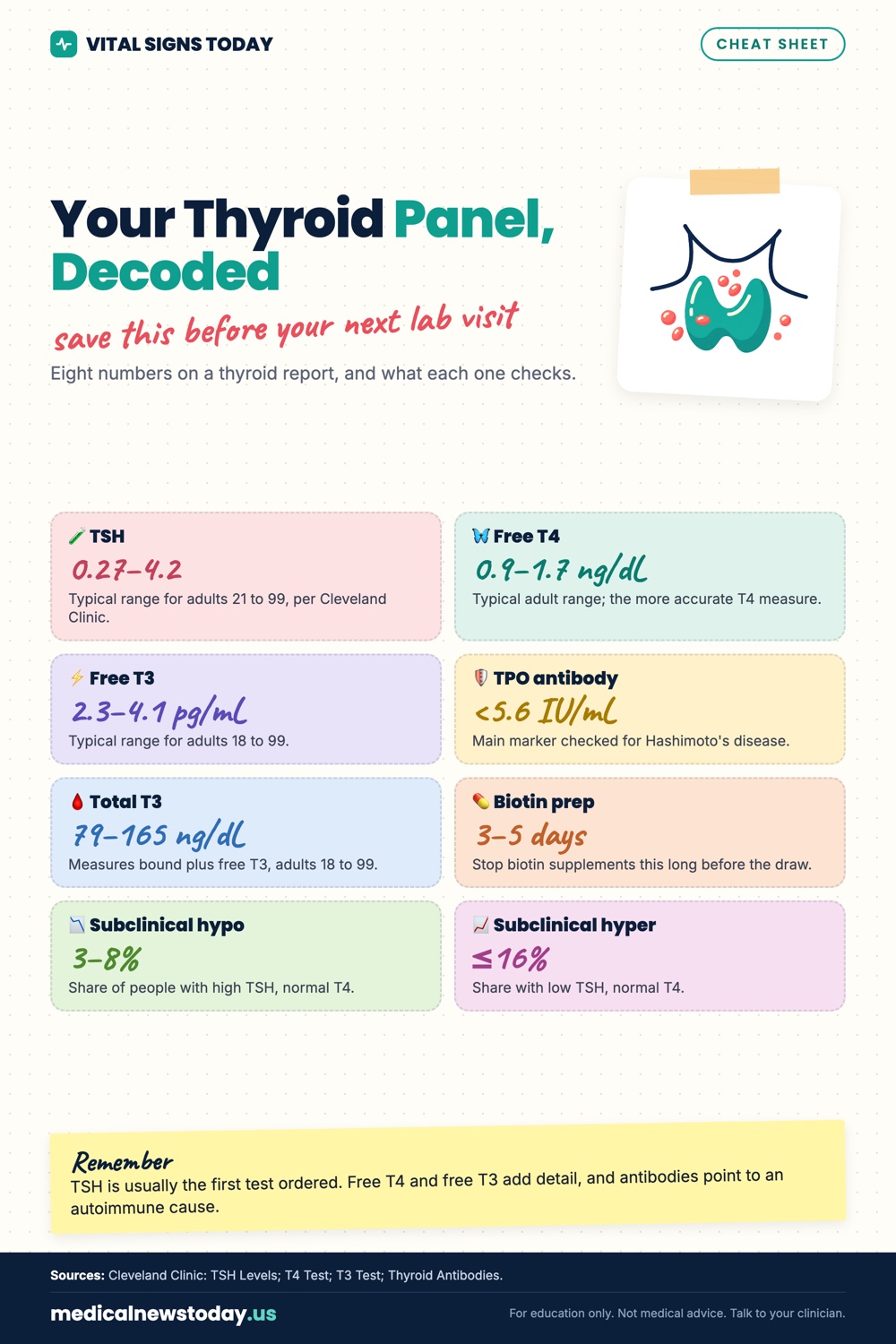
- Standard reference ranges are roughly TSH 0.4 to 4.0 mIU/L, free T4 0.8 to 1.8 ng/dL, and free T3 2.0 to 4.4 pg/mL, but each lab sets its own ranges, so always read your results against the numbers printed on your own report.
A thyroid panel blood test measures the hormones that control how fast your body burns energy. It is ordered when symptoms such as fatigue, unexplained weight change, a racing or sluggish heart, feeling cold or hot, or mood changes suggest your thyroid may be over or underactive. Looking at TSH alongside free T4 and free T3 lets a clinician see not just whether a level is off, but where in the control loop the problem sits.
What is a Thyroid Panel?
The thyroid is a small butterfly-shaped gland at the front of your neck. It releases hormones that set your metabolic pace, influencing heart rate, body temperature, digestion, energy, and weight. A thyroid panel is a bundle of blood tests run from a single draw that, read together, give a fuller picture than any one number alone.
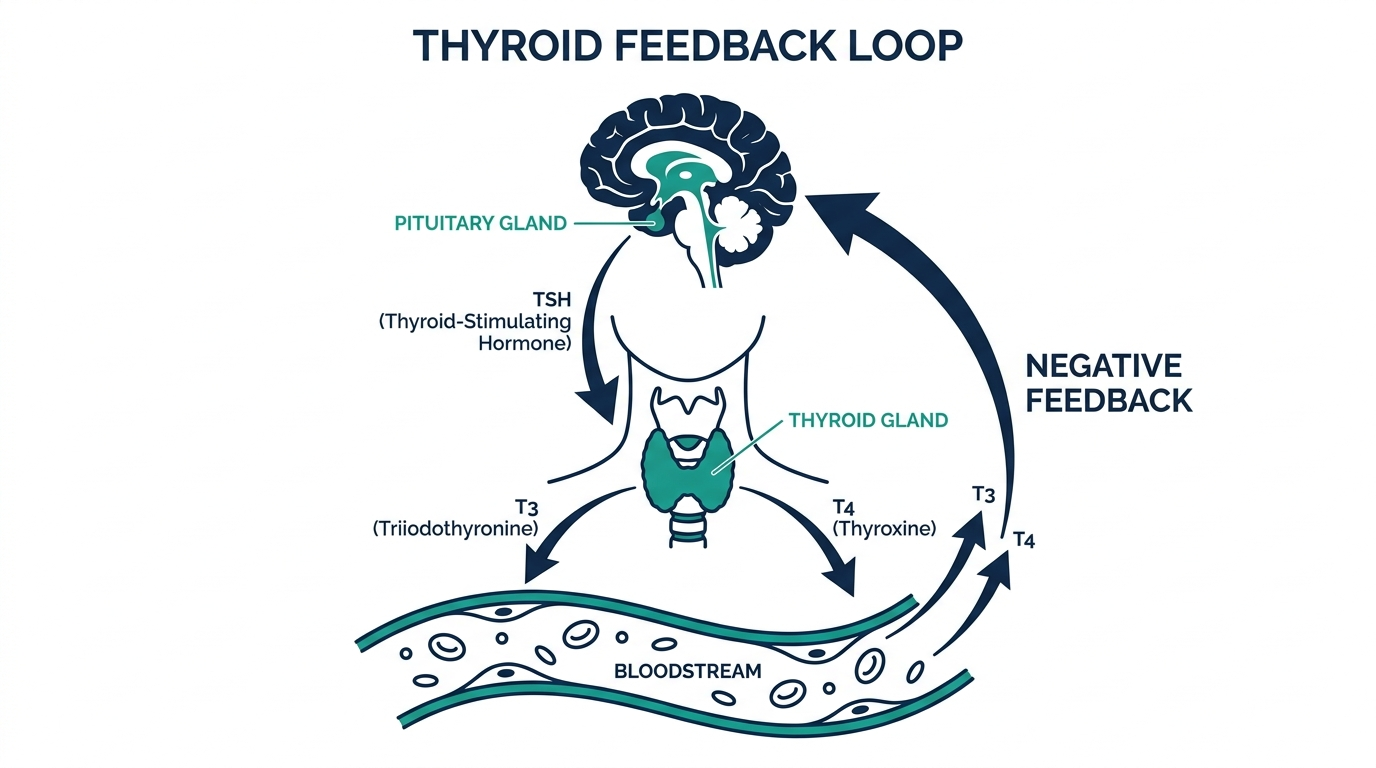
The system works as a feedback loop. The pituitary gland in your brain releases TSH (thyroid stimulating hormone) to tell the thyroid how hard to work. The thyroid responds by producing T4 and T3. When thyroid hormone is low, the pituitary pushes more TSH; when it is high, the pituitary backs off. Because of this loop, an abnormal TSH paired with thyroid hormone levels tells a clinician whether the gland is failing, overworking, or being mis-signaled from above.
What does a Thyroid Panel measure?
A standard panel reports the three markers below. Each one tells a different part of the story, and each has its own deep-dive article.
- TSH (thyroid stimulating hormone): the pituitary signal that tells the thyroid how much hormone to make, and the most sensitive early sign that something is off.
- Free T4 (free thyroxine): the main hormone the thyroid releases, measured as the unbound portion available to act on your tissues.
- Free T3 (free triiodothyronine): the active hormone your cells actually use, mostly converted from T4, measured as the free, usable fraction.
Why would a doctor order a Thyroid Panel?
The most common reason is to investigate symptoms that point toward a thyroid problem. An underactive thyroid (hypothyroidism) can cause fatigue, weight gain, constipation, dry skin, feeling cold, low mood, and heavy or irregular periods. An overactive thyroid (hyperthyroidism) can cause a fast or irregular heartbeat, unexplained weight loss, anxiety, tremor, sweating, and trouble sleeping. Because these symptoms overlap with many other conditions, a blood test is the clearest way to confirm or rule out the thyroid.
Doctors also order a thyroid panel to screen people at higher risk, including those with a family history of thyroid disease, a personal history of autoimmune conditions, or an enlarged thyroid (goiter) felt during an exam. It is used during pregnancy and when planning pregnancy, since thyroid hormone is critical for fetal development. And it is the standard way to monitor anyone already on thyroid medication, to check whether the dose is keeping levels in range over time.
How to read your Thyroid Panel results
Read each marker against the reference range printed on your own report, not a number from the internet, because labs calibrate their assays differently. As general orientation, common adult ranges are TSH 0.4 to 4.0 mIU/L, free T4 0.8 to 1.8 ng/dL, and free T3 2.0 to 4.4 pg/mL.
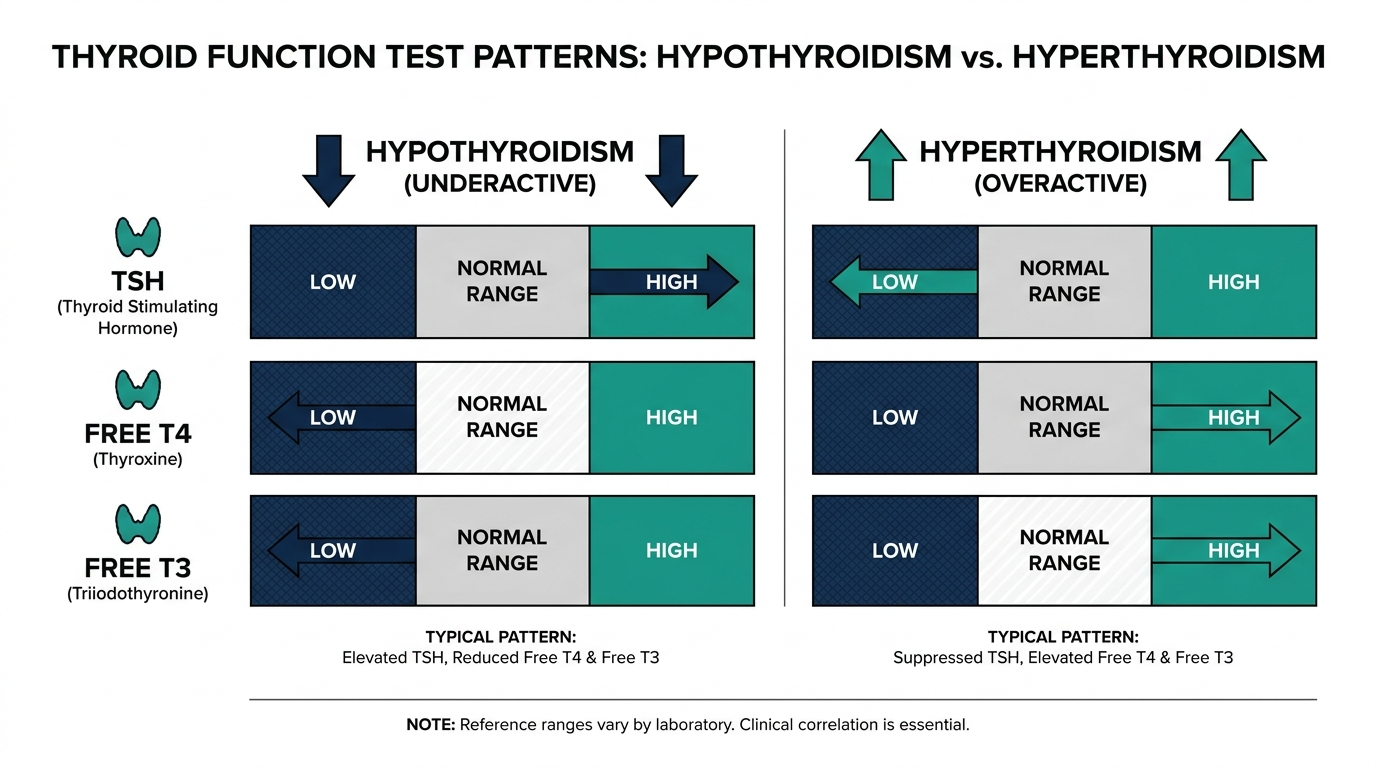
The most useful skill is reading the markers together rather than one at a time. A few classic patterns:
- High TSH with low free T4 points to primary hypothyroidism, where the thyroid is underperforming and the pituitary is shouting louder to compensate.
- Low TSH with high free T4 or free T3 points to hyperthyroidism, where the thyroid is overproducing and the pituitary has gone quiet.
- High TSH with normal free T4 is often called subclinical hypothyroidism, an early or mild stage that may need monitoring rather than immediate treatment.
- Low TSH with low free T4 is less common and can suggest a pituitary problem rather than a thyroid one, since the signal from above is missing.
Direction matters because of the feedback loop. TSH moves in the opposite direction to thyroid hormone, so a single number out of range is a clue, not a diagnosis. Your clinician interprets the pattern alongside your symptoms, your medication, and sometimes antibody tests before deciding what it means.
What do high and low results mean?
Once you know the classic patterns, it helps to understand what a single marker moving up or down is actually telling you, because each one carries a different weight in the diagnosis.
TSH: high vs low
TSH is the most sensitive marker and it runs backwards, so a high TSH usually means the thyroid is underactive and the pituitary is pushing harder to compensate. It is often the first number to drift before free T4 changes, which is why a high TSH with a still-normal free T4 gets labeled subclinical hypothyroidism. A low TSH usually means the thyroid is overproducing and the pituitary has gone quiet, the hallmark of hyperthyroidism. The rare exception is a pituitary problem, where a low or inappropriately normal TSH sits next to a low free T4, and the fault is the signal from above rather than the gland itself.
Free T4: high vs low
Free T4 is the reservoir hormone, and it confirms what TSH hints at. A low free T4 with a high TSH nails down primary hypothyroidism. A high free T4 with a low TSH confirms hyperthyroidism. When free T4 disagrees with TSH, for example a high TSH but a normal free T4, it usually means an early or mild stage that your clinician will watch and recheck rather than treat on the spot.
Free T3 and antibodies: what they add
Free T3 is the active hormone your cells use, and it is most useful in hyperthyroidism, where it can be high even when free T4 is borderline, a pattern sometimes called T3 toxicosis. In hypothyroidism, free T3 is less helpful because the body protects T3 levels until late. To find the cause rather than just the state, clinicians often add thyroid antibodies. High TPO antibodies point to Hashimoto’s disease as the reason for an underactive thyroid, while TSI or TRAb antibodies point to Graves’ disease behind an overactive one. Antibodies explain why the thyroid is misbehaving, which the hormone levels alone cannot.
Optimal ranges vs the standard lab range
The thyroid is a good example of why “normal” and “optimal” are not the same conversation. The standard TSH range, roughly 0.4 to 4.0 mIU/L, is a population statistic, and where you feel best inside that range can differ from person to person, which is the whole reason our TSH optimal range guide exists. Two people can share the same TSH and feel very different, because symptoms, free T4, free T3, and antibodies all shape the picture. The practical takeaway is not to chase a single ideal number off the internet, but to read your TSH against your free hormones and how you actually feel, and to interpret any value against the range printed on your own report, since labs calibrate their assays differently.
When should you get this panel tested?
Test when you have persistent symptoms that fit an over or underactive thyroid, especially fatigue, weight change you cannot explain, or heart rhythm changes. Test if you have a known risk factor, such as a family history of thyroid disease, an autoimmune condition, or a previously borderline result that a doctor asked you to recheck.
If you take thyroid medication, follow your clinician’s monitoring schedule. After a dose change, levels are commonly rechecked in about six to eight weeks because TSH takes time to settle, and once stable, testing may move to roughly once a year. For consistency, many people get tested in the morning and, if levothyroxine is involved, before taking that day’s dose, so results are comparable from visit to visit. Your own doctor sets the right timing for your situation.
How to prepare for a thyroid panel
Thyroid testing needs less prep than most panels, but a few habits make results far more comparable. Fasting is usually not required, though you may be asked to fast if glucose or a lipid panel is drawn at the same time. Because TSH is naturally higher in the early morning and drifts down through the day, try to get tested at a consistent time, ideally morning, so one visit compares cleanly to the next. If you take levothyroxine, most clinicians suggest drawing blood before that day’s dose, since taking it first can transiently raise free T4. Pause biotin supplements for a couple of days beforehand, as biotin can distort some thyroid assays, and tell your doctor about steroids, estrogen, and any heart or psychiatric medications, all of which can shift the numbers.
How your thyroid panel connects to your other blood work
Thyroid symptoms overlap heavily with other conditions, so the thyroid panel is often read next to the rest of your bloodwork before anyone draws a conclusion.
- Iron studies. Low iron causes the same fatigue, hair shedding, and low mood as hypothyroidism, and the two frequently travel together. A ferritin is a common companion test. See the iron studies guide for how those numbers read.
- Lipid panel. An underactive thyroid raises LDL and total cholesterol, so an unexplained jump in cholesterol can be the first clue to check TSH. The lipid panel guide covers that link.
- Metabolic markers. Thyroid hormone sets your metabolic pace, so blood sugar and weight often shift with it, which is why glucose and a metabolic panel round out the picture.
- Sex hormones. Thyroid dysfunction can disrupt menstrual cycles and fertility, so in women being worked up for irregular periods, thyroid and reproductive hormones are often checked in the same draw.
This is the case for a broad draw rather than a lone TSH. When the thyroid, iron, lipid, and metabolic numbers sit side by side, a symptom like exhaustion stops being a guessing game and starts pointing at a specific cause.
A real-world example of reading the pattern
Take a 41-year-old woman with creeping fatigue, dry skin, and a few extra pounds she cannot shift. Her free T4 is still inside the range, so a single glance says the thyroid is fine. Read as a panel, the picture sharpens: TSH is elevated, free T4 sits at the low end, and TPO antibodies are high. That is early Hashimoto’s, caught before it became full hypothyroidism, and the antibodies explain why it is happening.
Now take a 30-year-old man with a racing heart, anxiety, tremor, and weight loss he did not intend. His TSH comes back very low. Alone that might be dismissed, but free T4 and free T3 are both high, and TRAb antibodies are positive. That combination is not stress, it is Graves’ disease, and reading the markers together is what moves him toward the right treatment instead of a prescription for anxiety.
Every marker in this panel
Tap any marker for a full plain-English explainer, including what high and low results mean.
- TSH Optimal Range vs Normal Range: What the Numbers Really Mean
- What Does High TSH Mean in a Blood Test? Causes, Cutoffs, and When to Worry
- What Does Low TSH Mean in a Blood Test? Causes and When to Worry
- What Is TSH in a Blood Test? The Thyroid Number That Works Backwards
- What Is a T3 Blood Test? The Active Thyroid Hormone Your TSH Alone Cannot Explain
- Free T3 and Free T4 Explained: What These Thyroid Biomarkers Mean
Frequently asked questions
Do I need to fast before a thyroid panel blood test?
Fasting is generally not required for a thyroid panel. If your blood is drawn at the same time as other tests, such as glucose or a lipid panel, your doctor may ask you to fast for those. Timing can matter more than fasting, since TSH tends to be higher in the early morning, so following the same routine each time helps comparisons.
What is the difference between total and free T4 or T3?
Most thyroid hormone in your blood is bound to carrier proteins and is not active. Total T4 and total T3 measure everything, bound and unbound. Free T4 and free T3 measure only the unbound fraction that can actually reach your cells, which is why most modern panels favor the free measurements as a truer reflection of thyroid activity.
Can my thyroid results be abnormal even if I feel fine?
Yes. Mild thyroid changes, such as subclinical hypothyroidism, can show up on bloodwork before you notice clear symptoms. This is one reason screening is offered to people at higher risk and why a single borderline result is usually rechecked rather than acted on immediately.
Why is my TSH normal but I still feel tired?
A normal TSH makes a thyroid problem less likely but does not rule out every cause of fatigue. Energy and mood are affected by sleep, iron levels, vitamin D, blood sugar, stress, and many other factors. If symptoms persist with a normal panel, your clinician may look beyond the thyroid or recheck free T4 and free T3 for a fuller view.
Do medications and supplements affect thyroid test results?
They can. Biotin supplements, often taken for hair and nails, can interfere with some thyroid assays and skew results, so many labs advise pausing biotin for a couple of days before testing. Steroids, some heart and psychiatric medications, estrogen, and of course thyroid medication itself can also shift the numbers. Tell your doctor everything you take so results are read correctly.
How soon after a dose change should I retest?
TSH is slow to respond, so most clinicians recheck about six to eight weeks after starting or adjusting thyroid medication. Testing sooner often shows a number that has not caught up yet, which can lead to over-adjusting. Once your dose is stable and your levels are in range, monitoring usually stretches to about once a year unless symptoms change.
Can pregnancy change my thyroid results?
Yes, and it matters. Pregnancy shifts thyroid hormone demand and uses trimester-specific TSH ranges, because normal non-pregnant cutoffs do not apply. Thyroid hormone is critical for fetal brain development, so thyroid levels are watched closely before and during pregnancy, and medication doses often need to rise. If you are pregnant or planning to be, your results should be read against pregnancy ranges by your clinician.
Sources
- UCLA Health, Normal Thyroid Hormone Levels: https://www.uclahealth.org/medical-services/surgery/endocrine-surgery/conditions-treated/thyroid/normal-thyroid-hormone-levels
- UCLA Health, TSH (Thyrotropin) Test: https://www.uclahealth.org/medical-services/surgery/endocrine-surgery/conditions-treated/thyroid/tsh-thyrotropin-test
- National Library of Medicine, Reference ranges for TSH and thyroid hormones: https://www.ncbi.nlm.nih.gov/pmc/articles/PMC4480274/
- Testing.com, Thyroid Test Results Chart: https://www.testing.com/thyroid-testing-example-results/
This article is for general educational purposes and is not medical advice. It cannot diagnose or treat you and does not replace your clinician. Always discuss your lab results and any health decisions with a qualified healthcare professional.
Related: compare at-home thyroid hormone tests.
Vital Signs Today may earn a commission if you buy through links on this page. It does not affect our editorial assessments.