Best At-Home Blood Tests of 2026: 4 Services We Compared Side by Side
At-home blood testing has moved from a novelty to a real way to track your health between doctor visits. We spent weeks comparing the leading services on price, biomarker depth, accuracy, and how usable the results actually are. Below are our four picks, who each one is best for, and the current pricing so you can choose without guessing.
We may earn a commission if you buy through links on this page. Here is our process.
Key Takeaways
- Superpower is the best overall value for most people in 2026, offering 100+ biomarkers and a physician-reviewed longevity dashboard for around $199 per year.
- Function Health gives you the deepest panel with two full lab draws a year and clinician-written notes, but it is the priciest pick here, with a first-year rate around $365 and a standard membership of $499 (see current pricing at Function Health).
- Everlywell is the best choice if you want a single targeted test, like thyroid or hormones, without paying for an annual membership, with kits ranging from about $49 to $249.
A quick look at our top picks
- Best overall value: Superpower
- Best for deepest panel and twice-yearly testing: Function Health
- Best for single targeted tests: Everlywell
- Best for needle-free, fast turnaround: SiPhox Health
At-home blood test comparison
| Service | VST score (out of 5) | Price | Best for |
|---|---|---|---|
| Superpower | 4.8 | ~$199/year | Best overall value |
| Function Health | 4.6 | ~$365 first year, $499 standard | Deepest panel, twice yearly |
| Everlywell | 4.4 | ~$49 to $249 per kit | Single targeted tests |
| SiPhox Health | 4.3 | from ~$125 | Needle-free, fast turnaround |
Superpower – Best for overall value
Superpower is our top pick because it bundles a 100+ biomarker panel, a physician-reviewed dashboard, and ongoing tracking for around $199 a year, which undercuts most premium rivals. For most people who want a serious annual checkup without a doctor visit, this is the easiest yes.
Pros
- 100+ biomarkers covering metabolic, hormonal, cardiovascular, and longevity markers
- Physician-reviewed results with a clean dashboard and a biological age estimate
- Membership is FSA and HSA eligible
- Flexible collection: at-home kit or a lab draw at thousands of partner locations
Cons
- Pricing is higher in some states such as New York and New Jersey
- An at-home mobile phlebotomist costs extra if you do not want to visit a lab
- Supplements the platform recommends are an additional out-of-pocket cost
What sets Superpower apart is the value math. You get a panel that rivals services costing twice as much, paired with a dashboard built for people who want to track longevity markers over time rather than just pass or fail a single test. The biological age feature is genuinely motivating, and the care team access means you are not left to interpret a wall of numbers alone.
The membership model is the catch worth understanding. This is a recurring yearly cost, not a one-time kit, so it pays off most for people who plan to retest and track trends. If you only want one snapshot and never again, a single-kit service may fit better. For anyone serious about a yearly baseline, Superpower is the strongest value in 2026.
Pricing: Around $199 per year for the core membership, higher in select states.

Function Health – Best for the deepest panel and twice-yearly testing
Function Health is the pick if you want the most lab data and a clinician reading every result. It tests 100+ biomarkers at your first draw and adds a 60+ biomarker follow-up halfway through the year, all reviewed by a clinician. The first-year rate runs around $365, with the standard membership at $499 (see current pricing at Function Health).
Pros
- Two lab draws per year, so you see what actually changed
- Clinician review with a written action plan, food guide, and supplement list
- No per-test fees and no surprise charges inside the membership
- FSA and HSA eligible, with advanced add-ons available
Cons
- The most expensive option here, around $365 for the first year and $499 standard
- Draws are done at a partner lab, not a fully at-home finger prick
- Add-ons like advanced cancer screening cost extra on top of membership
Function offers a first-year rate around $365, with the standard membership at $499, so the introductory year is the most competitive entry point. The standout is the twice-yearly cadence. Most services give you one snapshot, but Function builds in a mid-year retest so you can confirm whether a lifestyle change moved the needle. The clinician notes are detailed and written in plain language.
This is the right tool for someone who treats their health like a project and wants the deepest possible dataset with professional interpretation. It is overkill if you just want to check one or two markers, and the price means casual users will feel it. But for thorough, clinician-backed monitoring, nothing else here matches the depth.
Pricing: Around $365 for the first year, $499 for the standard membership. See current pricing at Function Health.
SEE PLANS AT FUNCTION HEALTH →
Everlywell – Best for single targeted tests
Everlywell wins for anyone who wants one specific answer without an annual commitment. It sells individual at-home kits, like thyroid, hormone, and metabolism panels, processed at CLIA-certified labs, priced from about $49 to $249 depending on the panel.
Pros
- Buy only the test you need, no membership required
- Wide catalog of focused panels: thyroid, hormones, metabolism, food sensitivity, and more
- Samples processed at CLIA-certified labs for reliable results
- HSA and FSA accepted at checkout
Cons
- Per-kit cost adds up fast if you test many markers separately
- No unified longevity dashboard like membership services offer
- Some tests are not available in every state
The appeal of Everlywell is simplicity and control. If your doctor flagged your thyroid, you can order a thyroid kit for around $149, collect a sample at home, and get results in days without paying for a hundred markers you do not care about. The catalog is broad enough that most common concerns have a dedicated kit.
Where it falls short is breadth at scale. If you want a full-body baseline across dozens of markers, buying separate kits costs more than a single membership panel from Superpower or Function. Everlywell is the smart pick for a targeted question, not a comprehensive yearly checkup. Used that way, it is hard to beat on flexibility.
Pricing: Around $49 to $249 per kit, with the thyroid test near $149.
SiPhox Health – Best for needle-free testing and fast turnaround
SiPhox Health is the pick if needles are the thing stopping you from testing. It uses a finger-prick and an arm-based EasyDraw collection method, is HSA and FSA eligible, and returns results in about 5 to 7 days, with memberships starting around $125.
Pros
- Needle-free EasyDraw option plus a standard finger-prick, no lab visit required
- Fast turnaround, typically 5 to 7 days for results
- Lower entry price than the full membership services
- HSA and FSA eligible, with flexible testing frequency
Cons
- Base panel covers fewer biomarkers than Superpower or Function
- Expanding to the full panel costs extra on top of the starting price
- Less established track record than the larger players
SiPhox solves a real friction point. Plenty of people skip blood testing entirely because they dread a lab draw or cannot easily get to one. The arm-based collection device removes that barrier, and the quick result window means you are not waiting weeks to act. For convenience-first users, it is the most approachable option here.
The trade-off is depth. The starting panel is leaner than the membership giants, and you pay more to expand it toward the 60-biomarker range. If your priority is the widest possible dataset, look at Superpower or Function instead. If your priority is getting tested at all, without needles or a lab trip, SiPhox is the easiest on-ramp.
Pricing: Starting around $125, with upgrades available to expand the panel.
Why trust Vital Signs Today
We compared 12 at-home testing services and reviewed what each panel actually measures, not just the marketing claims. We verify current pricing before publishing, read the fine print on lab certification, and update this guide as services change their plans. We do not let affiliate relationships change our rankings, and we say plainly when a cheaper option is the smarter buy.
How we picked
We ranked each service on the criteria that matter most for at-home testing, then weighted value heavily since price is the main barrier for most readers.
- Biomarker depth: how many markers and which organ systems each panel covers
- Accuracy and lab quality: CLIA certification and clinician or physician review
- Value: total cost relative to what you actually receive
- Usability: how clear the dashboard and result interpretation are
- Convenience: collection method, turnaround time, and FSA or HSA eligibility
What biomarkers a good at-home panel should cover
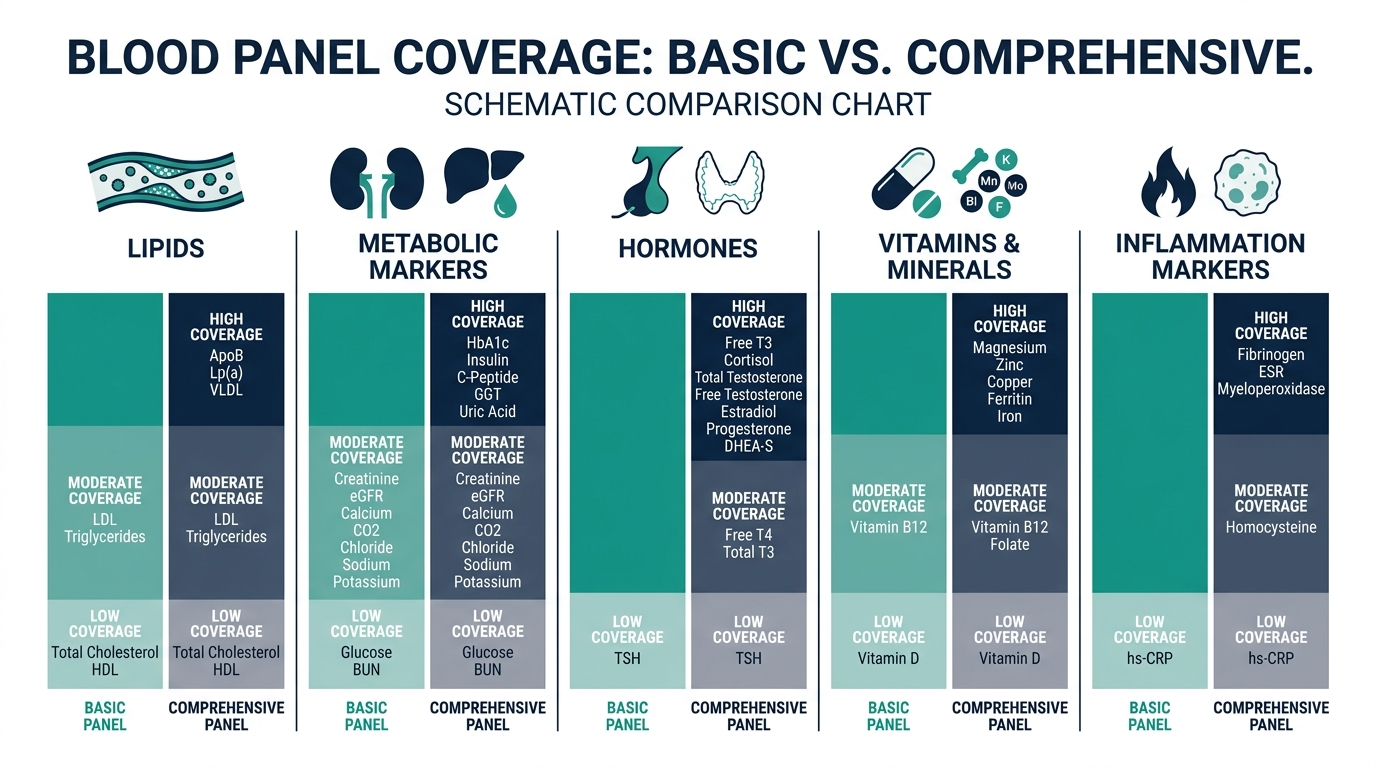
Biomarker count is the headline number services advertise, but the coverage across organ systems matters far more than the raw total. A panel of 30 well-chosen markers can tell you more than 100 redundant ones. When comparing services, look for representation across these core categories.
- Metabolic health. Fasting glucose and HbA1c reveal how your body handles blood sugar and can flag prediabetes years before symptoms. A fasting insulin adds an earlier view of insulin resistance.
- Cardiovascular risk. A full lipid panel, ideally with ApoB or a triglyceride-to-HDL read, gives a truer picture of heart risk than total cholesterol alone. High-sensitivity CRP adds an inflammation angle.
- Thyroid and hormones. TSH at a minimum, with free T4 and free T3 for a fuller thyroid view. Sex hormones and cortisol matter if fatigue, mood, or libido is the concern.
- Kidney and liver function. Creatinine and eGFR for the kidneys, and ALT, AST, and related enzymes for the liver, catch quiet organ stress that rarely produces early symptoms.
- Nutrients and blood count. Ferritin and iron studies, vitamin D, vitamin B12, and a complete blood count round out a panel by catching deficiencies and anemia that drive everyday fatigue.
A panel that touches all five of these areas gives you a genuine full-body baseline. One that piles on dozens of narrow markers while skipping a whole category can look impressive on paper yet leave a real blind spot.
Finger-prick versus venous draw: the accuracy tradeoff
The collection method is the biggest driver of accuracy differences between at-home services, and it is worth understanding before you choose.
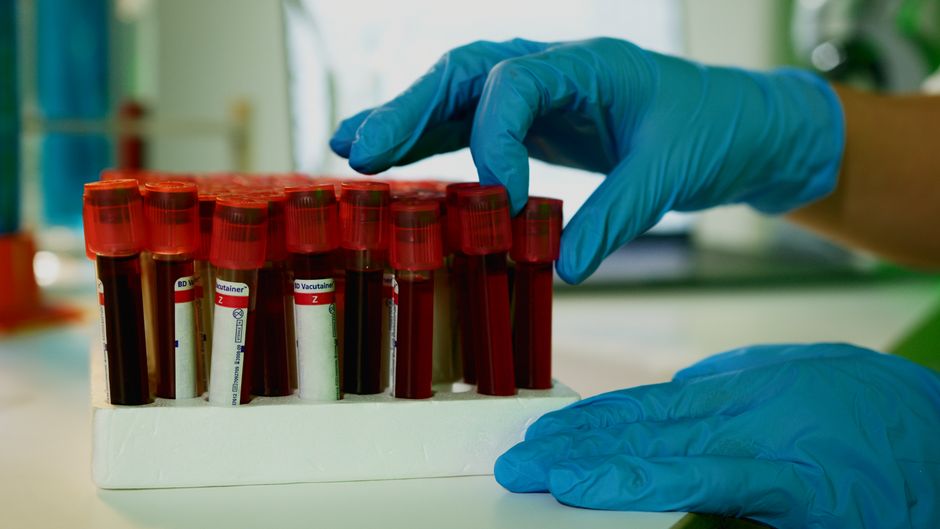
A venous draw, the standard tube of blood taken from your arm at a lab, is the reference standard. It provides ample sample volume and works for essentially every biomarker, which is why the membership services that aim for the deepest panels rely on it. The tradeoff is that you leave home for the collection or pay extra for a mobile phlebotomist.
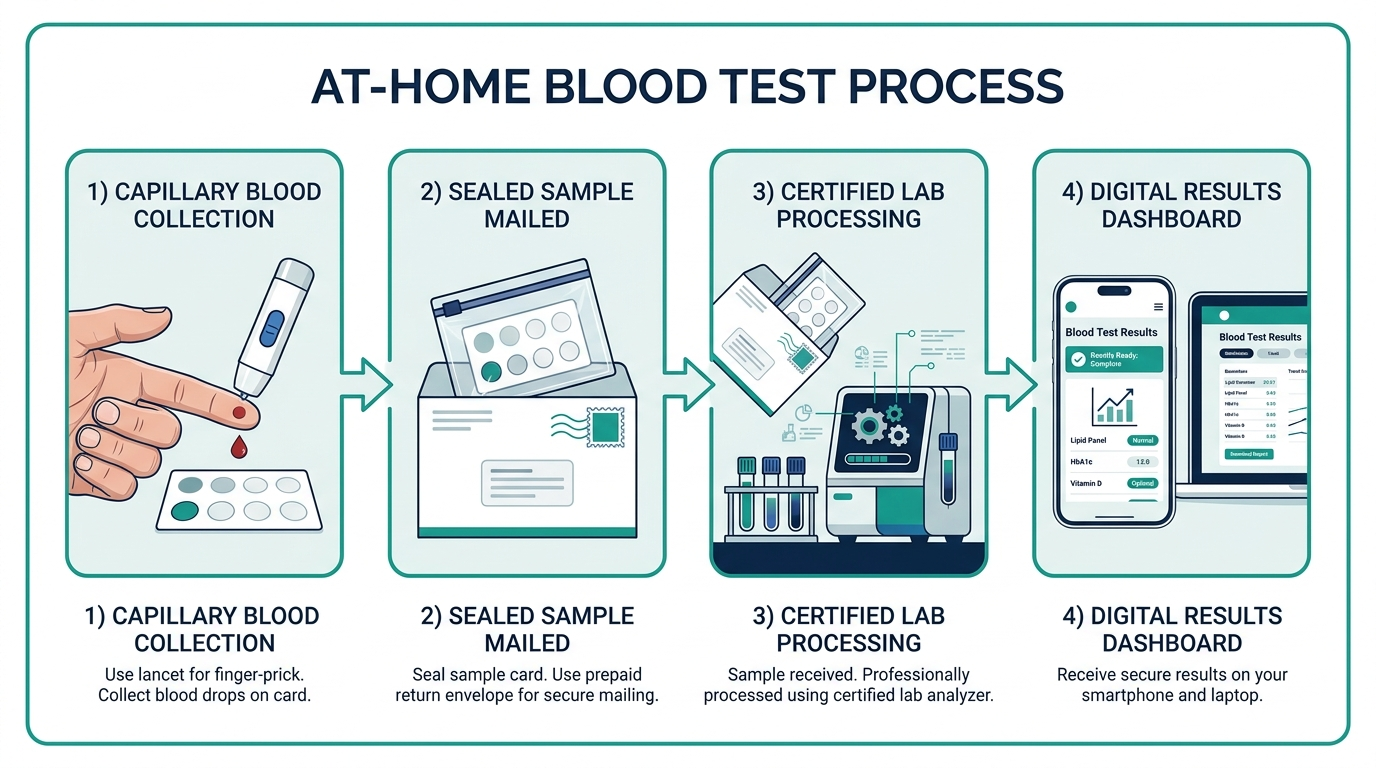
A finger-prick collects a much smaller volume of capillary blood at home. For many common markers this is perfectly adequate, and modern kits are validated against venous samples. The limitations are practical: some tests simply need more blood than a finger-prick provides, and the technique is less forgiving. Squeezing the finger too hard, using cold hands with poor flow, or collecting too little can dilute or damage the sample and skew the result or trigger a rejection. Arm-based collection devices sit between the two, capturing a larger sample than a fingertip while still avoiding a traditional needle.
The practical takeaway is that finger-prick convenience is real and the accuracy is sound when done correctly, but the margin for collection error is smaller. If your panel is broad or includes markers that demand volume, a venous draw remains the more reliable route.
How to make your at-home test actually count
An at-home test is only as good as the sample you provide and the preparation behind it. Because no phlebotomist or clinician is there to catch a mistake, following the protocol closely is what separates a clean result from a wasted kit.
- Read the fasting and timing instructions first. Panels with glucose, insulin, or lipids usually need an 8 to 12 hour fast, and hormone panels are most accurate when collected in the early morning.
- Warm your hands and get blood flowing for finger-pricks. Run your hands under warm water, shake them out, and let your arm hang down before you lance. This is the single biggest factor in getting enough blood.
- Fill to the line. Under-filling the collection device is the most common reason a home sample is rejected. Take the time to reach the required volume.
- Ship the sample back promptly. Blood samples degrade over time, so mail your kit the same day you collect, ideally early in the week so it does not sit in transit over a weekend.
- Pause interfering supplements. High-dose biotin, common in hair and skin supplements, can distort several hormone and thyroid assays, so many services ask you to stop it for a day or two beforehand.
These small steps cost nothing and dramatically improve the odds that your result reflects your actual physiology rather than a collection artifact.
Reading your results and building a useful trend
The real payoff of at-home testing is not a single snapshot, it is watching your numbers move over time. A structured way of reading results turns a wall of values into something you can act on.
- Start with the reference range on your own report. Different labs use slightly different ranges, so the one printed beside your value is the one that applies.
- Weigh how far out of range a value sits. A number just past the edge of normal is common and often harmless, while one well outside deserves more attention. Roughly 1 in 20 healthy people fall outside the range on any given marker by chance.
- Compare against your own prior results. This is where memberships that keep your history shine. A value that is stable across draws is reassuring, while one trending steadily in the wrong direction is worth investigating even if it is still technically in range.
- Bring real abnormalities to a clinician. These services flag and explain results, but a genuinely abnormal value, or one paired with symptoms, belongs in front of a doctor who can order confirmatory testing.
Choosing one primary service and letting it hold your history over years is more valuable than scattering one-off kits across different providers, because the trend line is the thing that actually informs decisions.
Who should skip at-home testing and see a doctor instead
At-home testing is a strong tool for healthy people tracking their baseline, but it is the wrong tool in several situations, and recognizing them protects you.
- Anyone with acute or severe symptoms. Chest pain, severe shortness of breath, high fever, or sudden neurological changes call for urgent in-person care, not a mail-in kit and a several-day wait.
- People needing a diagnosis or treatment decision. These panels are for awareness and tracking. Diagnosing a condition or adjusting medication requires a clinician who can examine you and see your full history.
- Those managing a serious chronic illness. If you have significant kidney, heart, or liver disease, your monitoring should be coordinated by your care team, whose testing is tailored to your specific situation.
- Anyone likely to be alarmed by an incidental finding. A minor out-of-range value with no context can cause real anxiety. If you know you will spiral over a borderline number, testing through a clinician who can interpret it in real time may serve you better.
For everyone else, a healthy adult wanting to keep an informed eye on their health between checkups, at-home testing is a genuinely useful addition, as long as it complements rather than replaces a relationship with a clinician.
Frequently asked questions
Are at-home blood tests accurate?
Yes, when the service uses a CLIA-certified lab to process samples, results are clinically reliable. All four services here use certified labs. The main variable is collection: a proper finger-prick or lab draw done correctly gives accurate results, while a poorly collected sample can be rejected or skew low.
Which at-home blood test is the best value?
Superpower offers the best value for most people in 2026, with 100+ biomarkers and a physician-reviewed dashboard for around $199 a year. If you only want one targeted test, Everlywell is cheaper per kit. Function Health costs more, a first-year rate near $365 and $499 standard, but gives you two full draws a year.
Are these tests covered by insurance?
At-home test kits and memberships are generally not covered by traditional insurance. However, all four services are FSA and HSA eligible, so you can pay with pre-tax dollars, which effectively lowers the cost depending on your tax bracket.
Do I need a doctor to order an at-home blood test?
No. These services include physician ordering as part of the process, so you do not need to bring your own prescription. Superpower and Function also include clinician or physician review of your results, while Everlywell provides reference ranges and optional telehealth follow-up.
How often should I take an at-home blood test?
For general tracking, once or twice a year is enough for most people. Function builds a mid-year retest into its membership for exactly this reason. If you are actively changing your diet, training, or supplements, retesting every few months helps you confirm whether those changes are working.
Bottom line
For most people, Superpower is the best at-home blood test in 2026 because it combines a deep 100+ biomarker panel, a physician-reviewed dashboard, and a price around $199 that beats its closest rivals. Choose Function Health if you want the deepest panel and twice-yearly clinician-reviewed draws and the budget to match. Pick Everlywell for a single targeted test without a membership, and SiPhox Health if a needle-free, fast-turnaround option is what gets you to finally test. Whichever you choose, testing at home and tracking the trend beats never testing at all.
Sources
- Superpower, Membership FAQs and pricing (superpower.com/faqs, superpower.com/blog/superpower-is-now-199), accessed June 2026
- Function Health, Pricing and “Function membership is now $365/year” (functionhealth.com/pricing, functionhealth.com/article/function365), accessed June 2026
- Everlywell, Products and Thyroid Test pricing (everlywell.com/products), accessed June 2026
- SiPhox Health, “How much does SiPhox Health cost?” and pricing programs (siphoxhealth.com), accessed June 2026