Iron Studies Blood Test: What This Panel Measures and How to Read It
Key Takeaways
- An iron studies blood test is a group of related markers (iron, ferritin, TIBC, UIBC, and transferrin) that together reveal how much iron is in your blood, how much is stored in your body, and how much capacity your blood has to carry more.
- No single marker tells the whole story, so doctors read the panel as a pattern: low iron with low ferritin and high TIBC points toward iron deficiency, while high iron with high ferritin and low TIBC points toward iron overload.
- Ferritin is the most specific marker of your iron stores, but it rises with inflammation or infection, so a normal or high ferritin does not always rule out a true iron shortage.
An iron studies blood test is a panel of several measurements ordered together to assess your body’s iron status from multiple angles in one draw. Doctors order it when someone shows signs of anemia, unexplained fatigue, or suspected iron overload, because checking iron alone can be misleading and the full panel separates a genuine deficiency from an inflammatory pattern or excess storage. The markers in a standard panel are serum iron, ferritin, total iron-binding capacity (TIBC), unsaturated iron-binding capacity (UIBC), and transferrin, and they are interpreted together rather than one at a time.
What is a Iron Studies?
Iron studies (also called an iron panel) is a collection of blood tests that measure both the iron circulating in your bloodstream and your body’s ability to transport and store it. Iron is essential for making hemoglobin, the protein in red blood cells that carries oxygen, so when iron status is off, the whole body feels it. Rather than relying on a single number, the panel combines complementary markers so your clinician can see the full picture: how much iron is available right now, how much is held in reserve, and how much unused carrying capacity remains.
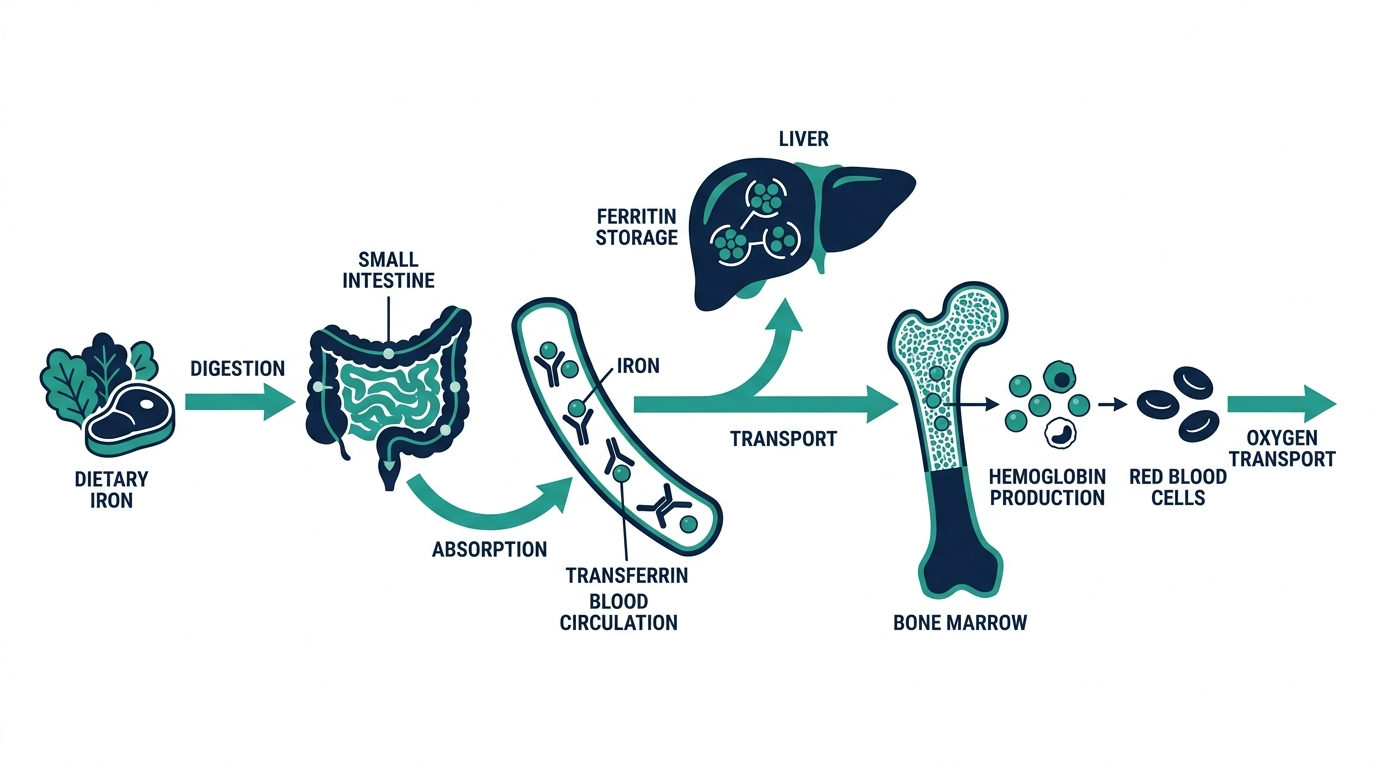
The panel works because iron in the blood does not float freely. It rides on a transport protein called transferrin, and most of your reserve iron sits locked inside a storage protein called ferritin. By measuring the iron, the transporter, the spare capacity, and the stores at the same time, iron studies turn a vague symptom like tiredness into a readable pattern.
What does a Iron Studies measure?
Each marker below answers a different question about your iron, and each has its own deep-dive article linked underneath this section. Use this as a quick map before going deeper.
- Iron (serum iron): the amount of iron actually circulating in your blood at the moment of the draw, typically around 50 to 175 mcg/dL in adults.
- Ferritin: the protein that stores iron, used as the best single estimate of your total iron reserves (roughly 20 to 250 mcg/L in men and 20 to 200 mcg/L in women).
- TIBC (total iron-binding capacity): the blood’s maximum capacity to bind and carry iron, usually about 250 to 370 mcg/dL, which rises when iron is scarce.
- UIBC (unsaturated iron-binding capacity): the spare, unused portion of that carrying capacity not yet filled with iron, calculated alongside TIBC and serum iron.
- Transferrin: the actual transport protein that ferries iron through the bloodstream, often reported with transferrin saturation (normally about 20 to 50 percent), which shows how full the carriers are.
Why would a doctor order a Iron Studies?
The most common reason is to investigate anemia or symptoms that suggest it, such as persistent fatigue, weakness, shortness of breath, pale skin, headaches, brittle nails, or unusual cravings to chew ice. When a routine complete blood count shows small or pale red blood cells, iron studies help confirm whether iron deficiency is the cause and how severe it is.
Doctors also order the panel to look for the opposite problem: too much iron. Conditions like hereditary hemochromatosis cause iron to build up and damage the liver, heart, and pancreas over years, and an iron panel can flag this long before symptoms appear. Other reasons include monitoring people on iron supplements or iron infusions, checking patients with chronic kidney disease or chronic inflammatory illness, evaluating a family history of iron overload, and following up an abnormal ferritin found on other testing. Because heavy menstrual bleeding, pregnancy, gastrointestinal blood loss, and plant-based diets all raise the risk of low iron, the panel is a practical first step whenever iron status is in doubt.
How to read your Iron Studies results
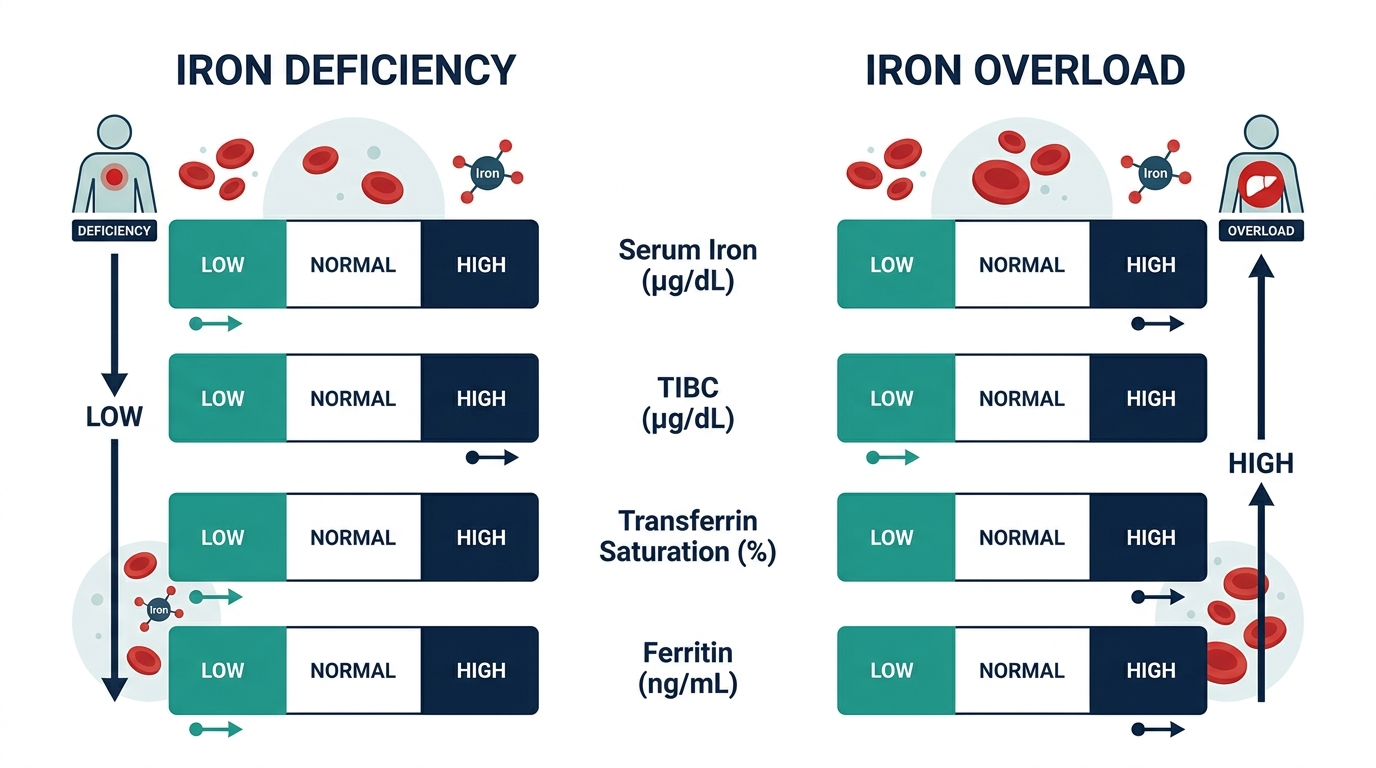
The single most important principle is that you read the pattern across markers, not one value in isolation. The markers move together in recognizable directions, and the direction is what points to a diagnosis.
In iron deficiency, serum iron falls, ferritin falls, transferrin saturation falls, and the body compensates by producing more carriers, so TIBC, UIBC, and transferrin rise. Think of it as empty trucks: there are many carriers but little cargo. In iron overload, the opposite happens. Serum iron is high, ferritin is high, transferrin saturation is high (often above 45 percent), and TIBC and UIBC tend to fall because the carriers are already full.
A trickier pattern is anemia of chronic disease or inflammation. Here serum iron is low, but ferritin is normal or even high because inflammation drives ferritin up independently of true iron stores. This is the main trap in reading the panel, and it is why ferritin alone can be falsely reassuring. Keep three things in mind: reference ranges differ slightly between laboratories, so always compare against the range printed on your own report; values shift with recent meals, supplements, and the time of day, which is why fasting morning samples are often preferred; and a single abnormal number should always be interpreted in the context of your symptoms, your complete blood count, and the rest of the panel by your clinician.
What do high and low results mean?
Because the markers move together, the useful question is not whether one number is flagged, but which direction the whole panel is pointing. Here is what a high or low value on each marker typically signals once you read it next to the others.
Ferritin: high vs low
A low ferritin is the most reliable single sign of true iron deficiency, and it is often the earliest, showing up before anemia appears on a complete blood count. It means the storage tank is running dry. A high ferritin is trickier. It can mean genuine iron overload, but because ferritin climbs during inflammation, infection, liver disease, and heavy alcohol use, a high value on its own does not confirm excess iron. Clinicians confirm overload by checking whether transferrin saturation is also high, since inflammation raises ferritin without raising saturation.
Serum iron and transferrin saturation: high vs low
Serum iron is the least stable marker on the panel, swinging with meals, supplements, and time of day, so it is rarely read alone. Transferrin saturation, which combines serum iron and TIBC into a percentage, is more informative. A low saturation, often under 20 percent, supports iron deficiency. A high saturation, especially above 45 percent, is one of the first clues to hereditary hemochromatosis and prompts genetic testing. A saturation that is high while ferritin is only mildly raised can be an early overload signal worth watching.
TIBC and transferrin: high vs low
TIBC and transferrin rise when iron is scarce, because the body builds more carriers to scavenge what little iron is around. So a high TIBC supports iron deficiency. They fall in iron overload, since the carriers are already saturated, and they can also fall in chronic disease, malnutrition, and conditions that lose protein. Reading TIBC against serum iron and ferritin is what separates deficiency from an inflammatory pattern.
Optimal ferritin vs the standard lab range
Ferritin is the marker where the population range and the practical target diverge most. Many labs still flag ferritin as low only below about 15 or 30 mcg/L, yet a growing body of clinical opinion argues those cutoffs miss real, symptomatic iron deficiency, particularly in menstruating women and endurance athletes, where symptoms such as fatigue, hair shedding, and restless legs can appear with ferritin in the 30 to 50 range (American Society of Hematology). The lesson is not to pick a personal number off the internet, but to read your ferritin against your symptoms rather than treating a technically normal value as proof that iron is fine. As always, labs differ in method and units, so compare only against the range printed on your own report.
When should you get this panel tested?
Consider asking about an iron studies blood test if you have ongoing fatigue that rest does not fix, symptoms of anemia, heavy or prolonged menstrual periods, a diagnosis of inflammatory bowel disease or another condition that affects absorption, or a strict vegetarian or vegan diet maintained for a long time. Pregnant people are frequently screened because iron demands climb sharply, and athletes in heavy training sometimes test because intense exercise can lower iron.
On the overload side, get tested if a close relative has hereditary hemochromatosis, or if you have joint pain, abdominal pain, or unexplained liver test abnormalities. If you are already on iron supplements or have had an iron infusion, your doctor will usually retest after a defined interval to confirm the treatment is working and that levels are not climbing too high. There is no fixed schedule for healthy people with no symptoms; testing is driven by symptoms, risk factors, and your clinician’s judgment rather than a calendar.
How to prepare for iron studies
A little preparation makes iron studies much easier to interpret. Book a morning slot and ask whether to fast, since serum iron peaks in the morning and rises after meals. Hold off on iron supplements and iron-containing multivitamins beforehand if your clinician advises it, because a recent dose can push serum iron up and mask a true deficiency, and some labs suggest pausing them for 24 hours or more. Mention any recent infection or illness, since inflammation temporarily raises ferritin and can hide low iron stores. Avoid a large iron-rich meal or a hard workout right before the draw, and bring a list of all your supplements so the result is read in the right context. If you are being retested to track treatment, try to match the timing and fasting state of your first draw so the two are comparable.
How iron studies connect to your other blood work
Iron studies are rarely read in isolation. The panel that surrounds them usually decides what the iron numbers actually mean.
- Complete blood count. The CBC is the usual trigger. Small, pale red cells (low MCV and MCH) alongside low ferritin confirm iron deficiency anemia, while a normal CBC with low ferritin flags a deficiency caught early, before anemia sets in. See the CBC guide for how those indices read.
- Inflammatory markers. A CRP drawn at the same time helps decode a confusing ferritin, since a high CRP explains a raised ferritin that would otherwise look like overload.
- Reticulocyte count. After starting iron treatment, a rising reticulocyte count is one of the first signs the bone marrow is responding, often before ferritin recovers.
- Kidney and liver markers. Chronic kidney disease and liver conditions both distort iron handling, so those panels put an abnormal iron result in context.
This is the practical argument for a broad draw over a single ferritin. When the CBC, inflammatory markers, and iron panel sit side by side, the difference between true deficiency and an inflammatory pattern usually becomes clear in one visit rather than three.
A real-world example of reading the pattern
Take a 29-year-old woman with heavy periods, constant tiredness, and thinning hair. Her hemoglobin is still just inside the normal range, so a quick glance says she is fine. Read as a panel, the story changes: ferritin is low, transferrin saturation is under 20 percent, and TIBC is high. That is textbook early iron deficiency, caught before it became frank anemia, and it points straight at the menstrual blood loss as the driver.
Now consider a 52-year-old man with joint aches and mildly abnormal liver enzymes. His ferritin is high, which alone might be blamed on his weekend drinking. But his transferrin saturation is also high, above 50 percent, and TIBC is low. That combination does not fit inflammation, it fits iron overload, and it is exactly the pattern that sends a clinician toward testing for hereditary hemochromatosis before the excess iron can damage the liver, heart, or pancreas.
Every marker in this panel
Tap any marker for a full plain-English explainer, including what high and low results mean.
- What Blood Tests Show Low Iron? Reading Ferritin, TIBC & Saturation
- What Does High Iron Mean on a Blood Test? The Number That Fools Everyone
- What Is Iron on a Blood Test? Serum Iron, Ferritin, and What Your Number Really Means
- What Does High Ferritin Mean in a Blood Test? Causes and Cutoffs
- What Is Ferritin in a Blood Test? The Iron Reserve Number That Catches Problems Early
- What Is Low Ferritin in a Blood Test? What a Low Result Really Means
- What Is TIBC in a Blood Test? The Iron Marker That Measures Hunger, Not Supply
- What Is TIBC in a Blood Test High? What an Elevated TIBC Really Means
- What Is UIBC in a Blood Test? The Spare-Capacity Number That Decodes Your Iron Panel
- What Is Transferrin in a Blood Test? The Iron Truck That Runs Backward From Your Iron
Frequently asked questions
Do I need to fast before an iron studies blood test?
Many laboratories prefer a fasting morning sample because serum iron is highest in the morning and rises after meals and iron supplements, which can skew the result. Follow the specific instructions on your lab order, and tell the staff about any iron supplements or multivitamins you take, since stopping them briefly before the draw is sometimes advised.
What is the difference between iron and ferritin?
Serum iron measures the iron circulating in your blood at that moment, which can swing with diet and time of day. Ferritin measures the iron held in storage, so it reflects your longer-term reserves and is the more stable, more specific marker of overall iron status. The two together tell you both the immediate supply and the savings account.
Can my ferritin be normal even if I am iron deficient?
Yes. Ferritin behaves as an acute-phase reactant, meaning it rises during inflammation, infection, or tissue damage. So someone with both an infection and low iron stores can show a deceptively normal ferritin. This is why doctors read ferritin alongside serum iron, transferrin saturation, and TIBC rather than on its own.
What does a high TIBC mean?
A high TIBC usually signals that your body is short on iron and has ramped up production of iron carriers to grab whatever iron it can, which is a classic sign of iron deficiency. A low TIBC tends to point the other way, toward iron overload or, in some cases, chronic disease and protein loss. TIBC is most meaningful when read with serum iron and ferritin.
How long does it take to get iron studies results?
Iron studies are common, routine blood tests, and most laboratories return results within one to a few days. Turnaround depends on the lab and whether the panel is processed locally or sent out, so your clinic can give you the expected timing when you have blood drawn.
Can I raise low iron with diet alone?
It depends on how low you are and why. Mild shortfalls can improve with more iron-rich food, and pairing plant iron with vitamin C while separating it from coffee, tea, and calcium improves absorption. But an established deficiency, especially from ongoing blood loss, usually needs supplements or, in some cases, an infusion, because diet alone often cannot refill depleted stores fast enough. The underlying cause of the loss still has to be found and addressed.
Why is my iron high but my doctor is not worried?
A single high serum iron is easy to overreact to, because serum iron swings with recent meals and supplements. What matters is whether ferritin and transferrin saturation are also high. If those are normal and only the momentary serum iron is up, it often reflects a recent iron dose or meal rather than a real problem. Persistent high ferritin and high saturation together are what prompt a closer look.
How often should I retest my iron?
There is no fixed schedule for a healthy person with no symptoms. If you are treating a deficiency, clinicians often recheck after a couple of months to confirm stores are rebuilding, then less often once levels stabilize. If you are monitoring overload or a chronic condition, your specialist sets the interval. Retesting is driven by treatment and risk, not the calendar.
Sources
- Testing.com. Transferrin and Iron-binding Capacity (TIBC, UIBC) Test. https://www.testing.com/tests/transferrin-and-iron-binding-capacity-tibc-uibc/
- Medscape Reference. Iron: Reference Range, Interpretation, Collection and Panels. https://emedicine.medscape.com/article/2085704-overview
- Iron Disorders Institute. Tests to Determine Iron Levels. https://irondisorders.org/tests-to-determine-iron-levels/
- American Society of Hematology Education Program. Sex, lies, and iron deficiency: a call to change ferritin reference ranges (2023). https://ashpublications.org/hematology/article/2023/1/617/506479/Sex-lies-and-iron-deficiency-a-call-to-change
- University of Iowa Health Care, Pathology Handbook. Iron Panel (IRON, TRANSFERRIN, TIBC and % SATURATION). https://www.healthcare.uiowa.edu/path_handbook/handbook/test1151.html
This article is for general educational purposes and is not medical advice. It cannot diagnose or treat you and does not replace your clinician. Always discuss your lab results and any health decisions with a qualified healthcare professional.
Vital Signs Today may earn a commission if you buy through links on this page. It does not affect our editorial assessments.