You opened your blood work, scanned past hemoglobin and cholesterol, and somewhere in the iron panel you hit four letters with a fat number beside them: TIBC, maybe 410 mcg/dL. No flag, no asterisk, so you moved on. Here is what most explainers skip. TIBC is not really a measure of your iron at all. It is a measure of how hard your body is hunting for iron, and that flips the way you read it.
Once you understand what TIBC is actually tracking, a high number stops being scary and a low number stops being ignorable. Let me walk you through it.
Part of our Iron Studies guide.
What is TIBC in a blood test?
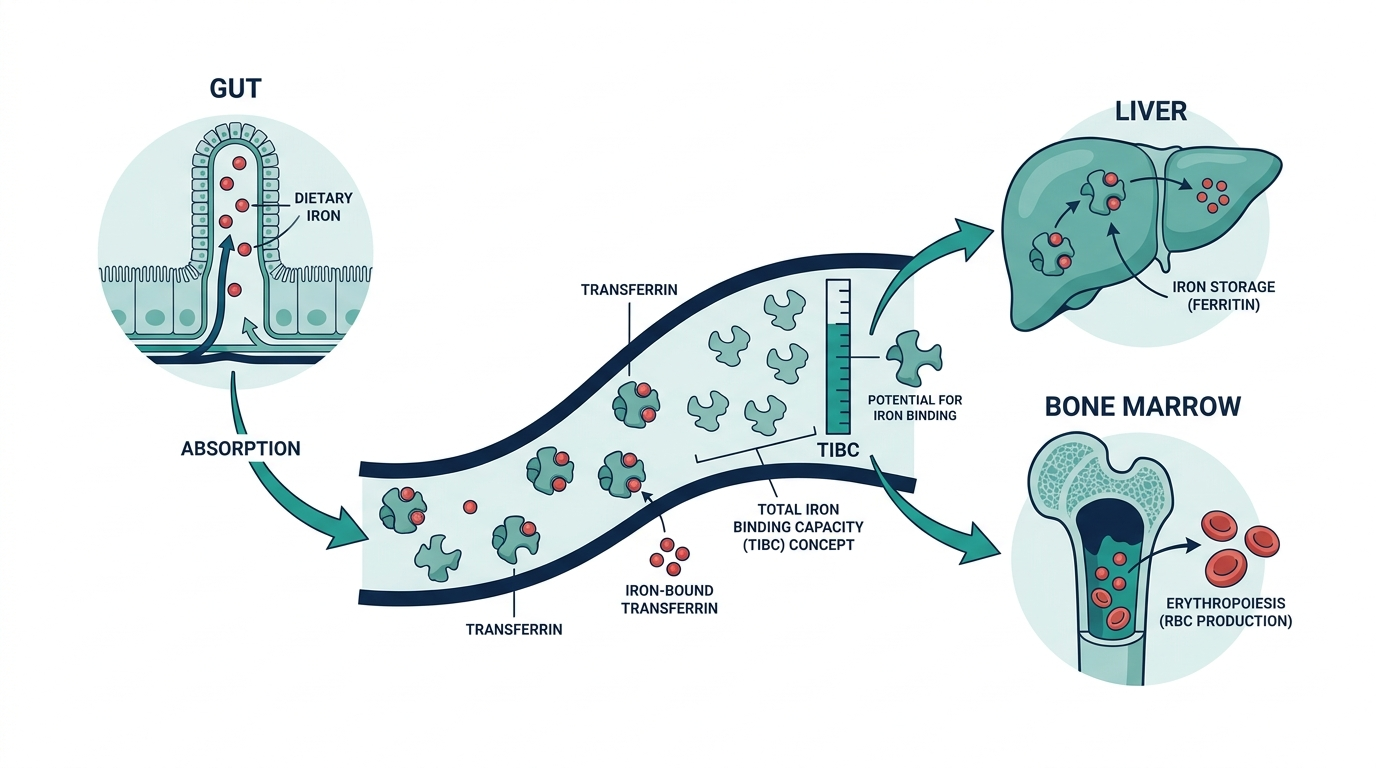
TIBC stands for total iron-binding capacity, and it measures your blood’s total ability to bind and carry iron. It does this by gauging transferrin, the liver-made protein that ferries iron through your bloodstream (Cleveland Clinic). In plain terms, TIBC counts the empty seats on the iron bus. The more empty seats, the higher the TIBC.
That single reframing is the key to the rest of this page. TIBC does not tell you how much iron you have. It tells you how much capacity your body has built to catch iron, and that capacity rises precisely when iron is running low.
What does a TIBC blood test actually measure?
A TIBC blood test measures the maximum amount of iron your transferrin proteins could carry if every binding site were full. Because transferrin is the main iron-transport protein, TIBC is essentially an indirect headcount of how much transferrin is circulating (Cleveland Clinic). At any given moment in a healthy person, only about one-third of those seats are occupied, leaving roughly two-thirds open as the unsaturated iron-binding capacity, or UIBC (StatPearls, NIH).
Here is a detail worth knowing when you compare lab reports. Most modern analyzers do not measure TIBC directly. They measure UIBC, then add it to your serum iron to calculate TIBC (StatPearls, NIH). So when someone asks what does TIBC mean in a blood test, the honest answer is that it is usually a derived number, built from two other measurements, which is one reason it is always read as part of a panel rather than alone.
What is a normal TIBC level?
A normal TIBC generally falls between about 240 and 450 mcg/dL, though the exact range depends on your lab and the units it uses (Cleveland Clinic). The MedlinePlus encyclopedia lists slightly wider sex-specific ranges of 171 to 505 mcg/dL for men and 149 to 492 mcg/dL for women, which corresponds to roughly 26.7 to 90.3 micromol/L in international units (about 30.6 to 90.3 for men and 26.7 to 88.0 for women) (MedlinePlus).
The practical takeaway: do not chase a TIBC number in isolation. Compare your result to the reference range printed on your own report, because that is the range your specific lab and instrument were calibrated against, and the cutoffs genuinely differ from one lab to the next.
What can affect your TIBC and iron panel results?
Because TIBC is usually calculated from your serum iron, anything that moves iron around in the short term can shift the whole panel, and a few of those things are entirely within your control before the draw. Getting them right is what separates a number your clinician can act on from one that has to be repeated.
- Time of day. Serum iron follows a daily rhythm and tends to peak in the morning and dip later, so iron studies are typically drawn in the morning to keep results comparable from one visit to the next (StatPearls, NIH).
- Fasting. Many labs ask you to fast beforehand, because a recent meal, especially an iron-rich one, can lift serum iron and skew the saturation math.
- Iron supplements. A supplement or multivitamin taken close to the draw can transiently raise serum iron, so ask your clinician whether to hold iron pills for a day or so before testing.
- Estrogen and pregnancy. Oral contraceptives and estrogen can raise transferrin, and therefore TIBC, and late pregnancy pushes it up as iron demand climbs (MedlinePlus).
- Acute illness. An infection or flare of inflammation can lower both serum iron and TIBC within days, which is why iron studies drawn during an acute illness can mislead.
The practical prep is simple: schedule the draw for the morning, ask whether to fast and whether to skip iron supplements first, and if you have been fighting an infection, say so, because inflammation can rewrite the entire panel for a week or more.
What does a high TIBC mean?
A high TIBC almost always means your body is short on iron. When iron stores run low, the liver ramps up transferrin production to scavenge every available iron atom, so the number of empty binding seats climbs and TIBC rises (MedlinePlus). The classic signature is a high TIBC paired with a low ferritin, which together point to iron-deficiency anemia, the most common form of anemia worldwide (Cleveland Clinic).
A few situations push TIBC up:
- Iron deficiency. The headline cause. Low iron triggers more transferrin, and TIBC goes up while transferrin saturation drops (StatPearls, NIH).
- Late pregnancy. Iron demand surges to support the growing baby, and TIBC commonly rises (MedlinePlus).
- Oral contraceptive use, which can raise transferrin levels in some people (MedlinePlus).
Here is the insider point that rarely reaches the patient version. In iron deficiency, the meaningful clue is not the TIBC by itself but transferrin saturation, which you get by dividing serum iron by TIBC and multiplying by 100. In genuine iron deficiency, that saturation falls to about 16 percent or lower (StatPearls, NIH). So a high TIBC sitting next to a low saturation is a far stronger fingerprint of iron deficiency than either number alone. If you only stare at the TIBC value, you miss the math that clinicians actually use.
What does a low TIBC mean?
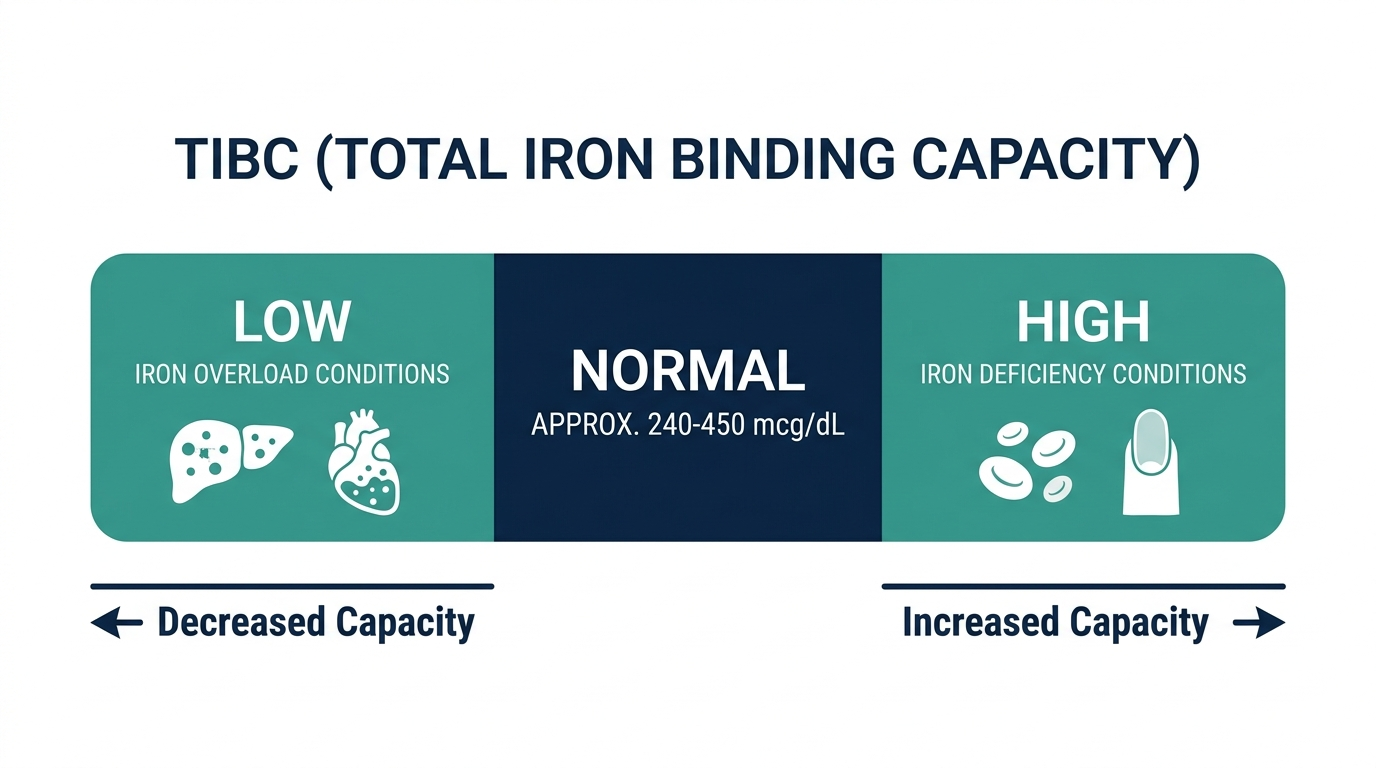
A low TIBC means your body has fewer empty iron-binding seats, which can happen for opposite reasons, so context decides everything. The two patterns split cleanly by your serum iron (MedlinePlus):
- Low TIBC with high iron suggests iron overload, such as hemochromatosis, where the body is loaded with iron and has little need to build extra transferrin (Cleveland Clinic).
- Low TIBC with low iron points toward chronic inflammation, infection, liver disease or cirrhosis, malnutrition, or nephrotic syndrome (Cleveland Clinic).
This is the part people get backwards. Because a high TIBC signals deficiency, it is tempting to assume a low TIBC always means plenty of iron. Not true. Anemia of chronic inflammation often shows a low TIBC even though the body cannot use the iron it has, because inflammation suppresses transferrin and locks iron away (StatPearls, NIH). A low TIBC is never automatically reassuring.
What symptoms go with an abnormal TIBC?
TIBC itself causes no symptoms. What you feel comes from the iron problem behind it, and the two directions look quite different. Since a high TIBC usually signals iron deficiency, it tends to travel with the familiar low-iron picture (MedlinePlus):
- Persistent fatigue and weakness that rest does not fix
- Pale skin, shortness of breath on mild exertion, and a racing or pounding heartbeat
- Cold hands and feet, brittle nails, and hair that sheds more than usual
- Restless legs at night, and sometimes odd cravings for ice or non-food items, a pattern called pica
A low TIBC linked to iron overload can be the opposite problem, and it is often silent for years before symptoms surface. When they do, hereditary hemochromatosis classically brings fatigue, joint pain, abdominal discomfort, a bronze or gray tint to the skin, and reduced libido (Cleveland Clinic). That quiet early phase is exactly why overload is so often caught on a blood panel before anyone feels sick, and why a low TIBC sitting next to a high iron deserves follow-up rather than relief.
Why is TIBC measured with serum iron and ferritin?
TIBC is nearly useless on its own and powerful in company. Clinicians read it alongside serum iron, ferritin, and transferrin saturation because that quartet is what separates one cause of anemia from another (StatPearls, NIH). Think of serum iron as how much iron is in transit, ferritin as how much is stored in the warehouse, and TIBC as how many delivery trucks are waiting empty.
A simplified read of how they combine:
- High TIBC, low iron, low ferritin: the classic picture of iron-deficiency anemia (MedlinePlus).
- Low TIBC, high iron, high ferritin: points toward iron overload such as hemochromatosis (Cleveland Clinic).
- Low TIBC, low iron, high or normal ferritin: the fingerprint of anemia of chronic disease and inflammation (StatPearls, NIH).
That middle versus bottom distinction is exactly why TIBC earns a spot on the panel. Iron-deficiency anemia and anemia of chronic disease can both leave you tired and low on hemoglobin, but they move TIBC in opposite directions. One cheap calculated number helps tell them apart, and the treatments could not be more different.
What should you do about a high or low TIBC?
The number itself is never the target. The point is to find and fix what is driving it, and the next step depends entirely on the pattern around it.
- High TIBC with low iron and low ferritin. This is iron deficiency, and the real question is where the iron is going. In menstruating women it is often blood loss through heavy periods; in men and postmenopausal women, unexplained deficiency prompts a look at the gastrointestinal tract, since slow bleeding is a common and important cause. Treatment usually pairs iron repletion, through diet or supplements, with fixing the source of loss (StatPearls, NIH).
- Low TIBC with high iron and high saturation. When transferrin saturation runs above roughly 45 percent, clinicians start thinking about iron overload and may check for hereditary hemochromatosis, sometimes with genetic testing. Confirmed overload is treated, often by removing blood periodically, long before organ damage sets in (Cleveland Clinic).
- Low TIBC with low iron and normal or high ferritin. This is the anemia-of-chronic-disease pattern, and adding iron rarely helps. The fix is to treat the underlying inflammation, infection, or organ disease that is locking the iron away (StatPearls, NIH).
As for retesting, iron studies are usually rechecked weeks to a few months after a change, whether that is starting iron, treating an infection, or beginning a workup, because the panel needs time to reflect the new reality. Repeating it the following week rarely tells you anything the first draw did not.
The part most people never hear: TIBC as an inflammation and outcome signal
This is where TIBC quietly outgrows the iron panel. Researchers studying critically ill patients found that a low TIBC on intensive care admission was the single strongest predictor of needing a red blood cell transfusion within 28 days, outperforming hemoglobin and albumin among twelve anemia-related biomarkers tested, with an area under the curve of 0.835 (PMC, decreased TIBC predicts transfusion in critically ill patients).
Why would a measure of empty iron seats predict who needs blood? The answer points back to inflammation. In that study, patients with low TIBC showed elevated hepcidin and IL-6, the inflammatory signals that suppress transferrin and trap iron away from where the body needs it (PMC, decreased TIBC predicts transfusion in critically ill patients). In other words, TIBC can act as a sensitive, inexpensive mirror of how much inflammatory stress the body is under, not just an iron readout. That study was single-center with a modest sample, so it is not a verdict, but it reframes a number most people scroll past. A TIBC that drifts low while your iron is not high is worth a closer look, not a shrug.
Consider a common real-world tangle. A 34-year-old woman comes in exhausted with a borderline-low hemoglobin. Her TIBC is high and her ferritin is low, a clean iron-deficiency signature, and iron plus a look at her heavy periods sets her right. Her colleague, also tired with the same hemoglobin, shows a low TIBC and a normal ferritin while recovering from a stubborn sinus infection. Same fatigue, same anemia on paper, opposite iron panels, opposite fixes. Iron would have done the second woman no good at all. That single calculated TIBC number is what pointed each of them toward the right answer.
Frequently asked questions
Is a high TIBC something to worry about?
A high TIBC is a clue, not a diagnosis. It most often means your body is low on iron and is building extra transferrin to capture more, which paired with a low ferritin points to iron-deficiency anemia (Cleveland Clinic). Your clinician will read it alongside iron and ferritin before drawing conclusions.
What is a normal TIBC level?
A normal TIBC is generally about 240 to 450 mcg/dL, with some labs reporting sex-specific ranges from roughly 149 to 505 mcg/dL (Cleveland Clinic). Always compare your result to the reference range printed on your own report.
What does a low TIBC mean?
It depends on your iron level. A low TIBC with high iron suggests iron overload such as hemochromatosis, while a low TIBC with low iron points toward chronic inflammation, liver disease, malnutrition, or nephrotic syndrome (MedlinePlus).
What does TIBC mean on a blood test compared to transferrin?
They measure nearly the same thing from different angles. TIBC gauges the total amount of iron your transferrin can carry, so it is essentially an indirect measure of how much transferrin is circulating (StatPearls, NIH).
Why is TIBC measured with serum iron and ferritin?
Because no single iron marker is conclusive alone. TIBC, serum iron, ferritin, and transferrin saturation together separate iron-deficiency anemia from iron overload and anemia of chronic disease, which can look alike but need opposite treatment (StatPearls, NIH).
Do I need to fast for a TIBC test?
Often yes. Because TIBC is calculated from serum iron, and iron rises after meals and shifts through the day, many labs ask you to fast and to have blood drawn in the morning so results stay comparable over time (StatPearls, NIH). Follow the specific instructions your lab gives you.
Can iron supplements affect TIBC?
They can affect the panel. Iron supplements or a multivitamin taken shortly before the draw can transiently raise serum iron and distort transferrin saturation, so ask your clinician whether to hold iron pills for a day or so before testing.
What is transferrin saturation, and what is a normal level?
Transferrin saturation is the percentage of your iron-carrying capacity that is actually filled, calculated as serum iron divided by TIBC times 100. In healthy people it typically sits in the low-to-mid range; a saturation near 16 percent or lower suggests iron deficiency, while a value above roughly 45 percent raises the question of iron overload (StatPearls, NIH).
This article is for general educational purposes and is not medical advice. It cannot diagnose or treat you and does not replace your clinician. Always discuss your lab results and any health decisions with a qualified healthcare professional.
Vital Signs Today may earn a commission if you buy through links on this page. It does not affect our editorial assessments.