You scanned your iron panel, saw most numbers sitting inside the reference range, and then hit TIBC with a little “H” flag next to it. Your first instinct is probably worry. Here is the counterintuitive truth that catches almost everyone off guard: a high TIBC, on its own, is usually a sign that your body is doing exactly what it should. It is reacting to a shortage, not breaking down.
The trick is understanding what TIBC is actually measuring, because once you do, a high value stops looking like a problem and starts looking like a clue that points somewhere specific.
Part of our Iron Studies guide.
What is TIBC in a blood test high, and what does it tell you?
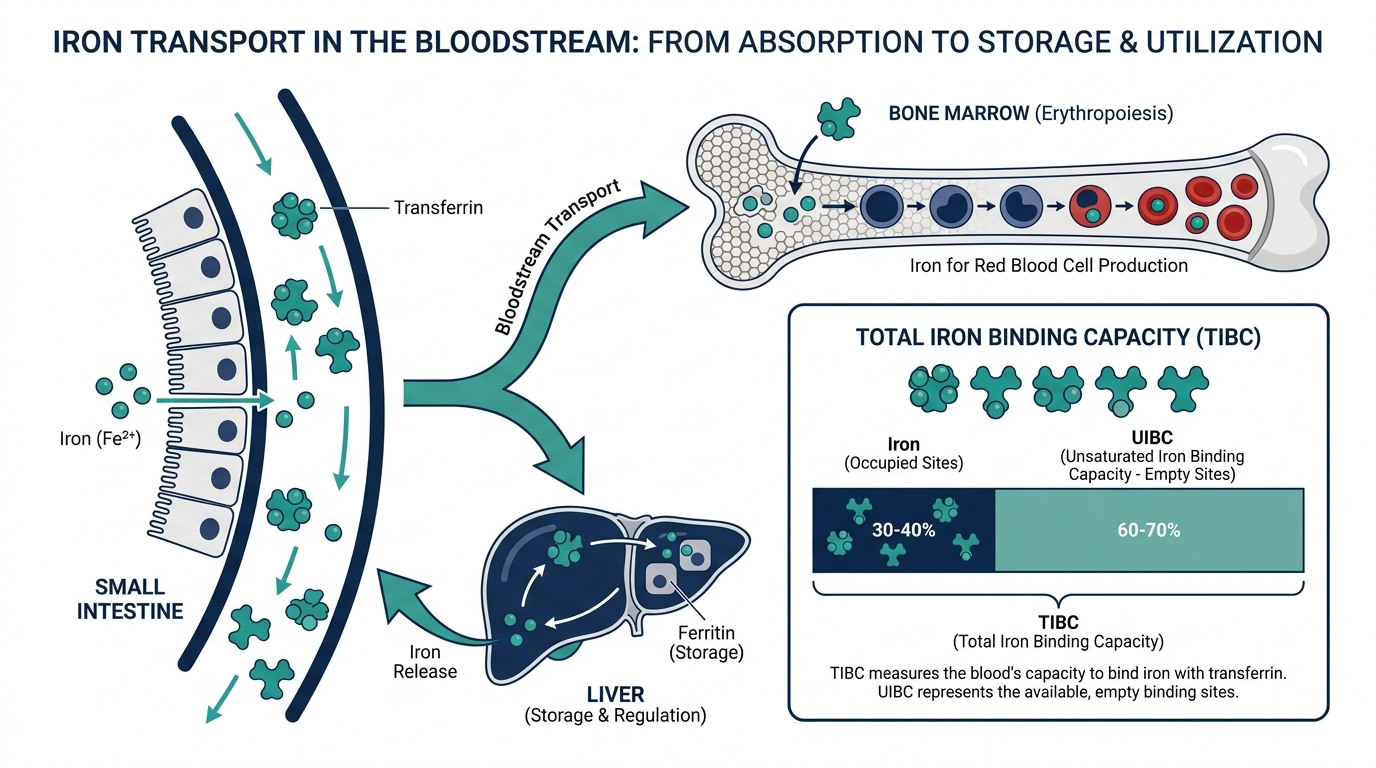
TIBC stands for total iron-binding capacity, and it measures how much iron your blood is capable of carrying. It does this by gauging the amount of transferrin, the protein your liver makes to ferry iron through your bloodstream (Cleveland Clinic). So when someone asks what is TIBC in blood test high actually mean, the short version is this: a high TIBC means your blood has lots of unused capacity to grab iron, which almost always means iron itself is in short supply.
Think of transferrin as a fleet of delivery trucks and iron as the cargo. When cargo is scarce, your body builds more trucks to scoop up every last bit of available iron. More trucks equals more binding capacity equals a higher TIBC. A high number is your body shouting that it is hungry for iron, not that it has too much.
What does a high TIBC mean on a blood test?
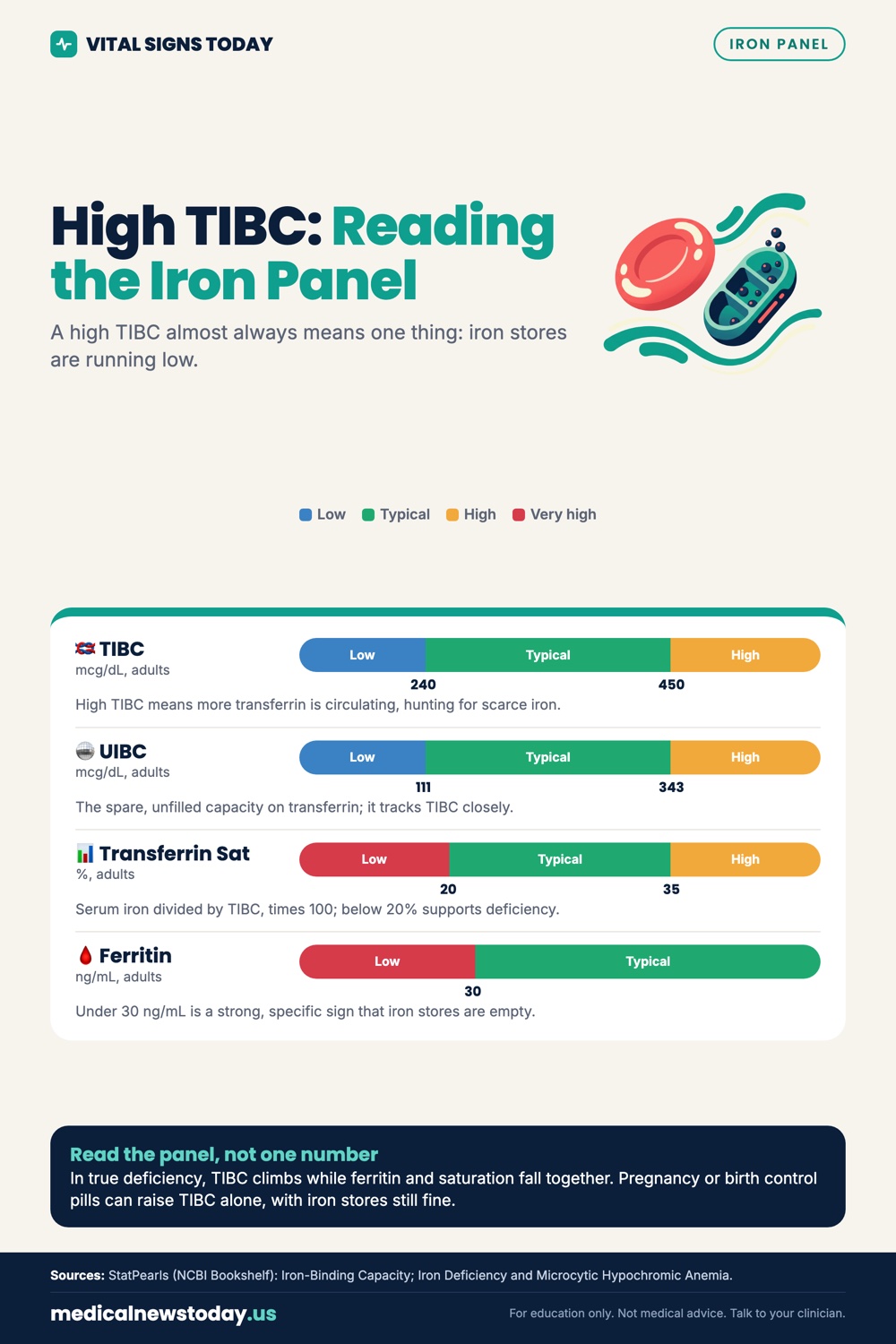
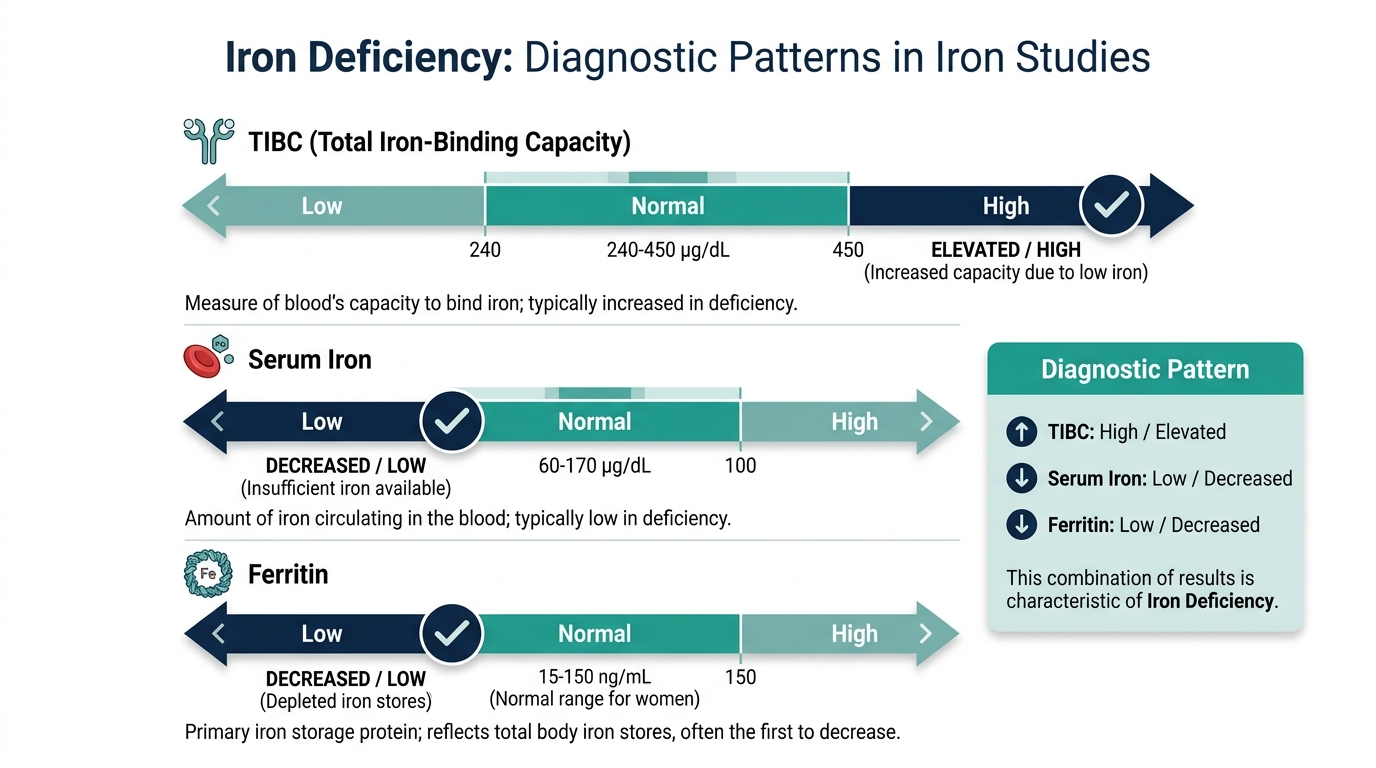
A high TIBC almost always means your iron stores are low. The general normal range runs from about 240 to 450 micrograms per deciliter (mcg/dL), so a result climbing above roughly 450 mcg/dL is where most labs flag it as high (StatPearls, NCBI). Some labs report a wider reference interval, for example MedlinePlus lists up to 505 mcg/dL for men and 492 mcg/dL for women, so the exact cutoff depends on whose machine ran your sample (MedlinePlus).
Here is why the value rises. In iron-deficient states, the amount of transferrin goes up relative to the amount of iron available, which drives TIBC higher (StatPearls, NCBI). Your liver ramps up transferrin production to compensate for the shortfall. That is why TIBC is described as a measure of hunger, not supply. A high reading means lots of empty trucks waiting for cargo that is not arriving.
One important caveat: TIBC rarely tells the full story alone. Clinicians read it next to serum iron, ferritin, and transferrin saturation. Transferrin saturation is calculated by dividing serum iron by TIBC and multiplying by 100, and a normal value sits around 25 to 35 percent (StatPearls, NCBI). The classic iron deficiency signature is low ferritin and low serum iron with a high TIBC and low saturation. That combination is far more telling than TIBC by itself.
How does TIBC fit with the rest of your iron panel?
TIBC is one number on a panel of four, and it only makes sense next to its neighbors. Reading them together is what separates a real iron problem from a false alarm.
- Serum iron: the iron actually circulating right now. It swings a lot during the day and after meals, so a single value is noisy on its own.
- Ferritin: your stored iron, the reserve in the tank. It is the most reliable everyday marker of whether iron is truly low, though it also rises with inflammation, which can mask a deficiency.
- Transferrin saturation: serum iron divided by TIBC, times 100. It tells you what fraction of your carrying capacity is filled. Below about 20 percent points toward deficiency, and above 45 percent raises the opposite question of iron overload.
- UIBC: the unsaturated iron-binding capacity, or the spare seats still open. TIBC is essentially serum iron plus UIBC, so a high UIBC and a high TIBC travel together in iron deficiency.
When these line up in the classic deficiency pattern, low ferritin, low serum iron, high TIBC, high UIBC, and low saturation, the picture is convincing. When they disagree, for example a high TIBC with a normal ferritin and normal saturation, that mismatch is usually the fingerprint of estrogen or pregnancy rather than a shortage.
What causes a high TIBC?
The differential is short, and one cause dominates. In rough order of how often you will encounter it:
- Iron deficiency, with or without anemia. This is by far the most common reason. When iron stores run down, transferrin rises and TIBC climbs (MedlinePlus). Causes of the underlying deficiency include blood loss from heavy periods or the gut, poor dietary iron, and malabsorption.
- Pregnancy, especially the later stages. Late pregnancy raises TIBC as iron demand surges and the body shifts into accumulation mode (StatPearls, NCBI). This is a normal physiological rise, not necessarily a sign of disease.
- Estrogen and oral contraceptives. Estrogen-containing medications and birth control pills can elevate TIBC independently of iron status (StatPearls, NCBI). This one fools people because the TIBC looks deficiency-like even when iron is fine.
- Polycythemia vera. A less common bone marrow disorder that can be associated with elevated TIBC (StatPearls, NCBI).
Notice the spread. Most high TIBC results trace back to genuine iron shortage, but two of the four causes, pregnancy and estrogen medications, are physiological or pharmacological and not a disease at all. That is exactly why your clinician will not act on TIBC in isolation.
What are the symptoms of a high TIBC?
Here is the part that surprises people: a high TIBC itself produces no symptoms. TIBC is a lab measurement, not a disease, so it cannot make you feel anything. What you actually feel comes from the condition driving it, and most of the time that is iron deficiency.
If a high TIBC reflects low iron, the symptoms to watch for are the familiar ones of iron deficiency anemia: fatigue that sleep does not fix, pale skin, shortness of breath on mild exertion, cold hands and feet, brittle nails, headaches, and sometimes unusual cravings for ice or non-food items (MedlinePlus). Many people with a high TIBC and early iron deficiency feel nothing at all yet, which is precisely why a blood test catches it before symptoms arrive.
If your high TIBC is driven by pregnancy or birth control rather than true deficiency, you may have no iron-related symptoms whatsoever. The number is high, but the tank is not actually empty.
When is a high TIBC dangerous or a medical emergency?
A high TIBC is essentially never an emergency in itself. There is no red-flag TIBC threshold that demands a same-day visit, because the number is a marker of capacity, not a toxin or a crisis state. The danger, when there is any, lives in the cause and how far it has progressed.
The situations that warrant prompt attention are tied to severe underlying iron deficiency or its source, not the TIBC value. Seek urgent care if you have chest pain, a racing or pounding heart, severe shortness of breath, fainting, or signs of significant blood loss such as black or bloody stools, vomiting blood, or unusually heavy bleeding. These point to either advanced anemia or an active bleed that needs investigation, and they are urgent regardless of what TIBC says (MedlinePlus). The TIBC is a passenger here, not the driver.
What should you do about a high TIBC?
First, do not treat the TIBC number. Treat what it points to. The single most useful next step is making sure your clinician has the full iron panel, because TIBC only becomes meaningful alongside ferritin, serum iron, and transferrin saturation (Cleveland Clinic).
A practical sequence looks like this:
- Check ferritin. A low ferritin alongside a high TIBC is the strongest everyday signal of true iron deficiency. Ferritin reflects your stored iron, so it tells you whether the tank is genuinely low.
- Confirm with transferrin saturation. A saturation well below the normal 25 to 35 percent supports iron deficiency; a normal saturation despite a high TIBC hints the elevation may be from estrogen or pregnancy instead (StatPearls, NCBI).
- Find the why, not just the what. If deficiency is confirmed, the real question is the source. In adults, especially men and postmenopausal women, unexplained iron deficiency often warrants looking for a slow gastrointestinal bleed.
- Treat the deficiency if present. That may mean dietary iron, oral iron supplements, or in some cases intravenous iron, depending on severity and how well you absorb it. This is a clinician-guided decision, not a self-prescription.
If the high TIBC turns out to be from pregnancy or birth control and your iron stores are actually fine, often no treatment is needed at all beyond the routine iron monitoring already built into prenatal care.
How to rebuild iron if deficiency is the cause
If your clinician confirms genuine iron deficiency, a few practical habits make treatment work faster. Not all dietary iron is equal, and how you take it matters as much as whether you take it.
- Favor heme iron: iron from meat, poultry, and fish is absorbed far better than the non-heme iron in plants, so even small amounts help. Vegetarians can lean on beans, lentils, tofu, and fortified cereals but should expect to work a little harder.
- Pair non-heme iron with vitamin C: a source of vitamin C such as citrus, peppers, or strawberries taken with a plant-iron meal can meaningfully boost absorption.
- Separate iron from blockers: tea, coffee, calcium supplements, and dairy all reduce iron absorption, so keep them a couple of hours away from an iron-rich meal or supplement.
- Take supplements sensibly: many people absorb oral iron better on an empty stomach or every other day, which can also ease the constipation and nausea that lead people to quit. Your clinician will set the dose.
Expect ferritin and hemoglobin to recover slowly. Stores can take three to six months of consistent treatment to refill, so a follow-up panel a few months out, not a few weeks, is what confirms the plan is working. Stopping the moment you feel better is the classic reason deficiency comes straight back.
When should you see a doctor?
Book an appointment to review any high TIBC result, even without symptoms, because the value is meaningful only in context and your clinician can pull the rest of the iron panel together (Cleveland Clinic). This is routine, not alarming.
Move faster if you also have ongoing fatigue, breathlessness, heavy menstrual bleeding, any sign of blood in your stool, or a known history of conditions that impair iron absorption. And as covered above, seek urgent care for chest pain, fainting, or active heavy bleeding regardless of your TIBC number.
The part most people never hear: when a high TIBC is a false alarm
Here is the insider nuance that gets lost in the patient summaries. A high TIBC can be genuinely misleading, and there are two traps worth knowing.
The first is the estrogen trap. Birth control pills and estrogen-containing medications can markedly raise TIBC even when your iron is perfectly normal (StatPearls, NCBI). A young woman on the pill can show a textbook deficiency-looking TIBC while her ferritin and saturation are completely fine. If nobody asks about her medications, she can end up chasing an iron problem she does not have. This is one of the most common reasons a high TIBC gets misread.
The second is the lab assay quirk. The traditional method of measuring TIBC adds excess iron to the sample, and that added iron can bind nonspecifically to albumin and other proteins, overestimating the true capacity. This matters most in people with liver disease or nephrotic syndrome, where protein handling is already abnormal (StatPearls, NCBI). And reference intervals themselves vary by as much as 35 percent across commercial testing methods, so a “high” on one lab’s scale might be normal on another.
Two quick examples show how differently a high TIBC can play out. A 34-year-old woman with heavy periods feels wiped out by mid-afternoon and her panel shows a TIBC of 470 mcg/dL, a ferritin of 8, and a saturation of 12 percent. That is textbook iron deficiency, and the real work is finding and fixing the blood loss, then rebuilding stores. Contrast that with a 22-year-old on the combined pill whose TIBC reads 460 mcg/dL but whose ferritin sits at a healthy 60 and saturation at 30 percent. Same flagged TIBC, no deficiency at all, and no iron needed. Only the surrounding numbers tell them apart.
The practical lesson from both traps is the same. Never let a single high TIBC drive a conclusion. The number earns its keep only when it is read alongside ferritin and transferrin saturation, with your medications and pregnancy status on the table. A high TIBC is a question, not an answer.
Frequently asked questions
Is a high TIBC something to worry about?
Usually not on its own. A high TIBC most often means your iron stores are low, so your body has built extra transferrin to capture available iron (MedlinePlus). It is a clue, not a diagnosis, and your clinician will interpret it alongside ferritin, serum iron, and transferrin saturation before deciding anything.
What is a high TIBC level?
The general normal range is about 240 to 450 mcg/dL, so results above roughly 450 mcg/dL are typically flagged as high, though some labs report a higher ceiling (StatPearls, NCBI). Always compare your value to the reference range printed on your own report, because methods vary widely.
Can a high TIBC happen without iron deficiency?
Yes. Pregnancy, especially later stages, and estrogen-containing medications such as oral contraceptives can raise TIBC even when iron stores are normal (StatPearls, NCBI). That is why TIBC is always read in context rather than alone.
What does high TIBC with low iron and low ferritin mean?
That combination is the classic signature of iron deficiency, often iron deficiency anemia, where serum iron and ferritin are low while TIBC rises and transferrin saturation falls (StatPearls, NCBI). It is the most clinically telling pattern for iron shortage.
Should I take iron supplements if my TIBC is high?
Not without confirmation. A high TIBC alone does not prove you need iron, since it can rise from pregnancy or birth control too (Cleveland Clinic). Have your clinician confirm true deficiency with ferritin and saturation first, because taking iron you do not need carries its own risks.
How do you lower a high TIBC?
You lower TIBC by fixing what drives it. If iron deficiency is the cause, replenishing iron through diet, supplements, or in some cases an infusion brings transferrin and TIBC back down as stores refill. If the cause is pregnancy or an estrogen medication, the value typically settles on its own after pregnancy or if the medication changes, and no action is aimed at the TIBC itself.
Does a high TIBC always mean anemia?
No. A high TIBC signals low or borderline iron stores, which can exist well before anemia develops. Many people show a high TIBC and low ferritin while their hemoglobin is still normal, a stage called iron deficiency without anemia. Catching it there is an advantage, because it is easier to correct before the red blood cell count drops.
This article is for general educational purposes and is not medical advice. It cannot diagnose or treat you and does not replace your clinician. Always discuss your lab results and any health decisions with a qualified healthcare professional.
Vital Signs Today may earn a commission if you buy through links on this page. It does not affect our editorial assessments.