Your iron panel came back, and tucked among the familiar lines like iron and ferritin was a word that sounds more like a sci-fi gadget than a body part: transferrin. No flag next to it, so you probably moved on. Here is what most explainers skip. Transferrin is not just another number on the page. It is the truck that hauls iron around your body, and reading it well tells you something iron alone never can.
The trick is that transferrin often moves in the opposite direction from your iron. Once you see why, your whole iron panel starts to make sense.
Part of our Iron Studies guide.
What is transferrin in a blood test?
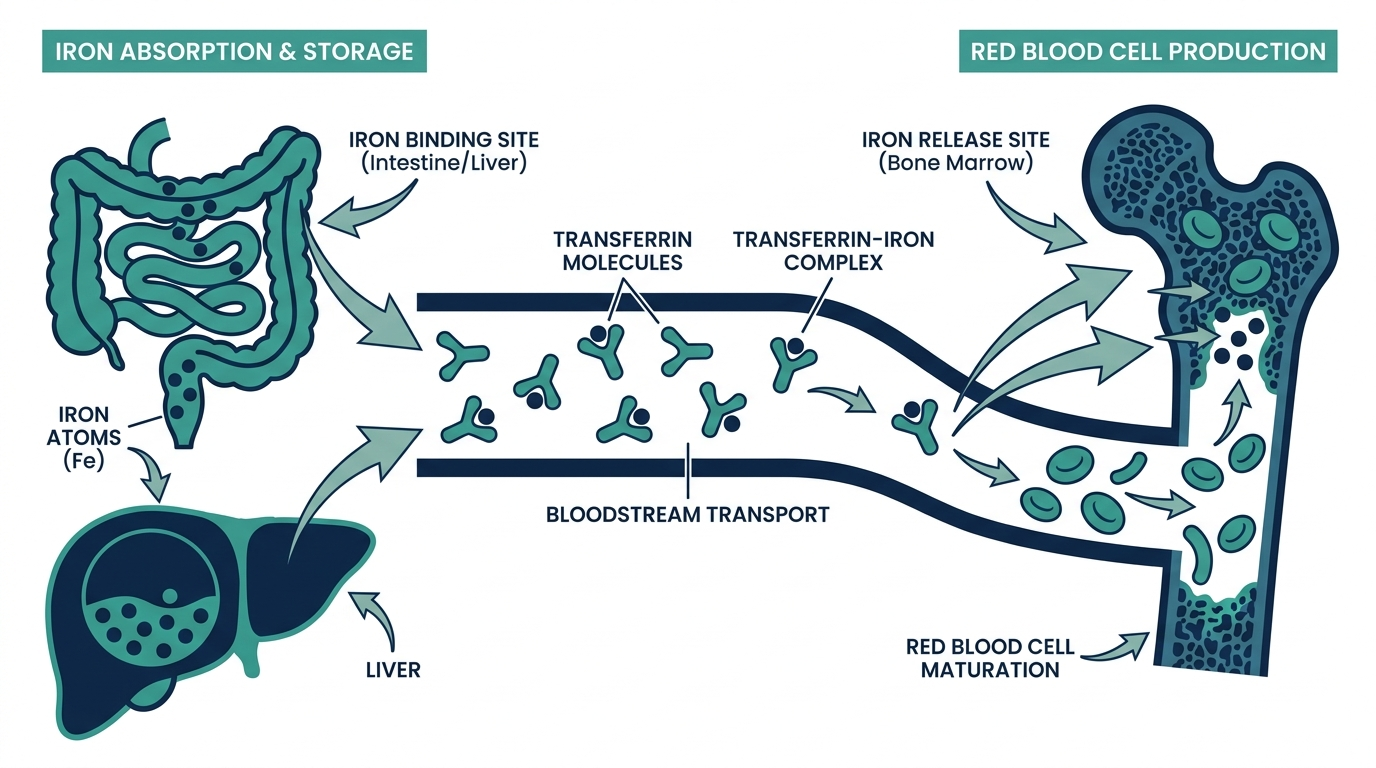
Transferrin is a protein your liver makes that carries iron through your bloodstream, and the test measures how much of it you have. Your body cannot let iron float freely in the blood, because loose iron is toxic and useless to your cells. So the liver builds transferrin to grab iron and deliver it where it is needed, mostly to the bone marrow to build red blood cells (Cleveland Clinic). In plain terms, transferrin is your body’s iron delivery service, and the test counts how many delivery trucks are on the road.
That single idea, transferrin as the iron transporter, is the key to everything below. When you understand that the liver builds more trucks when iron is scarce and fewer when iron is plentiful, the high and low results stop being confusing and start telling a story.
What does transferrin mean in a blood test, and how is it measured?
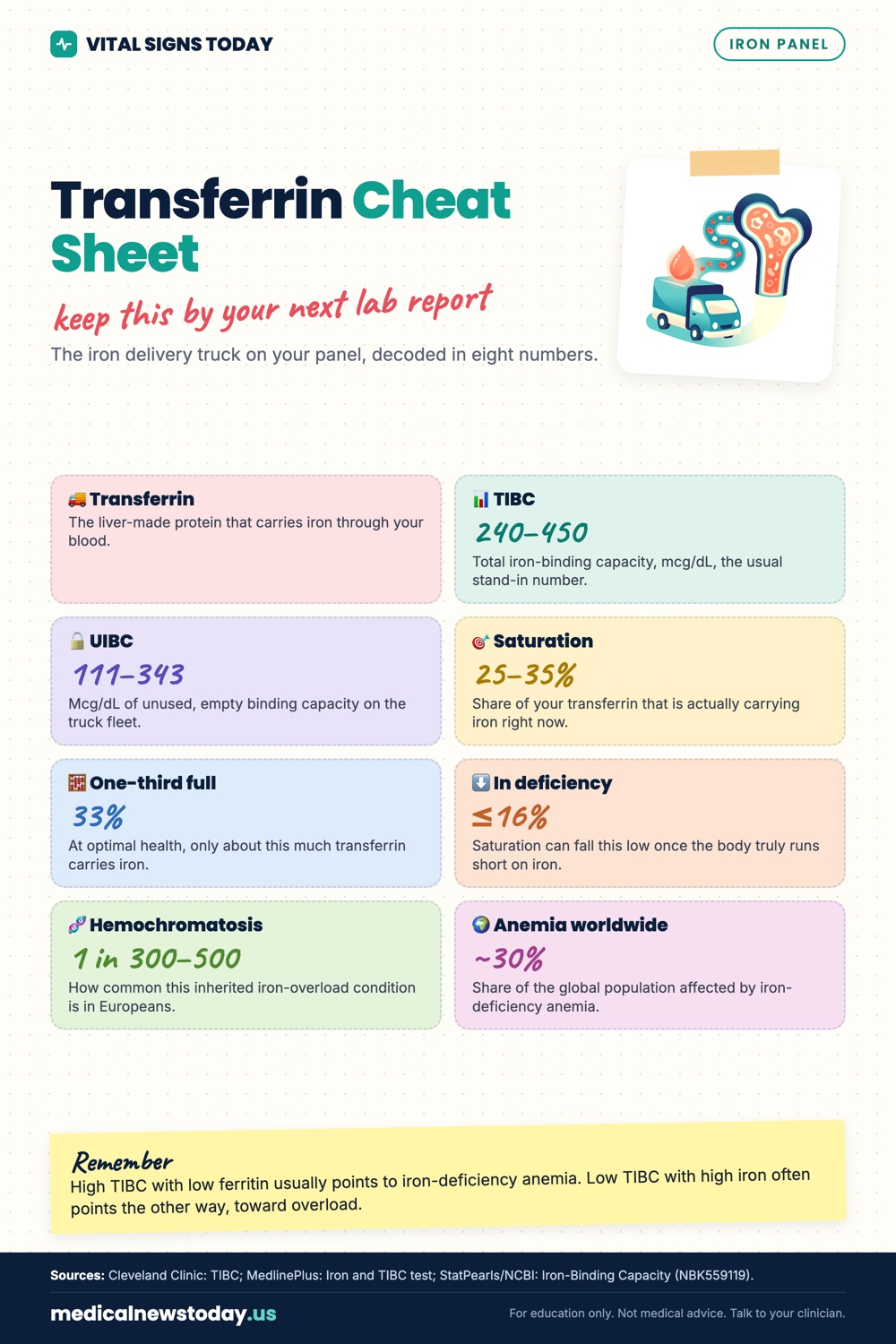
When people ask what is transferrin on a blood test, they are usually looking at one of three closely related measurements that all describe the same protein. Transferrin can be measured directly, but more often labs report it indirectly through total iron-binding capacity, or TIBC. TIBC measures how much iron your blood can bind, and because transferrin is the main iron-binding protein, TIBC is a stand-in for the amount of transferrin you have (MedlinePlus).
The three numbers you may see on a report:
- Transferrin measures the protein itself, usually in milligrams per deciliter.
- TIBC measures your blood’s total capacity to bind iron, which rises and falls with transferrin (MedlinePlus).
- Transferrin saturation is the percentage of your transferrin that is actually carrying iron, calculated by dividing serum iron by TIBC and multiplying by 100 (StatPearls, NCBI).
Here is a detail worth holding onto. In healthy blood, only about one-third of your transferrin is loaded with iron at any moment (StatPearls, NCBI). The rest of the trucks are driving around empty, ready to pick up more. That spare capacity is exactly what TIBC and saturation are measuring.
What is a normal transferrin level?
Because most labs report transferrin through TIBC, the normal range is usually given for TIBC, and it generally runs about 240 to 450 micrograms per deciliter (Cleveland Clinic). Some labs use wider cutoffs and split them by sex. MedlinePlus, for example, lists TIBC of roughly 171 to 505 mcg/dL for men and 149 to 492 mcg/dL for women (MedlinePlus).
For transferrin saturation, a normal value sits in the rough neighborhood of 20 to 50 percent for men and 15 to 45 percent for women (MedlinePlus). StatPearls cites a tighter typical range around 25 to 35 percent (StatPearls, NCBI). The practical takeaway: always read your result against the reference range printed on your own lab report, because that is the range your specific lab and instrument calibrated.
Standard range versus a tighter optimal window
The printed reference range is built to flag disease, not to define ideal. That distinction matters more on the iron panel than on almost any other test. A TIBC parked at the very top of its range, sitting next to a saturation drifting toward the bottom, can mean your iron supply is already tightening even though nothing on the report is flagged. Many iron-aware clinicians start paying attention when transferrin saturation slips under about 20 percent or climbs past roughly 45 percent, values that are still technically inside the normal band, because those edges tend to move first. Treat the printed range as the floor and ceiling for outright disease, and treat the middle as a zone worth trending over time rather than a place to relax.
Why saturation is often the number that matters most
Transferrin and TIBC tell you how many trucks are on the road. Saturation tells you how full they are, and that ratio usually tracks your real iron status more tightly than either number on its own. A person can carry a perfectly normal transferrin yet run a saturation of 12 percent, which points hard at early iron deficiency. Another can show a normal transferrin with a saturation near 55 percent, which is a classic early flag for iron overload. If you only have room to follow one figure on your iron panel across the years, saturation is usually the one that moves first and tells you the most. This is also why a single serum iron reading, on its own, is one of the weakest ways to judge your iron status.
What does a high transferrin mean?
A high transferrin, or a high TIBC, usually means your body is low on iron. This is the part that trips people up, so it is worth saying slowly. When iron stores run down, the liver responds by manufacturing more transferrin to scavenge whatever iron is left, so transferrin and TIBC climb (StatPearls, NCBI). More empty trucks on the road is a sign there is not enough cargo to fill them.
The most common reasons transferrin and TIBC run high:
- Iron deficiency anemia. The classic pattern is high TIBC with low iron and low ferritin, which together typically point to iron deficiency (Cleveland Clinic).
- Late pregnancy, when iron demand rises sharply and TIBC commonly increases (MedlinePlus).
- Estrogen-containing medications, such as some birth control pills, which can nudge iron test results (MedlinePlus).
Here is the insider point that rarely makes it into the patient summary. A rising transferrin can be one of the earliest signals of iron deficiency, sometimes showing up while your hemoglobin still looks completely normal. The body cranks up transferrin production to fight for scarce iron before anemia has had time to set in. So if your iron and ferritin are drifting down but your TIBC is creeping up, that combination can be the first quiet hint your iron tank is draining, well before you would feel tired or look anemic on a standard blood count.
Because a high transferrin usually rides alongside falling iron, the symptoms that show up are the symptoms of iron deficiency rather than of transferrin itself. Early on there may be nothing at all, which is part of the trap. As iron drains further, people often notice fatigue that a good night of sleep does not fix, breathlessness on stairs that used to be easy, cold hands and feet, brittle or spoon-shaped nails, more hair shedding than usual, and in some cases an odd craving to chew ice. None of these is specific on its own, which is exactly why the blood panel matters. A rising TIBC can put a name to a vague tiredness weeks or even months before a standard blood count would ever call it anemia.
What does a low transferrin mean?
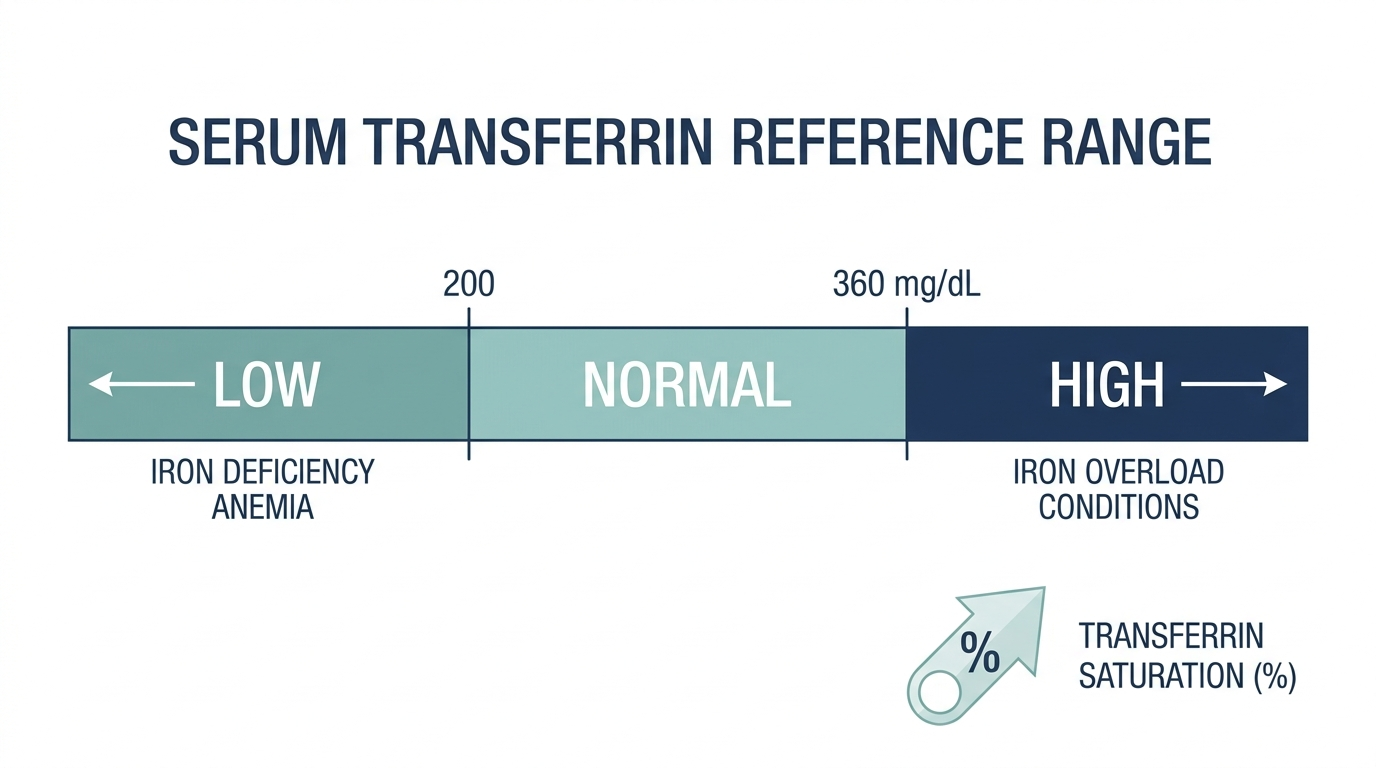
A low transferrin, or a low TIBC, can mean your body has plenty of iron, or that your liver is not making enough of the protein. There are two very different stories behind a low result, and the rest of your iron panel tells you which one applies.
When low TIBC pairs with high iron, the picture often points toward iron overload, including hemochromatosis, a condition where the body absorbs and stores too much iron (Cleveland Clinic). The body sees no reason to build extra transferrin trucks when iron is already overflowing.
When low TIBC pairs with low iron, the cause is usually somewhere other than your iron stores. Because the liver makes transferrin, conditions that damage the liver or starve the body of protein can drag transferrin down. Cleveland Clinic lists cirrhosis, chronic inflammation, infection, malnutrition, and nephrotic syndrome among the causes of a low TIBC with low iron (Cleveland Clinic). MedlinePlus adds hemolytic anemia and protein deficiency to that list (MedlinePlus).
A low transferrin driven by iron overload can stay quiet for years, and that silence is exactly what makes it dangerous. When symptoms finally appear they tend to be nonspecific at first, things like joint aches, ongoing fatigue, low libido, or vague abdominal discomfort, and in more advanced cases a bronze or gray tint to the skin. Because early hemochromatosis hides so well, a low TIBC paired with a high saturation is one of the few early paper trails there is, which is why clinicians take that combination seriously even in someone who feels perfectly fine (Cleveland Clinic). A low transferrin coming from liver disease or malnutrition, by contrast, usually travels with other clues, such as swelling, poor appetite, or abnormal liver enzymes, that point toward the underlying problem rather than iron itself.
Why is transferrin read together with iron and ferritin?
Transferrin almost never tells the full story alone, which is why it is read alongside serum iron and ferritin. Each number answers a different question. Iron tells you how much is circulating right now, ferritin tells you how much is in storage, and transferrin tells you how hard the body is working to carry it. Read together, they separate conditions that look identical when you stare at iron by itself (MedlinePlus).
A simplified version of how the pieces combine:
- High transferrin or TIBC with low iron and low ferritin: the classic signature of iron deficiency anemia (Cleveland Clinic).
- Low transferrin or TIBC with high iron and high saturation: points toward iron overload or hemochromatosis (Cleveland Clinic).
- Low transferrin or TIBC with low iron: often reflects chronic illness, inflammation, liver disease, or poor nutrition rather than a simple iron problem (MedlinePlus).
That middle row is exactly why transferrin earns its place on the panel. Both iron deficiency and iron overload can leave serum iron looking abnormal, but they push transferrin in opposite directions. Iron deficiency drives transferrin up as the body scrambles to grab iron, while overload drives it down because the body has no need for more trucks. One protein, read alongside ferritin, helps tell those two opposite problems apart.
The part most people never hear: transferrin runs backward from iron
This is the single most useful thing to understand about transferrin, and it is the part that confuses even careful readers. Transferrin moves inversely to your iron stores. Low iron pushes transferrin up. High iron pushes transferrin down (StatPearls, NCBI). If you expect transferrin to rise and fall with iron the way most lab values track their own marker, you will read your panel exactly wrong.
There is a second wrinkle that even some clinicians forget. Transferrin is made by the liver, and the liver throttles it back during inflammation and acute illness. That means a person who is genuinely iron deficient can show a falsely normal or low transferrin if they also have an infection, an autoimmune flare, or another inflammatory illness at the same time. The empty-truck signal that should be shouting iron deficiency gets muffled by the inflammation. This is why a single iron number is never enough, and why transferrin, ferritin, and saturation are interpreted as a set rather than one at a time. When the picture is mixed, that is a reason to look closer, not to scroll past.
How do you prepare for a transferrin or TIBC test, and what can throw it off?
Iron studies are more sensitive to timing and prep than most people expect, and a handful of avoidable things can push your numbers around. Serum iron swings through the day, usually running higher in the morning and lower by evening, and because saturation is calculated from iron, that swing drags saturation along with it. For that reason many labs prefer a morning draw, and some ask you to fast beforehand so a recent meal or a morning iron pill does not distort the picture (MedlinePlus). If your clinic handed you fasting instructions, follow them closely, because a single iron supplement swallowed that morning can lift serum iron and saturation enough to mask a real deficiency.
Other common things that move the result:
- Iron supplements and iron-rich meals in the hours before the draw can transiently raise serum iron and saturation.
- Oral contraceptives and other estrogen-containing medications can nudge iron test values (MedlinePlus).
- Pregnancy, especially the later months, raises TIBC as iron demand climbs (MedlinePlus).
- Acute or chronic inflammation, infection, or a recent illness, which can lower transferrin even when iron is genuinely low and quietly muffle the deficiency signal.
- Time of day, since a late-afternoon draw can read differently from a morning one on the same person.
The practical move is simple. Book the draw for the morning, ask whether to fast, hold any iron supplement until after the blood is taken unless your clinician tells you otherwise, and mention any infection or flare-up so the result is read in context. If a value looks off and you happened to be sick that week or took iron that morning, that alone can be reason enough to repeat the test on a calmer day rather than act on a single skewed reading.
What should you do about a high or low transferrin?
A single transferrin or TIBC number is a starting point, not a verdict. What it means depends entirely on the company it keeps, so the first step is always to read it next to serum iron, ferritin, and saturation rather than in isolation. A high TIBC with low iron and low ferritin points one direction; a low TIBC with high iron and high saturation points the opposite way. Matching the pattern is what turns a lone number into a decision you can act on.
From there, a few sensible next steps depending on the pattern:
- If the pattern looks like iron deficiency (high TIBC, low iron, low ferritin), the usual path is to confirm it, hunt for a source of blood or iron loss, and treat the cause rather than just the number. Do not start high-dose iron on your own before deficiency is confirmed, because loading iron into someone who is not actually deficient can cause harm.
- If the pattern looks like iron overload (low TIBC, high iron, high saturation), that is a reason to talk with your clinician about screening for hemochromatosis, which can include genetic testing, rather than something to watch quietly and hope it settles.
- If transferrin is low with low iron and the story does not fit simple deficiency, the workup usually shifts toward liver health, inflammation, kidney protein loss, or nutrition, because transferrin is a liver-made protein that reflects those systems too.
On retesting, timing matters as much as the result. If your iron studies were drawn during an illness or right after an iron pill, repeating them a few weeks later on a normal day gives a far cleaner read. When someone is being treated for iron deficiency, clinicians typically recheck the panel after some weeks of treatment to confirm the trucks are filling back up, not the next day. The trend across weeks and months tells you much more than any single snapshot ever will.
Two quick real-world reads
Picture a distance runner who feels flat and winded on easy miles. Her hemoglobin comes back normal, so a basic panel would wave her through, but her ferritin is low and her TIBC is high. That combination, empty storage plus extra trucks on the road, is early iron deficiency showing up before anemia does, and it explains the fatigue a single hemoglobin number completely missed. Now picture a man in his fifties with vague joint aches whose saturation reads 60 percent and whose TIBC sits low. Nothing there looks dramatic on the surface, but that pairing is a textbook prompt to screen for hemochromatosis before iron quietly loads into his joints, liver, and heart. Same panel, opposite directions, two very different next steps.
Frequently asked questions
What is a transferrin blood test used for?
A transferrin blood test, often reported as TIBC, helps your clinician find out whether your body has too little or too much iron. It is used to diagnose and monitor iron deficiency anemia and iron overload conditions like hemochromatosis, and it is interpreted alongside serum iron and ferritin (Cleveland Clinic).
What is a normal transferrin level?
Transferrin is most often reported through TIBC, with a general normal range of about 240 to 450 mcg/dL, though some labs report up to roughly 505 mcg/dL and split the range by sex (Cleveland Clinic). Always compare your result to the reference range on your own report.
Does high transferrin mean high iron?
No, usually the opposite. A high transferrin or high TIBC most often signals low iron, because the liver makes more transferrin to capture scarce iron. High TIBC with low iron and low ferritin is the classic pattern of iron deficiency (StatPearls, NCBI).
What does low transferrin mean?
A low transferrin or low TIBC can mean iron overload when it pairs with high iron, or it can reflect liver disease, chronic inflammation, infection, or malnutrition when it pairs with low iron (Cleveland Clinic).
What is transferrin saturation?
Transferrin saturation is the percentage of your transferrin that is actually carrying iron, calculated by dividing serum iron by TIBC and multiplying by 100. A normal value is generally around 20 to 50 percent, with some sources citing a tighter 25 to 35 percent (StatPearls, NCBI).
Do I need to fast for a transferrin or TIBC test?
It depends on your lab. Because serum iron runs higher in the morning and can rise after an iron-containing meal or supplement, many labs prefer a morning, sometimes fasting, draw for iron studies (MedlinePlus). Follow whatever instructions your clinic gives, and hold your iron supplement until after the blood is taken unless told otherwise.
Can transferrin be high without anemia?
Yes. A rising transferrin or TIBC can appear while your hemoglobin is still normal, because the liver ramps up transferrin to fight for scarce iron before the shortage is severe enough to cause anemia (StatPearls, NCBI). That early signal is one of the reasons the marker is worth reading at all.
What is the difference between transferrin and ferritin?
Ferritin measures stored iron, while transferrin measures the transport protein that moves iron around. They usually move in opposite directions, so when iron runs low, ferritin falls and transferrin rises. Reading them together, alongside serum iron, is what separates iron deficiency from iron overload and from chronic illness (MedlinePlus).
How often should I retest transferrin?
There is no single schedule that fits everyone. If a result was drawn during illness or right after an iron pill, a repeat in a few weeks on a normal day is reasonable. If you are being treated for iron deficiency, clinicians usually recheck the panel after several weeks of treatment rather than immediately. For general monitoring, tracking it once a year alongside the rest of your iron panel is a common approach.
This article is for general educational purposes and is not medical advice. It cannot diagnose or treat you and does not replace your clinician. Always discuss your lab results and any health decisions with a qualified healthcare professional.
Vital Signs Today may earn a commission if you buy through links on this page. It does not affect our editorial assessments.