Related: TSH normal range by age (full chart)
You got your thyroid panel back, scanned past the long words, and landed on three letters with a tiny number beside them: TSH. Maybe it was flagged, maybe it sat quietly inside the reference range. Either way, this is the number your doctor looks at first when they want to know how your thyroid is doing. Here is what most people miss. TSH is not a measure of your thyroid hormone at all. It is a measure of how loudly your brain is shouting at your thyroid, and that backwards logic is exactly why it confuses so many smart people.
Once you understand which direction TSH moves, the rest of your thyroid results stop looking like a foreign language.
Part of our Thyroid Panel guide.
What is TSH in a blood test?
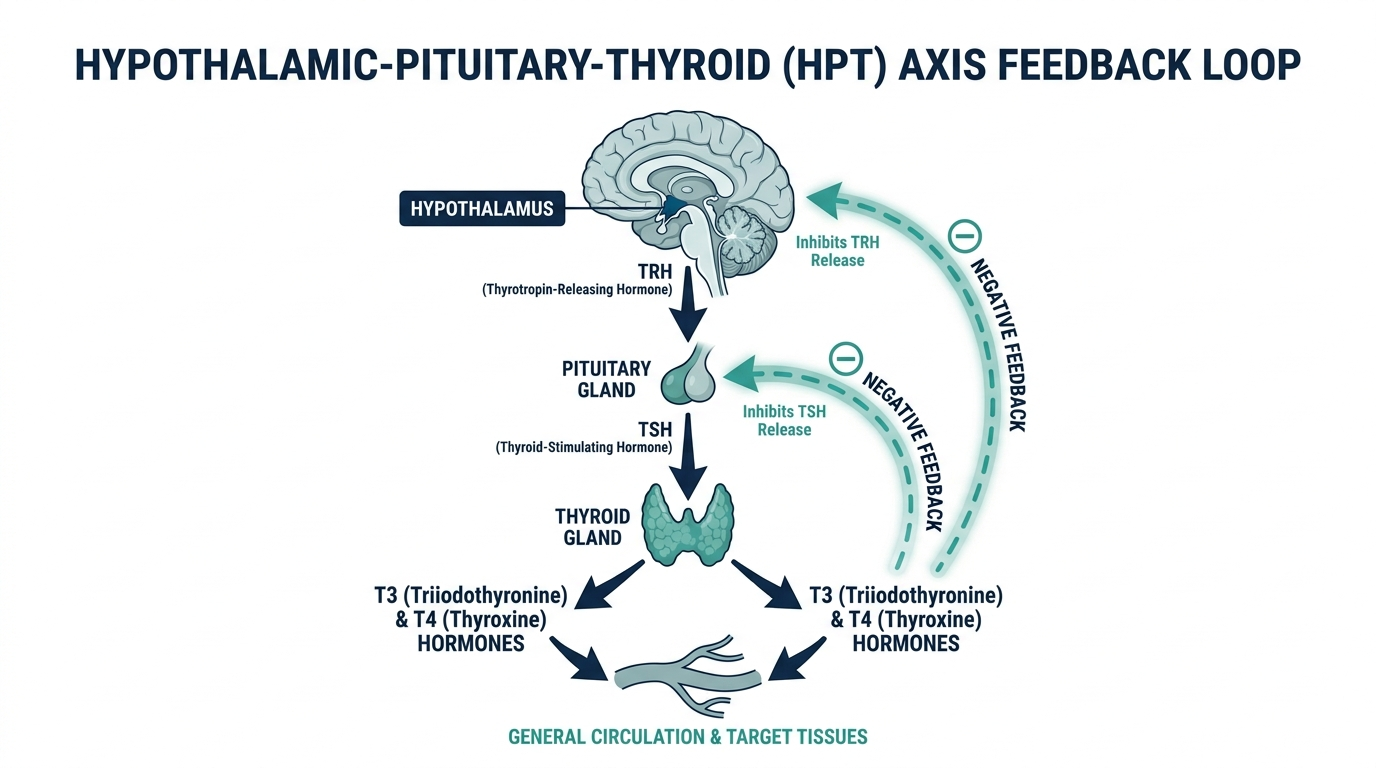
TSH stands for thyroid-stimulating hormone, and a blood test measures how much of it your pituitary gland is releasing. Your pituitary, a small gland at the base of your brain, makes TSH and sends it to your thyroid as a signal to produce the thyroid hormones T3 and T4 (Cleveland Clinic). So when people ask what is a TSH blood test, the honest one-line answer is this. It is a test of the signal, not the supply.
That distinction is everything. TSH works like a thermostat. When thyroid hormone in your blood runs low, the pituitary turns the dial up and TSH rises to push the thyroid harder. When thyroid hormone runs high, the pituitary backs off and TSH falls. This is why a high TSH usually means an underactive thyroid and a low TSH usually means an overactive one, which feels upside down until the thermostat picture clicks into place.
What does TSH mean in a blood test, and why is it measured first?
When people ask what does TSH mean in a blood test, they usually want to know why this one number gets so much weight. The reason is sensitivity. TSH is the first test most providers order because the pituitary reacts to even small shifts in thyroid hormone, often before you feel a single symptom (Cleveland Clinic). It is the screening test for both an underactive thyroid (hypothyroidism) and an overactive one (hyperthyroidism).
The pituitary and thyroid sit in a feedback loop. A tiny drop in available thyroid hormone triggers a proportionally larger jump in TSH, which makes TSH an amplifier for problems that are still too quiet to show up elsewhere (MedlinePlus). That amplification is the whole point. Your free T4 might still read normal while your TSH has already crept up, flagging trouble early.
What is a normal TSH level?
A normal TSH for most non-pregnant adults falls roughly between 0.27 and 4.2 microunits per milliliter, though the exact cutoffs vary by laboratory and the assay used (Cleveland Clinic). Across the wider literature, the upper limit of normal tends to land somewhere around 4.2 to 4.5 mU/L depending on the testing method (Lewandowski, Thyroid Research). Always read your number against the reference range printed on your own report, because that is the range your lab actually validated.
One detail that catches people off guard. The normal range is not fixed across your lifetime. The upper limit drifts higher with age, and in healthy people over 70 it may stretch up toward about 6.0 mU/L without any thyroid disease present (Lewandowski, Thyroid Research). Pregnancy shifts the goalposts too. Cleveland Clinic lists trimester-specific ranges, such as roughly 0.18 to 2.99 in the first trimester, because the demands on the thyroid change as pregnancy progresses (Cleveland Clinic). A single number means little without knowing whose body it came from.
Optimal TSH versus normal TSH, and the fight over the upper cutoff
Here is where thyroid medicine gets genuinely contentious. The lab flags you only when TSH crosses the upper limit of the reference range, often around 4.0 to 4.5 mU/L, but a long-running argument holds that the true healthy ceiling for younger adults sits lower, closer to the mid-2s or low-3s. The reasoning is that when researchers strip out people who carry thyroid antibodies or have a family history of thyroid disease, the remaining healthy population clusters at a lower TSH, which drags the honest upper bound down. Others push back that lowering the cutoff would label millions of people who will never get sick.
You do not need to settle that debate to use it. The practical move is to read a TSH in the upper third of the range as worth watching rather than automatically fine, especially if you have symptoms or thyroid antibodies, and to compare it against your own past results. A rising trend from 1.5 to 3.5 over two years tells you something a single in-range value never could. Our deeper piece on TSH optimal range versus normal range walks through where the lines are drawn.
How is a TSH test done, and what can throw it off?
A TSH test is a routine blood draw, usually from a vein in your arm, and it needs no fasting or special prep on its own. That simplicity hides a few real gotchas that can move the number enough to change a decision, so they are worth knowing before you read too much into a borderline result.
- Time of day. TSH follows a daily rhythm. It peaks overnight and in the early morning and drifts lower through the afternoon, and the swing can be substantial. For serial testing, drawing blood at a consistent time, many clinics favor morning, keeps your results comparable.
- Biotin supplements. High-dose biotin, common in hair, skin, and nail products, can interfere with the lab assay and produce a falsely low TSH that mimics hyperthyroidism. Most labs advise stopping biotin for about two days before the draw.
- Recent illness. A serious infection or hospital-level illness can temporarily push TSH and thyroid hormones around in a pattern called non-thyroidal illness, which is why thyroid testing is usually deferred until you have recovered.
- Medications. Steroids, certain heart and mood medications, and estrogen therapy can all nudge TSH, and thyroid hormone replacement obviously does. Tell whoever interprets the result what you take.
None of these change your underlying thyroid. They change the reading, which is a different thing. When a result does not fit how you feel, the timing and the supplement bottle are the first places to look.
What does a high TSH mean?
A high TSH usually means your thyroid is underactive. The pituitary is shouting louder because your thyroid is not making enough hormone, so it cranks up TSH to compensate (Cleveland Clinic). This is the lab signature of hypothyroidism, and it tends to show up alongside the classic complaints: fatigue, weight gain, feeling cold, dry skin, and constipation (MedlinePlus).
How high it climbs matters for what happens next:
- Mildly raised TSH with normal free T4. This pattern is called subclinical hypothyroidism, where TSH sits above the reference range but thyroid hormone itself still reads normal (Papaleontiou and Cappola, JAMA).
- Clearly raised TSH with low free T4. This is overt hypothyroidism, the version most likely to need treatment.
- Very high TSH. A markedly elevated TSH points toward more significant thyroid underactivity and usually prompts a closer look at the cause, such as Hashimoto’s thyroiditis.
Here is the insider point that rarely reaches the patient version. A mildly high TSH on a single test does not automatically mean you have a thyroid disease. TSH naturally fluctuates, and mild elevations frequently resolve on their own. In one analysis, about 46 percent of people with a TSH between 4.5 and 7.0 mIU/L had returned to normal when retested two years later (Papaleontiou and Cappola, JAMA). This is precisely why a careful clinician repeats the test before reaching for a prescription pad. One borderline reading is a question, not a verdict.
What happens after a high TSH?
A single high TSH rarely leads straight to a prescription. The standard next steps are to repeat the test, usually with a free T4, and to check thyroid peroxidase (TPO) antibodies, which reveal whether autoimmune Hashimoto’s thyroiditis is driving the underactivity. That antibody result often decides how aggressively to act, because antibody-positive people are far more likely to progress to overt disease.
Treatment itself splits along the pattern. Overt hypothyroidism, meaning a high TSH with a low free T4, is generally treated with levothyroxine, a synthetic version of the T4 hormone, with the dose titrated by rechecking TSH after several weeks. Subclinical hypothyroidism, a high TSH with a normal free T4, is more of a judgment call. Many clinicians watch and repeat rather than treat, and lean toward treatment mainly when TSH climbs above about 10 mU/L, when symptoms or antibodies are present, or during pregnancy or attempts to conceive. In older adults especially, a mildly high TSH is often left alone.
What does a low TSH mean?
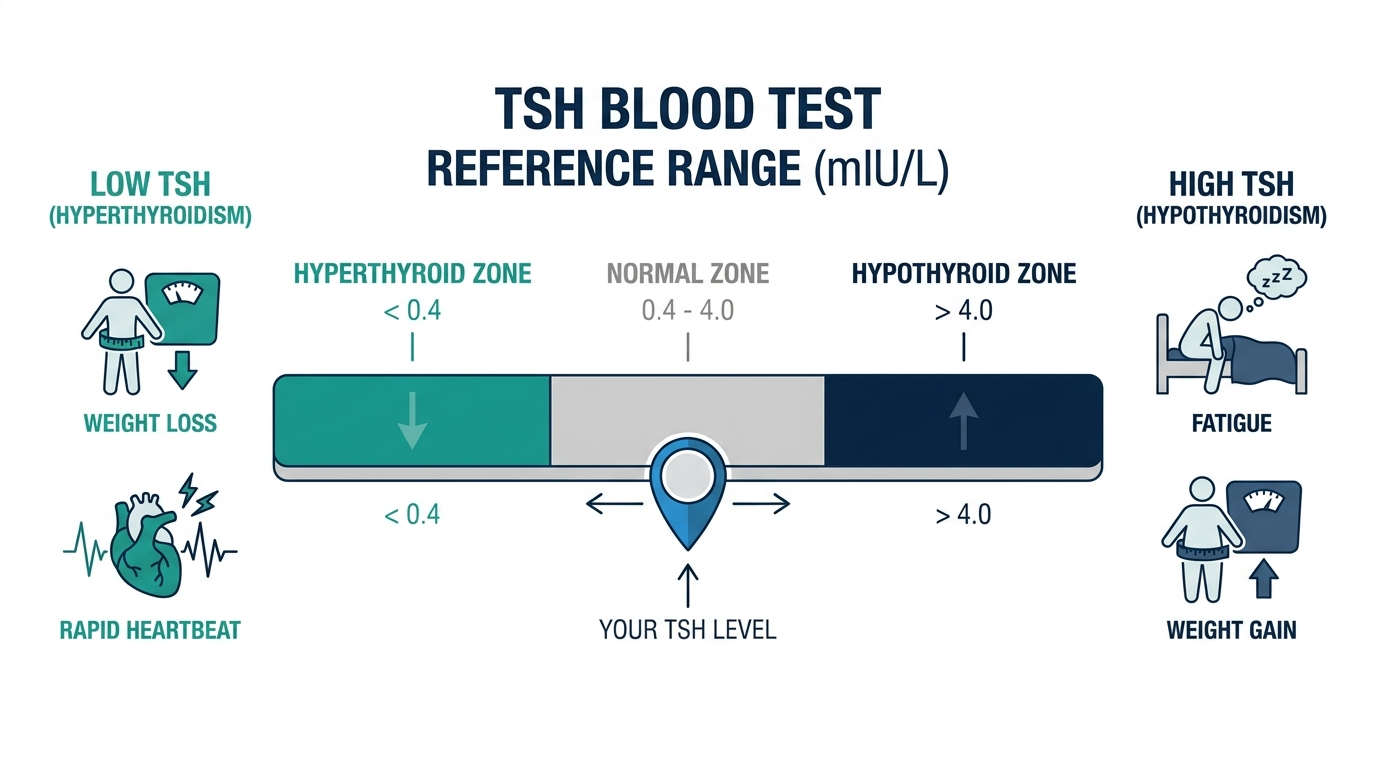
A low TSH usually means your thyroid is overactive. When your thyroid pumps out too much hormone, the pituitary senses the excess and dials TSH down, sometimes nearly to zero (Cleveland Clinic). This is the fingerprint of hyperthyroidism, and it often comes with a racing or pounding heartbeat, anxiety, unexplained weight loss, heat intolerance, and shakiness (MedlinePlus).
Common drivers of a suppressed TSH include Graves’ disease, an overactive thyroid nodule, or too high a dose of thyroid hormone medication. A low TSH with normal thyroid hormone levels is called subclinical hyperthyroidism, the mirror image of the subclinical pattern on the high side. As with a high reading, the cause matters more than the number alone, and your clinician will usually pair the TSH with a free T4 and sometimes a free T3 to see the full picture.
What happens after a low TSH?
A low TSH is followed up by measuring free T4 and often free T3 to confirm the thyroid is genuinely overactive, then by hunting for the cause. Antibody tests for Graves’ disease and imaging such as a radioactive iodine uptake scan can separate Graves’ from a hot nodule or thyroiditis, and the right treatment depends on which it is. If you already take thyroid hormone, a suppressed TSH may simply mean your dose is a little too high and needs trimming.
The reason this matters beyond the lab sheet: a persistently low TSH from true hyperthyroidism is not cosmetic. Over time it raises the risk of atrial fibrillation and accelerates bone loss, so even a subclinical pattern, a low TSH with normal hormones, gets more attention in older adults and people with heart or bone concerns. Here again the response is guided by cause and by repeat testing, not by one value.
Why is TSH read together with T4 and T3?
TSH rarely tells the whole story by itself, which is why it is interpreted alongside the actual thyroid hormones, free T4 and sometimes free T3. TSH is the signal, and T4 and T3 are the supply, so reading them together shows both what your brain is asking for and what your thyroid is delivering (MedlinePlus). Measuring TSH alone can occasionally mislead, so confirmatory hormone levels matter.
A simplified version of how the pieces combine:
- High TSH with low free T4: overt hypothyroidism, an underactive thyroid.
- High TSH with normal free T4: subclinical hypothyroidism, an early or mild picture.
- Low TSH with high free T4 or T3: overt hyperthyroidism, an overactive thyroid.
- Low TSH with normal free T4 and T3: subclinical hyperthyroidism.
There is one uncommon but important exception. If both TSH and free T4 are low at the same time, the problem may not be in the thyroid at all. It can point to a pituitary issue, where the gland that sends the signal is itself underperforming. That pattern breaks the usual thermostat logic and is exactly why TSH is never read in a vacuum.
TSH in pregnancy, on medication, and when symptoms do not match
Three real-world situations bend the usual rules and account for a lot of confused patients. Pregnancy is the biggest. The thyroid has to work harder to supply both mother and baby, the reference ranges tighten and shift by trimester, and women already on levothyroxine often need a dose increase early in pregnancy. Thyroid problems in pregnancy carry real stakes for both mother and child, which is why obstetric care watches TSH closely rather than casually.
Medication timing is the second. Levothyroxine is absorbed best on an empty stomach, and calcium, iron, some antacids, and even coffee taken too close to the pill can blunt how much gets in, which then shows up as a stubbornly high TSH that looks like a dosing failure. Separating the pill from those by several hours often fixes the number without touching the dose.
The third is the mismatch between how you feel and what the lab says. Symptoms of thyroid trouble are vague and overlap with stress, poor sleep, anemia, and menopause, so people sometimes feel unwell with a normal TSH or feel fine with a mildly abnormal one. That gap is not a reason to chase the number with treatment. It is a reason to retest over time, look at free T4 and antibodies, and consider what else might explain the symptoms.
The part most people never hear: a borderline TSH is a trend, not a snapshot
This is where TSH separates the careful clinicians from the rest. A TSH result is a moment in time, and that moment moves. TSH follows a daily rhythm, runs higher in older age, climbs temporarily after illness, and can be nudged by certain medications and even biotin supplements that interfere with the assay. Treating one slightly out-of-range value as a fixed truth is the most common mistake patients and even some providers make.
The research backs the patience. Mild TSH elevations are often a normal manifestation of aging rather than disease, and subclinical hypothyroidism affects roughly 15 percent of adults aged 65 and older, many of whom never progress to anything (Papaleontiou and Cappola, JAMA). The upper edge of normal genuinely shifts with age, which means a TSH of 5 mU/L can be a red flag in a 30-year-old and unremarkable in an 80-year-old (Lewandowski, Thyroid Research). The practical takeaway is simple. A borderline TSH deserves a repeat test in a few weeks or months, ideally with free T4, before anyone decides you have a disease. The direction it moves over time tells you more than any single reading ever will.
Frequently asked questions
What is TSH on a blood test in simple terms?
TSH on a blood test is thyroid-stimulating hormone, the signal your pituitary gland sends to tell your thyroid how hard to work (Cleveland Clinic). It measures the signal, not the thyroid hormone itself, which is why a high TSH usually means an underactive thyroid and a low TSH usually means an overactive one.
What is a normal TSH level?
For most non-pregnant adults, a normal TSH is roughly 0.27 to 4.2 microunits per milliliter, though cutoffs vary by lab and assay (Cleveland Clinic). The upper limit also rises with age, so compare your result to the reference range on your own report.
Should I worry about a slightly high TSH?
Not from a single test. A mildly high TSH often reflects subclinical hypothyroidism, and many cases resolve on their own. About 46 percent of people with a TSH of 4.5 to 7.0 mIU/L returned to normal when retested two years later (Papaleontiou and Cappola, JAMA). Clinicians usually repeat the test before treating.
What does a low TSH mean?
A low TSH usually means your thyroid is overactive and making too much hormone, so the pituitary has dialed the signal down (Cleveland Clinic). It is the lab signature of hyperthyroidism and is confirmed with free T4 and sometimes free T3.
Why does my TSH need to be checked with T4?
TSH alone can mislead, so it is read alongside free T4 to compare the signal with the actual hormone supply (MedlinePlus). The combination separates an underactive thyroid from an overactive one and flags rarer pituitary problems where both values are low.
Do I need to fast for a TSH test?
No. TSH does not require fasting. If your thyroid draw is bundled with a glucose or lipid panel you may be asked to fast for those, so follow the order. Because TSH runs higher in the early morning, drawing it at a consistent time of day makes serial results easier to compare.
Can biotin supplements affect my TSH result?
Yes. High-dose biotin, often found in hair and nail supplements, can interfere with the lab test and produce misleading thyroid numbers, sometimes a falsely low TSH. Most labs suggest pausing biotin for about two days before the blood draw, and it is worth mentioning any supplement you take to whoever interprets the result.
This article is for general educational purposes and is not medical advice. It cannot diagnose or treat you and does not replace your clinician. Always discuss your lab results and any health decisions with a qualified healthcare professional.
Related: test your thyroid and hormones from home.
Vital Signs Today may earn a commission if you buy through links on this page. It does not affect our editorial assessments.