Disclosure: Vital Signs Today may earn a commission if you buy through links on this page, at no extra cost to you. This does not influence our evidence-based assessments. We are not a medical provider; talk to a clinician before acting on test results.
If you have ever stared at a thyroid lab report and felt your eyes glaze over at “FT3” and “FT4,” you are not alone. These two numbers are quietly some of the most useful biomarkers on the whole panel, yet most people only ever hear about TSH. Here is the insider truth: free T3 and free T4 are the hormones actually doing the work in your body, and learning to read them changes how you understand your own metabolism.
What are free T3 and free T4 in simple terms?
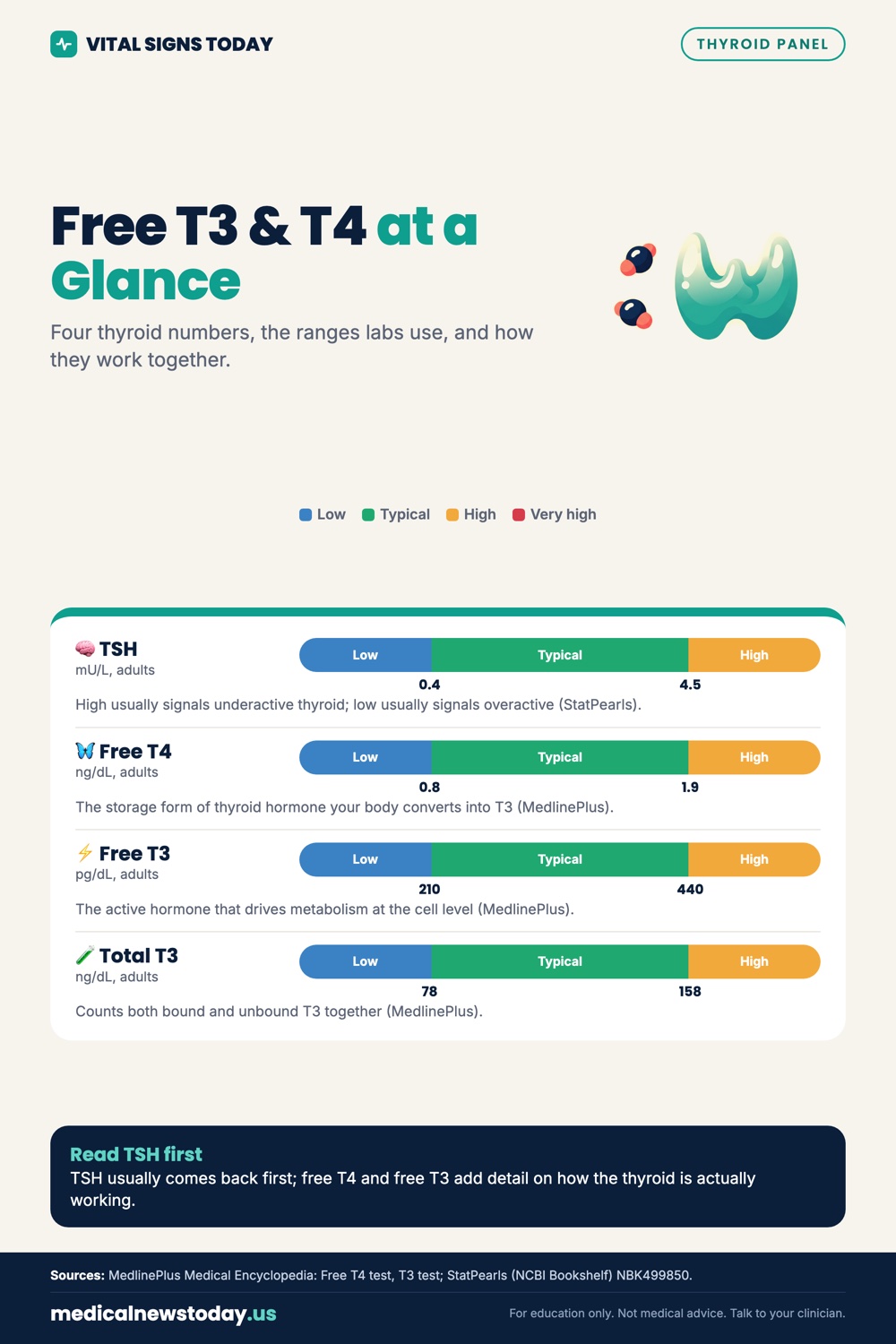
Free T3 (free triiodothyronine) and free T4 (free thyroxine) are the unbound, active fractions of your two main thyroid hormones. Free T4 is the storage form your body converts into the metabolically active free T3, which drives heart rate, temperature, and energy at the cellular level. Measuring the “free” portion shows what tissues can actually use right now.
What does the word “free” actually mean on a thyroid test?
Most thyroid hormone in your blood is not free at all. It rides around bound to carrier proteins, mainly thyroxine-binding globulin, like passengers locked in a bus. Bound hormone is inactive. Only the small unbound fraction can step off the bus, enter your cells, and switch on metabolism.
That distinction matters more than it sounds. A “total T4” test counts everyone on the bus, bound and unbound. Pregnancy, estrogen, and certain medications can raise binding proteins and inflate total numbers without changing how you actually feel. Free T4 sidesteps that noise by measuring only the active fraction, which is why clinicians often consider it more reliable than total T4 (MedlinePlus, Thyroxine T4 Test).
How are free T3 and free T4 different from each other?
Think of free T4 as the warehouse and free T3 as the delivery truck. Your thyroid gland pumps out mostly T4, which is relatively stable and long-lasting. T4 is largely a prohormone. The real action happens when your liver, kidneys, and other tissues convert T4 into T3 by removing one iodine atom.
Free T3 is the heavy hitter. It binds thyroid receptors several times more strongly than T4 and is the form that ramps your basal metabolic rate up or down. So free T4 tells you how much raw material is available, and free T3 tells you how much active signal is reaching your cells. When the two diverge, it can hint at a conversion problem rather than a gland problem.
What are normal free T3 and free T4 ranges?
Reference ranges vary by lab and by the assay used, so always read your numbers against the range printed on your own report. That said, commonly cited adult ranges look like this:
- Free T4: roughly 0.8 to 1.8 ng/dL, with some labs citing 0.82 to 1.77 ng/dL.
- Free T3: roughly 2.0 to 4.4 pg/mL.
These figures come from clinical lab reference summaries and should be treated as ballpark, not gospel (Medscape, Triiodothyronine Reference Range). A value one point outside the range is not automatically a diagnosis. A value comfortably inside it does not always mean everything is perfect. Context is everything, which is why these hormones are almost never read in isolation.
Why is TSH usually tested before free T3 and free T4?
Here is a workflow detail many patients never learn. In most settings, your clinician orders TSH first and only adds free T4 and free T3 if the TSH comes back abnormal (InformedHealth.org via NCBI Bookshelf).
The logic is elegant. TSH (thyroid-stimulating hormone) comes from your pituitary, not your thyroid. The pituitary acts like a thermostat. When thyroid hormone runs low, the pituitary pumps out more TSH to crank up the gland, so a high TSH typically signals an underactive thyroid. When thyroid hormone runs high, the pituitary backs off and TSH drops, so a low TSH typically signals an overactive thyroid. Because the pituitary is so sensitive, TSH often shifts before the free hormones do, making it a sharp early screen.
Free T3 and free T4 then add the detail. They confirm whether the gland output truly matches what TSH is predicting, and they help separate a thyroid-gland problem from a rarer pituitary one.
How do you interpret high or low free T3 and free T4?
Doctors read these biomarkers as a pattern, not as solo numbers. A few classic combinations:
- Low free T4 and free T3 with high TSH: the textbook picture of primary hypothyroidism, an underactive gland. Symptoms often include fatigue, weight gain, cold intolerance, and a sluggish feeling (MedlinePlus).
- High free T4 and free T3 with suppressed TSH: the classic thyrotoxicosis or hyperthyroidism pattern, an overactive gland. Common symptoms are a racing heart, anxiety, weight loss, and heat intolerance (Medscape).
- Normal free hormones with mildly elevated TSH: often labeled subclinical hypothyroidism, a milder or early state that clinicians watch closely.
One nuance worth knowing: free hormone immunoassays are not flawless. Antibody interference and unusual binding proteins can occasionally throw off a free T4 or free T3 result, producing a number that does not fit the clinical picture. Published case reports describe exactly this kind of assay interference, which is why a result that contradicts how you feel deserves a second look rather than blind acceptance (Favresse et al., case report on free thyroid hormone assay interference).
When should you actually care about free T3 and free T4?
You do not need to obsess over these numbers if you feel well and your TSH is normal. They earn their keep when something is off: persistent fatigue, unexplained weight change, palpitations, hair thinning, or temperature intolerance that does not add up. They also matter for people already on thyroid medication, where free T4 helps confirm the dose is landing in the right zone.
If you are mapping out your own bloodwork, free T3 and free T4 sit naturally alongside other markers in a broader metabolic picture. For readers building that bigger view, our overview of biomarkers explained is a useful next stop, and those exploring hormone-adjacent compounds may find our peptides explained guide helpful for context.
Want to check your thyroid?
Three ways to get it measured. Pick whichever fits you.
Affiliate links: we may earn a commission at no extra cost to you. A lab test does not replace a visit with your clinician.
Frequently asked questions
Is free T3 or free T4 more important?
Neither wins outright. Free T4 reflects the storage form your gland produces, while free T3 reflects the active hormone your tissues use. Clinicians read them together, and the relationship between them can reveal conversion issues that one number alone would hide.
Can free T3 and free T4 be normal while TSH is abnormal?
Yes, and it is common. In early or subclinical thyroid changes, TSH often shifts first because the pituitary is highly sensitive, while free hormones can still read within range (InformedHealth.org).
Why is the “free” version measured instead of total?
Because only the free, unbound fraction can enter cells and act. Total measurements include inactive protein-bound hormone, which can be skewed by pregnancy, estrogen, or other factors without reflecting true thyroid activity.
Do reference ranges differ between labs?
Yes. Ranges depend on the assay and the population a lab uses, so a “normal” value at one lab may differ slightly at another. Always interpret your result against the range printed on your own report.
Can a free T3 or free T4 result ever be wrong?
Lab values are usually reliable, but antibody interference and unusual binding proteins can occasionally distort free hormone immunoassays. A result that clearly conflicts with your symptoms should be rechecked rather than trusted blindly.
This article is for general information only and is not medical advice. Thyroid results must be interpreted by a qualified clinician in the context of your full health picture. Talk to your doctor before making any decisions based on lab values.
Related: best at-home thyroid and hormone tests.