Disclosure: Vital Signs Today may earn a commission if you buy through links on this page, at no extra cost to you. This does not influence our evidence-based assessments. We are not a medical provider; talk to a clinician before acting on test results.
Related: Creatinine normal range by age (full chart)
You scanned your blood work, and one line stopped you cold: creatinine, flagged high. Either way, the word that probably jumped into your head was “kidneys,” and that instinct is right more often than not. But a single high creatinine is one of the most over-interpreted numbers on the whole panel. It can mean serious kidney trouble. It can also mean you skipped water, crushed a leg workout, or ate a steak the night before your draw.
Here is what actually matters: not just that the number is high, but how high, how fast it got there, and what the rest of your panel says alongside it. Let me walk you through it the way a clinician reads it.
Part of our Comprehensive Metabolic Panel guide.
What is high creatinine in blood test results?
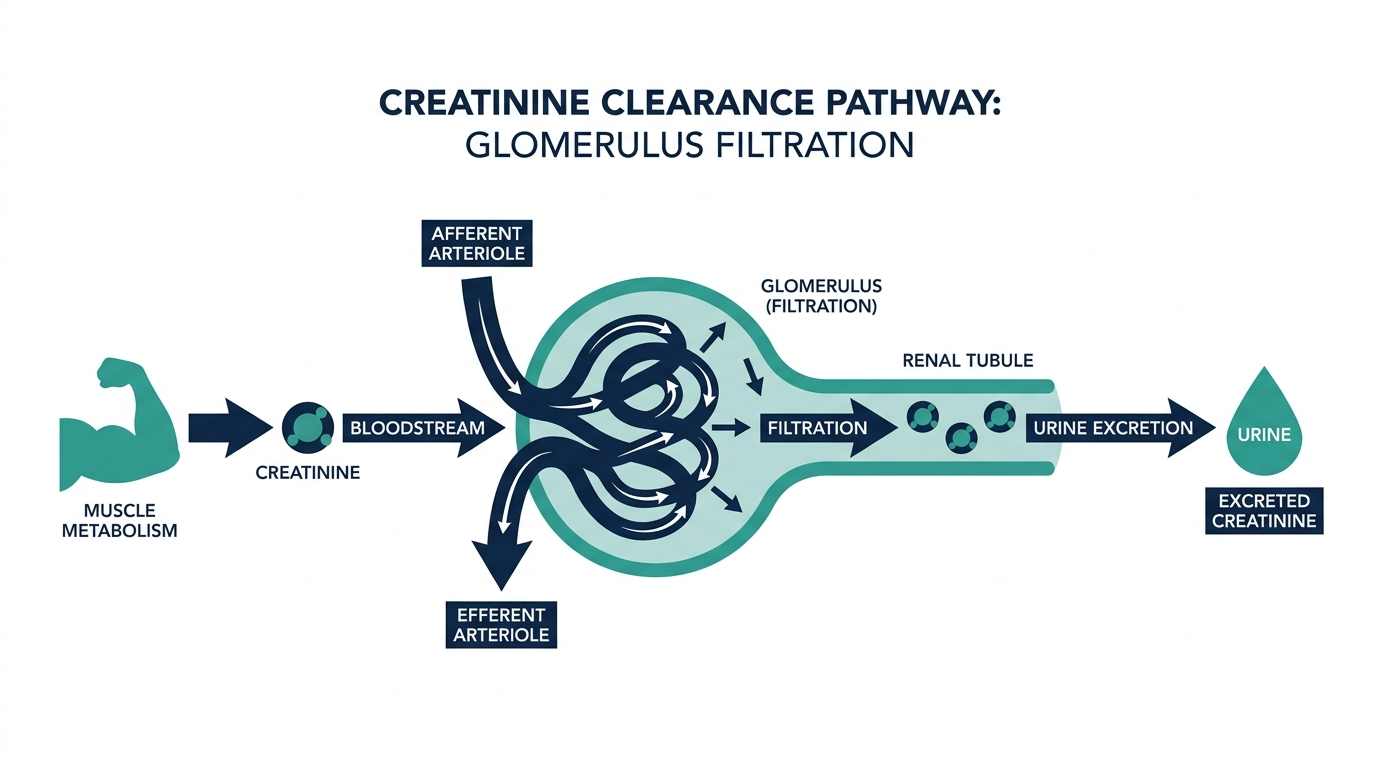
Creatinine is a waste product your body makes constantly as your muscles do their normal wear and tear, and your kidneys are supposed to filter it out into your urine (MedlinePlus). So the logic is simple: if creatinine is building up in your blood, it usually means your kidneys are not clearing it as efficiently as they should (Cleveland Clinic).
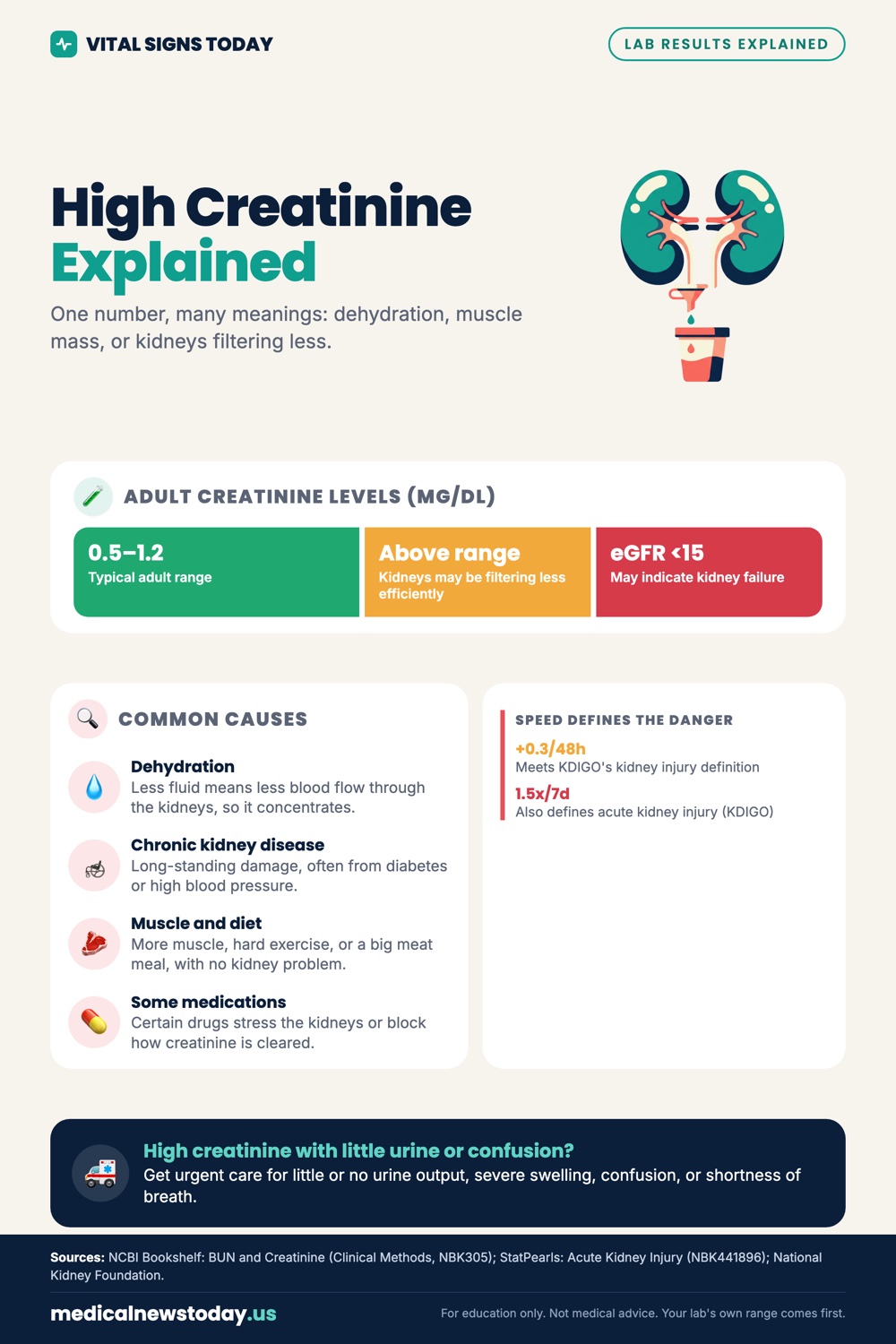
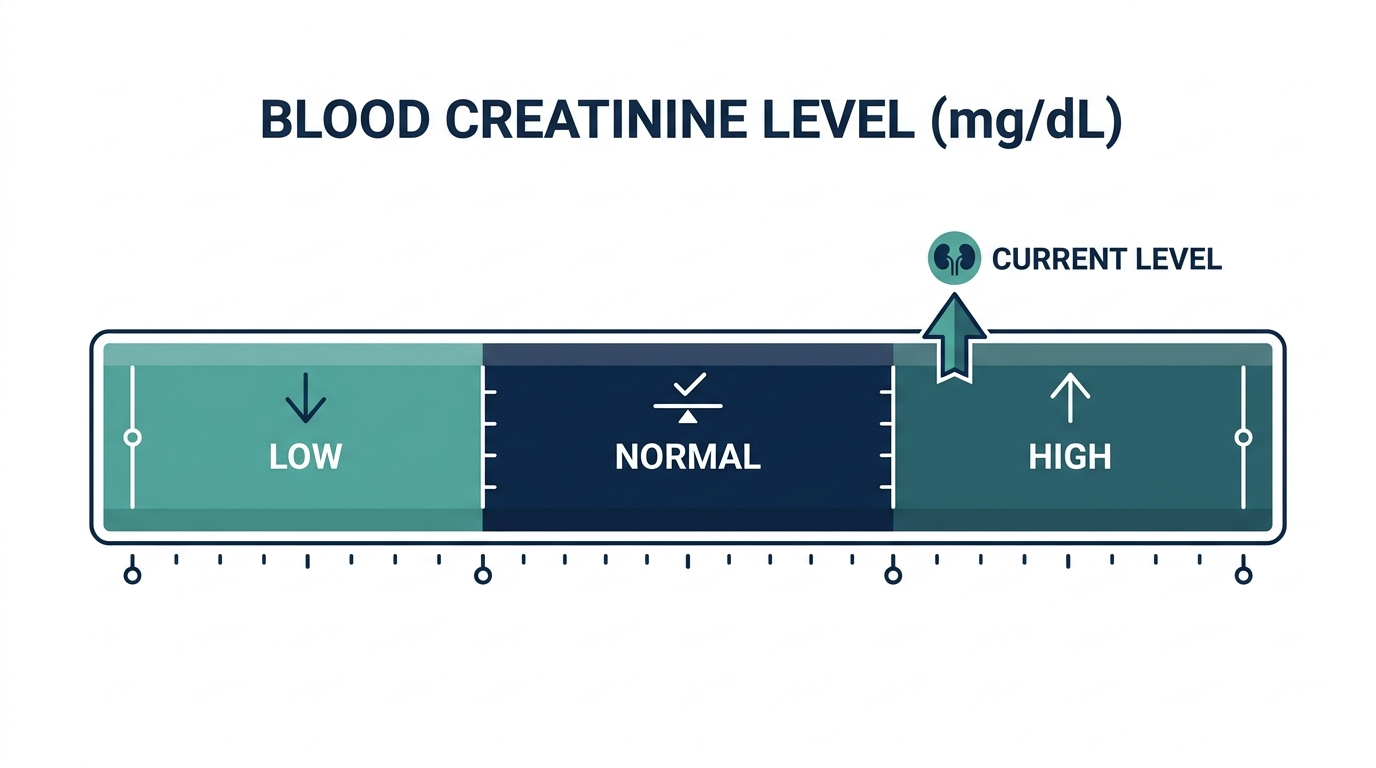
For most adults, a normal serum creatinine runs roughly 0.7 to 1.3 mg/dL for men and 0.6 to 1.1 mg/dL for women, though the exact cutoff shifts with muscle mass, age, and the lab (Cleveland Clinic). “High” generally means a result above the top of your lab’s reference range, so anything past about 1.3 for men or 1.1 for women earns a closer look. Think of creatinine as a clog gauge. The more it backs up in the blood, the more it suggests the filter is struggling.
One important caveat up front: a normal creatinine does not guarantee healthy kidneys, because levels can stay in range during the early stages of kidney disease. The number is useful, but it is a lagging indicator, not an early-warning light.
What does a high creatinine mean on a blood test?
The direct answer: a high creatinine most often means your kidneys are filtering less effectively than they should, but it is a signal to investigate, not a diagnosis on its own. A single high reading cannot name the cause, and you will almost always need a repeat test plus context (MedlinePlus).
This is why your doctor rarely stops at the raw creatinine. The number that actually drives decisions is your eGFR, the estimated glomerular filtration rate, which is calculated from your creatinine along with your age and sex to estimate how well your kidneys are filtering (Cleveland Clinic). A normal eGFR is about 90 or higher (National Kidney Foundation). Because creatinine and eGFR move in opposite directions, a creatinine that climbs is the same news as an eGFR that falls.
Here is roughly how the National Kidney Foundation maps eGFR to kidney function (National Kidney Foundation):
- 90 or higher: normal filtering.
- 60 to 89: may be early-stage kidney disease, especially if there is other evidence of damage.
- 15 to 59: may indicate kidney disease.
- Below 15: may mean kidney failure.
So a mildly high creatinine with an eGFR of 75 is a very different conversation than a creatinine of 5.0 with an eGFR of 12. Same marker, opposite urgency.
What causes a high creatinine?
The causes fall into two buckets: real kidney problems, and things that nudge creatinine up without your kidneys being damaged. Sorting which is which is the whole game. The most common drivers, roughly in order of how often they explain an elevated result (Cleveland Clinic, MedlinePlus):
- Chronic kidney disease. Long-standing damage, very often driven by diabetes or high blood pressure, is the leading reason creatinine creeps up over months and years.
- Acute kidney injury. A sudden insult to the kidneys, from poor blood flow, a urinary blockage, infection, or certain medications, can spike creatinine over days.
- Dehydration. Less fluid means less blood flow through the kidneys, so creatinine concentrates and rises. This is one of the most common reversible causes.
- Heart failure. A weak heart pushes less blood to the kidneys, which shows up as a higher creatinine even when the kidneys themselves are structurally fine.
- High muscle mass, intense exercise, or a heavy meat diet. More muscle and more dietary creatine simply produce more creatinine, no kidney problem required (Cleveland Clinic).
- Medications. Some drugs, including certain pain relievers and others, can raise creatinine or stress the kidneys.
Notice that the bottom half of this list has nothing to do with diseased kidneys. That is exactly why a lone high creatinine should never be read as a kidney diagnosis by itself.
What are the symptoms of a high creatinine?
Here is the part that surprises people: a high creatinine, by itself, usually causes no symptoms at all. Creatinine is just a marker. What you feel comes from the underlying kidney problem, and in early kidney disease there is often nothing to feel, which is precisely why it gets caught on routine blood work rather than because someone felt sick.
When kidney function drops far enough, symptoms can show up, and they tend to be vague and easy to blame on something else (MedlinePlus):
- Swelling in the hands, feet, or around the eyes
- Fatigue and trouble concentrating
- Changes in how often or how much you urinate, or foamy urine
- Dry, itchy skin
- Poor appetite, nausea, or muscle cramps
- Trouble sleeping or shortness of breath
The takeaway is uncomfortable but useful: feeling fine tells you very little about your creatinine. By the time the kidneys produce symptoms, a fair amount of function may already be gone.

When is a high creatinine dangerous or a medical emergency?
Two things make a high creatinine genuinely worrying: how fast it changed, and how high it has climbed.
Speed matters most. A creatinine that jumps suddenly is the red flag clinicians watch for. The standard definition of acute kidney injury is a rise in serum creatinine of 0.3 mg/dL or more within 48 hours, or a rise to 1.5 times your baseline within the prior 7 days (StatPearls, NCBI). In other words, a number that looks only “a little high” can still signal something acute if it climbed quickly from your normal.
Magnitude matters too. Very high levels point toward severe impairment. In adults, creatinine reaching 5.0 mg/dL or higher can indicate severe kidney trouble, and the corresponding eGFR below 15 falls into the kidney-failure range (National Kidney Foundation).
Get urgent care if a high creatinine comes with warning signs such as little or no urine output, severe swelling, confusion, shortness of breath, chest pain, or you recently started a new medication or had a contrast scan and feel unwell. Those combinations are how acute kidney injury announces itself, and it is treatable when caught early.
What should you do about a high creatinine?
First, do not panic over a single number, especially a borderline one. The most useful next step is almost always to repeat the test and look at the full picture (MedlinePlus). Practically, here is what a sensible workup looks like:
- Recheck creatinine and calculate eGFR. A repeat draw, ideally well hydrated and without a huge meat meal or hard workout beforehand, separates a true elevation from a one-off blip.
- Add a urine test. Checking urine for protein (a urine albumin-to-creatinine ratio) tells your doctor whether the kidneys are leaking, which creatinine alone cannot show (National Kidney Foundation).
- Review the reversible causes. Hydration, medications, and recent exercise or diet all get examined first, because fixing those can normalize a mildly high result.
- Treat the underlying driver. If kidney disease is confirmed, controlling blood pressure and blood sugar is the core of protecting remaining function.
Treatment is not aimed at “lowering the creatinine number.” It is aimed at the cause behind it. Chasing the number while ignoring the diabetes or dehydration driving it is backwards.
When should you see a doctor?
Book a visit any time creatinine is flagged high on your results so it can be interpreted in context, even if you feel completely well. Make it sooner rather than later if you have diabetes, high blood pressure, or a family history of kidney disease, since those raise the odds the elevation is meaningful. And treat it as urgent if a high creatinine arrives alongside the emergency signs above, or if it climbed sharply from a recent normal value. A quick repeat test often settles the question, and that is a conversation worth having rather than guessing.
The part most people never hear: why your creatinine can mislead
This is where the number gets tricky, and where a lot of needless worry (and false reassurance) comes from. Creatinine is produced by muscle, so it is tied to how much muscle you carry. That creates two classic misreads.
A very muscular person, or someone who just did heavy resistance training or ate a large amount of meat, can show a “high” creatinine with perfectly healthy kidneys, simply because they generate more of it (Cleveland Clinic). The opposite is the more dangerous trap: a frail, older, or low-muscle person can have a creatinine that looks reassuringly “normal” while their kidney function is genuinely poor, because they barely produce any creatinine to begin with. The same 1.0 mg/dL means something very different in a 25-year-old bodybuilder and an 80-year-old who has lost muscle.
That is the whole reason eGFR exists. By factoring in age and sex, it corrects some of this distortion and gives a fairer estimate of filtering than the raw creatinine ever could (Cleveland Clinic). The clinical move that gets missed by patients reading their own results is comparing the current value to their own past creatinine. A trend over time tells you far more than one number against a generic range.
The three zones of a high creatinine: prerenal, intrinsic, postrenal
When a clinician sees a high creatinine, especially one that rose quickly, they mentally sort the cause into one of three zones based on where the problem sits relative to the kidney. This is the same framework used to classify acute kidney injury, and it explains why the workup goes the way it does.
- Prerenal (before the kidney). The kidney itself is healthy, but not enough blood is reaching it. Dehydration, blood loss, heart failure, and severe illness all fall here. This is the most common and most reversible cause of a sudden creatinine rise. Restore the blood flow, and the number usually comes back down.
- Intrinsic (inside the kidney). The filtering tissue itself is damaged, whether by certain medications, a lack of blood flow that went on long enough to injure the tissue, or inflammation of the kidney’s filters. This is genuine kidney injury and needs a targeted diagnosis.
- Postrenal (after the kidney). Urine cannot get out because something downstream is blocking it, such as a large prostate, kidney stones, or a tumor. The backed-up pressure impairs filtering. Relieving the obstruction often reverses the rise.
Knowing these three zones demystifies the tests your doctor orders. A question about your fluid intake probes the prerenal zone. A medication review probes the intrinsic zone. An ultrasound of the bladder and kidneys probes the postrenal zone. The creatinine number tells you filtering is impaired, and these three questions locate why.
The BUN-to-creatinine ratio and why it matters
Creatinine rarely travels alone on a metabolic panel. Its most informative partner is BUN, blood urea nitrogen, another waste product the kidneys clear. The ratio between the two adds a clue that creatinine alone cannot give.
- A normal BUN-to-creatinine ratio runs roughly 10 to 20 to 1 (PMC, BUN/creatinine ratio in AKI).
- A high ratio, above about 20 to 1, classically suggests a prerenal cause such as dehydration or reduced blood flow, because BUN gets reabsorbed more than creatinine when the kidneys are conserving fluid.
- A low ratio, below about 10 to 1, can point toward liver disease, very low protein intake, or muscle breakdown.
One honest caveat: this ratio is a clue, not a verdict. The evidence that it reliably separates one type of kidney injury from another is weaker than textbooks once implied, so clinicians read it alongside the clinical picture rather than treating it as decisive (PMC, BUN/creatinine ratio in AKI). Still, when your creatinine is high and your BUN is disproportionately high too, dehydration is often near the top of the list, and it is often the easiest thing to fix.
Want to check your creatinine?
Three ways to get it measured. Pick whichever fits you.
Affiliate links: we may earn a commission at no extra cost to you. A lab test does not replace a visit with your clinician.
The rest of the kidney panel worth reading alongside creatinine
A high creatinine becomes far more interpretable when you look at the markers that surround it:
- eGFR translates your creatinine, age, and sex into an estimate of filtering, and it is the number that actually drives staging decisions.
- Urine albumin-to-creatinine ratio (ACR) checks whether the kidneys are leaking protein, an early sign of damage that a normal creatinine can completely miss. This is why a urine test is a standard companion to a high blood creatinine.
- Cystatin C is an alternative filtering marker that does not depend on muscle mass. It is especially useful when creatinine is hard to interpret, such as in very muscular or very frail people, and it can confirm whether a borderline creatinine reflects real impairment.
- Electrolytes and bicarbonate on the same panel show whether the kidneys are still keeping your blood chemistry balanced. Rising potassium or falling bicarbonate alongside a high creatinine raises the urgency.
Read together, these turn a lone creatinine into a coherent story about whether the kidneys are filtering, leaking, and balancing chemistry, or falling behind on one of those jobs.
Medications and the difference between injury and a harmless bump
Medications are one of the most important and most misunderstood causes of a high creatinine, because they raise it through two very different mechanisms.
Some drugs genuinely stress or injure the kidneys, particularly when combined, dehydrated, or used long term. The classic trio to be aware of is NSAIDs (common pain relievers), certain blood pressure medications, and diuretics, which together can reduce kidney blood flow. Contrast dye used in some imaging scans can also injure vulnerable kidneys.
Other drugs raise creatinine without harming the kidney at all. They simply block the transporter that secretes creatinine into the urine, so the blood level ticks up while true filtering is unchanged. This benign effect can look alarming on paper. The way to tell the two apart is to look at whether other kidney markers, like eGFR trend, urine protein, and electrolytes, moved along with the creatinine, or whether the creatinine rose in isolation. That is a distinction worth raising with your clinician if a new medication coincided with your flagged result, rather than assuming the worst.
How to prepare and what can skew a creatinine result
Creatinine is unusually sensitive to what you do in the day or two before the draw, which is exactly why a single high value is often best confirmed with a repeat under better conditions. Factors that can push it up without any kidney problem include:
- A large meat meal the night before, since cooked meat contains creatinine that briefly raises the blood level.
- Intense exercise, especially heavy resistance training, which increases muscle turnover.
- Dehydration, which concentrates the blood and reduces kidney blood flow.
- Creatine supplements, popular with athletes, which can modestly raise measured creatinine.
For a fair recheck, the sensible setup is to be well hydrated, avoid a heavy meat meal and hard workout the day before, and ideally test at a similar time of day to your baseline. If a borderline creatinine drops back into range on a well-prepared repeat, that itself is informative and can spare an unnecessary workup.
A worked example of interpreting a high creatinine
Consider three people who each show a creatinine of 1.4 mg/dL.
- A 27-year-old competitive powerlifter, well and hydrated. With high muscle mass and a recent training block, this value may be normal for him, and his eGFR interpreted with that context, plus a stable history, points to healthy kidneys rather than disease.
- A 70-year-old with diabetes whose creatinine was 1.0 last year. The same 1.4 is a meaningful upward trend against his own baseline. It prompts an eGFR, a urine protein check, and a focus on blood pressure and glucose control.
- Someone who developed vomiting and poor intake over three days. A creatinine that jumped from a known normal, with a high BUN-to-creatinine ratio, fits prerenal dehydration and often improves quickly with rehydration.
Same 1.4 mg/dL, three completely different meanings. The number alone is nearly mute. Its speed of change, the muscle behind it, and the markers beside it are what give it a voice.
Frequently asked questions
What does a high creatinine in a blood test mean?
It most often means your kidneys are filtering waste less efficiently than they should, but it is a signal to investigate rather than a diagnosis on its own (MedlinePlus). Non-kidney causes like dehydration, heavy exercise, high muscle mass, and a meat-rich diet can also raise it, so doctors interpret it alongside eGFR and a repeat test.
What is a high creatinine level in a blood test?
Generally, a result above your lab’s reference range counts as high, which for adults is roughly above 1.3 mg/dL for men and 1.1 mg/dL for women, though cutoffs vary with muscle mass and lab (Cleveland Clinic). Levels of 5.0 mg/dL or higher in adults can point to severe kidney impairment.
What if my creatinine is high in a blood test but I feel fine?
That is common, because a high creatinine itself usually causes no symptoms and early kidney disease is often silent (MedlinePlus). Feeling well does not rule out a real elevation, which is why a repeat test and eGFR are worth doing even without symptoms.
When is high creatinine a medical emergency?
A fast rise is the key danger sign. An increase of 0.3 mg/dL within 48 hours, or to 1.5 times your baseline within 7 days, defines acute kidney injury (StatPearls, NCBI). Seek urgent care if a high creatinine comes with little or no urination, severe swelling, confusion, or shortness of breath.
Can a high creatinine go back to normal?
Yes, when the cause is reversible. Elevations from dehydration, a heavy meat meal, intense exercise, or certain medications often normalize once the cause is corrected (Cleveland Clinic). Elevations from established chronic kidney disease are managed rather than cured, by treating the underlying condition.
This article is for general educational purposes and is not medical advice. It cannot diagnose or treat you and does not replace your clinician. Always discuss your lab results and any health decisions with a qualified healthcare professional.
Vital Signs Today may earn a commission if you buy through links on this page. It does not affect our editorial assessments.