
Disclosure: Vital Signs Today may earn a commission if you buy through links on this page, at no extra cost to you. This does not influence our evidence-based assessments. We are not a medical provider; talk to a clinician before acting on test results.
Related: ALP blood test: the full guide
You opened your lab report, ran down the liver panel, and there it was: ALP, with a number sitting above the top of the reference range. Maybe there was a little “H” next to it. Your stomach dropped, because everything you half remember about ALP involves the word “liver.” Take a breath. A high alkaline phosphatase is one of the most commonly flagged results in all of medicine, and most of the time the story behind it is far more ordinary than the panic suggests.
Here is what the one-page printout will not tell you. ALP is not a single thing. It is a family of nearly identical enzymes coming from at least two completely different places in your body, and the whole game of interpreting a high result is figuring out which one is talking.
Part of our Liver Function Tests guide.

What is alkaline phosphatase high in blood test, and what does it actually mean?
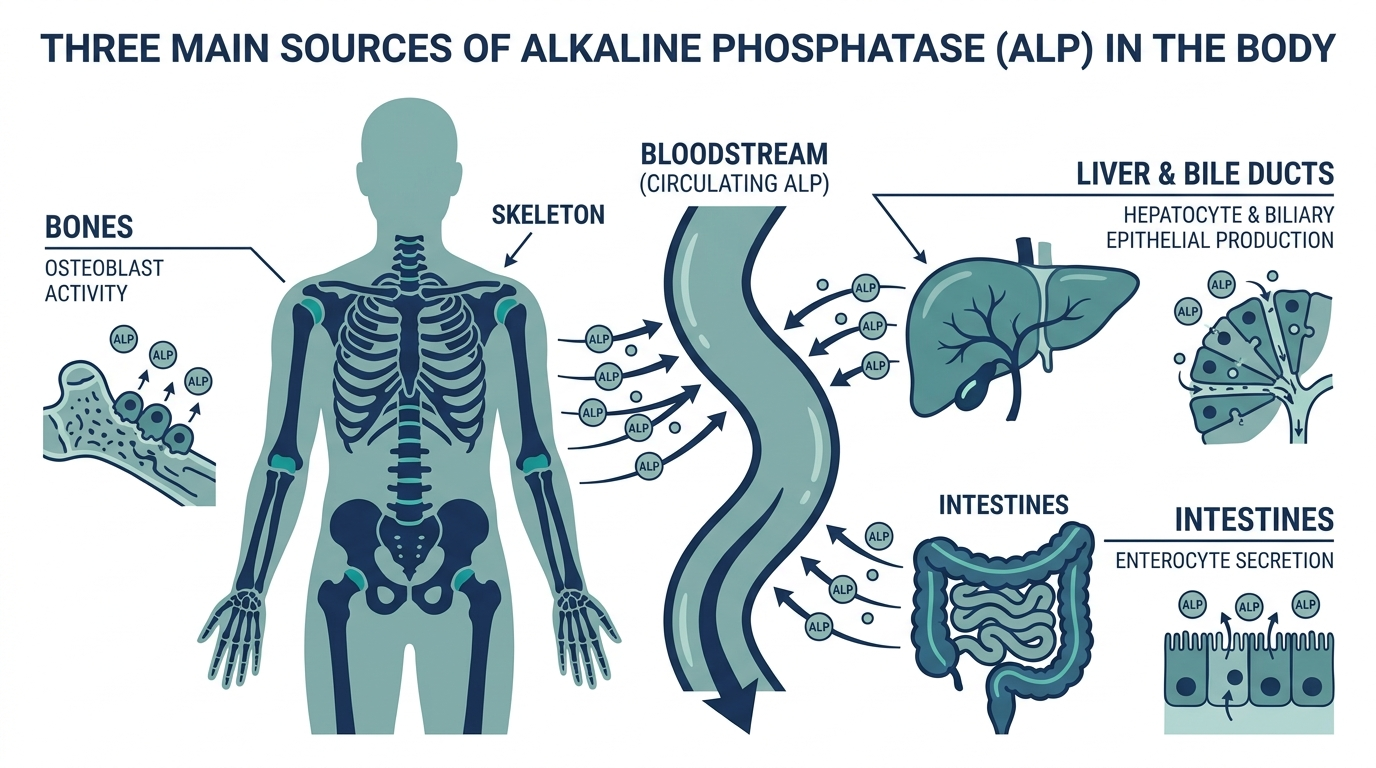
Alkaline phosphatase (ALP) is an enzyme found throughout your body, but the ALP measured in a standard blood test comes mostly from two sources: your liver and your bones (Cleveland Clinic). A high ALP means there is more of this enzyme circulating than expected, and that usually points to either a liver and bile duct problem or a bone problem. The catch, and it is a big one, is that the basic ALP number cannot tell you which (MedlinePlus).
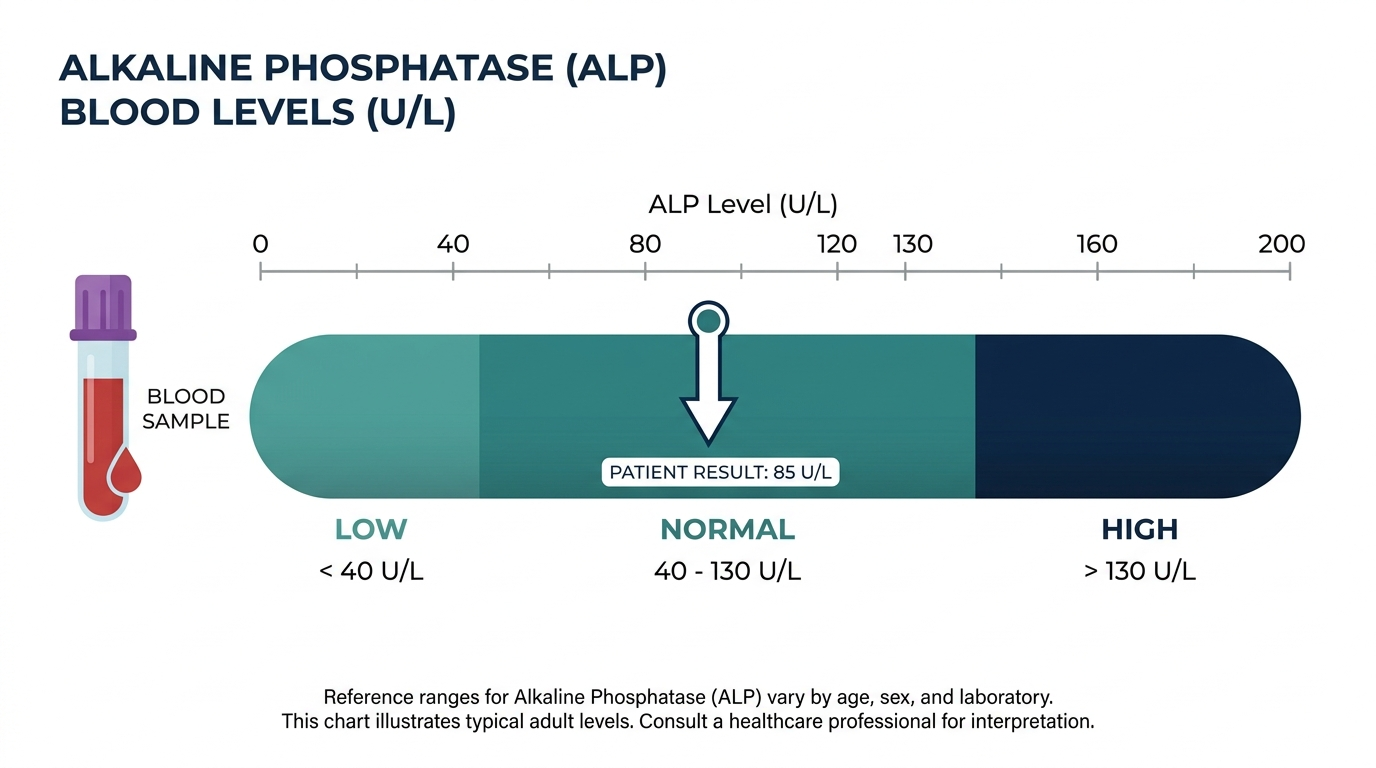
So what counts as high? One common reference range runs from about 44 to 147 international units per liter (IU/L), though some labs and professional bodies use 30 to 120 IU/L (Cleveland Clinic). Anything above the top of your lab’s range gets flagged as high. But read that number against the reference range printed on your own report, because the cutoff genuinely varies by lab, by age, and by sex. A teenager, a pregnant woman, and a 55-year-old man will each have a different “normal,” and a result that is high for one is perfectly expected for another.
The single most useful frame: a high ALP is a question, not an answer. It tells your clinician where to look next, not what you have.

What causes a high ALP?
The differential splits cleanly into two columns, liver and bone, plus a handful of perfectly benign physiologic causes that trip people up constantly. Here they are, roughly in order of how often they show up.
Physiologic and harmless first, because these are missed most. Growing children and teenagers normally run ALP levels 2 to 5 times higher than adults because their bones are actively building (NCBI Bookshelf, Clinical Methods). Pregnancy raises ALP 2 to 3 fold in the second and third trimesters because the placenta makes its own version of the enzyme (NCBI Bookshelf, Clinical Methods). A healing bone fracture pushes ALP up starting about a week after the break and can keep it elevated for up to three months (NCBI Bookshelf, Clinical Methods). None of these need treatment.
Liver and bile duct causes. ALP climbs sharply when bile cannot drain properly, a situation called cholestasis. The classic triggers (MedlinePlus):
- A blocked bile duct, from a gallstone, a stricture, or a tumor pressing on the ducts.
- Cirrhosis and hepatitis, where liver tissue is inflamed or scarred (Cleveland Clinic).
- Cholestasis of pregnancy, a specific bile-flow problem of late pregnancy.
- Mononucleosis, which can swell the liver and nudge ALP up (MedlinePlus).
Bone causes. Anything that ramps up bone-cell activity raises bone ALP (Cleveland Clinic):
- Paget’s disease of bone, a disorder of overactive bone remodeling that can drive ALP to dramatic heights.
- Osteomalacia, softening of bone usually from vitamin D deficiency.
- Hyperparathyroidism and hyperthyroidism, which speed up bone turnover.
- Bone metastasis and osteogenic sarcoma, the serious end of the list, where cancer involves bone.
A few other conditions can also raise ALP, including untreated celiac disease (Cleveland Clinic), Hodgkin lymphoma, and heart failure (MedlinePlus). And do not forget medications: some drugs and even birth control pills can shift the number (MedlinePlus).
What are the symptoms of a high ALP?
Here is the part that surprises people: a high ALP itself causes no symptoms. The enzyme floating in your blood does not make you feel anything. Whatever symptoms you have, if any, come from the underlying condition driving the number up, not from the ALP. Plenty of people with a mildly high ALP feel completely fine and only learn about it from a routine panel.
When symptoms do appear, they cluster by source. Liver and bile duct problems tend to bring jaundice (yellowing of the skin or eyes), abdominal pain, dark urine, easy bruising, itching, or unexplained weight loss (Cleveland Clinic). Bone problems more often show up as bone or joint pain, and in Paget’s disease, sometimes bone deformity. If your ALP is high and you have none of these, that is genuinely reassuring, but it does not replace the follow-up testing below.
When is a high ALP dangerous or a medical emergency?
The ALP number alone does not declare an emergency. What makes a high ALP urgent is the company it keeps. Pay attention if your elevated ALP comes with any of these red flags:
- Jaundice plus fever and right-upper-belly pain. This triad can signal a blocked, infected bile duct (cholangitis), which is a true emergency and needs same-day care.
- A markedly high ALP with a high bilirubin, which together strongly suggest the bile is backing up and the drainage system is obstructed.
- A very high ALP with unexplained weight loss or new bone pain, which deserves prompt evaluation to rule out malignancy involving liver or bone (MedlinePlus).
Magnitude matters too. A result a little above the top of the range is a different conversation from one that is several times the upper limit. Strikingly high levels, the kind seen in Paget’s disease or widespread bone metastasis, always warrant a focused workup. But context beats the raw number every time, which is why no responsible clinician treats an ALP value in isolation.

What should you do about a high ALP?
The honest first step is almost always to confirm and clarify, not to treat. A high ALP is a signpost, and the next tests point you down the right road.
Repeat or recheck. A single mildly high value, especially if you ate a fatty meal beforehand or are taking certain medications, may simply normalize on a repeat draw (MedlinePlus).
Pin down the source with a GGT. This is the move that decides everything. Gamma-glutamyl transferase (GGT) rises with liver and bile duct disease but stays normal in bone disease, so pairing it with ALP separates the two columns fast (NCBI Bookshelf, Clinical Methods). High ALP plus high GGT points to the liver. High ALP with a normal GGT points to bone.
Or order the ALP isoenzyme test. When GGT does not settle it, a specialized ALP isoenzyme test can directly identify which tissue the enzyme came from, although it is more involved and not available everywhere (Cleveland Clinic).
Then treat the cause, not the number. There is no treatment for “high ALP” as such. If it is vitamin D deficiency, you replace vitamin D. If it is a blocked duct, you relieve the obstruction. If it is a healing fracture or pregnancy, you wait and watch. Lifestyle steps like limiting alcohol and managing weight help liver health broadly, but they are not a fix for an ALP number on their own.
When should you see a doctor?
If your ALP was flagged high on a routine panel and you feel well, you do not need the emergency room, but you do need a conversation with your clinician about next tests, ideally a GGT and a look at the rest of your liver panel. Make that appointment promptly rather than letting the result sit.
Seek care urgently, the same day, if a high ALP comes with yellowing skin or eyes, fever with belly pain, severe abdominal pain, or dark urine with pale stools (Cleveland Clinic). And flag it soon if you have new, unexplained bone pain or weight loss alongside the elevated value.
The insider read: the trap that catches even experienced clinicians
Here is the nuance that separates a careful interpretation from a reflexive one. The reflex when ALP is high is to assume “liver” and start chasing hepatitis and gallstones. But a meaningful share of high ALP results are coming from bone, not liver, and you will miss it entirely if you skip the GGT (NCBI Bookshelf, Clinical Methods). A patient with a high ALP, a normal GGT, and a normal bilirubin almost certainly does not have a liver problem at all. Sending that person for a liver ultrasound and a hepatitis panel is a common, expensive detour.
The flip side trap is just as common: not asking who the patient is. Before working up a high ALP at all, the experienced eye checks for the obvious physiologic explanations. A growing teenager runs ALP 2 to 5 times the adult level as a matter of normal biology, and a pregnant woman in her third trimester runs 2 to 3 times higher because of the placenta (NCBI Bookshelf, Clinical Methods). Treating those numbers as pathology generates needless tests and needless fear. The skill is not memorizing the causes. It is knowing, for the person in front of you, which causes are even on the table.
One more practical note: a fatty meal before the draw can transiently raise ALP, so a borderline result is sometimes worth repeating fasting before anyone reads too much into it (MedlinePlus).

What alkaline phosphatase does in the body
The name sounds intimidating, but the enzyme’s job is simple to picture. Alkaline phosphatase removes phosphate groups from molecules, and it works best in an alkaline (higher pH) environment, which is where the name comes from. The reason it shows up in blood tests as a liver-and-bone signal is that these two tissues are where the enzyme is most abundant and most active.
- In the liver, ALP lines the tiny bile-carrying channels. When bile flow is blocked or slowed (cholestasis), pressure and irritation prompt these cells to produce and release more ALP into the blood. That is why a blocked duct or a backed-up bile system pushes the number up so reliably.
- In bone, ALP is made by osteoblasts, the cells that build new bone. Any time bone-building activity accelerates, whether from a growing skeleton, a healing fracture, or a disease of bone remodeling, more bone ALP spills into the circulation.
- In the placenta and intestine, smaller amounts are produced, which is why pregnancy and, occasionally, a fatty meal can nudge the total higher.
This biology is the whole reason a single ALP number is ambiguous. The blood test measures total ALP, adding up every source at once. A high total tells you production somewhere has increased, but not where. Everything else in the workup exists to answer that one question.
How a high ALP is read alongside the rest of your liver panel
ALP is one line in a liver panel, and its neighbors decide whether the story is liver, bone, or benign. Reading them together is how a clinician turns an ambiguous number into a direction.
| Companion value | What it adds to a high ALP |
|---|---|
| GGT (gamma-glutamyl transferase) | The key tiebreaker. High GGT with high ALP points to liver or bile ducts. Normal GGT with high ALP points to bone. |
| Bilirubin | A high ALP with high bilirubin strongly suggests bile is backing up, raising concern for obstruction. |
| ALT and AST | These liver enzymes rise more with liver-cell injury (hepatitis). ALP rising out of proportion to ALT and AST suggests a cholestatic (bile-flow) rather than hepatocellular pattern. |
| Calcium, phosphate, vitamin D | Relevant when the source is bone. Low vitamin D with high ALP suggests osteomalacia. |
| Albumin | A broader marker of liver synthetic function that helps gauge overall liver health. |
Want to check your alkaline phosphatase?
Three ways to get it measured. Pick whichever fits you.
Affiliate links: we may earn a commission at no extra cost to you. A lab test does not replace a visit with your clinician.
The practical shortcut clinicians use is the pattern, not any single value. High ALP and high GGT and high bilirubin together read as a cholestatic, liver-side problem. High ALP with a completely normal GGT and normal bilirubin reads as bone or benign, and it steers the workup toward calcium, vitamin D, and the patient’s age and pregnancy status rather than a liver ultrasound.
How to prepare for the test and what can skew ALP
Because several ordinary factors move ALP, knowing them prevents chasing a false alarm:
- Recent food. A fatty meal can transiently raise ALP, particularly in certain blood types, so a borderline result is sometimes repeated fasting. Ask your clinician whether a fasting draw is preferred.
- Age. Children and teenagers normally run much higher levels because their bones are actively growing, so an adult reference range does not apply to them.
- Pregnancy. The placenta makes its own ALP, raising the total substantially in the second and third trimesters. This is expected, not disease.
- A recent fracture. A healing bone keeps ALP elevated for weeks to a few months.
- Medications and supplements. Some drugs, and even oral contraceptives, can shift the value. Share your full medication list.
- Lab variation. Reference ranges differ by lab, age, and sex, so read your value against your own report’s range.

Interpreting your result: worked scenarios
Placing the number in context is what makes it meaningful. A few common patterns:
- ALP mildly high, GGT normal, bilirubin normal, in an otherwise well adult. This points away from the liver. The next questions are age, recent fracture, and vitamin D, not a hepatitis workup.
- ALP high and GGT high and bilirubin rising, with itching or dark urine. A cholestatic pattern suggesting bile flow is obstructed. This warrants prompt imaging of the liver and bile ducts.
- ALP high in a healthy pregnant woman in her third trimester. Expected from placental ALP. Interpreted in context, it is usually not a concern on its own.
- ALP high with normal GGT, low vitamin D, and bone aches. Points toward osteomalacia. Correcting vitamin D is the path, and ALP often falls as the bone heals.
- ALP strikingly high, several times the upper limit, with bone pain in an older adult. This magnitude, with a bone source, prompts evaluation for Paget’s disease or bone involvement and deserves a focused workup.
The ALP isoenzymes: pinning down the exact source
When the GGT does not fully settle the question, a specialized ALP isoenzyme test can separate the different forms of the enzyme directly, because the liver, bone, intestinal, and placental versions are subtly different proteins. This test is more involved and not available in every lab, but it can be valuable when the source remains unclear after the standard workup.
A related everyday clue is heat stability. The bone form of ALP is more fragile to heat than the liver form, a property labs have historically used to help distinguish them. You do not need to know the biochemistry, but it explains why “high ALP” is never the end of the investigation: the enzyme genuinely comes in distinguishable flavors, and modern testing can tell them apart when it matters. The takeaway for you as a patient is to ask, when a high ALP is unexplained, whether the source has actually been identified rather than assumed.
Common misconceptions about a high ALP
- “High ALP means liver disease.” Not necessarily. A large share of high results come from bone or are simply physiologic. The GGT is what sorts liver from bone.
- “My ALP is high, so I need a liver ultrasound now.” Only if the pattern points to the liver. A high ALP with normal GGT and bilirubin usually does not.
- “A high number always means something is wrong.” Growing teenagers, pregnant women, and people healing a fracture all run high ALP as normal biology.
- “I can lower my ALP with diet or supplements.” There is no target for the number itself. Treatment addresses the cause, whether that is replacing vitamin D or relieving a blocked duct.
- “One high reading needs a big workup.” A mildly high value, especially after a fatty meal, may simply normalize on a repeat, ideally fasting.
Frequently asked questions
What does high alkaline phosphatase mean in a blood test?
It means more ALP enzyme is circulating than expected, which usually points to a liver and bile duct problem or a bone problem (Cleveland Clinic). The basic ALP value cannot tell which source it is, so your clinician typically adds a GGT or an isoenzyme test to find out (MedlinePlus).
What is a high alkaline phosphatase level in a blood test?
Any result above your lab’s upper limit is high. A common reference range is 44 to 147 IU/L, though some labs use 30 to 120 IU/L, and the cutoff varies by age and sex (Cleveland Clinic). Always compare against the range printed on your own report.
Can a high ALP be harmless?
Yes, often. Growing children and teens normally run 2 to 5 times the adult level, pregnancy raises ALP 2 to 3 fold, and a healing fracture can keep it up for months (NCBI Bookshelf, Clinical Methods). Mildly elevated levels frequently do not signal a condition needing treatment (MedlinePlus).
How do doctors tell if high ALP is from the liver or bone?
They check a GGT. GGT rises in liver and bile duct disease but stays normal in bone disease, so high ALP with high GGT points to the liver, and high ALP with normal GGT points to bone (NCBI Bookshelf, Clinical Methods). An ALP isoenzyme test can confirm the source directly (Cleveland Clinic).
When is a high ALP an emergency?
When it comes with red flags, especially jaundice plus fever and right-upper-belly pain, which can mean an infected, blocked bile duct (Cleveland Clinic). A markedly high ALP with high bilirubin, or with new bone pain and weight loss, also needs prompt evaluation (MedlinePlus).
This article is for general educational purposes and is not medical advice. It cannot diagnose or treat you and does not replace your clinician. Always discuss your lab results and any health decisions with a qualified healthcare professional.
Vital Signs Today may earn a commission if you buy through links on this page. It does not affect our editorial assessments.