
Related: What a low LDH result means
You opened your lab report, scanned past the cholesterol and the blood sugar, and landed on three letters with a number beside them: LDH. Maybe it was flagged high. Maybe your doctor ordered it and never quite explained why. Either way, LDH is one of those results that sounds ominous and gets almost no plain-English explanation.
Here is what makes LDH genuinely interesting. It is one of the most sensitive markers on the panel and one of the least specific, all at once. That combination is exactly why it confuses people, and exactly why it matters once you understand how to read it.
What is an LDH blood test?
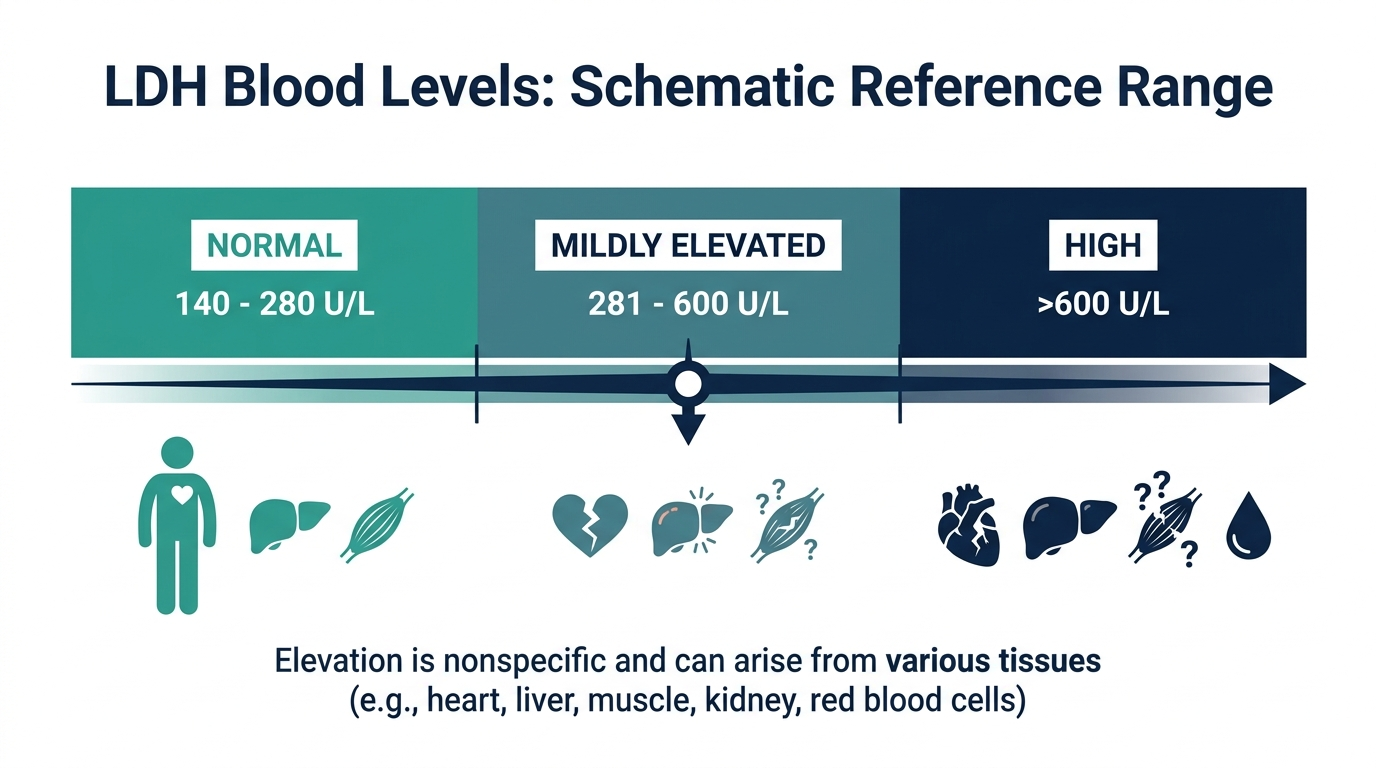
An LDH blood test measures the amount of lactate dehydrogenase, an enzyme found inside almost every cell in your body, that has leaked into your bloodstream. When cells are healthy, LDH stays mostly inside them. When cells are damaged or destroyed, they spill LDH out, so a higher blood level signals tissue damage somewhere in the body (Cleveland Clinic). In plain terms, the question “what is an LDH blood test” has a simple answer: it is a tissue-damage detector. The catch is that it does not tell you, by itself, which tissue.
LDH does real work in your cells. It helps turn glucose into energy during cellular respiration, and the enzyme sits at the very end of the glycolysis pathway, converting pyruvate to lactate (MedlinePlus). Because it lives everywhere, with the highest concentrations in muscle, liver, kidneys, and red blood cells, damage almost anywhere can push the number up.

What does LDH measure, and why is the LDH blood test ordered?
The LDH blood test measures cellular leakage. A clinician orders it when they suspect tissue is being injured or destroyed and want a quick, cheap signal of how much. It is used to look for damage in the blood, liver, lungs, kidneys, heart, pancreas, brain, and spinal cord, and to monitor conditions such as muscular dystrophy and HIV (MedlinePlus).
You will commonly see “what is LDH in blood test” come up in a few specific situations. Doctors order it to gauge how severe an infection or disease is, to track certain cancers over time, and to check fluid other than blood. The same enzyme can be measured in cerebrospinal fluid, abdominal fluid, or fluid around the lungs to tell whether a problem is brewing in those spaces (MedlinePlus). The test is a simple blood draw, with the usual minimal risks of bruising, brief lightheadedness, or a small hematoma at the needle site (MedlinePlus Encyclopedia).
What is a normal LDH level on a blood test?
A normal LDH result for adults generally falls around 125 to 220 international units per liter, though the exact range depends on the lab and the testing method (MedlinePlus Encyclopedia). Cleveland Clinic lists a slightly different breakdown by sex: about 135 to 225 units per liter in adults assigned male at birth, and 135 to 214 units per liter in adults assigned female at birth (Cleveland Clinic).
Two practical notes. First, children normally run higher than adults, so a kid’s result is read against a different yardstick (Cleveland Clinic). Second, always compare your value to the reference range printed on your own report, because that is the range your specific lab calibrated. A result of 230 is not the same story at every lab.
What does a high LDH on a blood test mean?
A high LDH means cells somewhere are breaking down and releasing their contents into your blood. It confirms that tissue damage is happening, but on its own it does not say where or why. The list of possible causes is long: anemia, kidney disease, lung disease, liver disease, muscle injury, muscular dystrophy, bone fractures, heart attack, pancreatitis, infections such as meningitis and encephalitis and HIV, and several cancers including melanoma, multiple myeloma, lymphoma, testicular cancer, and leukemia (MedlinePlus).
Some of the most common reasons for a mildly raised LDH are completely benign. Intense exercise can elevate it, as can certain medicines including aspirin (MedlinePlus). And here is a quiet one worth knowing: if your blood sample is handled roughly or sits too long, the red blood cells can rupture in the tube, a process called hemolysis, and dump LDH into the sample. That can make your level look high when nothing is wrong with you at all (MedlinePlus). A surprising share of “abnormal” LDH results are really lab artifacts, which is why a single high value usually gets repeated before anyone reads too much into it.
What does a low LDH level mean?
A low LDH is uncommon and almost never a health concern. Lower than normal levels are usually not considered a problem, and they can show up in people taking large amounts of vitamin C or vitamin E (MedlinePlus). In rare cases, a genetically low LDH points to an inherited lactate dehydrogenase A or B deficiency, which can affect how muscles handle intense exertion. For the vast majority of people, a low LDH with an otherwise unremarkable report is nothing to chase.
Why is an LDH blood test followed by an isoenzyme test?
Because total LDH cannot tell you where the damage is, an elevated result is often followed by an LDH isoenzyme test that pinpoints the source. LDH comes in five forms, and each one concentrates in different tissues, so the pattern of which form is elevated acts like a fingerprint (MedlinePlus).
- LDH-1: mainly in the heart and red blood cells.
- LDH-2: mainly in white blood cells, with smaller amounts in the heart and red cells.
- LDH-3: mainly in the lungs.
- LDH-4: mainly in the kidneys and pancreas, and in the placenta during pregnancy.
- LDH-5: mainly in the liver and skeletal muscles.
The relationships between the forms carry the meaning. An LDH-1 level that is higher than LDH-2 can signal a certain type of anemia, while an LDH-5 that outpaces LDH-4 can point to liver damage or disease (MedlinePlus). When several forms rise at once, it can mean either multiple problems or cancer that has spread across more than one tissue. This is the step that turns a vague “something is damaged” into an actual lead.
The part most people never hear: LDH as a window into cancer prognosis
This is where LDH goes from a generic damage signal to something oncologists watch closely. In several cancers, LDH is not used to make the diagnosis. It is used to gauge how aggressive the disease is and how a patient is likely to do over time. The biology is straightforward: many tumors run their metabolism through glycolysis at high speed, the exact pathway LDH sits on, so a high LDH can reflect a large, fast-burning tumor burden.
The data backs this up across many cancer types. In a study of 7,895 cancer patients, those with an LDH above the upper limit of normal had a meaningfully higher risk of death, with a hazard ratio of about 1.43 for overall mortality compared with patients who had low LDH, and the link held after adjusting for age, sex, and other factors (PMC, LDH and survival after cancer diagnosis). The association was strongest when LDH was measured close to diagnosis, suggesting it tracks active disease rather than something incidental. In non-Hodgkin lymphoma specifically, an elevated LDH has been shown to be a poor prognostic factor, which is why it is built directly into lymphoma risk scoring (PMC, LDH as a prognostic factor in non-Hodgkin lymphoma).
Here is the insider takeaway that rarely reaches patients. For someone in cancer treatment, the single LDH number matters less than the direction it is moving. A falling LDH over successive draws often signals that therapy is working and tumor burden is dropping, while a rising trend can be an early hint that disease is progressing, sometimes before scans catch up. That is why your oncology team may order LDH again and again. They are reading the slope, not just the dot. For everyone else, a one-off high LDH with no symptoms is far more likely to be exercise, a common illness, or a roughly handled blood tube than anything sinister.

How to prepare for an LDH test, and what quietly skews the result
LDH is a test where the handling of your sample matters almost as much as your biology. There is usually no fasting requirement and no need to stop eating or drinking beforehand, but the things that raise LDH before and around the draw are worth knowing, because they are the most common reason a healthy person gets a mildly high number.
The single biggest source of false elevation is hemolysis, the rupture of red blood cells inside the collection tube. Red cells are packed with LDH, so if the sample is drawn through too fine a needle, shaken, left sitting too long before it reaches the lab, or exposed to temperature swings during transport, the cells burst and release their enzyme straight into the serum being measured. The result can read high when nothing at all is wrong inside you. This is why a laboratory that suspects hemolysis will often flag the sample and ask for a redraw rather than report a misleading value.
The things you do in the day or two before also register. Consider avoiding or disclosing the following:
- Strenuous exercise. Hard workouts, long runs, or heavy lifting stress skeletal muscle enough to leak LDH. Many clinicians suggest easing off intense activity for a day or two before the draw.
- Recent intramuscular injections or surgery. Any procedure that injures muscle or tissue can nudge the number up for a while afterward.
- Certain medicines. Aspirin, some narcotics, and anesthetic agents can influence the result, so bring a full list of what you take, including over-the-counter drugs and supplements.
- High-dose vitamin C or vitamin E. Large amounts of these can push LDH lower, occasionally masking a value that would otherwise sit at the top of the range.
The practical lesson is simple. If your only abnormal marker is a modestly high LDH and you feel completely well, the first questions to ask are whether you exercised hard beforehand and whether the sample might have been hemolyzed. A repeat draw handled carefully resolves a large share of these cases without any further workup.
Reading LDH inside the panel: the markers it travels with
LDH is almost never interpreted alone. Because it flags damage without naming a location, its real value emerges when you line it up next to the more specific markers ordered on the same panel. The pattern of what is high and what is normal is what turns a vague signal into a lead.
| If LDH is high alongside | The likely story it points toward |
|---|---|
| ALT and AST (liver enzymes) | Liver cell injury, since LDH-5 concentrates in the liver and rises with hepatocellular damage. |
| Low haptoglobin, high bilirubin, high reticulocytes | Hemolytic anemia, where red cells are breaking down in the body and releasing LDH. |
| High creatine kinase (CK) | Skeletal or cardiac muscle injury, from intense exercise to rhabdomyolysis. |
| High creatinine and urea | Kidney involvement, since renal tissue also holds LDH. |
| Abnormal complete blood count with blasts or cytopenias | A hematologic process such as leukemia or lymphoma that warrants specialist review. |
Two companions deserve special mention. When LDH rises but haptoglobin drops and bilirubin climbs, the trio is a classic fingerprint of hemolysis happening inside the body rather than in the tube, and a good clinician will chase that pattern rather than dismiss it. And when LDH climbs in lockstep with the liver enzymes ALT and AST, the liver moves to the top of the suspect list. The point is that LDH earns its keep as a corroborating marker: it rarely closes a case on its own, but it frequently confirms or challenges the story the rest of the panel is telling.
Worked examples: how the same LDH number means different things
Numbers only become useful when you see how a clinician reasons through them. Here are several realistic interpretation scenarios that show why context changes everything about a single LDH value.
Scenario one: high LDH, everything else normal, and you ran a half marathon yesterday. This is the most common benign pattern. Skeletal muscle worked hard, leaked some LDH, and the rest of your panel is unremarkable. The usual next step is to rest, avoid heavy exertion, and repeat the test in a week or two. It nearly always normalizes.
Scenario two: high LDH with low haptoglobin and high bilirubin. Here the isolated LDH is not the headline. The combination suggests red blood cells are being destroyed somewhere in your body, a state called hemolysis. This is a real finding that deserves a workup to find the cause, not a lab artifact to shrug off.
Scenario three: high LDH plus elevated ALT and AST after starting a new medication. The liver enzymes localize the problem, and LDH-5 from the liver is consistent with it. The conversation shifts to whether a drug is stressing the liver and whether it should be paused and rechecked.
Scenario four: mildly high LDH, no symptoms, and the lab noted the sample was hemolyzed. This is not a health finding at all. The most useful next move is a carefully drawn repeat sample before anyone reads meaning into the number.
Scenario five: LDH that keeps climbing over several draws in someone under cancer treatment. For this person the trend is the message. A rising slope can hint that disease is progressing, sometimes before imaging shows it, which is exactly why oncology teams retest LDH repeatedly. Read the direction, not just the dot.

LDH beyond cancer: infection, lung disease, and severity
Oncology gets most of the attention, but LDH also functions as a general severity dial in serious infections and lung disease, because widespread tissue stress and inflammation drive it up. This role became widely visible during the COVID-19 pandemic, when LDH turned out to be one of the more reliable early signals of who was heading toward severe illness.
Research consistently linked higher LDH to worse lung involvement and worse outcomes in COVID-19 pneumonia. A high blood LDH was positively associated with a larger extent of lung abnormality on CT imaging, with cardiovascular complications, and with a greater initial need for supplemental oxygen (Scientific Reports). A systematic review and meta-analysis found elevated LDH carried real prognostic weight for poor outcomes in patients with the disease (Postgraduate Medical Journal). The mechanism fits the biology already described: extensive damage to lung tissue spills LDH, and the more tissue involved, the higher the number climbs.
The broader lesson is that LDH behaves like a smoke detector for tissue stress across many settings, not just tumors. In a sick, hospitalized patient, a markedly high and rising LDH is a signal clinicians take seriously as a marker of how much tissue is under strain, even while they use more specific tests to work out exactly what is causing it.
Who should have an LDH test, and how often to follow it
LDH is not a marker most healthy people need to check on a routine annual basis in isolation, because on its own it is too nonspecific to guide much. It earns its place in a few clear situations.
- When a clinician suspects active tissue damage. Symptoms such as unexplained fatigue, dark urine, or signs pointing to the liver, muscles, or blood can prompt an LDH to gauge whether cells are breaking down.
- As part of monitoring certain cancers. In lymphomas and some other malignancies, LDH is tracked repeatedly to watch disease activity and response to treatment. The retest frequency is set by the treating oncologist and can be as often as each cycle.
- When evaluating anemia. If hemolysis is on the table, LDH is checked alongside haptoglobin, bilirubin, and a reticulocyte count.
- As one input in a broad wellness panel. When LDH is measured together with dozens of other markers, an out-of-range value becomes a prompt to look at the surrounding pattern rather than a standalone alarm.
The follow-up rhythm depends entirely on why it was ordered. A benign, exercise-related bump warrants nothing more than a relaxed repeat draw. A value tied to a diagnosed condition is retested on whatever schedule the underlying disease demands. And a single unexplained elevation in someone who feels well is usually rechecked once, carefully, before it triggers any larger investigation.
Common misconceptions about LDH
Few markers are as widely misread as LDH, largely because its name sounds serious and its meaning is genuinely nonspecific. Clearing up the frequent misunderstandings makes the number far less frightening.
- “High LDH means cancer.” No. LDH cannot diagnose cancer and is elevated far more often by benign causes: hard exercise, a common infection, or a hemolyzed sample. In cancer it is a prognostic and monitoring tool used after a diagnosis is already established, not a screening test.
- “A single high value tells you what is wrong.” It does not. Total LDH names damage without a location. That is precisely why isoenzyme testing and the surrounding panel exist, to convert a vague signal into a specific lead.
- “The exact number is what matters.” Often the direction matters more. In someone being monitored, a falling trend can signal improvement and a rising trend can signal progression, and the slope over several draws carries more information than any one measurement.
- “An abnormal LDH always reflects your body.” Not necessarily. A meaningful share of high results are lab artifacts from hemolysis or rough sample handling, which is why an unexpected value in a well person is typically repeated before it is trusted.
- “LDH is a routine screening test everyone should get.” It is not usually ordered in isolation for healthy screening, because its nonspecificity limits what a normal or slightly abnormal result can tell you on its own.
Frequently asked questions
Is a high LDH something to worry about?
Not by itself. A high LDH confirms tissue damage somewhere but does not say where or why, and common harmless causes include intense exercise, aspirin, and red cells rupturing in the sample tube (MedlinePlus). Your clinician will read it alongside your symptoms and other tests, and may repeat it or order an isoenzyme test.
What is a normal LDH level on a blood test?
For adults it is generally about 125 to 220 international units per liter, with some labs reporting roughly 135 to 225 units per liter for males and 135 to 214 for females (Cleveland Clinic). Always compare against the reference range on your own report.
What is LDH in a blood test used to detect?
It is a general marker of tissue damage and is used to look for problems in the blood, liver, lungs, kidneys, heart, pancreas, brain, and spinal cord, and to monitor conditions like muscular dystrophy, HIV, and certain cancers (MedlinePlus).
Why would my doctor order an LDH isoenzyme test?
Because total LDH cannot localize the damage. The isoenzyme test separates LDH into five forms tied to specific tissues, so the pattern helps point to the heart, lungs, liver, kidneys, or red blood cells as the source (MedlinePlus).
Can LDH predict outcomes in cancer?
In several cancers, yes. A higher LDH is linked to worse survival and is used to track how aggressive disease is, with the trend over time being more informative than a single value (PMC). It is a prognostic and monitoring tool, not a standalone way to diagnose cancer.
This article is for general educational purposes and is not medical advice. It cannot diagnose or treat you and does not replace your clinician. Always discuss your lab results and any health decisions with a qualified healthcare professional.
Vital Signs Today may earn a commission if you buy through links on this page. It does not affect our editorial assessments.