
Related: ALT normal range by age (full chart)
You scanned your blood work, your eyes drifted across the liver panel, and there it was: ALT, with a number beside it that meant nothing to you. Maybe it was flagged, maybe it was not. Either way, three letters carrying real weight got reduced to a shrug. Here is what the lab printout does not tell you. ALT is the single most useful number on the page for one specific job, and once you understand what it is, you read your own liver results very differently.
Most explainers stop at “it is a liver enzyme.” That is true and almost useless. The interesting part is what ALT actually signals, why the “normal” range is quietly under debate, and how a number that looks fine on paper can still be telling you something.
Part of our Liver Function Tests guide.
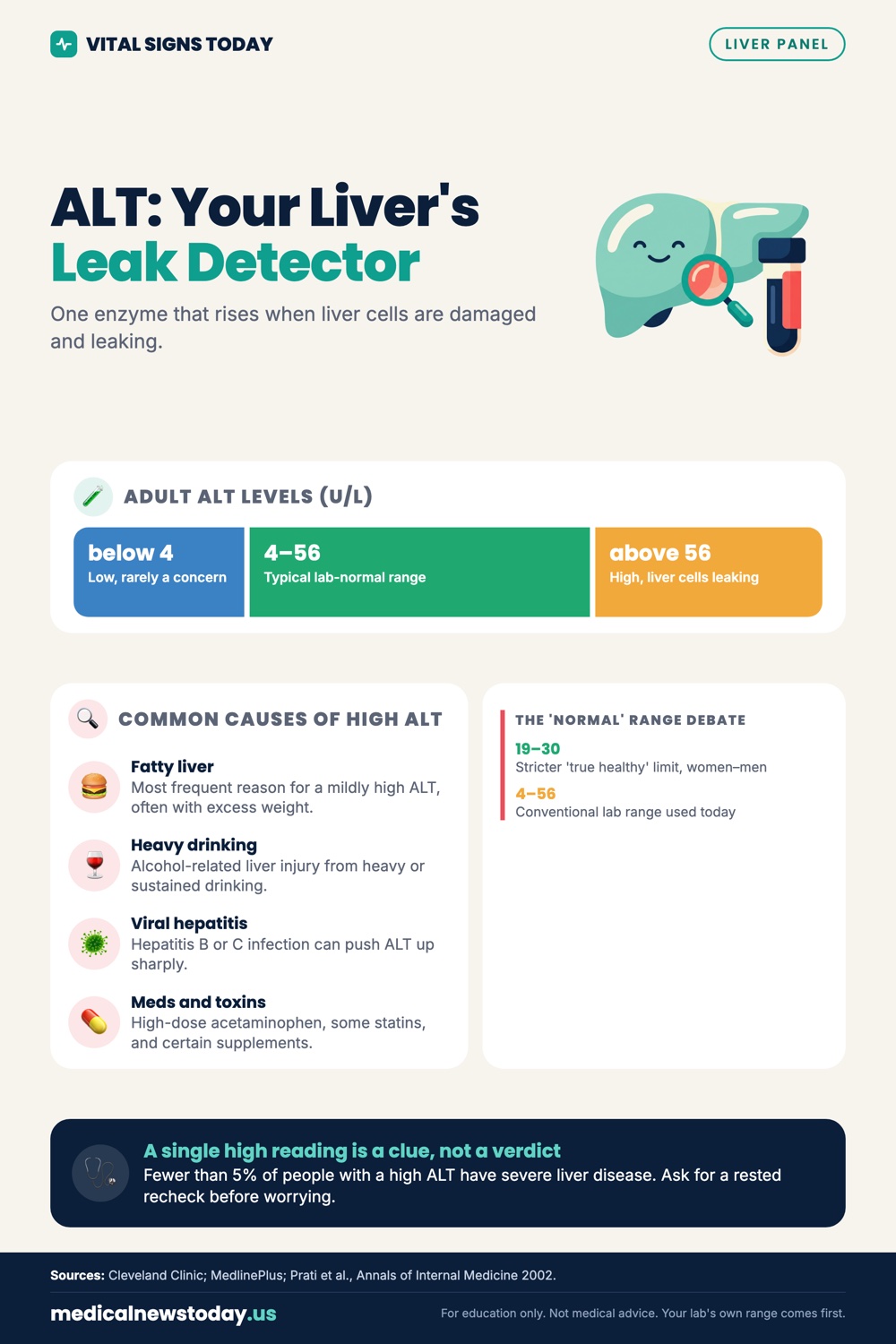
What is ALT in a blood test?
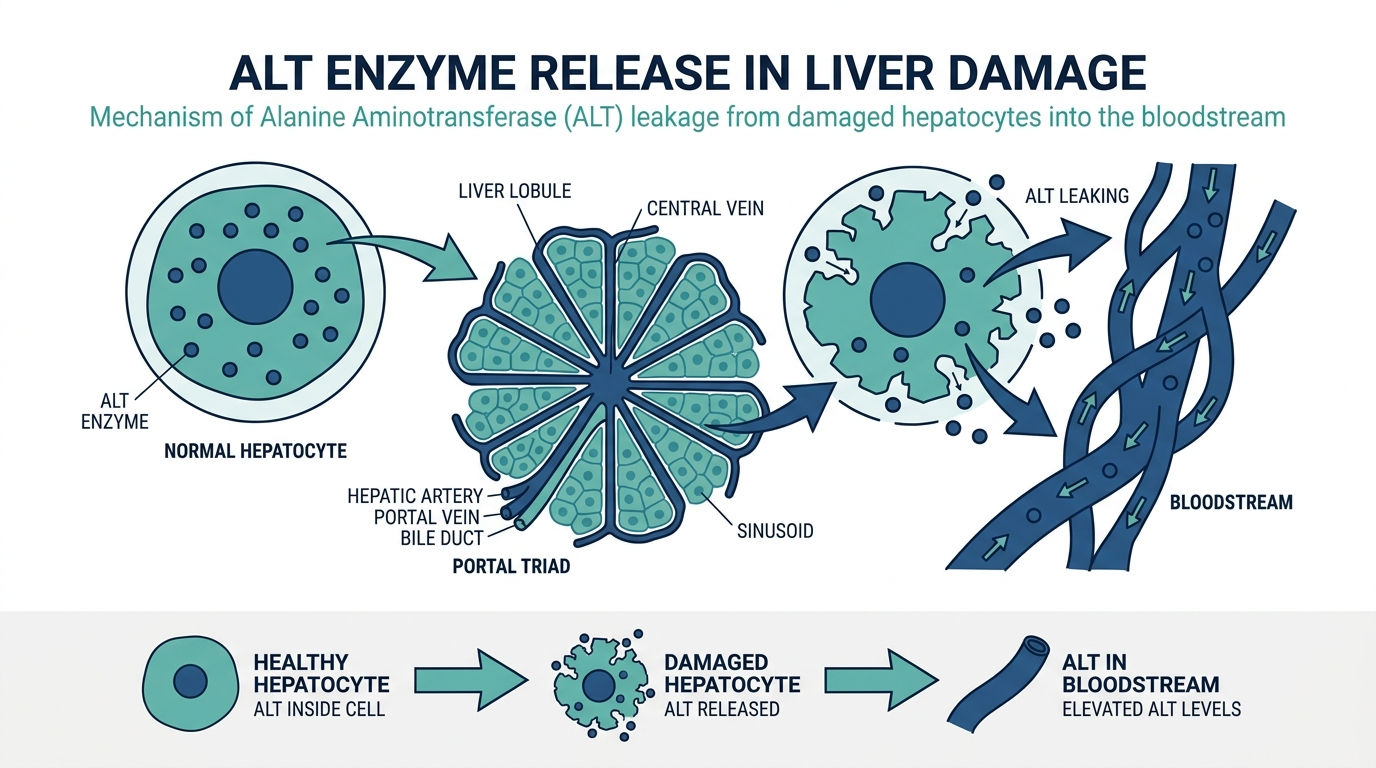
ALT stands for alanine transaminase, also called alanine aminotransferase, and it is an enzyme found mainly inside your liver cells (Cleveland Clinic). The ALT blood test measures how much of that enzyme is floating in your bloodstream. When liver cells are healthy and intact, ALT stays mostly inside them and very little leaks out. When liver cells are damaged or inflamed, they spill ALT into the blood, and the level on your report rises (MedlinePlus).
So the simplest way to picture it: ALT is a leak detector for your liver. A normal level usually means your liver cells are holding together. A high level means cells are breaking open and releasing their contents. That one idea, leakage from damaged cells, explains almost everything below.

What does ALT actually measure?
ALT measures the degree of liver cell injury, not how well your liver is doing its job. This distinction trips up a lot of people. A normal ALT does not prove your liver is healthy, and a high ALT does not tell you how the liver is functioning overall, it only tells you that liver cells are damaged and leaking enzyme into the blood (Cleveland Clinic).
ALT is more liver-specific than its partner enzyme AST. That is because there are large amounts of AST in other tissues like your heart, skeletal muscle, and pancreas, while ALT is concentrated much more heavily in the liver (Cleveland Clinic). When ALT is elevated, the liver is almost always the source. That is exactly why ALT is one of the headline numbers on a liver panel rather than a footnote. You will rarely see ALT ordered alone. It usually rides along with AST, ALP, and bilirubin as part of a liver function test or comprehensive metabolic panel.
What is a normal ALT level?
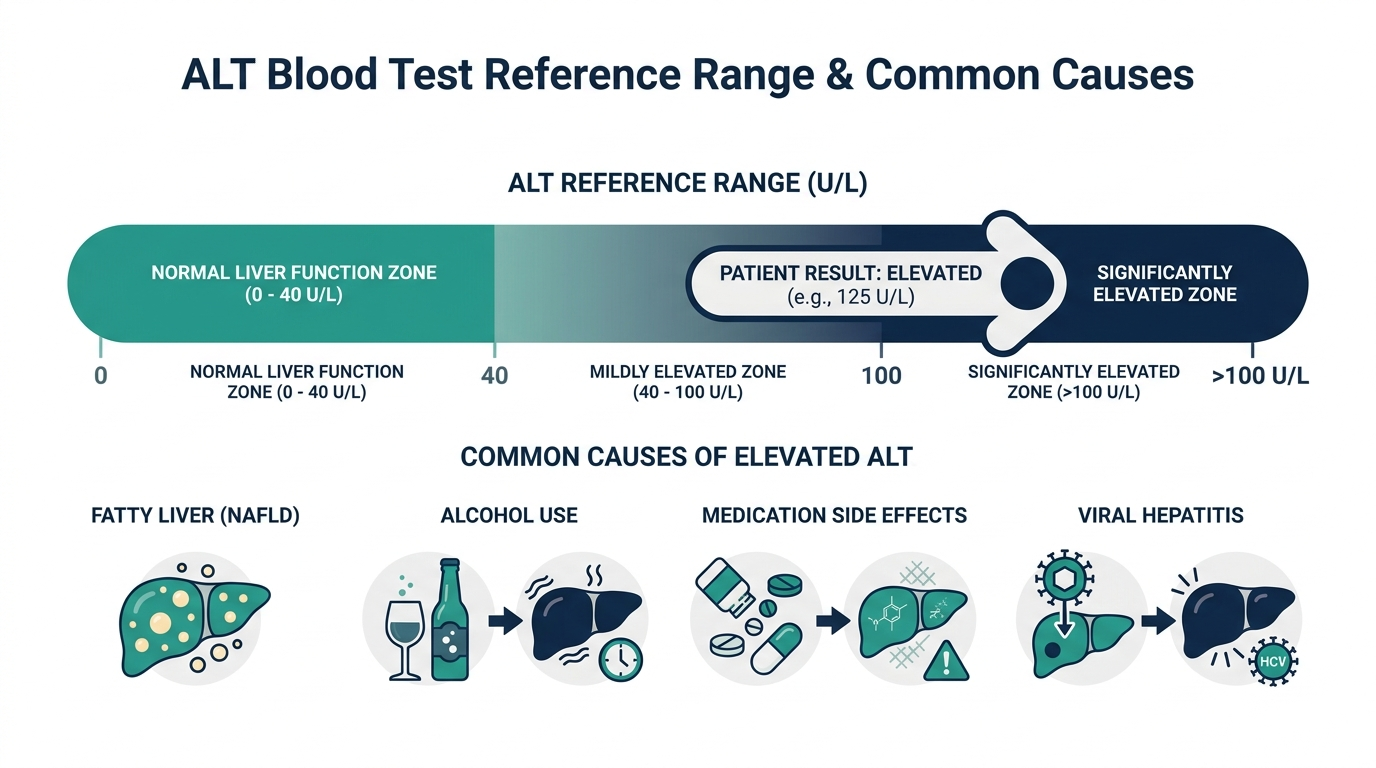
A commonly cited normal range for ALT is roughly 7 to 56 U/L (units per liter), although the exact cutoff varies by laboratory, and levels run a bit higher in men than in women (Cleveland Clinic). MedlinePlus lists a reference range of about 4 to 36 U/L, which shows just how much the “normal” window shifts between labs and methods (MedlinePlus). The practical rule is the same one that applies to every lab value: read your result against the reference range printed on your own report, because that is the range your lab actually calibrated.
Here is the part that matters for how you interpret the number. The “normal” range you see is wider than many liver specialists think it should be, and that gap is not trivial. More on that in the insider section, because it changes how you should read a result that lands at the high end of normal.
What does a high ALT mean?
A high ALT means liver cells are being damaged and leaking enzyme into your blood, which makes it a sensitive early sign of liver disease (MedlinePlus). It is a clue, not a diagnosis. Reassuringly, fewer than 5 percent of people with an elevated ALT turn out to have a severe liver condition (Cleveland Clinic). The common causes include:
- Fatty liver disease. Non-alcoholic fatty liver disease, now often called metabolic-associated steatotic liver disease, is the most frequent reason a routine ALT comes back mildly high, especially with excess weight, type 2 diabetes, or high triglycerides (MedlinePlus).
- Alcohol-related liver injury, from heavy or sustained drinking (Cleveland Clinic).
- Viral hepatitis, such as hepatitis B or C, which can push ALT up sharply (MedlinePlus).
- Medications and toxins, including acetaminophen in high doses and certain statins and supplements (MedlinePlus).
- Other causes, including cirrhosis, hemochromatosis (iron overload), mononucleosis, and reduced blood flow to the liver (MedlinePlus).
How high the number climbs is itself a clue. A mildly elevated ALT, say in the dozens above the upper limit, most often points to fatty liver or medication effects. A dramatically elevated ALT, into the hundreds or thousands, suggests acute, intense liver injury such as a viral hepatitis flare, a toxic overdose, or a sudden loss of blood flow. Your clinician reads the magnitude, the trend over time, and the company ALT keeps on the rest of the panel.

What does a low ALT mean?
A low ALT is generally not a cause for concern. A result below the normal range is uncommon and on its own is not considered a sign of disease (Cleveland Clinic). When a low value does get attention, it is sometimes associated with vitamin B6 deficiency or chronic kidney disease, but these are rarely diagnosed from a low ALT alone (Cleveland Clinic). If your ALT is on the low side and the rest of your liver panel looks unremarkable, it is usually nothing to chase.
Why is ALT read together with AST?
ALT is almost always interpreted next to AST, because the relationship between the two enzymes helps point toward a cause. Both are released when liver cells are injured, but their ratio carries information that neither number gives alone. AST lives in the liver too, but also in heart and muscle, so comparing the two helps separate liver damage from other sources (Cleveland Clinic).
A simplified version of how clinicians use the pairing:
- ALT higher than AST is the typical pattern in fatty liver disease and many forms of chronic hepatitis.
- AST higher than ALT, often roughly two to one or more, is a classic fingerprint of alcohol-related liver damage.
- Both very high together suggests acute, widespread liver cell injury, such as a drug overdose or acute viral hepatitis.
This is why a good clinician never reads ALT in isolation. The single number tells you a leak exists. The pattern across ALT, AST, ALP, and bilirubin tells you where the leak is coming from and roughly how serious it might be.
The part most people never hear: your “normal” ALT may be set too high
Here is the insider point that rarely reaches the patient version. The standard upper limit of normal for ALT that most labs still use was set decades ago using populations that, it turned out, secretly included people with undiagnosed fatty liver disease. In other words, the bar for “normal” was calibrated against a group that was not actually healthy, so the ceiling drifted upward.
In a landmark 2002 study, Prati and colleagues re-derived the healthy range using donors screened to exclude hidden liver disease and obesity. Their proposed healthy upper limits came out far lower than the conventional cutoffs: about 30 U/L for men and 19 U/L for women (PubMed, Prati et al.). Tightening the range this way caught substantially more people with genuine liver injury who were being waved through as normal, at the cost of a small drop in specificity (PubMed, Prati et al.).
What this means for you in practice: an ALT that sits in the upper end of your lab’s normal range, say in the high 30s or 40s, is technically “normal” on the printout but would be flagged as elevated under the stricter, evidence-based thresholds many hepatologists prefer. It is one of the most common reasons early fatty liver gets missed. If your ALT keeps creeping up over successive tests even while staying inside the printed range, that trend is worth a conversation, especially if you carry extra weight, have prediabetes or diabetes, or have rising triglycerides. A single number can look fine and still be a quiet early signal.

How to prepare, and what nudges ALT without touching your liver
ALT is usually drawn as part of a broader panel, so any fasting instruction typically comes from the other tests bundled with it rather than from ALT itself. What is more useful is knowing what can push the number up or down for reasons that have nothing to do with liver disease, because a mildly high ALT in a well person is often one of these.
- Strenuous exercise. Hard workouts, especially heavy resistance training or a long endurance session in the day or two before the draw, can raise ALT because skeletal muscle contains some of the enzyme too. This is a common reason a fit person gets a surprising flag.
- Medications and supplements. Acetaminophen at high doses, some statins, certain antibiotics, and a number of herbal and bodybuilding supplements can raise ALT. Bring a complete list, including anything over the counter.
- Recent muscle injury. A significant bruise, a fall, or an intramuscular injection can contribute a little enzyme.
- Body weight and metabolic factors. Excess weight, high triglycerides, and insulin resistance are associated with a higher baseline ALT, largely through early fatty liver.
The practical takeaway is to interpret a single mildly high ALT in context. If you lifted heavy or ran long the day before, that alone can explain a modest bump, and a repeat test after a few quiet days often settles it. The value that earns attention is one that stays up on a rested repeat or keeps drifting higher over successive tests.
Reading ALT across the full liver panel
ALT is one instrument in a small orchestra. The liver panel usually reports ALT, AST, alkaline phosphatase (ALP), gamma-glutamyl transferase (GGT), bilirubin, and albumin, and the pattern across them tells a far richer story than ALT alone. Broadly, these markers split into two groups: the ones that flag liver cell injury and the ones that flag a bile flow problem.
| Marker | What it mainly signals |
|---|---|
| ALT | Liver cell injury, and the most liver-specific of the enzymes. |
| AST | Liver cell injury too, but also present in heart and muscle, so read against ALT. |
| ALP | Bile duct or bone activity. High ALP shifts attention toward blocked bile flow or bone. |
| GGT | Confirms whether a high ALP is coming from the liver rather than bone, and rises with alcohol. |
| Bilirubin | The liver’s ability to clear a breakdown product of red cells. High bilirubin can cause jaundice. |
| Albumin | The liver’s synthetic function. Low albumin can point to long-standing liver disease. |
The distinction that clarifies most reports is hepatocellular versus cholestatic. When ALT and AST dominate the elevation, the pattern is hepatocellular, meaning the problem is liver cells being injured. When ALP and bilirubin dominate instead, the pattern is cholestatic, meaning bile flow is obstructed, and a high GGT confirms the ALP is liver in origin rather than bone. ALT is the enzyme that anchors the hepatocellular side of that fork.
Worked examples: how clinicians read an ALT result
Seeing the reasoning makes the number usable. These realistic scenarios show why the same ALT value can mean different things.
Scenario one: ALT in the high 40s, AST normal, and you carry extra weight with high triglycerides. Technically inside many labs’ normal range, but under stricter evidence-based thresholds this is a classic early fatty liver picture. The useful move is lifestyle change and a recheck to watch the trend rather than dismissing it as normal.
Scenario two: AST roughly twice the ALT, both moderately high. That two-to-one tilt toward AST is a well-known fingerprint of alcohol-related liver injury, and the conversation shifts to drinking history.
Scenario three: ALT and AST both in the hundreds or thousands. This signals acute, intense liver injury such as a viral hepatitis flare, a toxic ingestion like an acetaminophen overdose, or a sudden loss of blood flow to the liver. It is urgent and needs prompt evaluation.
Scenario four: normal ALT and AST but high ALP and bilirubin. The elevation has moved to the bile flow markers, so attention turns to a blockage such as gallstones or a duct problem rather than liver cell injury. A GGT helps confirm the ALP is coming from the liver.
Scenario five: a mildly high ALT the day after a heavy gym session. Often just muscle contributing enzyme. A rested repeat commonly normalizes, which is why one-off mild elevations are rechecked before anyone reads much into them.

What to do after a high ALT, and how it usually comes down
A high ALT is a prompt, not a verdict. The sensible sequence after an unexplained mild elevation is straightforward, and much of the time the number improves without any dramatic intervention.
- Repeat the test. A single elevation is often rechecked after a few weeks, avoiding heavy exercise and alcohol beforehand, to see whether it was a transient bump or a persistent pattern.
- Review medications and supplements. Stopping or adjusting a drug or supplement that stresses the liver, under medical guidance, sometimes resolves the elevation on its own.
- Address metabolic drivers. Because early fatty liver is the leading cause of a mild rise, gradual weight loss, cutting added sugar and refined carbohydrate, moderating alcohol, and increasing physical activity can meaningfully lower ALT over months.
- Test for specific causes when warranted. If the elevation persists, clinicians look for viral hepatitis, iron overload, and other identifiable conditions, and may image the liver.
The encouraging reality is that the most common cause, early fatty liver, is also among the most responsive to lifestyle change. A steady downward trend in ALT over successive tests is one of the clearer signals that those changes are working.
Who should check ALT, and how often
ALT appears automatically in most routine metabolic and liver panels, so the general population gets periodic exposure without asking. Some people warrant closer or more frequent attention.
- People with metabolic risk factors. Excess weight, type 2 diabetes or prediabetes, and high triglycerides raise the odds of fatty liver, making ALT a marker worth tracking over time.
- People taking liver-metabolized medications. Certain long-term drugs come with periodic liver monitoring built into their use.
- People with known liver disease or viral hepatitis. Here ALT is followed on a schedule the treating clinician sets, to gauge activity and response.
- Anyone with a prior borderline-high or upward-trending ALT. A recheck to establish the trajectory is more informative than a single snapshot.
The right interval depends entirely on the reason. A one-off bump after exercise needs only a rested repeat. A value tied to a diagnosed condition follows that condition’s monitoring cadence.
Common misconceptions about ALT
ALT is widely misread, partly because it sounds like a verdict on liver health when it is really a leak detector. Correcting the frequent misunderstandings makes the number far less confusing.
- “A normal ALT means my liver is healthy.” Not quite. ALT measures cell injury, not overall function, and the conventional normal ceiling is set higher than many specialists prefer, so a value in the high normal zone can still reflect early fatty liver.
- “A high ALT means serious liver disease.” Usually not. Fewer than 5 percent of people with an elevated ALT have a severe liver condition, and the most common cause of a mild rise is fatty liver, which responds to lifestyle change.
- “ALT tells me what is wrong with my liver.” On its own it only says cells are leaking. The pattern across AST, ALP, GGT, and bilirubin is what localizes the problem and hints at severity.
- “Only heavy drinkers get a high ALT.” Alcohol is one cause, but fatty liver linked to weight and metabolism, viral hepatitis, and certain medications are all common drivers, and many people with a high ALT drink little or nothing.
- “One reading is enough to know.” Often it is not. Exercise, medications, and muscle injury can nudge ALT temporarily, so the trend across repeated tests carries more meaning than a single value.
Frequently asked questions
What does ALT mean in a blood test?
ALT means alanine transaminase, an enzyme found mainly in liver cells. The level rises when liver cells are damaged and leak the enzyme into your blood, so it works as a sensitive marker of liver injury (Cleveland Clinic).
What is a normal ALT level?
A commonly used range is about 7 to 56 U/L, though some labs list ranges starting near 4 to 36 U/L, and values run slightly higher in men (MedlinePlus). Always compare your result to the reference range printed on your own report.
Should I worry about a high ALT?
A high ALT is a clue, not a diagnosis. Fewer than 5 percent of people with an elevated ALT have a severe liver condition, and the most common cause of a mild elevation is fatty liver disease (Cleveland Clinic). Your clinician will read it alongside AST and the rest of your liver panel.
What does a high ALT with high AST mean?
Both enzymes rising together points to active liver cell injury. When AST is markedly higher than ALT it leans toward alcohol-related damage, while ALT higher than AST is more typical of fatty liver or chronic hepatitis (Cleveland Clinic).
Can ALT be high if my liver is otherwise fine?
Yes. Strenuous exercise, certain medications and supplements, and muscle injury can nudge ALT up temporarily, and a mild elevation often reflects early fatty liver rather than serious disease (MedlinePlus). A repeat test and the trend over time help sort out a one-off bump from a real pattern.
This article is for general educational purposes and is not medical advice. It cannot diagnose or treat you and does not replace your clinician. Always discuss your lab results and any health decisions with a qualified healthcare professional.
Vital Signs Today may earn a commission if you buy through links on this page. It does not affect our editorial assessments.