Disclosure: Vital Signs Today may earn a commission if you buy through links on this page, at no extra cost to you. This does not influence our evidence-based assessments. We are not a medical provider; talk to a clinician before acting on test results.
Related: ALP blood test: the full guide
You scanned your blood test, and while most eyes go straight to cholesterol or glucose, yours snagged on a number that came in under the reference range: alkaline phosphatase, flagged low. That is the unusual one. Almost every article online is written about a high ALP, because that is what doctors see far more often. A low ALP is the quieter, rarer finding, and it tends to get waved away. Sometimes that is fine. Sometimes it is the single clue that something worth knowing has been hiding in plain sight for years.
Here is the honest framing before we go deeper. A mildly low ALP is usually nothing dramatic. But ALP is one of the very few lab values where a persistently low number, the kind that shows up again and again, can point to a condition that gets missed for a decade or more. Let us read your result properly.
Part of our Liver Function Tests guide.
What does low alkaline phosphatase mean in a blood test?
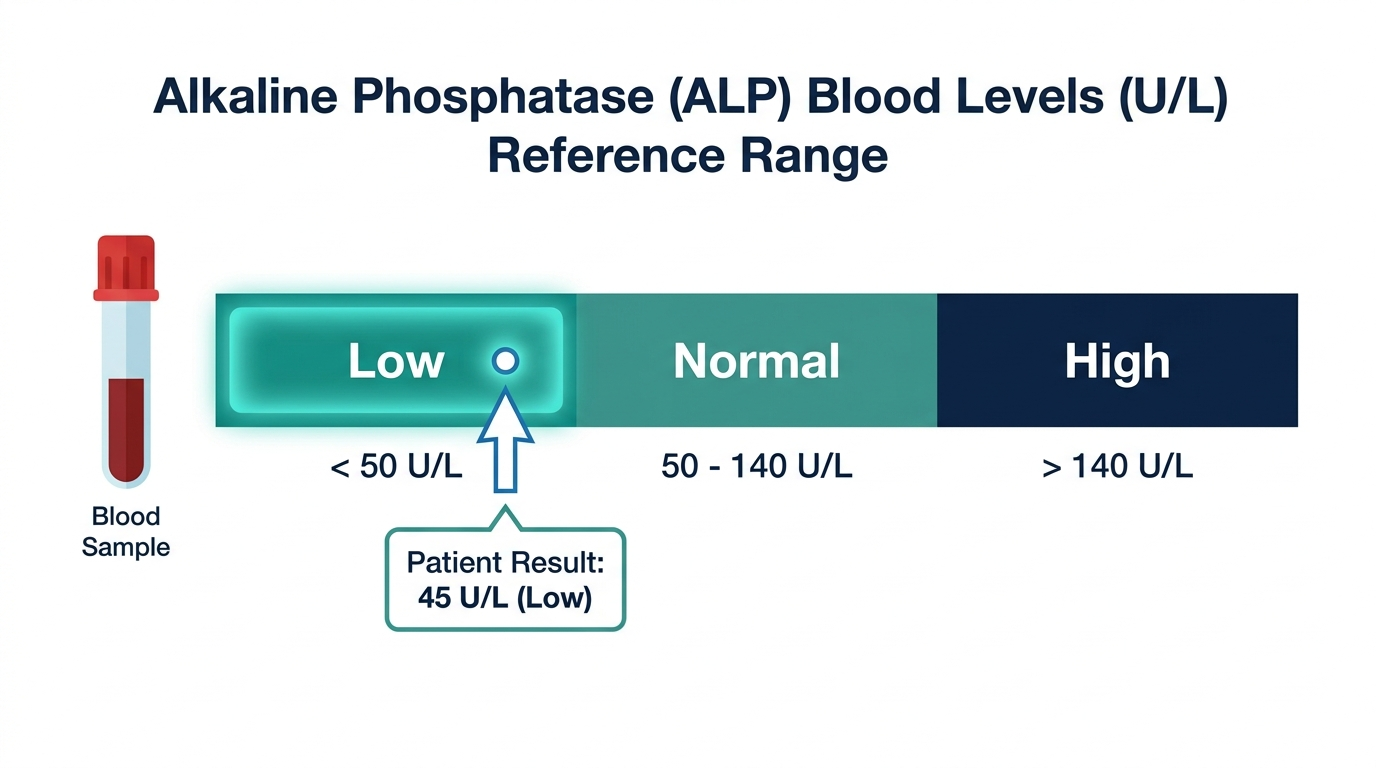
Alkaline phosphatase (ALP) is an enzyme found throughout your body, with the highest concentrations in your liver, bones, kidneys, and digestive tract (Cleveland Clinic). It shows up automatically on most comprehensive metabolic panels and liver panels. A low alkaline phosphatase result means the enzyme activity in your blood has dropped below your lab’s reference range. In plain terms, your body is producing or circulating less of this enzyme than expected.
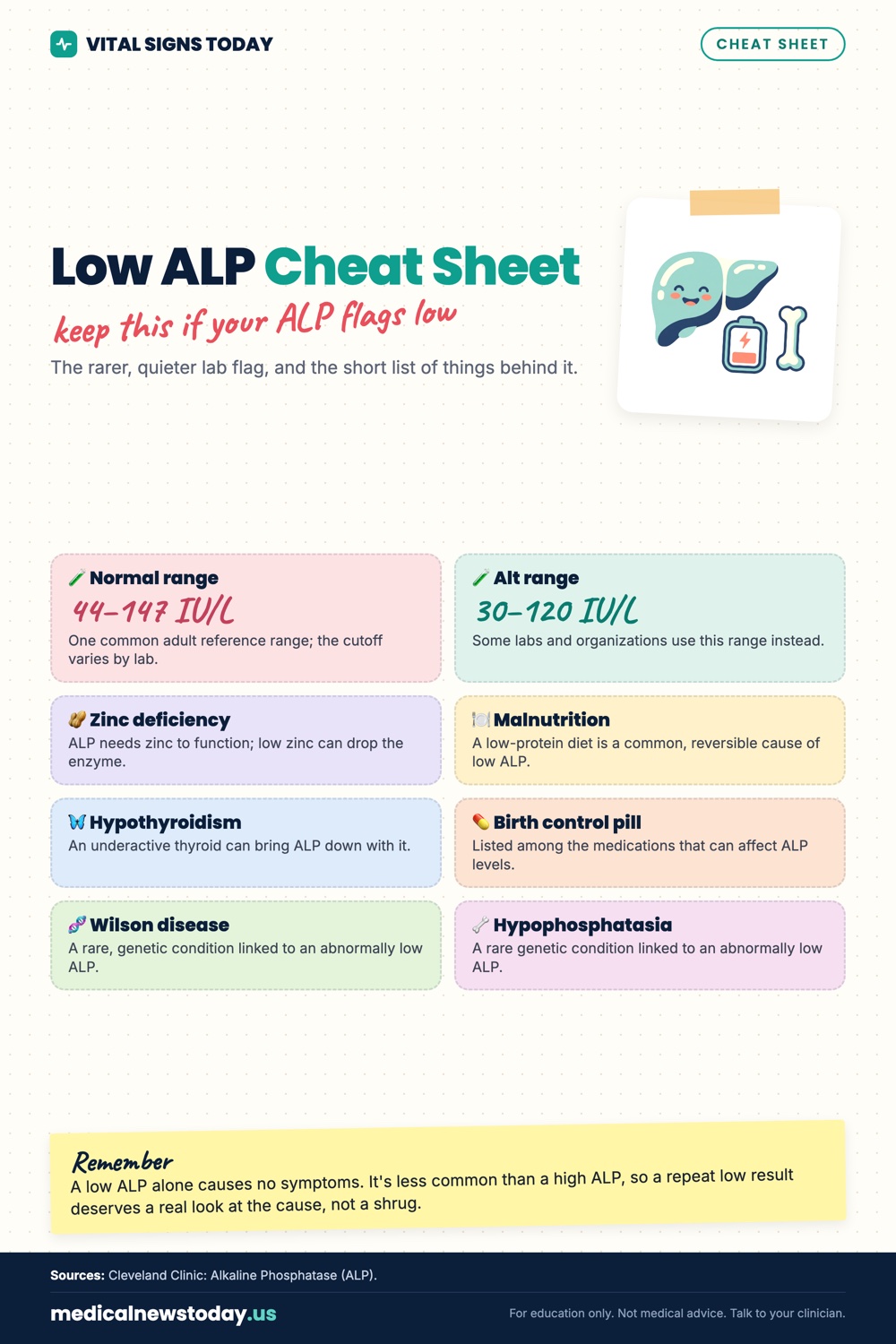
One commonly used reference range is roughly 44 to 147 international units per liter (IU/L), although some labs use 30 to 120 IU/L, and the exact cutoff varies by laboratory, age, and sex (Cleveland Clinic). So the threshold that counts as “low” depends on whose ruler you are using. If your lab’s floor is 44, then a 38 is low. If the floor is 30, that same 38 is normal. Always read your result against the reference range printed on your own report, not a number you found online.
The key idea to carry forward: a low ALP is less common than a high ALP, and unlike many quietly low values, it deserves a second look rather than an automatic shrug (MedlinePlus).

What causes a low ALP?
Most low ALP results trace back to nutrition, hormones, or, much more rarely, genetics. Here is the real differential, roughly in order of how often it explains a low result in everyday practice (Cleveland Clinic, MedlinePlus):
- Nutritional and mineral deficiencies. Low protein intake, malnutrition, and deficiencies of zinc or magnesium are among the most common reversible causes. ALP literally needs zinc and magnesium to function, so when those run low, enzyme activity falls.
- Hypothyroidism (underactive thyroid). A sluggish thyroid slows bone turnover, and ALP tends to drift down with it.
- Pernicious anemia and B12-related issues. Listed by MedlinePlus among recognized causes of a low result (MedlinePlus).
- Certain medications. Birth control pills and some other drugs can lower ALP (Cleveland Clinic).
- Wilson disease. A rare inherited copper-overload disorder that can suppress ALP, sometimes strikingly so.
- Hypophosphatasia (HPP). A rare genetic disorder caused by mutations in the ALPL gene, the gene that codes for ALP itself. It impairs the body’s ability to mineralize bone and teeth, and it is the classic genetic cause of a persistently low ALP (PMC, Diagnosis and Treatment of Hypophosphatasia).
The mental model that helps: a one-off mildly low ALP is most likely diet, thyroid, or a medication effect. A repeatedly low ALP with no obvious reason is the pattern that should raise the question of HPP.
What are the symptoms of a low ALP?
This is the part that trips people up. A low ALP itself causes no symptoms. It is a lab finding, not a feeling. You will not sense your enzyme level the way you might feel low blood sugar. Any symptoms come from the underlying cause, not the number.
So the question becomes: what is driving the low result, and does that thing have symptoms? If hypothyroidism is behind it, you might notice fatigue, cold intolerance, or weight gain. If it is a zinc or protein deficiency, you might have poor wound healing or low energy. And in the case of hypophosphatasia, the clues are skeletal and dental: unexplained fractures or stress fractures, bone or joint pain, muscle weakness, and a striking dental history. Adults with HPP often have a story of baby teeth that fell out too early, with the root still attached, or adult teeth lost prematurely (PMC, Diagnosis and Treatment of Hypophosphatasia). That dental history is one of the most useful, and most overlooked, threads to pull.
The practical version: if your ALP is low and you feel fine, the number alone is not an emergency. If your ALP is low and you have a pattern of fractures, bone pain, or early tooth loss, that combination is the one to bring to a doctor by name.
When is a low ALP dangerous or a medical emergency?
A low ALP is almost never an acute emergency on its own. There is no number that means “go to the ER tonight” the way a critically high potassium might. The danger with a low ALP is slower and more about what gets missed than what happens fast.
Here is the threshold worth knowing. Research on flagging low values for hypophosphatasia screening has used a cutoff around the top of the low range, with one study using roughly 160 U/L on its lab’s scale as the line above which to stop worrying, and treating values below the local reference floor as the trigger to investigate (PMC, Alerting Physicians for Low ALP). The same work made an important point: most labs do not generate an automatic alert for a low ALP the way they do for many other abnormal values, which is exactly why low results slip through unexamined (PMC, Alerting Physicians for Low ALP).
The genuinely high-stakes scenario is hypophosphatasia presenting in infancy. Severe perinatal and infantile HPP can cause life-threatening problems with bone mineralization, breathing, and vitamin B6-responsive seizures, and that is a true medical situation requiring specialist care (PMC, Diagnosis and Treatment of Hypophosphatasia). For an adult with a mildly low number and no symptoms, the “danger” is simply that nobody ever asks why.

What should you do about a low ALP?
The answer-first version: confirm it, then look for a cause. A single low ALP is worth repeating, because lab variation and testing errors happen (Cleveland Clinic). If a repeat result is also low, the next steps depend on the clinical picture.
- Review the easy explanations first. Your clinician will consider diet and protein intake, recent illness, pregnancy, and any medications such as oral contraceptives.
- Check the reversible causes. Reasonable follow-up labs can include thyroid function, zinc and magnesium levels, and a B12 or nutritional assessment depending on your history.
- Address what you find. If a deficiency or hypothyroidism is the cause, treating it typically brings ALP back toward normal. There is no treatment for a “low ALP” itself, only for the thing causing it.
- Escalate if the pattern fits HPP. Persistently low ALP plus bone pain, fractures, or early tooth loss warrants checking ALP substrates such as pyridoxal-5′-phosphate (vitamin B6) and, if indicated, genetic testing of the ALPL gene (PMC, Diagnosis and Treatment of Hypophosphatasia).
On lifestyle: there is no supplement that meaningfully “raises ALP” as a goal in itself, and chasing the number is the wrong target. The right target is correcting any real deficiency your clinician identifies. If your protein and minerals are adequate and your thyroid is fine, a slightly low ALP with no symptoms usually needs nothing more than awareness.
When should you see a doctor?
See your clinician if your ALP is low on more than one test, or if it is low alongside symptoms that could share a cause. Specifically, book the conversation if you have any of the following with a low ALP: a history of fractures that seem out of proportion to the injury, ongoing bone or joint pain, muscle weakness, or a striking dental history of premature tooth loss. Those are the signals that move a low ALP from “probably nothing” to “worth a proper workup” (PMC, Diagnosis and Treatment of Hypophosphatasia).
Also see a doctor if you have symptoms of hypothyroidism, signs of malnutrition, or you are on medications and want to understand whether they are affecting your results. The goal is not to panic over the number. It is to make sure someone actually asked the question instead of scrolling past it.
The insider nuance: the low number that is actually a paradoxical high
Here is the detail that separates a careful workup from a missed diagnosis, and it surprises even some clinicians. In hypophosphatasia, the broken enzyme is exactly the one that normally breaks down vitamin B6 in its active form, pyridoxal-5′-phosphate (PLP). When ALP activity is low, PLP cannot be cleared properly, so it piles up in the blood. The result is a strange biochemical signature: a low ALP sitting next to a high vitamin B6 (PLP) level (PMC, Vitamin B6 challenge in hypophosphatasia).
That paired pattern, low ALP and elevated PLP, is one of the most reliable fingerprints of HPP, and it is the thing that gets missed when a low ALP is read in isolation. There is even a vitamin B6 challenge test, giving a short course of B6 and watching how PLP responds, that can help flag ALPL mutation carriers among people with otherwise unexplained low ALP (PMC, Vitamin B6 challenge in hypophosphatasia).
The common misread runs the other way too. A flagged-high B6 on a panel often gets blamed on supplements, and a flagged-low ALP gets ignored, when together they may be telling one coherent story. The lesson for reading your own results: a low ALP is not just a number that is low. It is a clue that other markers, especially vitamin B6 and bone health, deserve to be read alongside it. One cheap enzyme value, taken seriously, can be the thread that unravels a diagnosis people have carried unrecognized for years.

What ALP actually does, and why a low level matters biologically
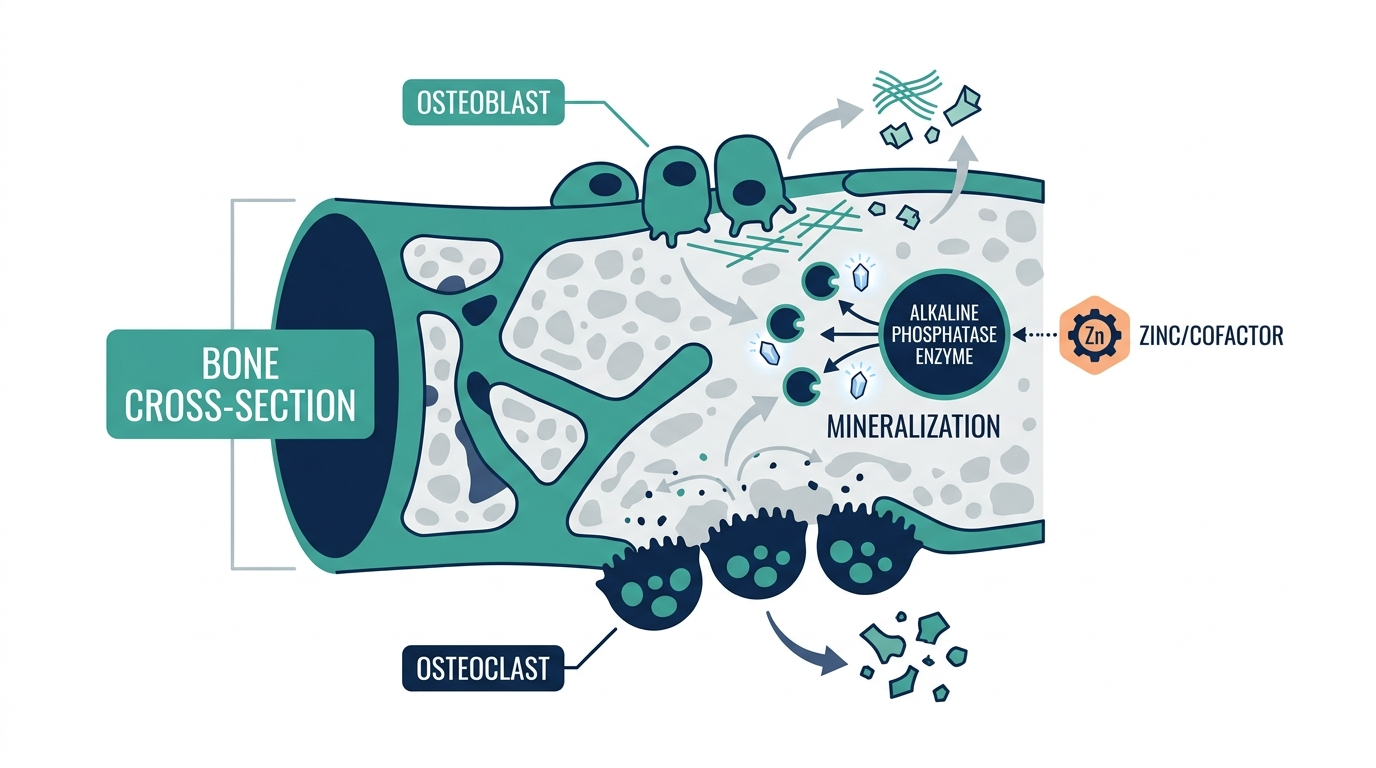
To understand why a low ALP can be meaningful, it helps to know the enzyme’s day job. Alkaline phosphatase removes phosphate groups from molecules, and one of its most important roles is in bone. It clears a substance called inorganic pyrophosphate, which acts as a natural brake on mineralization. By removing that brake, ALP allows calcium and phosphate to be laid down into bone and teeth as they should be.
This mechanism explains the entire clinical logic of a low ALP. When ALP activity is too low, pyrophosphate accumulates and keeps blocking mineralization, so bones and teeth do not harden properly. That is precisely the problem in hypophosphatasia, where the enzyme is genetically impaired (PMC, Diagnosis and Treatment of Hypophosphatasia). It also explains why nutritional causes matter: ALP requires zinc and magnesium as cofactors to work at all, so a shortage of those minerals lowers its activity and, in principle, its bone-building function. Seen this way, a low ALP is not just an abstract number, it is a readout of a specific biochemical process that quietly shapes your skeleton.
The ALP isoenzymes: not all alkaline phosphatase is the same
The ALP on your report is a total, but the enzyme actually comes from several tissues, each producing its own version, called an isoenzyme. The main sources are the liver, bone, intestine, and, in pregnancy, the placenta. In most healthy adults, the total ALP is roughly a mix of liver and bone forms.
This matters for interpreting a low result because it tells you which pool might be depleted. Since bone and liver dominate the total, a low ALP often reflects reduced bone-derived enzyme, which is one reason low ALP ties so closely to bone and mineral conditions. When the source of an abnormal ALP is genuinely unclear, a lab can run a bone-specific ALP or use techniques to separate the isoenzymes, though this is used far more often to work up a high ALP than a low one. The practical point for a low result is that the bone fraction is usually the part of the story worth pursuing, which is why the workup leans toward bone health, minerals, and, when the pattern fits, hypophosphatasia.
How age, sex, and pregnancy move the ALP baseline
ALP is one of the more age-sensitive values on a panel, and ignoring that context is a common way to misread a result.
- Children and teenagers. Growing bones are highly active, and bone-derived ALP is high during childhood and especially during the adolescent growth spurt. A value that would look elevated in an adult can be entirely normal in a growing teenager. Because their baseline is naturally high, a “normal-looking” adult value in a child could actually be relatively low for their age, which is why pediatric interpretation uses age-specific ranges.
- Adults. Once growth stops, ALP settles into the adult range and is relatively stable, which is what makes a persistently low adult value stand out.
- Pregnancy. The placenta produces its own ALP isoenzyme, so ALP rises substantially in the later stages of pregnancy. This is a normal, expected increase, not a sign of disease, and it means a low ALP is even more conspicuous against a backdrop where the number usually climbs.
The takeaway is to always read your ALP against a range matched to your age and situation. A number is only low relative to what is normal for someone like you.

Want to check your alkaline phosphatase?
Three ways to get it measured. Pick whichever fits you.
Affiliate links: we may earn a commission at no extra cost to you. A lab test does not replace a visit with your clinician.
The companion markers to read alongside a low ALP
A low ALP gains meaning when it is read with the markers that share its biology. If your workup does not include some of these, they are reasonable questions to raise.
- Calcium and phosphorus. These are the minerals ALP helps deposit into bone. In hypophosphatasia, calcium and phosphorus can actually run on the higher side because they are not being incorporated into bone normally, an unusual pattern that, paired with a low ALP, is a strong clue.
- Vitamin B6 (pyridoxal-5′-phosphate, PLP). As covered above, an elevated PLP alongside a low ALP is one of the most specific biochemical fingerprints of hypophosphatasia (PMC, Vitamin B6 challenge in hypophosphatasia).
- Zinc and magnesium. Because these are cofactors ALP needs to function, low levels can both explain a low ALP and be worth correcting.
- Thyroid function. An underactive thyroid slows bone turnover and can lower ALP, so thyroid testing is a common reasonable follow-up.
- Vitamin D and PTH. These govern bone and mineral metabolism broadly and help place a low ALP in the wider context of bone health.
Reading these together, rather than fixating on the lone ALP value, is how a clinician decides whether a low number is a benign nutritional footnote or the first sign of something like hypophosphatasia.
Hypophosphatasia across the lifespan: why it hides so well in adults
Hypophosphatasia is often thought of as a severe disease of infancy, and its most dangerous forms do appear early in life. But there is a much milder adult-onset spectrum, and that is precisely what makes it so easy to miss in someone who has lived decades without a name for their symptoms.
In adults, HPP can present quietly: recurrent stress fractures, especially in the feet, that heal slowly, aching bones and joints, muscle weakness, and a dental history that stands out only in hindsight, such as losing baby teeth unusually early with the roots intact, or losing adult teeth prematurely (PMC, Diagnosis and Treatment of Hypophosphatasia). Because these complaints are common and nonspecific, they get attributed to overuse, aging, or bad luck, while the one lab clue, a persistently low ALP, sits ignored on old reports.
There is also a treatment reason this matters. HPP is not merely a label. A targeted enzyme replacement therapy exists for the disease, which is part of why establishing the diagnosis has real consequences rather than being an academic exercise. The practical message is not that everyone with a low ALP has HPP, most do not, but that a repeatedly low ALP with any bone or dental history deserves a proper look rather than a shrug.
Common misunderstandings about a low ALP
- “Low is always better than high.” For many lab values a lower result is reassuring, but ALP is an exception. A very low ALP is not a sign of superior health, it can signal a mineral deficiency or, rarely, a genetic bone condition.
- “A low ALP has no consequences because I feel fine.” The number itself causes no symptoms, but the process behind it can matter over years. The risk with a low ALP is a slow, missed diagnosis, not an acute event.
- “My lab would have alerted me if it were important.” Many labs do not automatically flag a low ALP the way they flag other abnormal values, which is a documented reason low results slip through unexamined (PMC, Alerting Physicians for Low ALP). A low ALP can sit on a report for years without anyone asking why.
- “A high vitamin B6 just means I take too many supplements.” Often it does, but when a high B6 sits next to a low ALP, the two together can point to hypophosphatasia rather than to a vitamin bottle, which is exactly the pattern that gets missed when each result is read alone (PMC, Vitamin B6 challenge in hypophosphatasia).
Frequently asked questions
What is a low alkaline phosphatase level in a blood test?
A low ALP is a result below your lab’s reference range. A common range is about 44 to 147 IU/L, though some labs use 30 to 120 IU/L, and the cutoff varies by lab, age, and sex (Cleveland Clinic). Always compare your result to the range printed on your own report.
What does low alkaline phosphatase mean on a blood test?
It means your circulating ALP enzyme activity is below normal. It is less common than a high ALP and most often reflects nutrition, mineral deficiency such as zinc or magnesium, hypothyroidism, certain medications, or, rarely, genetic conditions like hypophosphatasia or Wilson disease (MedlinePlus).
Is a low alkaline phosphatase result dangerous?
A low ALP is rarely an acute emergency on its own and usually causes no symptoms. The main risk is that an underlying cause, especially persistently low ALP from hypophosphatasia, goes unrecognized because labs often do not auto-flag low values (PMC, Alerting Physicians for Low ALP).
Can a low ALP be caused by diet or supplements?
Yes. Low protein intake, malnutrition, and deficiencies of zinc or magnesium are among the most common reversible causes, because ALP depends on those minerals to function (Cleveland Clinic). Correcting a true deficiency typically brings the number back toward normal.
When should I see a doctor about a low ALP?
See a clinician if your ALP is low on more than one test, or if it is low alongside fractures, bone or joint pain, muscle weakness, or early tooth loss. That combination warrants checking ALP substrates such as vitamin B6 and, if indicated, ALPL genetic testing for hypophosphatasia (PMC, Diagnosis and Treatment of Hypophosphatasia).
This article is for general educational purposes and is not medical advice. It cannot diagnose or treat you and does not replace your clinician. Always discuss your lab results and any health decisions with a qualified healthcare professional.
Vital Signs Today may earn a commission if you buy through links on this page. It does not affect our editorial assessments.