
You scanned your blood work, your liver enzymes looked fine, and then you hit a line that said ALP with a number next to it. Maybe it was flagged high, maybe it was not, and either way nobody explained what it actually meant. Here is the part that trips up most people, including more than a few clinicians at first glance. Alkaline phosphatase is not really a liver test. It is an enzyme that lives in two completely different organs at once, and reading it correctly is about figuring out which one is doing the talking.
Get that one idea right and a confusing result suddenly makes sense. Miss it, and a perfectly benign number can send you down a rabbit hole, or a real warning sign can get waved off.
Part of our Liver Function Tests guide.
What is alkaline phosphatase in a blood test?
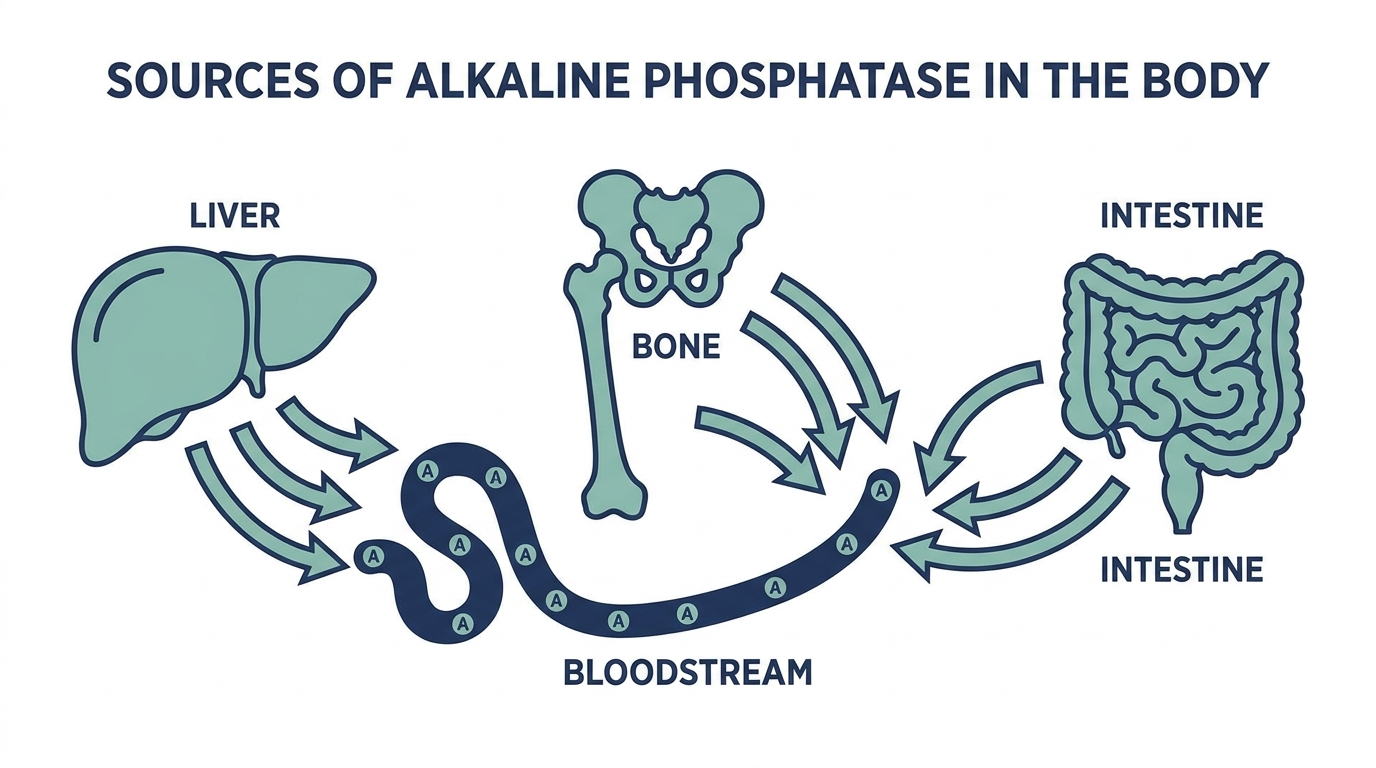
Alkaline phosphatase, abbreviated ALP, is an enzyme found throughout your body, with the highest concentrations in your liver, your bile ducts, and your bones (MedlinePlus). A blood test measures how much of it is circulating, and the result is used to screen for liver disease and bone disorders. It usually shows up automatically as part of a comprehensive metabolic panel or a liver function panel, which is why so many people see it without ever asking for it.
The single most useful thing to understand about what alkaline phosphatase means in a blood test is that it has two main home addresses, the liver and the skeleton. When the number climbs, the entire clinical question becomes: is this coming from the liver or from the bones? Almost everything else about interpreting ALP flows from answering that.

What does alkaline phosphatase actually measure?
An ALP test measures the total amount of the alkaline phosphatase enzyme in your blood, summed across every tissue that releases it. The trouble, and the genius, of the test is that this single number is a blend. More than 80 percent of the ALP in your blood comes from just two sources, the liver and bone, with smaller contributions from the intestine, kidneys, and, during pregnancy, the placenta (StatPearls, NCBI).
Because the liver and bone versions of the enzyme are chemically very similar, a standard ALP test cannot tell them apart on its own (MedlinePlus). That is the whole reason the rest of this article exists. When a result is puzzling, a lab can run an ALP isoenzyme test or use other clues to separate the liver signal from the bone signal. One more useful fact: ALP has a half-life of about seven days in the blood, so changes show up gradually rather than overnight (StatPearls, NCBI).
What is a normal alkaline phosphatase level?
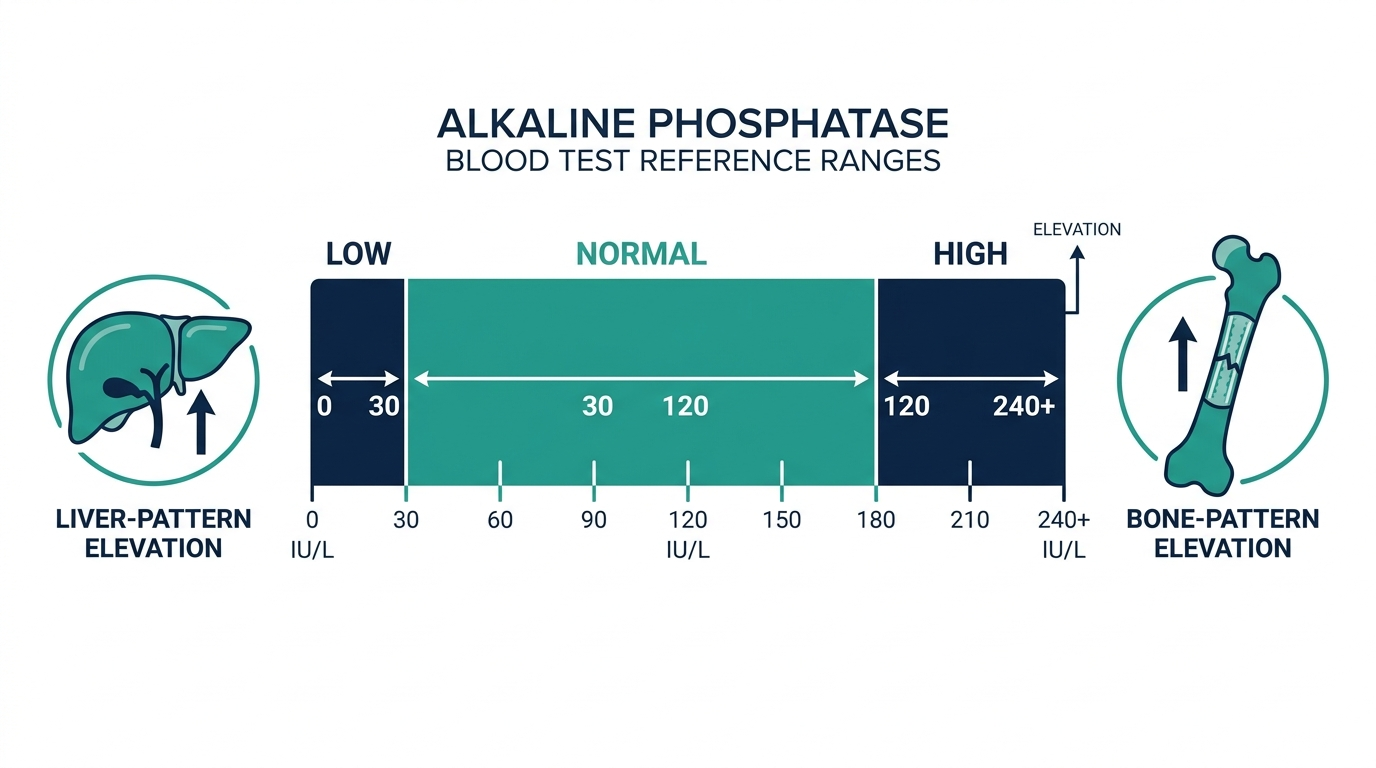
A normal alkaline phosphatase level is commonly cited as roughly 30 to 120 IU/L, though reference ranges vary by laboratory and method (Cleveland Clinic). MedlinePlus lists a normal range around 40 to 129 IU/L, which shows just how much the cutoff shifts from lab to lab (MedlinePlus). Always read your result against the reference range printed on your own report, because that is the range your lab actually validated.
Here is the catch that catches people off guard. The normal range is not one fixed number, because alkaline phosphatase changes with age and sex (Cleveland Clinic). It runs naturally high in children and teenagers whose bones are actively growing, and it climbs again in the late third trimester of pregnancy as the placenta pumps out its own version of the enzyme (StatPearls, NCBI). A teenager with an ALP that would alarm you in a 50 year old can be completely, boringly normal.
What does a high alkaline phosphatase mean?
A high alkaline phosphatase usually points to one of two systems, the liver and bile ducts or the bones, and the test alone cannot tell you which (MedlinePlus). It is a flag that says look closer, not a diagnosis. The common causes split cleanly into two columns.
Liver and bile duct causes tend to involve something blocking or irritating the drainage of bile:
- Blocked bile ducts, for example from a gallstone or a narrowing, which is one of the classic triggers of a high ALP (MedlinePlus).
- Cirrhosis and other forms of chronic liver scarring (Cleveland Clinic).
- Hepatitis, or inflammation of the liver from any cause.
Bone causes tend to involve bone being actively rebuilt:
- Paget’s disease of bone, a disorder of overactive bone turnover that is a textbook cause of a strikingly high ALP (MedlinePlus).
- Healing fractures and other states of rapid bone formation (Cleveland Clinic).
- Hyperparathyroidism and some vitamin D problems that drive bone remodeling.
Now the insider detail that separates a confident read from a guess. When liver tests come back normal but ALP is still high, the smart money shifts toward a bone source, such as Paget’s disease (MedlinePlus). And when clinicians want to nail down the source quickly, they do not always wait for a fancy isoenzyme assay. They order a GGT, a second enzyme that rises with liver and bile duct problems but stays put in bone disease. If ALP and GGT are both up, the trouble is almost certainly hepatobiliary. If ALP is up but GGT is normal, the bones move to the top of the list (StatPearls, NCBI). That single inexpensive add-on test settles the liver versus bone question more often than most patients realize.

Why is alkaline phosphatase measured together with GGT?
Alkaline phosphatase is read next to GGT because GGT is the tiebreaker that tells you whether a high ALP is coming from the liver or the bones. GGT, or gamma-glutamyl transferase, is highly sensitive to problems in the liver and bile ducts but is not raised by bone disease at all (StatPearls, NCBI). That asymmetry is exactly what makes the pairing so powerful.
A simplified version of how the two numbers combine:
- High ALP with high GGT: the elevation is almost certainly from the liver or bile ducts.
- High ALP with normal GGT: the source is more likely bone, for example Paget’s disease or a healing fracture.
- Normal ALP with high GGT: often a sign of alcohol use or certain medications affecting the liver, separate from any bile duct blockage.
This is why a thoughtful clinician rarely reacts to an isolated ALP in a vacuum. The same number means very different things depending on what GGT, and the rest of the liver panel, are doing alongside it. One enzyme that ignores bone turns a vague signal into a pointed one.
What does a low alkaline phosphatase mean?
A low alkaline phosphatase is far less common than a high one and is usually not the headline of your report, but it is not always nothing (Cleveland Clinic). Because ALP depends on minerals and nutrients to function, a low value can reflect a deficiency state. Reported causes include zinc or magnesium deficiency, protein deficiency or malnutrition, and an underactive thyroid (MedlinePlus).
There is also a rare but important genetic cause worth knowing the name of: hypophosphatasia, an inherited condition in which the body cannot make functional alkaline phosphatase, leading to weak bones and teeth (Cleveland Clinic). It is uncommon, but it is one of the few situations where a persistently low ALP is the clue that cracks an otherwise puzzling case. For most people with a slightly low ALP and an otherwise unremarkable panel, it is not something to chase on its own.
The part most people never hear: a normal ALP does not rule out liver trouble
This is where alkaline phosphatase humbles people who treat it as a simple pass or fail liver test. ALP rises mainly when bile flow is obstructed or bile ducts are irritated, a pattern doctors call cholestatic. It is much less sensitive to the kind of liver cell damage that shows up in conditions like early fatty liver or mild hepatitis, where ALT and AST are the enzymes that move first (PMC, Evaluation of Elevated Liver Enzymes).
So a perfectly normal ALP can sit right next to a liver that is quietly accumulating fat or inflammation. Plenty of people with metabolic fatty liver disease have a normal alkaline phosphatase, because their problem is hepatocyte injury, not blocked bile. The flip side is just as instructive. A high ALP can come from sources that have nothing to do with your liver at all, from growing bones in a teenager to a healing wrist to the placenta in late pregnancy (StatPearls, NCBI). The lesson is the same in both directions. Alkaline phosphatase is a clue, not a verdict, and its real value only appears when you read it next to GGT, ALT, AST, and the clinical picture of the actual person in front of you.

How to prepare for the test and what can skew ALP
Alkaline phosphatase is usually drawn as part of a comprehensive metabolic panel or a liver panel, and whether you fast depends on what else is being tested. ALP itself is not dramatically food dependent, but a few real factors can nudge it, and knowing them helps you avoid misreading a temporary bump.
- A recent fatty meal. Some people, particularly those with certain blood types, produce a burst of intestinal ALP after a fatty meal, which can lift the total slightly. This is one reason a fasting sample is cleaner if ALP is the focus.
- Age and growth. This is the big one. Children and teenagers in active bone growth normally run high, sometimes far above the adult range, and that is expected rather than alarming.
- Pregnancy. The placenta makes its own alkaline phosphatase, so levels climb in the third trimester and are read against a different expectation.
- Medications. Certain drugs can raise ALP, including some anticonvulsants and hormonal agents, while others can affect the liver. Tell your clinician what you take.
- Recent fracture. A healing bone pours out ALP for weeks, so a recent break is a benign explanation worth mentioning before a workup begins.
The practical rule is to interpret ALP against your own age, sex, and situation, and to confirm a surprising value with the context of the day rather than reacting to a single flagged number.
Symptoms and red flags that give ALP context
Alkaline phosphatase is silent by itself, so its meaning sharpens when you look at the symptoms around it. Because the enzyme lives in two organs, the clues you feel help point toward liver or bone before any extra test is run.
Signals that push toward a liver or bile duct source alongside a high ALP include:
- Yellowing of the skin or eyes, known as jaundice.
- Dark urine and pale, clay colored stools, which suggest bile is not draining properly.
- Itching all over, a classic feature of cholestasis where bile products build up.
- Pain in the upper right abdomen, nausea, or loss of appetite.
Signals that push toward a bone source include:
- Bone or joint pain, sometimes deep and aching.
- Bones that fracture more easily than expected.
- In Paget’s disease, enlargement or bowing of a bone, or headaches and hearing changes when the skull is involved.
The red flags that call for prompt evaluation rather than watchful waiting are jaundice, severe abdominal pain, or a markedly high ALP with any of the liver symptoms above. Those combinations point to something obstructing bile flow, which is not a wait and see situation.
Does the size of the elevation matter?
Yes, the degree of elevation is itself a clue, and clinicians use it to narrow the field. A mild bump and a dramatic surge are not read the same way.
- Mildly high ALP. A small elevation is common and often benign. It can follow a healing fracture, appear in ordinary bone remodeling, or accompany a range of mild liver conditions. It usually prompts a GGT and a look at the rest of the panel rather than an immediate deep dive.
- Strikingly high ALP. Very large elevations tend to have a shorter list of heavy hitters. Extensive bile duct obstruction, Paget’s disease of bone, and certain infiltrative liver conditions are the kinds of causes that drive ALP to several times the upper limit. A dramatic number earns a more focused and urgent workup.
This is why a clinician does not just note that ALP is high, but how high, and pairs that with GGT to decide where to look first. The magnitude and the company it keeps are what turn a lone value into a direction.

Reading ALP within the full liver and bone picture
ALP earns its keep only in context. A thoughtful read lines it up against the neighboring markers so the pattern speaks.
- ALP with GGT. The core tiebreaker. High ALP with high GGT points to liver or bile ducts. High ALP with normal GGT points to bone.
- ALP with ALT and AST. ALT and AST rise mainly with liver cell injury. A pattern where ALP and GGT dominate over ALT and AST is called cholestatic and suggests a bile flow problem, while the reverse pattern suggests hepatocellular injury.
- ALP with bilirubin. A high ALP together with a rising bilirubin strengthens the case for obstructed bile drainage.
- ALP with calcium, phosphate, and vitamin D. When the source looks skeletal, these values help characterize the bone process behind the elevation.
- ALP isoenzyme test. When the source is still unclear, a lab can fractionate ALP into its liver and bone components directly, settling the question with the sample itself.
Reading these together is exactly why a single comprehensive draw beats chasing ALP alone. One panel that captures the liver enzymes, GGT, bilirubin, and the bone related minerals gives a clinician the full board to interpret ALP correctly rather than guessing from one number.
Who should test, and what happens next after a high ALP
ALP shows up on most routine metabolic and liver panels, so many people have it checked without asking. Specific reasons to test include symptoms of liver or bile duct trouble like jaundice or right upper abdominal pain, unexplained bone pain, monitoring a known liver or bone condition, or following up an abnormal result found on a screening panel.
If ALP comes back high, the next step is usually not dramatic. A clinician typically adds a GGT to sort liver from bone, reviews the rest of the liver panel, and considers the clinical picture. If the trail points to the liver, imaging such as an ultrasound of the abdomen may follow to look for a blocked duct or gallstones. If it points to bone, imaging of the affected area or measurement of calcium, phosphate, and vitamin D may come next. The ALP opens the question. The targeted follow up answers it.
Common misconceptions about alkaline phosphatase
- “ALP is a liver test.” Only half true. ALP lives in both the liver and bone, so a high value is a liver or bone question until GGT or other clues settle it.
- “A normal ALP means my liver is fine.” Not necessarily. ALP rises mainly with blocked bile flow, so a fatty or inflamed liver can have a normal ALP while ALT and AST are the ones that move.
- “A high ALP means something is wrong.” Not in everyone. It runs naturally high in growing teenagers and in late pregnancy, both entirely normal.
- “The online normal range applies to me.” Ranges shift with lab, age, and sex. The reference range on your own report is the one to use.
- “A low ALP is always harmless.” Usually it is, but a persistently low value can occasionally signal zinc or magnesium deficiency, malnutrition, or rarely the genetic condition hypophosphatasia, so it is not always nothing.
Frequently asked questions
Is a high alkaline phosphatase something to worry about?
Not on its own. A high ALP is a clue that points toward either liver and bile duct problems or bone disorders, and it cannot diagnose anything by itself (MedlinePlus). Your clinician will usually look at GGT and the rest of your liver panel to decide whether the source is your liver or your bones, and may order follow-up tests.
What is a normal alkaline phosphatase level?
A normal ALP is commonly cited as about 30 to 120 IU/L, though some labs report a range closer to 40 to 129 IU/L, and the range shifts with age and sex (Cleveland Clinic). Always compare your result to the reference range printed on your own report.
Can alkaline phosphatase be high without liver disease?
Yes, very often. ALP runs naturally high in growing children and teenagers, rises in late pregnancy from the placenta, and goes up with bone conditions like Paget’s disease and healing fractures, none of which involve the liver (StatPearls, NCBI). A normal GGT alongside a high ALP points away from a liver source.
What does high ALP with normal liver enzymes mean?
When ALP is high but the other liver tests are normal, the cause is more likely a bone disorder such as Paget’s disease rather than a liver problem (MedlinePlus). A GGT test helps confirm this, since GGT rises with liver issues but not with bone disease.
Should I be concerned about a low alkaline phosphatase?
Usually not, since a low ALP is far less common and often harmless. It can reflect zinc or magnesium deficiency, malnutrition, or thyroid issues, and rarely a genetic condition called hypophosphatasia (Cleveland Clinic). On an otherwise normal panel it is generally not something to chase.
This article is for general educational purposes and is not medical advice. It cannot diagnose or treat you and does not replace your clinician. Always discuss your lab results and any health decisions with a qualified healthcare professional.
Vital Signs Today may earn a commission if you buy through links on this page. It does not affect our editorial assessments.