Hormone Panel Blood Test, Explained
Key Takeaways
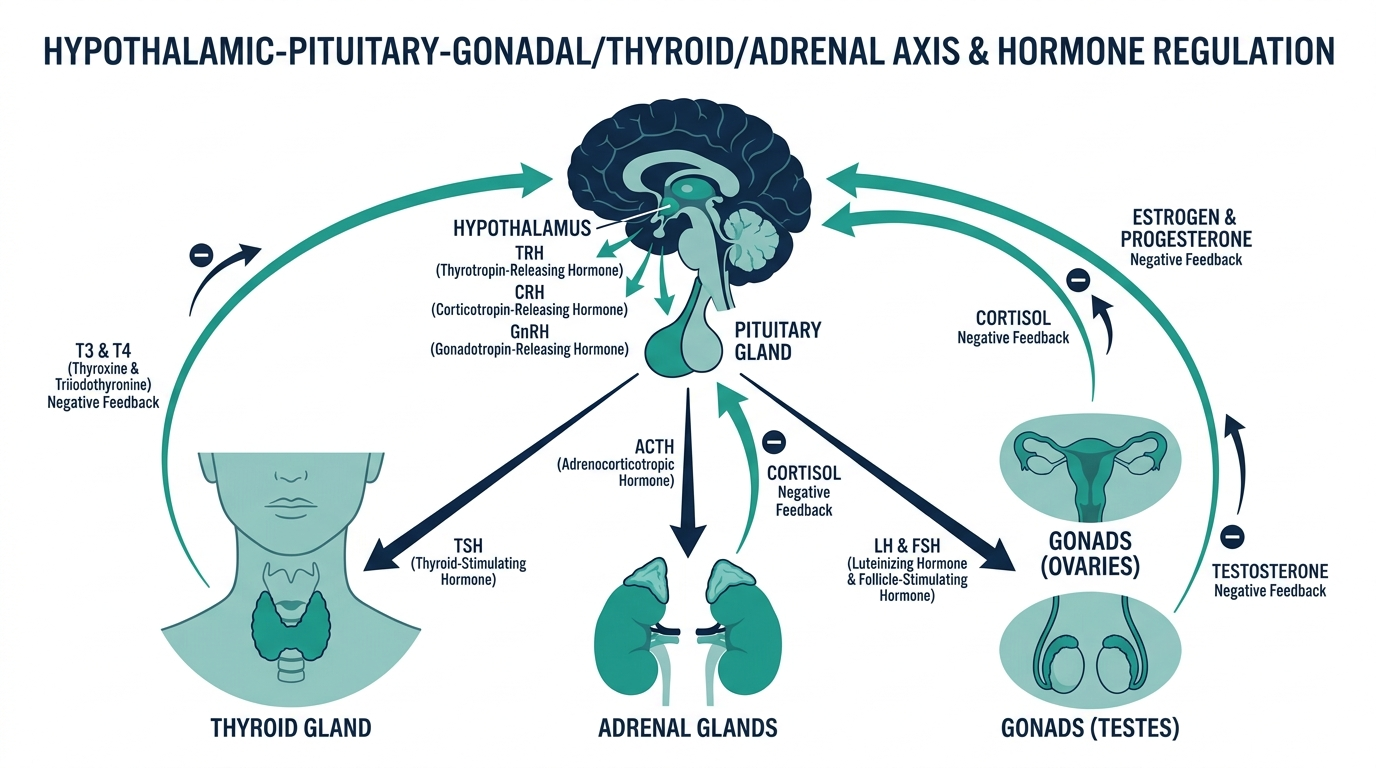
- A hormone panel blood test measures the chemical messengers that control reproduction, energy, mood, and the stress response, most commonly testosterone, FSH, LH, estradiol, and cortisol.
- Doctors order a hormone panel to investigate symptoms like low libido, fatigue, irregular periods, infertility, or unexplained weight change, because these hormones rarely act alone and need to be read together.
- Because hormone levels swing with the time of day, your menstrual cycle, and even stress, when and how the blood is drawn matters as much as the number itself.
A hormone panel blood test is a single blood draw that measures several of the body’s key hormones at once, giving your clinician a snapshot of how your reproductive and stress systems are working together. It is ordered when symptoms such as low energy, changes in sex drive, irregular menstrual cycles, fertility problems, or mood shifts suggest a hormone may be out of balance. Because no single hormone tells the whole story, this panel groups related markers so they can be interpreted as a connected system rather than isolated numbers.
What is a Hormone Panel?
The simplest way to actually get this done
Superpower is a full-body lab membership that runs 100+ biomarkers, has each result reviewed by a doctor, and tracks your numbers year over year (about $199/year). It is what we point readers to when they would rather get one clean, complete draw than chase single tests one at a time. Here is superpower reviewed in full.
A hormone panel is a grouped set of blood tests that measures the body’s main signaling hormones in one sitting. Hormones are chemical messengers made by glands such as the testes, ovaries, pituitary, and adrenal glands. They travel through the bloodstream and tell distant organs what to do, from making sperm or eggs to managing your reaction to stress.
Testosterone, cortisol, estradiol, FSH, LH: symptoms like fatigue or low libido rarely trace to just one hormone. Want the full panel? One at-home Superpower draw checks 100+ biomarkers, physician-reviewed.
The hormones in a standard panel work in feedback loops. The brain’s pituitary gland releases FSH and LH, which then signal the ovaries or testes to produce estradiol and testosterone. When the sex hormones rise, they tell the pituitary to ease off, like a thermostat. Cortisol, the main stress hormone from the adrenal glands, runs on its own daily clock. Reading these markers together lets a clinician see where in the chain a problem starts, which a single test in isolation cannot do.
What does a Hormone Panel measure?
The core panel covered here includes five markers. Each one has its own deep-dive article, so the lines below are intentionally short and scannable.
- Testosterone: the main male sex hormone, present in smaller amounts in women, tied to libido, muscle, mood, and energy.
- FSH (Follicle-Stimulating Hormone): a pituitary hormone that drives egg development in women and sperm production in men.
- LH (Luteinizing Hormone): a pituitary hormone that triggers ovulation in women and signals testosterone production in men.
- Estradiol (E2): the most active form of estrogen, central to the menstrual cycle, bone health, and present at low levels in men.
- Cortisol: the primary stress hormone from the adrenal glands, which also regulates blood sugar, blood pressure, and the daily wake cycle.
Why would a doctor order a Hormone Panel?
A clinician reaches for a hormone panel when symptoms point to a hormonal cause but the exact source is unclear. In men, common triggers are low libido, erectile difficulty, persistent fatigue, loss of muscle, or low mood, which together may suggest low testosterone. The panel checks whether the testes are underproducing, or whether the pituitary signals FSH and LH are off, which changes the diagnosis and treatment.
In women, the panel is often ordered for irregular or absent periods, difficulty conceiving, symptoms of perimenopause or menopause, or signs of conditions such as polycystic ovary syndrome. Measuring FSH, LH, and estradiol on a specific cycle day helps map ovarian function and timing. Cortisol is added when fatigue, weight change, high blood pressure, or symptoms of an over or underactive adrenal gland are part of the picture. The goal is always to separate a gland problem from a signaling problem, and to rule conditions in or out before treating.
How to read your Hormone Panel results
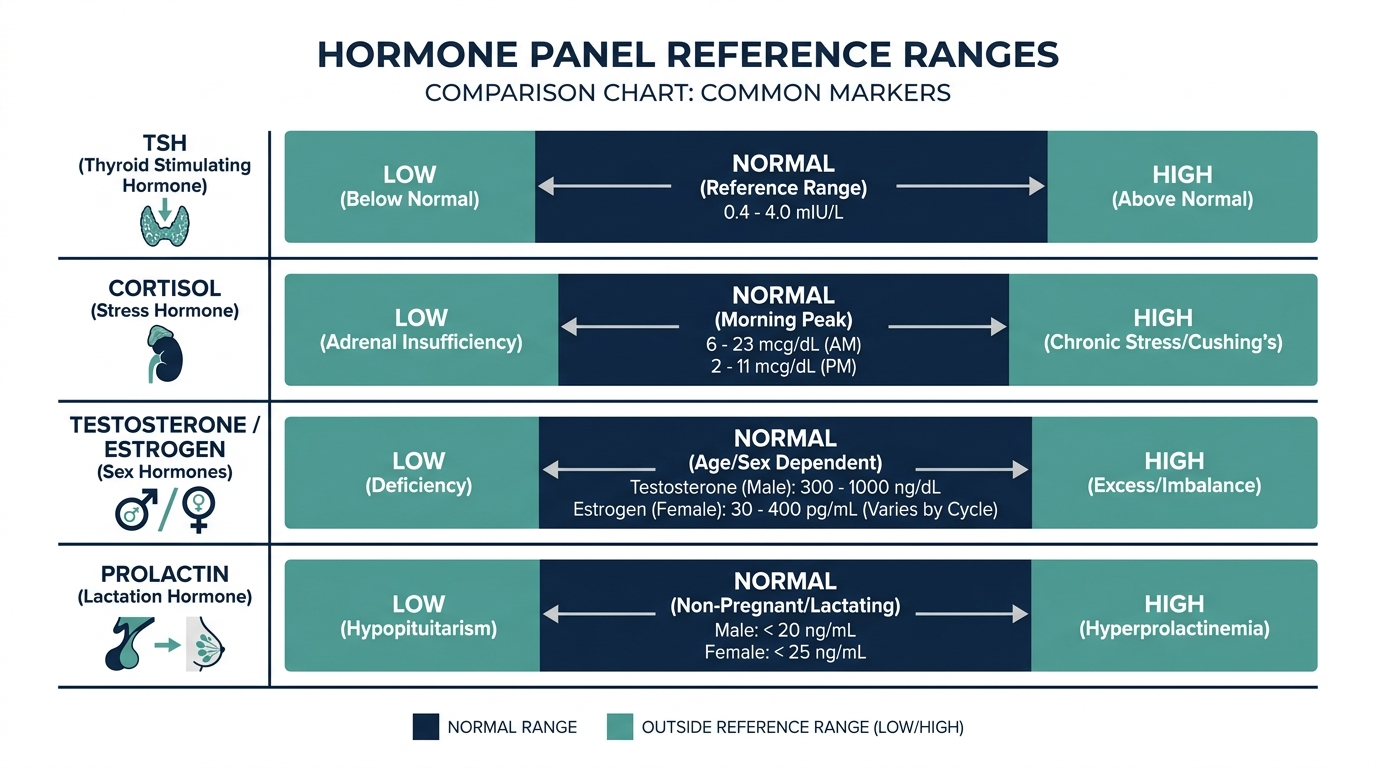
Start with the reference range printed next to each result, since labs use slightly different methods and ranges. A value flagged high or low is a flag for discussion, not a diagnosis. The pattern across markers usually matters more than any one number. Approximate adult reference ranges, which vary by lab, age, and sex, look like this:
- Testosterone (total): roughly 300 to 1,000 ng/dL in adult men, and roughly 10 to 70 ng/dL in adult women (Baptist Health).
- FSH: about 2 to 12 IU/L in men, 4.7 to 21.5 mIU/mL in cycling women, and 25.8 to 134.8 mIU/mL after menopause (Cleveland Clinic).
- LH: about 2 to 9 IU/L in men and roughly 5 to 20 mIU/mL in the early follicular phase in women (bpac NZ).
- Estradiol: roughly 25 to 75 pg/mL in the early follicular phase, with much lower levels after menopause (EarlyMenopause).
- Cortisol (morning draw): roughly 6 to 20 mcg/dL when drawn between about 6 and 8 a.m. (WebMD).
Two interpretation rules help. First, read the pituitary hormones against the gland hormones. High FSH and LH with low testosterone or estradiol points to a problem in the testes or ovaries, while low FSH and LH with low sex hormones points upstream to the pituitary or brain. Second, respect timing. A cortisol of 18 mcg/dL is normal at 7 a.m. but would be a concern at 10 p.m., when it should be low.
What do high and low results mean?
A flagged result is a starting point, not a verdict. What matters is the direction of the change, the marker it sits next to, and how you feel. Here is how clinicians usually read a value that lands outside the reference range for each hormone in the panel.
Testosterone: high vs low
Low total testosterone in a man, confirmed on a second morning draw, points toward hypogonadism, and the FSH and LH beside it tell you where the fault lies. Low testosterone with high FSH and LH means the testes are underperforming, called primary hypogonadism. Low testosterone with low or normal FSH and LH points upstream to the pituitary or hypothalamus, called secondary hypogonadism, which can be caused by obesity, sleep apnea, opioid use, or a pituitary problem. High testosterone in a woman is often the more useful finding, because it can flag polycystic ovary syndrome, especially when it appears with irregular cycles and a raised LH to FSH ratio.
FSH and LH: high vs low
These two pituitary signals are best read as a pair. High FSH and LH usually mean the brain is shouting at a gland that cannot respond, the classic pattern of menopause in women and of testicular failure in men. Rising FSH is one of the earliest lab clues that ovarian reserve is falling. Low FSH and LH mean the signal itself is weak, which can follow from significant stress, very low body weight, over-exercise, high prolactin, or a pituitary condition. In women being assessed for PCOS, clinicians look less at the absolute numbers and more at whether LH is running noticeably higher than FSH.
Estradiol: high vs low
In a cycling woman, estradiol is only meaningful against the day it was drawn, because it rises and falls sharply across the month. Persistently low estradiol with high FSH is the menopausal pattern. Low estradiol in a younger woman who is not menopausal can reflect low body fat, intense training, or a signaling problem in the brain. In men, estradiol is made by converting testosterone, so a high reading often tracks with excess body fat or with testosterone therapy, and it can drive symptoms such as breast tenderness or water retention.
Cortisol: high vs low
Cortisol is the marker most often misread, because a single number means little without the time of day attached. A high morning cortisol can be normal stress physiology, but a cortisol that stays high late at night, or that does not fall as expected, may prompt testing for Cushing syndrome. A low morning cortisol can point toward adrenal insufficiency, especially with fatigue, low blood pressure, and salt craving. Because one draw is a snapshot, abnormal cortisol is almost always followed by a timed or dynamic test, such as a morning and evening pair or a stimulation test, before any diagnosis.
Optimal ranges vs the standard lab range
The reference range printed on your report is a statistical range, built from a population of people the lab tested, not a personal target for feeling well. This is where “normal” and “optimal” part ways. A testosterone at the very bottom of the range can be technically normal yet leave a man symptomatic, which is why a good clinician weighs the number against libido, energy, mood, and muscle rather than treating the lab value alone. The same logic runs the other way. A cortisol at the top of its morning range is not a disease if your rhythm and symptoms are fine. Treat the range as a map of the population, then let the pattern across your markers and your own symptoms decide what the number means for you. Labs also differ in method and units, so a value from one lab cannot be compared cleanly against a range from another.
When should you get this panel tested?
Timing changes the result, so most hormone panels follow simple rules. Testosterone and cortisol are highest in the morning, so blood is usually drawn between 8 and 10 a.m. to capture the peak and to make results comparable to the reference ranges (Lamkin Clinic). A repeat fasting morning draw is common to confirm a low testosterone result before any treatment.
For women who still menstruate, FSH, LH, and estradiol are cycle dependent, and your clinician will tell you which day to come in. A day 3 draw, counting the first day of your period as day 1, is standard for assessing baseline ovarian function and fertility. If you are perimenopausal, postmenopausal, or not cycling, the draw can be done on any day. You should also test when new symptoms appear, when monitoring an existing condition, or when checking a treatment such as testosterone therapy or fertility care. Always tell the lab about any hormones, birth control, or supplements you take, since these can shift the numbers.
How to prepare for a hormone panel
A few simple steps make your results far more reliable. Book a morning slot, ideally between 8 and 10 a.m., since testosterone and cortisol peak early and the reference ranges assume a morning draw. Ask whether to fast, because some clinics prefer it to cut variability. Avoid intense exercise, alcohol, and a poor night of sleep right before the test, as all three can nudge cortisol and sex hormones. Bring a full list of everything you take, including birth control, testosterone or estrogen, steroids, opioids, and supplements such as biotin, since biotin in particular can distort some hormone assays. If you are being retested to confirm a low result, try to match the conditions of your first draw, same time of day and same fasting state, so the two numbers are truly comparable.
How your hormone panel connects to the rest of your blood work
Hormones do not sit in a silo. The reason a clinician often orders a hormone panel alongside other tests is that the same symptoms, fatigue, weight change, low mood, can come from several systems at once. Reading the panel next to your wider results is what turns a list of numbers into an answer.
- Thyroid markers. An underactive thyroid can mimic low testosterone and menstrual problems, so TSH is frequently checked in the same draw. See the thyroid panel guide for how those numbers read.
- Prolactin. A high prolactin level suppresses FSH and LH, which can lower testosterone and stop periods. When sex hormones are low with low FSH and LH, prolactin is a standard next check.
- Metabolic markers. Insulin resistance and blood sugar are tightly linked to PCOS and to low testosterone in men, so fasting glucose and related metabolic markers often move with hormone changes.
- SHBG. Sex hormone binding globulin decides how much of your testosterone and estradiol is actually free and active, so a total hormone level can look normal while the usable amount is low.
This is the practical case for a broad draw rather than one test at a time. When the thyroid, metabolic, and hormone numbers sit side by side, the pattern that explains your symptoms usually becomes obvious, and you avoid the loop of testing one marker, getting a normal result, and starting over.
A real-world example of reading the pattern
Consider a 34-year-old woman with irregular cycles, acne, and trouble losing weight. Tested alone, her total testosterone comes back only slightly high, easy to dismiss. Read as a panel, the picture sharpens: LH is running well above FSH, estradiol fits an early-cycle draw, and her metabolic markers hint at insulin resistance. No single value screams a diagnosis, but the pattern is a textbook PCOS signature, and it moves her toward the right next steps rather than another year of guessing.
Now take a 45-year-old man with low energy, low libido, and lost gym progress. His total testosterone is at the low end. Whether that number matters depends on what sits beside it. Low testosterone with high FSH and LH means the testes are the problem. Low testosterone with low FSH and LH sends the workup toward the pituitary, and toward reversible drivers like weight, sleep apnea, and certain medications. Same low number, two different paths, decided entirely by the markers around it.
Every marker in this panel
Tap any marker for a full plain-English explainer, including what high and low results mean.
- What Blood Tests for Testosterone? Total, Free, and the One Most People Order Wrong
- What Is FSH in a Blood Test? The Hormone Number Whose Meaning Flips With Your Age
- What Is LH in a Blood Test? Normal Ranges, High vs Low, and the PCOS Clue Most People Miss
Turn what you just learned about hormone panel into action.
Superpower lets you test hormone panel and 100+ biomarkers from home, then re-check them over time so you can actually see progress, physician-reviewed at every step.
Frequently asked questions
Do I need to fast before a hormone panel blood test?
Most hormone tests do not strictly require fasting, but clinics often ask you to come in early morning and sometimes fasting, because testosterone and cortisol peak in the morning and a fasting state reduces variability. Follow the specific instructions your clinician or lab gives you.
Can stress or poor sleep affect my results?
Yes. Acute stress, illness, intense exercise, and poor sleep can raise cortisol and shift sex hormones temporarily. This is one reason a single abnormal result is usually repeated before any conclusion is drawn.
What is the difference between FSH, LH, and testosterone or estradiol?
FSH and LH are signals sent by the pituitary gland in the brain, while testosterone and estradiol are the hormones the testes or ovaries make in response. Reading the signals next to the output tells the clinician whether a problem is in the gland or in the brain’s signaling.
How long do hormone panel results take?
Most hormone results return within a few business days, though turnaround depends on the lab. Your clinician will review the full pattern with you rather than just the flagged values.
Can a hormone panel diagnose menopause or low testosterone on its own?
Not by itself. A panel supports a diagnosis, but menopause and low testosterone are clinical diagnoses that combine your symptoms, your history, and often repeat testing. Numbers are interpreted alongside how you feel, not in place of it.
What is the difference between total and free testosterone?
Total testosterone measures everything in the blood, both the portion bound to proteins and the small free portion that your tissues can actually use. Free testosterone measures only the active part. When symptoms and total testosterone disagree, a free testosterone or an SHBG level often explains the gap, because a normal total can hide a low usable amount.
Why did my hormone results change so much between two tests?
Normal biological swing is the usual reason. Cortisol changes hour to hour, sex hormones shift across the menstrual cycle, and acute stress, illness, or a hard workout can move numbers for days. This is exactly why clinicians repeat an abnormal value under matched conditions before acting on it, rather than treating a single reading.
Can I test my hormone panel at home?
Yes. At-home and walk-in lab services can run the same markers as a clinic, which is convenient for a morning draw or a cycle-day draw. The result still needs a clinician to interpret it against your symptoms and history, so use at-home testing to gather the numbers, not to self-diagnose.
Sources
- WebMD, Cortisol Test
- Cleveland Clinic, Follicle-Stimulating Hormone (FSH)
- Baptist Health, Normal Testosterone Levels by Age
- bpac NZ, Reproductive Hormones
- EarlyMenopause, Estradiol and FSH Levels
- Lamkin Clinic, Cortisol AM Reference Ranges
- UCSF Health, Cortisol Blood Test
This article is for general educational purposes and is not medical advice. It cannot diagnose or treat you and does not replace your clinician. Always discuss your lab results and any health decisions with a qualified healthcare professional.
Related: compare at-home thyroid hormone tests.
Vital Signs Today may earn a commission if you buy through links on this page. It does not affect our editorial assessments.