You got a fertility workup, a menopause question, or just a hormone panel, and there it was: FSH, with a number beside it and a reference range that somehow spans from single digits to over a hundred. If that range alone made you blink, you are reading it correctly. FSH is one of the few blood markers where the “normal” number depends almost entirely on who you are, where you are in your cycle, and what stage of life you are in.
Most explainers hand you a chart and move on. The chart is the easy part. The hard part, the part that actually changes how you read your own result, is knowing why one FSH number can mean perfectly healthy in one person and a real problem in another.
FSH means something different depending on your age and stage. See it alongside your full hormone panel for context. One at-home Superpower draw checks 100+ biomarkers, physician-reviewed.
Part of our Hormone Panel guide.
What is FSH in a blood test?
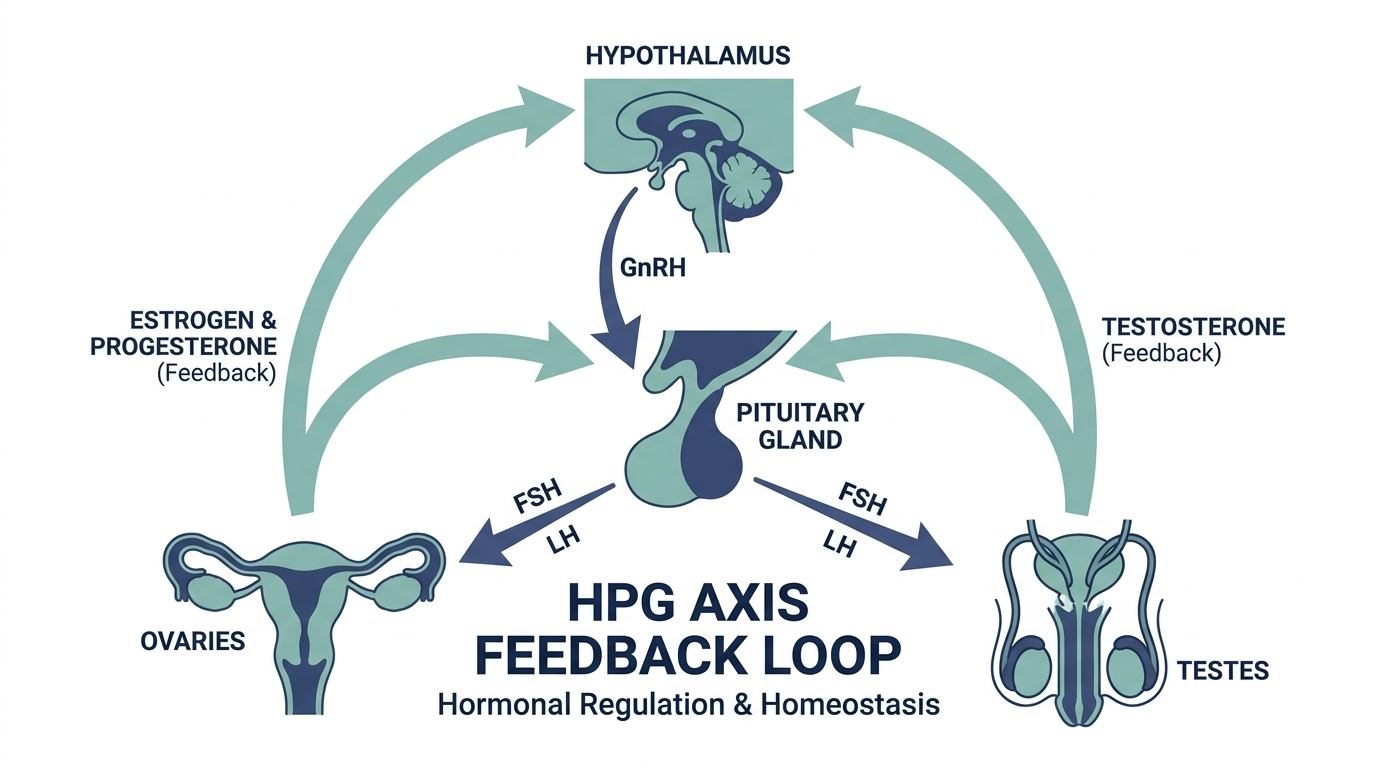
FSH stands for follicle-stimulating hormone, and a blood test measures how much of it is circulating in your blood. FSH is made by your pituitary gland, the small gland at the base of your brain, and it drives reproduction: in people with ovaries it stimulates follicles to grow and prepare eggs for ovulation, and in people with testes it stimulates sperm production (Cleveland Clinic). So if you are asking what is FSH in a blood test, the short answer is that it is a readout of how hard your pituitary is pushing your ovaries or testes to do their job.
That last idea is the key to the whole report. FSH is not a measure of your ovaries or testes directly. It is a measure of the signal your brain is sending them. When the gonads stop responding well, the brain shouts louder, and FSH climbs. Hold onto that, because it explains nearly every high and low result below.
What is the FSH test used for?
The simplest way to actually get this done
Superpower is a full-body lab membership that runs 100+ biomarkers, has each result reviewed by a doctor, and tracks your numbers year over year (about $199/year). It is what we point readers to when they would rather get one clean, complete draw than chase single tests one at a time. Here is superpower reviewed in full.
The FSH test is used to help diagnose conditions that cause too much or too little FSH, which usually means problems with fertility, the menstrual cycle, puberty, or pituitary function (MedlinePlus). When people ask what blood test is FSH or what is FSH test in blood, this is the context: it is a single tube of blood, drawn like any routine lab, that gets sent for hormone analysis.
Doctors typically order it when a woman cannot conceive after 12 months of trying, has irregular or absent periods, or is showing menopausal symptoms, and when a man has fertility concerns or low sexual interest (MedlinePlus). In children it helps sort out puberty that arrives too early or too late. FSH is almost never read in isolation, which brings us to its constant companion.
Why is FSH tested together with LH?
FSH is usually drawn alongside luteinizing hormone (LH) because the two are released by the same gland and work as a team to control reproduction (MedlinePlus). Reading one without the other is like hearing half a conversation.
The reason this pairing matters is a feedback loop. When the ovaries or testes are not producing enough sex hormones, the pituitary responds by raising both FSH and LH at the same time (Cleveland Clinic). So when both are high together, the message points to the gonads themselves. When both are low, the message points upstream, to the pituitary or hypothalamus. The combination tells the story that either number alone cannot.
How is the FSH test done, and when should it be drawn?
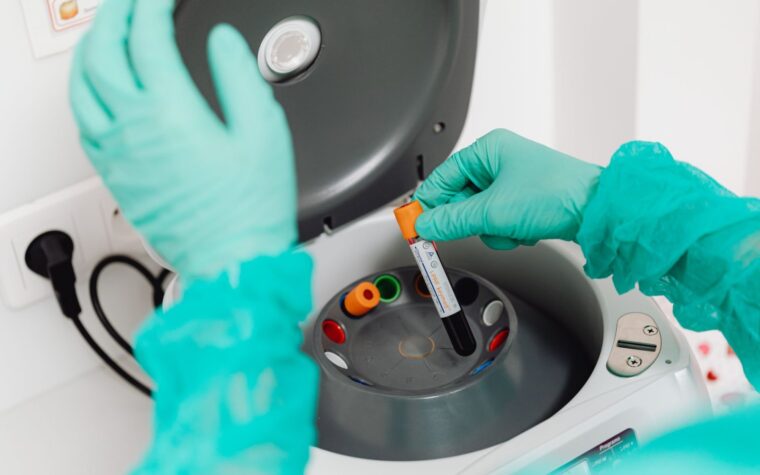
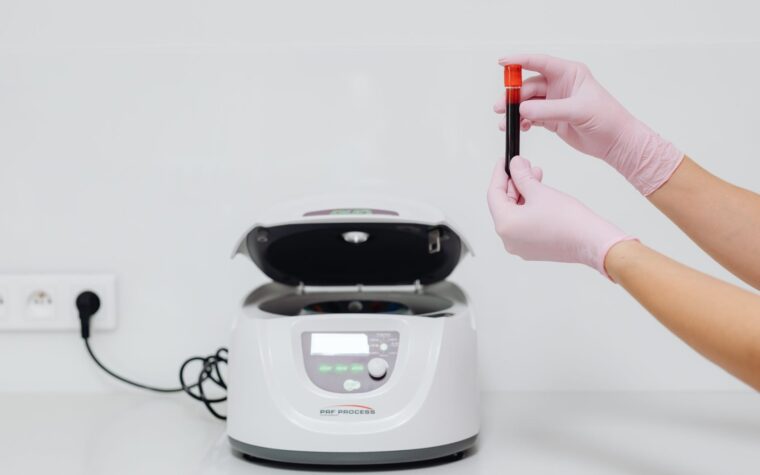
The draw itself is unremarkable. A phlebotomist takes a single tube of blood from a vein in your arm, the same as any routine lab, and no fasting is required (MedlinePlus). What matters far more than preparation is timing, because FSH is not a steady number you can sample at random.
For a menstruating woman being evaluated for fertility or ovarian reserve, the test is usually drawn early in the cycle, around day 3, counting the first day of full flow as day 1. That early-follicular window is when FSH is at its most interpretable, and it is the value fertility clinics anchor on. Draw the same woman at mid-cycle and the number can look completely different, which is why a result with no cycle day attached is hard to read.
Two other things quietly move or mask the result:
- Hormonal contraception. The pill, patch, ring, and hormonal IUD suppress the pituitary signal, so an FSH measured while you are on them reflects the medication, not your own physiology. Clinicians often want you off hormonal birth control for a stretch before testing.
- Biotin supplements. High-dose biotin, common in hair and nail products, can interfere with many hormone immunoassays and skew the reading in either direction. Most labs advise pausing biotin for a couple of days before the draw.
Pregnancy also drives FSH down, so a test taken without knowing pregnancy status can mislead. The lesson is that when and how you test FSH shapes the answer as much as the biology does.
What is a normal FSH level?
There is no single normal FSH level, because the healthy range shifts with sex, age, and cycle stage. Reference ranges also vary from lab to lab, so always read your result against the range printed on your own report (Cleveland Clinic). With that caveat, here are the typical ranges Cleveland Clinic publishes, measured in milli-international units per milliliter (mIU/mL).
For females:
- Before puberty: 0 to 4.0 mIU/mL
- During puberty: 0.3 to 10.0 mIU/mL
- After puberty (reproductive years): 4.7 to 21.5 mIU/mL
- After menopause: 25.8 to 134.8 mIU/mL
For males:
- Before puberty: 0 to 5.0 mIU/mL
- During puberty: 0.3 to 10.0 mIU/mL
- Adult: 1.5 to 12.4 mIU/mL
Notice the postmenopausal jump. An FSH of 60 would be alarming in a 28-year-old trying to conceive and completely expected in a 58-year-old. Same number, opposite meaning. That is why the age column is not optional context, it is the whole interpretation.
What does a high FSH mean?
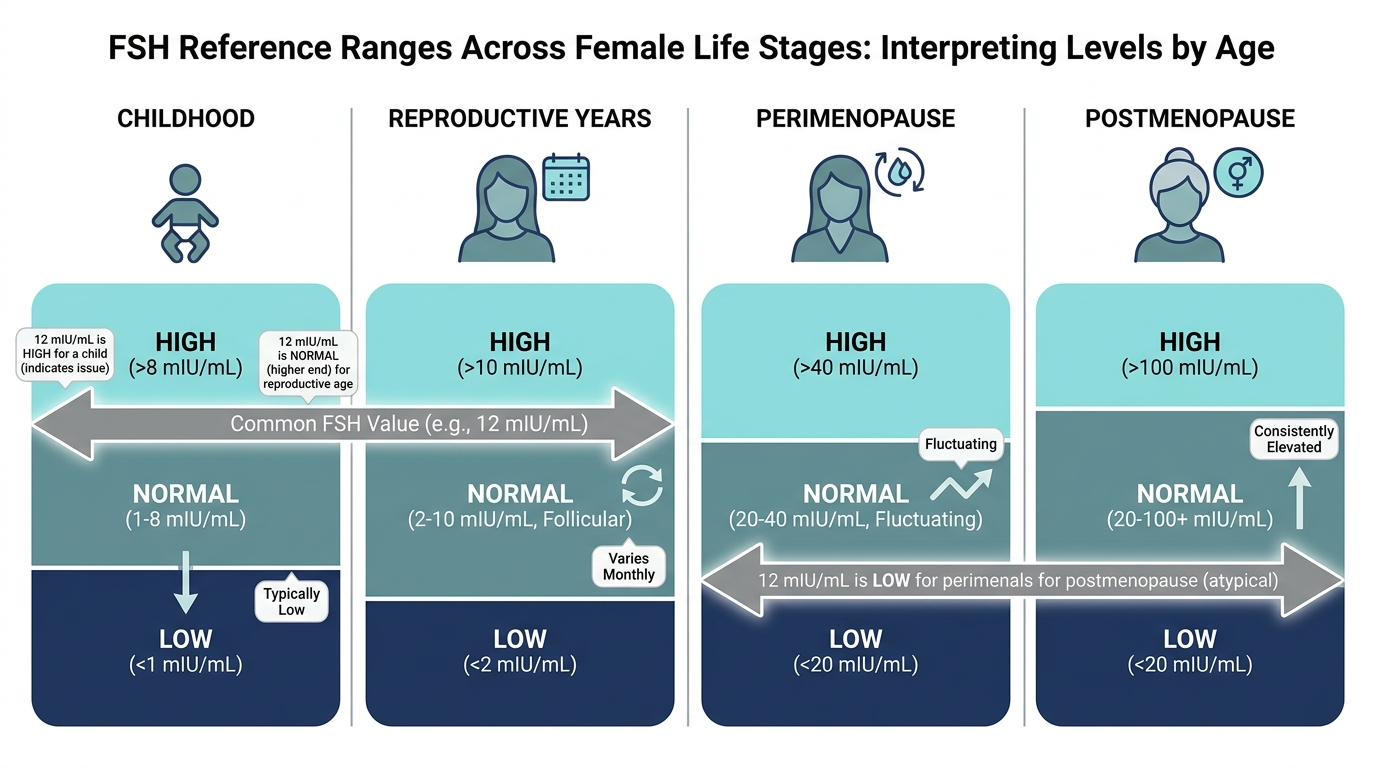
A high FSH usually signals that the ovaries or testes are not making normal levels of sex hormones, so the pituitary is working overtime to compensate (MedlinePlus). It is a symptom of the gonads underperforming, not the cause. The common explanations include:
- Menopause or perimenopause. As the ovaries wind down, FSH rises, and a consistently high FSH is one of the markers of approaching menopause (MedlinePlus). In postmenopausal women, a high FSH is normal and expected (Cleveland Clinic).
- Primary ovarian insufficiency. When the ovaries lose function before age 40, FSH climbs even in a young woman (MedlinePlus).
- Diminished ovarian reserve. People with fewer remaining eggs tend to have higher FSH than others their age (Cleveland Clinic).
- Testicular damage or failure in men. A high FSH can point to injury, certain genetic conditions, or rarely a germ cell tumor (MedlinePlus).
Here is the insider point that almost never makes it into the patient handout. A single high FSH in a woman in her forties is one of the least reliable results in the lab. Cleveland Clinic states plainly that hormone testing is not necessary to diagnose perimenopause, because hormone levels fluctuate so much that the tests are not reliable (Cleveland Clinic). During perimenopause, FSH can be high one week and normal the next. A normal result does not rule perimenopause out, and a single high result does not lock it in. Experienced clinicians diagnose this stage from your age, symptoms, and cycle pattern, and they treat a one-off FSH as a hint, not a verdict. If you tested at home and got a “normal” reading while having textbook symptoms, this is exactly why.
What does a low FSH mean?
A low FSH usually points upstream, to a problem with the pituitary gland or the hypothalamus rather than the ovaries or testes (MedlinePlus). If the brain is not sending the signal, the gonads never get the message, and the FSH number stays low.
In women, a low FSH can also accompany significant weight loss or extreme exercise, both of which can suppress the pituitary’s reproductive signaling (MedlinePlus). In children, a low FSH can be part of the picture in delayed puberty. Because the pituitary controls many hormones, a low FSH sometimes shows up alongside other low pituitary readings, which is one more reason it gets interpreted as part of a panel rather than alone.
What does the FSH to LH ratio add?
Because FSH and LH are drawn together, the relationship between them often says more than either number alone. In a healthy reproductive-age woman early in her cycle, FSH and LH sit in a roughly similar range. When that balance tips, it points in specific directions.
The classic example is polycystic ovary syndrome. In many women with PCOS, LH runs higher than FSH, sometimes markedly so, producing an elevated LH to FSH ratio that supports the picture alongside symptoms and ultrasound. It is a supporting clue rather than a stand-alone diagnosis, because the ratio is normal in plenty of women who still have PCOS, but when it is skewed it is a meaningful nudge.
The pairing also separates two broad kinds of problem. When both FSH and LH are high, the pituitary is shouting at gonads that cannot answer, which is the pattern of primary ovarian insufficiency or menopause, called hypergonadotropic hypogonadism. When both are low, the signal itself is missing, pointing upstream to the pituitary or hypothalamus, called hypogonadotropic hypogonadism. That single fork in the road, both high versus both low, is the most useful thing the two hormones do together, because it tells a clinician which organ to investigate next rather than leaving the whole axis open.
How do you read FSH blood test results?
To read FSH blood test results properly, you compare your number against the reference range for your sex and life stage, factor in where you are in your menstrual cycle if you menstruate, and never read FSH without LH and the rest of the panel (Cleveland Clinic). A few practical rules make the difference between a useful read and a scary misread:
- Match the range to your stage. A premenopausal range and a postmenopausal range barely overlap. Make sure you are comparing your number to the right row.
- Mind the cycle timing. In menstruating women, FSH changes day to day across the cycle, so fertility FSH is typically drawn early, around day 3, to be meaningful.
- Read FSH and LH together. Both high points to the gonads; both low points to the pituitary or hypothalamus.
- Treat one result as a snapshot. Especially in perimenopause, a single value can mislead, and your clinician may repeat it or lean on symptoms instead.
The honest bottom line is that FSH is a powerful clue and a weak verdict. It earns its place by narrowing the question, not by closing it.
Don’t just read about FSH, track it.
A single result is a snapshot. Superpower re-tests FSH and 100+ markers over time so you can watch them move as you change sleep, food, and training.
What does FSH tell you in men?
FSH is often framed as a female hormone, but it does real work in men, where it drives the testes to produce sperm. In a fertility workup for a man, FSH read alongside testosterone and LH sorts the problem into one of two levels, exactly as it does in women.
A high FSH in a man usually means the testes themselves are failing to respond, so the pituitary pushes harder. Paired with a low testosterone, that high-FSH pattern is the signature of primary testicular failure, which can follow injury, certain infections, chemotherapy, or a genetic condition such as Klinefelter syndrome. When a man has no measurable sperm and a high FSH, it points toward a production problem in the testes rather than a blockage.
A low FSH alongside low testosterone flips the location of the problem upstream, to the pituitary or hypothalamus, the secondary pattern. This can come from a pituitary tumor, significant weight or illness stress, anabolic steroid use that shuts down the natural signal, or an inherited deficiency. The distinction matters because the two are treated very differently, and FSH is one of the cheapest ways to tell them apart. For any man handed an FSH result, the number is close to meaningless without a testosterone and an LH sitting next to it.
Frequently asked questions
What is FSH on a blood test in simple terms?
FSH is follicle-stimulating hormone, made by your pituitary gland, and the blood test measures how much is circulating. It drives egg development in women and sperm production in men, so it is mainly used to investigate fertility, menstrual changes, menopause, puberty, and pituitary problems (Cleveland Clinic).
What is a normal FSH level?
It depends on sex and life stage. For women in their reproductive years a typical range is about 4.7 to 21.5 mIU/mL, rising to roughly 25.8 to 134.8 mIU/mL after menopause, while adult men sit around 1.5 to 12.4 mIU/mL. Ranges vary by lab, so compare against your own report (Cleveland Clinic).
Does a high FSH mean I am in menopause?
Not necessarily. A consistently high FSH can signal approaching menopause, but a single high reading is unreliable in perimenopause because hormones fluctuate so much, and hormone testing is not even required to diagnose it (Cleveland Clinic). Clinicians lean on age, symptoms, and cycle patterns.
What does a low FSH mean?
A low FSH usually points to a problem with the pituitary gland or hypothalamus rather than the ovaries or testes, and in women it can also relate to significant weight loss or extreme exercise (MedlinePlus).
Why is FSH tested with LH?
FSH and LH come from the same gland and work together to control reproduction, so they are read as a pair. When the gonads underperform, both rise together, which helps pinpoint whether the issue is in the ovaries and testes or higher up in the pituitary (Cleveland Clinic).
Can I test FSH at home?
At-home FSH kits exist, usually marketed as menopause tests, and they detect FSH in urine rather than blood. They can hint that FSH is elevated, but they share the same weakness as any single FSH measurement: in perimenopause the hormone swings so much that one reading, high or low, does not confirm or rule anything out. Treat a home result as a prompt to talk to a clinician, not an answer.
Does FSH change from day to day?
Yes, especially in women. FSH moves across the menstrual cycle and can vary noticeably from one week to the next during perimenopause, which is why fertility testing anchors on an early-cycle draw and why clinicians may repeat the test. Treating a single value as fixed is the most common way people misread FSH.
What FSH level suggests menopause?
A consistently elevated FSH, into the postmenopausal range published by your lab, alongside 12 months without a period, fits menopause. The key word is consistently. Because a lone high reading is unreliable during the transition, clinicians weigh your age, symptoms, and cycle history rather than leaning on one number (Cleveland Clinic).
This article is for general educational purposes and is not medical advice. It cannot diagnose or treat you and does not replace your clinician. Always discuss your lab results and any health decisions with a qualified healthcare professional.
Related: test your thyroid and hormones from home.
Vital Signs Today may earn a commission if you buy through links on this page. It does not affect our editorial assessments.