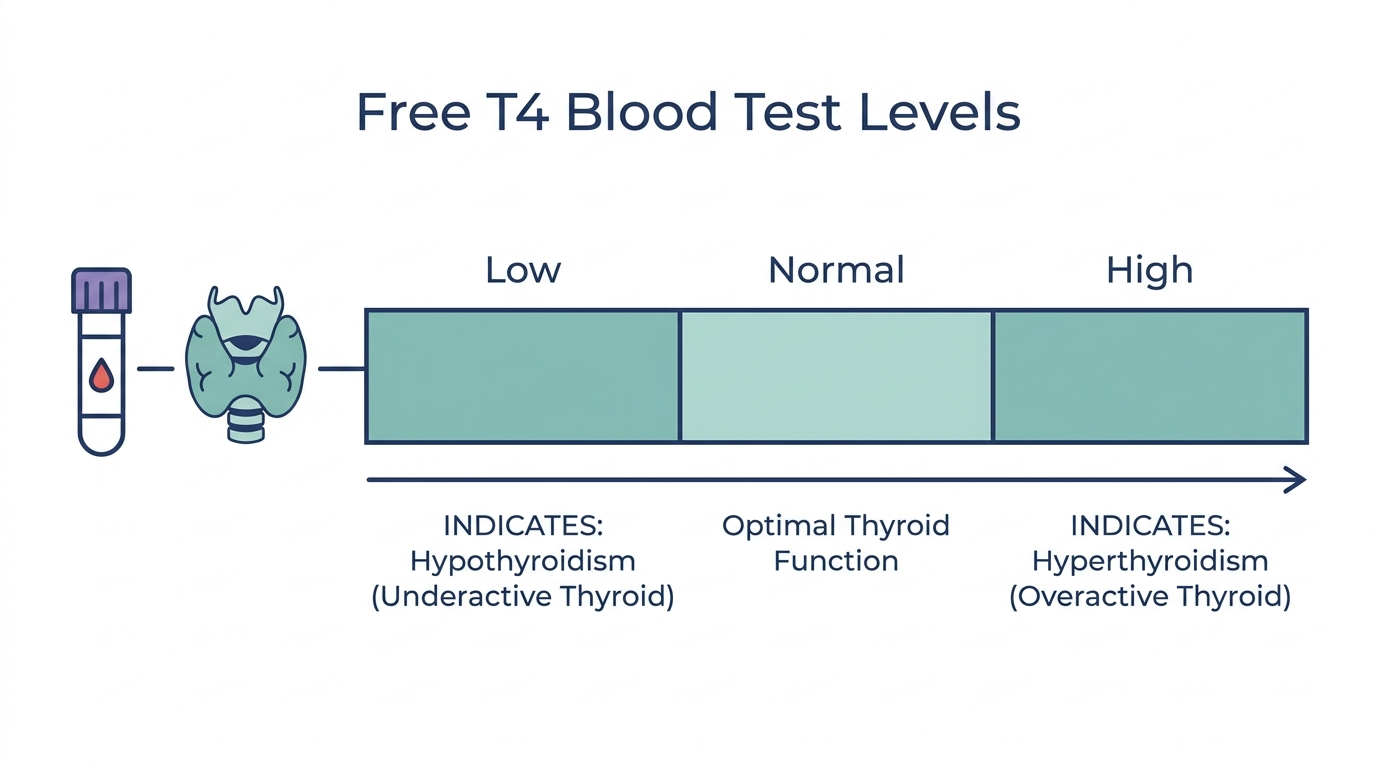
- A low free T4 blood test means your thyroid is releasing too little active thyroid hormone, most often a sign of hypothyroidism, with adult free T4 falling below about 0.9 ng/dL on the Cleveland Clinic range of 0.9 to 1.7 ng/dL.
- When free T4 is low and TSH is high, the cause is usually primary hypothyroidism such as Hashimoto disease, while a low free T4 with low or normal TSH points to a rarer pituitary or hypothalamic problem called central hypothyroidism.
- A single low free T4 is not an emergency, but it needs a repeat test with TSH and a clinician review, because untreated low thyroid hormone can slow your heart, raise cholesterol, and in rare cases progress to a life-threatening state called myxedema.
If your lab report flags free T4 below the reference range, you are reading the most direct measure of the active thyroid hormone circulating in your blood. This guide explains what the number means, what drives it down, and what to do next.
Part of our Thyroid Panel guide.
Low free T4 often signals hypothyroidism. See your complete thyroid panel to know for sure. One at-home Superpower draw checks 100+ biomarkers, physician-reviewed.
What does a low free T4 result mean, and what is the cutoff?
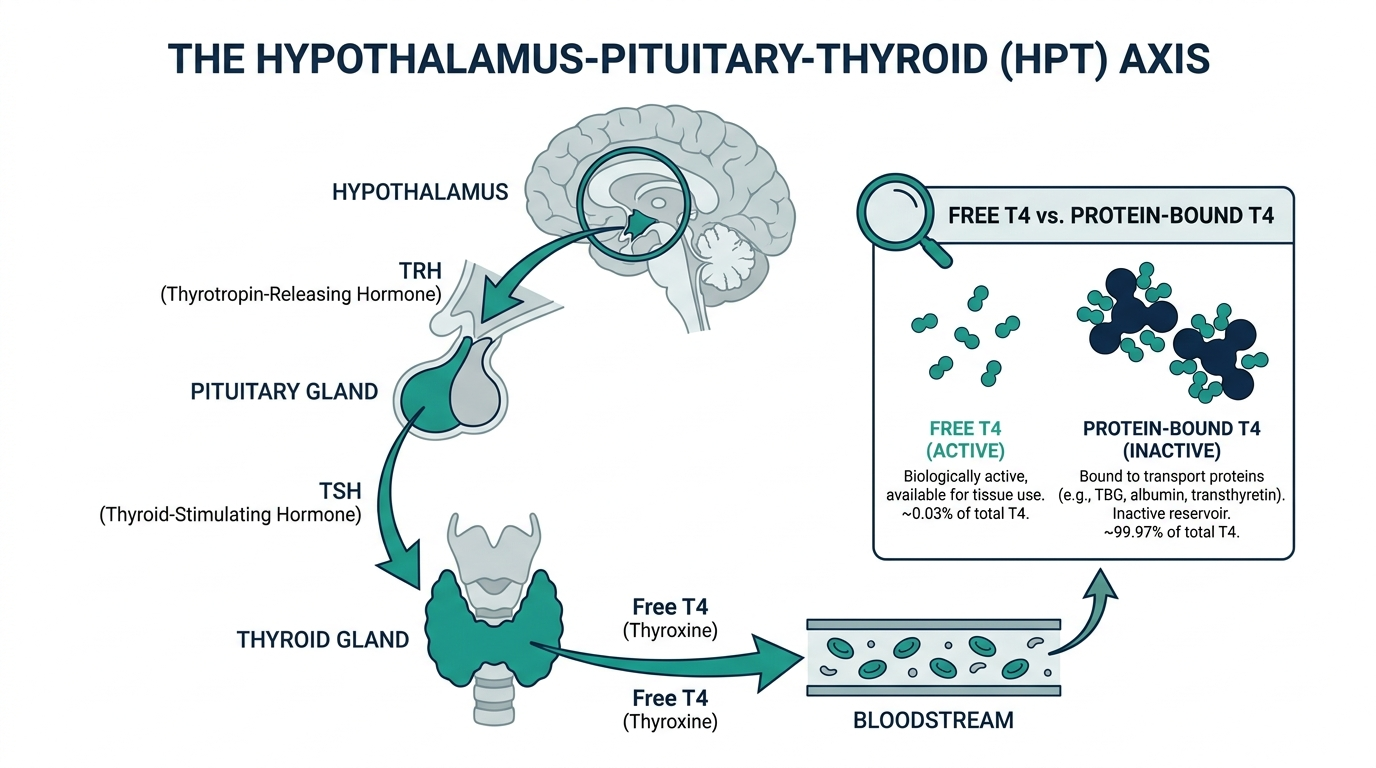
A low free T4 means the amount of unbound, biologically active thyroxine in your blood is below normal, which usually signals hypothyroidism, or an underactive thyroid (Cleveland Clinic). For adults over 18, the Cleveland Clinic reference range for free T4 is 0.9 to 1.7 ng/dL, so a result under 0.9 ng/dL is generally flagged as low. MedlinePlus lists a slightly wider typical range of 0.8 to 1.9 ng/dL.
“Free” T4 matters because most thyroxine in your blood is bound to proteins and inactive. Only the free fraction can enter cells and do work. Reference ranges vary by lab and assay, so always read the range printed next to your own result. Free T4 is rarely interpreted alone. Your clinician reads it alongside TSH (the pituitary signal that tells the thyroid to work harder) to locate where the problem sits.
Free T4 versus total T4, and why “free” is the number that counts
Your blood carries two versions of the same hormone. Total T4 measures all the thyroxine present, but roughly 99 percent of it is stuck to carrier proteins such as thyroxine-binding globulin and cannot reach your cells. Free T4 measures only the small unbound slice that is actually active. That distinction is not academic. Anything that changes your carrier proteins moves total T4 without changing how much active hormone your tissues see, which is exactly why free T4 is the more trustworthy read.
The classic example is estrogen. Pregnancy and estrogen-containing birth control raise thyroxine-binding globulin, which lifts total T4 while free T4 stays normal. Read total T4 in that setting and you might think the thyroid is fine or even overactive when the active hormone is unchanged. Free T4 sidesteps that trap, so a low free T4 is a more direct statement that active thyroid hormone is genuinely running short (MedlinePlus, Cleveland Clinic).
Optimal versus flagged: reading the free T4 range
Labs generally flag free T4 as low below about 0.9 ng/dL, but the reference band is wide, and where you sit inside it can matter. A free T4 near the bottom of normal, paired with a clearly high TSH and real symptoms, can still represent inadequate thyroid hormone for you even if no “low” flag appears. This is why clinicians read free T4 as a continuum against TSH and how you feel, not as a simple pass or fail against one cutoff (MedlinePlus).
What causes a low free T4?
The simplest way to actually get this done
Superpower is a full-body lab membership that runs 100+ biomarkers, has each result reviewed by a doctor, and tracks your numbers year over year (about $199/year). It is what we point readers to when they would rather get one clean, complete draw than chase single tests one at a time. Here is superpower reviewed in full.
The most common cause of a low free T4 is primary hypothyroidism, where the thyroid gland itself underperforms, and Hashimoto disease (autoimmune thyroiditis) is the leading driver in iodine-sufficient countries like the US (MedlinePlus, Cleveland Clinic). In primary hypothyroidism, free T4 is low and TSH is high because the pituitary is pushing hard on a failing gland.
Other recognized causes include:
- Hashimoto disease: autoimmune attack on the thyroid, the top US cause (MedlinePlus).
- Iodine deficiency: too little dietary iodine limits hormone production (Cleveland Clinic).
- Thyroid surgery or radioactive iodine: removed or ablated thyroid tissue.
- Medications: lithium, amiodarone, and some others can suppress output (Cleveland Clinic).
- Central hypothyroidism: a pituitary or hypothalamic problem where free T4 is low but TSH is low or inappropriately normal (NCBI/StatPearls).
- Severe illness, fasting, or malnutrition: can transiently lower free T4 (MedlinePlus).
How does free T4 fit with TSH, T3, and thyroid antibodies?
Free T4 is one instrument in a small orchestra. On its own it can mislead, but paired with TSH it locates the problem, and with a couple of extra tests it usually names the cause. The single most useful pairing is TSH and free T4 together, because their relationship tells you where in the system the fault lies.
- High TSH, low free T4: overt primary hypothyroidism. The gland is failing and the pituitary is shouting at it.
- High TSH, normal free T4: subclinical hypothyroidism, an early or mild form that may or may not need treatment yet.
- Low or normal TSH, low free T4: central hypothyroidism, where the pituitary or hypothalamus, not the thyroid, is the problem.
- Low TSH, high free T4: the opposite direction, an overactive thyroid, which a low free T4 does not indicate.
Two add-on tests refine the picture. Thyroid peroxidase (TPO) antibodies confirm Hashimoto disease as the autoimmune cause behind most primary hypothyroidism, and free T3 shows whether the active downstream hormone is also affected. You rarely need all of them at once, but knowing they exist explains why a doctor orders a small panel instead of a single free T4 (Cleveland Clinic, MedlinePlus).
There is a reason TSH usually leads the workup even though free T4 is the active hormone. The pituitary is exquisitely sensitive, so TSH often moves before free T4 leaves the normal range, which is what makes subclinical hypothyroidism, high TSH with still-normal free T4, detectable early. Free T4 then adds the severity dimension: once it falls too, the deficiency has crossed from mild and subclinical into overt disease that more clearly calls for treatment. Reading the two together tells you not just whether there is a thyroid problem but how far along it is.
What are the symptoms, or is it silent?
Low free T4 can be silent early on, but as levels fall, the classic symptoms of hypothyroidism appear because nearly every organ slows down without enough thyroid hormone (Cleveland Clinic). Many people have mildly low or borderline numbers for months before they notice anything, which is exactly why a blood test catches it before symptoms do.
When symptoms do show up, they tend to creep in gradually and get blamed on stress or aging. Common ones include:
- Fatigue and sluggishness: feeling tired even after a full night of sleep.
- Cold intolerance: feeling cold when others are comfortable.
- Weight gain: often modest, from a slower metabolism.
- Dry skin and hair, hair thinning.
- Constipation.
- Low mood, brain fog, or trouble concentrating.
- Heavier or irregular menstrual periods.
Symptoms can occur even when free T4 sits in the lower end of the normal range, which is why doctors weigh how you feel alongside the number (MedlinePlus).
When is a low free T4 dangerous?
A low free T4 is rarely an emergency, but profoundly low levels left untreated can lead to myxedema coma, a rare but life-threatening state with a reported mortality of roughly 25 to 60 percent even with treatment (NCBI/StatPearls). For the vast majority of people, a low free T4 is a manageable condition that responds well to daily hormone replacement.
The danger is not the single number, it is prolonged, untreated deficiency. Over months to years, low thyroid hormone can raise LDL cholesterol and cardiovascular risk, slow the heart, and worsen fatigue and mood. Warning signs that need urgent care include severe drowsiness or confusion, very low body temperature, a slow heart rate, and swelling of the face or legs, especially in older adults or after a major illness, infection, or cold exposure. These can signal severe decompensated hypothyroidism and warrant immediate medical attention.
How do you prepare for a free T4 test, and what can skew it?
Free T4 is steadier than T3, but it is not immune to interference, so a single low value drawn under messy conditions is worth confirming before it drives a diagnosis. A few practical factors change the result or its interpretation.
- Biotin supplements: high-dose biotin, common in hair, skin, and nail products, can distort many thyroid immunoassays and produce false readings. Many labs advise stopping it for a couple of days before testing.
- Serious illness or fasting: severe acute illness, prolonged fasting, and malnutrition can transiently lower free T4 without true thyroid disease, so retesting after recovery gives a cleaner answer.
- Medications: lithium and amiodarone can suppress thyroid output, while estrogen changes binding proteins. Bring a full medication and supplement list to the interpretation.
- Existing levothyroxine: if you already take thyroid hormone, the timing of your dose relative to the draw can shift the number, so tell the lab when you last took it.
There is no strict fasting rule for free T4 the way there is for glucose, but a draw taken when you are otherwise well and off short-term confounders is the most reliable. The goal is to capture your true baseline, not a temporary dip.
What should you do next, and when should you see a doctor?
If your free T4 is low, the first step is a repeat test that includes TSH (and often thyroid antibodies), since one abnormal reading can be temporary and TSH tells your doctor whether the problem is in the thyroid or the pituitary (Cleveland Clinic). Book a visit with your primary care clinician or an endocrinologist to interpret the full panel rather than acting on free T4 alone.
Practical next steps:
- Do not start or change any supplement (including iodine or biotin) before talking to your clinician. Biotin can distort thyroid lab results.
- Bring your medication list, since drugs like lithium and amiodarone affect thyroid function.
- Ask about treatment: confirmed hypothyroidism is usually treated with levothyroxine, a synthetic T4 taken once daily, with follow-up labs to fine-tune the dose.
- Seek prompt care if you develop severe drowsiness, confusion, or feel very cold and slow.
What do low free T4 results look like in real life?
Scenario one: classic Hashimoto. A 38-year-old woman has months of fatigue, cold hands, dry skin, and a few extra pounds she cannot explain. Her free T4 is low, her TSH is clearly high, and TPO antibodies are positive. This is overt primary hypothyroidism from Hashimoto disease, the most common cause in the US. She starts levothyroxine, her doctor rechecks labs after several weeks and adjusts the dose, and over a couple of months her energy and numbers recover together.
Scenario two: the normal TSH that hides the problem. A 55-year-old man is tired and low, and a routine TSH-only screen comes back normal, so he is told his thyroid is fine. Because he still feels off, a fuller panel is run, and his free T4 is actually low while TSH is only low-normal. That mismatch points to central hypothyroidism from a pituitary problem, which a TSH-only test would have missed entirely. He is referred for pituitary evaluation. Same low free T4 as scenario one, but a completely different origin and workup.
The insider nuance: free T4 with normal TSH can hide central hypothyroidism
Here is what gets missed: a low free T4 paired with a low or normal TSH is a red flag for central hypothyroidism, a pituitary or hypothalamic disorder, because the usual feedback loop between TSH and free T4 is broken (NCBI/StatPearls). In ordinary primary hypothyroidism, a low free T4 should push TSH high. When it does not, the signal is coming from the brain, not the gland.
This matters because TSH-only screening, the default for many checkups, can completely miss central hypothyroidism. If your free T4 is low but your TSH came back “normal,” that pairing deserves a closer look and possibly pituitary imaging or hormone testing. It is one of the few situations where free T4, not TSH, is the more reliable guide to whether thyroid hormone is adequate, including for monitoring people already on levothyroxine for a pituitary cause.
Curious what your own levels look like?
Baseline 100+ biomarkers today and retest as life changes, all in one membership with physician review.
Frequently asked questions
Is a low free T4 the same as hypothyroidism?
Usually yes. A low free T4 is the hallmark lab finding of hypothyroidism, but doctors confirm the diagnosis by also checking TSH and often repeating the test, since illness, fasting, or certain drugs can temporarily lower free T4.
What free T4 number counts as low?
For adults, Cleveland Clinic lists a normal free T4 of 0.9 to 1.7 ng/dL, so a result under 0.9 ng/dL is generally flagged low. MedlinePlus uses 0.8 to 1.9 ng/dL. Always compare to the range printed on your own report.
Can low free T4 be temporary?
Yes. Severe acute illness, fasting, malnutrition, and some medications can transiently lower free T4 without true thyroid disease (MedlinePlus). This is why clinicians often repeat the test and add TSH before diagnosing a lasting problem.
What if my free T4 is low but my TSH is normal?
That combination can signal central hypothyroidism, a pituitary or hypothalamic issue, because a low free T4 should normally raise TSH. It deserves specialist evaluation and possibly pituitary testing rather than reassurance from a normal TSH alone.
How is low free T4 treated?
Confirmed hypothyroidism is most often treated with levothyroxine, a synthetic form of T4 taken once daily. Your clinician adjusts the dose using follow-up blood tests until free T4 and TSH settle into the right range and symptoms improve.
What is the difference between free T4 and total T4?
Total T4 measures all thyroxine in the blood, including the roughly 99 percent bound to carrier proteins, while free T4 measures only the active unbound portion. Because pregnancy, estrogen, and other factors change carrier proteins, total T4 can shift while free T4 stays accurate, which is why free T4 is usually preferred (MedlinePlus, Cleveland Clinic).
Does biotin affect a free T4 test?
It can. High-dose biotin from hair and nail supplements interferes with many thyroid assays and can produce misleading free T4 and TSH results. Many labs recommend pausing biotin for about two days before testing, but confirm the exact interval with your lab.
Can pregnancy affect free T4?
Yes. Pregnancy raises thyroid-binding proteins and shifts thyroid demand, and pregnancy-specific reference ranges are often used. Thyroid function in pregnancy should be interpreted and managed with your clinician, since both low and borderline levels can matter for you and the baby.
How soon after starting treatment is free T4 rechecked?
After starting or adjusting levothyroxine, clinicians typically recheck thyroid labs after several weeks, often around six to eight, because the body needs time to reach a steady state. The dose is then fine-tuned until free T4 and TSH settle and symptoms improve.
Sources
- Cleveland Clinic, T4 (Thyroxine) Test
- MedlinePlus, Free T4 test
- NCBI StatPearls, Thyroxine-Binding Globulin Deficiency
- NCBI PMC, Free Thyroxine Index in the Diagnosis of Central Hypothyroidism
This article is for general educational purposes and is not medical advice. It cannot diagnose or treat you and does not replace your clinician. Always discuss your lab results and any health decisions with a qualified healthcare professional.
Related: compare at-home thyroid hormone tests.
Vital Signs Today may earn a commission if you buy through links on this page. It does not affect our editorial assessments.