- A low T3 blood test usually means the body is making less of the active thyroid hormone triiodothyronine, with adult total T3 below the typical reference range of 79 to 165 ng/dL or free T3 below 2.3 to 4.1 pg/mL (Cleveland Clinic).
- The most common cause of low T3 is not a thyroid disease at all but nonthyroidal illness syndrome, also called euthyroid sick syndrome, which appears in roughly 70 percent of hospitalized patients (StatPearls, NIH).
- A low T3 on its own does not diagnose hypothyroidism, so doctors interpret it alongside TSH and free T4 before deciding whether any treatment is needed (Cleveland Clinic).
If your lab report flags a low T3, it can look alarming, especially next to a chart of “normal” numbers. The good news is that an isolated low T3 is often less serious than it seems, and it rarely tells the whole story on its own. This guide explains what the number means, why it drops, and exactly when it should send you back to your doctor.
Part of our Thyroid Panel guide.
Low T3 on your labs? See the complete thyroid panel instead of guessing from one number. One at-home Superpower draw checks 100+ biomarkers, physician-reviewed.
What a low T3 result means and the cutoff
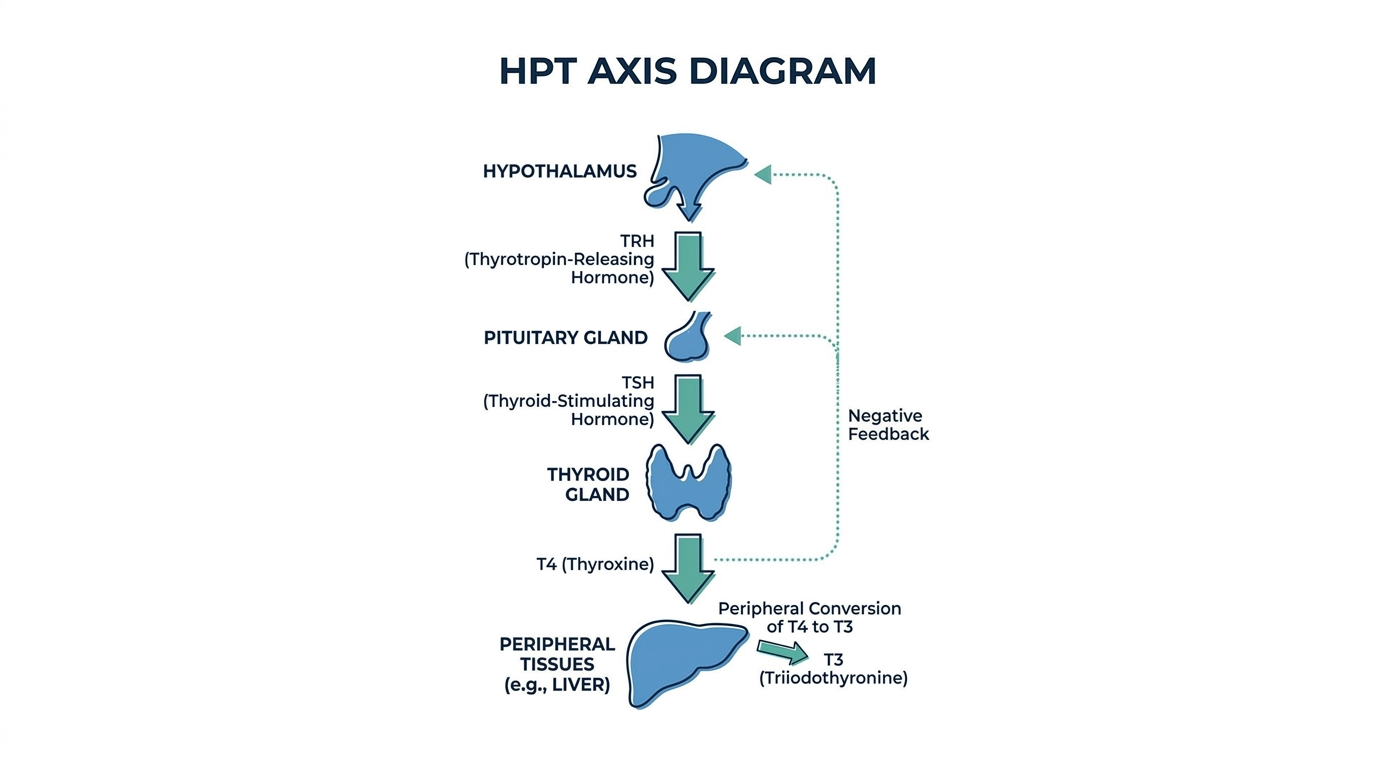
A low T3 means your blood holds less triiodothyronine than the laboratory reference range, which for adults is roughly 79 to 165 ng/dL for total T3 and 2.3 to 4.1 pg/mL for free T3 (Cleveland Clinic). T3 is the active thyroid hormone that drives metabolism in nearly every cell. Most T3 is made when the body converts the storage hormone T4 into T3, so anything that slows that conversion can pull the number down.
Reference ranges differ slightly between labs and shift with age, so always read the range printed next to your own result rather than a generic chart. A value a few points under the cutoff is interpreted very differently from one that is far below it. Importantly, T3 is not the primary test doctors use to diagnose thyroid disease. As Cleveland Clinic notes, a person can have severe hypothyroidism with a high TSH and low free T4 yet still show a normal T3, which is why your result is read in context.
Total T3 versus free T3, and why the units matter
Two different tests both get called “T3,” and mixing them up is a common source of needless worry. Total T3 measures all the triiodothyronine in your blood, both the fraction bound to carrier proteins and the small free fraction, and runs roughly 79 to 165 ng/dL in adults. Free T3 measures only the unbound, biologically active portion and runs about 2.3 to 4.1 pg/mL (Cleveland Clinic). Because the two use completely different units and scales, a free T3 of 3.0 is normal while a total T3 of 3.0 would be nonsensical. Check which test your report lists before comparing it to any range.
Total T3 can also read low simply because carrier proteins are low, since most T3 rides on thyroxine-binding globulin. Illness, low protein states, and certain drugs lower that carrier, which drags total T3 down without the active free T3 necessarily falling. This is one reason many clinicians prefer free T3 when they want a cleaner read on active hormone.
Why T3 sits downstream of everything else
Your thyroid gland secretes mostly T4, the storage form, and only a little T3 directly. The majority of active T3 is produced later, when enzymes called deiodinases convert T4 into T3 in the liver, kidneys, and other tissues (StatPearls, NIH). That detail explains why T3 is often the first domino to fall under stress: the body can dial down conversion almost instantly to save energy, long before the gland itself changes output. A low T3 therefore often reflects how the body is handling hormone, not whether the thyroid can make it.
What causes a low T3
The simplest way to actually get this done
Superpower is a full-body lab membership that runs 100+ biomarkers, has each result reviewed by a doctor, and tracks your numbers year over year (about $199/year). It is what we point readers to when they would rather get one clean, complete draw than chase single tests one at a time. Here is superpower reviewed in full.
The single most common cause of low T3 is nonthyroidal illness syndrome, also called euthyroid sick syndrome, which appears in about 70 percent of hospitalized patients and is the most frequent thyroid lab abnormality in that group (StatPearls, NIH). In this state the thyroid itself is healthy, but the body deliberately slows conversion of T4 into T3 to conserve energy during stress.
Common drivers of a low T3 include:
- Acute or chronic illness: infection, heart failure, kidney or liver disease, and major surgery all blunt T3 production.
- Medications: steroids, certain heart-rhythm drugs such as amiodarone, and beta blockers can lower T3 (Cleveland Clinic).
- Hypothyroidism: an underactive thyroid can eventually reduce T3, though TSH and free T4 usually move first.
- Starvation, fasting, or very low calorie intake: the body downshifts metabolism and trims T3.
Because so many of these causes are temporary, a low T3 measured during a hospital stay or an acute illness is often expected and does not by itself mean your thyroid is broken.
How T3 fits with TSH, free T4, and reverse T3
A T3 value is nearly meaningless in isolation, which is why endocrinologists read it as one line in a four-part pattern: TSH, free T4, T3, and, when the picture is murky, reverse T3. Each combination tells a different story.
- High TSH, low free T4, low T3: the classic pattern of primary hypothyroidism, where the gland is genuinely underactive.
- Low or normal TSH, normal free T4, low T3, high reverse T3: the signature of nonthyroidal illness syndrome, where the thyroid is fine and the body is simply conserving energy.
- Low TSH, high free T4 or T3: points toward an overactive thyroid, the opposite problem, and is not what a low T3 suggests.
Reverse T3 is the quiet tiebreaker. During illness, the body shunts T4 toward inactive reverse T3 instead of active T3, so a high reverse T3 alongside a low T3 strongly favors nonthyroidal illness over true hypothyroidism (StatPearls, NIH). Most people never need reverse T3 measured, but it explains why two patients with an identical low T3 can have completely different diagnoses.
Symptoms of low T3, or when it is silent
Low T3 frequently produces no symptoms of its own, especially in nonthyroidal illness syndrome where the underlying illness dominates how you feel. When symptoms do appear, they overlap with an underactive thyroid because T3 controls metabolic rate. There is no single symptom that proves the cause is the thyroid versus another illness, which is one reason the number is never read alone.
Possible signs linked to low thyroid hormone activity include:
- Fatigue and low energy that does not improve with rest.
- Feeling cold more easily than usual.
- Weight gain or difficulty losing weight.
- Dry skin, constipation, and a slower heart rate.
- Low mood or mental fog.
If you feel well and the low T3 turned up on a routine panel, that combination points away from a primary thyroid problem and toward a temporary or lab-related cause.
When a low T3 is dangerous
A low T3 by itself is rarely the danger. The risk comes from the severity of the illness behind it, and in the sickest patients the thyroid pattern tracks closely with outcome. In hospitalized and critically ill patients, a falling T3 is associated with longer stays and a greater need for mechanical ventilation, and when the related hormone total T4 drops below 4 mcg/dL, mortality approaches 50 percent (StatPearls, NIH).
That statistic describes very sick, often intensive-care patients, not someone with a mildly low T3 on an outpatient blood draw. The number is a marker of how serious the underlying condition is, not a thyroid emergency you treat directly. In nonthyroidal illness syndrome, treating the low T3 with thyroid hormone has not been shown to help and can even cause harm, which is why doctors focus on the primary illness instead.
How to prepare for a T3 test and what can skew it
Thyroid hormone levels shift with timing, food, illness, and medication, so a single low T3 drawn under messy conditions is often worth confirming before anyone treats it. A few practical factors move the number more than most patients realize.
- Recent illness or surgery: even a bad cold or a recent operation can lower T3 for days to weeks. Retesting after you recover gives the truest baseline.
- Fasting and very low calorie or low carbohydrate diets: prolonged fasting and aggressive dieting reliably reduce T3 as the body downshifts metabolism, which can look like a thyroid problem but is a normal adaptation.
- Medications: beta blockers such as propranolol, the heart drug amiodarone, glucocorticoid steroids, and some others slow the conversion of T4 into T3. Bring a full medication list to the interpretation.
- Biotin supplements: high-dose biotin, common in hair and nail products, can interfere with several thyroid immunoassays and produce misleading results, so many labs advise pausing it for a couple of days before testing.
There is no strict fasting requirement for a T3 test the way there is for glucose, but a morning draw taken when you are otherwise well, and off short-term confounders, is the cleanest way to capture your real level.
What to do next and when to see a doctor
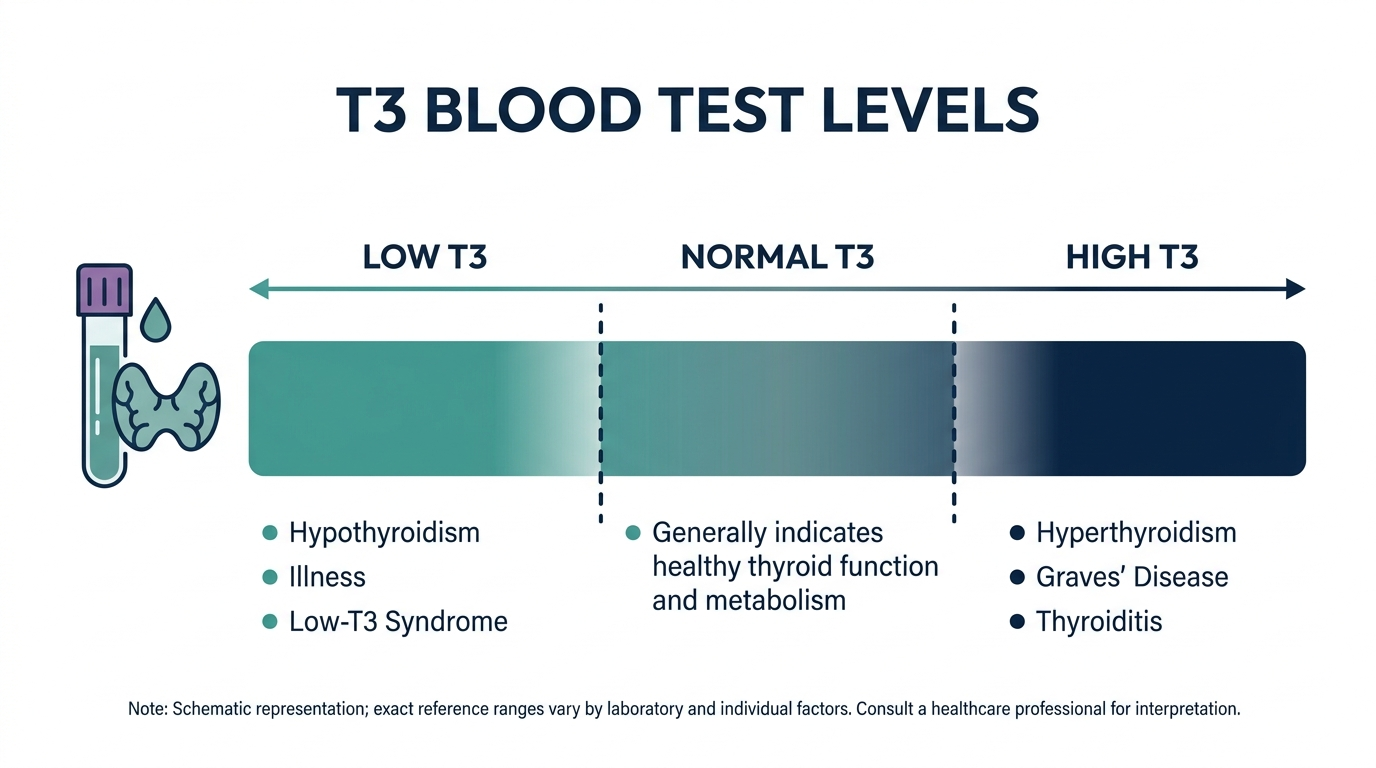
The first step is to review the full thyroid picture, because a low T3 means little without your TSH and free T4. See your doctor promptly if a low T3 comes with a clearly abnormal TSH, symptoms of hypothyroidism, or if you were recently very ill, since the testing context changes the interpretation entirely.
Practical next steps include:
- Ask for the matching TSH and free T4 from the same draw, since the pattern across all three is what guides diagnosis (Cleveland Clinic).
- Mention any recent illness, surgery, fasting, or new medication, all of which can lower T3 temporarily.
- Repeat testing after recovery if the low T3 was drawn during an acute illness, because the number often normalizes on its own.
- Seek urgent care for severe symptoms such as marked confusion, very slow heart rate, or extreme cold intolerance.
Two real-world patterns behind a low T3
Scenario one: the hospital lab. Someone admitted with pneumonia has thyroid tests drawn as part of a broad panel. The T3 comes back low, the TSH is normal, and free T4 is near the bottom of normal. It looks worrying, but this is textbook nonthyroidal illness syndrome, the most common thyroid abnormality in hospitalized patients (StatPearls, NIH). No thyroid treatment is given. Weeks after the infection clears, a repeat panel is completely normal. The low T3 was a signal of how sick the body was, not a thyroid disease.
Scenario two: the outpatient with symptoms. A woman with months of fatigue, cold intolerance, and weight gain has a low T3, but this time her TSH is clearly high and free T4 is low. That combination points to genuine primary hypothyroidism, and here the thyroid, not a passing illness, is the driver. She starts and titrates thyroid hormone replacement under her doctor, and her symptoms and numbers improve together. Same low T3, opposite meaning, decided entirely by the company it keeps.
The insider nuance most charts skip
Here is what experienced clinicians watch for that a simple high or low flag misses: in nonthyroidal illness syndrome the reverse T3 level is typically elevated, which helps distinguish a stressed but healthy thyroid from true hypothyroidism (StatPearls, NIH). True primary hypothyroidism usually pushes TSH up and free T4 down, while nonthyroidal illness tends to leave TSH low or normal with a high reverse T3.
This is why a standalone T3 test is one of the weaker ways to screen for thyroid disease. A low T3 is best treated as a prompt to look at the whole axis, not as a verdict. If your only abnormal value is a slightly low T3 and everything else is normal, the most likely explanation is a transient, non-thyroid cause rather than a disease that needs treatment.
Don’t just read about t3, track it.
A single result is a snapshot. Superpower re-tests t3 and 100+ markers over time so you can watch them move as you change sleep, food, and training.
Frequently asked questions
Is a low T3 always a sign of hypothyroidism?
No. The most common reason for low T3 is nonthyroidal illness syndrome, seen in about 70 percent of hospitalized patients, where the thyroid is healthy (StatPearls). Hypothyroidism usually raises TSH and lowers free T4 first, so a low T3 alone does not confirm it.
What is a normal T3 level on a blood test?
For adults, total T3 is roughly 79 to 165 ng/dL and free T3 is about 2.3 to 4.1 pg/mL, per Cleveland Clinic. Ranges vary by lab and age, so check the reference range printed on your own report.
Can stress or illness lower my T3?
Yes. Acute infection, surgery, fasting, and chronic illness all slow the conversion of T4 into active T3 to conserve energy. This is why a low T3 drawn during illness often returns to normal once you recover.
Should low T3 be treated with thyroid medication?
Usually not when it is caused by nonthyroidal illness. Treating that low T3 with thyroid hormone has not been shown to help and may cause harm (StatPearls). Doctors instead treat the underlying illness and recheck the thyroid afterward.
What other tests go with a T3 result?
TSH and free T4 are the key companions. The pattern across all three, sometimes plus reverse T3, is what tells your doctor whether a low T3 reflects a thyroid problem or simply the body responding to illness (Cleveland Clinic, StatPearls).
What is the difference between total T3 and free T3?
Total T3 measures all triiodothyronine, including the part bound to carrier proteins, while free T3 measures only the active unbound fraction. They use different units and scales, so a normal free T3 near 3 pg/mL is not comparable to a total T3 near 120 ng/dL. Low carrier proteins can lower total T3 without truly lowering active hormone (Cleveland Clinic).
Can dieting or fasting cause a low T3?
Yes, and it is common. Prolonged fasting, very low calorie diets, and aggressive low carbohydrate eating all reduce T3 as the body conserves energy. This is a normal metabolic adaptation rather than thyroid disease, and T3 usually recovers when calorie intake returns to normal.
What is reverse T3 and why does it matter?
Reverse T3 is an inactive form the body makes from T4 during stress and illness instead of active T3. A high reverse T3 alongside a low T3 favors nonthyroidal illness syndrome over true hypothyroidism, which is why clinicians sometimes add it when the pattern is unclear (StatPearls, NIH).
Do selenium or zinc affect T3?
They can play a supporting role, because the deiodinase enzymes that convert T4 into T3 depend on selenium, and zinc is involved in thyroid hormone metabolism. A clear deficiency may impair conversion, but supplementing beyond your needs does not push a normal thyroid higher and is not a treatment for low T3. Discuss any supplement plan with your clinician.
How soon should I recheck a low T3?
If the low T3 was drawn during an illness, surgery, or a period of heavy dieting, most clinicians recheck a few weeks after you have recovered, since the number often normalizes on its own. If your TSH and free T4 are clearly abnormal too, your doctor will usually act sooner rather than waiting, because that combination is more likely to reflect a genuine thyroid problem.
Sources
- Cleveland Clinic, Triiodothyronine (T3) Test
- StatPearls, NIH, Euthyroid Sick Syndrome (Nonthyroidal Illness Syndrome)
- Endotext, NIH, The Non-Thyroidal Illness Syndrome
This article is for general educational purposes and is not medical advice. It cannot diagnose or treat you and does not replace your clinician. Always discuss your lab results and any health decisions with a qualified healthcare professional.
Related: compare at-home thyroid hormone tests.
Vital Signs Today may earn a commission if you buy through links on this page. It does not affect our editorial assessments.