
Last updated 18 June 2026. Educational content only, not medical advice. Tesamorelin is a prescription peptide. Talk to a licensed clinician before pursuing any peptide therapy.
Short answer: The only legal way to get tesamorelin for human use in the United States is through a licensed physician’s prescription, filled at a compounding pharmacy or dispensed as brand-name Egrifta WR. As of mid-2026, telehealth clinics including Defy Medical, Wellcore, and TeleWellnessMD offer compounded tesamorelin for off-label visceral fat and metabolic optimization goals at $250 to $500 per month, a fraction of the $2,400 to $2,800 monthly cost of brand-name Egrifta WR. Research-chemical vials exist and are cheaper; they are also unverified, unregulated, and legally in a very different category the moment you inject them.
Getting tesamorelin means finding a prescriber, but finding out if you even need it starts with a blood panel. One at-home Superpower draw checks 100+ biomarkers, physician-reviewed.
Why are people suddenly searching for tesamorelin?
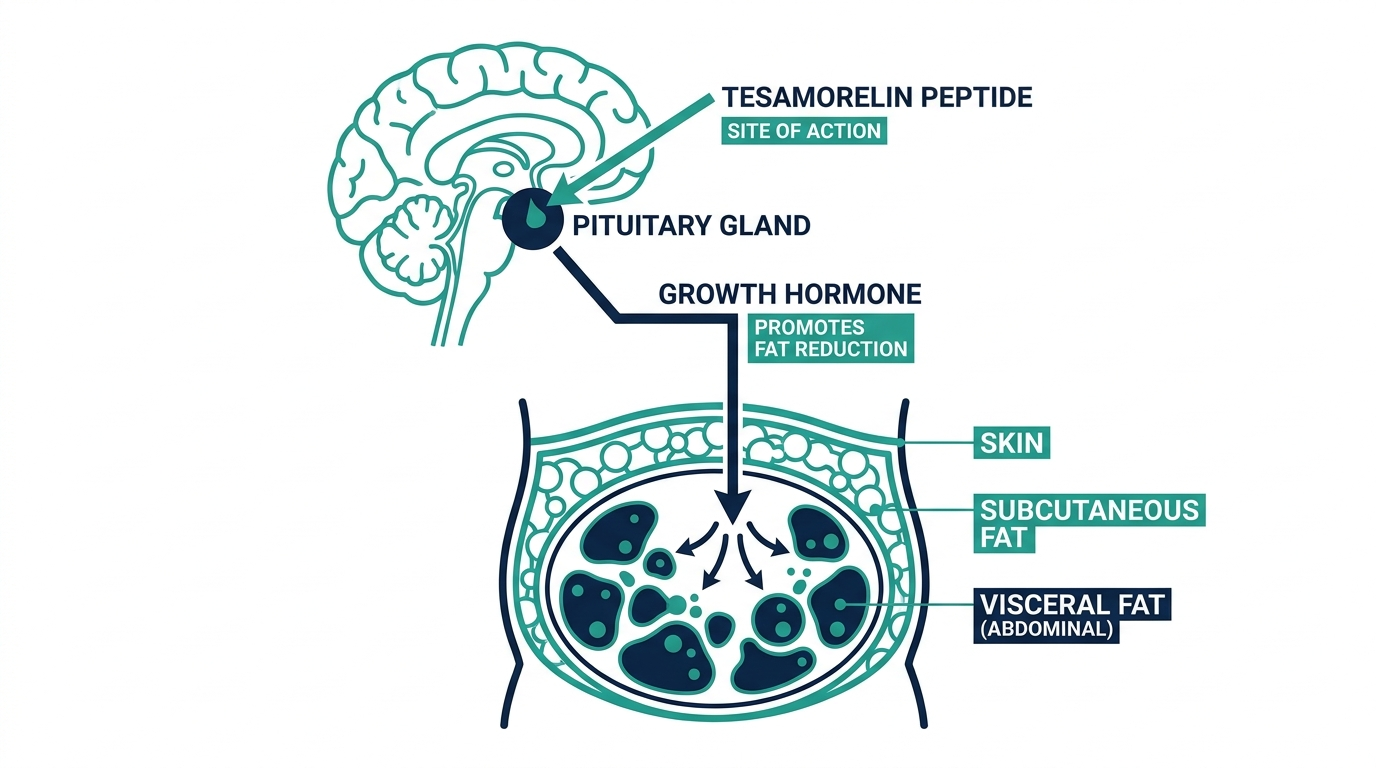
For most of the 2010s, tesamorelin was a niche HIV medication. The FDA approved it in 2010 under the brand name Egrifta for HIV-associated lipodystrophy, a condition where antiretroviral drugs cause abnormal fat accumulation around the abdomen, and it stayed quietly in that lane while the internet was busy debating BPC-157 and CJC-1295.
Then a pair of things happened in succession. First, a 20-week randomized controlled trial published in JAMA Internal Medicine showed that tesamorelin improved executive function and attenuated cognitive decline in both healthy adults over 55 and people with mild cognitive impairment, a finding that had nothing to do with HIV. Second, the GLP-1 wave of 2024 to 2025 trained a large, motivated audience to think about metabolic drugs in terms of mechanism and data, and those people started asking what else had actual clinical evidence behind it. Tesamorelin had a lot of actual clinical evidence behind it. The searches followed.
The result is that by 2026, tesamorelin is being prescribed off-label at a meaningful scale for visceral fat, metabolic health, and increasingly, cognitive aging, by a set of telehealth clinics that have figured out how to work inside a prescription framework. That framework matters. Getting it wrong is the mistake most buyers make, and it is worth understanding before you start pricing vials.
Full-body lab membership: 100+ biomarkers, doctor-reviewed, tracked over time.
What tesamorelin actually does, and why the clinical data is different from most peptides
Most peptides discussed on longevity forums have thin or zero human trial data. Tesamorelin is the exception. Because it is FDA-approved for an indication requiring rigorous proof, it has a published Phase III program, peer-reviewed mechanistic data, and long-term safety studies with real patient numbers. Understanding that data is how you tell a legitimate provider from one selling hope in a vial.
The visceral fat mechanism. Tesamorelin is a synthetic analog of growth hormone releasing hormone (GHRH) with a trans-3-hexenoic acid modification that extends its half-life to roughly 26 minutes, compared to about 10 minutes for unmodified GHRH and about 10 to 12 minutes for sermorelin. It tells the pituitary to pulse growth hormone the way it naturally would, which preserves the somatostatin feedback loop that prevents runaway IGF-1 elevation. The result is a targeted increase in GH that is meaningfully different from injecting synthetic HGH directly.
What the Phase III trials actually showed. Across two multicenter, double-blind, placebo-controlled Phase III trials, tesamorelin at 2 mg daily for 26 weeks reduced visceral adipose tissue by approximately 15 to 18%. Appendicular lean mass tended to increase while trunk fat fell. IGF-1 rose by a mean of roughly 108 ng/mL but remained within normal physiological range across the trial population.
The NAFLD finding, the one most people miss. A randomized, double-blind multicenter trial published in PMC showed that 12 months of tesamorelin at 2 mg daily reduced hepatic fat by an average of 37% in HIV patients with nonalcoholic fatty liver disease and significantly slowed fibrosis progression. For context, that 37% hepatic fat reduction is among the largest effects any pharmaceutical has produced in NAFLD, a condition with very few effective treatments. No wellness influencer talks about this because it was studied in HIV patients, but the mechanism is the mechanism.
The cognitive angle. A 20-week randomized trial of 152 participants aged 55 to 87, including both healthy adults and people with mild cognitive impairment, found that tesamorelin at 1 mg daily improved executive function (P=.005), produced favorable overall cognition (P=.03), and attenuated the expected cognitive decline in the MCI group. Brain GABA levels increased and a metabolite linked to Alzheimer’s pathology decreased. IGF-1 receptors are concentrated in the hippocampus and prefrontal cortex, which suggests a plausible mechanism. This is not a proven Alzheimer’s treatment. It is a signal worth tracking.
Personally, the cognitive data is what separates tesamorelin from most peptides people ask about. Visceral fat reduction in a population that is metabolically compromised is one thing. A measurable executive function improvement in healthy older adults is a harder result to explain away.
The legal reality in 2026: three routes, very different risk profiles
Telehealth GLP-1 program with provider visits and pharmacy coordination.
Getting tesamorelin is not complicated if you stay in the right lane. The complexity comes from the fact that three different options exist, they look superficially similar online, and they carry completely different legal and safety profiles.
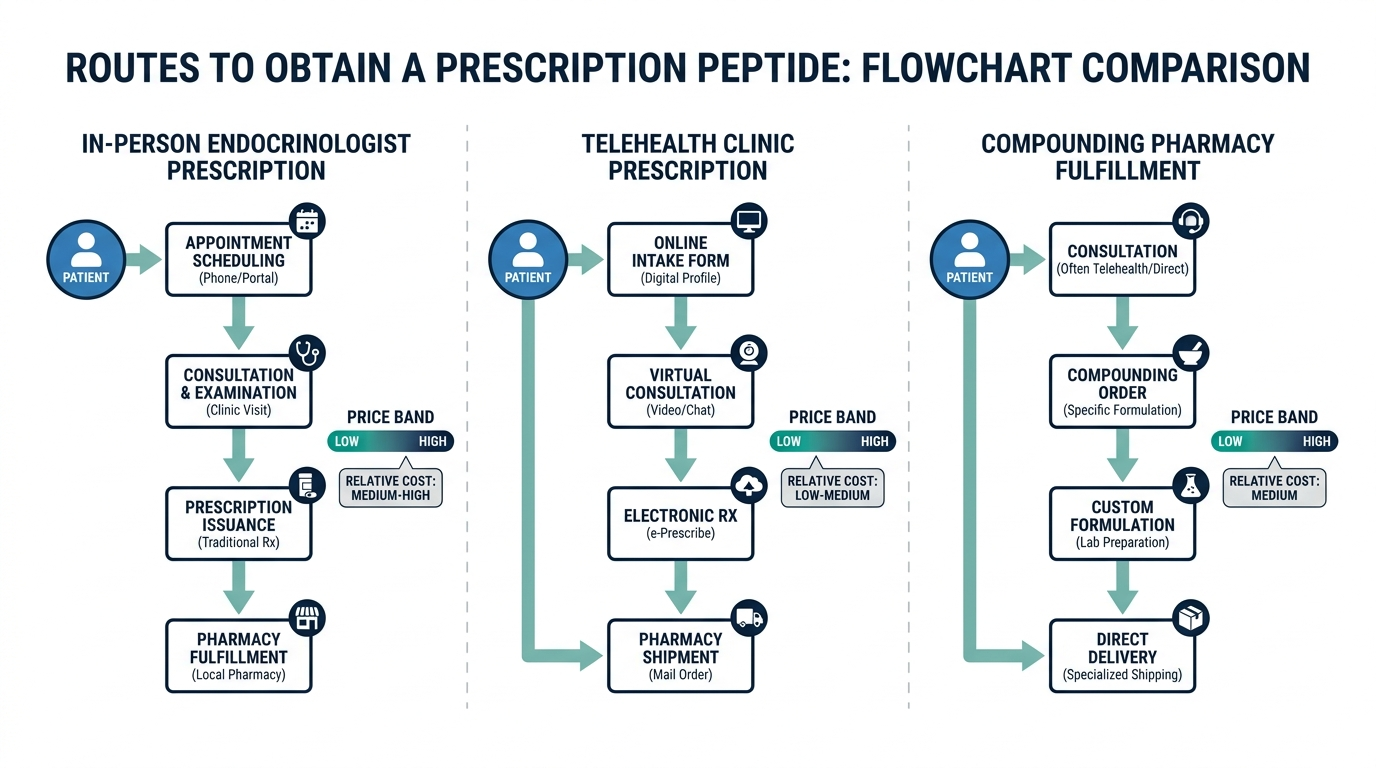
Route 1: Brand-name Egrifta WR (prescription, fully legal, very expensive). On March 25, 2025, the FDA approved Egrifta WR, the latest formulation of tesamorelin from Theratechnologies, designed for weekly reconstitution rather than daily. The brand price runs approximately $2,400 to $2,800 per month. Insurance coverage is generally limited to the approved HIV-lipodystrophy indication. For off-label wellness use, no insurance will touch it. This route is available, but it is not where most non-HIV patients end up.
Route 2: Compounded tesamorelin via licensed telehealth (prescription, legal, the practical route). Because tesamorelin is FDA-approved and on the bulk drug substances list, compounding pharmacies operating under Section 503A and 503B of the Federal Food, Drug and Cosmetic Act can legally compound it when a licensed physician prescribes it. This is the route that has built the current off-label market. A telehealth physician conducts intake, reviews labs, and sends a prescription to a named 503A or 503B pharmacy, which ships directly to you. Cost: typically $250 to $500 per month for the compounded medication, depending on dose and provider, with additional fees for the clinical consultation and labs.
Route 3: Research-chemical vendors (grey market, legally risky, quality uncertain). Research-grade tesamorelin vials are sold online as “not for human use.” A 10 mg vial runs roughly $60 to $150. No physician, no pharmacy oversight, no verified purity. The moment you inject it, you have left every legal protection the “research use” label offered. Unlike BPC-157 or TB-500, which have broad grey-market discussion communities, tesamorelin research vials are less commonly tested by third-party platforms like Finnrick, which means quality data is thinner. Do not believe the vendor’s own Certificate of Analysis unless you can verify it through the testing lab’s own key lookup system.
The practical gap between Routes 2 and 3 is smaller in price than it used to be, and far larger in accountability than it appears. A compounding pharmacy is regulated, inspected, and named on the prescription. A research-chem vendor is none of those things.
Which telehealth clinics actually prescribe tesamorelin?
This is the question most pages avoid answering with specifics, so here are the names that surface consistently in mid-2026.
Defy Medical (Tampa, FL, telehealth nationwide) explicitly offers tesamorelin within its peptide therapy program. Defy is one of the older and more established hormone optimization clinics in the US, with an actual physical location and a track record in TRT and GH peptides that predates the current telehealth boom. Pricing for peptide therapy at Defy runs toward the $200 to $400 range monthly depending on protocol, separate from consultation and lab fees.
Wellcore prescribes both tesamorelin standalone and a tesamorelin plus ipamorelin combination. Their model uses a low-cost initial consultation (listed at $34) with medication pricing determined during the clinical review. The combination with ipamorelin pairs a GHRH-pathway peptide with a ghrelin-pathway peptide, a stack intended to amplify the GH pulse and commonly used in longevity medicine.
TeleWellnessMD lists tesamorelin on its prescription therapy menu. The clinic focuses on personalized wellness protocols and ships from compounding pharmacies.
Florida Surgery and Weight Loss Center offers tesamorelin peptide therapy in-person and via telehealth for Florida residents, which is relevant if you are in a state with stricter telehealth compounding rules.
A note on clinic vetting that does not appear on most comparison pages: ask specifically which compounding pharmacy they use, and whether that pharmacy is 503A or 503B registered. A legitimate clinic names the pharmacy without hesitation. If the answer is evasive, or if the clinic says “our pharmacy” without giving a name or registration, that is a warning sign.
What a legitimate provider requires before prescribing (and why this protects you)
The biggest operational difference between a real tesamorelin prescription and a research vial is not the molecule. It is everything that surrounds the molecule. A physician who understands tesamorelin will require the following before you get a prescription, and if they do not, you should ask why.
Pre-treatment labs, non-negotiable. Tesamorelin raises IGF-1. Chronically elevated IGF-1 is associated with increased cancer risk, particularly colorectal and prostate cancer. Every prescribing standard of care requires a baseline IGF-1 before starting therapy and periodic monitoring afterward, typically every 90 days. A provider who does not check IGF-1 baseline is not practicing safely. Additional labs typically include fasting glucose and HbA1c (because tesamorelin can modestly increase insulin resistance), a comprehensive metabolic panel, and a lipid panel.
A real clinical intake, not a checkbox. Tesamorelin is contraindicated in active malignancy, pregnancy, and hypersensitivity to GHRH analogs. A clinician should be asking about your history, current medications, and risk factors, not just approving everyone who fills out the intake form correctly.
Named pharmacy. Your medication should come from a registered 503A or 503B pharmacy that you can look up on the FDA’s database of registered compounders. Do not accept “shipped from our partner pharmacy” as an answer.
Structured follow-up. At 90 days, your IGF-1 should be rechecked. If it has risen above the upper limit for your age, a good clinician will lower the dose or pause therapy. This is not a theoretical concern; the prescribing information for Egrifta explicitly recommends dose adjustment if IGF-1 exceeds the normal range.
The insider reality here is that most of the risk people ascribe to the peptide itself is actually risk from unsupervised use. The Phase III trial had zero serious safety signals that stopped enrollment. The people ending up with problems in the community are largely those who bought a vial, guessed at a dose, and had no IGF-1 data.
Tesamorelin vs. sermorelin vs. CJC-1295 + Ipamorelin: which GH secretagogue belongs in which situation
One of the most common points of confusion in telehealth peptide discussions is the word “growth hormone peptides” being used to cover several compounds that work differently, cost differently, and have very different evidence bases. The table below separates them.
| Peptide | Mechanism | Half-life | Phase III human data | Typical cost (telehealth) | Best use case |
|---|---|---|---|---|---|
| Tesamorelin | GHRH analog (44 AA + trans-3-hexenoic acid) | ~26 min | Yes (FDA-approved) | $250 to $500/mo | Visceral fat reduction, liver fat, cognitive aging |
| Sermorelin | GHRH analog (29 AA, natural fragment) | ~10 min | Limited human data | $175 to $225/mo | Mild GH support, sleep quality, entry-level |
| CJC-1295 | GHRH analog + DAC modification | Days (with DAC) | No | $150 to $300/mo | Steady GH elevation, lean mass, often stacked |
| Ipamorelin | Ghrelin receptor agonist | ~2 hr | No | $100 to $200/mo (stacked) | GH pulse without cortisol/prolactin spike |
| Synthetic HGH | Direct GH replacement | ~15 to 20 hr | Extensive | $600 to $1,200+/mo | Genuine GH deficiency, verified by stimulation test |
The table reveals something the forum comparisons tend to gloss over: tesamorelin is the only GH-secretagogue with FDA-approved Phase III data, and it earned that data specifically for visceral fat reduction. If visceral fat, liver fat, or cognitive function is your stated goal, the evidence points here, not to sermorelin or the CJC-1295 stack. If general GH support, sleep quality, or lean mass is the goal, sermorelin or ipamorelin are cheaper and have a longer telehealth prescription track record.
Do not believe the framing that sermorelin is “the same thing, just weaker.” Sermorelin is a 29-amino-acid fragment that corresponds to the active portion of natural GHRH. Tesamorelin is a 44-amino-acid full-length analog with a structural modification that doubles its half-life and produces meaningfully larger IGF-1 and GH responses. They are not the same drug at different doses.
The Egrifta WR upgrade and what it means for access
On March 25, 2025, Theratechnologies received FDA approval for Egrifta WR, the F8 formulation of tesamorelin. The practical change: Egrifta WR is reconstituted once weekly rather than daily, a meaningful convenience upgrade for patients who found the original Egrifta SV’s daily reconstitution tedious. Egrifta WR and Egrifta SV are not substitutable; they differ in concentration, vial count per dose, and reconstitution instructions.
The commercial impact for non-HIV users is limited, because the brand price remains in the $2,400 to $2,800 range. But the existence of an actively marketed brand-name product matters for compounding: it signals that Theratechnologies is still invested in the molecule, the pharmacy supply chain for raw tesamorelin remains robust, and the regulatory framework supporting compounded versions is unlikely to collapse in the near term. Compounded tesamorelin survives on the bulk drug substances list as long as the API (active pharmaceutical ingredient) remains available and a prescriber’s clinical rationale holds up.
What does it actually feel like to start tesamorelin? The timeline most guides skip
Forum reports and clinical trial data are not the same thing, but they do converge on a few consistent patterns worth knowing before you commit to three months of injections.
Weeks 1 to 2. Water retention and mild bloating are the most common early reports, following the physics of GH elevation. Some people notice a subtle shift in sleep depth within the first two weeks, consistent with GH’s known role in slow-wave sleep. Injection site reactions, usually redness or mild itching, are most common early and tend to diminish.
Weeks 4 to 8. The visceral fat reduction starts to become physically apparent for many users around week 6 to 8. The Phase III trial used imaging at 26 weeks to confirm the 15 to 18% reduction, but the waist circumference changes show up sooner in the mirror than they do on a DEXA scan. Energy and recovery quality tend to improve in this window.
Weeks 12 to 26. This is when the clinical trial data is most meaningful. The randomized trial that showed 37% liver fat reduction ran for 12 months. The cognitive function trial ran for 20 weeks. The fat loss result you can read in imaging studies is real, but it requires duration. Anyone promising dramatic transformation in 30 days is selling something different from what the science measured.
Side effects and the red lines that should prompt a dose adjustment
The published side effect data from tesamorelin’s Phase III program is generally reassuring, with a caveat worth understanding before you start.
Common, generally mild: injection site reactions (redness, itching, pain at the injection site) are the most frequent complaint. Peripheral edema, joint pain (arthralgia), and muscle aches appear in a small percentage of users and typically resolve with dose reduction.
The metabolic caution. Because GH opposes insulin at the cellular level, tesamorelin can modestly worsen insulin resistance, particularly in people with pre-existing metabolic vulnerabilities. A PLOS ONE randomized controlled trial found tesamorelin safe in patients with type 2 diabetes, but with monitoring required. If your fasting glucose or HbA1c rises meaningfully after starting therapy, that is a clinical signal, not something to explain away with “that’s normal on peptides.”
The IGF-1 red line. If your follow-up IGF-1 is elevated above the normal range for your age, the correct clinical response is dose reduction or a break, not continuation. Sustained supraphysiological IGF-1 is associated with increased cancer risk in epidemiological data. A real clinician runs the lab and adjusts. A bad provider ignores the result.
Tesamorelin is also contraindicated in active or suspected malignancy. If you have a current cancer diagnosis, personal or family history of GH-sensitive tumor types, or are on chemotherapy, this is not your peptide.
Turn what you just learned into action.
Superpower lets you test 100+ biomarkers from home, then re-check them over time so you can actually see progress, physician-reviewed at every step.
Frequently asked questions
Is tesamorelin a controlled substance?
No, tesamorelin is not a controlled substance under the Controlled Substances Act. It is a prescription drug requiring a licensed physician’s order, but it is not scheduled in the same category as testosterone or growth hormone. That said, research-chemical vendors selling it without a prescription are operating outside FDA drug distribution rules, and buyers assume the full regulatory and quality risk.
Can I get tesamorelin prescribed for weight loss if I do not have HIV?
Yes, off-label. Tesamorelin’s FDA approval is specifically for HIV-associated lipodystrophy, but physicians can legally prescribe any approved drug off-label when clinical judgment supports it. Many telehealth metabolic clinics in 2026 prescribe compounded tesamorelin for visceral fat reduction, NAFLD, and metabolic syndrome in non-HIV patients. You need a willing prescriber and a compounding pharmacy that fills off-label orders, both of which are readily available.
How does tesamorelin compare to semaglutide for fat loss?
Different mechanisms, different fat depots, different evidence bases. Semaglutide (Ozempic/Wegovy) is a GLP-1 receptor agonist that produces 10 to 15% total body weight loss across trials, mainly through appetite suppression. Tesamorelin specifically targets visceral adipose tissue, the deep abdominal fat surrounding organs, rather than total body weight. The two are not head-to-head competitors; in fact, some longevity clinicians are starting to combine them for patients with both high total body fat and disproportionate visceral accumulation.
What labs should I get before starting tesamorelin?
At minimum: IGF-1 (baseline and every 90 days on therapy), fasting glucose and HbA1c, a comprehensive metabolic panel, and a lipid panel. If you have risk factors, add a PSA for men over 40 and consider a DEXA or CT scan for visceral fat quantification so you can actually measure the result.
How long do I need to take tesamorelin to see results?
Meaningful visceral fat reduction in clinical trials was measured at 26 weeks with consistent dosing. The cognitive function trial ran 20 weeks. Six months is the minimum meaningful trial period. Users who quit at 6 to 8 weeks because their scale did not move are measuring the wrong thing at the wrong time.
Why is compounded tesamorelin so much cheaper than Egrifta WR?
Brand-name Egrifta WR carries the R&D, approval, and marketing costs of a regulated pharmaceutical. Compounded tesamorelin is synthesized from bulk API using existing manufacturing processes without those upstream costs. The molecule is the same; the supply chain and accountability structure are very different. The compounded version is produced under FDA oversight through registered 503A/503B pharmacies, but it does not carry the brand’s post-market safety program.
Does tesamorelin cause cancer?
No evidence from clinical trials suggests tesamorelin causes cancer. However, because it raises IGF-1 and GH, and because elevated IGF-1 is associated in epidemiological data with increased risk of certain cancers over long time horizons, it is contraindicated in people with active malignancy. IGF-1 monitoring exists precisely to ensure levels do not stay chronically elevated, and no prescribing physician should be leaving IGF-1 unchecked.
Telehealth GLP-1 program with provider visits and pharmacy coordination.
Author: Vital Signs Today Editorial Team, [credential]”]. Educational content, not medical advice. Sources linked inline.
Primary sources:
- Theratechnologies Egrifta WR FDA approval, March 25, 2025, GlobeNewswire
- Phase III visceral fat trial data, PMC
- Tesamorelin effect on liver fat/NAFLD, PMC randomized trial
- Tesamorelin cognitive function in aging, PubMed, JAMA Internal Medicine
- Tesamorelin safety in type 2 diabetes, PLOS ONE
- Tesamorelin LiverTox safety profile, NIH NCBI Bookshelf
- FDA bulk drug substances list, 503A compounding
- Wellcore tesamorelin product page
- TeleWellnessMD tesamorelin
- Innerbody tesamorelin 2026 guide
- PeptideDeck tesamorelin buying guide 2026
- Tesamorelin cost breakdown, RealPeptides
Related reading
Vital Signs Today may earn a commission if you buy through links on this page. It does not affect our editorial assessments.