Last updated 18 June 2026. Educational content, not medical advice. Most peptides sold online are labeled “for research use only” and are not approved for human use. Always consult a licensed clinician before using any injectable compound.
Short answer: Add bacteriostatic water slowly down the inside wall of the vial, never directly onto the powder; swirl gently, never shake; refrigerate at 2 to 8°C; and use within 28 days. Get the concentration math wrong by one decimal place and you are off by a factor of ten.
Why does reconstitution matter more than most guides admit?
Peptides arrive as a white or off-white lyophilized (freeze-dried) powder because that form is dramatically more stable. A 5 mg vial of BPC-157 stored at -20°C as dry powder retains potency for 12 to 24 months. Reconstitute that same vial and the clock resets to 28 days refrigerated before degradation becomes meaningful. Water-mediated reactions, hydrolysis, deamidation, and oxidation, cannot happen without water, so the manufacturer removes it entirely and ships you the raw powder.
Reconstitution is the process of putting that water back in a controlled, sterile way. Every instruction that follows exists to protect three things: sterility, molecular integrity, and dosing accuracy. A single shortcut can compromise all three simultaneously.
And the mistakes are more common than the forums suggest. Independent testing data from Finnrick, which has reviewed over 8,000 samples across 225 vendors, consistently shows that degradation in the field often traces back to handling errors and bad reconstitution, not just substandard powder to begin with.
Full-body lab membership: 100+ biomarkers, doctor-reviewed, tracked over time.
What solvent do you actually need?
This is the most misunderstood step, and using the wrong solvent can cause your peptide to clump, cloud, or simply not dissolve at all.
Bacteriostatic water (BAC water) is the correct choice for the vast majority of research peptides: BPC-157, TB-500, CJC-1295, Ipamorelin, PT-141, Sermorelin, Tesamorelin, Semaglutide, and Tirzepatide all reconstitute cleanly in BAC water. It contains 0.9% benzyl alcohol, which inhibits bacterial growth and makes the vial safe for multi-dose use for up to 28 days refrigerated. A 30 mL vial of Hospira-brand bacteriostatic water runs about $10 to $17 at retail pharmacies, no prescription needed, and GoodRx brings that down to roughly $10 at most chains (GoodRx).
Sterile water for injection has no preservative. Use it only if you know you have a benzyl alcohol sensitivity, and understand that a vial reconstituted with sterile water is effectively a single-use preparation, stable for 24 to 48 hours at most.
Acetic acid water (0.6%) is not a random upgrade. It solves a specific chemistry problem: peptides that are hydrophobic, rich in basic amino acids (arginine, lysine, histidine), or prone to aggregation at neutral pH. The compounds that routinely require it are GHK-Cu (copper peptide), AOD-9604, IGF-1 LR3, GHRP-2, GHRP-6, and Fragment 176-191. If you reconstitute any of these in BAC water and see persistent cloudiness or a gel forming, the issue is pH, not volume. Adding more solvent will not fix it.
The insider protocol for acid-dependent peptides is a two-step approach: dissolve first with 100 to 200 microliters of acetic acid water to achieve initial solubilization, then bring to final volume with BAC water. This preserves the antimicrobial benefit of benzyl alcohol in the finished solution while letting the acidic conditions do the dissolution work up front (Heritage Labs USA).
| Solvent | pH | Contains Preservative | Multi-Use Duration | Best For |
|---|---|---|---|---|
| Bacteriostatic water (0.9% benzyl alcohol) | ~5.7 | Yes | 21 to 28 days at 2-8°C | BPC-157, TB-500, CJC-1295, Ipamorelin, most standard peptides |
| Sterile water for injection | ~6-7 | No | 24 to 48 hours only | Benzyl alcohol-sensitive users, single doses |
| Acetic acid water (0.6%) | ~3.0 | No | 48 to 72 hours alone | GHK-Cu, IGF-1 LR3, AOD-9604, GHRP-2/6, Fragment 176-191 |
| Acetic acid + BAC water (two-step) | ~3 then ~5.7 | Yes (final solution) | 21 to 28 days at 2-8°C | Acid-dependent peptides needing multi-dose stability |
Do not guess which category your peptide falls into. Check the Certificate of Analysis (COA) or the manufacturer’s data sheet. “Reconstitution solution” listed on a vendor’s site usually means acetic acid water, and they are not being coy about it.
The eight-step reconstitution process
Speed is the enemy here. The whole process takes under five minutes, but rushing any single step can degrade 30 to 40% of the peptide before you draw the first dose (SeekPeptides).
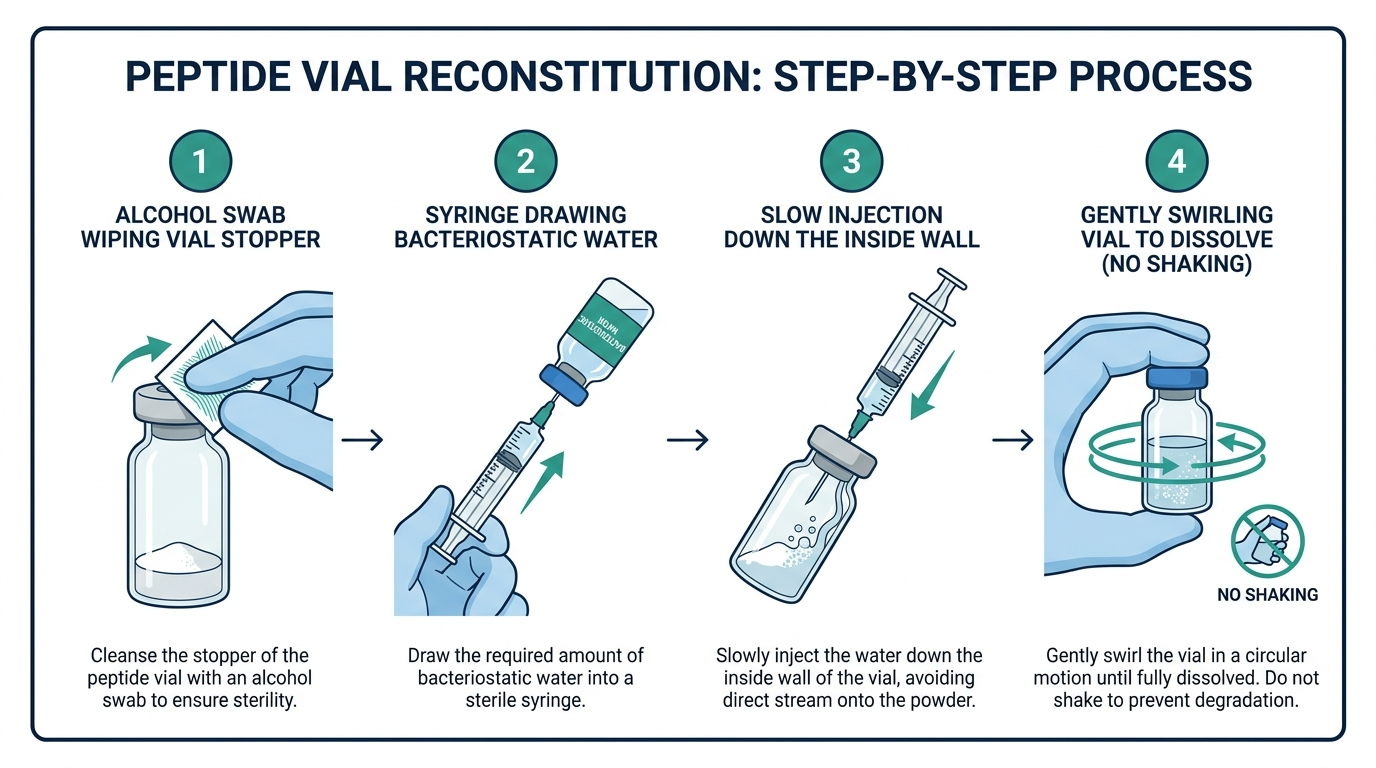
Step 1: Temperature equilibration. Remove the lyophilized vial from the freezer or refrigerator and let it sit at room temperature for 10 to 15 minutes. Lyophilized peptides are hygroscopic, meaning they readily absorb ambient moisture. Opening a cold vial in a warm room creates condensation inside the glass, which is uncontrolled, contaminated water making first contact with your powder. Let the temperature equalize before you break the seal.
Step 2: Hygiene. Wash hands thoroughly. Gloves are better. Skin oils and bacteria are the threat here, not dramatic contamination from the air.
Step 3: Sterilize the stoppers. Wipe the rubber stopper on both the peptide vial and the BAC water vial with a fresh 70% isopropyl alcohol swab. Wait 5 to 10 seconds for the alcohol to dry completely before inserting a needle. Injecting through wet alcohol introduces it into the solution, and it stings in tissue; more importantly, wet alcohol has not finished its antiseptic work yet.
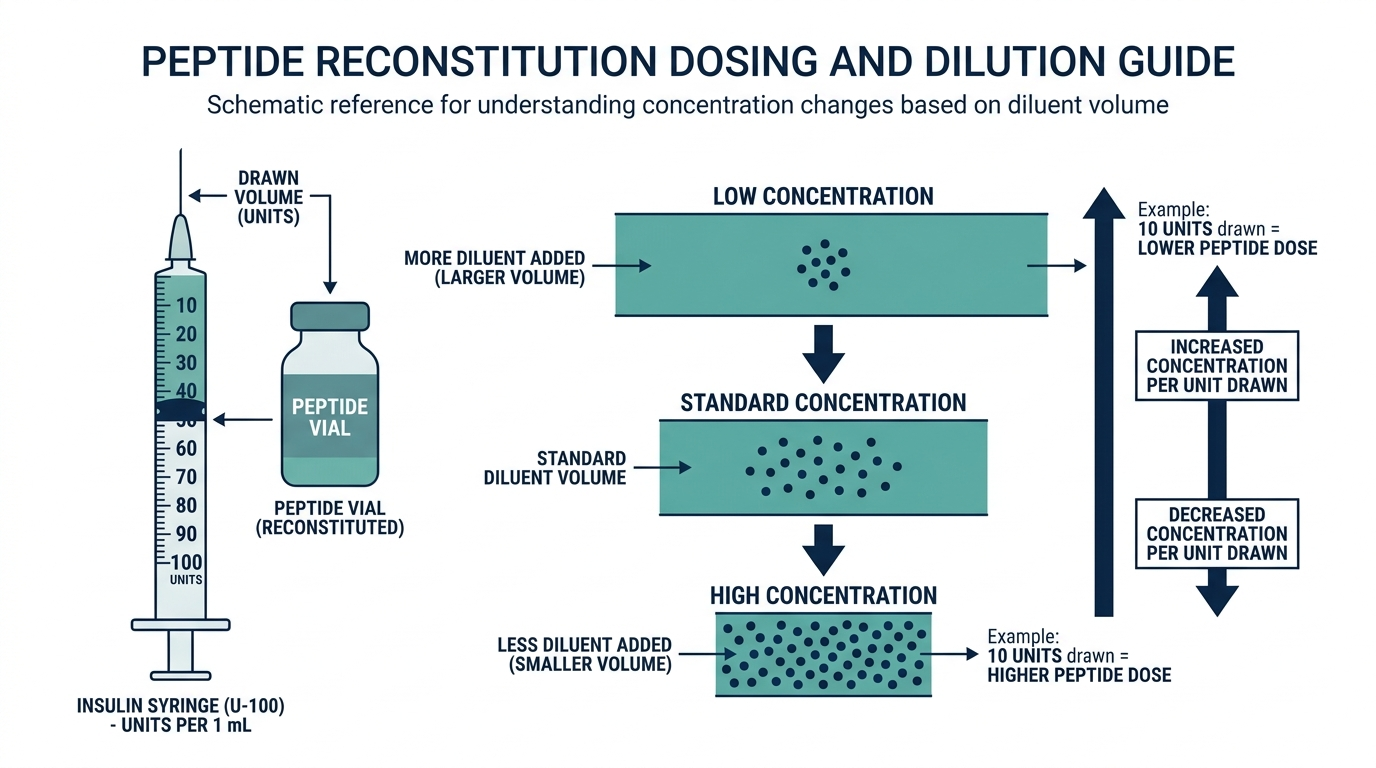
Step 4: Draw the solvent. Using a sterile insulin syringe, pull back the plunger and draw your target volume of bacteriostatic water. A 1 mL (100-unit) U-100 insulin syringe is standard. If your target concentration requires 2 mL total, use two syringes or draw twice.
Step 5: The wall drop. This is the single most important physical technique in the entire process. Insert the needle through the peptide vial stopper and angle the tip so it touches the inside glass wall, not the powder cake below. Push the plunger slowly, letting the solvent run down the glass and pool at the base rather than landing directly on the powder with force. Direct impact from a jet of liquid causes two problems: it physically fragments the lyophilized cake into clumps that are harder to dissolve, and if done fast enough, it creates shear stress at the molecular level. With fragile, larger-chain peptides, that shear can denature them before they are even in solution (Heritage Labs USA).
Step 6: Gentle swirling only. Once the solvent is in, gently rotate the vial in circular motions or roll it slowly between your palms. Do not shake it, do not vortex it, do not tap it aggressively on a hard surface. Vigorous shaking forces air from above the liquid into the solution as micro-bubbles. At those air-water interfaces, peptide molecules unfold and aggregate. The foam you see is not just cosmetic; it is partially denatured protein. Most peptides dissolve within 3 to 5 minutes of gentle swirling. Stubborn peptides may need 15 to 30 minutes of intermittent rotation, followed by overnight at 4°C for full dissolution (Verified Peptides).
Step 7: Visual inspection. The reconstituted solution should be clear and colorless or very faintly tinted. Persistent cloudiness, visible particles, or a gel-like consistency are warning signs. Cloudiness in a peptide that should dissolve in BAC water almost always means wrong solvent choice (pH mismatch). Visible particles could indicate contamination or protein aggregation. Do not use a cloudy or particulate solution.
Step 8: Label the vial. Write the reconstitution date, the solvent used, and your calculated concentration on the vial or on a label. This is not optional recordkeeping; it is how you track the 28-day clock and avoid concentration errors when you draw your next dose.
How to calculate concentration and dose volume
This is where most errors actually happen, and the math is not complicated once you see it clearly.
The fundamental formula is:
Concentration (mcg/mL) = Peptide amount (mcg) divided by solvent volume (mL)
A standard 5 mg vial contains 5,000 mcg. Add 1 mL of BAC water: concentration is 5,000 mcg/mL. Add 2 mL: concentration is 2,500 mcg/mL.
Now the dose volume:
Volume to draw (mL) = Target dose (mcg) divided by concentration (mcg/mL)
On a U-100 insulin syringe, every unit mark equals 0.01 mL, and the full barrel (100 units) equals 1 mL. So your draw in syringe units is:
Syringe units = Volume (mL) multiplied by 100
Three worked examples to make this concrete:
- 5 mg vial + 1 mL BAC water = 5,000 mcg/mL. A 500 mcg target dose: 500 divided by 5,000 = 0.1 mL = 10 units on a U-100 syringe.
- 5 mg vial + 2 mL BAC water = 2,500 mcg/mL. A 250 mcg target dose: 250 divided by 2,500 = 0.1 mL = 10 units again. Same draw volume, different concentration, same dose.
- 10 mg vial + 2 mL BAC water = 5,000 mcg/mL. A 1,000 mcg target dose: 1,000 divided by 5,000 = 0.2 mL = 20 units.
The critical insight most beginners miss: the draw volume that produces a given dose depends entirely on the concentration you chose, not on the vial size. Add 1 mL to a 5 mg vial and the dose math is entirely different from adding 2 mL to that same vial. Neither is “correct” in the abstract; the concentration you choose should match the practical syringe volume that makes your target dose easy to draw accurately.
Personally, I think the community underemphasizes this point: concentrate too high and you are trying to draw 2 or 3 units on a syringe that is honestly hard to read below 5 units. Concentrate too low and you are drawing 50 to 80 units for a single dose, which increases the volume of benzyl alcohol you are delivering with it. A middle concentration, roughly 2 to 5 mg/mL, usually puts most therapeutic-range doses in the 10 to 25 unit window, which is where U-100 syringes are most readable and accurate.
Do not believe anyone who tells you the math is “too complicated” and sells you a pre-configured kit at a markup to avoid it. Two minutes with a calculator is all it takes.
How to store reconstituted peptides correctly
Lyophilized peptides can survive years at -20°C. Reconstituted peptides cannot. Once water is added, degradation reactions begin, and temperature is the main variable you control.
Refrigerated at 2 to 8°C: reconstituted peptides in BAC water are generally stable for 21 to 28 days. Some sources extend this to 4 to 6 weeks for certain compounds, but 28 days is the conservative, defensible number and the one to use for anything you are uncertain about.
Frozen at -20°C: if you need to store beyond 28 days, pre-portion the reconstituted solution into individual aliquots (single-dose syringes capped with tip covers, or small microtubes) and freeze them. Frozen reconstituted solutions can last 2 to 3 months. The key rule is never refreeze a thawed aliquot. Each freeze-thaw cycle causes physical damage to the amino acid chain and measurable loss of potency.
Light and temperature fluctuation: store vials upright in the back of the refrigerator, away from the door (which fluctuates with every open), and away from direct light. Light, especially UV, accelerates oxidation of cysteine-containing peptides.
A practical detail nobody puts in beginner guides: the 28-day clock starts the moment you first puncture the stopper with a needle, not when you add the solvent. Strictly speaking, even the bacteriostatic properties of benzyl alcohol are not infinite. USP sterility studies show preservative efficacy begins to degrade measurably at approximately 4 weeks of refrigerated multi-draw use, even under correct aseptic technique.
Full-body lab membership: 100+ biomarkers, doctor-reviewed, tracked over time.
What goes wrong: the five most common reconstitution mistakes
Mistake 1: Injecting solvent directly onto the powder. The force of the liquid hitting the lyophilized cake fragments it into clumps and potentially denatures fragile peptides through shear stress. Always use the wall-drop technique described above.
Mistake 2: Shaking the vial. This is the mistake that can lose 30 to 40% of potency before the first dose is even drawn. Air-water interfaces created by foam physically denature proteins. Gentle swirling only.
Mistake 3: Using the wrong solvent. Reconstituting GHK-Cu or IGF-1 LR3 in BAC water instead of acetic acid water produces persistent cloudiness and incomplete dissolution. You will not get accurate dosing from a solution that has not fully dissolved.
Mistake 4: Skipping the temperature equilibration step. Opening a frozen vial in a warm room creates condensation on the inside of the glass. That moisture is uncontrolled, potentially bacterially contaminated, and it is the first thing that contacts the powder. Ten minutes at room temperature costs nothing.
Mistake 5: Using a COA from a vendor that was not batch-matched. This is not strictly a reconstitution error, but it belongs here because it is the upstream failure that makes every downstream step irrelevant. A well-executed reconstitution of a counterfeit or 75%-purity peptide is still a waste. Cross-check your vendor on Finnrick’s independent testing database before you reconstitute anything.
One myth worth busting directly: reconstituted peptides do NOT look milky or slightly cloudy “in some cases.” Clear solution is the only acceptable appearance for correctly reconstituted peptides in the right solvent. Persistent cloudiness is a problem, not a feature.
How the licensed clinical route handles reconstitution differently
This matters if you are comparing DIY research peptides against a clinic or compounding pharmacy setup, because the process is genuinely different, not just more expensive for the same thing.
A 503A compounding pharmacy, working under a physician’s prescription, prepares your peptide under USP 797 pharmaceutical cleanroom standards. The pharmacist calculates and verifies the concentration. The vial is labeled with the exact concentration, expiration date, beyond-use date, lot number, and prescribing physician. If a mistake happens, there is a licensed professional accountable for it.
The February 2026 HHS announcement that 14 previously restricted peptides, including BPC-157, TB-500, CJC-1295, Ipamorelin, and Thymosin Alpha-1, are moving back toward Category 1 compounding status means that the most popular therapy peptides are on a path to being legally available through exactly this channel, with a Pharmacy Compounding Advisory Committee meeting on 23 to 24 July 2026 expected to confirm the move (FDA).
The DIY route will always exist and will always be cheaper on the sticker. What it does not include: a pharmacist verifying the concentration, a physician reviewing your labs before you start, and any form of accountability if the powder in the vial is 75% of what the label says.
Frequently asked questions
Full-body lab membership: 100+ biomarkers, doctor-reviewed, tracked over time.
What is the best solvent for reconstituting peptides?
Bacteriostatic water (0.9% benzyl alcohol) is the correct choice for most research peptides including BPC-157, TB-500, CJC-1295, Ipamorelin, and Sermorelin. It allows safe multi-dose use for 21 to 28 days when refrigerated. Acetic acid water (0.6%) is required for specific compounds like GHK-Cu, IGF-1 LR3, GHRP-2, and AOD-9604 that will not fully dissolve at neutral pH.
How much bacteriostatic water do I add to a peptide vial?
There is no single correct answer; the amount you add sets your concentration, which determines your dose volume. For a 5 mg vial, adding 1 mL gives 5,000 mcg/mL (10 units on a U-100 syringe delivers 500 mcg), and adding 2 mL gives 2,500 mcg/mL (10 units delivers 250 mcg). Choose a concentration that places your target dose in the 10 to 25 unit range on a U-100 syringe for practical accuracy.
How long does a reconstituted peptide last?
Reconstituted in bacteriostatic water and refrigerated at 2 to 8°C, most peptides are stable for 21 to 28 days. Lyophilized (freeze-dried) powder stored at -20°C lasts 12 to 24 months. Do not freeze and thaw a reconstituted vial; pre-portion into aliquots before freezing if you need longer storage.
Why should you never shake a peptide vial?
Shaking forces air into solution as micro-bubbles. At those air-water interfaces, peptide molecules unfold and aggregate. The visible foam is partially denatured protein. Research estimates this mistake can destroy 30 to 40% of a vial’s potency before the first dose is drawn. Always swirl gently or roll between palms.
Can I reconstitute a peptide with regular water?
Regular tap water is not sterile and must never be used for reconstitution. Sterile water for injection is a legitimate option, but it has no preservative, so the reconstituted solution is stable for only 24 to 48 hours and must be treated as single-use. Bacteriostatic water is preferred for any multi-dose application.
What does cloudiness mean after reconstitution?
A clear solution is the only correct outcome for a properly reconstituted peptide in the right solvent. Persistent cloudiness, visible particles, or gel formation in a peptide that should dissolve in BAC water almost always indicates a pH mismatch, meaning the peptide needs an acidic solvent like acetic acid water instead. Adding more BAC water will not resolve the issue.
Is it legal to reconstitute peptides at home?
Possessing and reconstituting a “for research use only” peptide for personal use exists in a legal grey zone in the US. It is not currently prosecuted at the individual level. However, the safer and increasingly cost-competitive route in 2026 is a licensed telehealth clinic or compounding pharmacy, where reconstitution, dosing, and monitoring are all handled by licensed professionals. Several major therapy peptides including BPC-157 and TB-500 are pending reclassification to legal compounding status following the February 2026 HHS announcement.
Author: Vital Signs Today Editorial Team, [credential]”]. Educational content, not medical advice. Sources linked inline.
Primary sources:
– Heritage Labs USA: How to Reconstitute Peptides
– Heritage Labs USA: Acetic Acid Water vs BAC Water
– Verified Peptides: How to Reconstitute Lyophilized Peptides
– SeekPeptides: Peptide Vial Research Complete Guide
– GoodRx: Bacteriostatic Water Pricing 2026
– FDA: July 23-24, 2026 PCAC Meeting
– Finnrick: Independent Peptide Testing Database
– Onyx Biolabs: Peptide Stability Guide, Freezer vs Refrigerator Storage Protocols
– Peptide Dossier: Compounding Pharmacy Peptides Guide 2026
Related reading
Vital Signs Today may earn a commission if you buy through links on this page. It does not affect our editorial assessments.