
Last updated June 2026. Educational content, not medical advice. Consult a licensed clinician before making any health decisions based on biochemistry you read online.
Short answer: A peptide bond is a covalent amide linkage (CO-NH) formed when the carboxyl group of one amino acid reacts with the amino group of another, releasing one molecule of water. The bond has approximately 40% double-bond character due to resonance, which makes it rigid and nearly planar, and it is almost always found in the trans configuration in folded proteins.
Why does the question “which of the following correctly describes a peptide bond” show up on every biochemistry exam?
Because it targets exactly the cluster of facts most students confuse. Students mix up which groups react, which bond type forms, whether the bond is single or double, and why the geometry matters. The question is deliberately written with plausible wrong answers: “a bond between sp3-hybridized atoms,” “a bond usually found in the cis conformation,” “a bond formed by the carboxyl group and an R-group.” Each wrong answer captures a specific, common misread of the molecule. If you understand why every distractor is wrong, you understand the peptide bond.
The correct description almost always boils down to one of three accurate statements, depending on the option set:
- It is an amide bond (CO-NH), formed via dehydration synthesis between the carboxyl group of one amino acid and the amino group of the next.
- It displays resonance (partial double-bond character, roughly 40%), which makes the group planar and restricts rotation around the C-N bond.
- It is almost always in the trans configuration in real proteins, because the cis form is sterically disfavored.
All three are correct. Exactly which one the exam is asking for depends on the distractor set. Master all three, and no version of the question catches you off guard.
What is a peptide bond, precisely?
A peptide bond is the covalent chemical bond that links adjacent amino acids in a polypeptide or protein chain. Structurally, it is an amide bond with the notation -CO-NH-: a carbonyl carbon (C=O) on one side and a nitrogen (N-H) on the other. The bond forms between the alpha-carboxyl group of one amino acid and the alpha-amino group of the next (Wikipedia, Peptide Bond).
The word “covalent” is load-bearing here. Ionic bonds, hydrogen bonds, and van der Waals forces all participate in protein structure, but the peptide bond is the covalent backbone connection. Ionic and hydrogen bonds hold secondary and tertiary structure together once the backbone exists; they do not build the chain.
One thing that surprises most students: calling it a “peptide bond” does not mean it is unique to peptides. It is simply an amide bond that appears in the context of amino acid chains. The chemistry is identical to the amide bonds in nylon, for example.
How does a peptide bond form?
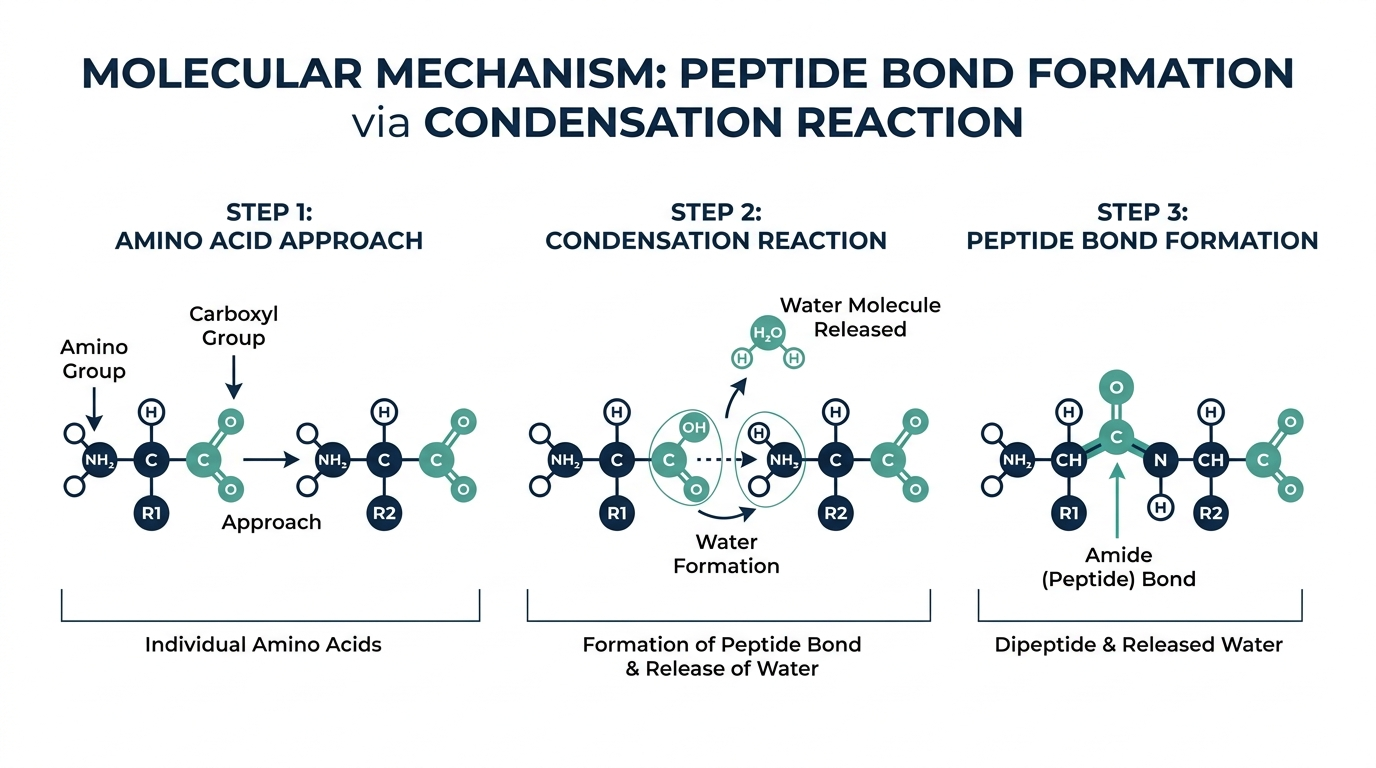
The reaction is a condensation reaction (also called dehydration synthesis), and the mechanism has three recognizable steps:
- The alpha-carboxyl group (-COOH) of one amino acid and the alpha-amino group (-NH2) of the incoming amino acid are positioned adjacent to each other.
- The carboxyl group donates its hydroxyl (-OH) and the amino group donates one hydrogen (-H). These combine to exit as one molecule of water (H2O).
- The remaining carbon and nitrogen form the new CO-NH bond, covalently joining the two residues into a dipeptide.
In living cells, this reaction does not happen spontaneously in water. Forming a peptide bond from free amino acids is actually endergonic (energy-consuming) in aqueous solution, because free amino acids exist as zwitterions and do not react readily (Verified Peptides, Bond Formation Overview). The ribosome solves this by coupling the reaction to the hydrolysis of the aminoacyl-tRNA ester bond, making the net process thermodynamically favorable.
Full-body lab membership: 100+ biomarkers, doctor-reviewed, tracked over time.
Why does the peptide bond have partial double-bond character?
This is the property most students get wrong on the exam, and it is also the one that drives almost everything interesting about protein structure.
The nitrogen atom next to the peptide carbonyl has a lone pair of electrons. Through resonance, those electrons delocalize into the carbonyl, creating two resonance structures: one with a C-N single bond and a C=O double bond, and one with a C=N double bond and a C-O single bond. Neither resonance form exists alone; the real bond is a weighted average of both (Chemistrylearner.com, Peptide Bond).
The result is measured, not estimated. The peptide C-N bond length is approximately 1.32 to 1.33 angstroms, meaningfully shorter than a typical C-N single bond (1.47 Å) but longer than a true C=N double bond (1.27 Å). That 40% double-bond character (AAT Bioquest, Why is peptide bond planar?):
- Makes the peptide group rigid and nearly planar: all four atoms (C, O, N, H) lie in the same plane.
- Prevents free rotation around the C-N bond.
- Forces the two flanking alpha-carbons into a fixed geometric relationship relative to each other.
This planarity does not trap the protein. The backbone still has two other rotatable bonds per residue: the phi (Φ) angle around the N-Cα bond and the psi (Ψ) angle around the Cα-C bond. These two angles are what the Ramachandran plot charts, and they account for the full conformational diversity of protein secondary structures like alpha-helices and beta-sheets. The rigid peptide plane is the constraint that makes those two angles the only variables worth plotting.
What is the correct configuration: cis or trans?
Nearly always trans. In the trans configuration, the two flanking alpha-carbons sit on opposite sides of the C-N bond (omega angle near 180°). In the cis configuration they sit on the same side (omega angle near 0°). The cis form forces two bulky side chains into close proximity, creating unfavorable steric clashes. As a result, well over 99% of peptide bonds in folded proteins are in the trans configuration (Biology LibreTexts, Main Chain Conformations).
The important exception is proline. Because proline’s side chain loops back to connect to the backbone nitrogen, the energy penalty for the cis form is much smaller. Roughly 5 to 6% of bonds preceding a proline residue adopt the cis configuration, versus about 0.05% for all other amino acids. This is not a footnote: proline cis-trans isomerization is a rate-limiting step in the folding of many proteins, and a class of enzymes called prolyl isomerases (including cyclophilins and FK-binding proteins) exist specifically to catalyze this interconversion.
Personally, I find the proline exception to be one of the most underappreciated facts in entry-level biochemistry. It shows that biology does not treat the “rules” as absolute, and that the 0.05% cis bonds that appear elsewhere in proteins are not noise: they often correspond to functionally important loop regions or binding sites.
How stable is a peptide bond, and how is it broken?
Surprisingly stable outside living systems. The spontaneous hydrolysis of a peptide bond in water at 25°C and neutral pH has a half-life of 350 to 600 years, depending on the specific residue pair (JACS, Rates of Uncatalyzed Peptide Bond Hydrolysis). That kinetic stability is what allows proteins to persist in biological tissues, dried samples, and, in some cases, fossil material.
Inside a living cell, that 500-year half-life is irrelevant because cells are full of proteases. Enzymes like trypsin, chymotrypsin, and pepsin cleave peptide bonds in milliseconds under the right conditions, by providing an active site that lowers the activation energy and positions a nucleophile (serine, cysteine, or a water molecule activated by a metal ion) to attack the carbonyl carbon. This enzymatic acceleration represents a rate enhancement on the order of 10^10 to 10^15 fold (Serine Proteases, Nature Scitable).
| Hydrolysis condition | Approximate rate |
|---|---|
| Neutral water, 25°C (spontaneous) | Half-life 350-600 years per bond |
| Strong acid or base, elevated temperature | Hours to days |
| Serine protease enzyme (trypsin, etc.) | Milliseconds |
| Metalloprotease (collagenase, MMP family) | Milliseconds to seconds |
Do not believe the idea that “strong” simply means “slow to break.” The peptide bond is kinetically stable but thermodynamically breakable: hydrolysis is actually exergonic (energy-releasing) under physiological conditions. The bond persists not because breaking it is uphill energetically, but because the activation energy is too high for water alone to clear.
How does the peptide bond differ from other bonds in protein structure?
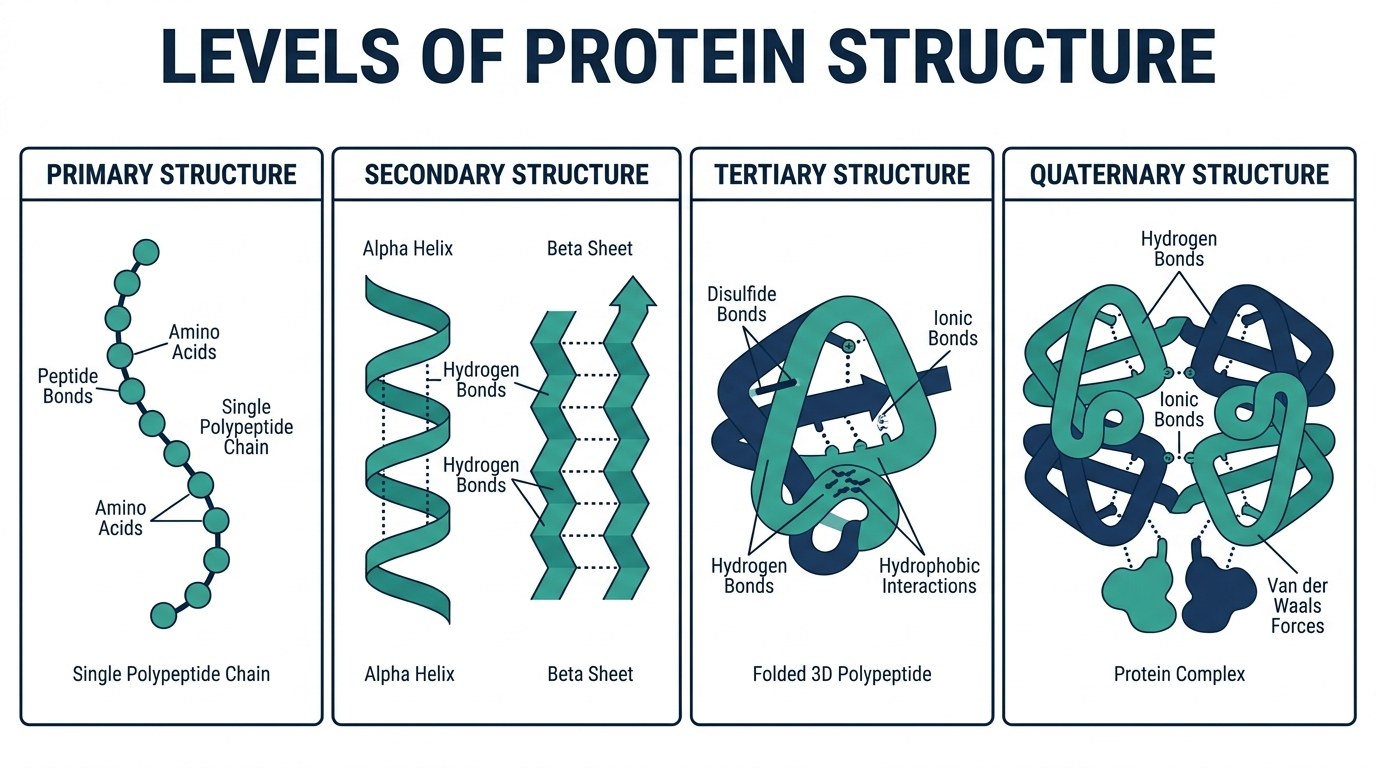
Students often conflate the bonds that build the polypeptide chain with the bonds that fold it. The comparison below clears that up.
| Bond type | Where it appears | Covalent? | Broken by |
|---|---|---|---|
| Peptide bond (CO-NH) | Primary structure backbone | Yes | Proteases; acid/base hydrolysis |
| Disulfide bond (S-S) | Tertiary structure (between Cys residues) | Yes | Reducing agents (DTT, beta-ME) |
| Hydrogen bond (N-H…O=C) | Alpha-helices, beta-sheets | No | Heat, denaturants |
| Ionic bond (salt bridge) | Tertiary structure surface | No | pH change, salt, denaturants |
| Hydrophobic interaction | Core of folded protein | No | Detergents, chaotropes |
| Ester bond (C-O-C=O) | Some lipids and post-translational mods | Yes | Weaker H-bond acceptance than amide |
The peptide bond is not the same as the bonds that stabilize alpha-helices and beta-sheets. This is a frequent exam trap. Alpha-helices are held together by hydrogen bonds between the carbonyl oxygen of residue n and the amide hydrogen of residue n+4. Beta-sheets are similarly held together by hydrogen bonds running between strands. Both those secondary structures would collapse without hydrogen bonding, but the polypeptide chain itself stays intact because the covalent peptide bonds are unaffected.
An analogy: the steel framework of a building versus the rivets connecting each beam. Peptide bonds are the beams themselves. Hydrogen bonds are the rivets. The building folds or collapses based on the rivets, but the beam lengths never change.
Full-body lab membership: 100+ biomarkers, doctor-reviewed, tracked over time.
Where does peptide bond formation actually happen in a cell?
On the ribosome, inside a specific region of the large subunit called the peptidyl transferase center (PTC). What makes this remarkable is that the PTC is made almost entirely of RNA, not protein. The 23S ribosomal RNA (in bacteria) or 28S rRNA (in eukaryotes) carries out the catalytic activity, meaning the ribosome is a ribozyme: an RNA molecule that acts as an enzyme (Wikipedia, Peptidyl Transferase Center).
The mechanism at the PTC:
- A peptidyl-tRNA (carrying the growing polypeptide chain) occupies the P site.
- An aminoacyl-tRNA (carrying the next amino acid, matched to the mRNA codon at the A site) enters.
- The alpha-amino group of the incoming amino acid attacks the carbonyl carbon of the peptidyl-tRNA in a nucleophilic substitution via a tetrahedral intermediate.
- The peptide chain transfers from the P-site tRNA to the A-site amino acid, extending by one residue.
- The now-empty tRNA moves to the E site and exits.
The ribosome forms approximately 15 to 20 peptide bonds per second in bacteria at 37°C. A protein of 300 amino acids takes roughly 15 to 20 seconds to synthesize from scratch. Recent 2026 cryo-electron microscopy work published as a preprint on bioRxiv showed that rRNA modifications around the PTC stabilize the native active-site conformation, and hypo-modified ribosomes form peptide bonds at 2 to 3-fold lower rates (biorxiv.org, 23S rRNA Modifications, 2026).
What are the most common wrong answers and why are they wrong?
If the exam gives you multiple-choice options, here are the distractors that appear most often and why each one fails.
“A bond between sp3-hybridized atoms”
Wrong. The carbonyl carbon in the peptide bond is sp2-hybridized (three bonds in a plane, partial double bond character). The nitrogen is also partially sp2 because resonance partially locks its lone pair into the pi system. An sp3 carbon would be tetrahedral with full single-bond freedom, which is exactly what the peptide bond does not have.
“Usually found in the cis conformation”
Wrong. Over 99% of non-proline peptide bonds are in the trans conformation. Cis is the rare exception, not the default.
“Formed between the carboxyl group and an R-group (side chain)”
Wrong. Peptide bonds form specifically between the alpha-carboxyl of one residue and the alpha-amino group of the next. R-groups are not involved in the backbone bond (though they participate in side-chain interactions, disulfide bonds, and post-translational modifications).
“A noncovalent bond”
Wrong. The peptide bond is fully covalent. Noncovalent bonds (hydrogen, ionic, hydrophobic, van der Waals) contribute to higher-order structure, but the primary chain is assembled from covalent peptide bonds that require enzymatic hydrolysis to break.
“A bond that allows free rotation”
Wrong. The 40% double-bond character restricts rotation around the C-N bond. The Phi and Psi angles at each alpha-carbon provide backbone flexibility, but the peptide bond itself is constrained to near-planar geometry.
Why does any of this matter for your health?
Understanding the peptide bond is not just a test question. Every protein in your body, including the enzymes processing your food, the antibodies patrolling your bloodstream, the hormones regulating your metabolism, and the structural collagen in your joints, is a chain of amino acids linked by peptide bonds. The way those bonds form and fold determines whether the protein does its job.
When a protein misfolds (as in Alzheimer’s disease with amyloid-beta, or Parkinson’s with alpha-synuclein), it is not the peptide bonds themselves that fail: those remain intact. What fails is the secondary and tertiary structure that the peptide-bond backbone must support. Knowing the hierarchy (covalent backbone first, then noncovalent folding) lets you understand why misfolding diseases are hard to treat: you cannot simply break the misfold without dismantling the whole chain.
Clinically, peptides are increasingly used as biomarkers in diagnostic blood panels. Brain natriuretic peptide (BNP) and its precursor NT-proBNP are standard markers for heart failure. C-peptide measures insulin production independent of exogenous insulin. Parathyroid hormone (PTH) monitors bone metabolism. Glucagon-like peptide 1 (GLP-1), the backbone of the semaglutide drug class, is itself a 30-amino-acid chain held together by 29 peptide bonds (PubMed, Peptide Biomarkers, 2024).
The jump from “peptide bond chemistry” to “your labs” is shorter than it looks.
Full-body lab membership: 100+ biomarkers, doctor-reviewed, tracked over time.
Frequently asked questions
What is a peptide bond?
A peptide bond is a covalent amide linkage (CO-NH) formed when the carboxyl group of one amino acid reacts with the amino group of another in a condensation reaction that releases water. It forms the backbone of every protein and polypeptide.
Is a peptide bond covalent or noncovalent?
Covalent. This is a common exam error. Peptide bonds require enzymatic catalysis (proteases) or prolonged exposure to strong acid or base to break, whereas noncovalent bonds (hydrogen bonds, ionic bonds, hydrophobic interactions) are disrupted by heat or chemical denaturants alone.
Why does a peptide bond have partial double-bond character?
Because the lone pair on the nitrogen delocalizes into the adjacent carbonyl through resonance. This gives the C-N bond approximately 40% double-bond character, shortening it to about 1.32 angstroms (versus 1.47 Å for a pure single bond) and making the entire four-atom group (C, O, N, H) nearly planar.
Is the peptide bond in cis or trans?
Almost always trans. The trans configuration places the two flanking alpha-carbons on opposite sides of the bond and avoids steric clash between side chains. Only about 0.05% of non-proline peptide bonds adopt the cis form; the exception is bonds preceding proline, where roughly 5-6% are cis.
How is a peptide bond formed in the cell?
On the ribosome, specifically at the peptidyl transferase center in the large subunit, which is catalyzed by the 23S/28S ribosomal RNA (a ribozyme). The amino group of the incoming aminoacyl-tRNA attacks the carbonyl carbon of the peptidyl-tRNA in a nucleophilic substitution, transferring the growing chain.
How is a peptide bond broken?
In living organisms, by proteases (serine, cysteine, aspartyl, and metalloproteases), which catalyze hydrolysis in milliseconds. Outside living systems, the bond is remarkably stable, with a spontaneous hydrolysis half-life of 350 to 600 years at neutral pH and 25°C. Strong acid or base at elevated temperatures breaks it in hours.
What is the difference between a peptide bond and a hydrogen bond in protein structure?
A peptide bond is the covalent bond that links amino acids in sequence (primary structure). A hydrogen bond is a noncovalent interaction, much weaker, between a carbonyl oxygen and an amide hydrogen in different parts of the chain. Hydrogen bonds create alpha-helices and beta-sheets (secondary structure). Breaking hydrogen bonds denatures the protein but leaves the peptide bond backbone intact.
Author: Vital Signs Today Editorial Team, [credential]”]. Educational content, not medical advice. Sources linked inline.
Primary sources:
– Wikipedia, Peptide Bond
– StatPearls / NCBI Bookshelf, Biochemistry Peptide
– Chemistrylearner.com, Peptide Bond
– AAT Bioquest, Why is the peptide bond planar?
– Verified Peptides, Peptide Bond Formation Mechanisms
– Wikipedia, Peptidyl Transferase Center
– Biology LibreTexts, Main Chain Conformations
– JACS, Rates of Uncatalyzed Peptide Bond Hydrolysis
– Nature Scitable, Serine Proteases and Enzyme Catalysis
– PubMed, Peptide Biomarkers as Diagnostic Tool
– bioRxiv, 23S rRNA Modifications and Peptidyl Transferase Center, 2026
Related reading
Vital Signs Today may earn a commission if you buy through links on this page. It does not affect our editorial assessments.