
Educational content only, not medical advice. Collagen supplements are food products, not drugs. Consult a healthcare provider if you have specific health conditions.
Short answer: Marine collagen IS a type of collagen peptide, so comparing them is like asking whether a Honda is better than a car. The real choice is between marine (fish-derived) and bovine (cow-derived) collagen peptides. For pure skin benefit, marine collagen’s smaller peptide size offers a slight absorption edge. For joint health, gut support, and budget, bovine wins. A 2024 randomized crossover study published in Frontiers in Nutrition found that once both are properly hydrolyzed, fish and bovine collagen hydrolysates show “highly comparable” overall absorption.
Wait, are marine collagen and collagen peptides even different things?
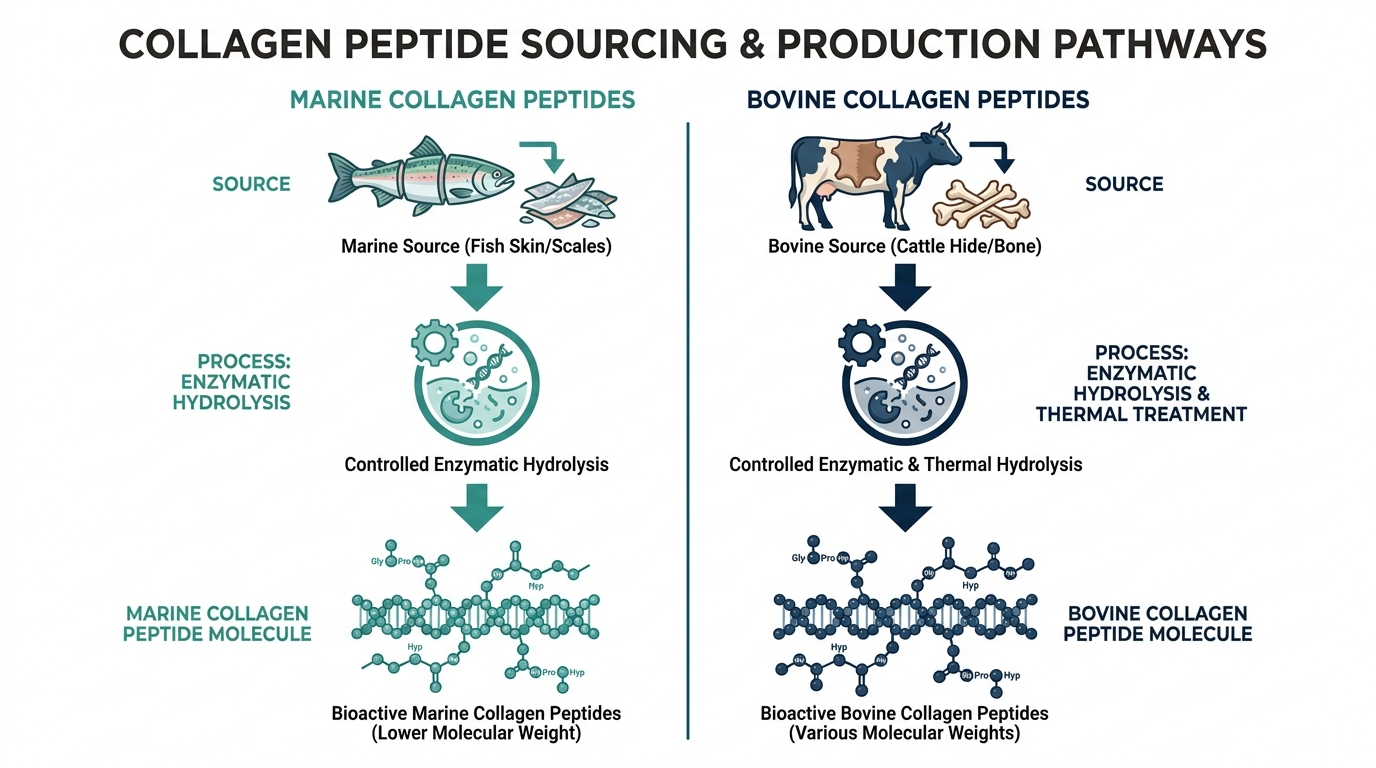
Here is the part that confuses almost everyone. “Collagen peptides” is a form of collagen, not a source. It means the collagen protein has been hydrolyzed, broken down by enzymes or acids into short chains of amino acids called peptides, which your digestive system can absorb far more efficiently than raw collagen. “Marine collagen” is a source. It tells you the raw material came from fish skin, scales, or bones rather than cattle hide or pig skin.
So when you see both terms on a supplement label, the product is actually hydrolyzed collagen that happens to come from fish. When people ask “which is better, marine collagen or collagen peptides,” they usually mean: should I buy the fish-sourced version or the standard bovine version? That is the question worth answering.
The label confusion is entirely deliberate. Brands use “marine collagen” as a premium signal and “collagen peptides” as a scientific-sounding descriptor. They sell you both at different price points for nearly the same physiological outcome.
Why does the source matter at all?
Different animal sources produce collagen with different amino acid profiles and, more importantly, different natural molecular weights before processing.
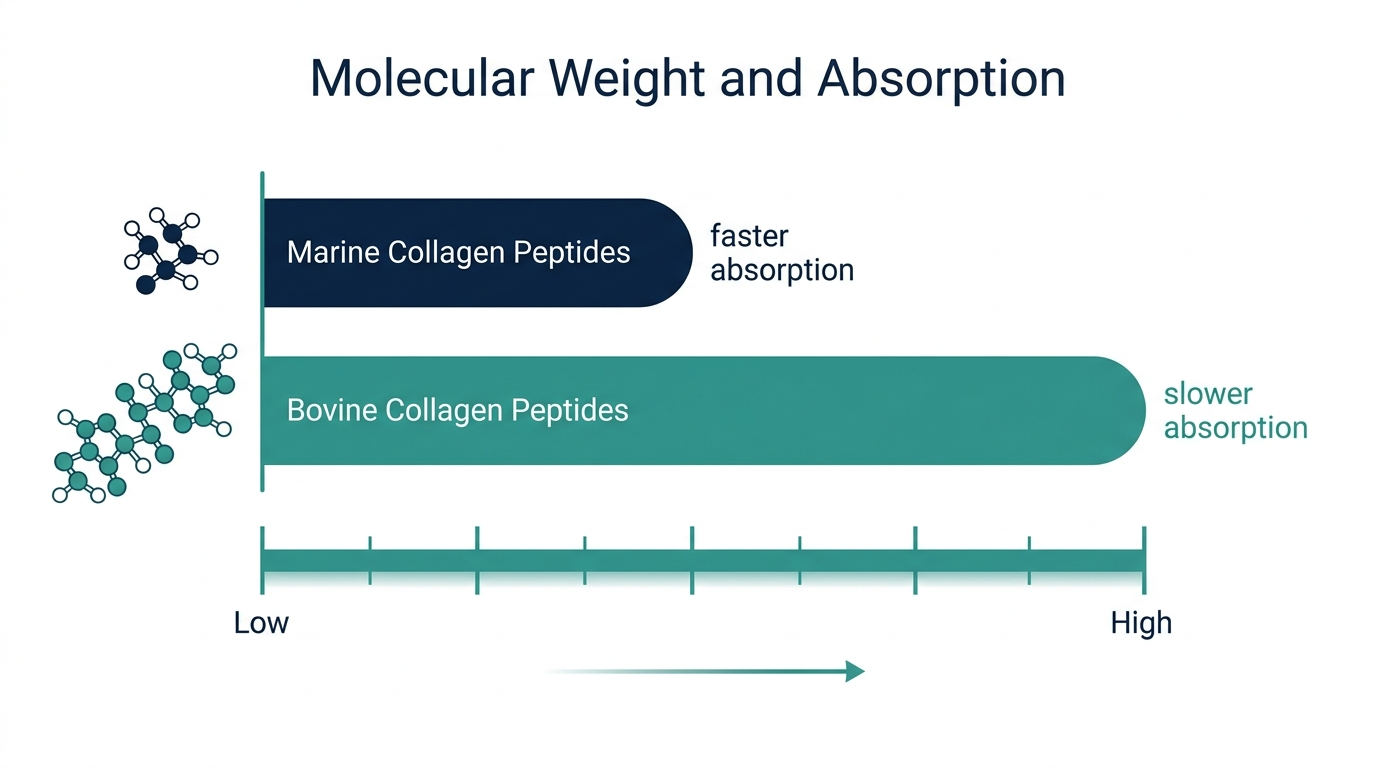
Marine collagen extracted from fish skin and scales starts life at a smaller molecular weight than bovine collagen from cattle hide. When hydrolyzed, marine peptides typically land in the 2,000 to 5,000 Dalton range, while bovine hydrolysates often run 3,000 to 8,000 Daltons, though high-quality bovine manufacturers can reduce this further. Smaller molecules cross the intestinal wall through the peptide transporter PEPT-1 more efficiently, which is why marine collagen’s bioavailability advantage became a popular marketing claim.
The claim has real science behind it, but reality is more nuanced. The 2024 crossover trial in Frontiers in Nutrition tested fish, porcine, and bovine hydrolysates at matched molecular weights (2,000 Da each) and found that free hydroxyproline absorption increased 7.2-fold from fish versus 6.2-fold from bovine, a modest difference, with porcine actually scoring highest at 9.9-fold. The study’s conclusion: “the absorption of fish, porcine and bovine collagen hydrolysate is highly comparable,” and certain products “may be used interchangeably.”
Full-body lab membership: 100+ biomarkers, doctor-reviewed, tracked over time.
What types of collagen do you actually get from each source?
This is where source matters more concretely. Not all collagen types do the same job in your body.
Marine collagen: Almost entirely Type I collagen, the most abundant collagen in human skin, comprising roughly 80% of dermal collagen. Type I collagen provides the structural scaffold that gives skin its firmness and resilience. For skin, hair, and nails, this is the most targeted type you can supplement.
Bovine collagen: Primarily a mix of Type I and Type III collagen. Type I covers skin and bones. Type III is the main collagen found in muscles, blood vessels, and the gut wall. It is particularly important for maintaining intestinal lining integrity, which is why bovine collagen appears more often in gut health protocols.
If your goal is specifically skin hydration and elasticity, the Type I focus of marine collagen is a genuine advantage, not just marketing. If your goals extend to joint support, gut health, or overall structural protein intake, bovine’s Type I plus III combination covers more ground.
What does the clinical evidence actually show?
The collagen supplement literature has grown substantially since 2020, and while not every study is rigorous, the headline findings are consistent enough to be useful.
For skin: A 2024 randomized, double-blind, placebo-controlled trial published in Dermatology Research and Practice followed participants for 12 weeks of daily hydrolyzed collagen supplementation and found improvements in skin collagen density, hydration, elasticity, wrinkle depth, and even scalp and hair condition. Earlier work by Kim et al. found that 12 weeks of low-molecular-weight collagen hydrolysate from fish produced skin hydration 2.9-fold higher than placebo. A 2024 review in Marine Drugs analyzing therapeutic marine collagen applications across multiple trials documented consistent improvement in skin wrinkle depth and elasticity at doses of 2.5 to 5 grams daily, with effects appearing at 8 weeks and continuing to 16 weeks.
For joints: A meta-analysis covering multiple randomized controlled trials found that 5 grams of hydrolyzed collagen peptides daily for 12 weeks significantly reduced hip and knee pain during daily activities. The joint data predominantly uses bovine-sourced collagen, simply because it was studied first and in larger trials.
For hair: A March 2025 study in the Journal of Drugs in Dermatology found normalization of cuticle structure and reduced hair shaft damage after 24 weeks of collagen peptide supplementation, with participants improving one to two grades on the standard SEM hair health grading scale.
One important caveat: most studies use hydrolyzed collagen broadly without isolating marine versus bovine head-to-head in the same trial. Researchers at Frontiers in Nutrition noted in 2024 that “a growing body of literature reports health benefits for different collagen hydrolysate products, regardless of their source.”
The myth that needs busting: “Your gut just breaks it into amino acids anyway”
This is the most persistent skeptic argument against collagen supplements, and it was partially true for older, unhydrolyzed collagen products. It is not accurate for modern hydrolyzed collagen peptides.
Here is what actually happens. Hydrolyzed collagen peptides are short enough (2 to 6 kDa) to be absorbed via the PEPT-1 transporter as intact di- and tripeptides, not just free amino acids. The 2024 Frontiers in Nutrition crossover study found that 36 to 47% of absorbed hydroxyproline remained peptide-bound in the bloodstream, meaning intact collagen-derived peptide structures enter circulation and reach target tissues including skin fibroblasts. These specific peptides, especially the Pro-Hyp dipeptide, signal fibroblasts to upregulate their own collagen production. Your body is not just using the amino acids as generic building blocks. It is responding to a specific molecular signal.
Personally, this is the finding that shifted my view of collagen supplements from “plausible but unproven” to “mechanistically credible.” The delivery vehicle matters, and the hydrolysis step is what makes it work.
Marine collagen vs. bovine collagen peptides: the practical comparison table
| Factor | Marine Collagen | Bovine Collagen Peptides |
|---|---|---|
| Primary source | Fish skin, scales (cod, tilapia, snapper) | Cattle hide, bones (grass-fed or conventional) |
| Collagen types | Predominantly Type I | Type I and Type III |
| Natural molecular weight | Lower (easier to get to small size) | Higher starting point, requires more processing |
| Absorption (clinical) | Comparable when matched at same MW | Comparable when matched at same MW |
| Best for | Skin, hair, nails | Joints, gut health, broad-spectrum |
| Taste/solubility | Mildly fishy if low quality; neutral if high quality | Virtually tasteless |
| Price per gram | 30 to 50% more expensive than bovine | Lower cost, widely available |
| Dietary suitability | Pescatarian-friendly, often Kosher | Kosher/Halal only with certified sourcing |
| Sustainability risk | Wild-catch pressure on fish stocks | Land-use and water footprint of cattle |
| Popular branded options | Vital Proteins Marine Collagen ($39.99/34 servings at Costco), Further Food | Vital Proteins Collagen Peptides, Ancient Nutrition Multi Collagen |
Who should choose marine collagen?
Marine collagen makes the clearest sense in four situations.
You follow a pescatarian diet and cannot use bovine or porcine sources. Marine collagen is the only animal-derived option for anyone who eats fish but avoids land animals.
Your primary goal is skin appearance. The Type I concentration and smaller starting molecular weight make marine collagen the more targeted choice for wrinkle depth, hydration, and elasticity, even if the absorption gap is smaller than brands advertise.
You have religious or cultural dietary rules that restrict beef. Marine collagen from non-bottom-feeding fish is generally considered halal under Islamic dietary law, though you should confirm the processing facility is certified, not just the source animal.
You have a sensitive stomach. Marine collagen is generally lighter on the digestive system than bovine, which can cause bloating in some people at doses above 10 grams. Fish-derived peptides sit easier for most users.
Hydrolyzed type I & III collagen peptides, third-party tested, unflavored.
Who should choose bovine collagen peptides?
Bovine collagen makes more sense in more situations, honestly, which is why it dominates supplement sales by volume.
If joint pain, tendon recovery, or bone density is your primary concern, the Type III collagen in bovine products addresses connective tissue beyond just skin. Clinical trials for joint pain and post-exercise recovery have overwhelmingly used bovine-sourced hydrolysates, so the evidence base is larger here.
If you supplement primarily for gut health or if you are exploring leaky gut or inflammatory bowel support, Type III collagen’s role in supporting the intestinal wall lining is the key mechanism, and marine sources simply do not deliver it in meaningful amounts.
If budget drives your decision, bovine collagen peptides cost 30 to 50% less per gram than marine equivalents. Vital Proteins Collagen Peptides in the 20-ounce size runs roughly $1.50 per serving at most retailers versus $2 or more for comparable marine products. When you are taking 10 to 20 grams daily for three months or longer, that difference compounds.
Does adding vitamin C actually matter?
Yes, and this is an insider detail most buyers skip. Collagen synthesis requires vitamin C at two critical steps: hydroxylation of proline and lysine, the amino acids that create the triple-helix structure of the collagen molecule. Without adequate vitamin C, those reactions stall regardless of how much collagen peptide you ingest.
A randomized, double-blind, placebo-controlled trial published in PubMed in 2024 compared hydrolyzed collagen alone against collagen plus 80 mg vitamin C over 16 weeks and found the combination produced superior skin density improvements. The Wiley clinical trial from 2024 using hydrolyzed collagen with vitamin C showed daily consumption produced better results than every 48-hour dosing for skin collagen content.
The practical implication: take your collagen powder mixed into a glass of citrus juice, or buy a formula that already includes 80 to 100 mg vitamin C per serving. Do not believe the brands that add a token 10 mg as a label claim and call it “vitamin C-enriched.” The dose needs to be meaningful.
The sustainability question nobody mentions in the comparison
Marine collagen has a problem that the premium positioning hides. Wild-caught fish stocks are already under pressure globally. An estimated one-third of fish stocks are currently overfished, and as the collagen market grows, some analysts have raised concerns about the species-level impact, particularly for cod and snapper commonly used in premium marine collagen products.
The most responsible marine collagen brands use byproduct material from fish processing, scales and skin that would otherwise be discarded, rather than fishing specifically for collagen. Look for MSC (Marine Stewardship Council) certification or explicit byproduct sourcing on the label. If a brand’s marine collagen costs significantly less than competitors and does not specify sourcing, the economics often mean lower-quality, less sustainable inputs.
Bovine collagen, by contrast, is an entirely byproduct-derived ingredient, hides and bones from the beef industry that would otherwise go to waste. Grass-fed sourcing matters for quality (higher omega-3 content in the animal) but bovine collagen’s environmental argument is simpler: it does not add a separate demand on the food system.
How to dose for real results
The supplement industry obscures dosing ranges because higher doses move more product. Here is what the clinical literature actually supports.
Skin goals: 2.5 to 5 grams of hydrolyzed collagen peptides daily. The Kim et al. fish collagen trial used 5 grams over 12 weeks. Multiple skin trials show measurable improvement at this range. You do not need 20 grams for skin; that is a gym-bro dose borrowed from protein supplementation.
Joint and connective tissue: 5 to 15 grams daily, taken 30 to 60 minutes before exercise when possible. The joint pain trials showing significant hip and knee improvement used 5 grams. Higher doses (10 to 15 grams) appear in tendon and bone density research.
General wellness or gut support: 10 to 15 grams daily is a reasonable middle range supported across multiple applications.
Timeline expectation: most skin studies show statistically significant changes at 8 weeks, with continued improvement through 12 to 16 weeks. Joint studies typically show measurable benefit by 12 weeks. Anyone claiming to see results after two weeks is either very sensitive or confusing placebo effect with outcome.
Frequently asked questions
Is marine collagen better than collagen peptides?
The question is slightly malformed because marine collagen is a type of collagen peptide. The real comparison is marine (fish-derived) versus bovine (cow-derived) collagen peptides. For skin and hair, marine has a slight edge due to its Type I focus and smaller peptide size. For joints and gut health, bovine’s Type I plus Type III profile is more complete. A 2024 randomized study found overall absorption is comparable when both are properly hydrolyzed.
What is the best collagen for skin?
Hydrolyzed marine collagen at 2.5 to 5 grams daily, taken with 80 to 100 mg vitamin C, has the strongest skin-specific evidence, driven by its nearly exclusive Type I content and smaller peptide size. Vital Proteins Marine Collagen and Further Food Marine Collagen are well-reviewed products with clean ingredient lists.
Can I take marine and bovine collagen together?
Yes, and some multi-collagen products deliberately combine sources to cover Types I, II, and III together. Ancient Nutrition Multi Collagen Protein is one widely available example. There is no known interaction risk, and the combination covers a broader range of tissue targets than either alone.
Does collagen peptide source affect taste?
Bovine collagen peptides are virtually tasteless in water or coffee. Marine collagen can carry a mild fishy undertone, particularly in cheaper products or at high doses. High-quality marine collagen from reputable brands processes the smell out almost entirely; if yours has a strong fish taste, that is a quality signal worth noting.
How long before you see results from collagen supplements?
Clinical trials consistently show measurable skin improvements at 8 weeks and significant improvements at 12 weeks. Joint pain studies show meaningful benefit by 12 weeks. Planning for 90 days of consistent daily use before evaluating results is the realistic minimum.
Is marine collagen worth the higher price?
For skin-focused use, the modest absorption advantage and Type I concentration make the premium reasonable for most buyers. For general wellness or joint support, the price difference does not buy meaningfully better outcomes, and bovine collagen is the better value. The real price signal to watch: marine collagen from certified sustainable, byproduct sources should cost more. Suspiciously cheap marine collagen is a sourcing quality red flag.
Do collagen supplements really work, or is it just absorbed as amino acids?
Modern hydrolyzed collagen peptides are not fully broken down to free amino acids during digestion. A 2024 Frontiers in Nutrition crossover study found 36 to 47% of absorbed hydroxyproline remained as intact di- and tripeptides in circulation. These peptides, particularly Pro-Hyp, directly signal skin fibroblasts to produce more collagen. The mechanism is established, not theoretical.
Author: Vital Signs Today Editorial Team. Educational content, not medical advice. Sources linked inline.
Hydrolyzed type I & III collagen peptides, third-party tested, unflavored.
Primary sources:
- Absorption of bioactive peptides following collagen hydrolysate intake: 2024 randomized crossover study, Frontiers in Nutrition
- Unlocking the Therapeutic Potential of Marine Collagen: A Scientific Exploration for Delaying Skin Aging, PMC/Marine Drugs 2024
- A Clinical Trial Shows Improvement in Skin Collagen, Hydration, Elasticity, Wrinkles following 12-Week Oral Intake of Hydrolysed Collagen, Dermatology Research and Practice 2024
- The Effects of Dietary Supplementation with Collagen and Vitamin C on Skin Density, PubMed 2024
- Vital Proteins Marine Collagen product page and pricing, Costco
- Marine collagen sustainability and fish stock concerns, CBC News
Related reading
Vital Signs Today may earn a commission if you buy through links on this page. It does not affect our editorial assessments.