Disclosure: Vital Signs Today may earn a commission if you buy through links on this page, at no extra cost to you. This does not influence our evidence-based assessments. We are not a medical provider; talk to a clinician before acting on test results.
Quick answer: A heart health test is not one test, it is two pictures stacked together: the electrical picture (an EKG, which reads your heart’s rhythm in about ten minutes for $25 to $150 cash) and the chemical picture (a blood panel that reveals the silent artery buildup an EKG cannot see). You can get an EKG at primary care, urgent care, some CVS and Walgreens clinics, and cardiology offices, but generally not at Quest or Labcorp draw sites, because an EKG is a physician-ordered procedure, not a specimen test. For the part that actually predicts heart attacks, you want a lipid panel upgraded with three advanced markers: ApoB, Lp(a), and hs-CRP. A basic cholesterol panel runs $20 to $75; the full advanced cardiac workup lands around $100 to $300 out of pocket. Most checkups stop at the cheap part and leave the predictive markers off unless you ask by name.
What a heart health test actually measures
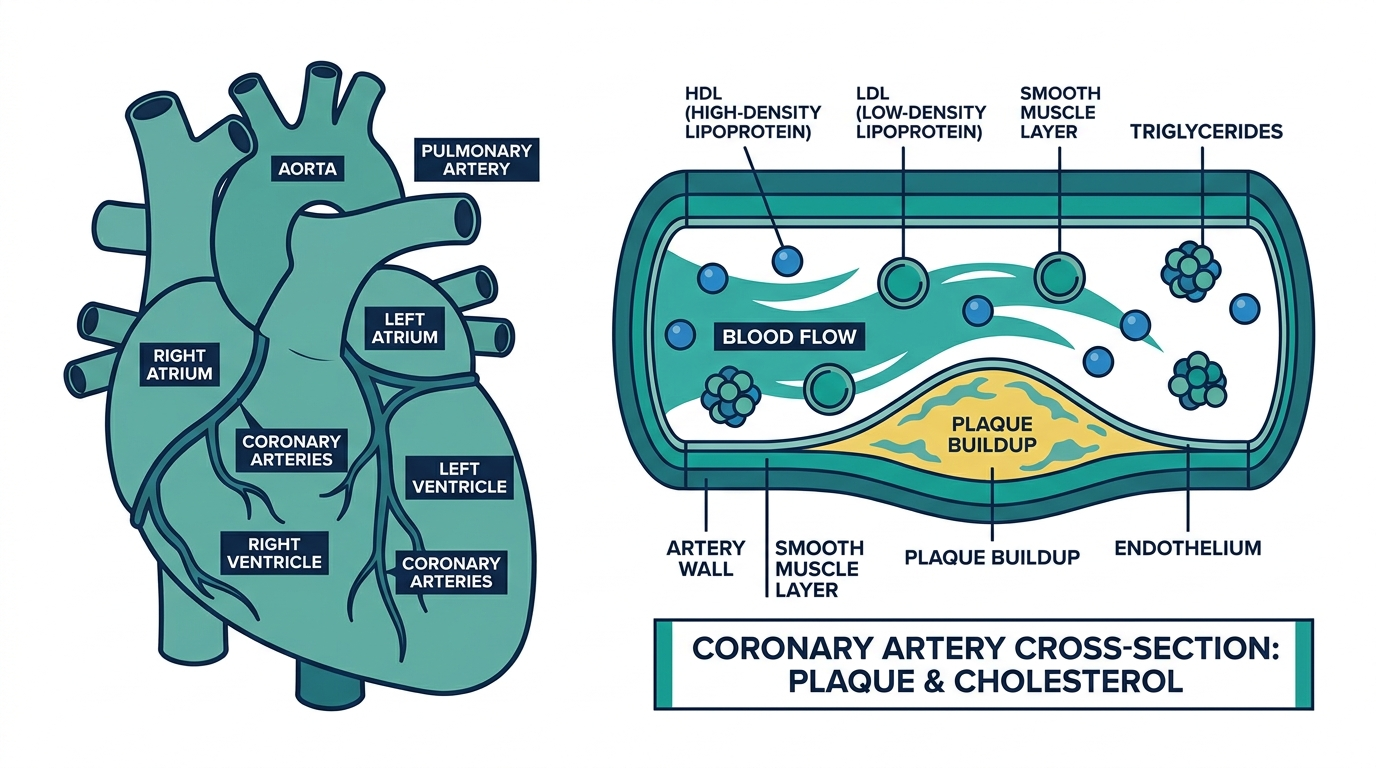
A complete heart health test answers two separate questions, and confusing them is the most common mistake people make. The first is electrical: is my heart beating in a normal rhythm right now? The second is structural and chemical: are my arteries quietly filling with plaque that will cause a heart attack in five or ten years? An EKG answers the first. Bloodwork answers the second. Neither covers for the other.
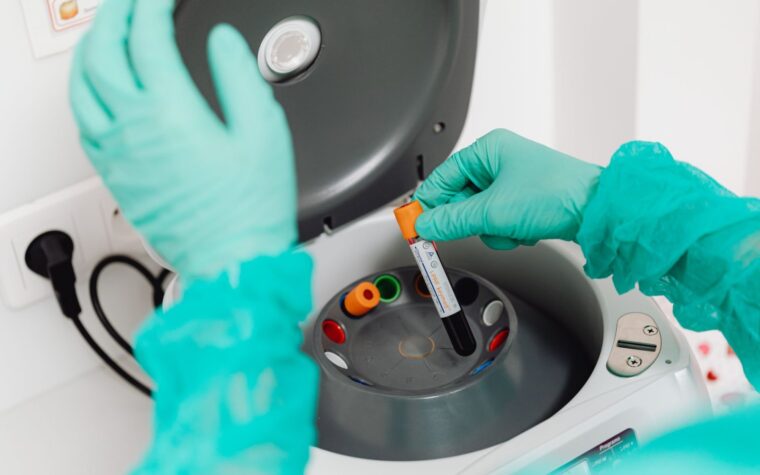
An EKG reads your heart’s rhythm, but only a blood panel reveals the silent artery buildup it can’t see. Want to check yours? One at-home Superpower draw checks 100+ biomarkers, physician-reviewed.
This matters because a resting EKG can look textbook perfect in a person whose arteries are 70 percent blocked. The EKG reads the electrical signal that fires each heartbeat. It catches arrhythmias, atrial fibrillation, signs of a past heart attack, and some thickening of the heart muscle. It says almost nothing about cholesterol particles lodging in your artery walls. So when someone walks out of a checkup with a “normal EKG” and assumes their heart is fine, they may have skipped the half of the picture that actually predicts a heart attack.
The reverse is also true. A flawless blood panel does not rule out a rhythm problem like atrial fibrillation, which can throw a clot to the brain and cause a stroke with no warning. That is why a real heart health test pairs the two. Below, the EKG side comes first because that is what most people search for, then the bloodwork.
Where can I get an EKG done?
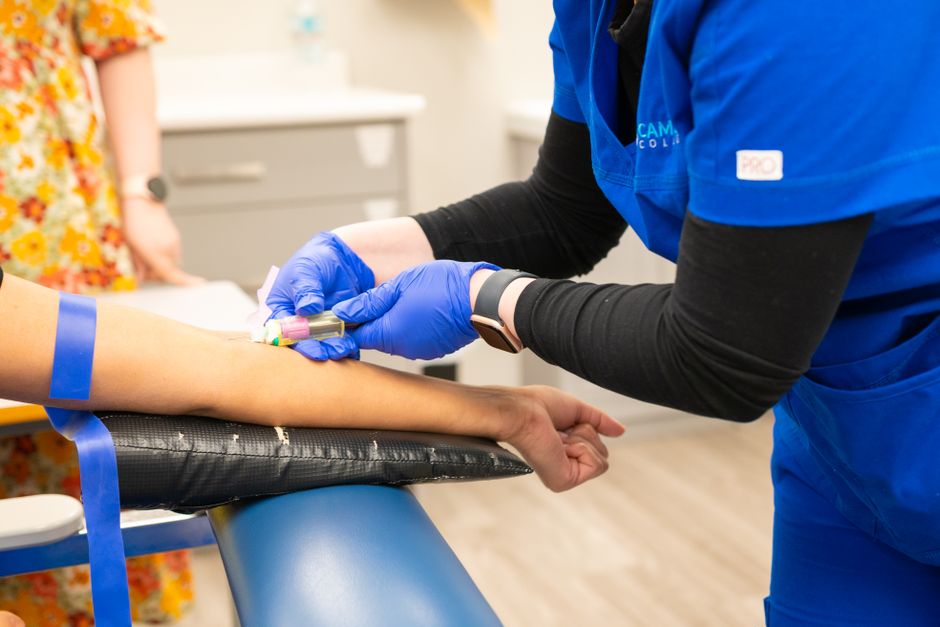
The fastest places to get an EKG done are urgent care centers and primary care offices, both of which keep a 12-lead machine on site and can run it the same day. A standard resting EKG (also written ECG) takes about ten minutes: a tech sticks ten electrodes on your chest, arms, and legs, and the machine prints your heart’s rhythm onto a strip. No needles, no fasting, no prep. Here is where it gets ordered most often.
- Primary care office: the default if you have symptoms or a checkup that flags risk. Often bundled into the visit, so you may not see a separate line item at all.
- Urgent care: walk-in, no appointment, useful for palpitations or chest tightness that is not an emergency. Cash price typically $50 to $150. Your fastest same-day option.
- Retail clinics: some CVS MinuteClinic and Walgreens-affiliated clinics offer EKGs, but availability varies a lot by location, so call the specific store first instead of assuming.
- Cardiology practice: the right call if you have a known heart condition or need a stress test or echocardiogram alongside it. They will also read it with the most expertise.
- Hospital outpatient department: available but usually the most expensive route for a simple resting EKG, and the facility fee can push the bill far past a clinic.
If you are searching for where to get an EKG done near me, call ahead and ask two things: do they have a machine on site, and will a clinician read the result the same day. A printout with nobody to interpret it is close to useless. An EKG tracing means nothing until a clinician compares it against your history and symptoms.
One thing that surprises people about EKG cost
A “free” or “preventive” wellness visit can still generate a billable EKG charge. The moment you mention a symptom, palpitations, chest pressure, shortness of breath, the EKG can be coded as diagnostic rather than preventive, and diagnostic services are not covered the same way. If cost matters, ask up front whether the EKG will be billed inside the wellness visit or as a separate diagnostic procedure.
Does Labcorp or Quest Diagnostics do EKG testing?
Generally no, neither Labcorp nor Quest Diagnostics performs EKG testing at their standard patient service centers. This trips people up constantly, because these are the names everyone associates with “getting tested.” Both companies are reference labs built around blood, urine, and specimen analysis, not in-clinic procedures. When people ask does Labcorp do EKG or does Quest do EKG, the honest answer is that an EKG needs a machine, a trained tech to place ten leads, and a physician to read the tracing, which is a clinical service the draw sites are simply not staffed or equipped to deliver.
There is one wrinkle. Both labs run large employer and occupational health programs, and a handful of those workplace clinics can do an EKG as part of a pre-employment or DOT physical. But you cannot walk into a Quest or Labcorp patient center and ask for one off the menu the way you would a cholesterol draw. So the rule is simple: for an EKG, go to a clinic. For the bloodwork that predicts heart disease, that is exactly where Quest and Labcorp shine, and you will likely route your advanced cardiac panel through one of them.
To put the does-Quest-do-EKG-testing and does-Labcorp-do-EKG-testing questions to rest in one table:
| Service | Quest / Labcorp patient center | Clinic (PCP, urgent care, cardiology) |
|---|---|---|
| Resting EKG (12-lead) | Generally no | Yes, same day |
| Lipid panel | Yes | Yes (often sent to a lab) |
| ApoB, Lp(a), hs-CRP | Yes | Yes (drawn, then sent to a lab) |
| Stress test / echocardiogram | No | Cardiology practice or hospital |
How to test your heart health beyond the EKG
The most useful way to test your heart health is a blood panel, because an EKG only catches rhythm problems that already exist, while blood markers reveal the silent buildup that causes heart attacks years before any symptom appears. A resting EKG can look perfectly normal in someone with severe artery disease. That is the trap. The plaque forming in your artery walls does not show up on a rhythm strip, and it does not announce itself until it ruptures.
So when people ask what are the tests to check heart health, the honest list pairs the electrical picture (EKG) with the chemical one (blood). The blood side is where the prediction lives, and where standard care still lags. Most checkups stop at a basic cholesterol panel and a blood pressure cuff, and the markers that actually move risk prediction are left off unless you request them.
The standard lipid panel (the starting point)
A lipid panel measures total cholesterol, LDL, HDL, and triglycerides. It is cheap, widely available, and a fine baseline. Fasting matters here for triglycerides, which spike for hours after a meal, but matters far less for cholesterol itself, which is why some modern guidance allows non-fasting lipid panels. The real problem is what it leaves out. LDL alone misses a large share of people who go on to have heart attacks with so-called normal numbers, because LDL measures the cholesterol cargo, not the number of particles carrying it. That distinction is the whole game.
The advanced cardiac markers (the ones that predict)
Three markers do far more predictive work than LDL alone, and most people have never had them drawn:
- ApoB: counts the actual number of artery-clogging particles, not just the cholesterol they carry. Every atherogenic particle carries exactly one ApoB protein, so ApoB is a direct particle count. Two people with identical LDL can have very different ApoB, and the one with the higher count is the one driving risk. Many cardiologists now treat ApoB as the better target than LDL.
- Lp(a): a largely genetic, inherited risk factor, pronounced “L-P-little-a.” You measure it once in your life because it barely changes. High Lp(a) raises heart attack and stroke risk even when every other number looks clean, and it explains a lot of early family heart disease, the relative who had a heart attack at 45 with normal cholesterol.
- hs-CRP: high-sensitivity C-reactive protein, a marker of arterial inflammation. Plaque becomes dangerous when it inflames and ruptures, and elevated hs-CRP flags that smoldering risk that cholesterol numbers can completely hide. It is sensitive to any infection, though, so you do not measure it when you are sick.
Together these turn a vague “your cholesterol is fine” into a real risk profile. If you want the broader context on which numbers earn their place in a workup, we keep a running list of the biomarkers worth tracking. Heart markers sit near the top of it.
Target ranges to know before you read your results
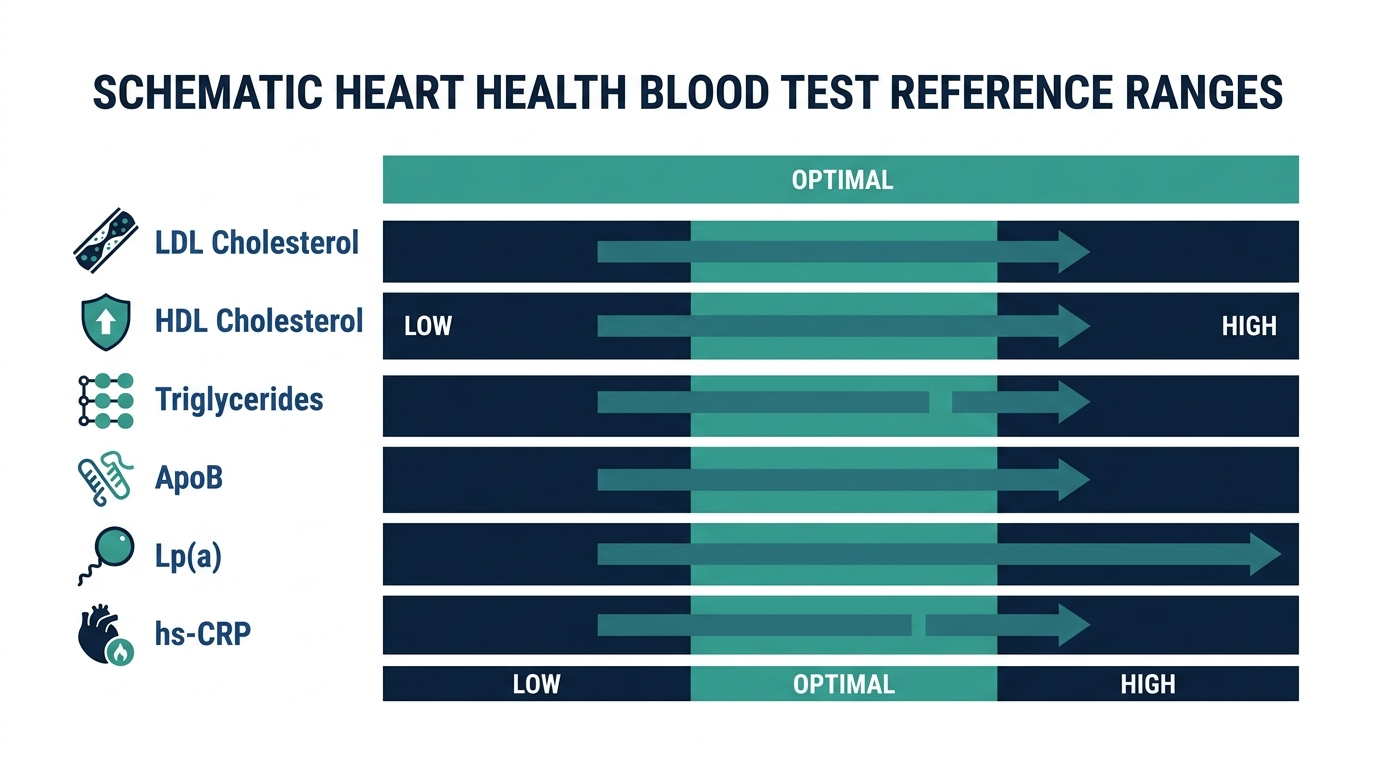
Numbers mean nothing without context, so here are the general reference points clinicians use. Your personal targets depend on your overall risk, and someone with diabetes or a prior event will be pushed lower, so treat this as orientation, not a verdict.
| Marker | General target | What it tells you |
|---|---|---|
| LDL cholesterol | Under 100 mg/dL (lower if high risk) | Cholesterol cargo, the classic but incomplete number |
| HDL cholesterol | Above 40 (men) / 50 (women) mg/dL | Higher is generally protective |
| Triglycerides | Under 150 mg/dL (fasting) | Metabolic strain, ties to insulin resistance |
| ApoB | Under 90 mg/dL (under 70 if high risk) | True count of artery-clogging particles |
| Lp(a) | Under 50 mg/dL (or under 125 nmol/L) | Inherited risk, measured once for life |
| hs-CRP | Under 1.0 mg/L low, 1.0 to 3.0 average, over 3.0 high | Arterial inflammation |
Notice that ApoB and Lp(a) are nowhere on a standard lipid panel. A person can be told “your numbers look great” while their ApoB sits at 110 and their Lp(a) is high, both quietly raising risk the basic panel never measured.
Markers and scans a clinician adds, not a self-order checkbox
The three above (ApoB, Lp(a), hs-CRP) are the screening upgrades worth asking for by name. A second tier exists, but it is ordered selectively by a clinician rather than checked off on a self-pay menu, and pretending otherwise sets up false expectations.
- Coronary artery calcium (CAC) score: a low-dose CT scan, not a blood test, that scores calcified plaque using the Agatston method. A score of 0 is reassuring; over 100 is moderate and over 400 is high. It is one of the strongest predictors of risk in symptom-free adults and is often used to decide whether someone with borderline numbers should start a statin. Typical cost is roughly $100 to $400 cash.
- LDL particle number (LDL-P, by NMR): counts LDL particles directly, much like ApoB, and flags people whose particle count is high even when their LDL cholesterol reads normal. ApoB and LDL-P measure overlapping things, so most clinicians order one, not both.
- Lp-PLA2: an enzyme tied to plaque inflammation, sometimes added to refine risk in people with already-elevated hs-CRP. Its added value over the core markers is debated, and it is not a routine screen.
- Homocysteine: an amino acid linked to vascular risk, but routine screening is not recommended because lowering it has not been shown to reduce heart attacks. It is a targeted test, not a baseline one.
- NT-proBNP and troponin: these are heart-strain and heart-injury markers, not screening tools for healthy arteries. NT-proBNP rises with heart failure and troponin rises when heart muscle is damaged, so they are ordered to diagnose or rule in a problem when symptoms are present, not to screen someone who feels fine.
What each heart panel costs and where to get the blood drawn
A basic lipid panel runs $20 to $75 cash, while a full advanced cardiac workup with ApoB, Lp(a), and hs-CRP typically lands between $100 and $300 out of pocket. The spread is wide because the same panel billed through a hospital outpatient lab can cost several times what a discount cash lab charges. Here is roughly how the options compare.
| Option | What it covers | Typical cash cost |
|---|---|---|
| Basic lipid panel (Quest, Labcorp, PCP) | Total cholesterol, LDL, HDL, triglycerides | $20 to $75 |
| Lipid panel plus hs-CRP | Standard lipids and inflammation marker | $50 to $120 |
| Advanced cardiac add-ons (ApoB, Lp(a)) | Particle count and inherited risk | $60 to $180 extra |
| Resting EKG (clinic) | Heart rhythm, electrical reading | $25 to $150 |
| Full-body membership panel | Heart markers inside a 100-plus biomarker draw | About $199/year |
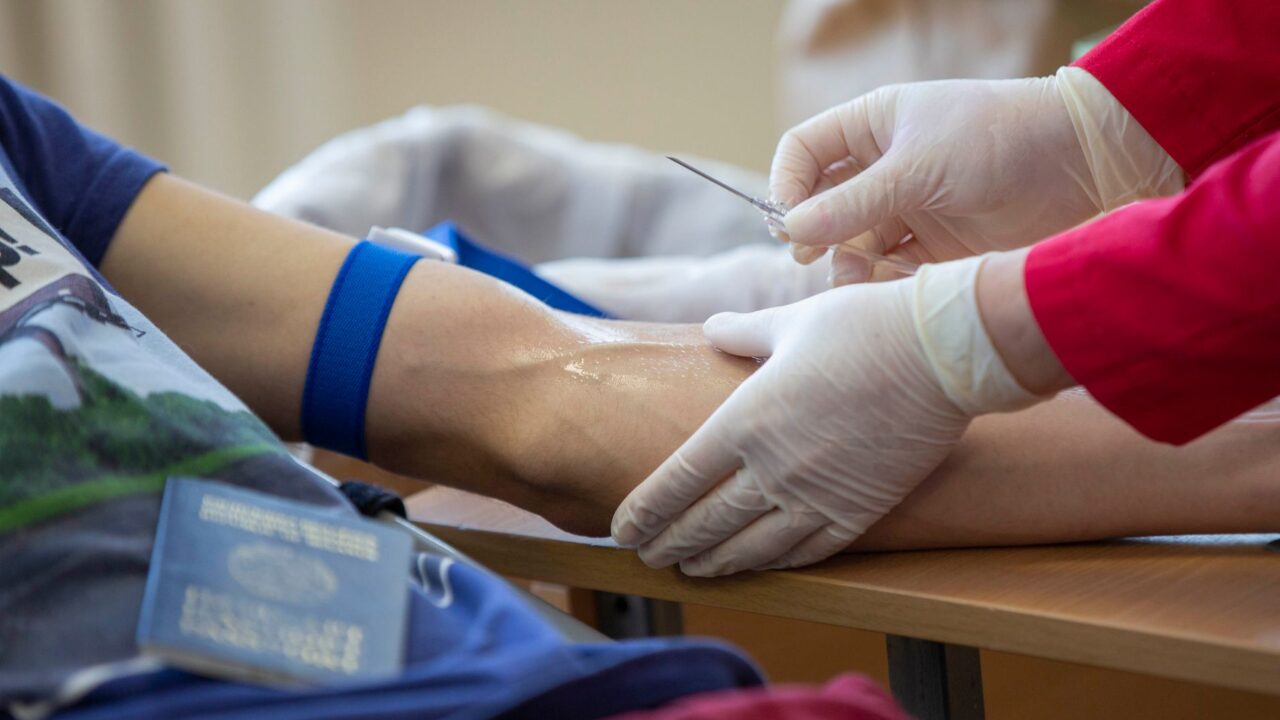
For the actual blood draw, this is exactly where Quest and Labcorp earn their keep. You order the test (through your doctor or a direct-to-consumer service), they draw it, and you get clean results. If you want the heart markers folded into the broader workup that most people skip, the same single draw can cover liver, kidney, metabolic, and thyroid lines too. We walk through one such workup in a complete blood panel, and the heart-adjacent metabolic side overlaps with what shows up on a Liver Function Test: What ALT, AST, and the Panel Reveal, since fatty liver and cardiac risk travel together more often than people realize.
A worked example of how the bill swings
Say you want lipids plus ApoB, Lp(a), and hs-CRP. Through a cash discount lab, that bundle might run about $130 total. Order it as separate add-ons through a hospital outpatient lab with no insurance, and each marker gets its own line item (ApoB alone can hit $50 to $90, Lp(a) another $40 to $80), and the bill creeps toward $300 for the same four results. The test is identical. The site of service moves the number, which is why cash payers route advanced cardiac panels through a direct-to-consumer service rather than ordering piecemeal at a hospital.
The simplest way to actually get this done
Superpower is a full-body lab membership that runs 100+ biomarkers, has each result reviewed by a doctor, and tracks your numbers year over year (about $199/year). It is what we point readers to when they would rather get one clean, complete draw than chase single tests one at a time. Here is superpower reviewed in full, and if you are weighing it against the other big name, our Superpower vs Function Health comparison breaks down the difference.

EKG, stress test, and echocardiogram: which one do you need?
People often lump these three together as “heart tests,” but they answer different questions and you rarely need all three. Choosing the wrong one wastes money and, worse, can give false reassurance. Here is the plain-language map.
- Resting EKG: a snapshot of your rhythm while you sit still. Catches arrhythmias, signs of a past heart attack, and some strain, but it only sees the moment it is recorded, so an intermittent rhythm problem can hide.
- Stress test: an EKG recorded while you walk a treadmill or get a medication that mimics exercise, designed to expose blockages that only cause trouble when the heart works harder. The right test when you have exertional chest pain or shortness of breath.
- Echocardiogram: an ultrasound of the heart that shows structure, valves, chamber size, and how well it pumps. The right test for suspected heart failure, valve disease, or a murmur, not for screening healthy arteries.
- Holter or event monitor: a portable EKG worn for 24 hours to weeks, used when palpitations come and go and a single resting EKG keeps missing them.
- Coronary calcium (CAC) CT scan: not an EKG at all, but the test that actually looks for plaque in symptom-free people. If your blood markers sit in a gray zone and you cannot decide about a statin, this is the scan that settles it.
For a person with no symptoms who simply wants a heart health test, the high-value combination is a resting EKG plus the advanced blood panel, not a stress test. Stress tests and echocardiograms are diagnostic tools triggered by symptoms or known disease, and ordering them on a whim tends to produce false alarms that snowball into more tests. Let symptoms, not anxiety, drive those.
Who actually needs advanced cardiac testing?
Almost everyone over 40 benefits from at least a baseline ApoB and a one-time Lp(a), but a few groups should move it up the priority list. The advanced markers earn their cost most clearly when standard numbers look fine but risk hides underneath.
- Anyone with early family heart disease: a parent or sibling with a heart attack or stroke before 55 (men) or 65 (women) is the single biggest reason to check Lp(a), since it is inherited and may be the hidden cause.
- People with “normal” cholesterol but other risk: high blood pressure, prediabetes, belly weight, or a smoking history. ApoB and hs-CRP often catch risk the lipid panel calls normal.
- South Asian and certain other ancestries: elevated cardiac risk at lower body weights and earlier ages, where standard thresholds can under-call risk.
- Anyone already on a statin: ApoB is the better way to confirm the medication is actually lowering particle count to target, not just nudging LDL.
- People who want a true baseline: measuring ApoB, Lp(a), and hs-CRP once in your 30s or 40s gives you a reference point that makes every future result more meaningful.
If you are young, lean, active, with no family history and a clean basic panel, you can reasonably start with lipids plus a one-time Lp(a) and add the rest later. The point is not to test everything constantly. It is to make sure the markers that predict are not silently missing.

Common mistakes people make with heart health testing
Most of the value in a heart health test gets lost not in the lab but in how people order, interpret, and act on it. These are the errors we see again and again.
- Treating a normal EKG as a clean bill of heart health. It is not. It is one normal rhythm strip. It says nothing about your arteries. This is the most dangerous and most common misread.
- Stopping at LDL. A “normal” LDL with a high ApoB is a false all-clear. If you only remember one upgrade from this page, ask for ApoB.
- Never checking Lp(a) even once. It is a one-time test that can explain a whole family’s heart history, and the vast majority of people have simply never had it drawn.
- Eating before a triglyceride draw without realizing. Triglycerides spike after meals. If your panel includes them and you grabbed breakfast, that number may read falsely high. Fasting matters for triglycerides even though it barely matters for cholesterol.
- Checking hs-CRP while fighting a cold. Any infection inflates CRP, so a number drawn during illness reflects the infection, not your baseline arterial inflammation. Wait until you are well.
- Getting numbers and never acting. A high ApoB or Lp(a) is information, and the value only appears when it changes a decision, diet, exercise, blood pressure control, or a conversation about medication with a clinician.
- Paying hospital outpatient prices out of pocket. The same panel often costs a third as much through a cash lab or membership. Site of service, not the test, drives most of the bill.
How to test heart health at home
You can test heart health at home with three tools: a blood pressure cuff, an at-home finger-stick cholesterol kit, and a smartwatch or single-lead device that records a basic EKG. Each one is useful, and each one has a ceiling worth knowing before you trust it.
- Blood pressure cuff: the single best at-home heart investment. A validated upper-arm cuff catches hypertension, the most common driver of heart and stroke risk, and lets you track trends instead of one nervous reading at the doctor’s office. Wrist cuffs are less reliable, so choose an upper-arm model.
- At-home cholesterol kits: a finger-stick gives you a rough total cholesterol and sometimes HDL. Fine for a ballpark, but it will not measure ApoB or Lp(a), the markers that actually predict, so treat it as a screen, not a verdict.
- Smartwatch and single-lead EKG: devices like the Apple Watch and KardiaMobile record a single-lead rhythm strip and can flag atrial fibrillation, which is genuinely valuable for catching an irregular rhythm early. They do not replace a 12-lead clinical EKG, and they say nothing whatsoever about your arteries.
Home tools are excellent for monitoring and early flags, not for the deep risk picture, and they are not a substitute for a full panel and a clinician’s read. If a watch flags an irregular rhythm or a cuff shows persistently high numbers, that is your cue to get a proper EKG and bloodwork, then talk to a clinician about your results.
Edge cases: uninsured, employer-required, Medicare, and minors
The standard advice shifts in a few situations.
- Uninsured: skip the hospital outpatient lab for bloodwork. A cash discount lab or a direct-to-consumer membership will run the same ApoB, Lp(a), and hs-CRP for a fraction of the billed price. For the EKG, urgent care cash pricing usually beats a hospital.
- Employer or DOT-required EKG: this is the one case where a Quest or Labcorp occupational-health partner site may actually do an EKG, because it is bundled into a structured physical. Confirm the specific clinic, not the brand.
- Medicare: a screening EKG is generally covered once as part of the initial “Welcome to Medicare” visit, but routine repeat screening EKGs without symptoms are often not covered. Diagnostic EKGs ordered for a symptom follow normal Part B rules.
- Minors and young adults: a one-time Lp(a) can be reasonable when there is strong early family heart disease, since the genetic risk is present from birth. Routine advanced cardiac panels in healthy children are not standard, so this is a conversation with a pediatrician or cardiologist.
Turn what you just learned into action.
Superpower lets you test 100+ biomarkers from home, then re-check them over time so you can actually see progress, physician-reviewed at every step.
FAQ
What is the best heart health test if I can only do one thing?
Add ApoB to your next blood draw. If your budget or time allows exactly one upgrade over a basic checkup, ApoB is it, because it counts the artery-clogging particles that LDL alone misses and it is the number most likely to change a normal-looking result into a real one. Pair it with a one-time Lp(a) if you have any family history of early heart disease.
Does Quest Diagnostics do EKG testing?
Generally no. Quest Diagnostics patient service centers focus on lab specimens like blood and urine, not in-clinic procedures such as an EKG. For an EKG you need a primary care office, urgent care, or cardiology practice. Quest is the place to send the bloodwork that screens for heart disease, including the advanced cardiac markers.
Does Labcorp do EKG testing?
Not at standard draw sites. Like Quest, Labcorp is built around lab analysis, so an EKG is not something you can request at a routine patient center. Some Labcorp occupational health or employer clinics can run one as part of a physical, but the everyday answer is to go to a clinic for the EKG and use Labcorp for the blood panel.
How to test heart health if my cholesterol is normal?
Ask for ApoB, Lp(a), and hs-CRP. A normal LDL can hide real risk: ApoB may still be high because you have a lot of small particles, Lp(a) is inherited and invisible on a standard panel, and hs-CRP catches arterial inflammation. These three are the most common gap in an otherwise clean checkup, and they are usually left off unless you request them by name.
What are the tests to check heart health most doctors skip?
The advanced lipid markers (ApoB and Lp(a)) and the inflammation marker hs-CRP. Standard care often stops at the basic lipid panel, so you usually have to request the rest by name or order them through a full-body draw. The EKG side is usually covered when there are symptoms, but the predictive bloodwork is where the gaps live.
Where to get an EKG done near me on the same day?
Urgent care is your fastest same-day option with no appointment, typically $50 to $150 cash. Call first to confirm they have a machine on site and a clinician to read it, since an unread tracing is not worth much. Primary care can also fit you in same day if you already have a relationship there.
How accurate is an Apple Watch or KardiaMobile EKG?
Reliable for flagging atrial fibrillation, not for the full picture. Single-lead consumer devices are genuinely good at catching an irregular rhythm and prompting you to seek care, but they record one lead, not twelve, and they tell you nothing about your arteries or cholesterol. Treat a watch alert as a reason to get a clinical EKG and bloodwork, not as a diagnosis.
Do I need to fast for a heart health blood test?
It depends on the marker. Triglycerides read more accurately fasting, so if your lipid panel includes them, an 8 to 12 hour fast is the safe default. Cholesterol, ApoB, and Lp(a) are far less affected by a recent meal, and many labs now accept non-fasting lipid panels. When in doubt, fast, because it is the one choice that never hurts your numbers.
How often should I repeat a heart health test?
Lipids and ApoB every one to two years for most adults, more often if you are adjusting diet or medication. Lp(a) is measured once for life because it is genetic and stable. hs-CRP is checked when you want an inflammation read and you are not currently sick. If you are on a statin or making changes, retesting ApoB at about three months shows whether the change is working.
Is a heart health test worth it if I feel fine?
Yes, because the markers that predict heart attacks are silent by design. Plaque builds for years with no symptoms, and the first sign for many people is the event itself. A baseline ApoB, a one-time Lp(a), and a blood pressure check while you feel fine give you the runway to act early, which is the whole point of screening.
Related: best at-home biomarker tests of 2026.