Disclosure: Vital Signs Today may earn a commission if you buy through links on this page, at no extra cost to you. This does not influence our evidence-based assessments. We are not a medical provider; talk to a clinician before acting on test results.
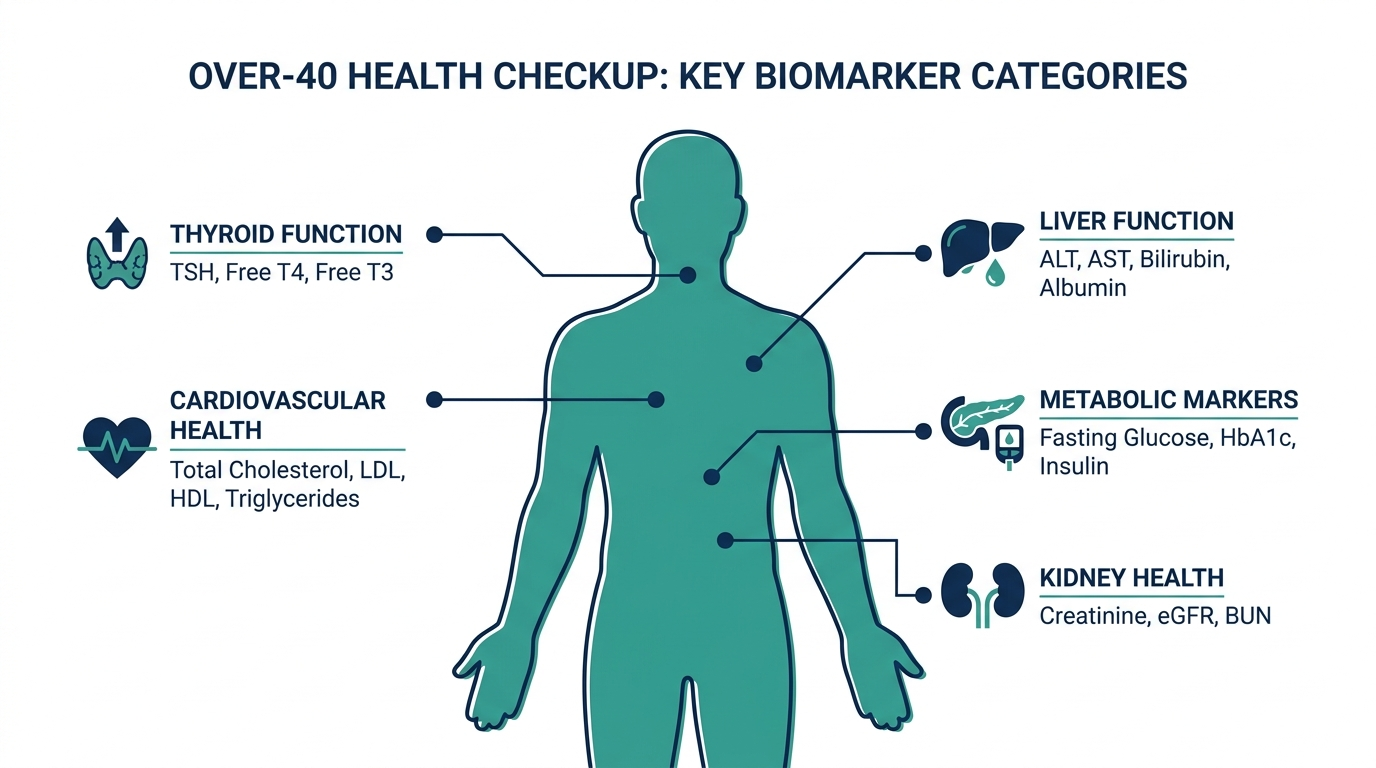
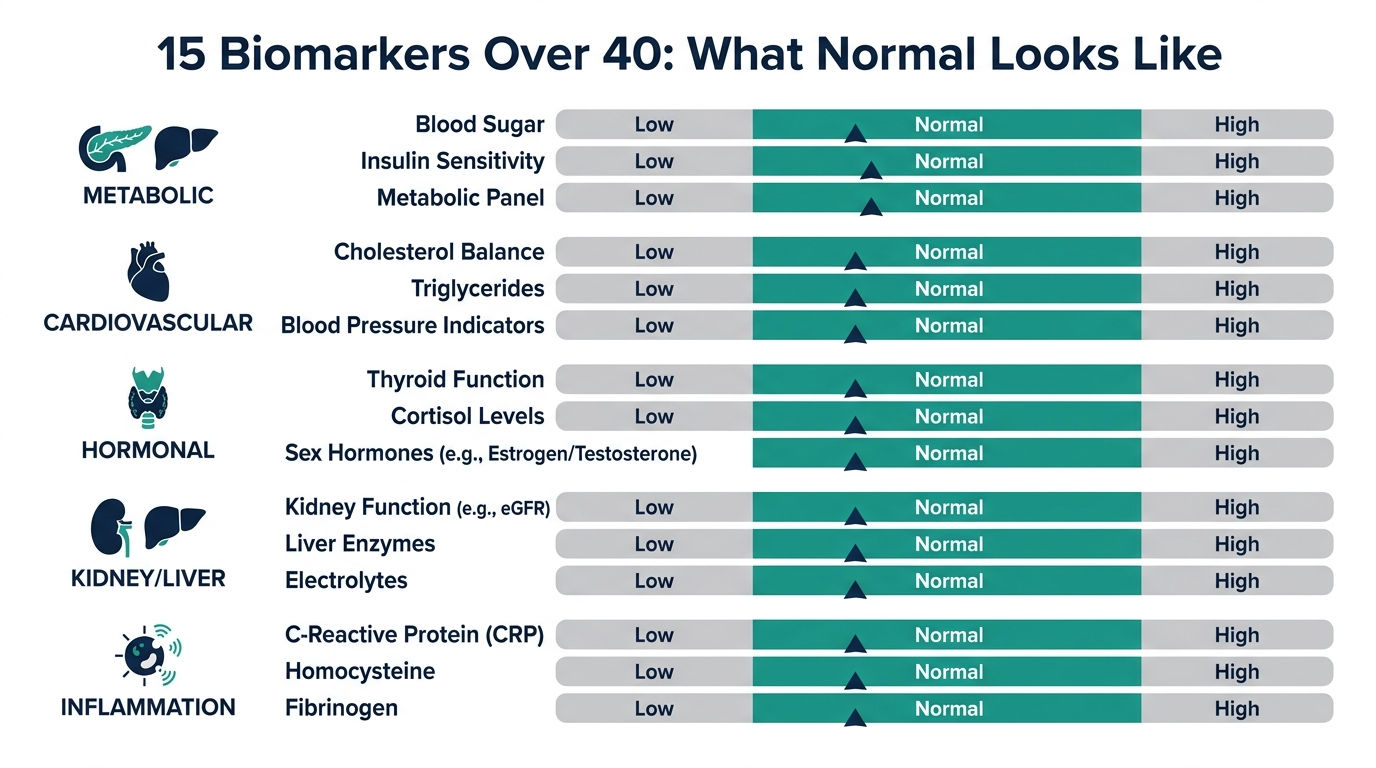
Quick answer: After 40, the biomarkers worth testing fall into five groups: heart (ApoB, Lp(a), hs-CRP, triglycerides), metabolic (fasting insulin, HbA1c, fasting glucose), liver and kidney (ALT, GGT, creatinine with eGFR), hormones (TSH, testosterone or estradiol, DHEA-S), and nutrients and longevity (ferritin, vitamin D, omega-3 index, homocysteine). These 15 markers catch the silent shifts in cardiovascular, metabolic, and hormonal health that begin around midlife, often years before symptoms. Most are not in a standard annual physical, so you usually have to ask for them or order a full panel yourself.
Forty is the age where the body quietly changes the rules. The cholesterol number that looked fine at 30 starts hiding a rising particle count. Fasting glucose stays normal while insulin climbs to keep it there. Muscle, bone, and hormones begin their slow drift. The markers below are the early-warning panel. This is a guide to the 15 biomarkers everyone over 40 should test: what each one is, why it matters after 40, and what counts as normal, plus how to test them all at once.
After 40, fifteen biomarkers across five systems catch the silent shifts your annual checkup might miss. Want to see all of yours? One at-home Superpower draw checks 100+ biomarkers, physician-reviewed.
Why 40 is the inflection point
The biomarkers to test after 40 matter because midlife is when several risk curves start bending upward at once, silently. None of these shifts announce themselves. You feel the same; the numbers, if you look, do not.
Three things happen around this decade. Cardiometabolic risk compounds: insulin resistance is often building for years before fasting glucose creeps up, and arterial plaque forms long before a stress test would flag it. Hormones change: testosterone in men declines roughly 1 to 2 percent a year from the late 30s, and women enter the runway to menopause as estradiol swings and falls. And the early-warning markers that move years before symptoms are exactly the ones a rushed physical tends to skip. The classic physical orders cholesterol and glucose, the markers that move late; ApoB and fasting insulin, which move early, go unordered unless you ask.
Testing after 40 is not about finding disease. It is about catching the slope before it becomes a diagnosis, while diet, training, and sometimes medication can still flatten it. A single out-of-range value is a reason to look closer, not to panic; bring any abnormal result to a clinician who can read it against your full picture.
Heart and cholesterol markers
Heart disease is still the leading cause of death in the United States, and it builds silently for decades. The four markers below predict cardiovascular risk far better than the total cholesterol number most people fixate on, and after 40 this is the group that earns the most attention.
1. ApoB
ApoB (apolipoprotein B) is a direct count of the artery-clogging particles in your blood. Every LDL, VLDL, and Lp(a) particle carries exactly one ApoB protein, so ApoB is a headcount of every particle that can lodge in an artery wall and start plaque. Why it matters after 40: ApoB catches the people whose standard LDL looks normal but whose particle count, and real risk, runs high, a mismatch common in anyone with early insulin resistance. A normal range note: optimal is under 90 mg/dL for average risk, and under 80 or even 65 mg/dL if you already carry heart risk. This is the single most important marker on the list, and the one a basic panel is most likely to leave off. See what a normal ApoB level looks like.
2. Lp(a)
Lp(a), said “L-P-little-a”, is a genetically determined lipoprotein that behaves like a turbocharged, sticky LDL particle, and an independent driver of heart attack, stroke, and aortic valve disease. Why it matters after 40: roughly one in five people carry a high Lp(a) and have no idea, because it is almost never tested and barely moves with diet, exercise, or standard statins. If yours is high, it reframes your whole risk picture. The good news is it is mostly genetic, so you usually only need to test it once in your life. A normal range note: under 50 mg/dL (about 125 nmol/L) is the common high-risk cutoff, with the gray zone running from roughly 30 mg/dL (75 nmol/L). Here is a full guide to the Lp(a) test and what your result means.
3. hs-CRP
High-sensitivity C-reactive protein (hs-CRP) measures low-grade inflammation, including the arterial inflammation that helps plaque rupture and cause heart attacks. Why it matters after 40: two people can have identical cholesterol, but the one with chronic inflammation is at higher cardiovascular risk, and hs-CRP is how you see it. It also flags metabolic stress, since visceral fat and insulin resistance both raise it. A normal range note: under 1.0 mg/L is low risk, 1.0 to 3.0 is average, over 3.0 mg/L is high risk. One caveat: a recent cold, injury, or inflammatory flare spikes it temporarily, so do not test in the week after you have been sick, and repeat a high reading. Here is what hs-CRP levels actually mean.
4. Triglycerides
Triglycerides are the fats circulating in your blood, tied tightly to diet, alcohol, and metabolic health, and the one heart marker you likely already get on a basic lipid panel. Why it matters after 40: high triglycerides paired with low HDL is the classic fingerprint of insulin resistance, and it often shows up here before fasting glucose moves. A normal range note: under 150 mg/dL is normal, 150 to 199 borderline, 200 to 499 high, and over 500 raises pancreatitis risk. This is the one marker here where fasting genuinely matters, since a fatty meal can push it up by 50 to 100 mg/dL.
| Heart marker | Normal range | What high means |
|---|---|---|
| ApoB | Under 90 mg/dL (under 80 if at risk) | More plaque-causing particles than LDL alone shows |
| Lp(a) | Under 50 mg/dL (~125 nmol/L) | Inherited high risk, manage everything else harder |
| hs-CRP | Under 1.0 mg/L | Arterial inflammation, higher heart-attack risk |
| Triglycerides | Under 150 mg/dL | Insulin resistance, metabolic strain, pancreatitis risk above 500 |
Metabolic and blood sugar markers
Type 2 diabetes develops over a decade or more, and the body hides the early years well. The three markers below show that progression in order, from the earliest hidden signal to the one your doctor usually waits for.
5. Fasting insulin
Fasting insulin measures how hard your pancreas is working to keep blood sugar normal. It is the earliest warning sign on this list and almost never ordered. Why it matters after 40: years before fasting glucose or HbA1c budge, insulin quietly climbs to force a normal glucose reading, so by the time glucose rises you have often had insulin resistance for a decade. Catch it early and you can reverse the trend with diet and training. A normal range note: optimal is roughly 2 to 6 mIU/L; above about 8 to 10 suggests the pancreas is overcompensating, even with normal glucose. This is the metabolic equivalent of ApoB. Here is the full fasting insulin normal range guide.
6. HbA1c
HbA1c (glycated hemoglobin) reflects your average blood sugar over the past two to three months, because glucose sticks to red blood cells in proportion to how high it runs. Why it matters after 40: it smooths out the noise of a single glucose reading and is the standard marker for diagnosing prediabetes and diabetes, moving after insulin but before symptoms. A normal range note: under 5.7 percent is normal, 5.7 to 6.4 is prediabetes, 6.5 or higher diagnoses diabetes. It does not require fasting, so you can draw it any time of day.
7. Fasting glucose
Fasting glucose is your blood sugar after an overnight fast, the most familiar metabolic number and a standard part of the comprehensive metabolic panel. Why it matters after 40: it is the marker doctors lean on most, which is why pairing it with insulin and HbA1c matters. On its own it can give false reassurance, because it is often the last of the three to rise. Read together, the trio shows where you are on the slope toward diabetes. A normal range note: under 100 mg/dL is normal, 100 to 125 prediabetes, 126 or higher on two tests diagnoses diabetes. Draw it first thing in the morning, water only beforehand.
| Metabolic marker | Normal range | What it catches |
|---|---|---|
| Fasting insulin | 2 to 6 mIU/L | Insulin resistance up to 10 years before glucose moves |
| HbA1c | Under 5.7% | Average blood sugar over 2 to 3 months |
| Fasting glucose | Under 100 mg/dL | Current blood sugar, the late-moving signal |
A worked example: a 45-year-old with a fasting glucose of 95 and an HbA1c of 5.5 percent reads as a clean bill on a standard physical. Add fasting insulin and it comes back 14 mIU/L, more than double optimal. That person is deep in insulin resistance with two normal sugar numbers, and only the skipped marker would have caught it.
Liver and kidney markers
Your liver and kidneys are silent organs that can lose a large share of function before you feel anything, and after 40 the most common driver, fatty liver tied to metabolic health, is rising fast. These three markers are an early read on both.
8. ALT
ALT (alanine aminotransferase) is a liver enzyme that leaks into the blood when liver cells are stressed. Why it matters after 40: the leading cause of a mildly high ALT today is not alcohol, it is fatty liver driven by insulin resistance, the same problem your insulin and triglycerides flag. A creeping ALT in someone who barely drinks is the liver’s version of an early metabolic warning. A normal range note: lab cutoffs run up to about 40 to 55 U/L, but many liver specialists consider healthy closer to under 30 for men and under 25 for women, so a result at the top of “normal” is worth a second look. ALT is part of a comprehensive metabolic panel, so this one usually is in a standard physical.
9. GGT
GGT (gamma-glutamyl transferase) is a second liver enzyme, especially sensitive to alcohol and oxidative stress. Why it matters after 40: a high GGT alongside a high ALT points more toward alcohol or bile-flow issues, and it also tracks independently with cardiometabolic risk, rounding out the liver picture. A normal range note: under 50 U/L for men and under 35 U/L for women, lower being better. GGT is not always in a basic panel, so you may need to add it.
10. Creatinine and eGFR
Creatinine is a muscle waste product your kidneys clear, and eGFR (estimated glomerular filtration rate) turns your creatinine, age, and sex into a kidney-function score. Why it matters after 40: kidney function declines with age, and its two biggest accelerators, high blood pressure and diabetes, are both more common now. eGFR catches that decline early. A normal range note: creatinine around 0.6 to 1.3 mg/dL by sex and muscle mass; eGFR above 90 is normal, 60 to 89 mildly reduced, and under 60 sustained points to chronic kidney disease. One insider note: heavy muscle mass or a big creatine-supplement habit can nudge creatinine up without any kidney problem. Both are standard on a comprehensive metabolic panel.
| Organ marker | Normal range | What high means |
|---|---|---|
| ALT | Under ~30 U/L (lower is better) | Liver cell stress, often fatty liver from insulin resistance |
| GGT | Under 50 U/L (men), under 35 (women) | Alcohol load, bile issues, oxidative and cardiometabolic stress |
| Creatinine | 0.6 to 1.3 mg/dL | Possible reduced kidney clearance (or high muscle mass) |
| eGFR | Above 90 | Under 60 sustained suggests chronic kidney disease |
Hormones and thyroid markers
Hormones drive how you feel day to day, and they shift hard in midlife. Low energy, poor sleep, stubborn weight, and low libido after 40 are often hormonal, yet these markers are rarely on a routine order. This group is sex-specific in places.
11. TSH
TSH (thyroid-stimulating hormone) is the brain’s signal telling the thyroid how hard to work, and the front-line screen for thyroid function. Why it matters after 40: thyroid problems, especially underactive thyroid, grow more common with age and disproportionately affect women, and the symptoms (fatigue, weight gain, cold intolerance, brain fog) are easy to write off as aging. A normal range note: roughly 0.4 to 4.0 mIU/L, though many clinicians treat symptomatic people in the upper half and add free T4 and free T3. TSH is sometimes in a physical and often not, so confirm it.
12. Testosterone (men) or estradiol (women)
This is the core sex hormone, and the one to test depends on you: for men, total and free testosterone; for women, estradiol, especially as menopause approaches. Why it matters after 40: men’s testosterone falls about 1 to 2 percent a year, dragging energy, muscle, mood, and libido down, while women’s estradiol swings and then drops through perimenopause, affecting bone, mood, sleep, and cardiovascular risk. These are the hormones behind the “I just feel off” complaint of midlife. A normal range note: total testosterone in men runs roughly 300 to 1000 ng/dL, optimal often in the upper half; estradiol in women varies by menstrual phase and menopausal status, so it is read in clinical context. Neither is standard on a physical unless you raise the symptom.
13. DHEA-S
DHEA-S (dehydroepiandrosterone sulfate) is an adrenal hormone and a building block for other sex hormones. Why it matters after 40: it peaks in your 20s and declines steadily after, serving as a rough marker of adrenal output and biological aging and giving context to your hormone picture. A normal range note: strongly age-dependent and sex-specific, read against age-matched norms rather than one fixed number. Like the other hormones here, it is an add-on, not a default.

Nutrients and longevity markers
The last group covers the inputs and the long game: nutrient levels that quietly affect energy, immunity, and brain health, plus the markers most associated with healthy aging. Deficiencies here are common, fixable, and almost never checked on a routine visit.
14. Ferritin
Ferritin measures your stored iron, the best single marker of iron status. Why it matters after 40: low ferritin causes fatigue, hair loss, and poor exercise tolerance and is common in menstruating and perimenopausal women, while high ferritin can signal inflammation, fatty liver, or the genetic iron-overload condition hemochromatosis, which often surfaces in midlife. A normal range note: roughly 30 to 300 ng/mL for men and 15 to 200 for women, though many clinicians want symptomatic people above 50 to 100. One catch: ferritin rises with inflammation, so a normal number during an illness can mask a deficiency. Here is a full guide to what ferritin levels mean.
15. Vitamin D
Vitamin D (measured as 25-hydroxyvitamin D) governs bone health, immune function, and muscle strength, and deficiency is one of the most widespread in the country. Why it matters after 40: bone density starts its real decline now, especially for women approaching menopause, and adequate vitamin D is central to keeping it. Most people who live indoors or at northern latitudes run low without knowing it. A normal range note: under 20 ng/mL is deficient, 20 to 30 insufficient, with many clinicians targeting 30 to 50 ng/mL. It is cheap to test, cheap to fix, and rarely on a standard order.
Omega-3 index and homocysteine
Two markers round out the longevity group. The omega-3 index measures the percentage of EPA and DHA in your red blood cell membranes and tracks with lower cardiovascular and cognitive risk; above 8 percent is protective, under 4 percent is high risk, and most Americans land low. Here is the omega-3 index test explained. Homocysteine is an amino acid linked, when elevated, to heart disease, stroke, and cognitive decline, often reflecting a B-vitamin shortfall (B12, B6, folate) that grows common with age. Optimal is under 10 micromoles per liter, and a high reading is frequently fixable with the right B vitamins. See what homocysteine levels mean.
| Nutrient/longevity marker | Optimal range | Why it matters after 40 |
|---|---|---|
| Ferritin | 50 to 150 ng/mL (sex-dependent) | Iron stores; low causes fatigue, high flags overload |
| Vitamin D | 30 to 50 ng/mL | Bone density and immune function as decline begins |
| Omega-3 index | Above 8% | Lower heart and cognitive risk |
| Homocysteine | Under 10 micromol/L | Heart, stroke, and brain risk; often B-vitamin fixable |
The insider detail: why your annual physical skips the markers that matter most
Here is the thing a layperson rarely hears. The two markers most predictive of where your health is heading after 40, ApoB and fasting insulin, are almost never on a standard annual physical, while the markers they outperform, LDL cholesterol and fasting glucose, are ordered by default.
The reason is partly history and partly billing. Standard panels were locked in decades ago around what was cheap and well-studied: a lipid panel that calculates LDL, and a metabolic panel with glucose. ApoB and fasting insulin were not in that default set and still are not, even though the evidence has moved. Insurance reimburses the legacy panel without a fuss, while add-on markers can require a specific indication, an extra order line, and sometimes an out-of-pocket charge, so a time-pressed visit defaults to what is already on the form.
The practical consequence: you can walk out of a physical with a clean LDL, a clean fasting glucose, and a doctor saying you look great, while your ApoB and fasting insulin sit quietly elevated and untested. The fix is in your hands: ask for ApoB and fasting insulin by name, or order a panel that includes them.

How to test all of these at once
You have three realistic routes, and they differ a lot in price and hassle. The 15 markers span lipids, metabolic, liver, kidney, hormones, and nutrients, which piecemeal means several separate orders, several add-on fees, and possibly more than one trip to the lab.
- Through your doctor, marker by marker: bring this list and ask for each by name. The basics (triglycerides, glucose, HbA1c, ALT, creatinine, eGFR) are usually easy and often covered. The high-value extras (ApoB, fasting insulin, Lp(a), hs-CRP, omega-3 index, homocysteine, hormones) frequently need to be requested and may be billed as add-ons.
- Self-ordered, test by test: online lab services let you order individual markers cash-pay through Quest or Labcorp. You control the order, but assembling all 15 means stacking many individual tests, and the total often runs higher than a bundled panel.
- A single full-body panel: one comprehensive draw that captures every marker together, reviewed and tracked over time. One appointment, one fasting morning, one result you can watch year over year.
For most people over 40, the bundled route is both cheaper and far less of a headache than chasing 15 separate tests. It also solves the tracking problem: a panel that captures the same numbers each year shows you the slope, not just a snapshot. If you are weighing the major full-body options, see our Superpower vs Function Health comparison.
The simplest way to actually get this done
Superpower is a single at-home draw that covers 100+ biomarkers including the heart, metabolic, hormone and longevity markers above ($199/year). It is what we point readers to when they would rather get one clean, complete draw than chase single tests one at a time. Here is superpower reviewed in full.
Who should prioritize which markers
All 15 are worth testing after 40, but if budget forces you to start somewhere, match the markers to your situation and confirm with a clinician.
| Your situation | Start with these |
|---|---|
| Family history of heart disease | ApoB, Lp(a), hs-CRP, triglycerides |
| Overweight, stubborn belly fat, fatigue | Fasting insulin, HbA1c, triglycerides, ALT |
| Low energy, low libido, poor sleep | TSH, testosterone or estradiol, DHEA-S, ferritin, vitamin D |
| Vegetarian, low-fish, or limited sun | Ferritin, vitamin D, omega-3 index, homocysteine |
| Just want the full baseline | All 15, then retest yearly to watch the trend |
The early metabolic and cardiac markers (fasting insulin, ApoB) deliver the most value for the money, because they catch problems while they are still reversible. Whatever you test, the real payoff is repeating the same markers year over year so you see the direction of travel.
Curious what your own levels look like?
Baseline 100+ biomarkers today and retest as life changes, all in one membership with physician review.
FAQ
Which of these biomarkers does a normal physical include?
A standard annual physical usually includes triglycerides, fasting glucose, ALT, creatinine, and eGFR, and sometimes TSH. It typically does not include ApoB, Lp(a), hs-CRP, fasting insulin, GGT, sex hormones, DHEA-S, omega-3 index, or homocysteine unless you ask. So a clean physical often leaves the highest-value early markers untested.
How often should I test these after 40?
For most healthy adults, once a year is the sweet spot for the full panel, since these markers are most useful as a trend. Lp(a) is the exception, because it is largely genetic, so testing it once is usually enough. If a marker comes back abnormal or you are changing diet, training, or medication, retest that one every 3 to 6 months until it stabilizes.
Can I get these biomarkers tested without a doctor?
Yes. Online lab services and full-body panel memberships let you order most of these markers directly, with the blood drawn at a Quest or Labcorp site or at home, no physician visit required. For anything abnormal, it is still worth bringing the result to a clinician who can read it against your full history.
What is the single most important biomarker to test after 40?
If you could only add one marker to a standard physical, make it ApoB, because it counts the actual particles that cause heart disease and catches risk a normal LDL hides. A close second is fasting insulin, which flags metabolic trouble up to a decade before glucose moves. Both are early-warning markers the default physical skips.
Do I need to fast for these blood tests?
Some yes, some no. Fasting glucose, fasting insulin, and triglycerides need an overnight fast (water only), so the simplest approach is to draw the whole panel first thing in the morning. HbA1c, ApoB, Lp(a), TSH, vitamin D, and ferritin do not strictly require fasting, but since the panel mixes both, fasting for the full draw keeps everything clean in one trip.
Are these biomarker ranges different for men and women?
Several are. The big one is sex hormones, where men test testosterone and women test estradiol, and DHEA-S and ferritin ranges also differ by sex. Ferritin targets run lower for women, especially before menopause. The heart, metabolic, liver, and kidney markers use broadly similar cutoffs for both, with creatinine running a bit higher in men due to greater muscle mass.
How much does it cost to test all 15 biomarkers?
Ordered piecemeal, the advanced markers add up fast, since ApoB, Lp(a), hs-CRP, fasting insulin, omega-3 index, and homocysteine are often add-on charges on top of the basics, so a self-assembled panel can run well into the hundreds. A bundled full-body panel that captures all of them in one draw is usually cheaper, often around $199 a year, and spares you ordering each test separately.
What does it mean if one of these markers is high but I feel fine?
That is exactly the point of testing. The most valuable markers here (ApoB, fasting insulin, Lp(a), hs-CRP) move years before you feel anything, so a high result while you feel fine is an early warning, not a false alarm. Repeat the test to confirm, then talk to a clinician about whether to act, rather than panic over one draw.
Should I retest a high result before doing anything about it?
Usually yes. Single readings can be thrown off by recent illness (which spikes hs-CRP and ferritin), a fatty meal (triglycerides), alcohol (GGT and triglycerides), or simple lab variation. Doctors treat trends, not snapshots, so a confirmatory retest a few weeks later under normal conditions is the right move before any medication or major change.
At what age should I start testing these biomarkers?
Forty is a sensible default for the full panel, but several markers are worth checking earlier with risk factors. Lp(a) should be tested at least once in everyone’s life, ideally young, since it is genetic. ApoB, fasting insulin, and a lipid panel are reasonable from your 30s with a family history of heart disease or diabetes. There is no benefit to waiting for a symptom to force the issue.
Related: best at-home biomarker tests of 2026.
Vital Signs Today may earn a commission if you buy through links on this page. It does not affect our editorial assessments.