
Last updated 18 June 2026. Educational content, not medical advice. Tesamorelin is a prescription peptide in the United States. Talk to a licensed clinician before starting.
Short answer: The safest and most cost-effective route to tesamorelin in 2026 is a licensed telehealth clinic that prescribes compounded tesamorelin from a US 503A or 503B pharmacy, typically $150 to $300 per month, compared to the brand-name Egrifta SV at roughly $3,085 per month retail. Research-grade vials from unvetted vendors exist but carry zero medical oversight and shift every safety responsibility onto you.
Tesamorelin telehealth runs $150 to $300 a month, so shouldn’t a baseline panel come before you commit? One at-home Superpower draw checks 100+ biomarkers, physician-reviewed.
What is tesamorelin, and why does it matter for fat loss?
Tesamorelin is not just another peptide. It is the only FDA-approved compound specifically cleared for visceral fat reduction, first approved in 2010 under the brand name Egrifta (now Egrifta SV, manufactured by Theratechnologies) for HIV-associated lipodystrophy. That regulatory pedigree is what separates it from the rest of the growth-hormone secretagogue market, where most compounds carry no human-trial data at therapeutic doses.
Mechanically, tesamorelin is a stabilized analog of the full 44-amino-acid GHRH sequence. Native GHRH is destroyed by the enzyme DPP-IV within minutes. Tesamorelin’s chemical modification blocks that degradation, giving it a meaningful receptor residence time. When it binds GHRH receptors on anterior pituitary somatotroph cells, it triggers the natural GH pulse, somatostatin feedback intact, driving selective lipolysis in visceral adipose tissue by elevating IGF-1.
Phase III clinical trials (the M311 program) documented an 18% reduction in visceral adipose tissue versus under 5% in placebo at 26 weeks on the 2 mg daily dose. A 2026 meta-analysis of five randomized controlled trials published in Obesity Research and Clinical Practice put the VAT reduction at a mean of 27.71 cm² (95% CI -38.37 to -17.06, p < 0.001), alongside a 1.18 kg drop in trunk fat, a 1.42 kg gain in lean body mass, and a 4.28% reduction in hepatic fat fraction. Those numbers come from trials in HIV populations, but the underlying biology of visceral fat and GHRH signaling does not change based on HIV status.
Full-body lab membership: 100+ biomarkers, doctor-reviewed, tracked over time.
The three routes to tesamorelin in 2026
Understanding why there are three access routes, and what is actually different about each, is more useful than a list of websites.
Route 1: Brand-name Egrifta SV (specialty pharmacy, insurance-billed)
This is the only route where you are holding a finished drug the FDA has directly evaluated. Egrifta SV comes as a 1 mg/mL subcutaneous injection kit, distributed through specialty pharmacies including AcariaHealth, Avita Pharmacy, and Walgreens Specialty. The retail list price runs approximately $3,085 per month. Most commercial insurance will only cover it for its approved indication, HIV-associated lipodystrophy, and typically requires prior authorization and documentation of an undetectable viral load or active antiretroviral therapy.
For the majority of people searching “where to buy tesamorelin peptide,” this route is functionally closed. You would need an HIV diagnosis, a qualified prescriber, and successful prior auth. If you qualify, Theratechnologies runs a patient assistance program that can reduce out-of-pocket cost dramatically. For anyone using it off-label for metabolic health, the brand route is both inaccessible and unnecessary, because Route 2 covers the same molecule.
Route 2: Compounded tesamorelin via telehealth (the working route for most people)
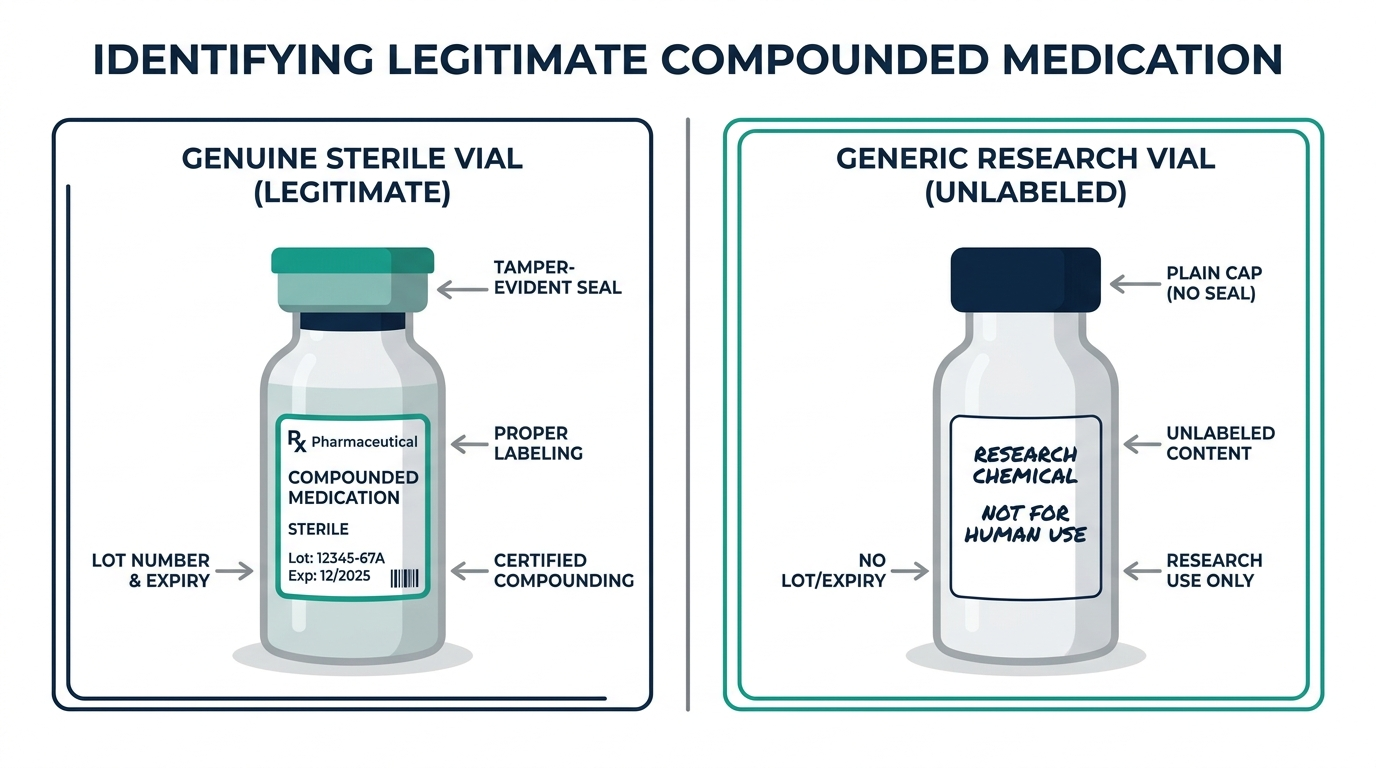
Compounding pharmacies licensed under 503A (patient-specific prescriptions) or 503B (outsourcing facility, larger batches) can mix tesamorelin bulk drug substance into injectable vials at clinician-specified concentrations, provided a licensed prescriber writes the order. This is the route that practically functions in 2026 for off-label use.
The cost is radically different from brand: most telehealth programs price compounded tesamorelin at $150 to $300 per month for the medication, with a consultation fee of $34 to $200 depending on the platform. Named providers actively offering tesamorelin in 2026 include Wellcore (listed at $195/month plus $34 initial consult), Marek Health, Defy Medical, and Eden Health. Florida Surgery and Weight Loss Center explicitly offers in-clinic and telehealth tesamorelin for both HIV-associated and off-label metabolic indications.
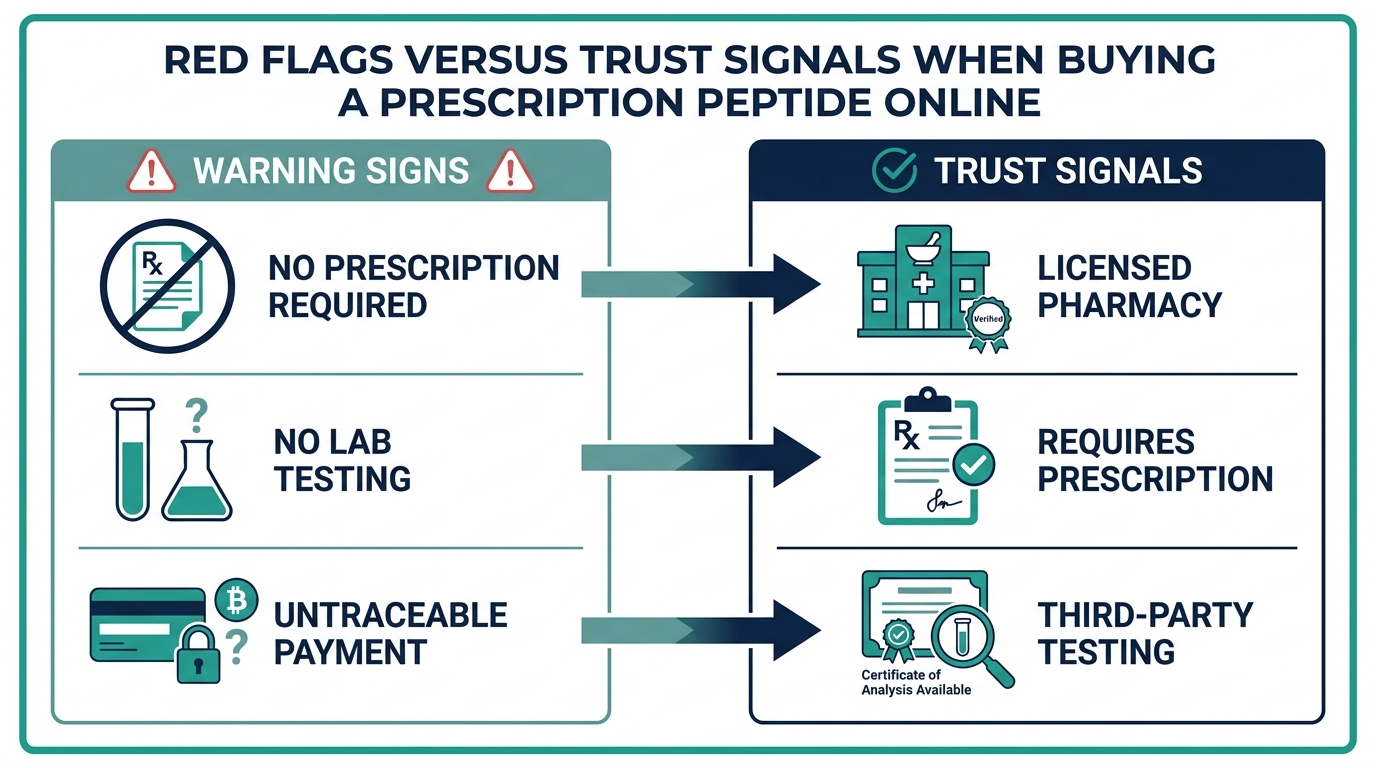
What a legitimate telehealth program must include, no exceptions: a licensed prescriber (physician, NP, or PA), baseline lab review before the first prescription, compounded product from a named, verifiable pharmacy with a Certificate of Analysis, structured follow-up with IGF-1 and glucose recheck at 12 weeks, and pricing that reflects all of the above. Programs offering same-day sign-up with no labs are not following the clinical standard.
Route 3: Research-grade lyophilized vials (proceed with extreme caution)
Research-grade tesamorelin is sold by peptide vendors as a freeze-dried powder “for laboratory research only.” These vials run $60 to $150 for a 10 mg vial from third-party-tested vendors, or as low as $36 per vial from sources with minimal accountability. The legal fiction works the same way it does for BPC-157 or TB-500: the label disclaims human use, and the moment you reconstitute and inject it, you have left every protection that label pretended to offer.
The specific quality risk with tesamorelin deserves naming. The authentic molecule has a molecular weight of 5,196 Da. A vendor COA should confirm that number by mass spectrometry. The substitutes you are most likely to receive instead, sermorelin (3,358 Da) or CJC-1295 (3,647 Da), are cheaper to synthesize and easily misrepresented. Without a COA that includes mass spec identity, you cannot know which molecule is in the vial. HPLC purity alone tells you how much of something is present. Only mass spec tells you it is the right something.
What a legitimate telehealth tesamorelin program actually looks like
Personally, I think the gap between a careful telehealth program and a grey-market vial is larger than most forum discussions acknowledge. The monthly price difference looks like $200 to $250. What that gap actually buys is more than chemistry.
A proper telehealth program orders baseline labs first, typically a full metabolic panel, fasting glucose, HbA1c, lipid panel, IGF-1, and thyroid function. Tesamorelin raises fasting glucose modestly (the 4.9 mg/dL mean from Phase III trials) and has a small but real effect on insulin resistance, particularly in patients with pre-existing glucose dysregulation. A PLOS One study on tesamorelin in type 2 diabetes confirmed the glucose effects are manageable but not zero. Without baseline labs, you cannot know if a rising fasting glucose in week six is the peptide doing its expected thing or a clinical problem that needs to stop the protocol.
The dosing conversation with a real clinician also changes the outcome meaningfully. The FDA-approved dose is 2 mg daily subcutaneously. But off-label clinical practice often starts patients at 1 mg daily, titrates based on IGF-1 response, and may cycle the protocol (12 weeks on, 4 to 8 weeks off) to prevent IGF-1 creep. Protocols are typically taken in the evening to align injections with the body’s natural nocturnal GH pulse. None of that nuance appears on a research-vendor checkout page.
Telehealth GLP-1 program with provider visits and pharmacy coordination.
Tesamorelin compared to the other GH peptides
This comparison matters because most buyers are not choosing tesamorelin in isolation. They are weighing it against sermorelin, CJC-1295 with or without DAC, and ipamorelin, and the differences are real, not marketing noise.
| Peptide | Type | Clinical evidence | FDA status | Approx. monthly cost (telehealth) | Key feature |
|---|---|---|---|---|---|
| Tesamorelin | GHRH analog (full 44-aa) | Phase III RCT data, VAT -18% | FDA-approved (Egrifta SV) | $150 to $300 | Only GHRH with visceral fat RCT data |
| Sermorelin | GHRH fragment (1-29 aa) | Smaller studies, less potency | Prescription (not brand) | $175 to $225 | Lower cost, milder effect, broader availability |
| CJC-1295 with DAC | GHRH analog (extended half-life) | Limited human data | Not FDA-approved | $150 to $250 | Sustained GH “bleed” vs pulsatile; may suppress natural rhythm |
| Ipamorelin | GHRP (ghrelin receptor agonist) | Phase 2 discontinued | Not FDA-approved | Often stacked, $100 to $200 | Different receptor pathway; commonly combined with GHRH analogs |
| CJC-1295 without DAC | GHRH analog (short-acting) | Limited human data | Not FDA-approved | $150 to $250 | Pulsatile-ish release, no DAC suppression risk |
The most important line in that table: CJC-1295 with DAC creates a sustained GH elevation that can flatten the natural GH pulse rhythm over time. Tesamorelin fires, leaves, and lets the pituitary recover. That is not a minor distinction if you are running a protocol for more than a few weeks. Clinicians at Marek Health and Eden Health have noted a shift toward tesamorelin or CJC-1295 without DAC for this reason.
The tesamorelin-ipamorelin blend has grown in popularity because the two hit completely different receptors: tesamorelin at GHRH-R, ipamorelin at GHS-R1a (the ghrelin receptor). The working theory is that hitting both simultaneously produces a larger GH pulse than either alone. No head-to-head randomized trial has tested this. The clinical logic is reasonable but the RCT evidence for the blend does not exist.
If the primary goal is documented visceral fat reduction with the backing of human trial data, tesamorelin is the only GHRH peptide with that evidence base. Everything else involves a meaningful extrapolation.
How to vet a COA if you are buying research-grade
Do not believe any claim about vendor quality without verifying it yourself. The process takes five minutes and filters out the majority of problems.
First, obtain the COA for the specific batch you are ordering, not a generic document on the product page. The batch number on the COA must match the number on the vial label when it arrives. If the vendor cannot provide a batch-specific COA before purchase, stop.
Second, confirm the COA shows two tests: HPLC purity (the standard community minimum is 96%, with 99%+ considered excellent) and mass spectrometry identity confirming the 5,196 Da molecular weight for authentic tesamorelin. Purity alone is not sufficient, because a vial can be 99% pure of the wrong compound.
Third, verify the COA is from an independent third-party lab. The labs the community tracks are Janoshik Analytical (whose reports include a unique key you verify on their own site at no cost), MZ Biolabs, and Colmaric Analyticals. A COA from the vendor’s “in-house lab” is unverifiable and should not be accepted.
Fourth, cross-check the vendor against Finnrick’s ratings database, which covers more than 8,000 tests across 225 vendors as of mid-2026 and is not funded by sellers. Any vendor with recent failed batches or purity below 96% on Finnrick should be avoided regardless of their reviews.
Crypto-only checkout is a payment-processor red flag, not a boutique option. Pricing under $4 per mg is almost certainly a quality signal, and not a good one. International shipping with no customs documentation is another.
What does reconstituting tesamorelin actually involve?
The research-vendor route involves a step that most buyer guides bury: you have to turn a freeze-dried powder into an injectable solution yourself. This is not complicated if you follow the process, but it is where errors happen.
Lyophilized tesamorelin must be refrigerated at 2 to 8 degrees Celsius before reconstitution, or frozen at -20 degrees for long-term storage. You reconstitute it with bacteriostatic water (which contains 0.9% benzyl alcohol, preserving the solution against bacterial growth for 14 to 21 days of repeated draws). Inject the water slowly down the inside glass wall of the vial, not directly onto the powder cake, and let it dissolve without shaking or agitating.
The dose calculation is where people make mistakes. Add 1 mL (100 units on a U-100 insulin syringe) to a 5 mg vial and you get a concentration of 5,000 mcg/mL. On that syringe, 20 units is 0.2 mL, which is 1,000 mcg (1 mg). The clinical off-label starting dose of 1 mg daily is 20 units on that syringe. Get the arithmetic wrong by one decimal and you are off by a factor of ten. With the clinic route, a pharmacist has already done this and the vial arrives at the right concentration with the right dose labeled on it. That is most of what the price difference buys.
Reconstituted solution should be discarded after 21 days, even if product remains. Mark the date.
The glucose question nobody in the forums answers honestly
Tesamorelin raises growth hormone, and growth hormone is a counter-regulatory hormone to insulin. This is not a debate; it is the mechanism. The Phase III trials showed a mean 4.9 mg/dL increase in fasting glucose at 26 weeks in participants without baseline diabetes. HbA1c increased by 0.03% versus 0.01% in placebo, which is within measurement error for the marker. These effects largely reverse after discontinuation.
Do not believe the forums that wave this off entirely. Also do not believe the vendors who imply it is a dealbreaker for healthy adults. The honest statement is: if your fasting glucose is normal at baseline and you get labs at the 12-week mark, this is a manageable and reversible signal. If you have prediabetes, metabolic syndrome, or existing insulin resistance, this is a real consideration that needs clinical oversight, not a forum thread.
This is precisely the insight that separates a protocol done with a clinician from one done with a grey vial and internet protocols. A good program catches the glucose drift early and adjusts. A research-vial protocol catches it when you happen to get bloodwork done for something else.
Red flags when evaluating providers and vendors
Any of these should stop a purchase:
- No prescription required for an injectable peptide labeled “for human therapeutic use”
- Same-day prescribing with no lab review
- COAs signed by an in-house lab
- Mass spec not included (HPLC purity only)
- Pricing under $50 per month for compounded tesamorelin
- Vendor-provided COA with no verifiable key on the testing lab’s own site
- Active negative Finnrick findings on the specific product
- International compounding pharmacy with no US license verifiable via state pharmacy board
- Product labeled “for research use only” being sold with clinical dosing guidance and human-use framing simultaneously
That last one is more common than it should be. A vendor cannot have it both ways. Either the label is accurate and it is not for human use, or the vendor is selling it for human use under a legal fiction that disclaims all responsibility.
Turn what you just learned into action.
Superpower lets you test 100+ biomarkers from home, then re-check them over time so you can actually see progress, physician-reviewed at every step.
Frequently asked questions
Is tesamorelin legal to buy without a prescription?
Not for human therapeutic use. Tesamorelin is a prescription drug under the brand Egrifta SV. Compounded versions are also only legally dispensed with a valid prescription from a licensed provider. Research-grade vials are sold under a “laboratory research only” label, but that label does not make personal injection legal or safe.
How much does tesamorelin cost per month in 2026?
Brand-name Egrifta SV runs approximately $3,085 per month retail, available only through specialty pharmacies for HIV-associated lipodystrophy. Compounded tesamorelin through a telehealth clinic typically costs $150 to $300 per month for medication, plus a one-time or annual consultation fee ranging from $34 (Wellcore) to $200 depending on the platform. Research-grade vials run $60 to $150 per 10 mg vial, but that price excludes bacteriostatic water, syringes, and any medical oversight.
What results should I expect from tesamorelin, and how fast?
Clinical trial data shows approximately 18% visceral adipose tissue reduction at 26 weeks on 2 mg daily, versus under 5% in placebo (M311 Phase III program). The 2026 PubMed meta-analysis puts the mean VAT reduction at 27.71 cm². Off-label clinical protocols often start at 1 mg daily with results noticeable within 8 to 12 weeks. Results attenuate after stopping: tesamorelin does not produce lasting fat redistribution after discontinuation, which distinguishes it from GLP-1 receptor agonists.
What labs do I need before starting tesamorelin?
At minimum: fasting glucose, HbA1c, lipid panel, IGF-1, comprehensive metabolic panel, and thyroid function. A legitimate clinic requires these before the first prescription. The glucose baseline matters because tesamorelin increases fasting glucose by roughly 4.9 mg/dL in non-diabetic subjects; you need the number before treatment to interpret the 12-week recheck.
How does tesamorelin compare to sermorelin?
Tesamorelin is the full 44-amino-acid GHRH sequence stabilized against DPP-IV degradation. Sermorelin is a shorter GHRH fragment (residues 1 to 29) with lower potency and shorter receptor occupancy. Tesamorelin has Phase III RCT data with body composition endpoints and FDA approval. Sermorelin has smaller supporting studies and costs somewhat less ($175 to $225 per month versus $150 to $300). For documented visceral fat reduction with clinical evidence, tesamorelin is the better-supported choice.
Can I buy tesamorelin over the counter?
No. Injectable tesamorelin has no legitimate over-the-counter route. Any website offering injectable peptides “no prescription, for human use” is either misrepresenting the legal status or operating outside US regulations. Cosmetic and supplement peptides (collagen, topical copper peptide serums) are sold OTC because they are classified as food supplements or cosmetics. Injectable therapeutic peptides are not.
What happens if I stop taking tesamorelin?
Visceral fat returns toward baseline after discontinuation, typically over 6 to 12 weeks. The Phase III extension data shows that VAT levels in patients who discontinued trended back toward pre-treatment levels within 26 weeks. This is a meaningful difference from lifestyle intervention, where the body composition change can be sustained. Some protocols cycle tesamorelin (12 weeks on, 4 to 8 weeks off) to attempt to maintain benefit while allowing the body to resume natural GH pulsatility, though no formal trial has tested optimal cycling intervals.
Telehealth GLP-1 program with provider visits and pharmacy coordination.
Author: Vital Signs Today Editorial Team. Educational content, not medical advice. Sources linked inline.
Primary sources:
– PubMed: Tesamorelin meta-analysis, Obesity Research and Clinical Practice, 2026
– FDA: Egrifta SV prescribing information and approval history
– Drugs.com: Egrifta retail pricing
– PLOS One: Tesamorelin in type 2 diabetes safety study
– Wellcore: Tesamorelin product page and pricing
– Eden Health: Tesamorelin vs. sermorelin comparison
– PrymaLab: Tesamorelin cost and access guide 2026
– TrimRx: Tesamorelin research review
– Innerbody: Tesamorelin buying advice 2026
– Finnrick: Independent peptide testing and vendor ratings
Related reading
Vital Signs Today may earn a commission if you buy through links on this page. It does not affect our editorial assessments.