Disclosure: Vital Signs Today may earn a commission if you buy through links on this page, at no extra cost to you. This does not influence our evidence-based assessments. We are not a medical provider; talk to a clinician before acting on test results.
Related: ferritin blood test: the full guide · Ferritin normal range by age (full chart)
You scanned your blood work, everything looked routine, and then one line was flagged high: ferritin. Maybe it was 400, maybe it was 900, maybe your doctor said the word “iron overload” and your stomach dropped. Here is the calm truth almost nobody explains up front. A high ferritin is a starting question, not a verdict, and most of the time the cause is far more ordinary than the scary one you just Googled.
The trap is that ferritin gets treated as a simple iron gauge. It is not. It is one of the most misread numbers on the entire panel, and knowing why changes everything about how you should react to yours.
Part of our Iron Studies guide.
What does high ferritin mean in a blood test?
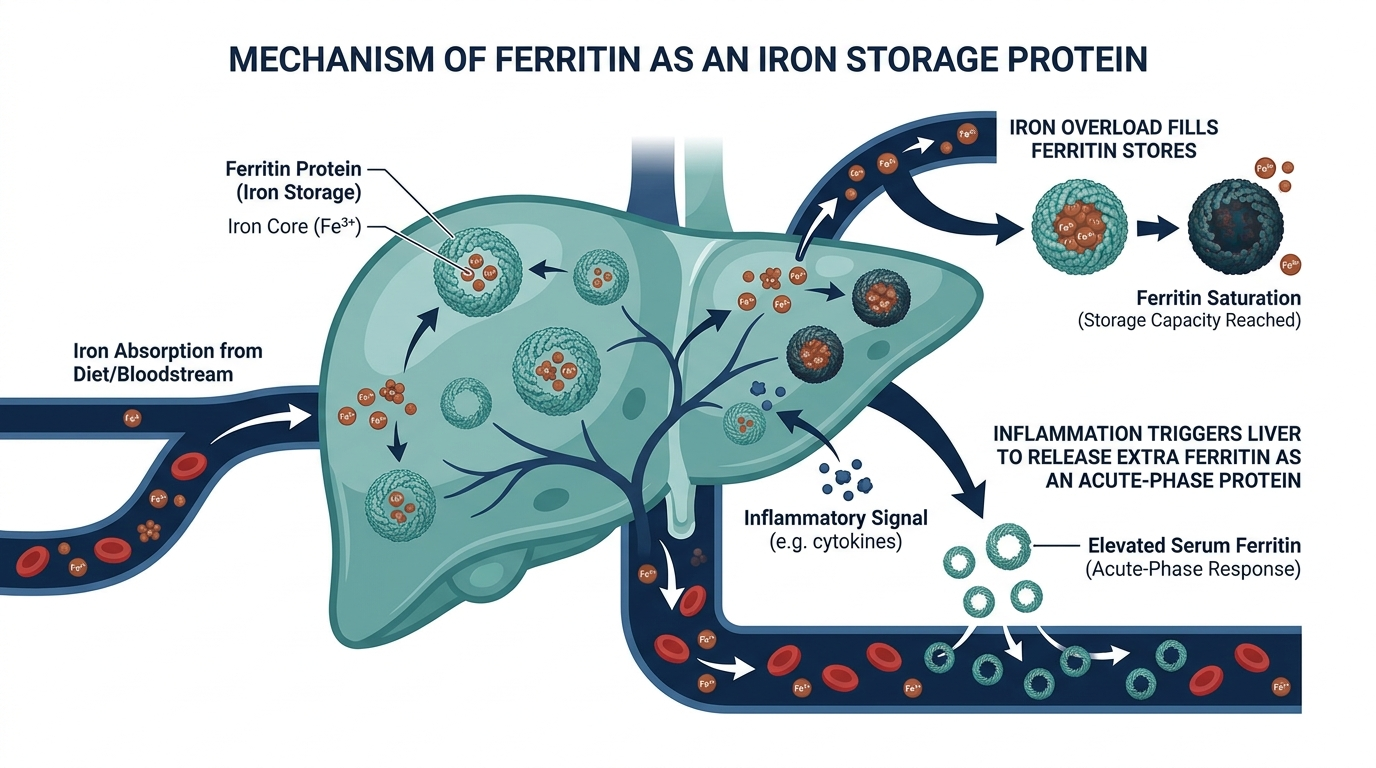
Ferritin is the protein that stores iron inside your cells, so a ferritin test is essentially a snapshot of how much iron your body has banked away (MedlinePlus). A high ferritin usually means one of two things: your body is storing too much iron, or your body is inflamed and pumping out ferritin as part of a stress response. Those are very different situations, and ferritin alone cannot tell you which one you are in.
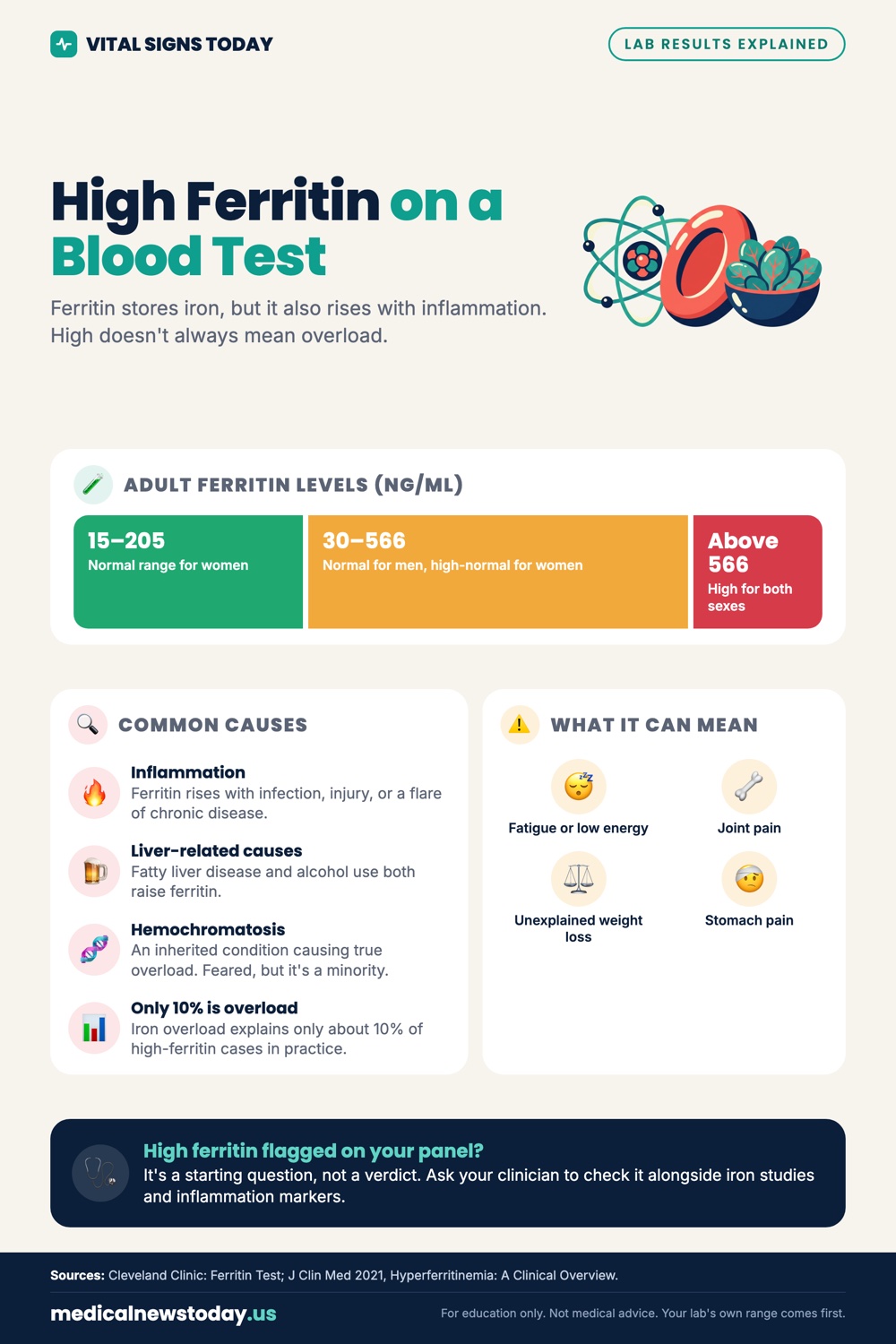
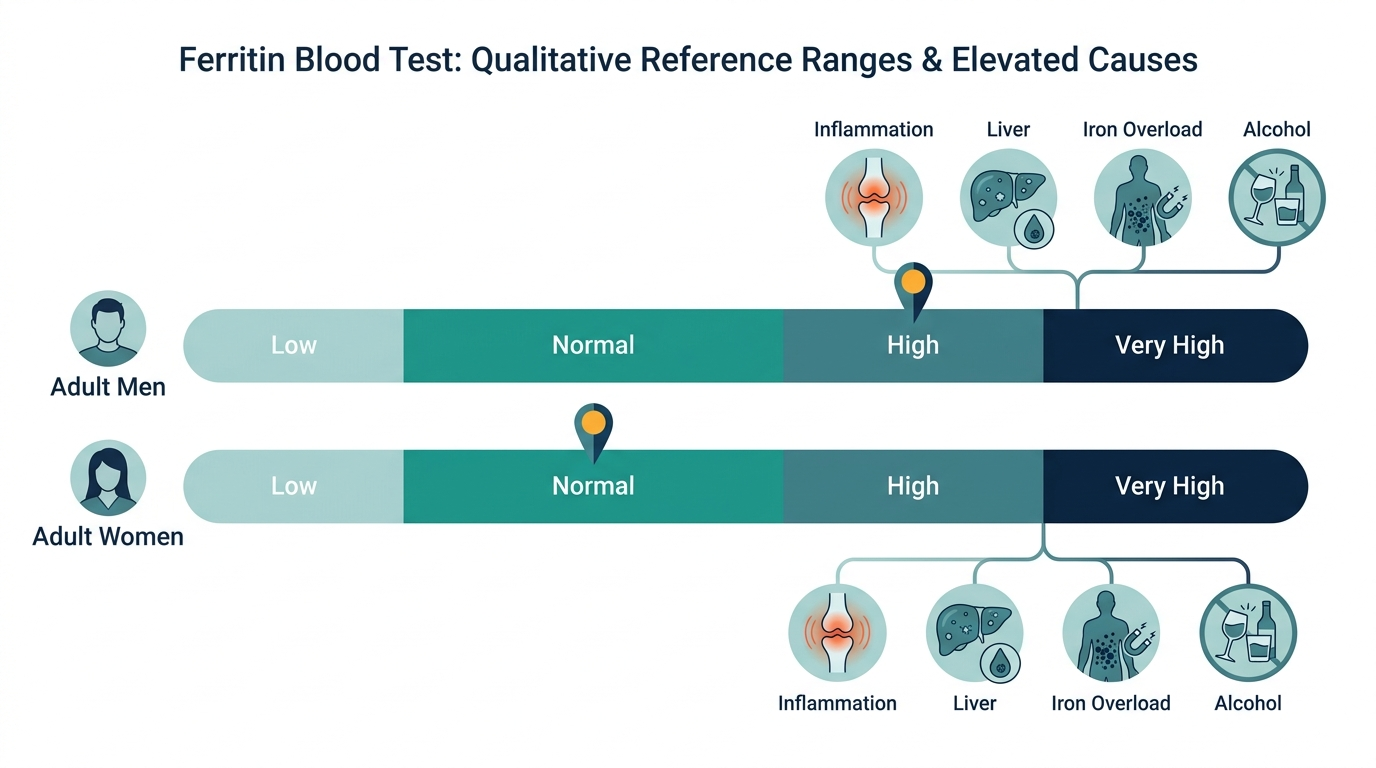
Where is the cutoff? Reference ranges vary by lab, sex, and instrument, but Cleveland Clinic lists a normal range of roughly 15 to 205 ng/mL for women and 30 to 566 ng/mL for men (Cleveland Clinic). In practice, clinicians start paying attention when ferritin climbs above about 200 ng/mL in menstruating women and above 300 ng/mL in men and postmenopausal women, because that is the level where true iron overload becomes worth ruling out (StatPearls). Always read your result against the range printed on your own report, since that is the range your lab actually calibrated.
Optimal versus simply “in range”
Here is a nuance the flag on your report does not capture. A ferritin can be inside the lab reference range and still sit at a point some clinicians would rather see moved. The reference range is a statistical band built from a testing population, not a target for good health, and the population it is built from includes plenty of people with quiet inflammation or early metabolic issues. That is why two people can both be “normal” and be in very different situations: one at the low-normal end, close to running out of iron reserve, and one near the high-normal end, where a slow metabolic or inflammatory process may be nudging the number up. This is also why chasing a single “ideal” ferritin figure is a mistake. The useful reading is your own trend over time against your own report’s range, not a magic number pulled from the internet. Where your ferritin sits inside the range matters, and it means more when you can compare it to a previous draw.
What causes a high ferritin?
Here is the part that surprises most people. Iron overload is the famous cause, but it is not the most common one. In one large analysis, iron overload accounted for fewer than 10 percent of people with elevated ferritin (StatPearls). The real differential, roughly most common first, looks like this:
- Inflammation and infection. Ferritin is a positive acute phase reactant, meaning it rises whenever your body is fighting something, from a recent infection to surgery to a flare of chronic disease (StatPearls). This is the quiet, everyday reason ferritin is high in a huge share of people.
- Liver-related causes. Fatty liver disease, alcohol use, and other liver damage all push ferritin up, and metabolic fatty liver in particular is now a leading driver of mildly raised ferritin (Cleveland Clinic).
- Metabolic conditions. Obesity, type 2 diabetes, chronic kidney disease, and hyperthyroidism can each elevate ferritin (Cleveland Clinic, MedlinePlus).
- Hemochromatosis (true iron overload). This inherited condition causes the body to absorb and store too much iron over years (Cleveland Clinic). It is the cause everyone fears, and it matters, but it is the minority.
- Too much iron from outside. Repeated blood transfusions or overdoing iron supplements can load the body with iron (MedlinePlus).
- Cancer, especially blood cancers or liver cancer, can raise ferritin (Cleveland Clinic).
The single most important takeaway: a mildly high ferritin on its own does not mean iron overload. It often means inflammation or a metabolic issue, and the only way to separate the two is to look at a second number, which we get to below.
What are the symptoms of a high ferritin?
Most of the time, nothing. A mildly elevated ferritin is usually silent, which is exactly why it tends to be found by accident on a routine panel rather than because you felt unwell. There is no symptom of “high ferritin” itself.
When ferritin is high because of genuine iron overload that has built up over years, the iron starts depositing in organs, and that is when symptoms appear (MedlinePlus):
- Persistent fatigue or weakness
- Joint pain, classically in the knuckles and knees
- Abdominal pain
- Low sex drive or erectile dysfunction
- A gray, metallic, or bronze tint to the skin
These are slow, nonspecific symptoms, easy to write off as aging or stress. If you have several of them alongside a high ferritin, that combination is worth flagging to your clinician rather than waiting.
When is a high ferritin dangerous or a medical emergency?
Most high ferritin results are not emergencies. The number is best read on a sliding scale of concern.
A mildly raised ferritin, say in the few-hundreds, is rarely urgent and usually points to inflammation or a metabolic cause. The picture changes as the number climbs. Ferritin above 1,000 ng/mL is the level at which clinicians take true iron overload seriously and may recommend a liver biopsy or imaging to assess organ damage in someone with hemochromatosis (StatPearls). Sustained, untreated iron overload can damage the liver, heart, and pancreas, which is why a persistently very high ferritin should never be ignored.
Extremely high ferritin, in the thousands and especially above 10,000 ng/mL, is a different category. In the right clinical setting it can signal serious systemic conditions such as hemophagocytic lymphohistiocytosis or adult-onset Still disease, which are genuine emergencies (StatPearls). A very high ferritin paired with high fever, confusion, or rapidly worsening illness warrants urgent medical attention. The number alone does not diagnose these, but it should never be dismissed.
What should you do about a high ferritin?
The first move is almost never treatment. It is a second test. A high ferritin is the start of a workup, not the end of one (Cleveland Clinic).
The key follow-up is transferrin saturation, a separate blood measure that tells your clinician whether your iron is actually overloaded or whether ferritin is up for some other reason. The rule of thumb: iron overload usually comes with a fasting transferrin saturation above 45 percent, and iron overload is unlikely when transferrin saturation is below 45 percent (StatPearls). High ferritin with a normal transferrin saturation points away from hemochromatosis and toward inflammation, liver, or metabolic causes.
Depending on that result, next steps may include:
- Repeat the test. A recent infection or illness can transiently spike ferritin, so a single high reading is often rechecked once you are well (StatPearls).
- Liver and metabolic screening, since fatty liver, alcohol, diabetes, and obesity are common culprits (Cleveland Clinic).
- Genetic testing for hemochromatosis if iron overload is suspected.
- Lifestyle levers, which matter when the cause is metabolic: reducing alcohol, addressing fatty liver, and not taking iron supplements unless a clinician has confirmed you need them.
Treatment, such as therapeutic phlebotomy (regularly removing blood to lower iron), is reserved for confirmed iron overload, not for a high ferritin number by itself.
A realistic version of this plays out constantly. Picture a man in his late forties, no symptoms, who gets a ferritin of 480 ng/mL on a routine panel. He reads the flag, finds hemochromatosis online, and spends a week convinced his liver is failing. His clinician orders a transferrin saturation, which comes back at 32 percent, comfortably below the 45 percent threshold. That single number reframes everything. The high ferritin is not iron overload, it is his fatty liver and a few extra pounds around the middle talking. The plan becomes cut back on alcohol, address the metabolic picture, and recheck in a few months, not a lifetime of blood removal. The panic was optional. The second test was not.
When should you see a doctor?
You should always review an abnormal ferritin with your clinician, but a few situations deserve prompt attention. See a doctor if your ferritin is high and you also have the symptoms of iron overload, such as joint pain, ongoing fatigue, or bronze-tinted skin. Get evaluated if your ferritin is markedly elevated, in the high hundreds or thousands, or if it stays high on a repeat test after any recent illness has cleared. And seek urgent care if a very high ferritin comes with high fever, confusion, or a rapidly worsening sense of being seriously ill.
Family history matters too. If a close relative has hemochromatosis, a high ferritin is a stronger reason to pursue iron studies and genetic testing (Cleveland Clinic).
What can throw off a ferritin result?
Because ferritin swings with more than just your iron stores, a few ordinary things can push a single reading up or down and lead you to the wrong conclusion. Knowing them helps you avoid overreacting to one number and helps you time a retest sensibly.
- A recent cold, flu, or any infection. This is the biggest one. Ferritin is an acute phase reactant, so an illness in the days or weeks before your draw can lift it well above your true baseline (StatPearls). If you were unwell recently, that alone can explain a surprise high, which is why clinicians often recheck once you have fully recovered.
- Iron supplements and iron-rich meals. Taking iron pills, a multivitamin with iron, or loading up on red meat close to the test can nudge the picture. If you are trying to see your real reserve, it is reasonable to ask your clinician whether to pause supplements beforehand rather than stopping on your own.
- Alcohol. A heavy drinking pattern, or even a big night shortly before the draw, can raise ferritin through its effect on the liver.
- Recent intense exercise. Hard training can transiently shift inflammatory markers, including ferritin, so a reading taken the morning after a race or a brutal session may not reflect your steady state.
- Chronic conditions in the background. Ongoing inflammatory, liver, or metabolic conditions keep ferritin elevated as a baseline, so the “high” reading is really the condition showing through, not a new iron problem.
Ferritin does not require fasting the way glucose or a lipid panel does, so you do not need an empty stomach for the ferritin value itself. The catch is that iron studies are frequently run together, and the transferrin saturation part of that panel is best measured fasting and in the morning, because serum iron naturally rises and falls through the day. If your clinician is ordering the full iron workup, follow their fasting instructions so the saturation number is trustworthy.
Want to check your ferritin?
Three ways to get it measured. Pick whichever fits you.
Affiliate links: we may earn a commission at no extra cost to you. A lab test does not replace a visit with your clinician.
How does ferritin fit with the rest of your iron panel?
Ferritin is one instrument in a small orchestra, and it only makes sense next to the others. Reading it alone is the single most common mistake, which is why the follow-up almost always widens the view rather than repeating the same test. The core companions are serum iron, transferrin (often reported as TIBC, the total iron-binding capacity), and the transferrin saturation calculated from them.
Think of it as storage versus transport. Ferritin is the warehouse, showing how much iron you have banked. Transferrin and TIBC are the delivery trucks, showing how much capacity your body has to move iron around. Transferrin saturation is how full those trucks are running. When ferritin is high and saturation is high, the warehouse and the trucks are both loaded, which is the fingerprint of genuine iron overload. When ferritin is high but saturation is normal or low, the warehouse number is being inflated by something other than iron, usually inflammation. That contrast is exactly why the panel, not the single marker, tells the story. If you want the individual pieces broken down, our guides to transferrin, TIBC, and UIBC walk through each one, and the full iron studies guide shows how they combine.
The part most people never hear: why ferritin lies in both directions
This is the insider detail that gets lost in patient explainers. Because ferritin is an acute phase reactant, it can be high for reasons that have nothing to do with your iron stores. That cuts two ways, and both are routinely misread.
First, inflammation can fake an iron problem. Someone with a recent infection or chronic inflammatory disease can have a ferritin of several hundred and completely normal iron stores. Treating that as iron overload is a classic overreaction. The fix is to look at transferrin saturation and, if needed, recheck ferritin once any illness has resolved.
Second, and more dangerous, inflammation can hide a real iron deficiency. There is a well-described scenario where a patient has a ferritin above 800 ng/mL, which looks like overload, alongside a transferrin saturation below 20 percent, which actually signals iron deficiency (StatPearls). Inflammation raises ferritin while simultaneously trapping iron so the body cannot use it. If a clinician reads ferritin in isolation here, they can miss an iron-deficient patient hiding behind a high number. This is exactly why ferritin should never be interpreted alone, and why “your ferritin is high” is the beginning of the conversation, not the end of it.
Frequently asked questions
Is a high ferritin something to worry about?
Usually not on its own. A high ferritin is a clue, not a diagnosis, and most often reflects inflammation or a metabolic cause rather than true iron overload, which accounts for fewer than 10 percent of cases (StatPearls). Your clinician will typically check transferrin saturation and may repeat the test before deciding anything.
What ferritin level is considered high?
Ranges vary by lab and sex, but Cleveland Clinic lists normal as roughly 15 to 205 ng/mL for women and 30 to 566 ng/mL for men (Cleveland Clinic). Clinicians generally start ruling out iron overload above about 200 ng/mL in menstruating women and 300 ng/mL in men and postmenopausal women (StatPearls). Compare your result to the range on your own report.
Can ferritin be high without iron overload?
Yes, and this is the most common situation. Ferritin is an acute phase reactant, so it rises with infection, inflammation, liver disease, obesity, and other conditions even when iron stores are normal (StatPearls). A normal transferrin saturation alongside high ferritin points away from iron overload.
What does a very high ferritin, over 1,000, mean?
Ferritin above 1,000 ng/mL is the level at which true iron overload is taken seriously and may prompt liver imaging or biopsy in someone with hemochromatosis (StatPearls). Extremely high levels can also signal serious inflammatory or systemic conditions, so a very high result should be evaluated promptly.
What test follows a high ferritin?
The key follow-up is transferrin saturation, which helps separate genuine iron overload from inflammation. A fasting value above 45 percent supports iron overload, while a value below 45 percent makes it unlikely (StatPearls). Liver and metabolic screening and, if warranted, genetic testing for hemochromatosis may follow.
Can a recent illness or infection cause a high ferritin?
Yes. Ferritin is an acute phase reactant, so a recent cold, flu, infection, or surgery can raise it above your true baseline for days or weeks (StatPearls). This is why a single high reading found soon after an illness is often rechecked once you have fully recovered, rather than acted on immediately.
Do I need to fast before a ferritin test?
Ferritin itself does not require fasting. However, iron studies are usually ordered together, and the transferrin saturation part of that panel is best drawn fasting and in the morning because serum iron shifts through the day. If your clinician ordered the full iron workup, follow their fasting instructions so the saturation value is reliable.
Should I stop iron supplements before a ferritin test?
Iron supplements and iron-rich meals close to your draw can affect the picture, so if you want to see your real reserve it is worth asking your clinician whether to pause them beforehand. Do not stop a prescribed supplement on your own. Let the clinician who ordered the test decide the timing.
This article is for general educational purposes and is not medical advice. It cannot diagnose or treat you and does not replace your clinician. Always discuss your lab results and any health decisions with a qualified healthcare professional.
Vital Signs Today may earn a commission if you buy through links on this page. It does not affect our editorial assessments.