
Disclosure: Vital Signs Today may earn a commission if you buy through links on this page, at no extra cost to you. This does not influence our evidence-based assessments. We are not a medical provider; talk to a clinician before acting on test results.
Related: Triglyceride levels by age: chart · What a low triglyceride result means
Your lipid panel came back, and tucked under the cholesterol numbers is a line for triglycerides with a value that sits above the reference range, maybe flagged in red, maybe not. If your eyes went straight to it and your stomach dropped a little, you are in good company. Triglycerides are the most misunderstood number on the standard lipid panel. People obsess over LDL cholesterol and barely glance at this one, yet a high triglyceride result tells you something specific about how your body is handling fuel, and at the extreme end it can put you in the hospital.
Here is what the number actually means, where the real danger lines are, and what to do next without either panicking or shrugging it off.
Part of our Lipid Panel guide.
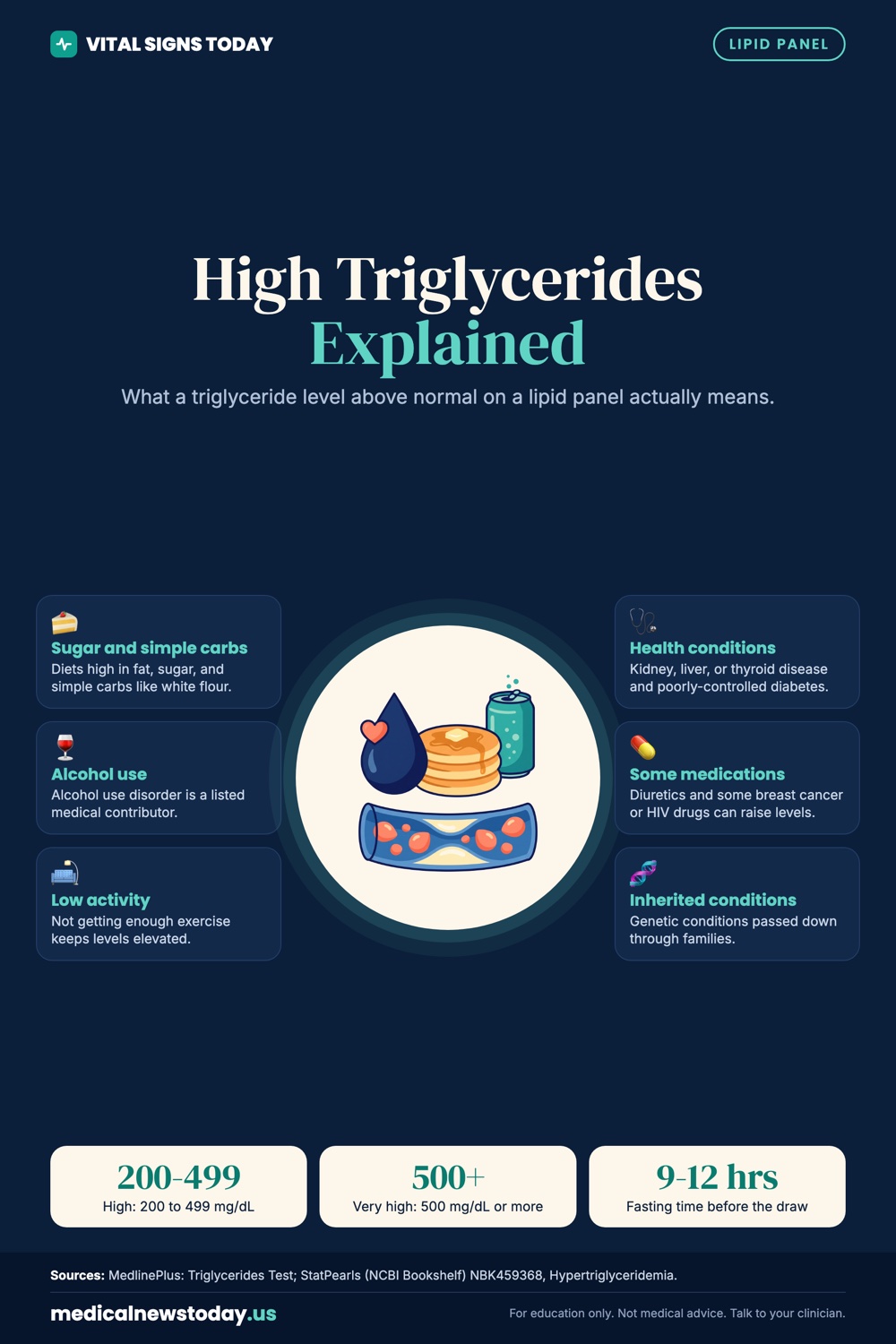
What does high triglycerides mean in a blood test?
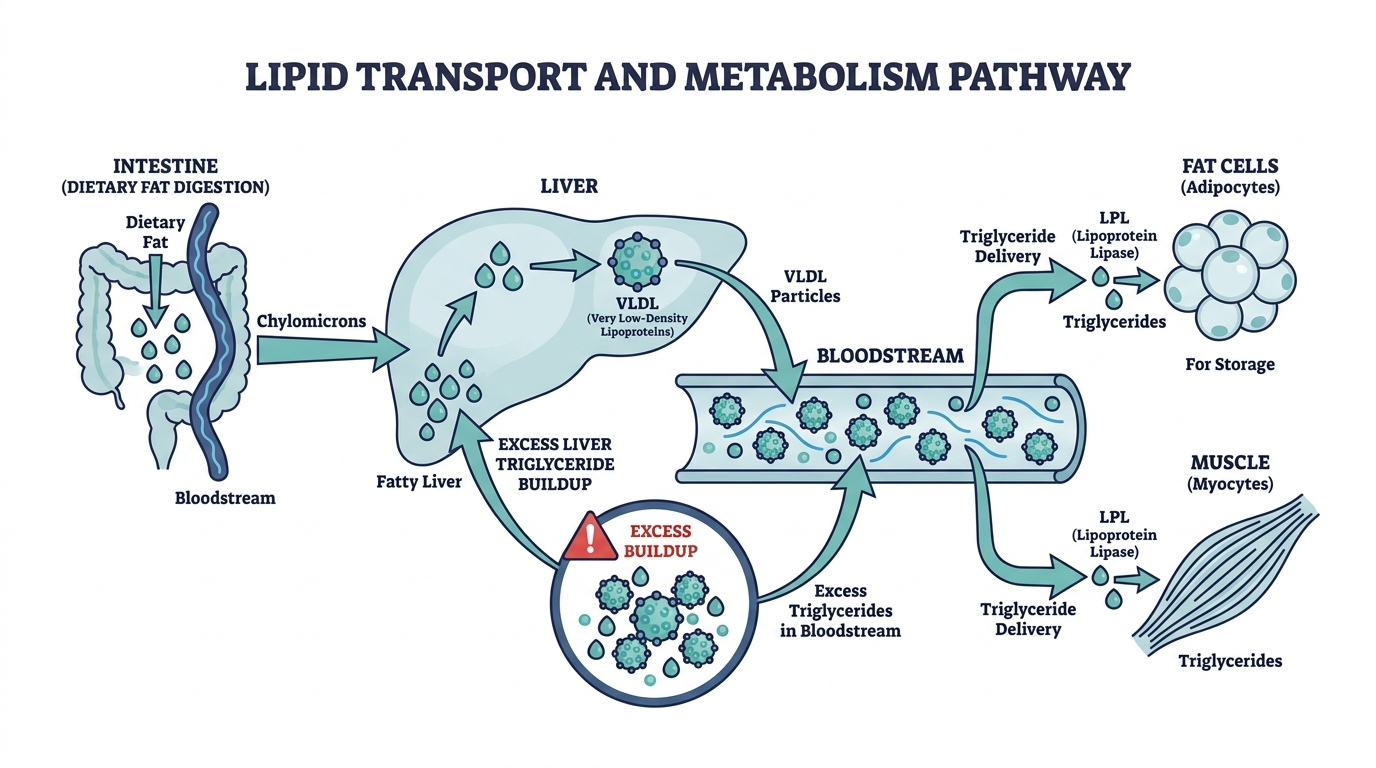
To answer the question directly, what does high triglycerides mean in a blood test: it means there is too much of a particular type of fat circulating in your blood. Triglycerides are the storage form of the calories you eat, especially sugar, refined carbohydrates, and alcohol. When you take in more energy than you burn, your body converts the excess into triglycerides and ships them around in the bloodstream. A high reading means that traffic is heavy (MedlinePlus).
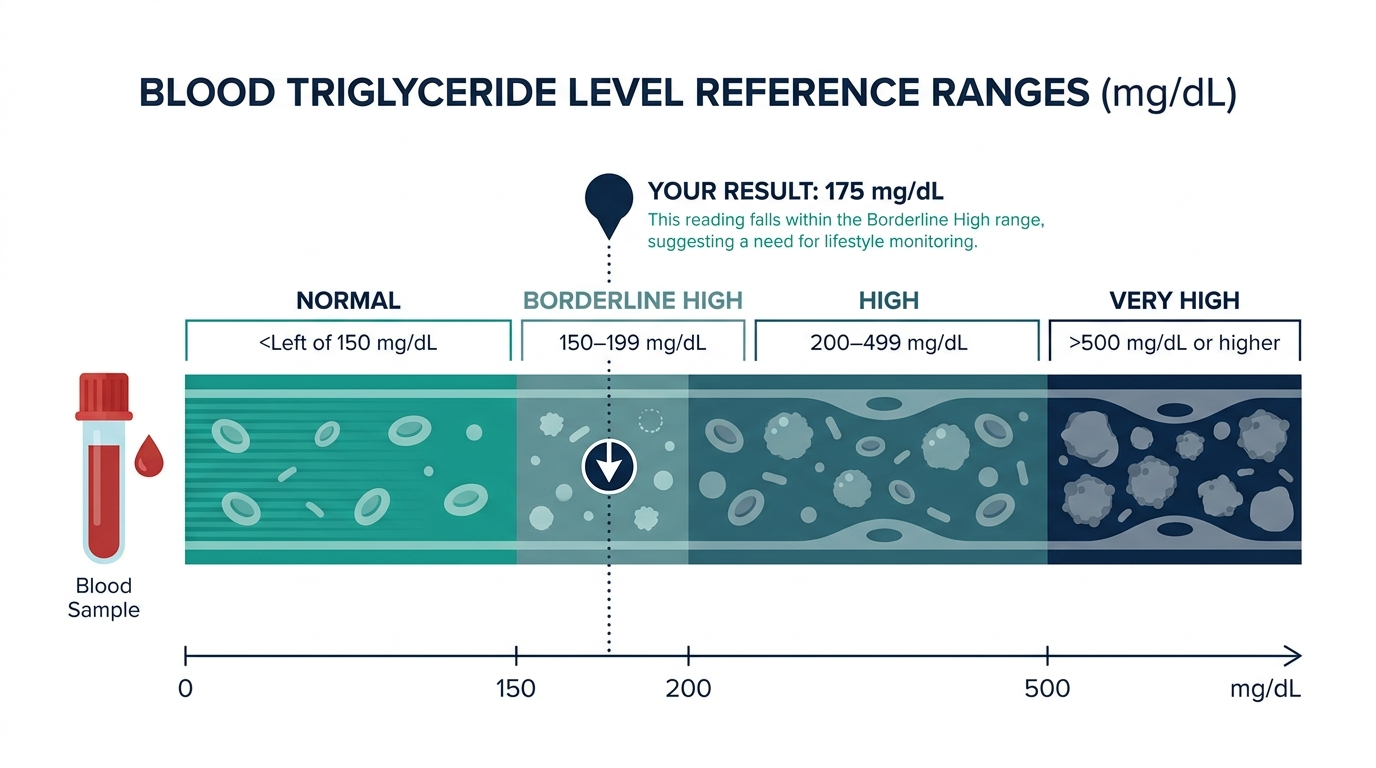
The standard adult cutoffs, measured in milligrams per deciliter (mg/dL) after fasting, are consistent across major sources (Cleveland Clinic):
- Normal: under 150 mg/dL
- Borderline high: 150 to 199 mg/dL
- High: 200 to 499 mg/dL
- Very high: 500 mg/dL or higher
So “high” in the strict sense starts at 200 mg/dL. Anything above 500 mg/dL is called severe hypertriglyceridemia, and that is a different conversation, because it stops being purely about long-term heart risk and starts being about an immediate threat to your pancreas (Cleveland Clinic). This is not a rare problem either. The NHLBI estimates that up to one in four adults has elevated triglycerides (NHLBI).

What causes a high triglycerides result?
The honest answer most people do not want to hear is that the single most common cause is diet and lifestyle, not a hidden disease. But the full differential matters, because the fix depends entirely on the cause. Here are the real culprits, roughly in order of how often they show up (MedlinePlus, NHLBI):
- Excess sugar and refined carbohydrates. White bread, soda, sweets, and other fast carbs are converted straight into triglycerides. This is the number one driver for most people.
- Alcohol. Triglycerides are unusually sensitive to alcohol, even at modest intake. A few drinks the night before a test can move the number on its own.
- Carrying excess weight and low physical activity. A sedentary pattern with extra body fat keeps triglycerides chronically elevated.
- Type 2 diabetes and poorly controlled blood sugar. High triglycerides are a hallmark of insulin resistance and metabolic syndrome.
- Other medical conditions. Hypothyroidism, kidney disease, and liver disease all raise triglycerides (Cleveland Clinic).
- Medications. Corticosteroids, beta-blockers, oral estrogen, and some antipsychotics can push levels up (Cleveland Clinic).
- Genetics. Inherited disorders such as familial hypertriglyceridemia and familial combined hyperlipidemia can drive levels very high regardless of how clean your diet is.
Notice how often these overlap. A person with excess weight, prediabetes, and a couple of glasses of wine most evenings is not dealing with one cause, they are stacking three. That stacking is exactly why triglycerides respond so well, and so fast, when several levers are pulled at once.
What are the symptoms of high triglycerides?
For the vast majority of people, there are none. High triglycerides usually cause no symptoms at all, which is precisely what makes them dangerous (NHLBI). You do not feel a 350 mg/dL. There is no headache, no fatigue you could point to, nothing that says “your blood is fatty right now.” It is a silent number, and the only reason most people ever find out is a routine lipid panel.
Symptoms only tend to appear at the extreme end. When triglycerides climb into the very high range, some people develop xanthomas, which are yellowish fatty deposits under the skin, often around the eyelids, elbows, or knees (Cleveland Clinic). At dangerously high levels, the fat can even be visible in the retina, a finding called lipemia retinalis (NHLBI). If you have any of those signs, the number behind them is usually not subtle.

When is a high triglycerides level dangerous or a medical emergency?
There are two separate dangers, and they live at different thresholds.
The first is the slow danger. Triglycerides in the 200 to 499 mg/dL range raise your risk of heart disease and stroke over years, especially when paired with high LDL or low HDL cholesterol (MedlinePlus). This is a long game. You manage it, you do not rush to the emergency room over it.
The second is the fast danger, and this is the one that gets underestimated. Once triglycerides cross 500 mg/dL, the risk shifts to acute pancreatitis, a sudden and potentially life-threatening inflammation of the pancreas (Cleveland Clinic). The risk climbs steeply with the number. Research summarized in the medical literature puts acute pancreatitis at roughly 10 percent of people with levels of 1,000 to 1,999 mg/dL, rising to about 20 percent once levels exceed 2,000 mg/dL (NCBI Bookshelf).
Treat severe abdominal pain as an emergency if your triglycerides are known to be very high. Sudden, intense pain in the upper abdomen that may radiate to the back, often with nausea and vomiting, is the classic picture of pancreatitis. That is a same-day, go-to-the-hospital situation, not a wait-and-see one.
What should you do about a high triglycerides result?
The good news is that triglycerides are one of the most responsive numbers in all of lab medicine. They can drop substantially within weeks of meaningful change, which is not true of most markers. The roadmap depends on how high you are.
First, confirm the result is real. If your test was not fasting, or you drank alcohol the night before, the number can be falsely inflated. A proper triglyceride test usually requires fasting for 9 to 12 hours (MedlinePlus). A single high reading on a non-fasting sample is worth repeating before anyone makes decisions.
Then attack the modifiable causes. The lifestyle levers that move triglycerides fastest are, in rough order of impact (NHLBI, Cleveland Clinic):
- Cut added sugar and refined carbohydrates. This is the highest-yield change for most people.
- Reduce or stop alcohol. The effect can be surprisingly large and surprisingly quick.
- Move more. Regular aerobic activity lowers triglycerides directly.
- Lose excess weight if you are carrying it. Even modest weight loss helps.
- Treat the underlying condition, such as getting blood sugar or thyroid under control.
Medication is added when lifestyle is not enough, or when levels are very high and pancreatitis is a real concern. The usual options are fibrates, prescription-strength omega-3 fatty acids, statins, and sometimes ezetimibe, chosen based on your overall lipid picture and cardiovascular risk (NHLBI). Very high levels above 500 mg/dL often warrant medication promptly, because the goal there is to get you below the pancreatitis danger zone, not just to nudge your heart risk over the decades.

When should you see a doctor?
Any high triglyceride result deserves a conversation with your clinician, but the urgency scales with the number. If you are in the borderline or high range (150 to 499 mg/dL), this is a planned visit to review your whole lipid panel, your other risk factors, and a lifestyle plan. If you are at or above 500 mg/dL, you should be talking to a doctor soon, not someday, because that level carries real pancreatitis risk and usually needs active treatment (Cleveland Clinic).
And to repeat the one rule that overrides everything else: sudden severe upper abdominal pain with very high triglycerides is an emergency. Do not try to interpret your lab report from a hospital parking lot. Go in.
The insider angle: the number on your report may not be your real number
Here is the nuance that gets missed constantly, even by people who are diligent about their health. Triglycerides are the single most diet-sensitive value on the entire lipid panel, far more than cholesterol. They can swing dramatically based on what you ate and drank in the hours before the blood draw. A heavy dinner, a couple of drinks, or simply not fasting can inflate the result enough to push a normal person into the “high” category on paper.
This cuts both ways. The first trap is the false high: someone gets flagged, panics, and starts treatment based on a number that was never their true baseline. The second, sneakier trap is the false reassurance. Some labs now run non-fasting lipid panels, which are perfectly fine for screening cholesterol, but triglycerides specifically are the one component that fasting status changes the most. If your number looks “fine” on a non-fasting test, it may be masking a genuinely elevated fasting level.
The practical move: before you accept any high triglyceride result as your truth, confirm it was a fasting sample of 9 to 12 hours with no alcohol the night before (MedlinePlus). If those conditions were not met, the right next step is usually a clean, properly fasted repeat, not a prescription. One controlled number tells you far more than two random ones.

Want to check your triglycerides?
Three ways to get it measured. Pick whichever fits you.
Affiliate links: we may earn a commission at no extra cost to you. A lab test does not replace a visit with your clinician.
Which lipid and metabolic markers to read alongside triglycerides
Triglycerides rarely tell the whole story alone. They gain meaning from the company they keep on your lipid and metabolic panels, and a clinician reads them as one piece of a pattern rather than a standalone verdict.
- HDL cholesterol. Triglycerides and HDL tend to move in opposite directions. A high triglyceride number paired with a low HDL is the classic metabolic-syndrome signature and carries more cardiovascular weight than either number alone.
- Non-HDL cholesterol. This is total cholesterol minus HDL, and it captures all the fat-carrying particles that drive plaque, including the triglyceride-rich ones. When triglycerides are high, non-HDL is often a better risk gauge than LDL by itself.
- LDL cholesterol. Worth noting that when triglycerides climb above roughly 400 mg/dL, the standard calculated LDL becomes unreliable, because the formula used to estimate it breaks down at high triglyceride levels. In that situation a direct LDL measurement or an apolipoprotein B test gives a truer picture.
- Fasting glucose and HbA1c. Because high triglycerides are so tightly linked to insulin resistance, these blood-sugar markers often move together. A high triglyceride level is frequently an early flag that blood sugar deserves a look.
- The triglyceride-to-HDL ratio. Many clinicians use this simple ratio as a quick read on insulin resistance. A high ratio, driven by high triglycerides and low HDL, points toward a metabolic problem even when other numbers look acceptable.
Read together, these markers answer the deeper question behind a high triglyceride result, which is whether you are simply carbohydrate-loaded on the day of the test or whether your metabolism is drifting toward insulin resistance.
Why high triglycerides and insulin resistance travel together
Understanding the mechanism makes the number far less mysterious. Triglycerides are not just a fat you eat, they are what your liver manufactures when it has more energy on hand than it can use, especially from sugar and refined carbohydrates.
When cells become resistant to insulin, the body struggles to move glucose out of the bloodstream efficiently. The liver responds by packaging the excess energy into triglyceride-rich particles and releasing them into circulation. That is why a high triglyceride level so often shows up alongside prediabetes, abdominal weight gain, and a low HDL, the whole cluster known as metabolic syndrome. The triglyceride number is, in effect, a window into how well your body is handling fuel.
This mechanism also explains why triglycerides respond so quickly to change. Cut the incoming sugar and alcohol, add movement that burns circulating fuel, and the liver has less excess to package. The number can fall meaningfully in weeks because you are turning down the supply at the source rather than waiting for a slow structural change.
Reading your own triglyceride number: worked scenarios
The same triglyceride value can mean very different things depending on context. These illustrative patterns show how a clinician moves from a flagged number toward a likely story. They are not a diagnosis, and your provider interprets your full panel and history.
- 240 mg/dL on a non-fasting sample after a pasta dinner and two glasses of wine. This is the most common false alarm. The number may not reflect your true baseline, and a clean fasting repeat often lands much lower.
- 210 mg/dL fasting, HDL low, waistline expanding. A genuinely high fasting value with low HDL points toward insulin resistance, and it is the pattern where lifestyle change pays the biggest dividends.
- 320 mg/dL fasting in someone with well-controlled diet. When the number stays high despite clean habits, a clinician looks harder at thyroid function, kidney issues, medications, or an inherited lipid disorder.
- 650 mg/dL fasting. This crosses into the very high range, where the concern shifts from long-term heart risk to near-term pancreatitis risk, and prompt medical attention is warranted rather than a slow lifestyle experiment.
The unifying lesson is that fasting status and the accompanying markers change the meaning of the number more than the raw value does.
Common misconceptions about high triglycerides
A few myths lead people to either panic or shrug when neither reaction fits. Clearing them up sharpens how you read your own result.
- “Triglycerides are just cholesterol.” They are a different type of fat with a different job. Cholesterol builds cell membranes and hormones, while triglycerides store and transport energy. They carry distinct risks and respond to different levers, which is why they get their own line on the panel.
- “Dietary fat is the main driver.” For most people, sugar, refined carbohydrates, and alcohol raise triglycerides far more than dietary fat does. Cutting bread, soda, and drinks usually moves the number more than cutting olive oil.
- “A high result means I need medication now.” In the high but not severe range, lifestyle change is the first-line treatment and often enough on its own. Medication is reserved for very high levels or when lifestyle change falls short.
- “My non-fasting result is fine, so I am fine.” Triglycerides are the lipid component most affected by recent eating, so a reassuring non-fasting number can mask a genuinely elevated fasting level. When in doubt, confirm with a properly fasted test.
Seen clearly, a high triglyceride result is less a scary verdict and more an unusually actionable signal, one of the few numbers on your panel you can move substantially in a matter of weeks.
A practical plan to bring triglycerides down
Because triglycerides respond so quickly to behavior, a clear sequence of changes usually beats a scattershot approach. The goal is not perfection but stacking a few high-leverage habits and then re-measuring to see what worked for your body specifically.
Start with the fastest lever, which for most people is liquid sugar and alcohol. Sugary drinks, fruit juice, and regular alcohol intake all feed straight into triglyceride production in the liver, and cutting them is often the single change that moves the number most within a few weeks. Refined starches such as white bread, pastries, and large portions of rice or pasta come next, since they behave much like sugar once digested. Replacing a share of those calories with vegetables, legumes, and protein tends to lower triglycerides while keeping meals satisfying.
Then layer in movement and fats. Regular aerobic activity, even brisk walking most days, improves how efficiently the body clears triglycerides from the blood, and losing a modest amount of weight if you are carrying excess often produces an outsized drop. On the fat side, the swap that matters is replacing saturated and fried fats with unsaturated sources like olive oil, nuts, and fatty fish, the last of which supplies omega-3s that specifically help lower triglycerides. The reason to re-test after four to eight weeks of consistent change is simple: triglycerides are so responsive that a follow-up draw gives honest feedback, showing whether your plan is working before you commit to it long term or decide a conversation about medication is warranted.
How age, sex, and pregnancy change the picture
The thresholds for triglycerides are the same on paper for most adults, but the context around them shifts across life stages, and knowing that context keeps you from over- or under-reacting to a single result. Triglyceride levels tend to drift upward with age in both sexes, part of the broader metabolic slowing that accompanies the years, which is one reason regular lipid testing becomes more valuable in midlife rather than less.
Sex differences show up too. Men often run higher triglycerides earlier in adulthood, while women frequently see their levels climb after menopause as the protective effects of estrogen fade. Neither pattern changes what a given number means, but both explain why a value that was reassuring in your thirties deserves a fresh look a couple of decades later. Tracking the trend over years, rather than judging any one draw in isolation, is what makes these gradual shifts visible early enough to act on.
Pregnancy is a special case worth flagging. Triglycerides normally rise substantially during pregnancy, especially in the third trimester, as the body mobilizes fats to support the growing baby. This expected increase is not judged against the usual adult cutoffs, so an elevated pregnancy result is generally interpreted very differently than the same number in a non-pregnant adult. Anyone pregnant with a strikingly high value should have it managed by their obstetric team rather than compared to a standard reference range, since the priorities and the safe treatment options differ.
Frequently asked questions
What is considered a high triglycerides level on a blood test?
For adults, a fasting triglyceride level of 200 to 499 mg/dL is classified as high, and 500 mg/dL or higher is very high, while normal is under 150 mg/dL and borderline high is 150 to 199 mg/dL (Cleveland Clinic). Compare your result to the reference range printed on your own report.
Can high triglycerides be lowered quickly?
Yes, often faster than other lipid numbers. Cutting added sugar, refined carbohydrates, and alcohol, plus regular exercise and weight loss, can reduce triglycerides substantially within weeks (NHLBI). Very high levels may also need medication such as fibrates or prescription omega-3s.
Are high triglycerides dangerous?
They carry two kinds of risk. In the high range they raise the long-term risk of heart disease and stroke, and above 500 mg/dL they raise the risk of acute pancreatitis, a sudden inflammation of the pancreas that can be life-threatening (MedlinePlus).
Do I need to fast before a triglyceride test?
Usually yes. A standard triglyceride test typically requires fasting for 9 to 12 hours, because triglycerides rise sharply after eating and drinking (MedlinePlus). A non-fasting result can be falsely high, so confirm your test conditions before acting on the number.
Do high triglycerides cause symptoms?
Usually none. High triglycerides typically cause no symptoms, which is why they are found on routine blood work (NHLBI). Only very high levels may produce fatty skin deposits called xanthomas or, rarely, the abdominal pain of pancreatitis.
This article is for general educational purposes and is not medical advice. It cannot diagnose or treat you and does not replace your clinician. Always discuss your lab results and any health decisions with a qualified healthcare professional.
Vital Signs Today may earn a commission if you buy through links on this page. It does not affect our editorial assessments.