Disclosure: Vital Signs Today may earn a commission if you buy through links on this page, at no extra cost to you. This does not influence our evidence-based assessments. We are not a medical provider; talk to a clinician before acting on test results.
Related: See the triglyceride reference chart by age and sex
Part of our Lipid Panel guide.
The first time most people meet their triglyceride number is by accident. You go in for a routine cholesterol panel, the results land in your inbox, and there it is: a line item you have never thought about, sitting next to LDL and HDL, quietly flagged in yellow. Triglycerides are the most ignored number on the standard lipid panel, and that is a shame, because they are one of the most responsive. Unlike your genetics, this number listens to what you ate last week.
So let us cut to what you actually came here for.
What is a good triglyceride level?
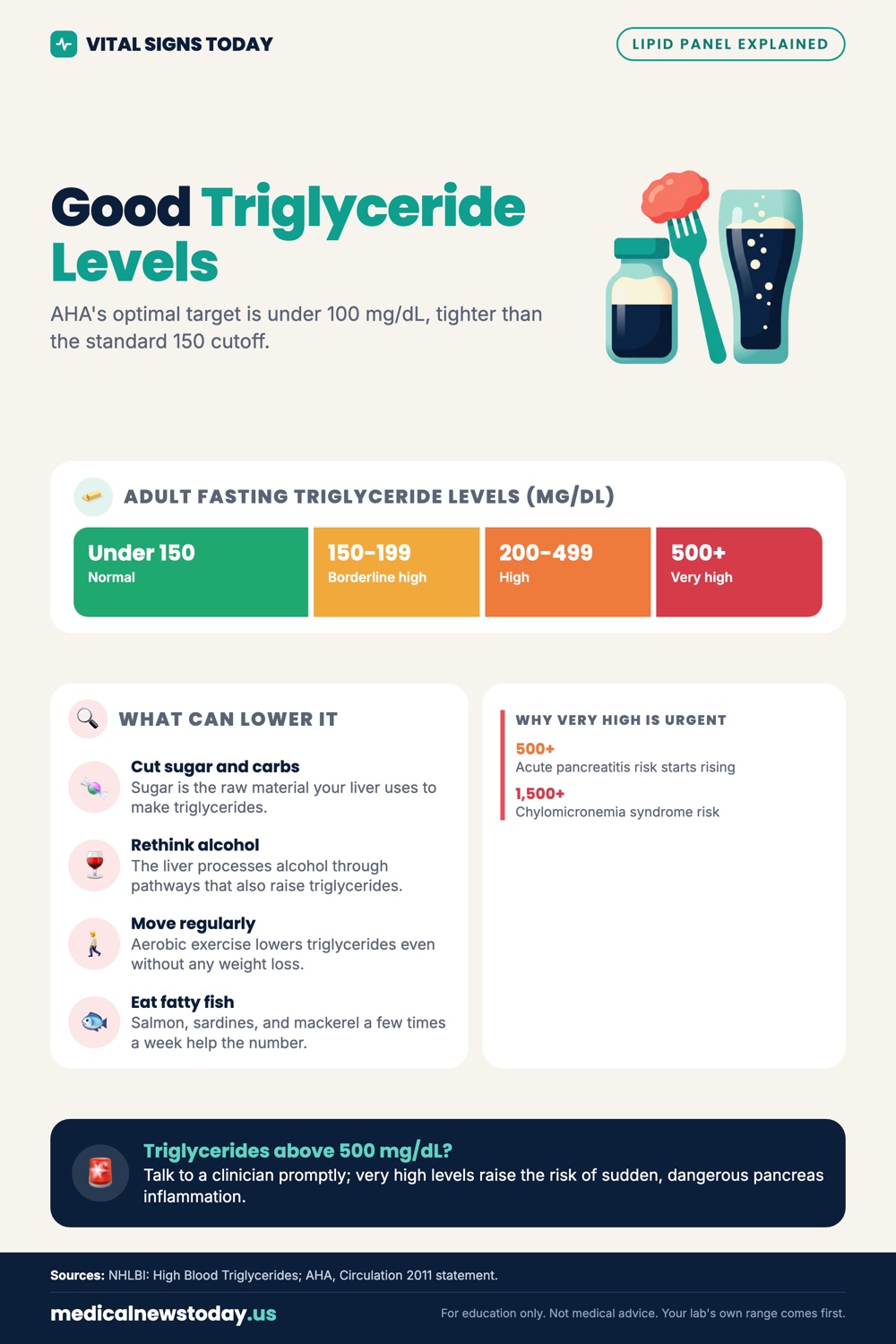
A good (normal) fasting triglyceride level is under 150 mg/dL. From 150 to 199 mg/dL is borderline high, 200 to 499 mg/dL is high, and 500 mg/dL or above is very high. The American Heart Association considers an optimal fasting level to be below 100 mg/dL, which is a tighter target than the standard cutoff.
What do the triglyceride numbers actually mean?
Here is the standard adult classification used by clinicians, drawn from the National Cholesterol Education Program thresholds that most labs still print on your report (NHLBI, Medical News Today):
- Normal: under 150 mg/dL
- Borderline high: 150 to 199 mg/dL
- High: 200 to 499 mg/dL
- Very high: 500 mg/dL and above
Notice the gap between the everyday cutoff (150) and the AHA optimal target (100). That gap is where the interesting conversation lives. The 2011 American Heart Association scientific statement on triglycerides argued for an optimal fasting level below 100 mg/dL and an optimal nonfasting level below 150 mg/dL, partly because risk does not politely wait until you cross 150 to start climbing (AHA, Circulation 2011). A level of 130 is technically “normal,” but it is not optimal, and for someone with other risk factors that distinction matters.
What are triglycerides, and why does the number move so much?
Triglycerides are the storage form of fat in your blood. When you eat more calories than you burn, especially from sugar, refined carbs, and alcohol, your liver converts the excess into triglycerides and ships them out to fat cells for later. They are not the villain. They are the warehouse receipts. The problem is when the warehouse is permanently overflowing.
This is why the number is so twitchy. A single large pasta dinner with two glasses of wine the night before your blood draw can visibly inflate the reading. That is also why the classic instruction has been to fast for at least eight hours before a triglyceride test, because levels rise sharply after eating (Mayo Clinic).
Do you actually have to fast for a triglyceride test?
For years the answer was an unconditional yes. The newer answer is: it depends on the question. The 2018 ACC/AHA cholesterol guidelines and the 2016 European consensus moved toward allowing nonfasting lipid panels for routine screening, because for most people the convenience outweighs the small accuracy loss (American College of Cardiology).
Here is the part that surprised a lot of clinicians: nonfasting triglycerides may actually be the better predictor. The AHA statement notes that nonfasting triglyceride correlates strongly with remnant lipoprotein particles, and in several studies nonfasting levels predicted future cardiovascular disease better than fasting ones (AHA, Circulation 2011). The logic is intuitive once you say it out loud: most of us spend most of the day in a fed, not fasted, state, so the fed number is closer to your real metabolic life. That said, if your doctor is making a treatment decision or your level is very high, a fasting test still gives the cleanest reading.
Why should you care about high triglycerides?
Two reasons, and they operate on different timelines.
The slow one is cardiovascular. Triglyceride-rich lipoproteins also carry cholesterol, and over years that contributes to atherosclerosis, the plaque buildup behind heart attacks and strokes (Mass General Brigham). Persistently elevated triglycerides are also a hallmark of metabolic syndrome and insulin resistance, so the number often functions as an early smoke alarm for problems that have not fully arrived yet.
The fast one is your pancreas. When triglycerides climb above 500 mg/dL, and especially above 1,000, the risk of acute pancreatitis rises sharply, a sudden and dangerous inflammation of the pancreas (NHLBI). This is the scenario that turns a lipid number into an emergency-room visit, and it is why very high readings get treated aggressively rather than watched.
If you are exploring how individual biomarkers fit into a bigger metabolic picture, our overview of biomarkers explained walks through how numbers like this one connect.
How do you lower triglycerides, and how fast does it work?
This is where triglycerides earn their reputation as the most fixable number on the panel. Because they respond to recent diet, lifestyle changes can move them in weeks, not years.
- Cut added sugar and refined carbs. Sugar is the raw material your liver uses to manufacture triglycerides, so reducing sweets, soda, and dessert directly cuts production (WebMD).
- Rethink alcohol. The liver processes alcohol through pathways similar to fructose, which drives triglyceride production. If you drink regularly and your level is above 150, cutting back is one of the fastest levers you have (WebMD).
- Move regularly. Aerobic exercise lowers triglycerides even without weight loss, and the standard target of about 150 minutes of moderate activity per week is a reasonable starting line (Healthline).
- Get omega-3s. Fatty fish like salmon, sardines, and mackerel a few times a week helps, and for clinically high levels, prescription omega-3 fatty acid medication can reduce triglycerides by roughly 20 to 30 percent in people who need treatment (Healthline).
The encouraging reality: someone who cuts added sugar, eases off alcohol, and starts walking daily can often see a meaningful drop at the next blood draw just a few weeks later. Few biomarkers reward effort this quickly.
What if lifestyle is not enough?
For very high triglycerides, or when lifestyle changes plateau, clinicians turn to medication: prescription omega-3s, fibrates, and sometimes statins, depending on the full lipid picture and overall cardiovascular risk. That decision belongs to you and your doctor together, because it depends on the rest of your panel, your family history, and conditions like diabetes that change the calculus. The number on the page is one input, not the whole story.
Want to check your triglycerides?
Three ways to get it measured. Pick whichever fits you.
Affiliate links: we may earn a commission at no extra cost to you. A lab test does not replace a visit with your clinician.
FAQ
Is a triglyceride level of 150 bad?
150 mg/dL sits right at the top edge of normal and the bottom of borderline high. It is not an emergency, but it is a nudge. The AHA optimal target is under 100, so a reading of 150 is a good moment to look at sugar, alcohol, and activity.
What is a dangerously high triglyceride level?
Levels above 500 mg/dL are classified as very high, and readings climbing past 1,000 mg/dL sharply raise the risk of acute pancreatitis. These warrant prompt medical attention rather than a wait-and-see approach.
Can triglycerides be too low?
Very low triglycerides are uncommon and usually not a concern on their own, but unusually low readings can occasionally point to malnutrition, an overactive thyroid, or a malabsorption issue, which a clinician would evaluate in context.
How quickly can I lower my triglycerides?
Faster than most lipids. Because triglycerides reflect recent intake, cutting sugar and alcohol while adding regular exercise can produce a noticeable drop within a few weeks.
Do I need to fast before a triglyceride test?
For routine screening, many guidelines now accept a nonfasting sample. For treatment decisions or very high levels, a fasting test (at least eight hours) still gives the most reliable reading. Follow your doctor’s instructions.
This article is for general information only and is not medical advice. Triglyceride targets and treatment decisions depend on your full health picture; consult a qualified clinician before making changes.
Confused by your own blood test?
The free Bloodwork Decoder explains any marker on your report in plain English, plus the Beyond Normal field guide on the numbers that predict how long, and how well, you will live.