Disclosure: Vital Signs Today may earn a commission if you buy through links on this page, at no extra cost to you. This does not influence our evidence-based assessments. We are not a medical provider; talk to a clinician before acting on test results.
You got your lipid panel back, scanned past the familiar names, total cholesterol, HDL, LDL, triglycerides, and then there it was: VLDL. Four letters most people have never had explained to them, sitting quietly with a small number next to it. No alarm, no asterisk, so you moved on. Here is what almost nobody tells you. VLDL is the cholesterol your liver makes, it is the bridge between the fat you eat and the plaque that clogs arteries, and the number on your report is not even measured directly. It is estimated.
Once you understand what VLDL really is and where that number comes from, the rest of your lipid panel starts to make a lot more sense.
Part of our Lipid Panel guide.
What is VLDL in a blood test?
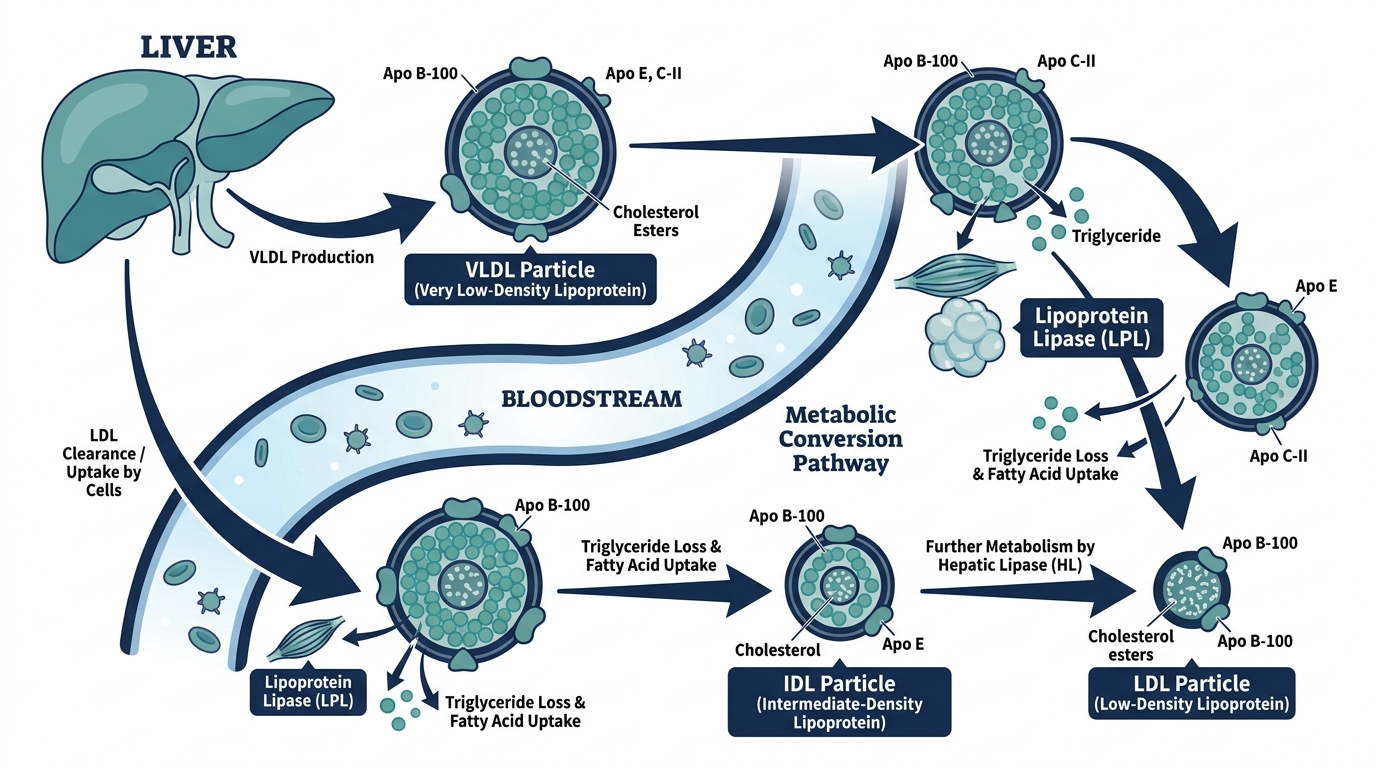
VLDL stands for very low density lipoprotein, a particle your liver builds to carry fat, mostly triglycerides, out into your bloodstream (Cleveland Clinic). On a blood test, the VLDL line tells you roughly how much of this triglyceride rich, artery clogging cholesterol is circulating in your blood. In plain terms: if HDL is the cleanup crew and LDL is the main cargo truck for cholesterol, VLDL is the delivery van the liver sends out loaded with fat.
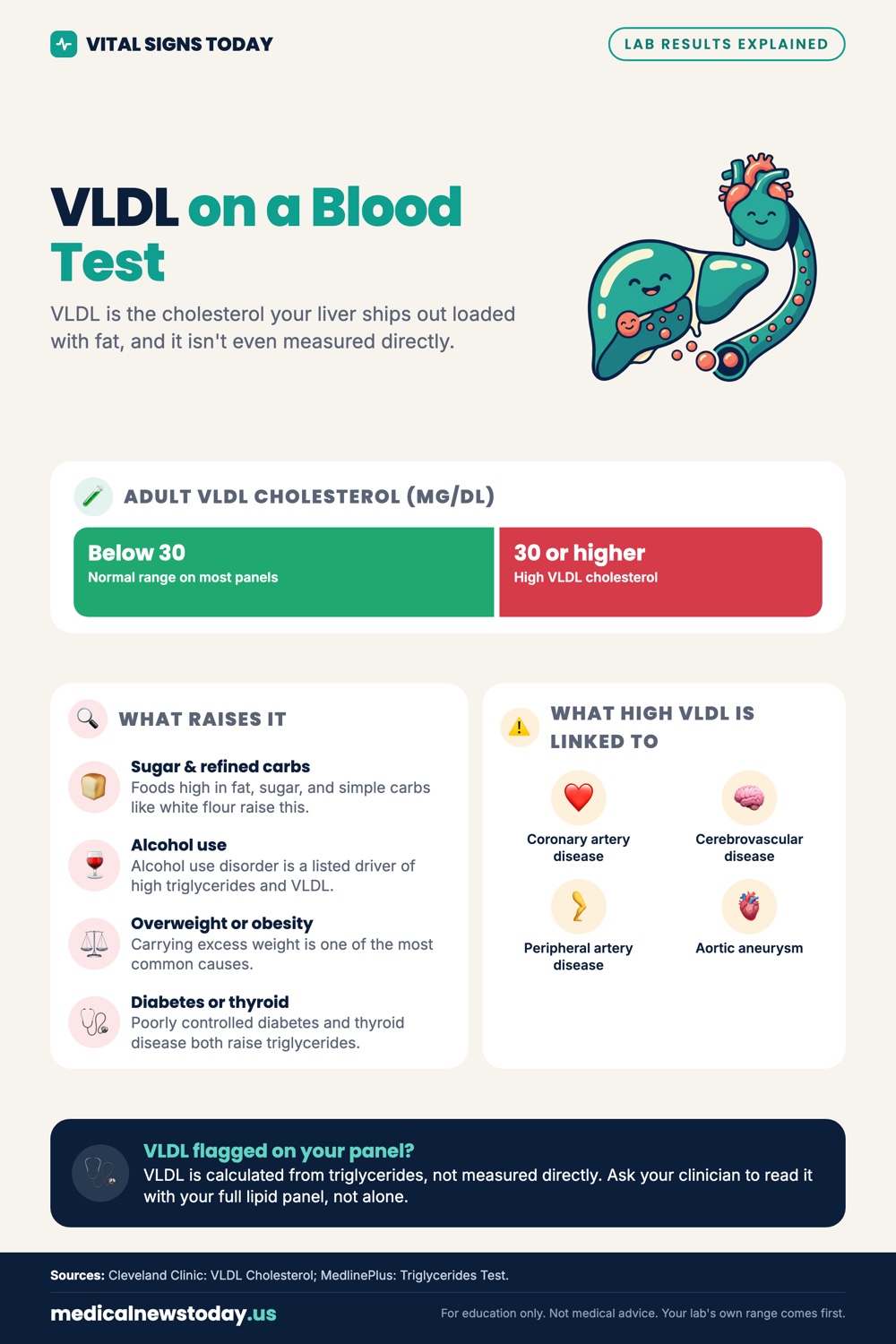
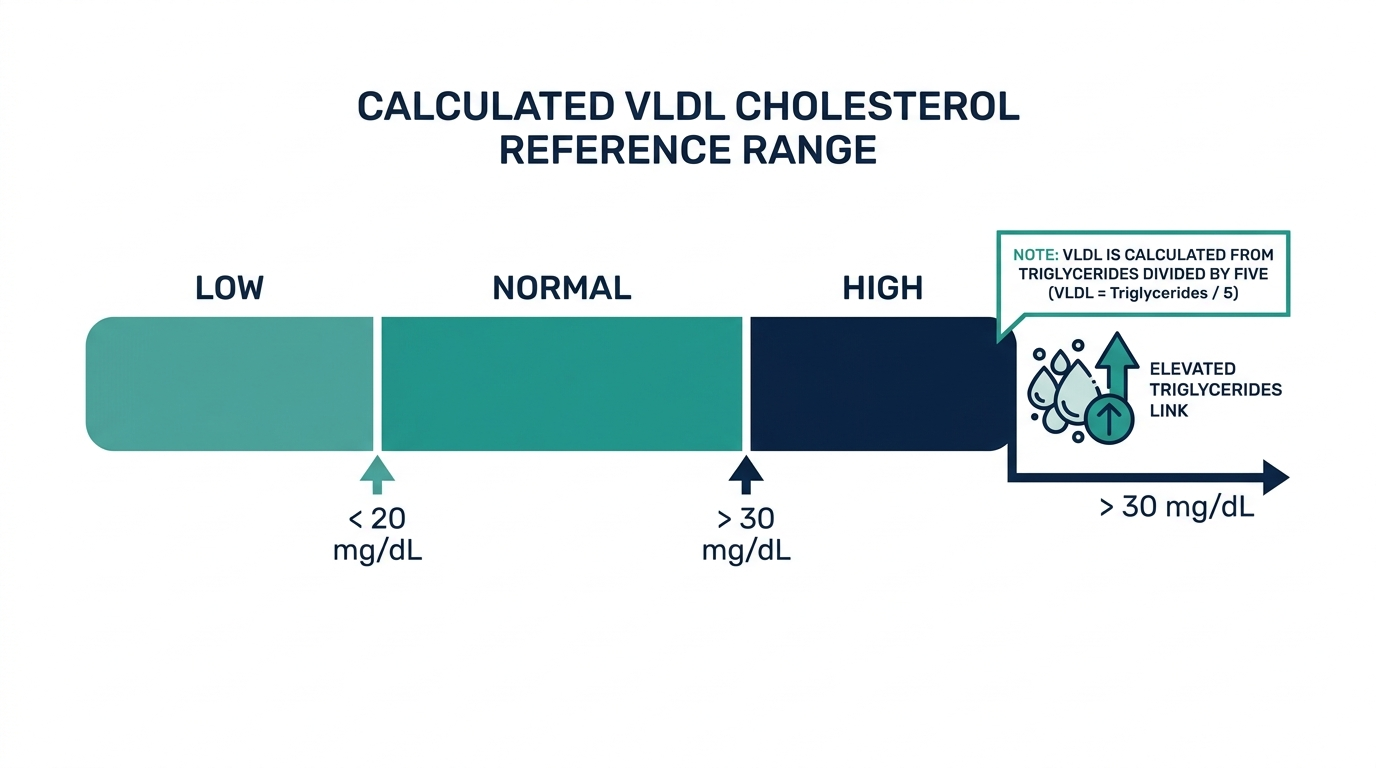
So when people ask what does VLDL mean on a blood test, the short answer is this. It is a measure of the cholesterol packaged inside your triglyceride carrying particles, and most labs print a normal target of less than 30 milligrams per deciliter (MedlinePlus).

What does VLDL mean on a blood test, and how is it calculated?
Here is the detail that surprises almost everyone, and it is the single most useful thing to understand about this number. There is no standard, direct way to measure VLDL in routine bloodwork. The lab does not actually count your VLDL particles. It estimates them from your triglycerides (Cleveland Clinic).
The formula is simple. Your lab takes your triglyceride level and divides it by five. That is the classic estimate built into the Friedewald equation that most labs use to report a lipid panel. Cleveland Clinic puts it plainly: your triglycerides are generally about five times higher than your VLDL level (Cleveland Clinic). So if your triglycerides come back at 150 mg/dL, your reported VLDL will be around 30 mg/dL.
This is why the question what is vldl test in blood is a little misleading. There usually is not a separate VLDL test. It is a calculated value riding on the back of your triglyceride result, which is exactly why fasting before the draw matters so much. Eat a heavy meal beforehand, your triglycerides spike, and your estimated VLDL spikes right along with them.
What is a normal VLDL level?
A normal VLDL cholesterol level is generally less than 30 mg/dL (MedlinePlus). Anything at 30 mg/dL or above is considered high (Cleveland Clinic). Because the number is derived from triglycerides, it tracks them step for step.
That link is worth seeing in full. Triglycerides have their own well defined categories (MedlinePlus):
- Normal: less than 150 mg/dL, which maps to a VLDL under 30.
- Borderline high: 150 to 199 mg/dL.
- High: 200 to 499 mg/dL.
- Very high: 500 mg/dL or above.
The practical takeaway: a VLDL of 30 or higher is the calculated mirror image of triglycerides that have crossed into the 150 plus range. If your VLDL is flagged, your triglycerides are the number to actually go fix.

What does a high VLDL mean on a blood test?
A high VLDL means your liver is pushing out more triglyceride rich particles than your body is clearing, and those particles are a direct driver of plaque buildup in your arteries (Cleveland Clinic). This is the part that makes VLDL more than a footnote. It is not inert cargo. As VLDL particles unload their triglycerides, they shrink into smaller, denser remnant particles and eventually LDL, and those remnants slip into artery walls and feed atherosclerosis.
Cleveland Clinic links high VLDL to a serious list of downstream conditions, including coronary artery disease, cerebrovascular disease, peripheral artery disease, and aortic aneurysm (Cleveland Clinic). The same source notes something most patients never hear: the combination of high VLDL and high LDL is more dangerous than a high level of either one alone.
What pushes VLDL up? The usual suspects are the same things that raise triglycerides: excess calories and refined carbohydrates, alcohol, being overweight, poorly controlled type 2 diabetes, and an underactive thyroid. Because the number is calculated from triglycerides, anything that moves triglycerides moves VLDL.
What does a low VLDL mean in a blood test?
A low VLDL is generally good news. It reflects low triglycerides and means your liver is not flooding your bloodstream with triglyceride rich particles. On its own, a low VLDL is not treated as a disease. There is no recognized condition defined by an abnormally low VLDL the way there is for high VLDL.
The only nuance worth flagging is that a very low triglyceride and VLDL result occasionally shows up alongside other issues such as malnutrition, an overactive thyroid, or rare inherited conditions that affect how the body handles fat. But for the overwhelming majority of people, a low VLDL paired with an otherwise unremarkable lipid panel is exactly what you want to see.
Want to check your VLDL?
Three ways to get it measured. Pick whichever fits you.
Affiliate links: we may earn a commission at no extra cost to you. A lab test does not replace a visit with your clinician.
Why is VLDL measured with triglycerides and the rest of the lipid panel?
VLDL is read alongside triglycerides because it is literally calculated from them, and alongside LDL and HDL because cardiovascular risk comes from the whole picture, not one line. A standard lipid panel reports total cholesterol, HDL, LDL, triglycerides, and the calculated VLDL together so your clinician can see how the pieces fit.
Here is the useful way to think about each one. HDL is the protective fraction that carries cholesterol back to the liver. LDL is the primary cholesterol carrier and the main target most people know about. Triglycerides are the circulating fat. And VLDL is the particle that connects triglycerides to cholesterol, the van that carries fat out and morphs into LDL on the way. A total cholesterol under 200 mg/dL is considered best (MedlinePlus), but two people can share that same total and carry very different risk depending on how it splits across these fractions.
This is also why VLDL gets quietly folded into the number your doctor often cares about most: non HDL cholesterol, which is total cholesterol minus HDL. That figure captures LDL and VLDL together, the entire atherogenic load in one number.
The part most people never hear: VLDL, remnants, and how long you live
This is where VLDL stops being a minor calculated value and becomes something genuinely worth watching. The cholesterol carried in VLDL and its leftover remnant particles, often called remnant cholesterol, has emerged in recent research as an independent predictor of death, not just heart attacks, and it carries that risk even when your LDL looks fine.
In a nationally representative U.S. cohort of 13,383 adults followed for a median of 26.6 years, people in the highest quartile of remnant cholesterol had a 23 percent higher risk of dying from any cause compared with the lowest quartile, after adjusting for other risk factors. The same study found elevated remnant cholesterol independently predicted mortality even when LDL cholesterol stayed normal (PMC, remnant cholesterol and long-term mortality). Remnant cholesterol is essentially the cholesterol riding in VLDL and its breakdown products, the fraction your standard panel half hides inside that small VLDL line.
Why would the cholesterol in a triglyceride carrying van predict survival? The leading explanation is that VLDL remnants are small enough to penetrate the artery wall and, unlike LDL, can be taken up by plaque without needing to be modified first. They also travel with inflammation and the metabolic stress of insulin resistance, the same forces that age your blood vessels. The honest caveat is that researchers are still untangling cause from marker, and not every clinician treats VLDL as a standalone target. But a high VLDL is rarely just a high VLDL. It is usually a flashing signal that your triglycerides, your diet, and your metabolic health all deserve a closer look rather than a scroll past.
When the divide-by-five estimate quietly breaks down
The convenient trick your lab uses, triglycerides divided by five, rests on an assumption that holds for most people most of the time. But it is an assumption, and it fails in two specific situations that are worth knowing about because they distort not just your VLDL but your LDL too.
The classic Friedewald calculation that produces this number assumes a fixed ratio of triglycerides to VLDL cholesterol of five to one. That ratio is not a law of nature. It is an average. When your triglycerides climb high, the real ratio drifts, and the fixed factor of five starts to misrepresent your particles (PMC). The estimate becomes unreliable once triglycerides pass roughly 400 mg/dL, and the underestimation of LDL that comes with it can begin at triglyceride levels as low as 150 mg/dL (American College of Cardiology). In other words, the exact situation that makes VLDL worth watching, elevated triglycerides, is also the situation where the simple estimate is least trustworthy.
This is why many labs have moved to a newer approach called the Martin-Hopkins method, which swaps the fixed factor of five for an adjustable one based on your own non-HDL cholesterol and triglyceride values (American College of Cardiology). The practical lesson for you as a patient is simple. If your triglycerides are high, ask whether your VLDL and LDL were calculated with the older divide-by-five method or a more accurate one, and whether a direct measurement is warranted. A borderline decision about starting or adjusting a statin should not rest on an estimate that is known to wobble in exactly your situation.
How to prepare so your VLDL number is actually accurate
Because VLDL rides directly on your triglycerides, and triglycerides are the most food-sensitive number on the whole lipid panel, preparation matters more here than for almost any other line on your report. A sloppy draw can inflate your VLDL enough to move you across a threshold.
- Fast if told to. When a fasting lipid panel is ordered, that usually means 9 to 12 hours with only water. Eating beforehand pushes triglycerides up, and your calculated VLDL rises right along with them.
- Skip alcohol the night before. Alcohol can spike triglycerides sharply and briefly, and a couple of drinks the evening before a morning draw can meaningfully distort the result.
- Do not treat the test day as a cheat day. An unusually fatty meal the day before, even if you technically fasted overnight, can leave triglycerides elevated at the draw.
- Be consistent draw to draw. If you are tracking VLDL over time, get tested under the same conditions each time, ideally the same lab, same time of day, same fasting status, so you are comparing like with like.
Non-fasting lipid panels have become more common and are perfectly fine for many screening purposes, but the one number they disturb most is triglycerides, and therefore VLDL. If your VLDL comes back surprisingly high on a non-fasting draw, that alone is a reason to repeat it fasting before drawing any conclusions.
A practical plan to bring VLDL down
Since there is no way to lower VLDL directly, every effective move works by lowering triglycerides. The good news is that triglycerides are among the most responsive of all lipids to lifestyle change, often shifting within weeks rather than months. Here is where the leverage concentrates.
- Cut liquid and refined carbohydrate. Sugary drinks, refined starches, and added sugar are converted to triglycerides efficiently by the liver, which then packages them into VLDL. This is usually the single highest-yield change.
- Address alcohol honestly. Alcohol is a potent triglyceride driver for many people, and reducing it can produce a striking drop on the next panel.
- Move most days. Regular aerobic activity improves how efficiently your body clears triglycerides from the blood, lowering the pool VLDL is estimated from.
- Lose excess weight and treat diabetes. Insulin resistance ramps up the liver’s VLDL output, so improving blood sugar control and shedding extra weight attack the problem at its source.
- Ask about omega-3s. At the right dose, marine omega-3 fatty acids can lower high triglycerides, though this is a conversation to have with your clinician rather than a guess at the supplement aisle.
Because triglycerides respond quickly, a genuine effort held for six to eight weeks is often enough to see movement on a repeat panel, which makes VLDL an unusually satisfying number to work on.
VLDL, non-HDL, and ApoB: which number your risk really hides in
If VLDL feels like an oddly minor line, it is because its risk is usually captured better by two other numbers that fold it in. Understanding the hierarchy helps you know what to actually ask your doctor about.
- Non-HDL cholesterol is simply total cholesterol minus HDL. It captures LDL and VLDL together, the entire atherogenic load, in one figure, which is why many clinicians now watch it more closely than LDL alone (MedlinePlus). Your VLDL is baked directly into this number.
- ApoB counts the actual number of atherogenic particles, since every LDL, VLDL, and remnant particle carries exactly one apolipoprotein B molecule. It sidesteps the estimation problem entirely because it measures particles rather than inferring cholesterol content.
The practical framing is this. VLDL on its own is a rough, calculated proxy. When it is high, the more informative questions are what your non-HDL cholesterol is, and whether an ApoB test would sharpen the picture, especially if your triglycerides are high enough to make the standard estimates unreliable. VLDL is the doorway. Non-HDL and ApoB are the fuller rooms behind it.
Reading VLDL in context: a few common scenarios
Numbers only mean something in combination. Here are patterns that recur on real lipid panels and how a clinician tends to read them.
- VLDL high, LDL normal. This points squarely at triglycerides and metabolic health, often diet, alcohol, weight, or blood sugar, rather than the classic LDL story. It is a signal to look at remnant cholesterol and non-HDL rather than to shrug because LDL looked fine.
- VLDL high and LDL high together. This combination is more concerning than either alone, because you have both a heavy cholesterol cargo and a heavy triglyceride-remnant load feeding plaque at once.
- VLDL low, everything else normal. Reassuring, and nothing to chase. There is no benefit to pushing VLDL below normal.
- VLDL very high with triglycerides above 500. This moves beyond heart risk into a different concern, because very high triglycerides can also threaten the pancreas, and it usually prompts prompt treatment rather than watchful waiting.
The through line is that VLDL is never read in isolation. It is a lens on your triglycerides and your metabolic health, and its real value is as a prompt to look at the fuller picture your panel is quietly showing you.
Questions people ask most about VLDL
The first question is often why VLDL was not tested directly. On most standard lipid panels VLDL is not measured at all; it is estimated by dividing your triglycerides by five. That shortcut works reasonably well for many people, but it can drift when triglycerides are very high or very low, which is why a VLDL number should be read as an estimate rather than a precise measurement. When accuracy really matters, a lab can measure VLDL and remnant particles more directly, but that is not what the number on a routine panel usually reflects.
People also ask whether VLDL is the bad cholesterol. It is one of the cholesterol carriers that raises risk, so in that sense it sits on the unfavorable side alongside LDL. VLDL is the particle that ferries triglycerides out of the liver, and as it unloads them it leaves behind smaller remnant particles that can lodge in artery walls. So a high VLDL is generally not something you want, but it is best understood as part of the triglyceride story rather than a separate villain to track in isolation.
A third recurring question is what actually moves VLDL. Because it tracks so closely with triglycerides, the same levers apply: refined carbohydrate and sugar intake, alcohol, excess weight, and blood sugar control all push it in one direction, while cutting those inputs and increasing activity tend to bring it down. This is encouraging news, since VLDL is one of the more responsive lipid numbers, often shifting noticeably within weeks of a genuine change in diet and activity, unlike some markers that barely budge.
How often to recheck VLDL, and what a changing number tells you
Because VLDL rides on triglycerides, it can move meaningfully in a fairly short window once you change what you eat, how much you drink, or how active you are. That responsiveness makes a repeat test genuinely useful, but only if the timing is right. Rechecking within days of a big meal, a weekend of drinking, or a bout of illness tells you more about that event than about your baseline. A more honest picture comes from retesting after you have held a change in place for several weeks, giving the number time to settle into a new steady state you can actually act on.
The direction of change usually says more than any single value. A VLDL that has drifted down across two tests, in step with falling triglycerides, is a sign that whatever you adjusted is working, and it often moves alongside improvements in blood sugar and weight. A VLDL creeping upward, even while still inside the normal band, can be an early nudge that triglycerides are climbing before they cross a threshold, which is a chance to intervene early rather than after the fact.
To make those comparisons trustworthy, keep the conditions steady from one draw to the next: the same fasting status, a similar time of day, and ideally the same lab, since instruments and the divide by five estimate can vary. Read VLDL next to triglycerides, non-HDL, and where available ApoB each time, rather than in isolation, so you can see whether the whole triglyceride rich cluster is moving together. A consistent trend across matched conditions is what turns a rough estimate into a number you can plan around, and that trend is exactly what is worth bringing to your clinician.
Frequently asked questions
What does VLDL stand for in a blood test?
VLDL stands for very low density lipoprotein, a particle made by your liver that carries triglycerides and cholesterol through your blood (Cleveland Clinic). It is one of the lipoproteins reported on a standard lipid panel.
What is a normal VLDL level on a blood test?
A normal VLDL cholesterol level is generally less than 30 mg/dL, and a value of 30 mg/dL or higher is considered high (MedlinePlus). Always compare your result to the reference range printed on your own lab report.
How is VLDL measured if there is no direct test?
Most labs do not measure VLDL directly. They estimate it by dividing your triglyceride level by five, since triglycerides run about five times higher than VLDL (Cleveland Clinic). This is why fasting before the blood draw matters.
Is high VLDL dangerous?
A high VLDL is linked to plaque buildup in the arteries and to conditions including coronary artery disease, peripheral artery disease, and stroke, and it is more dangerous when combined with high LDL (Cleveland Clinic). It is a clue, not a diagnosis, and is interpreted with the rest of your panel.
How do I lower my VLDL?
Because VLDL is calculated from triglycerides, lowering triglycerides lowers VLDL. That usually means cutting refined carbohydrates and alcohol, losing excess weight, exercising, and managing diabetes, and triglycerides under 150 mg/dL keep VLDL in the normal range (MedlinePlus).
This article is for general educational purposes and is not medical advice. It cannot diagnose or treat you and does not replace your clinician. Always discuss your lab results and any health decisions with a qualified healthcare professional.
Vital Signs Today may earn a commission if you buy through links on this page. It does not affect our editorial assessments.