Disclosure: Vital Signs Today may earn a commission if you buy through links on this page, at no extra cost to you. This does not influence our evidence-based assessments. We are not a medical provider; talk to a clinician before acting on test results.
Related: See the HDL reference chart by age and sex
You scanned your lipid panel, found the line marked HDL, and saw a number sitting comfortably above the others. Maybe a 75, maybe a 92. For years you have been told this is the “good” cholesterol and that higher is better, so a high HDL feels like a gold star. Then a nagging question creeps in. If it is so good, why does the lab still flag anything above a certain point, and why did your doctor pause on it?
Here is the honest version that most cholesterol explainers skip. HDL is genuinely protective across the normal range, but the “more is always better” story falls apart at the high end. A very high HDL is not automatically a win, and in some people it is a clue worth chasing down.
Part of our Lipid Panel guide.
What does high HDL mean in a blood test?
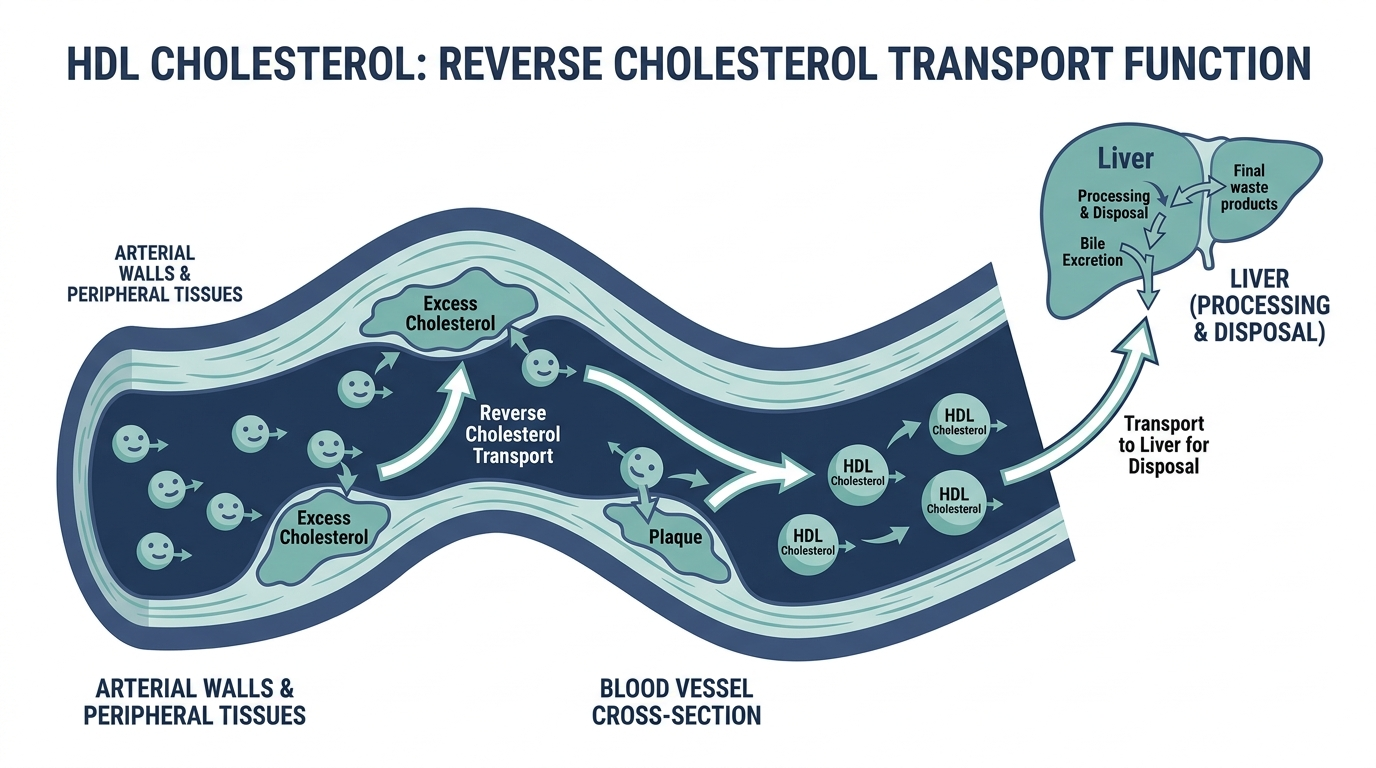
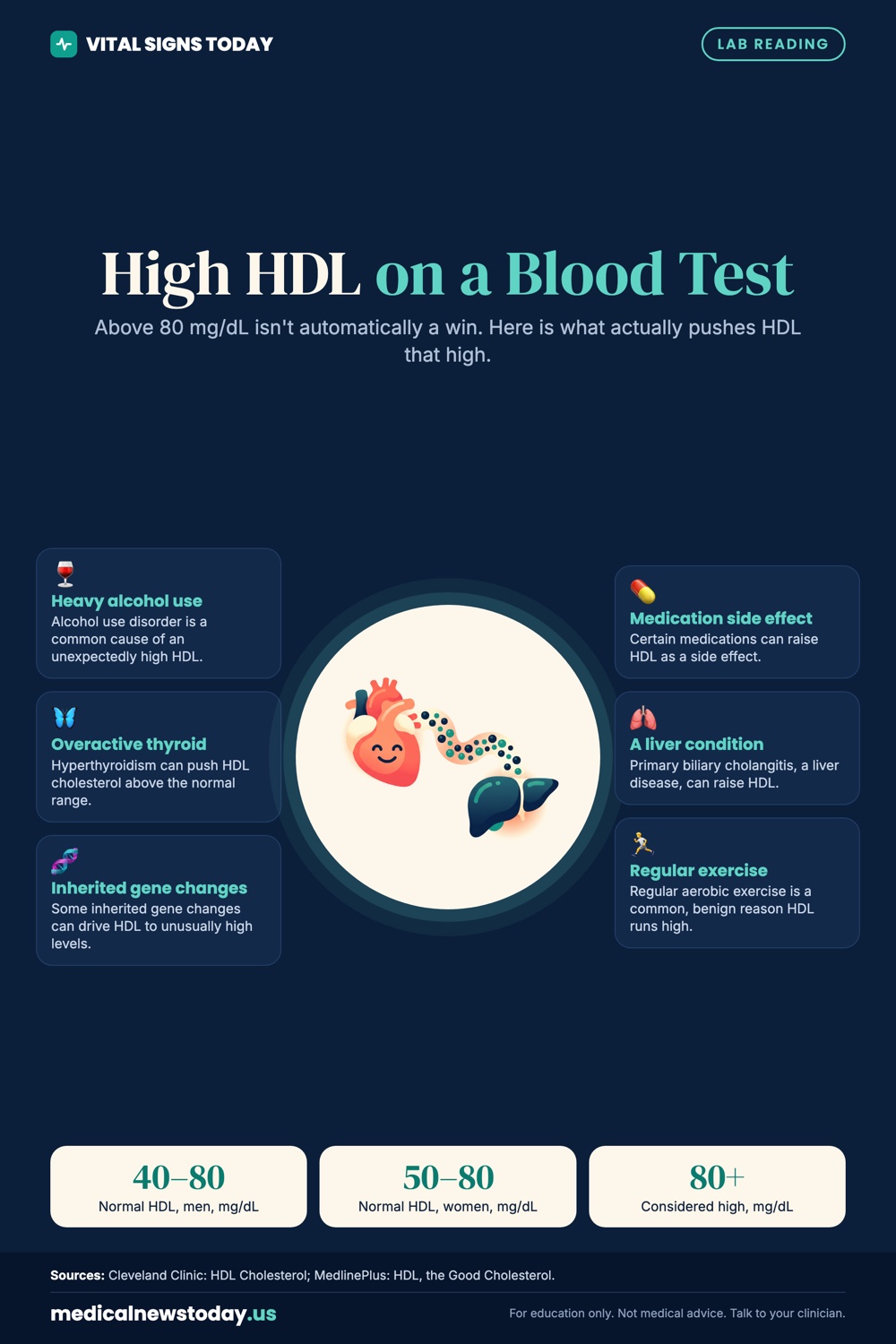
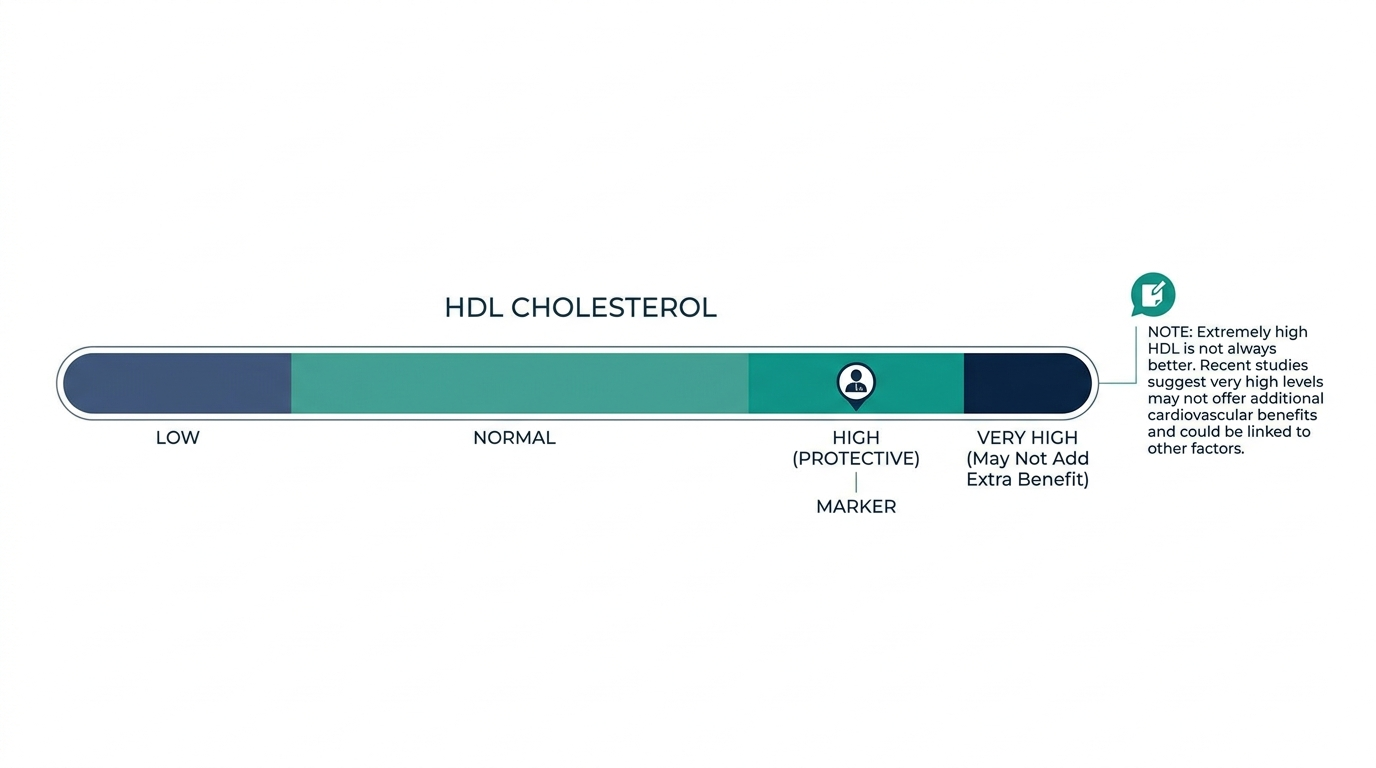
A high HDL on a blood test means the high-density lipoprotein carrying cholesterol back to your liver is elevated above the typical range. HDL is the particle that picks up excess cholesterol from your bloodstream and ferries it to the liver for disposal, which is why it earned the “good cholesterol” nickname (MedlinePlus). The threshold that counts as high is clear: most labs and Cleveland Clinic put the upper end of the normal range at 80 mg/dL, so an HDL above 80 mg/dL is considered high for adults of any sex (Cleveland Clinic).
For context, the usual reference ranges run from 40 to 80 mg/dL for men and 50 to 80 mg/dL for women, with children and teens generally falling between 45 and 80 mg/dL (Cleveland Clinic). So a 65 is solidly healthy. A 78 is great. A 95 is the number that makes a careful clinician ask why, rather than simply congratulate you.
The plain-English takeaway: a moderately high HDL is usually a sign of good habits and good genes. A very high HDL, especially well past 80, is the point where “good cholesterol” stops being a guaranteed compliment and becomes a question.

What causes a high HDL?
A high HDL has a short, fairly predictable differential. Most of the time the cause is benign, but the list runs from healthy lifestyle at one end to genetic and medical conditions at the other. In rough order of how often you will see it (Cleveland Clinic):
- Lifestyle and habits. Regular aerobic exercise, a diet rich in unsaturated fats such as olive oil, avocado, and nuts, a healthy weight, and not smoking all nudge HDL upward (MedlinePlus). This is the happy, common reason your HDL sits in the high-normal zone.
- Regular alcohol use. Alcohol reliably raises HDL, and heavier or chronic drinking can push it well above normal. This is one of the most common reasons for an unexpectedly high HDL, and it is not a health benefit worth chasing (Cleveland Clinic).
- Medications. Some drugs raise HDL as a side effect, and certain hormone and lipid medications can do the same (Cleveland Clinic).
- Thyroid overactivity (hyperthyroidism) and liver conditions such as primary biliary cholangitis can both elevate HDL (Cleveland Clinic).
- Genetics. Inherited changes can drive HDL to unusual heights. The classic example is cholesteryl ester transfer protein (CETP) deficiency, where the protein that normally moves cholesterol off HDL particles is missing or impaired, so HDL piles up. People with this condition can carry HDL levels two to five times higher than normal, and it is most common in people of Japanese descent (GeneReviews, NCBI).
The reason this matters is that the cause changes the meaning. An HDL of 90 in a marathon runner who eats Mediterranean and never drinks is a different story than an HDL of 90 in someone having three glasses of wine a night, even though the lab number is identical.
What are the symptoms of a high HDL?
A high HDL has no symptoms. You cannot feel it, it does not cause pain, fatigue, or any physical sign, and the only way to know your HDL is elevated is the blood test itself. Cholesterol abnormalities in general are silent, which is exactly why lipid panels exist (Cleveland Clinic).
If you do have symptoms alongside a high HDL, they are almost certainly coming from the underlying cause, not the HDL itself. Hyperthyroidism, for example, may show up as a racing heart, weight loss, tremor, or heat intolerance. Heavy alcohol use has its own downstream effects. The HDL number is a flag on the report, not a feeling in your body.

When is a high HDL dangerous or a medical emergency?
Let me be direct about the headline-grabbing part first: a high HDL is never a medical emergency. There is no scenario where a high HDL number sends you to the ER. It is not like a sky-high blood sugar or a dangerously low potassium. So if you are reading this in a mild panic, you can exhale.
That said, the research of the last decade has dismantled the comforting idea that HDL is a “the higher the better” number. The relationship between HDL and survival is not a straight line. It is U-shaped or J-shaped, meaning risk is lowest in the middle and rises at both ends (Frontiers in Medicine, PMC).
The numbers are striking. In a large Korean cohort, non-diabetic men with an HDL above 80 mg/dL had a higher risk of death from any cause than the reference group sitting at 40 to 60 mg/dL, with the highest-HDL men showing worse cumulative mortality than men with low HDL below 40 (Frontiers in Medicine, PMC). In people who already have coronary artery disease, the signal is sharper still: those with HDL above 80 mg/dL carried a substantially higher risk of all-cause and cardiovascular death compared with people in the 40 to 60 range (Association Between HDL and Adverse Cardiovascular Outcomes, PMC). A separate analysis of two prospective cohorts found that extremely high HDL was paradoxically tied to higher mortality in both men and women (PubMed, two prospective cohort studies).
Two important caveats keep this in perspective. First, these studies show association, not proof that high HDL itself does the damage. The leading interpretation is that dysfunctional HDL particles, or the conditions driving HDL up such as heavy alcohol use or inflammation, are the real problem, and the high number is the messenger. Second, the danger zone is the genuinely extreme end, above 80 and especially well beyond it. A high-normal HDL in the 60s or 70s is still a good thing.
What should you do about a high HDL?
The right move depends entirely on how high it is and why. A high HDL is not something you treat by trying to lower the number directly. There is no “HDL-lowering pill” the way there are LDL-lowering statins, and chasing a lower HDL is the wrong frame. Instead, the goal is to read the whole picture and find the cause.
Practical next steps:
- Read the full lipid panel, not just the HDL line. HDL only makes sense next to your LDL, total cholesterol, and triglycerides. An isolated high HDL with everything else in range is reassuring. A high HDL alongside other abnormal numbers can point to a broader dyslipidemia (Cleveland Clinic).
- Be honest about alcohol. If your HDL is unexpectedly high, regular drinking is one of the first things a clinician will consider. Cutting back is a health win on its own, regardless of what it does to the number (Cleveland Clinic).
- Check for treatable causes. If the level is very high or unexplained, your doctor may look at thyroid function and liver health, since hyperthyroidism and primary biliary cholangitis can both raise HDL (Cleveland Clinic).
- Keep the protective habits. If your high HDL comes from exercise, a healthy weight, not smoking, and good fats, none of that needs fixing. Those habits protect your heart through many channels, not just HDL (MedlinePlus).
Treatment, when it happens, targets the underlying condition, not the HDL number itself. Fix the thyroid, address the drinking, manage the liver disease, and the lipid picture usually follows.
When should you see a doctor?
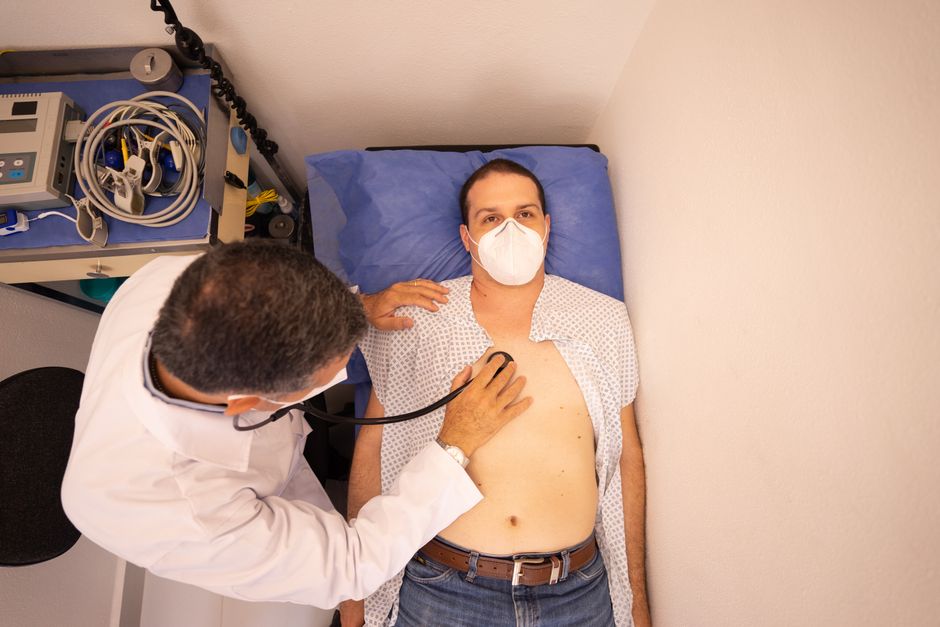
You do not need an urgent appointment for a high HDL, but it is worth a conversation at your next visit, and sooner if the number is well above 80 or paired with other red flags. Specifically, raise it with your clinician if your HDL is above 80 mg/dL, if it climbed sharply from a previous test, if the rest of your lipid panel is also off, or if you have symptoms that could point to thyroid or liver problems (Cleveland Clinic).
Anyone with existing heart disease has extra reason to discuss a very high HDL, because that is precisely the group in which extreme HDL has been linked to worse outcomes (Association Between HDL and Adverse Cardiovascular Outcomes, PMC). The point of the visit is not to lower your HDL. It is to make sure a high number is not a quiet signal of something else.
The insider read: why “higher is better” is the most common HDL misread
Here is the nuance that gets lost in the patient-facing version of cholesterol advice. For decades the message was simple, raise your HDL and protect your heart, and that message was built on observational data showing people with higher HDL had fewer heart attacks. The problem is that drug trials designed to raise HDL on purpose largely failed to reduce heart events, and the genetics tell the same story. This is why the field quietly shifted from “HDL is a target to push up” to “HDL is a marker to interpret.”
The practical consequence for reading your own report: HDL quality matters more than HDL quantity, and a single high number tells you nothing about whether your HDL particles actually work. A person with an HDL of 95 from a CETP genetic variant has a very different particle than a person with an HDL of 65 from running and olive oil, even though the higher number looks “better” on paper (GeneReviews, NCBI). The most common misread is treating HDL like a video game score where bigger always wins. It does not. The U-shaped curve is real, the safest zone is the broad middle, and an HDL that has wandered far above 80 deserves curiosity, not a victory lap (Frontiers in Medicine, PMC).
What HDL actually does in your body
To understand why “higher is better” breaks down, it helps to know what HDL is physically doing. HDL particles are the cleanup crew of your circulation. They travel through your bloodstream and along the walls of your arteries, pick up excess cholesterol from cells and from early plaque, and carry it back to the liver, which repackages or excretes it. This process is called reverse cholesterol transport, and it is the reason HDL earned its protective reputation (MedlinePlus).
The catch is that not all HDL particles do this job equally well. HDL is not a single substance but a family of particles that differ in size, protein cargo, and function. Some are efficient scavengers; some are effectively idle. Standard lab reports measure the cholesterol carried inside HDL particles (HDL-C), which is a proxy for how much HDL you have, not a measure of how well it works. This gap between quantity and quality is precisely why an extremely high HDL number can coexist with poor cardiovascular protection: you can have a lot of HDL that is not doing much cleaning.
Want to check your HDL?
Three ways to get it measured. Pick whichever fits you.
Affiliate links: we may earn a commission at no extra cost to you. A lab test does not replace a visit with your clinician.
Reading HDL in context: ratios and the rest of the panel
Clinicians rarely act on HDL in isolation. Some of the most useful information on a lipid panel comes from how HDL relates to the other numbers, not from its raw value.
- Total cholesterol to HDL ratio. This is calculated by dividing your total cholesterol by your HDL. A lower ratio is generally more favorable. Because a very high HDL mathematically lowers this ratio, an extreme HDL can make the ratio look reassuring even when the underlying picture is not, which is one more reason to read the whole panel rather than a single derived number (Cleveland Clinic).
- Triglyceride to HDL relationship. High triglycerides paired with the HDL value give a rough sense of metabolic health and insulin resistance. A high HDL alongside low triglycerides is a more benign metabolic pattern than a high HDL sitting next to elevated triglycerides.
- LDL and non-HDL cholesterol. Your cardiovascular risk is driven far more by the cholesterol in LDL and other atherogenic particles than by HDL. A high HDL does not cancel out a high LDL, and it should never be used as a reason to ignore an elevated LDL.
The practical rule: a high HDL is interpreted as one line in a four-line story. On its own it neither convicts nor exonerates.
How to prepare for the test and what can skew HDL
HDL is one of the more stable lipid measurements, but several factors can move it enough to matter, and some testing conditions can distort the reading.
- Fasting. Many labs still ask for a 9 to 12 hour fast before a lipid panel, mainly because triglycerides and calculated LDL are sensitive to recent food. HDL itself changes relatively little with eating, but follow whatever instruction your lab gives so all your numbers are comparable across visits.
- Recent alcohol. Because alcohol raises HDL, a heavy drinking session in the days before a test can nudge the number up. If your HDL reading is unexpectedly high, honest reporting of recent alcohol intake helps your clinician interpret it correctly.
- Acute illness, recent surgery, or pregnancy. These can temporarily shift lipid values. A lipid panel drawn during an acute illness may not reflect your usual baseline, so clinicians often prefer to recheck once you have recovered.
- Recent weight change and exercise. Sustained aerobic exercise and weight loss tend to raise HDL over weeks to months, so a rising HDL can simply reflect improving habits rather than a problem.
The takeaway on preparation: consistency matters more than any single tweak. Test under similar conditions each time so a change in your HDL reflects a real change in you, not a change in the circumstances of the draw.
How HDL differs by sex, age, and life stage
Reference ranges for HDL are not identical for everyone, and knowing the context prevents unnecessary worry. Women tend to run higher HDL than men on average, largely because of the effect of estrogen, which is why the typical normal range starts higher for women (about 50 mg/dL) than for men (about 40 mg/dL) (Cleveland Clinic).
HDL can shift across life stages as well. Hormonal changes around menopause commonly alter a woman’s lipid profile, and HDL may change alongside LDL and triglycerides during this transition. In children and teens, the reference range differs again. The consistent principle across all groups is the same one that runs through this whole article: compare your number to the range printed on your own report, interpret it next to the rest of your lipids, and treat a value that has drifted far above the upper limit as a reason for a conversation rather than a celebration.
Common misconceptions about a high HDL
- “The higher my HDL, the healthier I am.” This is the central myth this article exists to correct. Protection is strongest in the broad middle of the range, and very high levels above 80 mg/dL have been linked to worse outcomes in large studies, not better ones (Frontiers in Medicine, PMC).
- “A high HDL cancels out my high LDL.” It does not. LDL and other atherogenic particles drive risk on their own, and a strong HDL number is not a license to leave an elevated LDL untreated.
- “I should take a supplement to push my HDL even higher.” There is no evidence that deliberately raising HDL with supplements improves outcomes, and trials designed to raise HDL pharmacologically largely failed to reduce heart events.
- “A high HDL means I can drink freely.” Alcohol raises HDL, but that rise is not a health benefit and does not offset alcohol’s other harms. An alcohol-driven high HDL is a reason to look at drinking, not to keep going.
Frequently asked questions
Is a high HDL good or bad?
Both, depending on how high. A high-normal HDL in the 60s or 70s mg/dL is generally a healthy sign. But an HDL above 80 mg/dL is no longer reliably protective, and very high levels have been linked to higher mortality in several large studies, so it is interpreted with the rest of your lipid panel rather than celebrated on its own (Frontiers in Medicine, PMC).
What HDL level is considered high?
For adults of any sex, an HDL above 80 mg/dL is considered high. The typical normal range is about 40 to 80 mg/dL for men and 50 to 80 mg/dL for women (Cleveland Clinic). Always compare your result to the reference range printed on your own report.
What causes very high HDL cholesterol?
Common causes include regular exercise and a healthy diet, regular alcohol use, certain medications, hyperthyroidism, liver conditions such as primary biliary cholangitis, and genetic changes like CETP deficiency that can raise HDL several times above normal (Cleveland Clinic).
Does a high HDL have symptoms?
No. A high HDL causes no symptoms and can only be detected by a blood test. Any symptoms you have are likely from an underlying cause such as thyroid overactivity, not from the HDL itself (Cleveland Clinic).
Can I lower my HDL if it is too high?
There is no medication aimed at lowering HDL, and lowering the number is not the goal. The right approach is to find and address the cause, for example cutting back on alcohol or treating a thyroid or liver condition, while keeping heart-healthy habits in place (Cleveland Clinic).
This article is for general educational purposes and is not medical advice. It cannot diagnose or treat you and does not replace your clinician. Always discuss your lab results and any health decisions with a qualified healthcare professional.
Vital Signs Today may earn a commission if you buy through links on this page. It does not affect our editorial assessments.